
UNCW Institutional Risk Management Update Board of Trustees
UNCW Institutional Risk Management Update Board of Trustees Audit Committee November 20, 2014
IRM Best Practice Action Steps 1. 2. 3. 4. 5. 6. 7. 8. 9. Develop a disciplined process to consider risk in strategic discussions. Designate an owner of the risk identification process. Require all top administrators to prioritize risk. Sift through the prioritized risks to decide which ones warrant attention at the highest level. Require annual written reports on each high-priority risk being monitored. Re-assess priority risks at the board level at least once a year. Look for blind spots. Move risk identification deeper into the institution each year. Keep repeating the process. C 2009 Association of Governing Boards of Universities and Colleges, United Educators 2
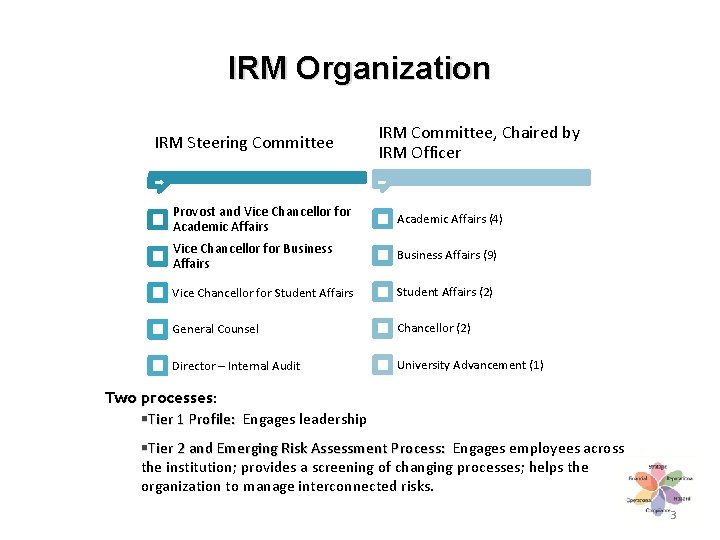
IRM Organization IRM Steering Committee IRM Committee, Chaired by IRM Officer Provost and Vice Chancellor for Academic Affairs (4) Vice Chancellor for Business Affairs (9) Vice Chancellor for Student Affairs (2) General Counsel Chancellor (2) Director – Internal Audit University Advancement (1) Two processes: processes §Tier 1 Profile: Engages leadership §Tier 2 and Emerging Risk Assessment Process: Engages employees across the institution; provides a screening of changing processes; helps the organization to manage interconnected risks. 3
Goals of the Tier 1 Profile (Strategic Risk Profile) § To understand institution-level risks* § Correlate those risks to their potential impact on institutional strategy § Measure, monitor and report on those risks to the board *Institution-level risks are not owned by any one department. 4
Tier 1 Evaluation – Interim Update IRM Best Practice Action Steps 1. Require annual written reports on each high-priority risk being monitored. (Annual report is in April. November is an interim update. ) 2. Keep repeating the process. C 2009 Association of Governing Boards of Universities and Colleges, United Educators 5
Interim Tier 1 Update – New Mitigations Essential Resources • Monitoring and watching state revenues for any downside impact • Monitoring average student debt and student cohort default rate Regulatory Intervention • Title IX responsibilities re-organized • Federal Grant for $300, 000 to provide enhancements to victim advocacy services, prevention and intervention teams, as well as bystander intervention programming • Financial Aid Compliance checklist completed during DOE Program Review of Financial Aid • Incorporated in the 2014 Annual Security Report (ASR) the requirements of new Sa. VE Act legislation (Clery Act amendment) Talent Management • AVC HR search nearing completion • Key positions filled for Assoc. Provost-Research/Dean, Vice Chancellor for Business Affairs, Dean – College of Arts & Sciences, Controller • Informal succession planning (by division) 6
Interim Tier 1 Update – New Mitigations (cont’d) Campus Health & Safety • $300, 000 federal grant to enhance prevention and intervention teams as well as bystander intervention programming • Active shooter exercise after action report • Study and proposal to design replacement of fire alarm notification system • Increased frequency of lab inspections and training • New and improved touch points between EH&S and new research faculty plus earlier warning of research lab closures • Updated Communicable disease plan, partnering with area health providers • Added express shuttle route on Randall Drive to accommodate new apartments off campus Continuity of Operations • Design proposal received for new code-compliant fire alarm notification system for main campus. • Design facilities plan for alarm receiving center in progress. (Also a safety item) • Infrastructure improvements: Performance Contract 2; Stormwater Plan; Randall Library structural improvements; Renovation of S&BS. 7
Identification Cycle for Emerging/Tier 2 Risks IRM Best Practice Action Steps 1. Sift through the prioritized risks to decide which ones warrant attention at the highest level. 2. Move risk identification deeper into the institution each year. C 2009 Association of Governing Boards of Universities and Colleges, United Educators 8
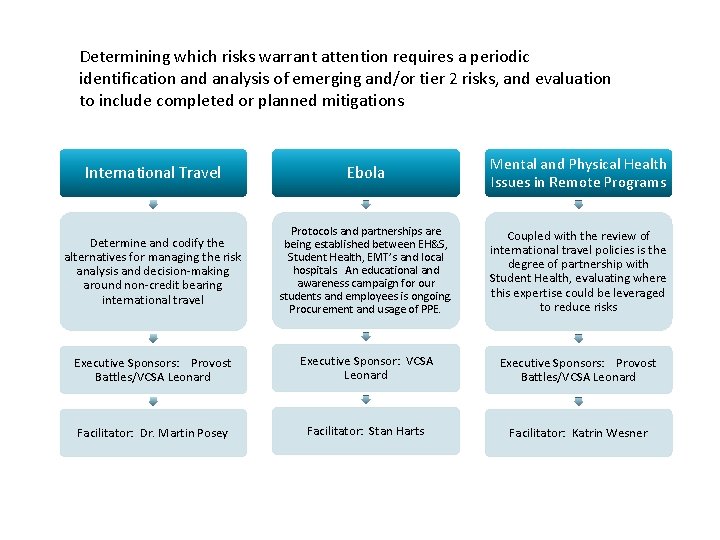
Determining which risks warrant attention requires a periodic identification and analysis of emerging and/or tier 2 risks, and evaluation to include completed or planned mitigations International Travel Ebola Mental and Physical Health Issues in Remote Programs Determine and codify the alternatives for managing the risk analysis and decision-making around non-credit bearing international travel Protocols and partnerships are being established between EH&S, Student Health, EMT’s and local hospitals. An educational and awareness campaign for our students and employees is ongoing. Procurement and usage of PPE. Coupled with the review of international travel policies is the degree of partnership with Student Health, evaluating where this expertise could be leveraged to reduce risks Executive Sponsors: Provost Battles/VCSA Leonard Executive Sponsor: VCSA Leonard Executive Sponsors: Provost Battles/VCSA Leonard Facilitator: Dr. Martin Posey Facilitator: Stan Harts Facilitator: Katrin Wesner
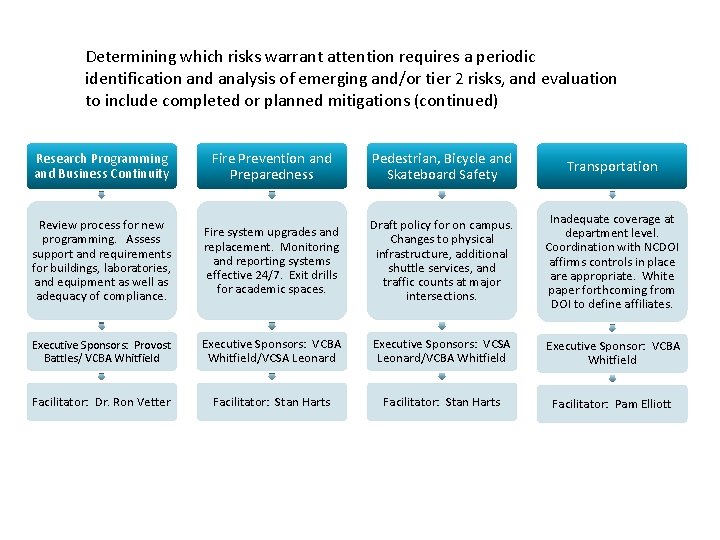
Determining which risks warrant attention requires a periodic identification and analysis of emerging and/or tier 2 risks, and evaluation to include completed or planned mitigations (continued) Fire Prevention and Preparedness Pedestrian, Bicycle and Skateboard Safety Transportation Review process for new programming. Assess support and requirements for buildings, laboratories, and equipment as well as adequacy of compliance. Fire system upgrades and replacement. Monitoring and reporting systems effective 24/7. Exit drills for academic spaces. Draft policy for on campus. Changes to physical infrastructure, additional shuttle services, and traffic counts at major intersections. Inadequate coverage at department level. Coordination with NCDOI affirms controls in place are appropriate. White paper forthcoming from DOI to define affiliates. Executive Sponsors: Provost Battles/ VCBA Whitfield Executive Sponsors: VCBA Whitfield/VCSA Leonard Executive Sponsors: VCSA Leonard/VCBA Whitfield Executive Sponsor: VCBA Whitfield Facilitator: Dr. Ron Vetter Facilitator: Stan Harts Facilitator: Pam Elliott Research Programming and Business Continuity
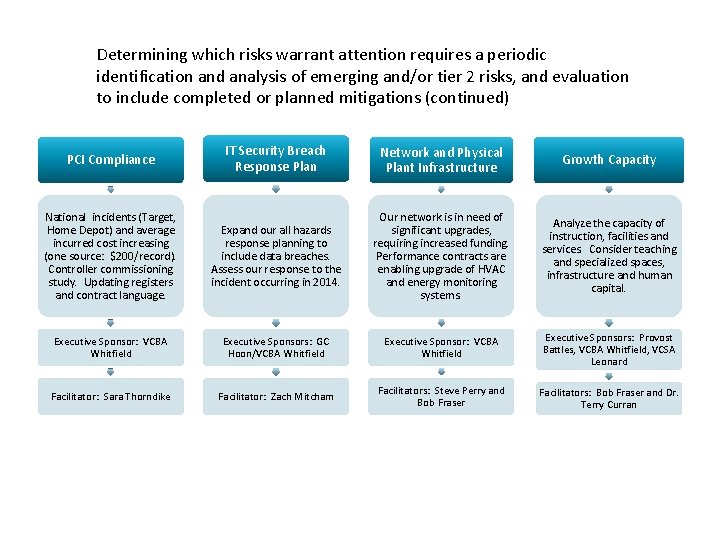
Determining which risks warrant attention requires a periodic identification and analysis of emerging and/or tier 2 risks, and evaluation to include completed or planned mitigations (continued) PCI Compliance IT Security Breach Response Plan Network and Physical Plant Infrastructure Growth Capacity National incidents (Target, Home Depot) and average incurred cost increasing (one source: $200/record). Controller commissioning study. Updating registers and contract language. Expand our all hazards response planning to include data breaches. Assess our response to the incident occurring in 2014. Our network is in need of significant upgrades, requiring increased funding. Performance contracts are enabling upgrade of HVAC and energy monitoring systems. Analyze the capacity of instruction, facilities and services. Consider teaching and specialized spaces, infrastructure and human capital. Executive Sponsor: VCBA Whitfield Executive Sponsors: GC Hoon/VCBA Whitfield Executive Sponsor: VCBA Whitfield Executive Sponsors: Provost Battles, VCBA Whitfield, VCSA Leonard Facilitator: Sara Thorndike Facilitator: Zach Mitcham Facilitators: Steve Perry and Bob Fraser Facilitators: Bob Fraser and Dr. Terry Curran
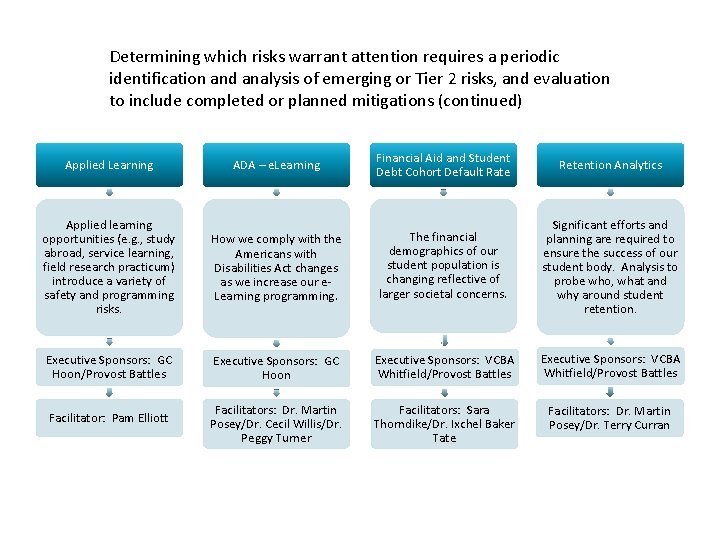
Determining which risks warrant attention requires a periodic identification and analysis of emerging or Tier 2 risks, and evaluation to include completed or planned mitigations (continued) Applied Learning ADA – e. Learning Financial Aid and Student Debt Cohort Default Rate Retention Analytics Applied learning opportunities (e. g. , study abroad, service learning, field research practicum) introduce a variety of safety and programming risks. How we comply with the Americans with Disabilities Act changes as we increase our e. Learning programming. The financial demographics of our student population is changing reflective of larger societal concerns. Significant efforts and planning are required to ensure the success of our student body. Analysis to probe who, what and why around student retention. Executive Sponsors: GC Hoon/Provost Battles Executive Sponsors: GC Hoon Executive Sponsors: VCBA Whitfield/Provost Battles Facilitator: Pam Elliott Facilitators: Dr. Martin Posey/Dr. Cecil Willis/Dr. Peggy Turner Facilitators: Sara Thorndike/Dr. Ixchel Baker Tate Facilitators: Dr. Martin Posey/Dr. Terry Curran
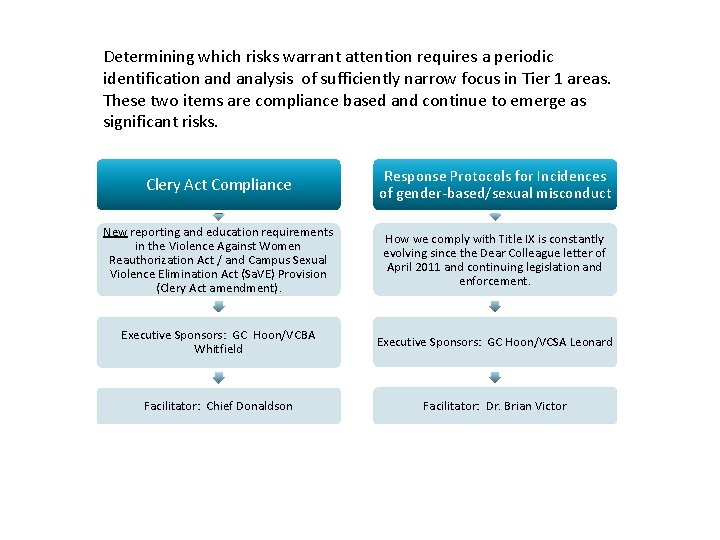
Determining which risks warrant attention requires a periodic identification and analysis of sufficiently narrow focus in Tier 1 areas. These two items are compliance based and continue to emerge as significant risks. Clery Act Compliance Response Protocols for Incidences of gender-based/sexual misconduct New reporting and education requirements in the Violence Against Women Reauthorization Act / and Campus Sexual Violence Elimination Act (Sa. VE) Provision (Clery Act amendment). How we comply with Title IX is constantly evolving since the Dear Colleague letter of April 2011 and continuing legislation and enforcement. Executive Sponsors: GC Hoon/VCBA Whitfield Executive Sponsors: GC Hoon/VCSA Leonard Facilitator: Chief Donaldson Facilitator: Dr. Brian Victor
UNCW Institutional Risk Management Update Questions? Board of Trustees Audit Committee
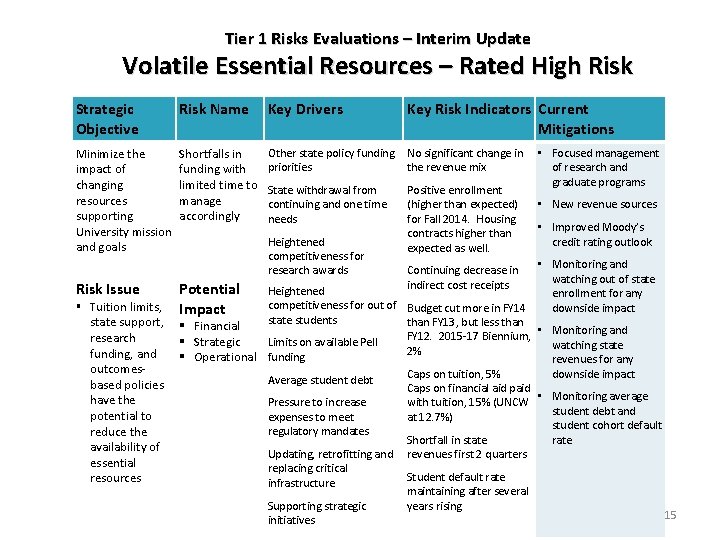
Tier 1 Risks Evaluations – Interim Update Volatile Essential Resources – Rated High Risk Strategic Objective Risk Name Key Drivers Key Risk Indicators Current Mitigations Minimize the impact of changing resources supporting University mission and goals Shortfalls in funding with limited time to manage accordingly Other state policy funding priorities No significant change in the revenue mix State withdrawal from continuing and one time needs Positive enrollment (higher than expected) for Fall 2014. Housing contracts higher than expected as well. Risk Issue § Tuition limits, state support, research funding, and outcomesbased policies have the potential to reduce the availability of essential resources Heightened competitiveness for research awards • Focused management of research and graduate programs • New revenue sources • Improved Moody’s credit rating outlook • Monitoring and watching out of state Potential Heightened enrollment for any competitiveness for out of Budget cut more in FY 14 downside impact Impact state students than FY 13, but less than § Financial FY 12. 2015 -17 Biennium, • Monitoring and § Strategic Limits on available Pell watching state 2% § Operational funding revenues for any Caps on tuition, 5% downside impact Average student debt Caps on financial aid paid with tuition, 15% (UNCW • Monitoring average Pressure to increase student debt and at 12. 7%) expenses to meet student cohort default regulatory mandates Shortfall in state rate Updating, retrofitting and revenues first 2 quarters replacing critical Student default rate infrastructure maintaining after several years rising Supporting strategic 15 initiatives Continuing decrease in indirect cost receipts
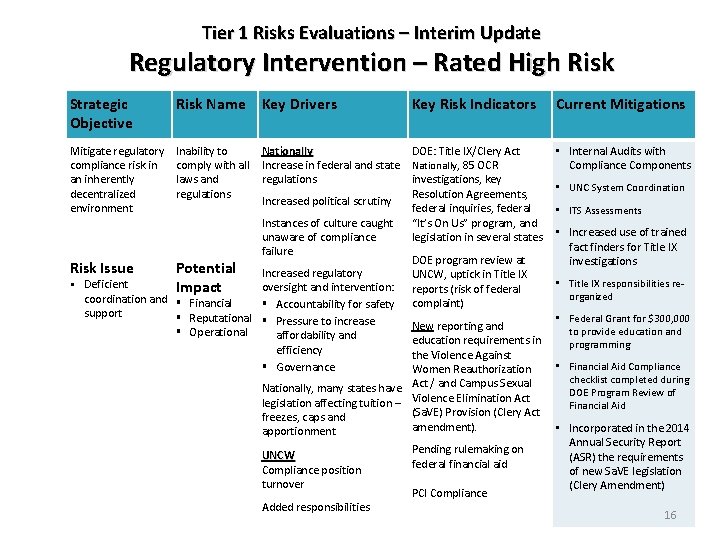
Tier 1 Risks Evaluations – Interim Update Regulatory Intervention – Rated High Risk Strategic Objective Risk Name Key Drivers Mitigate regulatory compliance risk in an inherently decentralized environment Inability to comply with all laws and regulations Key Risk Indicators Nationally DOE: Title IX/Clery Act Increase in federal and state Nationally, 85 OCR regulations investigations, key Resolution Agreements, Increased political scrutiny federal inquiries, federal Instances of culture caught “It’s On Us” program, and unaware of compliance legislation in several states failure DOE program review at Risk Issue Potential Increased regulatory UNCW, uptick in Title IX § Deficient oversight and intervention: Impact reports (risk of federal coordination and § Financial § Accountability for safety complaint) support § Reputational § Pressure to increase New reporting and § Operational affordability and education requirements in efficiency the Violence Against § Governance Women Reauthorization Nationally, many states have Act / and Campus Sexual legislation affecting tuition – Violence Elimination Act (Sa. VE) Provision (Clery Act freezes, caps and amendment). apportionment UNCW Compliance position turnover Added responsibilities Pending rulemaking on federal financial aid PCI Compliance Current Mitigations • Internal Audits with Compliance Components • UNC System Coordination • ITS Assessments • Increased use of trained fact finders for Title IX investigations • Title IX responsibilities reorganized • Federal Grant for $300, 000 to provide education and programming • Financial Aid Compliance checklist completed during DOE Program Review of Financial Aid • Incorporated in the 2014 Annual Security Report (ASR) the requirements of new Sa. VE legislation (Clery Amendment) 16
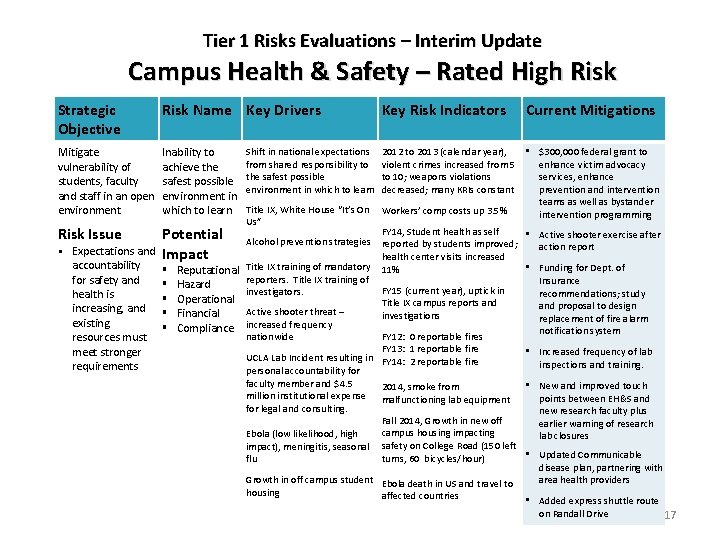
Tier 1 Risks Evaluations – Interim Update Campus Health & Safety – Rated High Risk Strategic Objective Risk Name Key Drivers Key Risk Indicators Mitigate vulnerability of students, faculty and staff in an open environment Inability to achieve the safest possible environment in which to learn 2012 to 2013 (calendar year), • $300, 000 federal grant to violent crimes increased from 5 enhance victim advocacy to 10; weapons violations services, enhance decreased; many KRIs constant prevention and intervention teams as well as bystander Workers’ comp costs up 3. 5% intervention programming Risk Issue Potential Impact Shift in national expectations from shared responsibility to the safest possible environment in which to learn Title IX, White House “It’s On Us” FY 14, Student health as self Alcohol prevention strategies reported by students improved; § Expectations and health center visits increased accountability § Reputational Title IX training of mandatory 11% reporters. Title IX training of for safety and § Hazard FY 15 (current year), uptick in investigators. health is § Operational Title IX campus reports and increasing, and § Financial Active shooter threat – investigations existing § Compliance increased frequency FY 12: 0 reportable fires nationwide resources must FY 13: 1 reportable fire meet stronger UCLA Lab Incident resulting in FY 14: 2 reportable fire requirements personal accountability for faculty member and $4. 5 2014, smoke from million institutional expense malfunctioning lab equipment for legal and consulting. Fall 2014, Growth in new off campus housing impacting Ebola (low likelihood, high impact), meningitis, seasonal safety on College Road (150 left turns, 60 bicycles/hour) flu Growth in off campus student Ebola death in US and travel to housing affected countries Current Mitigations • Active shooter exercise after action report • Funding for Dept. of Insurance recommendations; study and proposal to design replacement of fire alarm notification system • Increased frequency of lab inspections and training. • New and improved touch points between EH&S and new research faculty plus earlier warning of research lab closures • Updated Communicable disease plan, partnering with area health providers • Added express shuttle route on Randall Drive 17
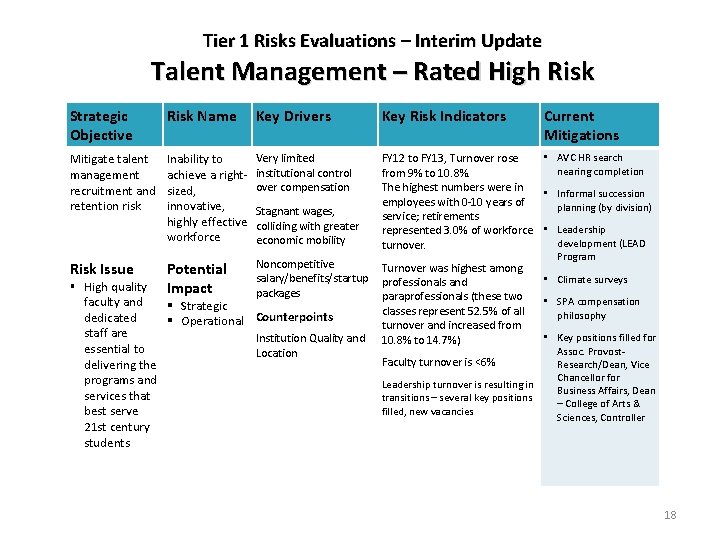
Tier 1 Risks Evaluations – Interim Update Talent Management – Rated High Risk Strategic Objective Risk Name Key Drivers Key Risk Indicators Mitigate talent management recruitment and retention risk Inability to achieve a rightsized, innovative, highly effective workforce Very limited institutional control over compensation • AVC HR search FY 12 to FY 13, Turnover rose nearing completion from 9% to 10. 8%. The highest numbers were in • Informal succession employees with 0 -10 years of planning (by division) service; retirements represented 3. 0% of workforce • Leadership development (LEAD turnover. Potential Impact Noncompetitive salary/benefits/startup packages Risk Issue § High quality Stagnant wages, colliding with greater economic mobility faculty and § Strategic dedicated § Operational Counterpoints staff are Institution Quality and essential to Location delivering the programs and services that best serve 21 st century students Turnover was highest among professionals and paraprofessionals (these two classes represent 52. 5% of all turnover and increased from 10. 8% to 14. 7%) Current Mitigations Program • Climate surveys • SPA compensation philosophy • Key positions filled for Assoc. Provost. Faculty turnover is <6% Research/Dean, Vice Chancellor for Leadership turnover is resulting in Business Affairs, Dean transitions – several key positions – College of Arts & filled, new vacancies Sciences, Controller 18
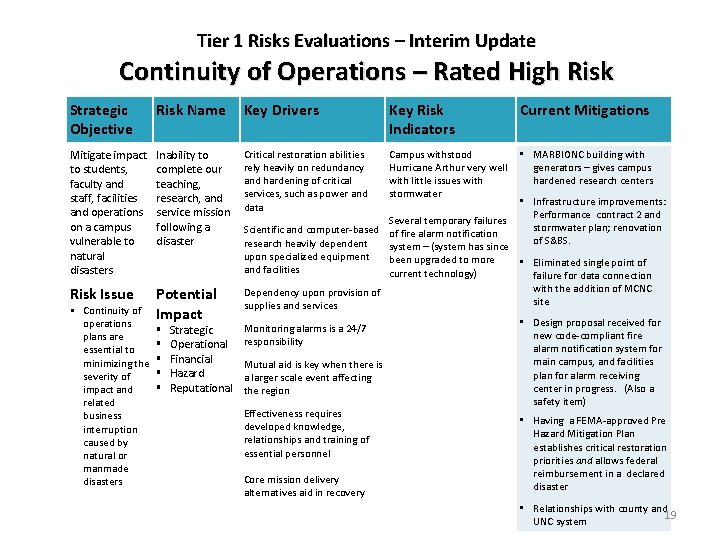
Tier 1 Risks Evaluations – Interim Update Continuity of Operations – Rated High Risk Strategic Objective Risk Name Key Drivers Key Risk Indicators Current Mitigations Mitigate impact to students, faculty and staff, facilities and operations on a campus vulnerable to natural disasters Inability to complete our teaching, research, and service mission following a disaster Critical restoration abilities rely heavily on redundancy and hardening of critical services, such as power and data Campus withstood Hurricane Arthur very well with little issues with stormwater • MARBIONC building with generators – gives campus hardened research centers Risk Issue Potential Impact § Continuity of operations plans are essential to minimizing the severity of impact and related business interruption caused by natural or manmade disasters § § § Strategic Operational Financial Hazard Reputational • Infrastructure improvements: Performance contract 2 and stormwater plan; renovation of S&BS. Several temporary failures of fire alarm notification system – (system has since been upgraded to more • Eliminated single point of current technology) failure for data connection with the addition of MCNC Dependency upon provision of site supplies and services Scientific and computer-based research heavily dependent upon specialized equipment and facilities Monitoring alarms is a 24/7 responsibility Mutual aid is key when there is a larger scale event affecting the region Effectiveness requires developed knowledge, relationships and training of essential personnel Core mission delivery alternatives aid in recovery • Design proposal received for new code-compliant fire alarm notification system for main campus, and facilities plan for alarm receiving center in progress. (Also a safety item) • Having a FEMA-approved Pre Hazard Mitigation Plan establishes critical restoration priorities and allows federal reimbursement in a declared disaster • Relationships with county and 19 UNC system
- Slides: 19