
Uncooled Infrared Photon Detection Concepts and Devices Viraj













- Slides: 71
Uncooled Infrared Photon Detection Concepts and Devices Viraj Jayaweera Piyankarage Department of Physics & Astronomy Georgia State University
Outline • Introduction • Infrared Detectors based on 1. Dye-Sensitization of Nanostructured Semiconductors • Dye-sensitized NIR detector design, experimental results, and conclusion • 1/f Noise on DS nano structures 2. Displacement Currents in Semiconductor Quantum Dots (QDs) Embedded Dielectric Media • Size quantization effects • QD capacitor based detector design, experimental results, and conclusion 3. Split-off Band Transitions in Ga. As/Al. Ga. As Heterojunctions • High operating temperature split-off response observed from HEIWIP design for 17μm threshold wavelength • Uncooled split-off band detector design Experimental results, and conclusion 4. Free Carrier Absorption in Ga. Sb Homojunctions • Ga. Sb HIWIP detector design, experimental results, and conclusion • Future Work 2
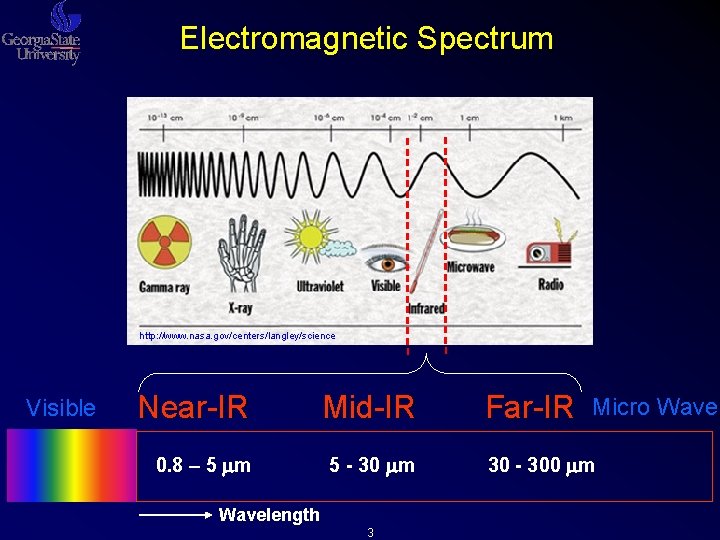
Electromagnetic Spectrum http: //www. nasa. gov/centers/langley/science Visible Near-IR Mid-IR 0. 8 – 5 m 5 - 30 m Wavelength 3 Far-IR Micro Wave 30 - 300 m
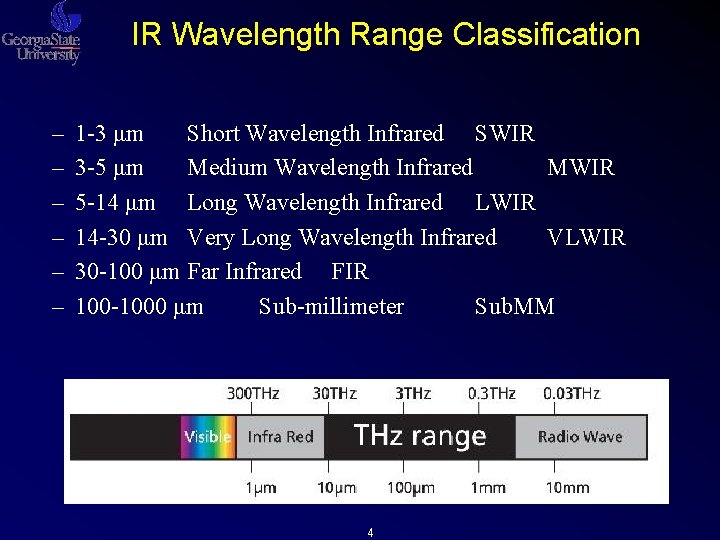
IR Wavelength Range Classification – – – 1 -3 μm Short Wavelength Infrared SWIR 3 -5 μm Medium Wavelength Infrared MWIR 5 -14 μm Long Wavelength Infrared LWIR 14 -30 μm Very Long Wavelength Infrared VLWIR 30 -100 μm Far Infrared FIR 100 -1000 μm Sub-millimeter Sub. MM 4
Applications http: //www. netcast. com. hk/Products. htm Infrared Body Temperature Thermometer Remote controller and receiver Visible Light Infrared 5
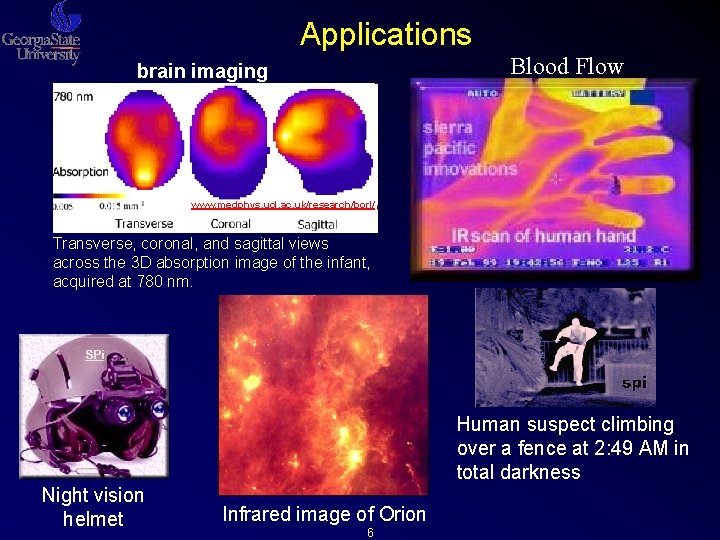
Applications Blood Flow brain imaging www. medphys. ucl. ac. uk/research/borl/ Transverse, coronal, and sagittal views across the 3 D absorption image of the infant, acquired at 780 nm. Human suspect climbing over a fence at 2: 49 AM in total darkness Night vision helmet Infrared image of Orion 6
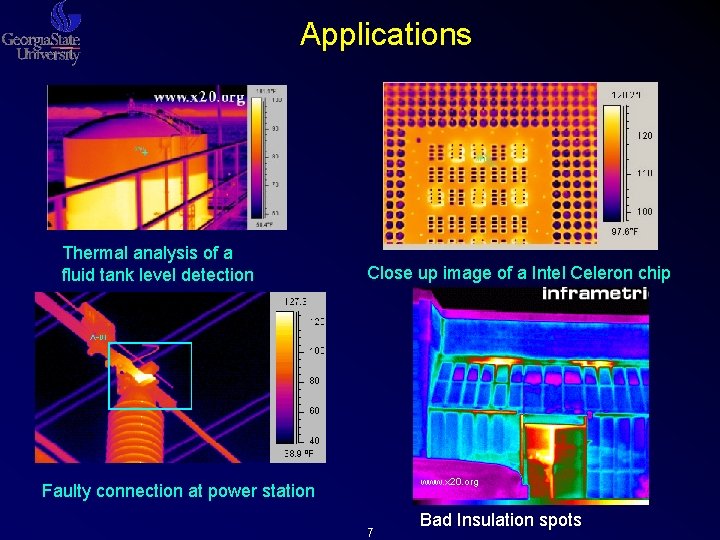
Applications Thermal analysis of a fluid tank level detection www. x 20. org Close up image of a Intel Celeron chip ºF www. x 20. org Faulty connection at power station 7 Bad Insulation spots
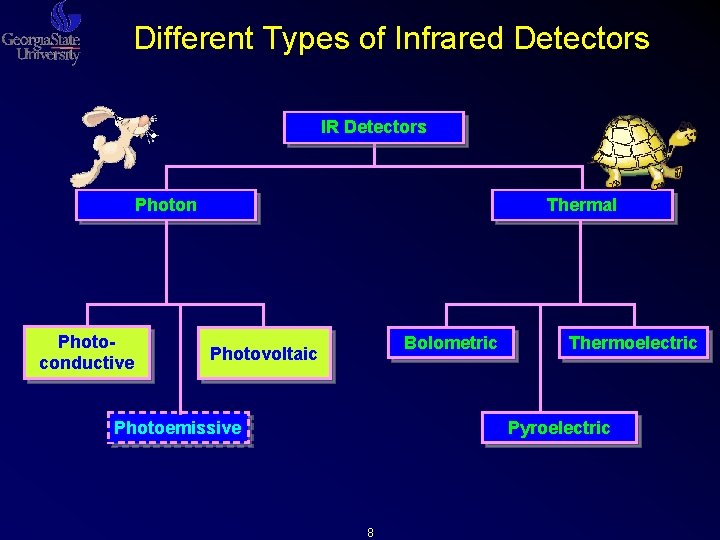
Different Types of Infrared Detectors IR Detectors Photon Photoconductive Thermal Bolometric Photovoltaic Thermoelectric Pyroelectric Photoemissive 8
Dye-Sensitized Near-Infrared Detectors (DSNID) 9
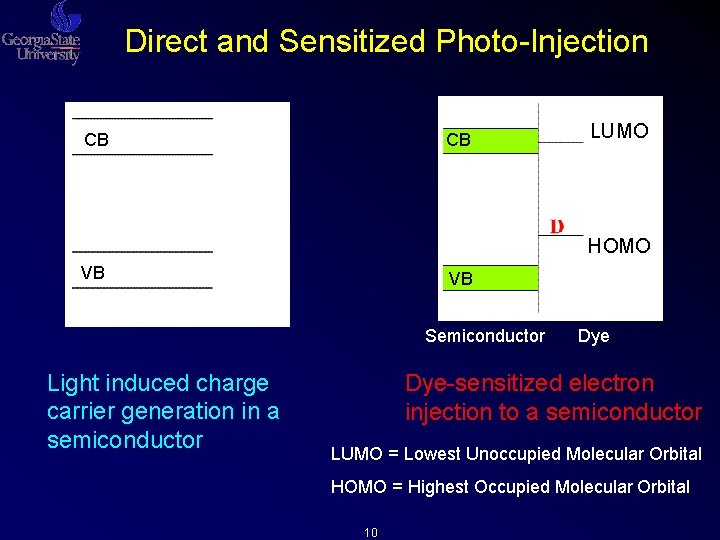
Direct and Sensitized Photo-Injection CB CB LUMO HOMO VB VB Semiconductor Light induced charge carrier generation in a semiconductor Dye-sensitized electron injection to a semiconductor LUMO = Lowest Unoccupied Molecular Orbital HOMO = Highest Occupied Molecular Orbital 10
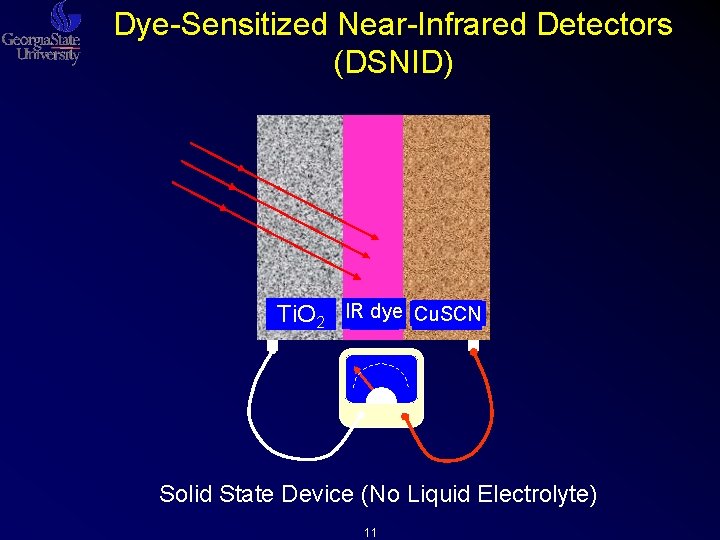
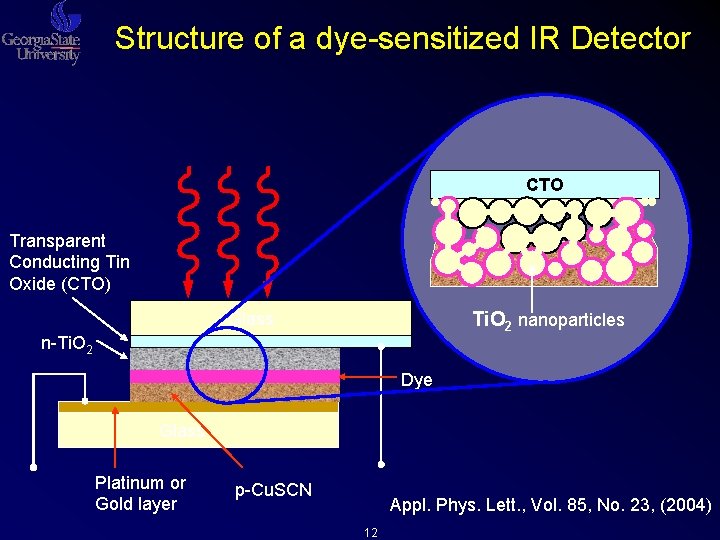
Dye-Sensitized Near-Infrared Detectors (DSNID) n-Ti. O 2 p-Cu. SCN nanoparticles IR dye Dye Cu. SCN p-type n-type Ti. ODye 2 V Solid State Device (No Liquid Electrolyte) 11
Structure of a dye-sensitized IR Detector CTO Transparent Conducting Tin Oxide (CTO) Ti. O 2 nanoparticles Glass n-Ti. O 2 Dye Glass Platinum or Gold layer p-Cu. SCN Appl. Phys. Lett. , Vol. 85, No. 23, (2004) 12
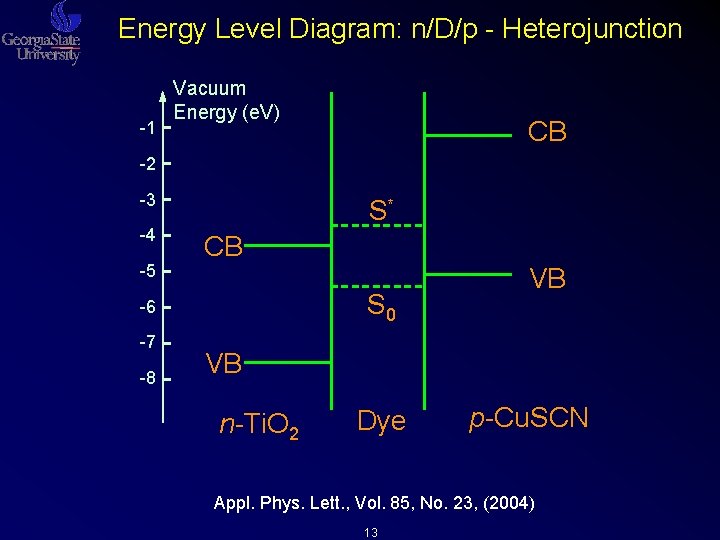
Energy Level Diagram: n/D/p - Heterojunction -1 Vacuum Energy (e. V) CB -2 -3 -4 -5 S* CB S 0 -6 -7 -8 VB VB n-Ti. O 2 Dye p-Cu. SCN Appl. Phys. Lett. , Vol. 85, No. 23, (2004) 13
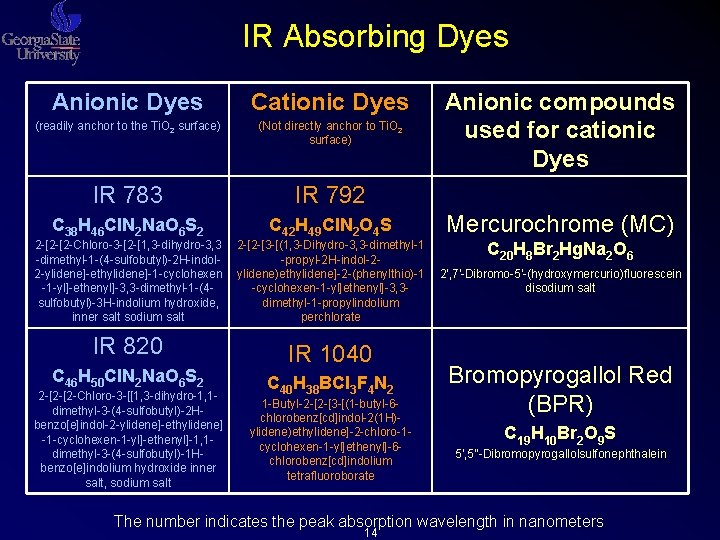
IR Absorbing Dyes Anionic Dyes Cationic Dyes (readily anchor to the Ti. O 2 surface) (Not directly anchor to Ti. O 2 surface) IR 783 IR 792 C 38 H 46 Cl. N 2 Na. O 6 S 2 C 42 H 49 Cl. N 2 O 4 S 2 -[2 -[2 -Chloro-3 -[2 -[1, 3 -dihydro-3, 3 -dimethyl-1 -(4 -sulfobutyl)-2 H-indol 2 -ylidene]-ethylidene]-1 -cyclohexen -1 -yl]-ethenyl]-3, 3 -dimethyl-1 -(4 sulfobutyl)-3 H-indolium hydroxide, inner salt sodium salt IR 820 C 46 H 50 Cl. N 2 Na. O 6 S 2 2 -[2 -[2 -Chloro-3 -[[1, 3 -dihydro-1, 1 dimethyl-3 -(4 -sulfobutyl)-2 Hbenzo[e]indol-2 -ylidene]-ethylidene] -1 -cyclohexen-1 -yl]-ethenyl]-1, 1 dimethyl-3 -(4 -sulfobutyl)-1 Hbenzo[e]indolium hydroxide inner salt, sodium salt 2 -[2 -[3 -[(1, 3 -Dihydro-3, 3 -dimethyl-1 -propyl-2 H-indol-2 ylidene)ethylidene]-2 -(phenylthio)-1 -cyclohexen-1 -yl]ethenyl]-3, 3 dimethyl-1 -propylindolium perchlorate IR 1040 C 40 H 38 BCl 3 F 4 N 2 1 -Butyl-2 -[2 -[3 -[(1 -butyl-6 chlorobenz[cd]indol-2(1 H)ylidene)ethylidene]-2 -chloro-1 cyclohexen-1 -yl]ethenyl]-6 chlorobenz[cd]indolium tetrafluoroborate Anionic compounds used for cationic Dyes Mercurochrome (MC) C 20 H 8 Br 2 Hg. Na 2 O 6 2′, 7′-Dibromo-5′-(hydroxymercurio)fluorescein disodium salt Bromopyrogallol Red (BPR) C 19 H 10 Br 2 O 9 S 5′, 5′′-Dibromopyrogallolsulfonephthalein The number indicates the peak absorption wavelength in nanometers 14
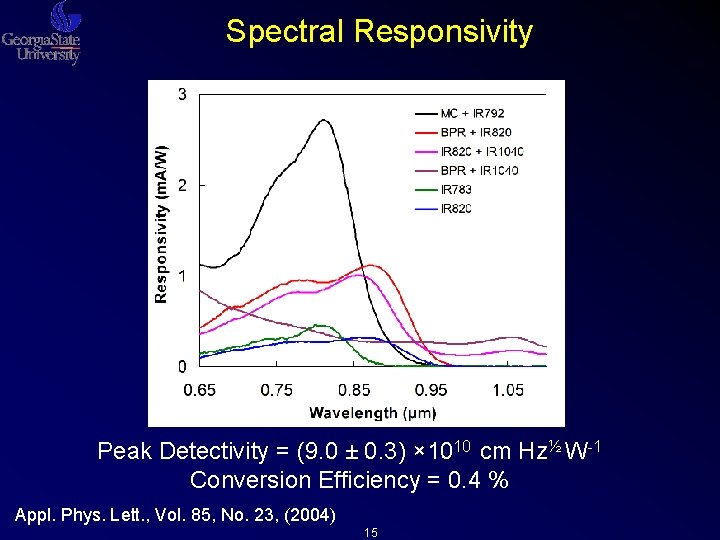
Spectral Responsivity Peak Detectivity = (9. 0 ± 0. 3) × 1010 cm Hz½ W-1 Conversion Efficiency = 0. 4 % Appl. Phys. Lett. , Vol. 85, No. 23, (2004) 15
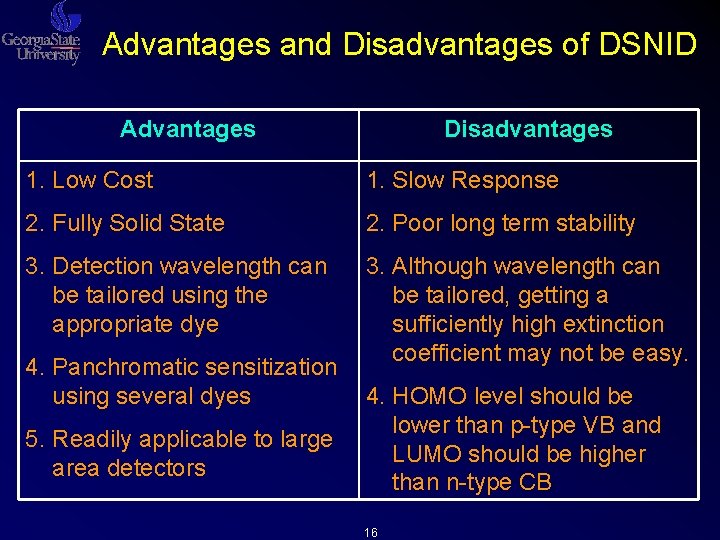
Advantages and Disadvantages of DSNID Advantages Disadvantages 1. Low Cost 1. Slow Response 2. Fully Solid State 2. Poor long term stability 3. Detection wavelength can be tailored using the appropriate dye 3. Although wavelength can be tailored, getting a sufficiently high extinction coefficient may not be easy. 4. Panchromatic sensitization using several dyes 4. HOMO level should be lower than p-type VB and 5. Readily applicable to large LUMO should be higher area detectors than n-type CB 16
Colloidal Quantum Dot Detectors 17
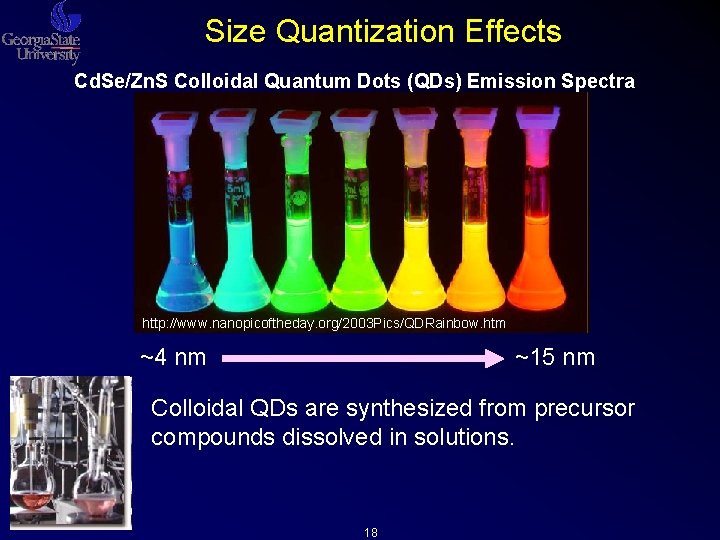
Size Quantization Effects Cd. Se/Zn. S Colloidal Quantum Dots (QDs) Emission Spectra http: //www. nanopicoftheday. org/2003 Pics/QDRainbow. htm ~4 nm ~15 nm Colloidal QDs are synthesized from precursor compounds dissolved in solutions. 18
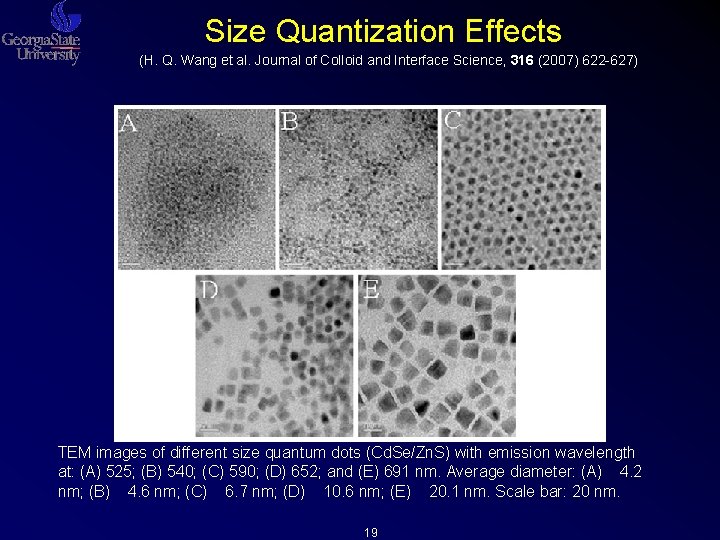
Size Quantization Effects (H. Q. Wang et al. Journal of Colloid and Interface Science, 316 (2007) 622 -627) TEM images of different size quantum dots (Cd. Se/Zn. S) with emission wavelength at: (A) 525; (B) 540; (C) 590; (D) 652; and (E) 691 nm. Average diameter: (A) 4. 2 nm; (B) 4. 6 nm; (C) 6. 7 nm; (D) 10. 6 nm; (E) 20. 1 nm. Scale bar: 20 nm. 19
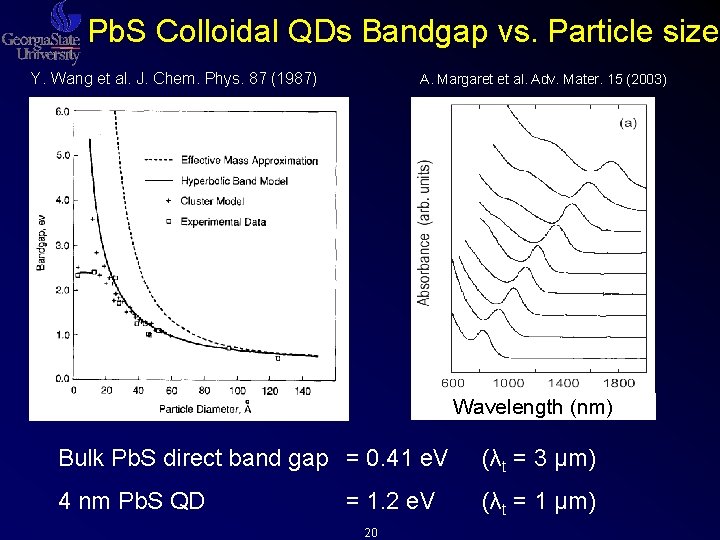
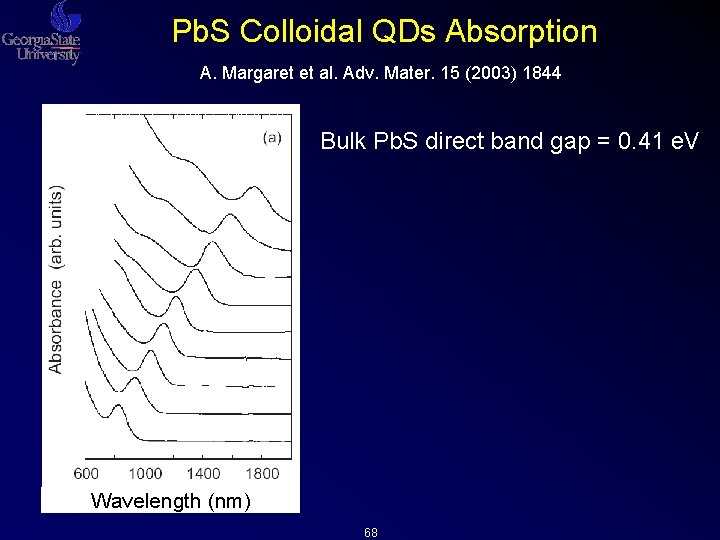
Pb. S Colloidal QDs Bandgap vs. Particle size Y. Wang et al. J. Chem. Phys. 87 (1987) A. Margaret et al. Adv. Mater. 15 (2003) Wavelength (nm) Bulk Pb. S direct band gap = 0. 41 e. V (λt = 3 μm) 4 nm Pb. S QD = 1. 2 e. V (λt = 1 μm) 20
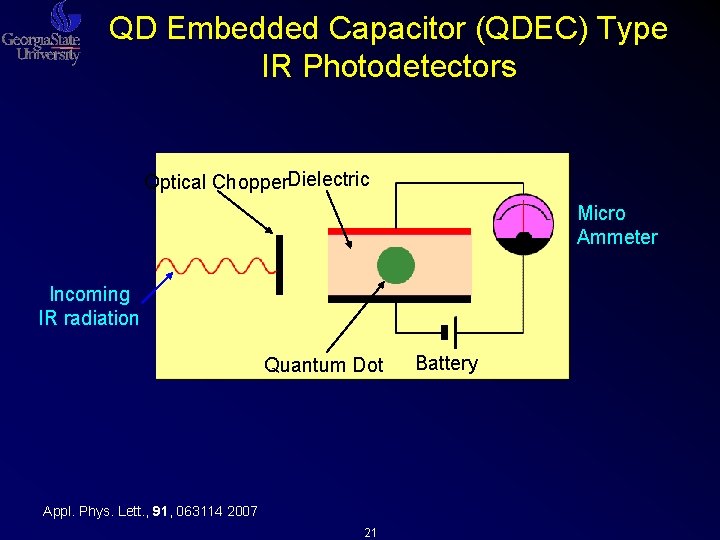
QD Embedded Capacitor (QDEC) Type IR Photodetectors Dielectric Optical Chopper Micro Ammeter Incoming IR radiation Quantum Dot Appl. Phys. Lett. , 91, 063114 2007 21 Battery
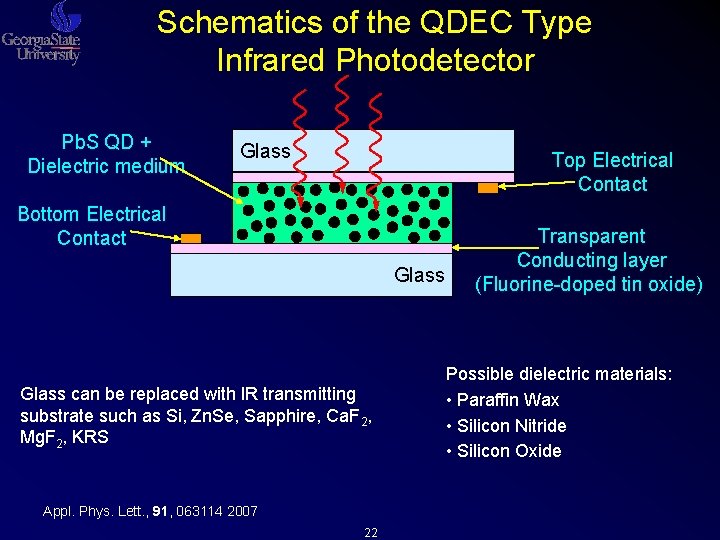
Schematics of the QDEC Type Infrared Photodetector Pb. S QD + Dielectric medium Glass Top Electrical Contact Bottom Electrical Contact Glass can be replaced with IR transmitting substrate such as Si, Zn. Se, Sapphire, Ca. F 2, Mg. F 2, KRS Appl. Phys. Lett. , 91, 063114 2007 22 Transparent Conducting layer (Fluorine-doped tin oxide) Possible dielectric materials: • Paraffin Wax • Silicon Nitride • Silicon Oxide
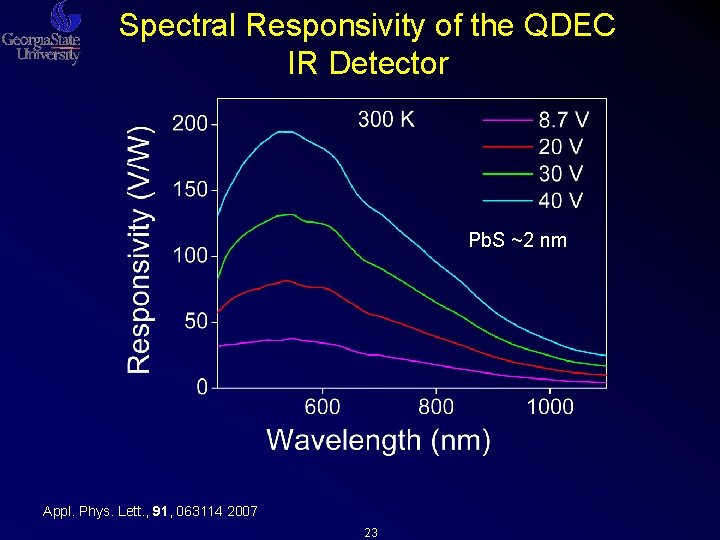
Spectral Responsivity of the QDEC IR Detector Pb. S ~2 nm Appl. Phys. Lett. , 91, 063114 2007 23
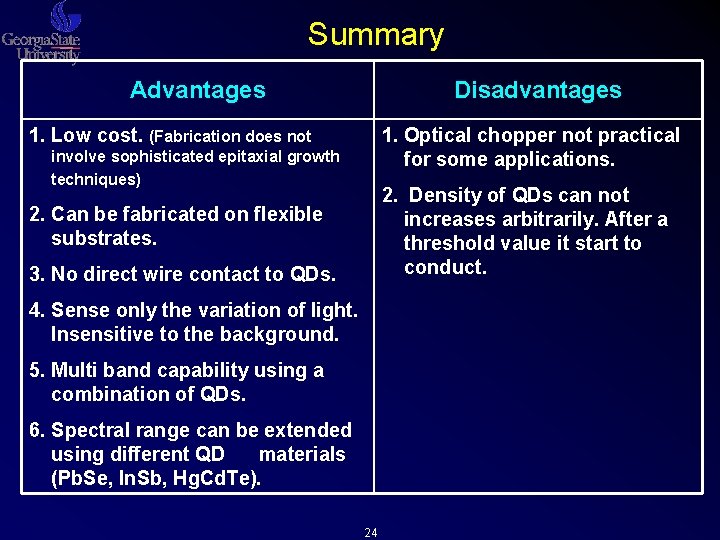
Summary Advantages Disadvantages 1. Low cost. (Fabrication does not 1. Optical chopper not practical for some applications. involve sophisticated epitaxial growth techniques) 2. Density of QDs can not increases arbitrarily. After a threshold value it start to conduct. 2. Can be fabricated on flexible substrates. 3. No direct wire contact to QDs. 4. Sense only the variation of light. Insensitive to the background. 5. Multi band capability using a combination of QDs. 6. Spectral range can be extended using different QD materials (Pb. Se, In. Sb, Hg. Cd. Te). 24
HEIWIP Free Carrier Detectors (Heterounction Interfacial Workfunction Internal Photoemission) 25
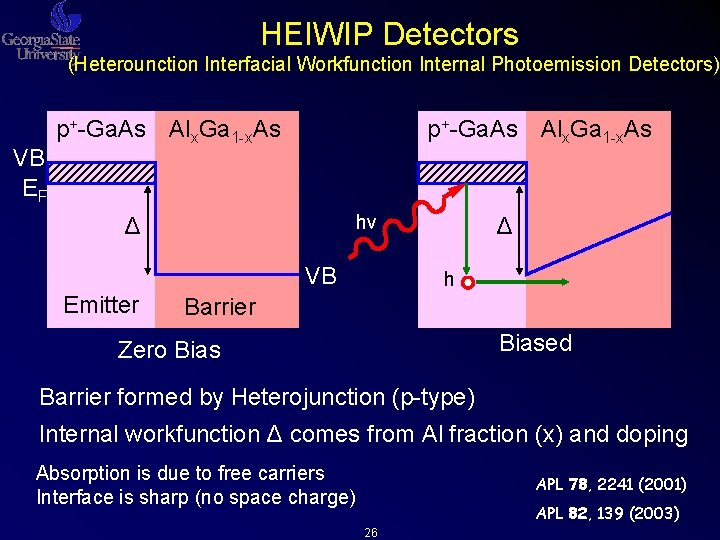
HEIWIP Detectors (Heterounction Interfacial Workfunction Internal Photoemission Detectors) VB EF p+-Ga. As Alx. Ga 1 -x. As hν Δ VB Emitter Δ h Barrier Biased Zero Bias Barrier formed by Heterojunction (p-type) Internal workfunction Δ comes from Al fraction (x) and doping Absorption is due to free carriers Interface is sharp (no space charge) APL 78, 2241 (2001) APL 82, 139 (2003) 26
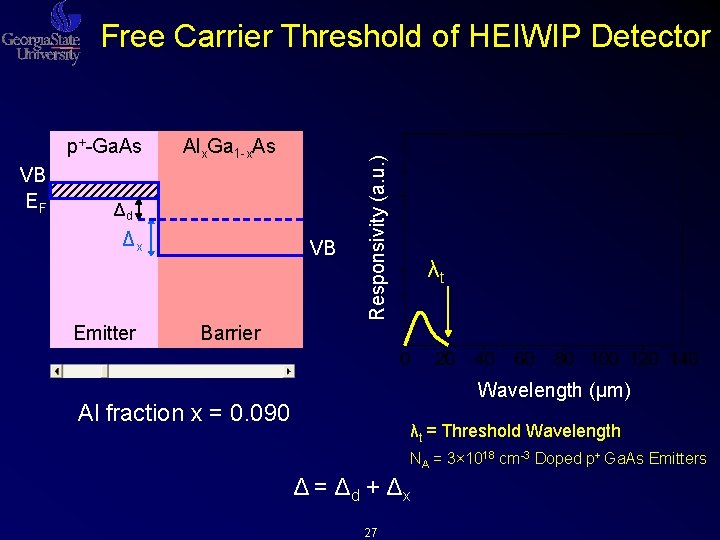
p+-Ga. As VB EF Alx. Ga 1 -x. As Δd Δx Emitter VB Responsivity (a. u. ) Free Carrier Threshold of HEIWIP Detector λt Barrier Wavelength (μm) Al fraction x = 0. 090 λt = Threshold Wavelength NA = 3× 1018 cm-3 Doped p+ Ga. As Emitters Δ = Δd + Δx 27
Split-off Band Detectors 28
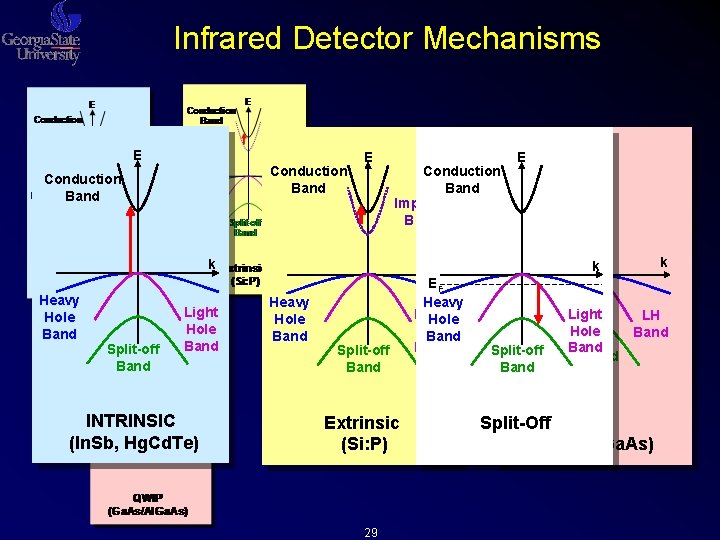
Infrared Detector Mechanisms E Conduction Band E Intersubband levels E E Conduction Band Impurity Band k Heavy Hole Band Split-off Band Light Hole Band INTRINSIC (In. Sb, Hg. Cd. Te) k Heavy Hole Band Split-off Band Extrinsic (Si: P) 29 EF Heavy Light Hole Band k k HH Band Split-off Band Light Hole Band SO Band LH Band Split-Off QWIP (Ga. As/Al. Ga. As)
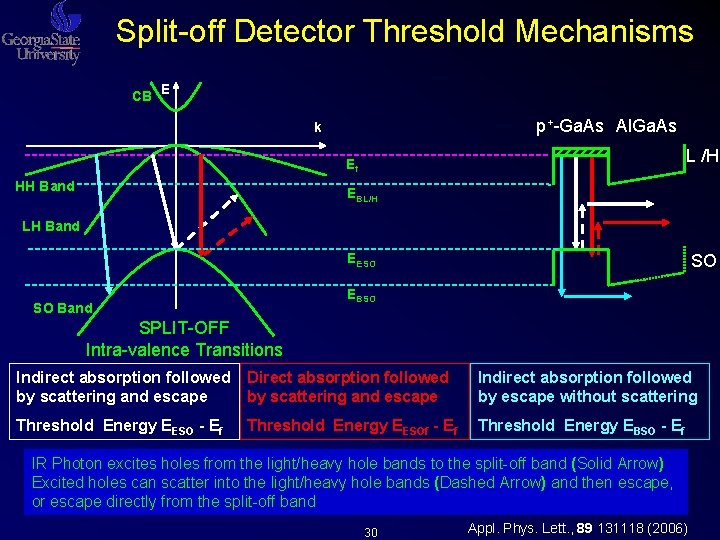
Split-off Detector Threshold Mechanisms CB E p+-Ga. As Al. Ga. As k L /H Ef HH Band EBL/H LH Band SO EESO EBSO SO Band SPLIT-OFF Intra-valence Transitions Indirect absorption followed by scattering and escape Direct absorption followed by scattering and escape Indirect absorption followed by escape without scattering Threshold Energy EESO - Ef Threshold Energy EESOf - Ef Threshold Energy EBSO - Ef IR Photon excites holes from the light/heavy hole bands to the split-off band (Solid Arrow) Excited holes can scatter into the light/heavy hole bands (Dashed Arrow) and then escape, Excited holes can scatter into the light/heavy hole bands (Dashed Arrow) and then escape or escape directly from the split-off band 30 Appl. Phys. Lett. , 89 131118 (2006)
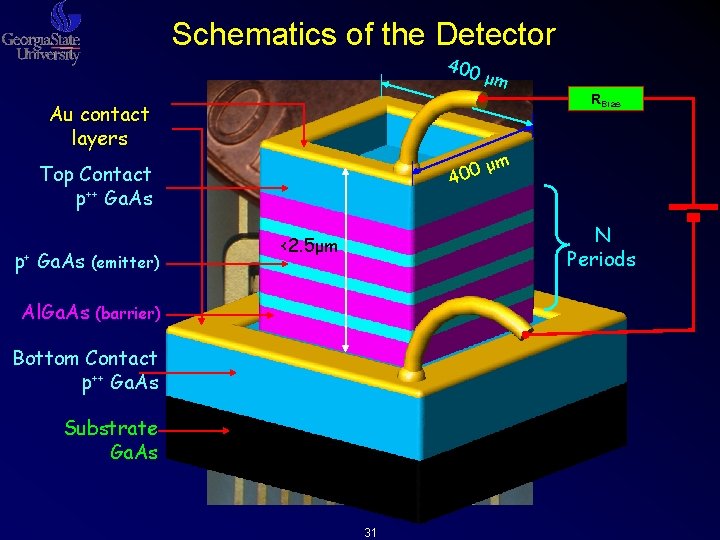
Schematics of the Detector 400 μm RBias Au contact layers μ 400 Top Contact p++ Ga. As p+ Ga. As (emitter) Al. Ga. As (barrier) m N Periods <2. 5μm Bottom Contact p++ Ga. As Substrate Ga. As 31
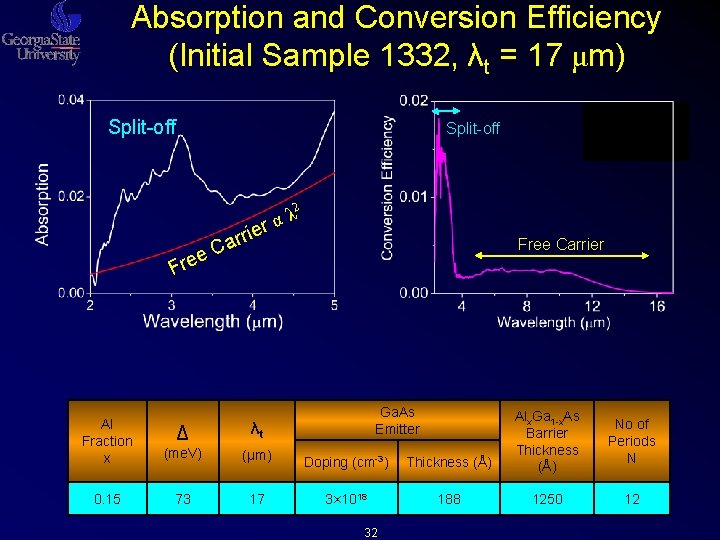
Absorption and Conversion Efficiency (Initial Sample 1332, λt = 17 μm) Split-off 2 λ r α e i r r Ca e re Free Carrier F Al Fraction x 0. 15 Δ λt Ga. As Emitter (me. V) (μm) Doping (cm-3) Thickness (Å) 73 17 3× 10¹⁸ 32 188 Alx. Ga 1 -x. As Barrier Thickness (Å) No of Periods N 1250 12
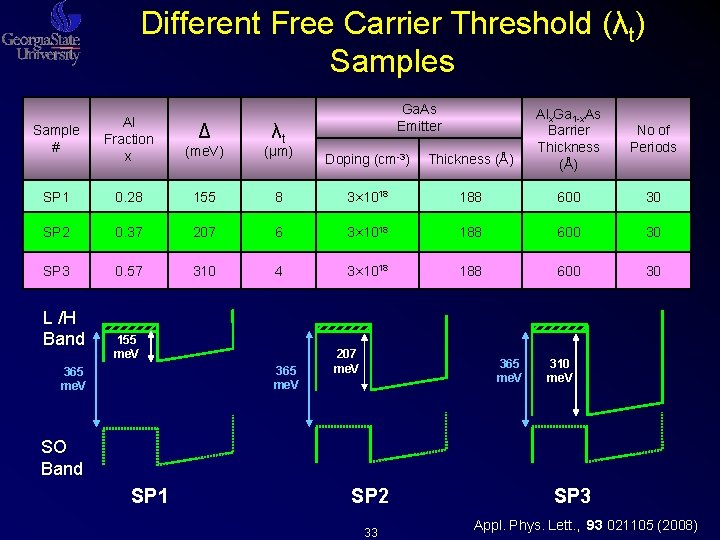
Different Free Carrier Threshold (λt) Samples Ga. As Emitter Alx. Ga 1 -x. As Barrier Thickness (Å) No of Periods 188 600 30 3× 10¹⁸ 188 600 30 Sample # Al Fraction x (me. V) (μm) SP 1 0. 28 155 8 3× 10¹⁸ SP 2 0. 37 207 6 SP 3 0. 57 310 4 L /H Band Δ λt 155 me. V 365 me. V Doping (cm-3) Thickness (Å) 207 me. V 365 me. V 310 me. V SO Band SP 1 SP 2 33 SP 3 Appl. Phys. Lett. , 93 021105 (2008)
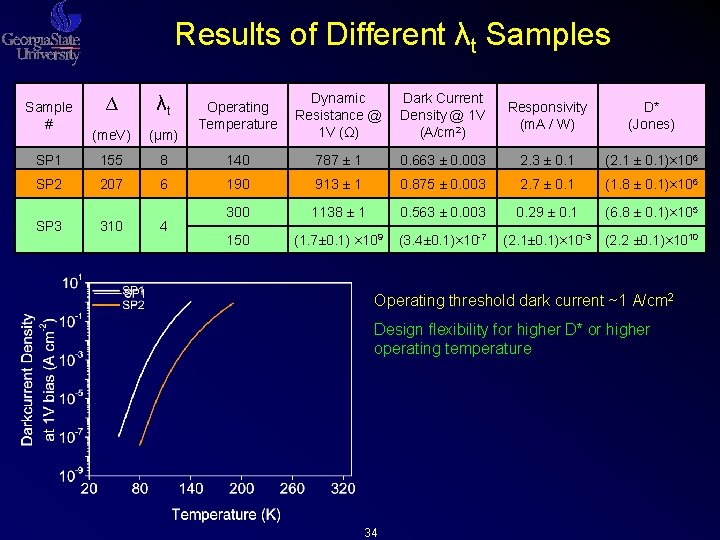
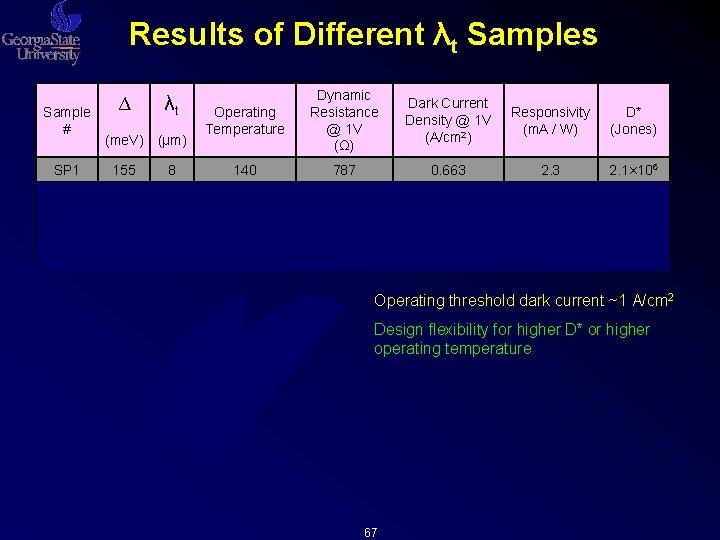
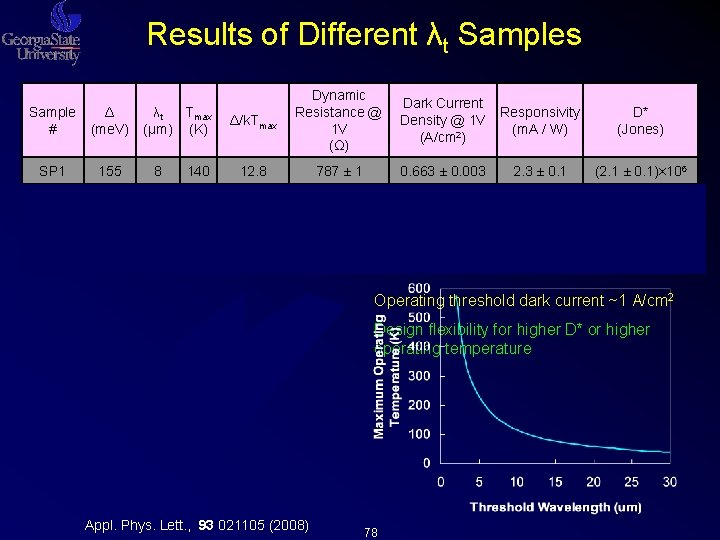
Results of Different λt Samples Dynamic Dark Current Operating Resistance @ Density @ 1 V Temperature 1 V (Ω) (A/cm 2) Δ λt (me. V) (μm) SP 1 155 8 140 787 ± 1 SP 2 207 6 190 Sample # SP 3 310 4 Responsivity (m. A / W) D* (Jones) 0. 663 ± 0. 003 2. 3 ± 0. 1 (2. 1 ± 0. 1)× 106 913 ± 1 0. 875 ± 0. 003 2. 7 ± 0. 1 (1. 8 ± 0. 1)× 106 300 1138 ± 1 0. 563 ± 0. 003 0. 29 ± 0. 1 (6. 8 ± 0. 1)× 105 150 (1. 7± 0. 1) × 109 (3. 4± 0. 1)× 10 -7 (2. 1± 0. 1)× 10 -3 (2. 2 ± 0. 1)× 1010 Operating threshold dark current ~1 A/cm 2 Design flexibility for higher D* or higher operating temperature 34
Room Temperature Response ( SP 3: 4 μm Free Carrier Threshold ) CB SP 3 k Ef L/H HH Band LH Band SO SO Band SPLIT-OFF Intra-valence Transitions ESO – Ef = 370 me. V 3. 4 μm ESOf – Ef = 420 me. V 2. 9 μm Appl. Phys. Lett. , 93 021105 (2008) 35
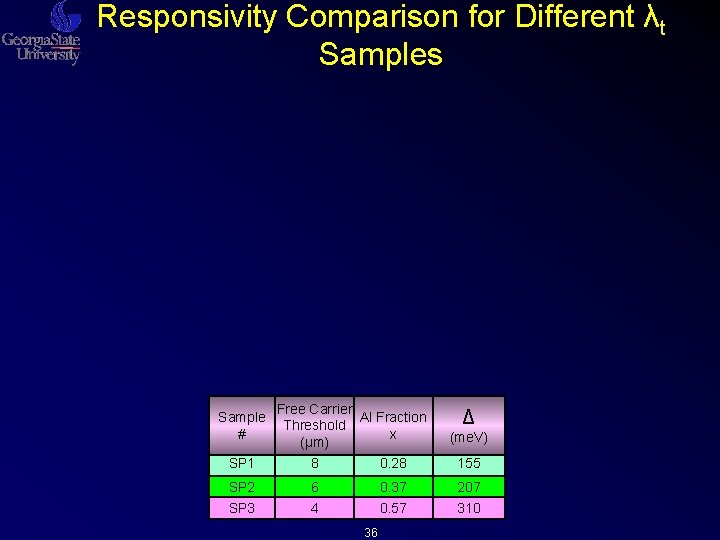
Responsivity Comparison for Different λt Samples Sample # Free Carrier Al Fraction Threshold x (μm) Δ (me. V) SP 1 8 0. 28 155 SP 2 6 0. 37 207 SP 3 4 0. 57 310 36
Above Room Temperature Operation 4 V Noise level 3 V 2 V 1 V 37
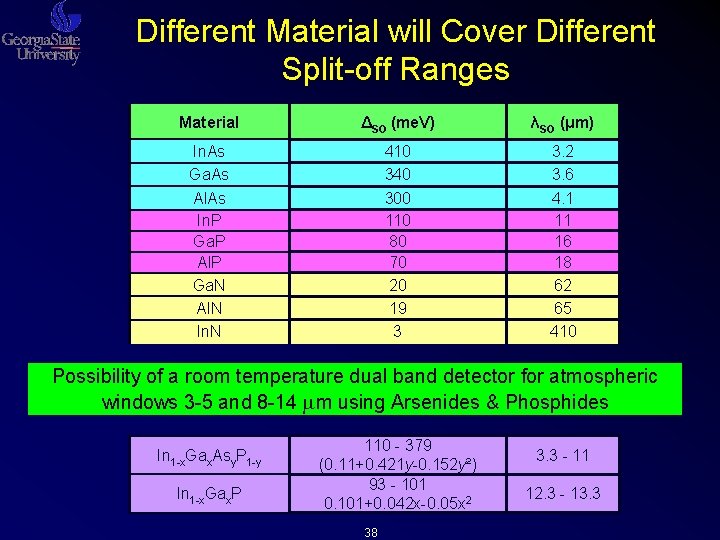
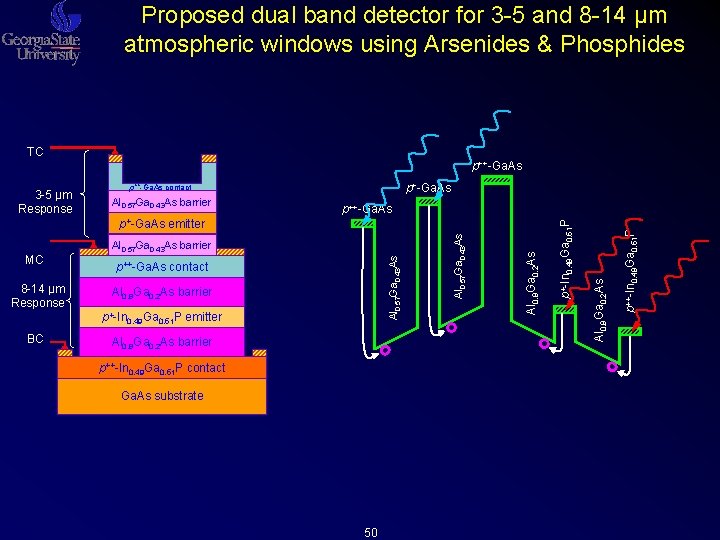
Different Material will Cover Different Split-off Ranges Material ΔSO (me. V) λSO (μm) In. As Ga. As Al. As In. P Ga. P Al. P Ga. N Al. N In. N 410 340 300 110 80 70 20 19 3 3. 2 3. 6 4. 1 11 16 18 62 65 410 Possibility of a room temperature dual band detector for atmospheric windows 3 -5 and 8 -14 m using Arsenides & Phosphides In 1 -x. Gax. Asy. P 1 -y In 1 -x. Gax. P 110 - 379 (0. 11+0. 421 y-0. 152 y²) 93 - 101 0. 101+0. 042 x-0. 05 x 2 38 3. 3 - 11 12. 3 - 13. 3
Summary • High Operating Temperature (Uncooled or TE Cooled) • Tunability (Wavelength, Detectivity, Operating Temperature) • Well Developed Materials, Readout Circuits, and Integrated Circuits • High Performance 39
Ga. Sb Homojunction Far-IR (THz) Detectors 40
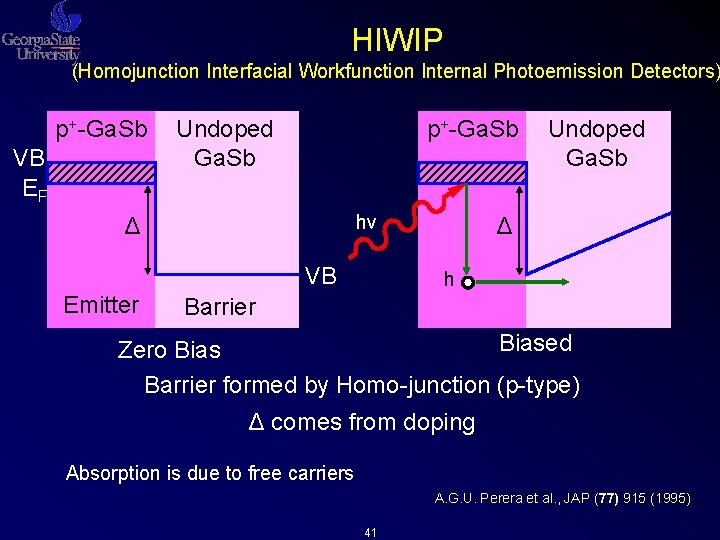
HIWIP (Homojunction Interfacial Workfunction Internal Photoemission Detectors) p+-Ga. Sb VB EF p+-Ga. Sb Undoped Ga. Sb hν Δ VB Emitter Undoped Ga. Sb Δ h Barrier Biased Zero Bias Barrier formed by Homo-junction (p-type) Δ comes from doping Absorption is due to free carriers A. G. U. Perera et al. , JAP (77) 915 (1995) 41
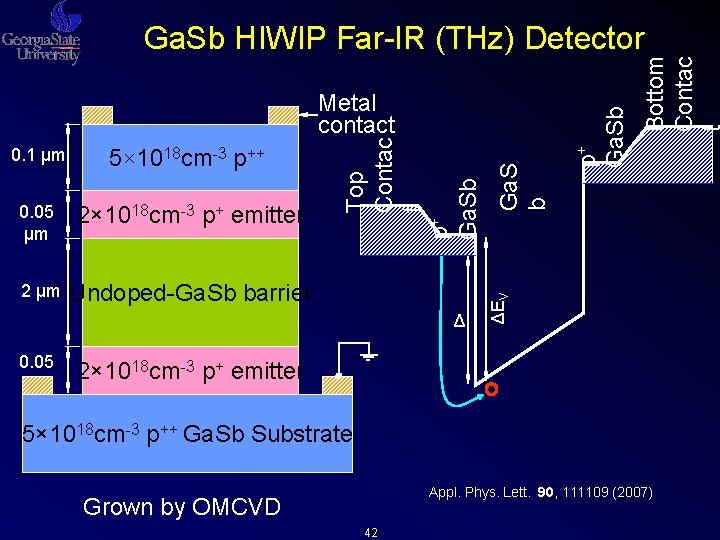
2× 1018 cm-3 p+ emitter 2 μm Undoped-Ga. Sb barrier Δ 0. 05 μm Ga. S b 0. 05 μm Bottom Contac ΔEV 5× 1018 cm-3 p++ p+ Ga. Sb 0. 1 μm Top Contac t Metal contact p+ Ga. Sb HIWIP Far-IR (THz) Detector 2× 1018 cm-3 p+ emitter 5× 1018 cm-3 p++ Ga. Sb Substrate Appl. Phys. Lett. 90, 111109 (2007) Grown by OMCVD 42
Ga. Sb HIWIP Far-IR (THz) Response Peak Detectivity at 36 μm = (5. 7 ± 0. 1)× 1011 cm Hz½ W-1 Conversion Efficiency = 33 % Appl. Phys. Lett. 90, 111109 (2007) 43
Ga. Sb HIWIP Far-IR (THz) Response 44
Ga. Sb THz Absorption Why Ga. Sb ? Ga. Sb Ga. As 45
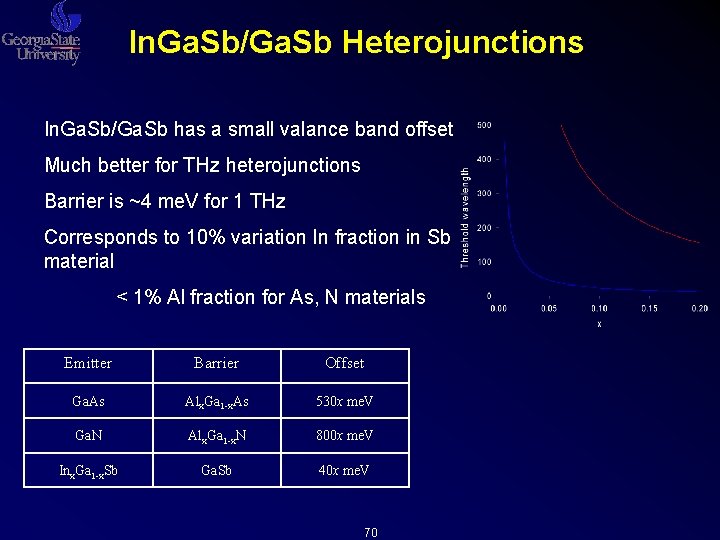
In. Ga. Sb/Ga. Sb Heterojunctions In. Ga. Sb/Ga. Sb has a small valance band offset Much better for THz heterojunctions Barrier is ~4 me. V for 1 THz Corresponds to 10% variation In fraction in Sb material < 1% Al fraction for As, N materials Emitter Barrier Offset Ga. As Alx. Ga 1 -x. As 530 x me. V Ga. N Alx. Ga 1 -x. N 800 x me. V Inx. Ga 1 -x. Sb Ga. Sb 40 x me. V 46
Summary • Higher absorption coefficient compared to Ga. As • High performance Responsivity 9. 7 A/W, Detectivity (5. 7 ± 0. 1)× 1011 Jones at 36 μm and 4. 9 K. • Wavelength tailorability • Design with 14 μm threshold expected to be work at TE cool temperatures. • In. Ga. Sb/Ga. Sb heterojunction has a small valance band offset much better for THz designs 47
Future Works 48
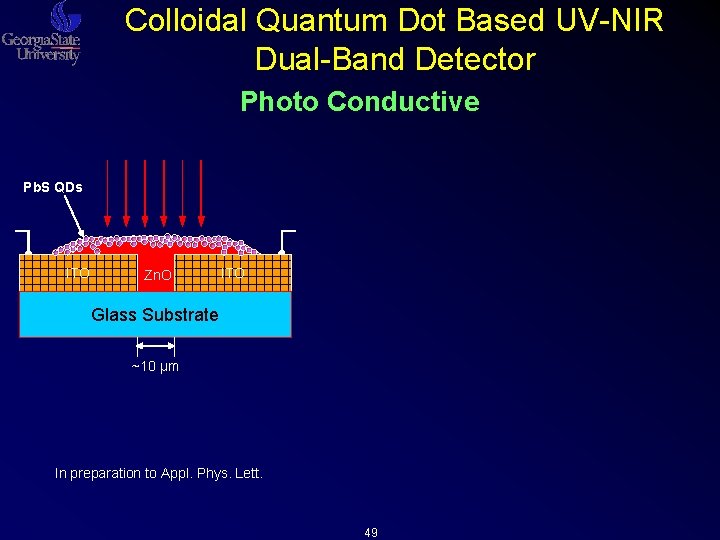
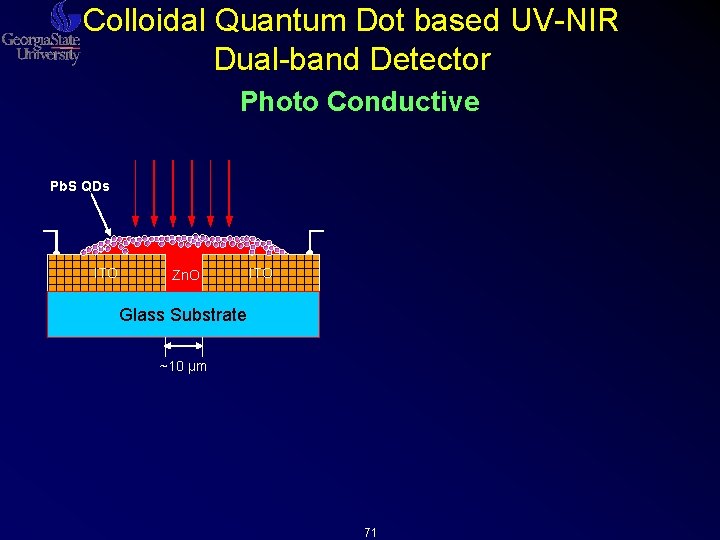
Colloidal Quantum Dot Based UV-NIR Dual-Band Detector Photo Conductive Pb. S QDs ITO Zn. O ITO Glass Substrate ~10 μm In preparation to Appl. Phys. Lett. 49
Proposed dual band detector for 3 -5 and 8 -14 μm atmospheric windows using Arsenides & Phosphides TC p++-Ga. As contact Al 0. 8 Ga 0. 2 As barrier p+-In 0. 49 Ga 0. 51 P emitter BC Al 0. 8 Ga 0. 2 As barrier p++-In 0. 49 Ga 0. 51 P contact Ga. As substrate 50 Al 0. 8 Ga 0. 2 As p++-Ga. As contact Al 0. 57 Ga 0. 43 As 8 -14 μm Response Al 0. 57 Ga 0. 43 As MC p++ -In. Ga. P emitter Al 0. 57 Ga 0. 43 As barrier p++-In 0. 49 Ga 0. 51 P p++-Ga. As p+-Ga. As emitter Al 0. 8 Ga 0. 2 As Al 0. 57 Ga 0. 43 As barrier p+-In 0. 49 Ga 0. 51 P 3 -5 μm Response
List of Publications Relevant to Presented Results 1. P. V. Jayaweera, S. G. Matsik, A. G. U. Perera, H. C. Liu, M. Buchanan and Z. R. Wasilewski "Uncooled infrared detectors for 3 -5 μm and beyond", Applied Physics Letters 93, 021105, (2008) 2. P. V. V. Jayaweera, A. G. U. Perera and K. Tennakone "Why Gratzel′s cell works so well” Inorganica Chimica Acta, 361, 707 -711, (2008) 3. A. G. U. Perera, P. V. Jayaweera, G. Ariyawansa, S. G. Matsik, M. Buchanan and H. C. Liu), "Room Temperature Nano and Micro Structure Photon Detectors", Microelectronics Journal, In Press, (2008) 4. P. V. V. Jayaweera, A. G. U. Perera, and K. Tennakone, "Displacement currents in semiconductor quantum dots embedded dielectric media: A method for room temperature photon detection" Applied Physics Letters 91, 063114 -3, (2007) 5. P. V. V. Jayaweera, S. G. Matsik, and A. G. U. Perera, Y. Paltiel, Ariel Sher and Arie Raizman, H. Luo, and H. C. Liu, “Ga. Sb homojunctions for Far-IR (THz) Detection” Applied Physics Letters, 90, 111109, (2007) 6. P. V. V. Jayaweera, P. K. D. D. P. Pitigala, M. K. I. Seneviratne, A. G. U. Perera and K. Tennakone “ 1/f Noise in dye -sensitized solar cells and NIR photon detectors” Infrared Physics & Technology, 50, 270 -273 (2007) 7. P. V. Jayaweera, S. G. Matsik, K. Tennakone, A. G. U. Perera, H. C. Liu and S. Krishna ) "Spin split-off transition based IR detectors operating at high temperatures" Infrared Physics & Technology, 50, 279 -283 (2007) 8. A. G. U. Perera, S. G. Matsik, P. V. V. Jayaweera, K. Tennakone, H. C. Liu, M. Buchanan G. Von Winckel, A. Stintz, and S. Krishna) “High Operating Temperature Split-off Band Infrared Detectors” Applied Physics Letters, 89, 131118, (2006) 9. P. V. V. Jayaweera, P. K. D. D. P. Pitigala, A. G. U. Perera and K. Tennakone "1/f noise and dye-sensitized solar cells", Semicond. Sci. Technol. 20, L 40–L 42, (2005) 10. P. V. Jayaweera, A. G. U. Perera, M. K. I. Senevirathna, P. K. D. D. P. Pitigala, and K. Tennakone, “Dyesensitized near-infrared room-temperature photovoltaic photon detectors" Applied Physics Letters 85 (23), 57545756, (2004) 51
Acknowledgement Advisor: • Dr. Unil Perera Department Staff: Yvette Hilaire, Felicia Watts, Carola Butler, Duke Windsor Committee • Dr. Vadym M. Apalkov • Dr. Douglas Gies • Dr. Xiaochun He • Dr. Kirthi Tennakone Instrument Shop: Charles Hopper, Peter Walker, Dwayne Alan Torres Group Members Dr. Steven Matsik, Dr. Gamini Ariyawansa, Ranga Jayasinghe, Dulipa Pitigala, Laura Byrum, Jiafeng Shao, Dr. Manmohan Singh, Greggory Rothmeier • Dr. Brian D. Thoms Department Chair: • Dr. H. R. Miller Associate Dean: • Dr. William H. Nelson 52
Oct. 28 2008 The End 53
54
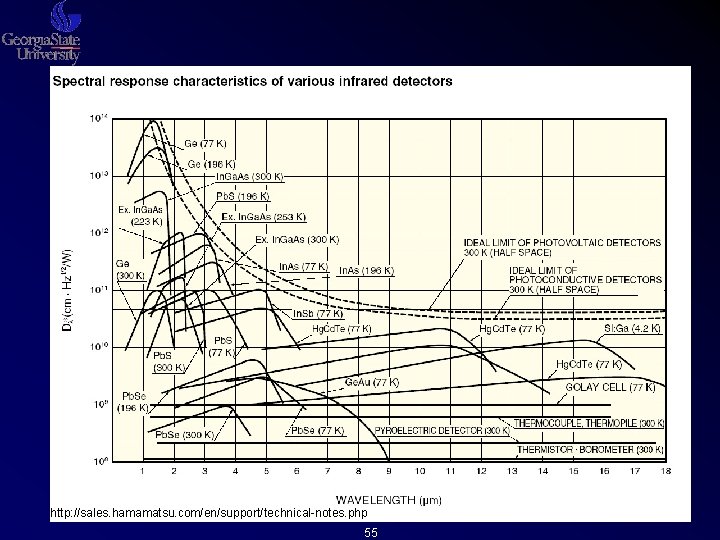
http: //sales. hamamatsu. com/en/support/technical-notes. php 55
Results of Different λt Samples Operating Temperature Dynamic Resistance @ 1 V (Ω) Dark Current Density @ 1 V (A/cm 2) Responsivity (m. A / W) D* (Jones) 8 140 787 0. 663 2. 1× 10⁶ 6 190 913 0. 875 2. 7 1. 8× 10⁶ 300 1138 0. 563 0. 29 6. 8× 10⁵ 150 1. 74× 109 3. 4× 10 -7 0. 0021 2. 2× 10¹⁰ Δ λt (me. V) (μm) SP 1 155 SP 2 207 Sample # SP 3 310 4 Operating threshold dark current ~1 A/cm 2 Design flexibility for higher D* or higher operating temperature 67
Pb. S Colloidal QDs Absorption A. Margaret et al. Adv. Mater. 15 (2003) 1844 Bulk Pb. S direct band gap = 0. 41 e. V Wavelength (nm) 68
Ga. Sb THz Absorption Why Ga. Sb ? Ga. Sb Ga. As 69
In. Ga. Sb/Ga. Sb Heterojunctions In. Ga. Sb/Ga. Sb has a small valance band offset Much better for THz heterojunctions Barrier is ~4 me. V for 1 THz Corresponds to 10% variation In fraction in Sb material < 1% Al fraction for As, N materials Emitter Barrier Offset Ga. As Alx. Ga 1 -x. As 530 x me. V Ga. N Alx. Ga 1 -x. N 800 x me. V Inx. Ga 1 -x. Sb Ga. Sb 40 x me. V 70
Colloidal Quantum Dot based UV-NIR Dual-band Detector Photo Conductive Pb. S QDs ITO Zn. O ITO Glass Substrate ~10 μm 71
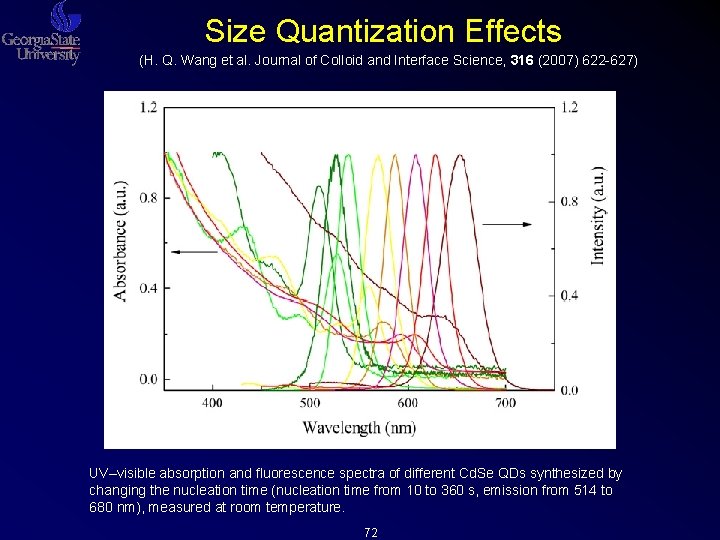
Size Quantization Effects (H. Q. Wang et al. Journal of Colloid and Interface Science, 316 (2007) 622 -627) UV–visible absorption and fluorescence spectra of different Cd. Se QDs synthesized by changing the nucleation time (nucleation time from 10 to 360 s, emission from 514 to 680 nm), measured at room temperature. 72
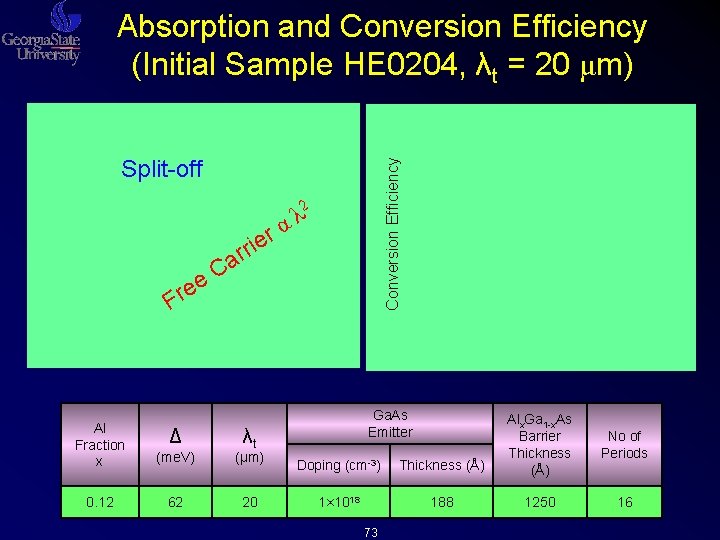
Absorption and Conversion Efficiency (Initial Sample HE 0204, λt = 20 μm) α r e e re Conversion Efficiency Split-off 2 λ i r r Ca F Al Fraction x (me. V) (μm) 0. 12 62 20 Δ Ga. As Emitter λt Doping (cm-3) Thickness (Å) 1× 10¹⁸ 188 73 Alx. Ga 1 -x. As Barrier Thickness (Å) No of Periods 1250 16
Split-off Response for the 20 μm Free Carrier Threshold Detector E CB Responsivity (m. A / W) k Ef ΔL/H HH Band HE 0204 LH Band ΔSO SO Band SPLIT-OFF Intra-valence Transitions ESO – Ef = 370 me. V 3. 4 μm ESOf – Ef = 420 me. V 2. 9 μm ΔSO – Ef = 420 me. V 2. 9 μm Appl. Phys. Lett. , 89, 131118 (2006) 74
Outline • Introduction • Infrared Detectors based on 1. Dye-Sensitization of Nanostructured Semiconductors • Dye-sensitized NIR detector design, experimental results and summery • 1/f Noise on DS nano structures 2. Displacement Currents in Semiconductor Quantum Dots (QDs) Embedded Dielectric Media • Size quantization effects • QD capacitor based detector design, experimental results and summery 3. Split-off Band Transitions in Ga. As/Al. Ga. As Heterojunction • High operating temperature split-off response observed from HEIWIP design for 17 μm threshold wavelength • Uncooled split-off band detector design Experimental results and Summery 4. Free Carrier Absorption in Ga. Sb Homojunction • Ga. Sb HIWIP detector design, experimental results and summery • Future Works 75
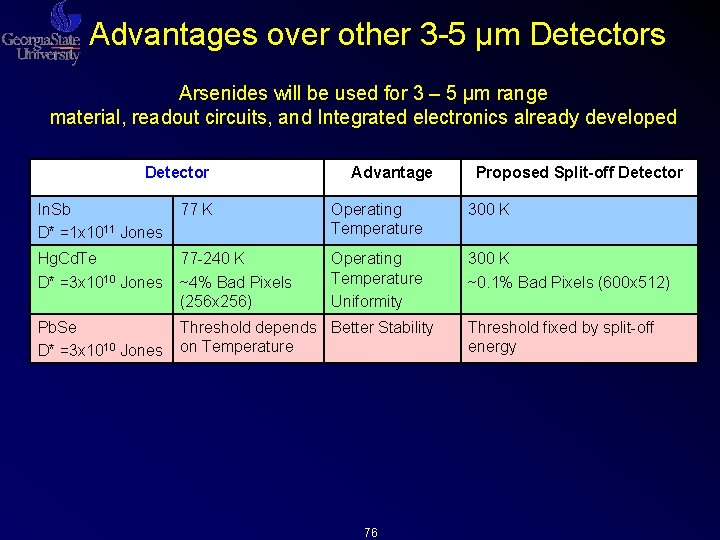
Advantages over other 3 -5 µm Detectors Arsenides will be used for 3 – 5 μm range material, readout circuits, and Integrated electronics already developed Detector Advantage Proposed Split-off Detector In. Sb 77 K D* =1 x 10¹¹ Jones Operating Temperature 300 K Hg. Cd. Te D* =3 x 10¹⁰ Jones 77 -240 K ~4% Bad Pixels (256 x 256) Operating Temperature Uniformity 300 K ~0. 1% Bad Pixels (600 x 512) Pb. Se D* =3 x 10¹⁰ Jones Threshold depends Better Stability on Temperature 76 Threshold fixed by split-off energy
77
Results of Different λt Samples λt Tmax (μm) (K) Dynamic Dark Current Resistance @ Responsivity Density @ 1 V (m. A / W) 1 V (A/cm 2) (Ω) Sample # Δ (me. V) SP 1 155 8 140 12. 8 787 ± 1 0. 663 ± 0. 003 2. 3 ± 0. 1 (2. 1 ± 0. 1)× 106 SP 2 207 6 190 12. 6 913 ± 1 0. 875 ± 0. 003 2. 7 ± 0. 1 (1. 8 ± 0. 1)× 106 SP 3 310 4 300 12. 0 1138 ± 1 0. 563 ± 0. 003 0. 29 ± 0. 01 (6. 8 ± 0. 1)× 105 Δ/k. Tmax D* (Jones) Operating threshold dark current ~1 A/cm 2 Design flexibility for higher D* or higher operating temperature Appl. Phys. Lett. , 93 021105 (2008) 78
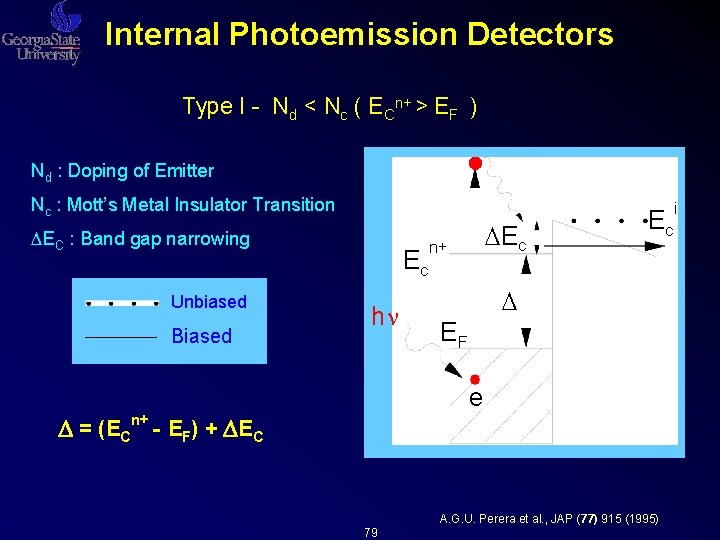
Internal Photoemission Detectors Type I - Nd < Nc ( ECn+ > EF ) Nd : Doping of Emitter Nc : Mott’s Metal Insulator Transition DEC : Band gap narrowing Unbiased Biased DEc n+ Ec hn i Ec D EF e D = (ECn+ - EF) + DEC A. G. U. Perera et al. , JAP (77) 915 (1995) 79
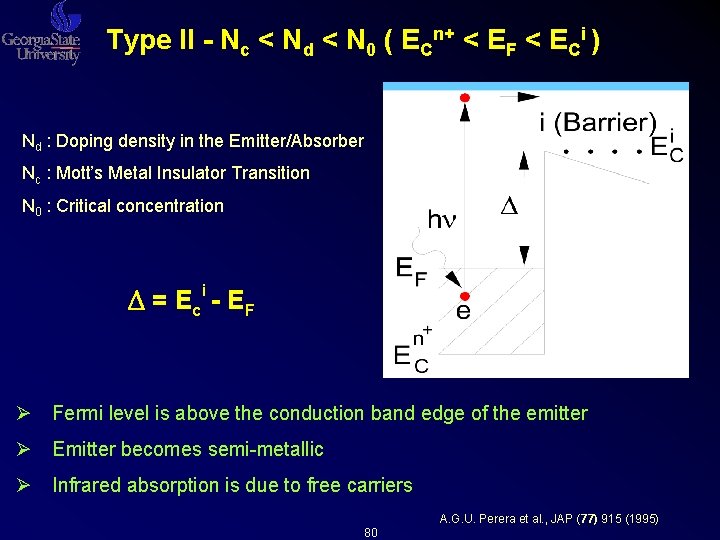
Type II - Nc < Nd < N 0 ( ECn+ < EF < ECi ) Nd : Doping density in the Emitter/Absorber Nc : Mott’s Metal Insulator Transition N 0 : Critical concentration D = Eci - EF Ø Fermi level is above the conduction band edge of the emitter Ø Emitter becomes semi-metallic Ø Infrared absorption is due to free carriers A. G. U. Perera et al. , JAP (77) 915 (1995) 80
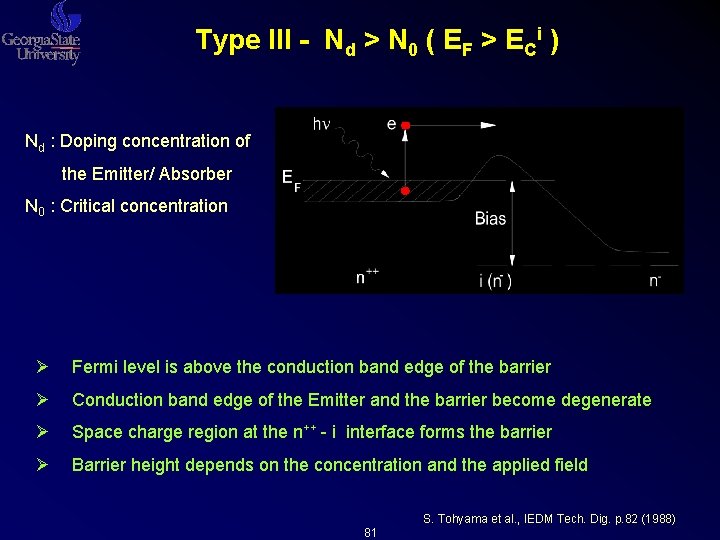
Type III - Nd > N 0 ( EF > ECi ) Nd : Doping concentration of the Emitter/ Absorber N 0 : Critical concentration Ø Fermi level is above the conduction band edge of the barrier Ø Conduction band edge of the Emitter and the barrier become degenerate Ø Space charge region at the n++ - i interface forms the barrier Ø Barrier height depends on the concentration and the applied field S. Tohyama et al. , IEDM Tech. Dig. p. 82 (1988) 81
p+-Ga. Sb CB Ga. Sb CB VB EF EF VB 82