
Unconventional superconductivity Author Jure Kokalj Mentor prof dr
- Slides: 18
Unconventional superconductivity Author: Jure Kokalj Mentor: prof. dr. Peter Prelovšek
Introduction n History and present status of SC (superconductivity) Properties of SC BCS theory - attractive interaction - Cooper pair - gap and pairing symmetry n n What is unconventional Experiments for probing pairing symmetry - Josephson junction - SQUID experiments
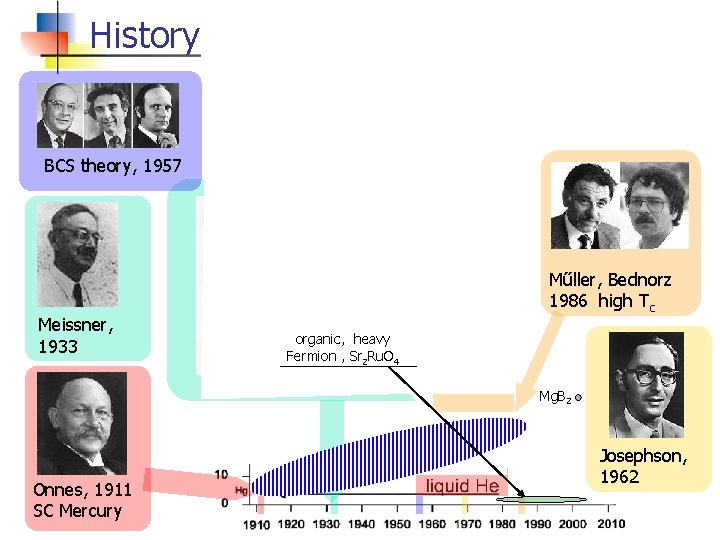
History BCS theory, 1957 Meissner, 1933 Műller, Bednorz 1986 high Tc organic, heavy Fermion , Sr 2 Ru. O 4 Mg. B 2 Onnes, 1911 SC Mercury Josephson, 1962
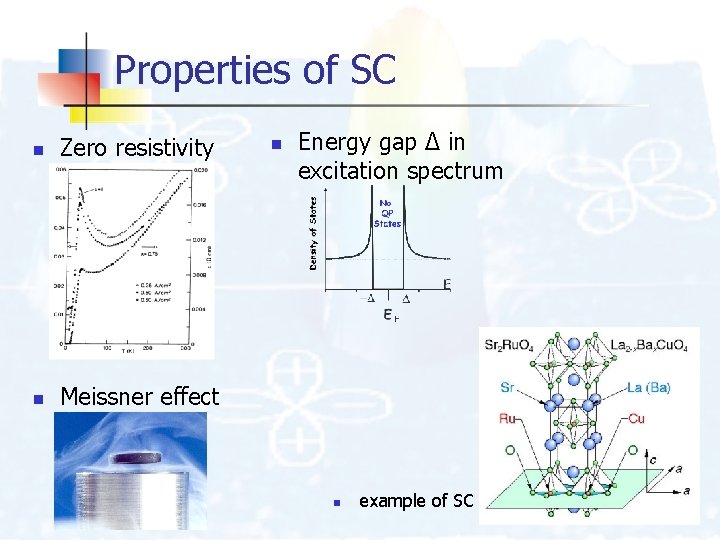
Properties of SC n Zero resistivity n Meissner effect n Energy gap Δ in excitation spectrum n example of SC
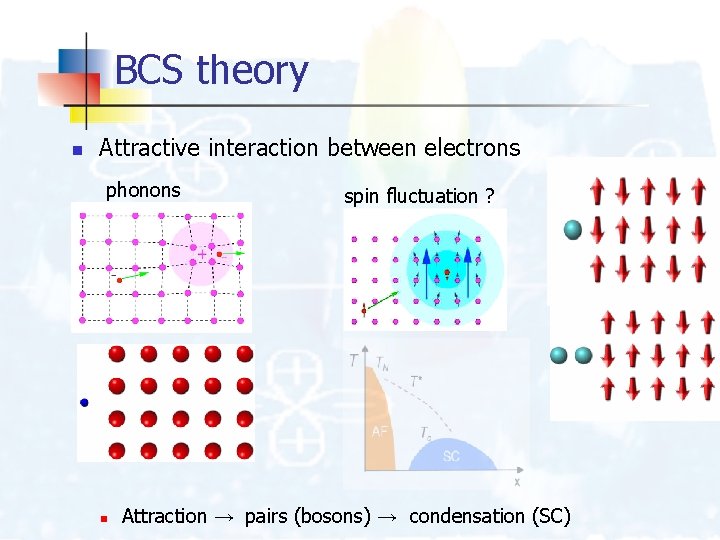
BCS theory n Attractive interaction between electrons phonons n spin fluctuation ? Attraction → pairs (bosons) → condensation (SC)
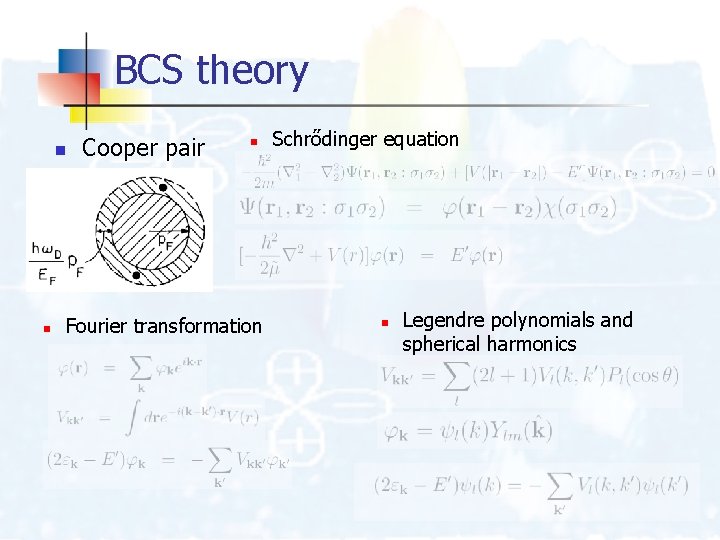
BCS theory n n Cooper pair n Fourier transformation Schrődinger equation n Legendre polynomials and spherical harmonics
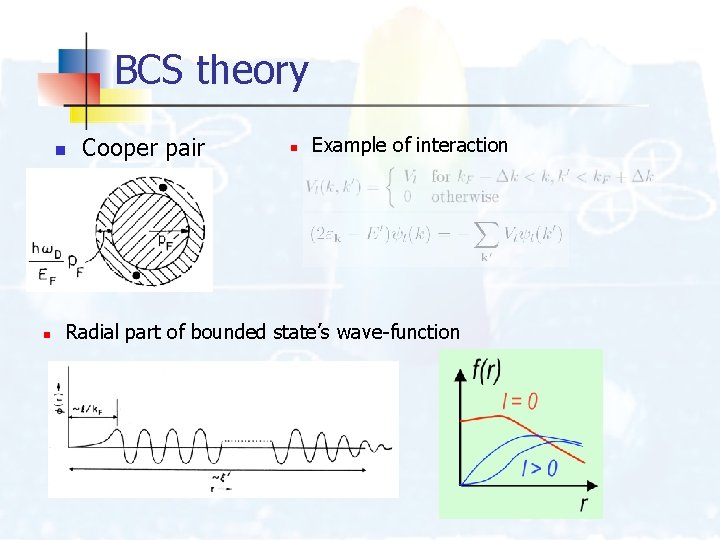
BCS theory n n Cooper pair n Example of interaction Radial part of bounded state’s wave-function
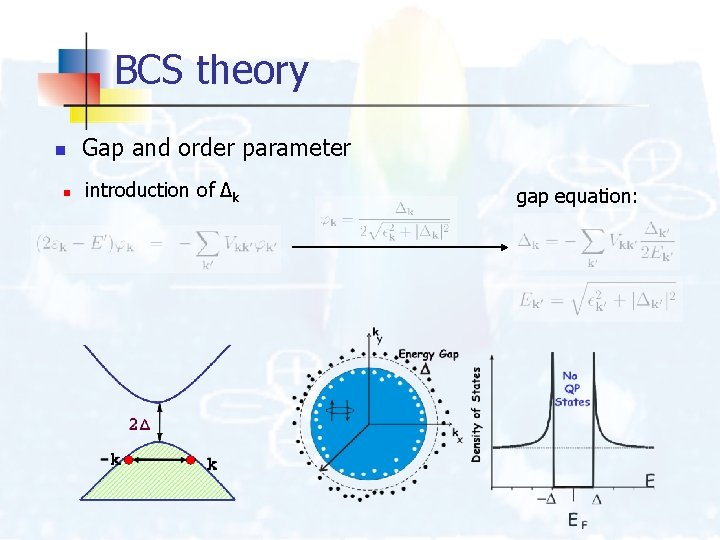
BCS theory n n Gap and order parameter introduction of Δk gap equation:
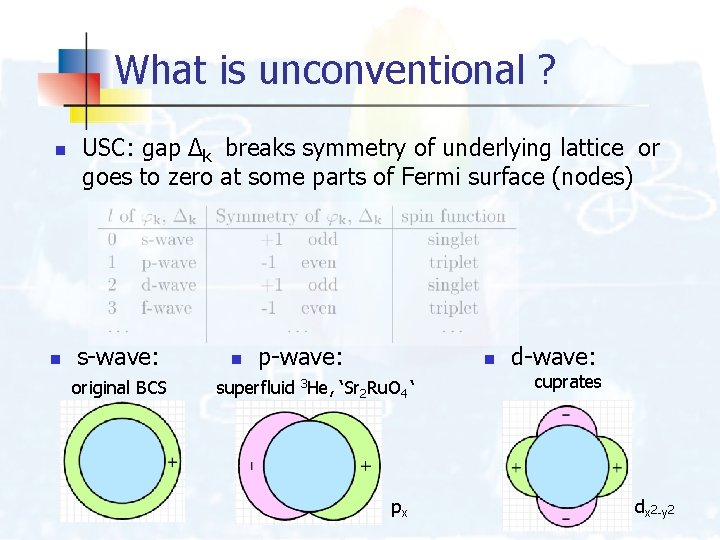
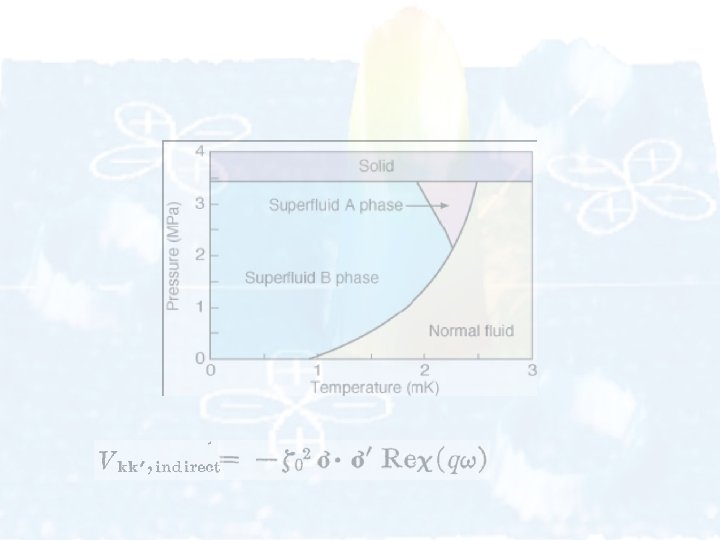
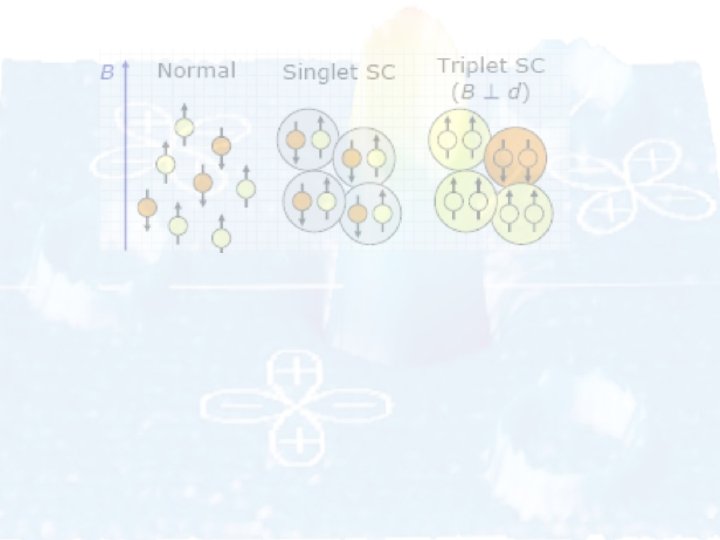
What is unconventional ? n n USC: gap Δk breaks symmetry of underlying lattice or goes to zero at some parts of Fermi surface (nodes) s-wave: original BCS n p-wave: n superfluid 3 He, ‘Sr 2 Ru. O 4 ‘ px d-wave: cuprates dx 2 -y 2
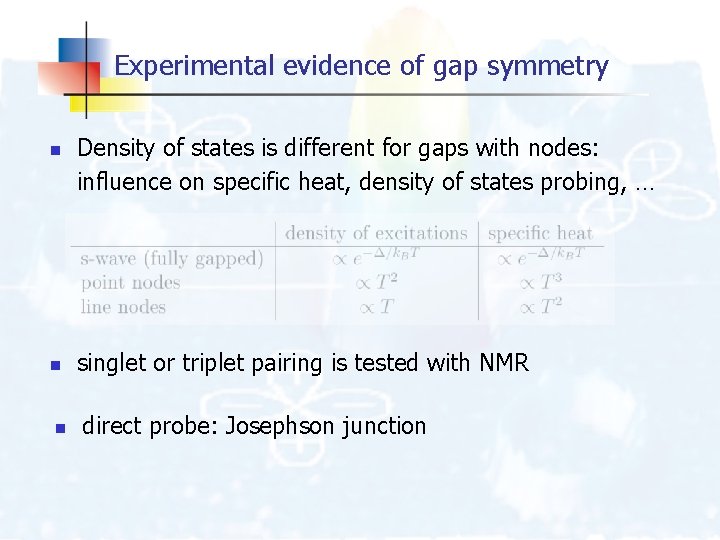
Experimental evidence of gap symmetry n n n Density of states is different for gaps with nodes: influence on specific heat, density of states probing, … singlet or triplet pairing is tested with NMR direct probe: Josephson junction
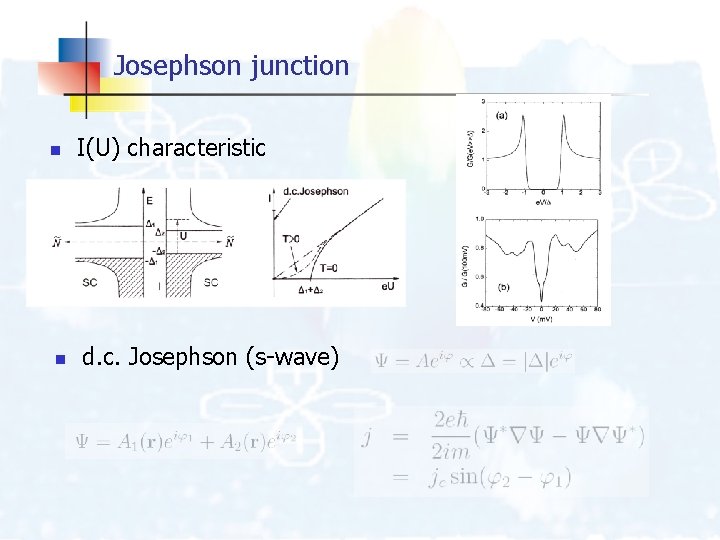
Josephson junction n n I(U) characteristic d. c. Josephson (s-wave)
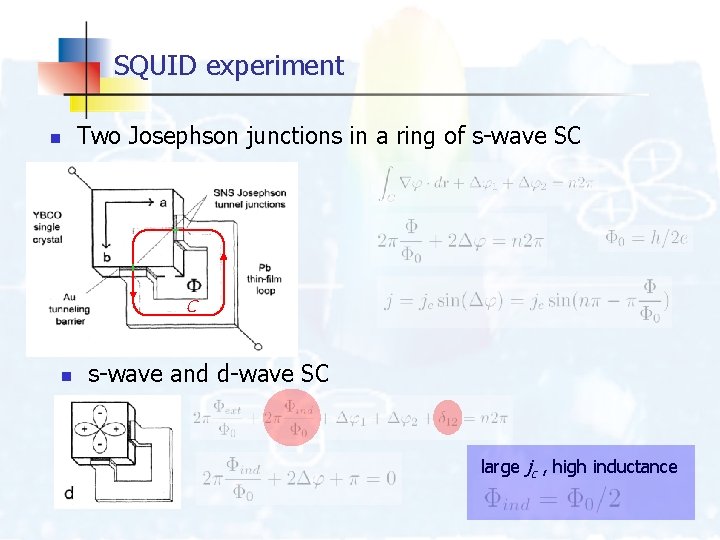
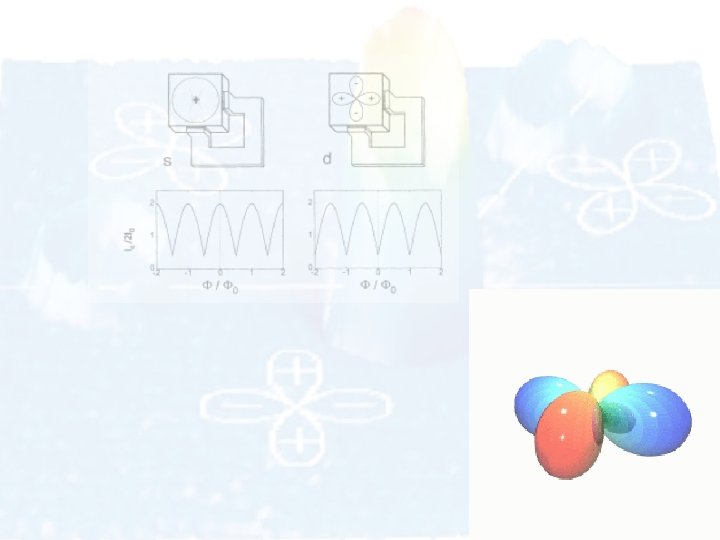
SQUID experiment Two Josephson junctions in a ring of s-wave SC n s-wave and d-wave SC large jc , high inductance
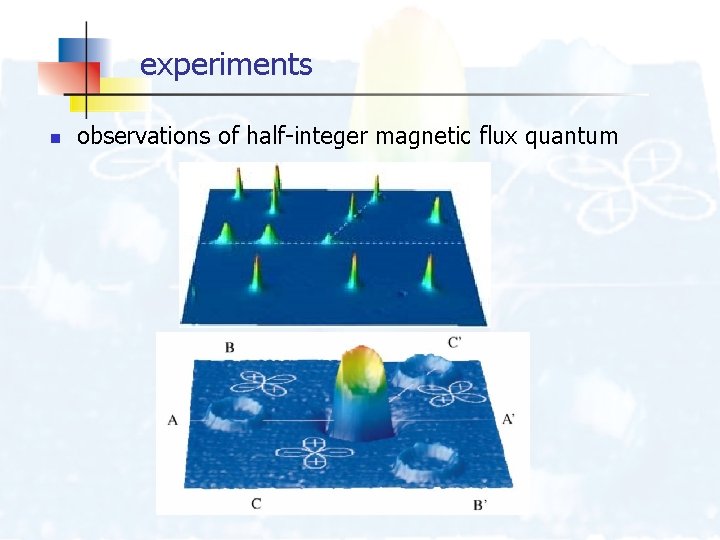
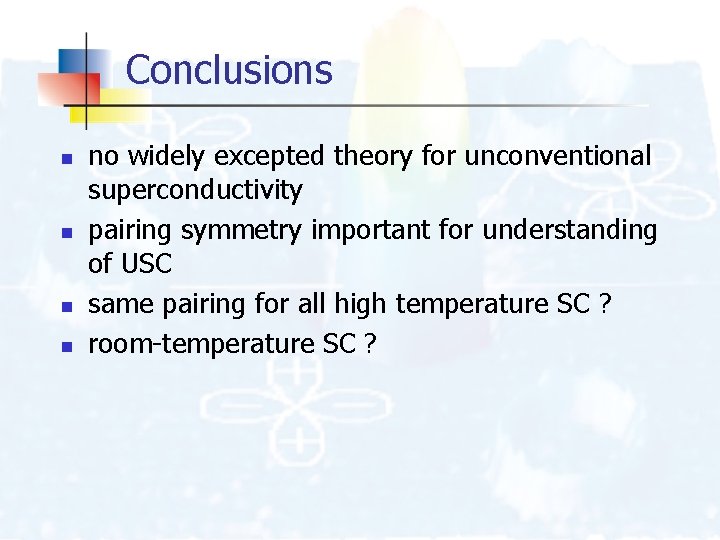
experiments n observations of half-integer magnetic flux quantum
Conclusions n n no widely excepted theory for unconventional superconductivity pairing symmetry important for understanding of USC same pairing for all high temperature SC ? room-temperature SC ?
Thank you