
Unconscious Bias in Clinical Care and Medical Education
Unconscious Bias in Clinical Care and Medical Education Fernando S. Mendoza, MD, MPH Lars Osterberg MD, MPH Magali Fassiotto, Ph. D.
Objectives • What is unconscious bias (UCB) • Demographic shifts in patient populations • Patient centered care and quality improvement • Evidence of UCB in organizations & clinical care • Interventions to address UCB in organizations and clinical care (teaching) • How do we evaluate changes in UCB 2
Definition Implicit or unconscious bias happens by our brains making incredibly quick judgments and assessments of people and situations without us realizing. Our biases are influenced by our background, cultural environment and personal experiences. We may not even be aware of these views and opinions, or be aware of their full impact and implications. 3
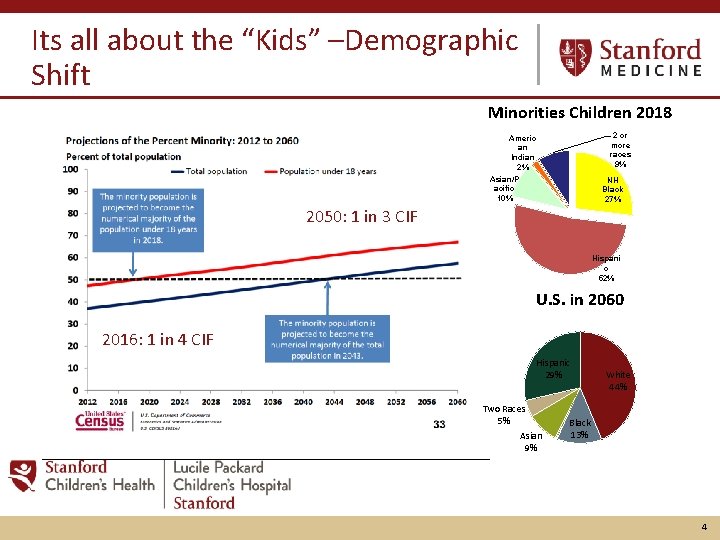
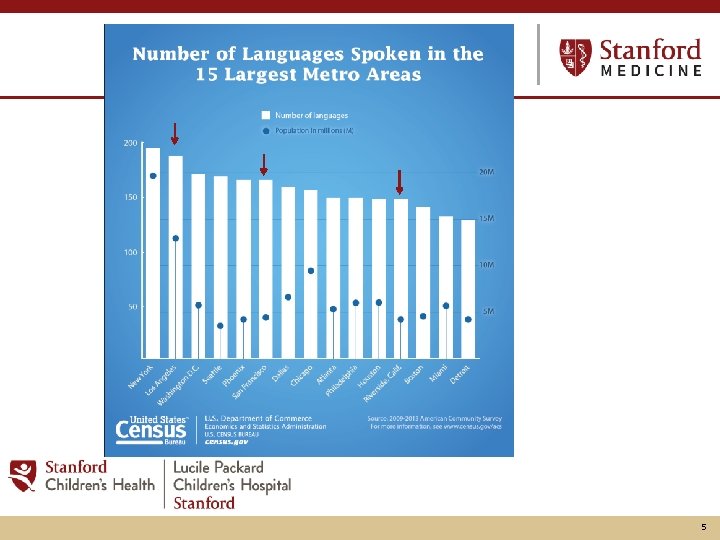
Its all about the “Kids” –Demographic Shift Minorities Children 2018 2 or more races 9% Americ an Indian 2% Asian/P acific 10% NH Black 27% 2050: 1 in 3 CIF Hispani c 52% U. S. in 2060 2016: 1 in 4 CIF Hispanic 29% Two Races 5% Asian 9% White 44% Black 13% 4
5
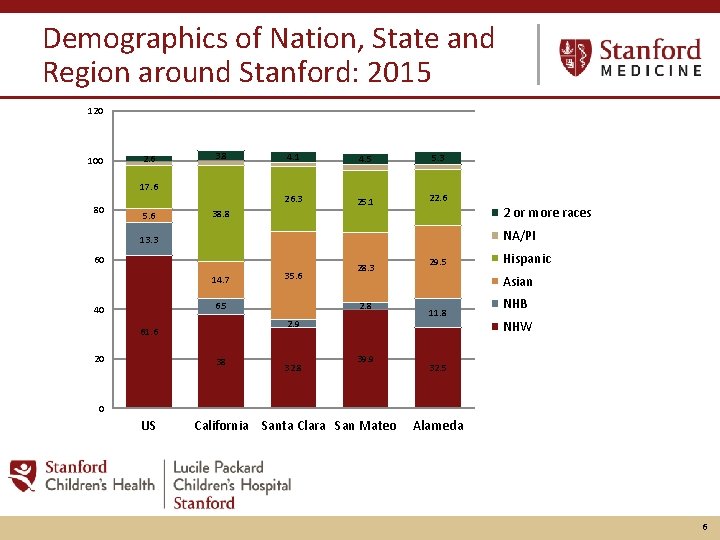
Demographics of Nation, State and Region around Stanford: 2015 120 100 2. 6 3. 8 17. 6 80 5. 6 4. 1 4. 5 5. 3 26. 3 25. 1 22. 6 2 or more races 38. 8 NA/PI 13. 3 60 14. 7 35. 6 2. 8 6. 5 40 2. 9 61. 6 20 28. 3 38 32. 8 39. 9 29. 5 Hispanic Asian 11. 8 NHB NHW 32. 5 0 US California Santa Clara San Mateo Alameda 6
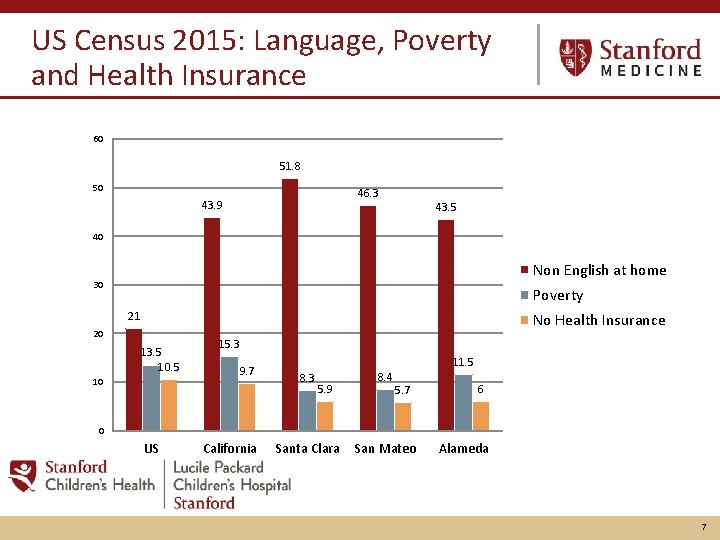
US Census 2015: Language, Poverty and Health Insurance 60 51. 8 50 46. 3 43. 9 43. 5 40 Non English at home 30 Poverty 21 No Health Insurance 20 13. 5 10 15. 3 9. 7 11. 5 8. 3 5. 9 8. 4 5. 7 6 0 US California Santa Clara San Mateo Alameda 7
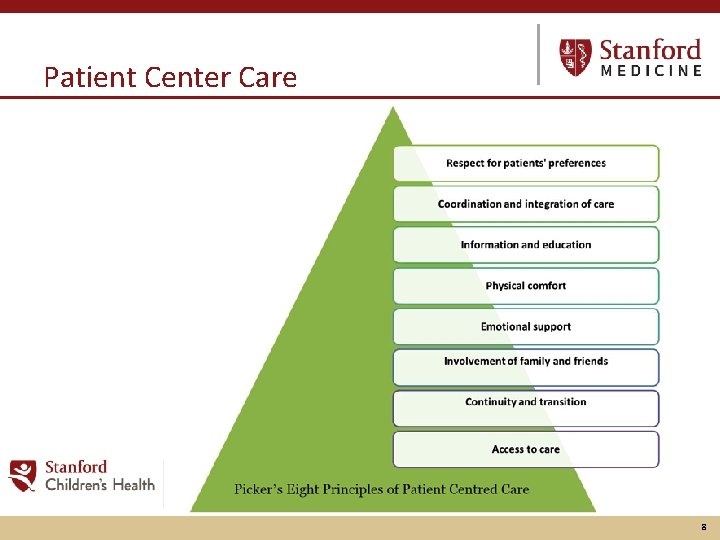
Patient Center Care 8
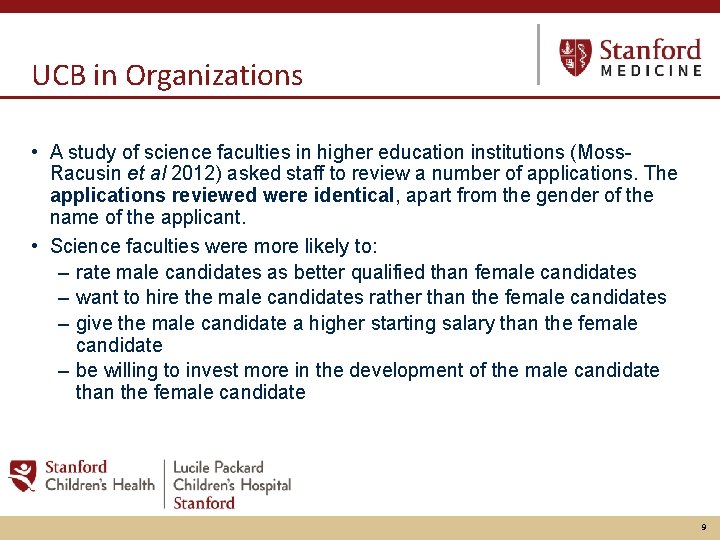
UCB in Organizations • A study of science faculties in higher education institutions (Moss- Racusin et al 2012) asked staff to review a number of applications. The applications reviewed were identical, apart from the gender of the name of the applicant. • Science faculties were more likely to: – rate male candidates as better qualified than female candidates – want to hire the male candidates rather than the female candidates – give the male candidate a higher starting salary than the female candidate – be willing to invest more in the development of the male candidate than the female candidate 9
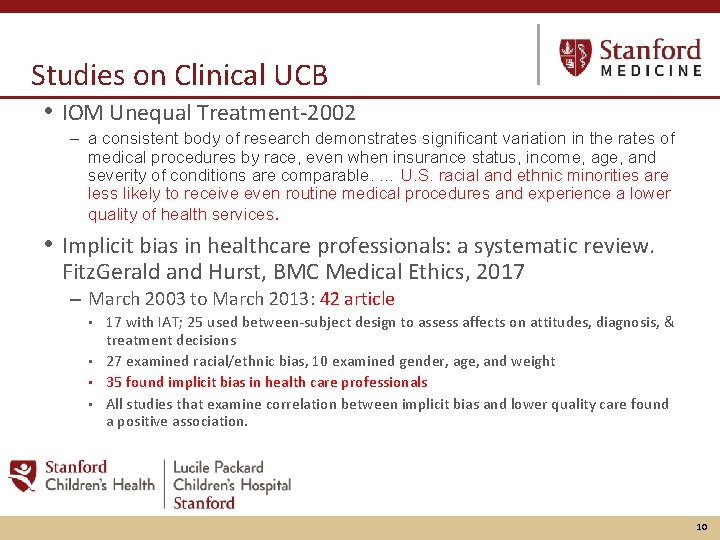
Studies on Clinical UCB • IOM Unequal Treatment-2002 – a consistent body of research demonstrates significant variation in the rates of medical procedures by race, even when insurance status, income, age, and severity of conditions are comparable. … U. S. racial and ethnic minorities are less likely to receive even routine medical procedures and experience a lower quality of health services. • Implicit bias in healthcare professionals: a systematic review. Fitz. Gerald and Hurst, BMC Medical Ethics, 2017 – March 2003 to March 2013: 42 article 17 with IAT; 25 used between-subject design to assess affects on attitudes, diagnosis, & treatment decisions • 27 examined racial/ethnic bias, 10 examined gender, age, and weight • 35 found implicit bias in health care professionals • All studies that examine correlation between implicit bias and lower quality care found a positive association. • 10
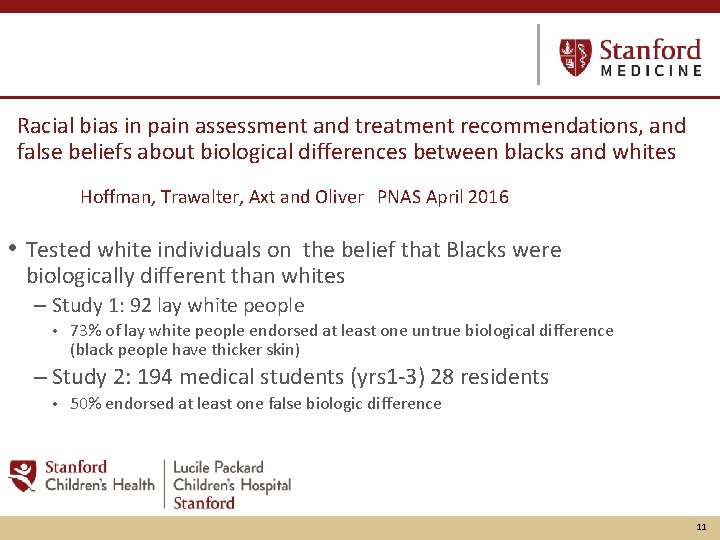
Racial bias in pain assessment and treatment recommendations, and false beliefs about biological differences between blacks and whites Hoffman, Trawalter, Axt and Oliver PNAS April 2016 • Tested white individuals on the belief that Blacks were biologically different than whites – Study 1: 92 lay white people • 73% of lay white people endorsed at least one untrue biological difference (black people have thicker skin) – Study 2: 194 medical students (yrs 1 -3) 28 residents • 50% endorsed at least one false biologic difference 11
Unconscious Bias and Faculty • OFDD UCB Training Opportunities – Cook Ross Seminars on Unconscious Bias – Unconscious Bias e-modules for faculty – Faculty search committee presentations – Partnership with MD Admissions – Department workshops and retreats 12
Unconscious Bias Education • Dean Taskforce on Diversity and Societal Citizenship (Mayes, Irvine, Osterberg, Mendoza) – Enhance the curriculum to promote societal citizenship and increase awareness of social determinants of health – Promote education of and reflection about current societal issues impacting health • TMA Innovation grant – An Educational Intervention Designed to Decrease Implicit Bias in the Practice of Medicine • OFDD – Cedar Interactive • Mendoza (COEDME) and Osterberg (E 4 C) 13
E 4 C Faculty development on cultural awareness and bias • Didactic on cultural awareness and Implicit Bias with 90 minute workshop (Summer 2016) • Faculty provided book: Blind Spot by Bahaji and Greenwald • Cultural Awareness and Bias in Clinical Settings (Summer 2017) – Faculty/residents/students helped create cases adapted from experiences – Case scenarios reviewed with focus on learning points from each case – Cases refined to highlight key points 14
Incorporating teaching on bias in our medical education curriculum as a thread • Doctors Roundtable I (year 1 students) – Implicit Bias and IAT introduced – Reflection with E 4 C faculty learning community groups • Doctors’ Roundtable II (year 2 students) – Small group session facilitated by Educators-4 -CARE faculty – Cultural Awareness and Bias in Clinical Settings- Five clinical scenarios with elements of bias introduced 15
Case Development and Creating Relevancy • Sought real case from students, residents, and faculty on conscious and unconscious bias in health care. – Race – Pain assessment – LGBTQ – rationalizing bias in health care – Bias against physician by patient’s parent – Personality difference linked with gender – Language – quality care vs. expediency – Spiritual care and religion 16
E 4 C UCB Education Faculty Manual Example: Scenario 1 • 18 -year-old African American male with severe abdominal pain • Vomiting; writhing in pain; with a fever to 101. 5 F. • Recent history of periumbilical pain with nausea and loss of appetite • Examination notable for abdominal tenderness 17
Some representative positive student feedback • “I enjoyed the interactive nature of the session, specifically the cases and associated discussions. This session helped add a lot of perspective to medicine and patient care for me. ” • “How to deal with racist patients because I think I will be having to deal with a lot of that” 18
Some representative corrective student feedback • “The online website scenarios for bias seemed very unrealistic and overdone, almost overemphasizing the bias. I think having training focused at more subtle forms of bias that we will encounter far more frequently would be appreciated. ” • “I did not feel that the tips we were given were realistic. Especially with regards to how we as medical students should handle when our attending physician does something that shows cultural/social bias. . . the responses given by the medical students in the scenarios were not realistic to how we as medical students would actually be able to speak to our attending physicians. ” 19
What worked well • Facilitator training and familiarity with materials • Small group setting with E 4 C learning communities • Promotion of a safe and positive learning environment • Scenarios prompted discussion • Sharing of personal experiences 20
What could be improved • Need to emphasize more subtle forms of bias • Dialogue and scenarios did not feel realistic to the medical students • Need for more practical strategies in confronting forms of bias that students feel they could use • Having facilitators or students talk more about personal experiences 21
- Slides: 21