
Unconformity An unconformity is a surface of erosion
- Slides: 26
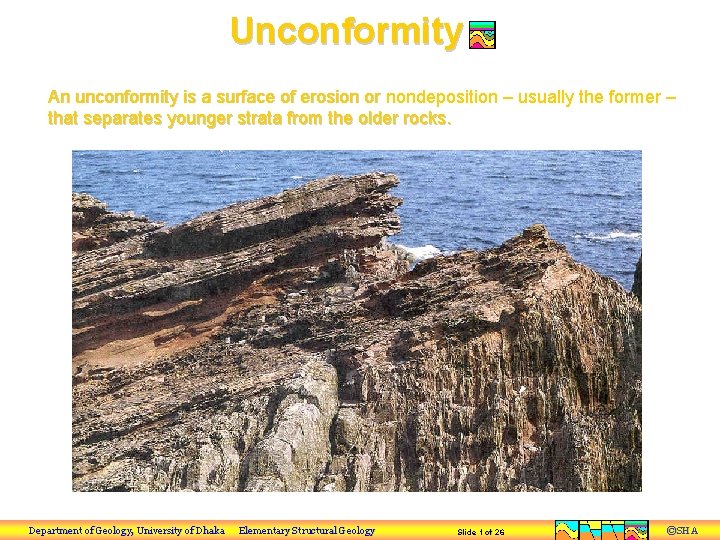
Unconformity An unconformity is a surface of erosion or nondeposition – usually the former – that separates younger strata from the older rocks. Department of Geology, University of Dhaka Elementary Structural Geology Slide 1 of 26 ©SHA
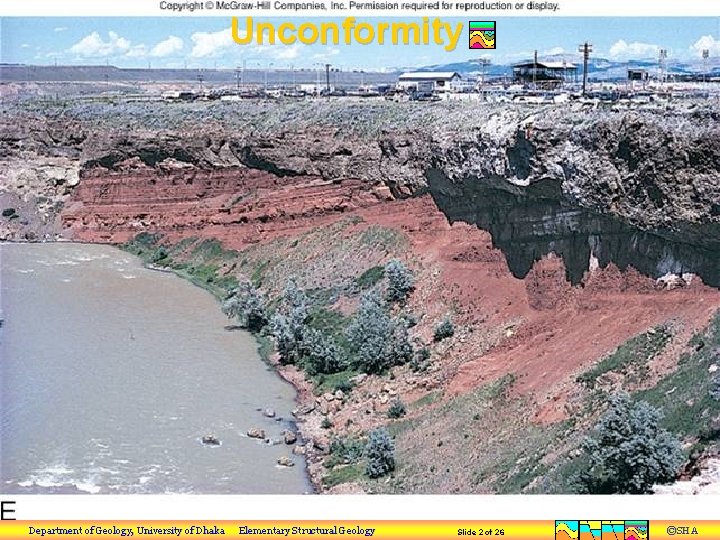
Unconformity Department of Geology, University of Dhaka Elementary Structural Geology Slide 2 of 26 ©SHA
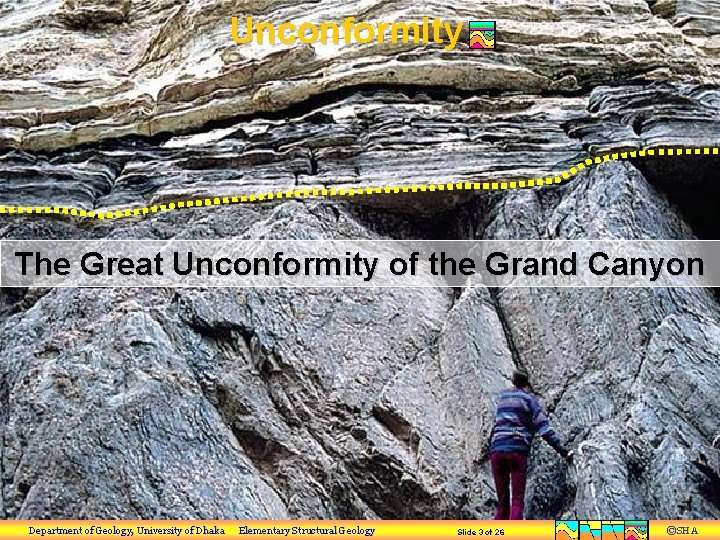
Unconformity The Great Unconformity of the Grand Canyon Department of Geology, University of Dhaka Elementary Structural Geology Slide 3 of 26 ©SHA
Unconformity • It is one of the most common geological feature found in rocks or in succession. • It is different than all other geological structures viz. the fold, joints and faults • Unconformities are resulted due to tectonic activity in form of uplift or subsidence of land • It is referred to a period of non-deposition Department of Geology, University of Dhaka Elementary Structural Geology Slide 4 of 26 ©SHA
Unconformity • The fundamental "laws" of stratigraphy, formulated in the 17 th Century by Nicolas Steno, is the law of Original Horizontality, which is known as Conformity • That is, any deposition when takes place is totally in horizontal fashion • Later due to tectonic movement the layers or beds are tilted (except in case of cross-bedding- which are formed under fluvial (riverine) or aeolian (wind) environment. Department of Geology, University of Dhaka Elementary Structural Geology Slide 5 of 26 ©SHA
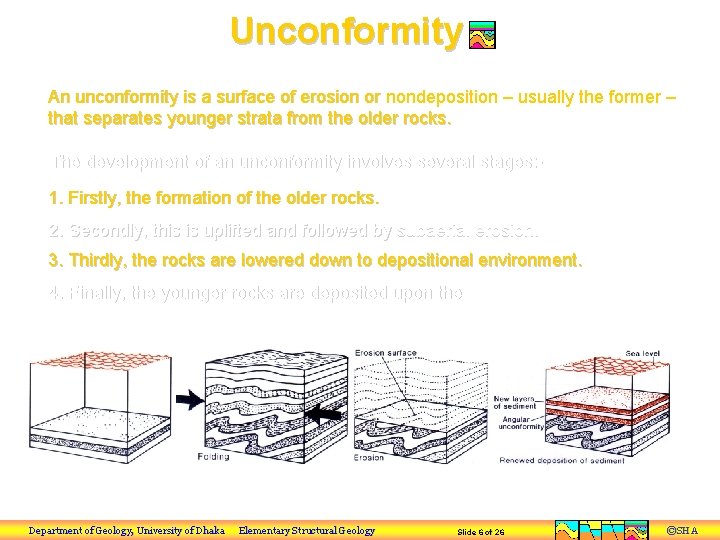
Unconformity An unconformity is a surface of erosion or nondeposition – usually the former – that separates younger strata from the older rocks. The development of an unconformity involves several stages: 1. Firstly, the formation of the older rocks. 2. Secondly, this is uplifted and followed by subaerial erosion. 3. Thirdly, the rocks are lowered down to depositional environment. 4. Finally, the younger rocks are deposited upon the erosional surface. Department of Geology, University of Dhaka Elementary Structural Geology Slide 6 of 26 ©SHA
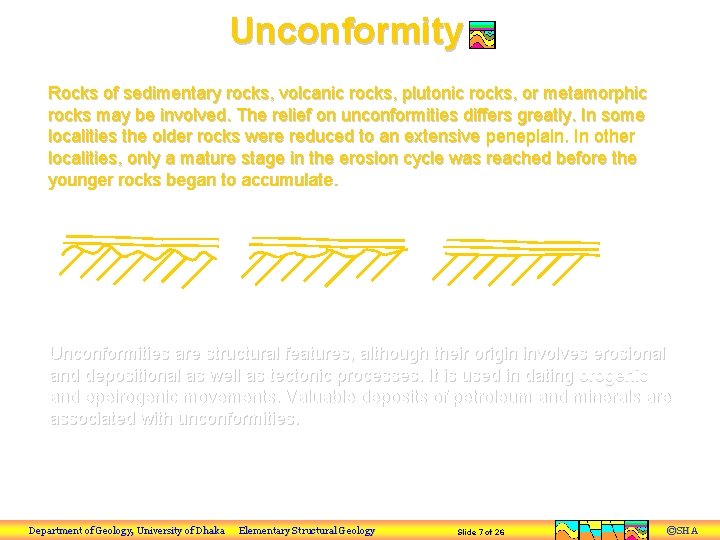
Unconformity Rocks of sedimentary rocks, volcanic rocks, plutonic rocks, or metamorphic rocks may be involved. The relief on unconformities differs greatly. In some localities the older rocks were reduced to an extensive peneplain. In other localities, only a mature stage in the erosion cycle was reached before the younger rocks began to accumulate. high relief low relief peneplain Unconformities are structural features, although their origin involves erosional and depositional as well as tectonic processes. It is used in dating orogenic and epeirogenic movements. Valuable deposits of petroleum and minerals are associated with unconformities. Department of Geology, University of Dhaka Elementary Structural Geology Slide 7 of 26 ©SHA
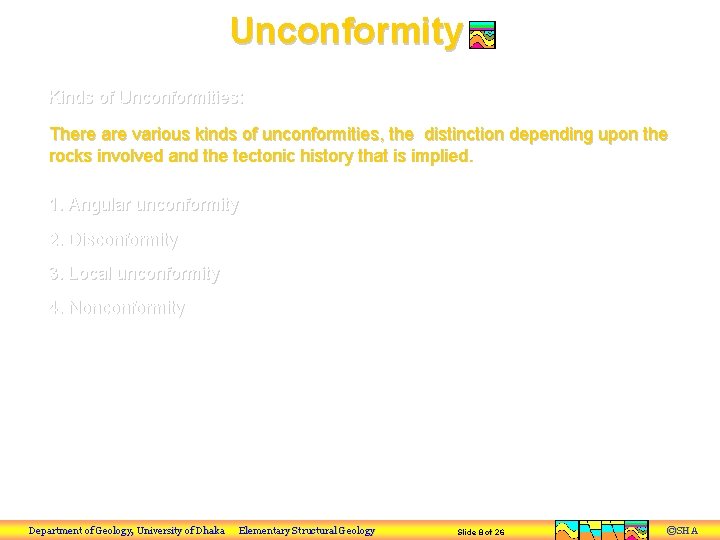
Unconformity Kinds of Unconformities: There are various kinds of unconformities, the distinction depending upon the rocks involved and the tectonic history that is implied. 1. Angular unconformity 2. Disconformity 3. Local unconformity 4. Nonconformity Department of Geology, University of Dhaka Elementary Structural Geology Slide 8 of 26 ©SHA
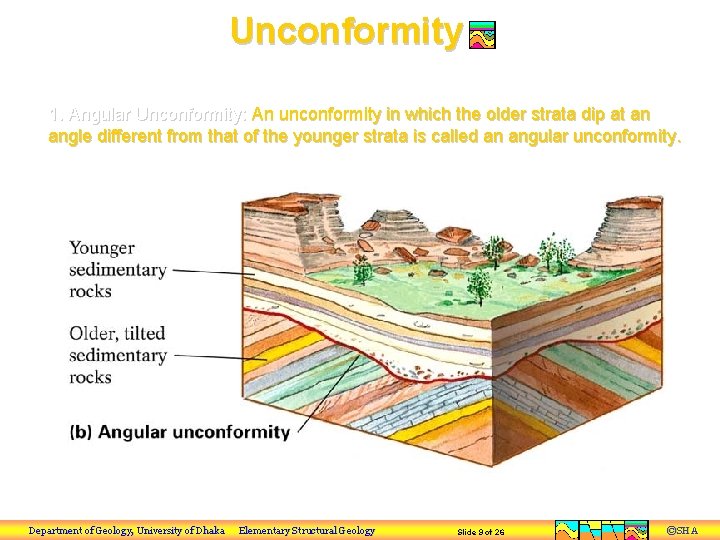
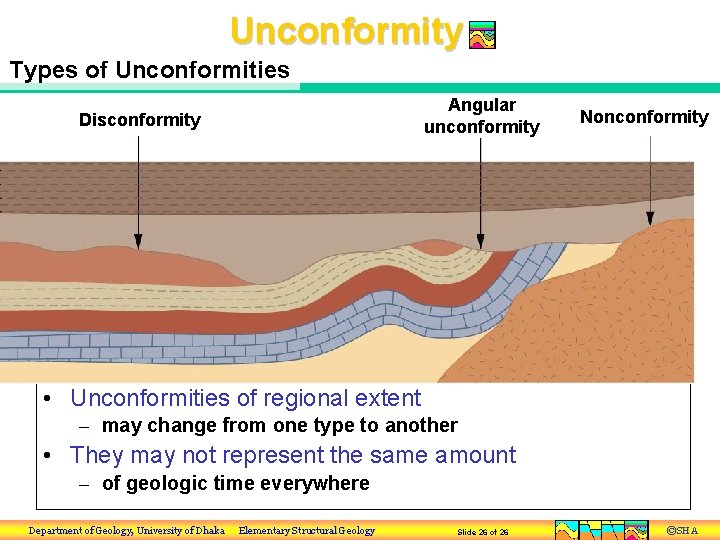
Unconformity 1. Angular Unconformity: An unconformity in which the older strata dip at an angle different from that of the younger strata is called an angular unconformity. Department of Geology, University of Dhaka Elementary Structural Geology Slide 9 of 26 ©SHA
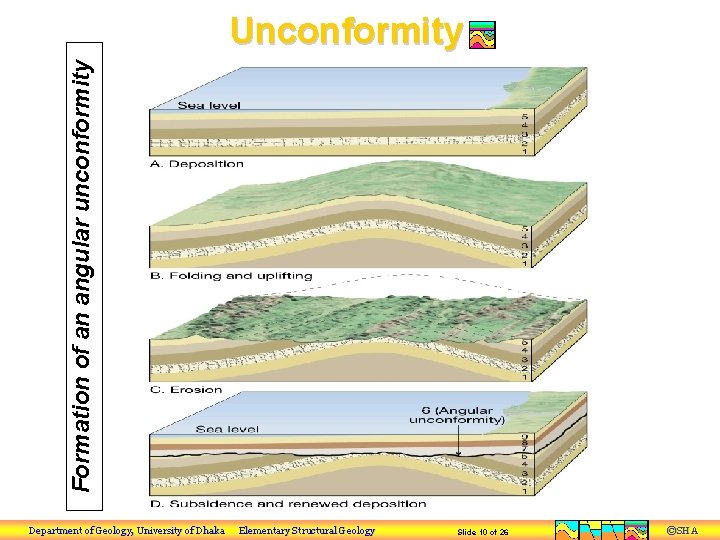
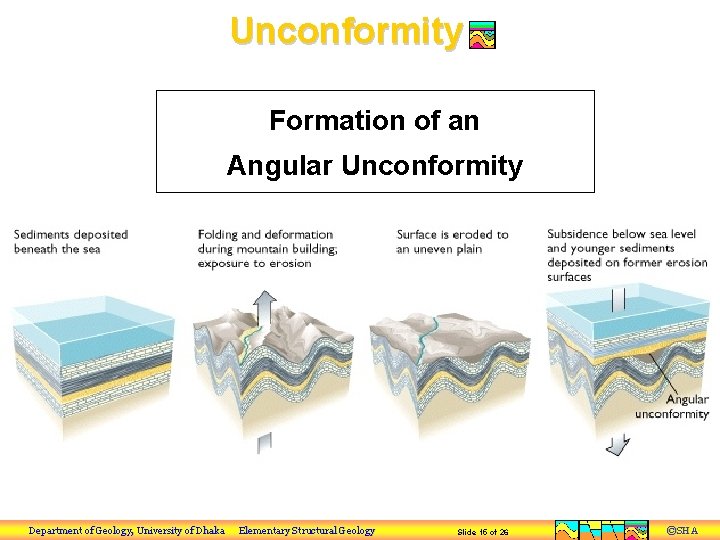
Formation of an angular unconformity Unconformity Department of Geology, University of Dhaka Elementary Structural Geology Slide 10 of 26 ©SHA
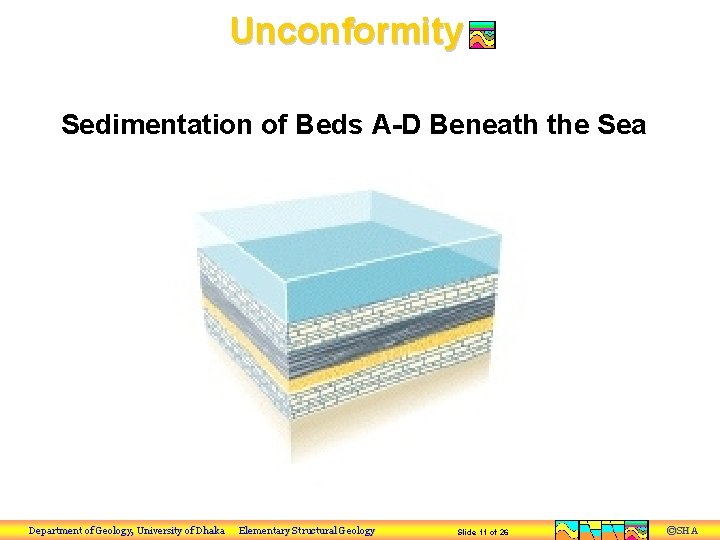
Unconformity Sedimentation of Beds A-D Beneath the Sea Department of Geology, University of Dhaka Elementary Structural Geology Slide 11 of 26 ©SHA
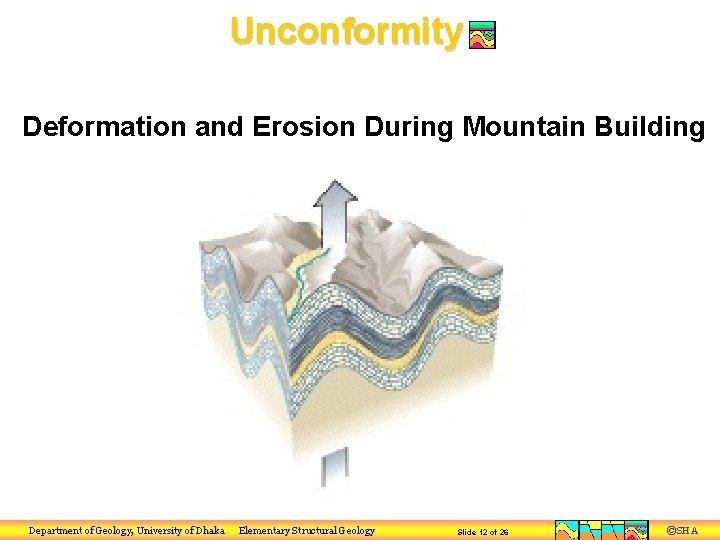
Unconformity Deformation and Erosion During Mountain Building Department of Geology, University of Dhaka Elementary Structural Geology Slide 12 of 26 ©SHA
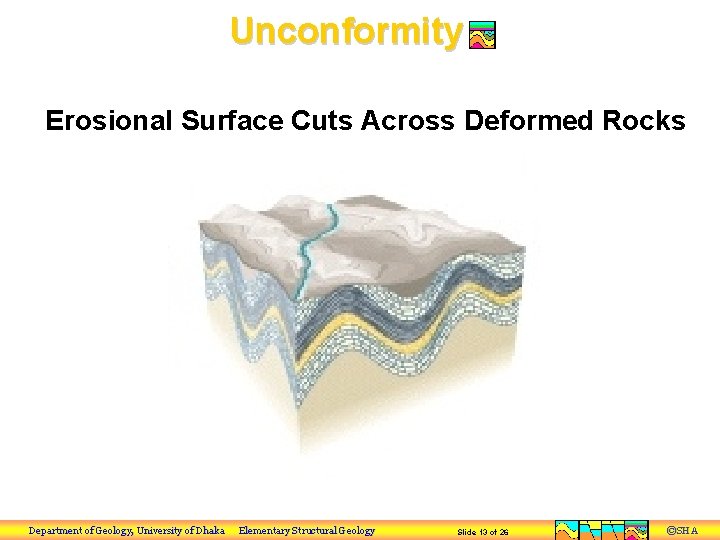
Unconformity Erosional Surface Cuts Across Deformed Rocks Department of Geology, University of Dhaka Elementary Structural Geology Slide 13 of 26 ©SHA
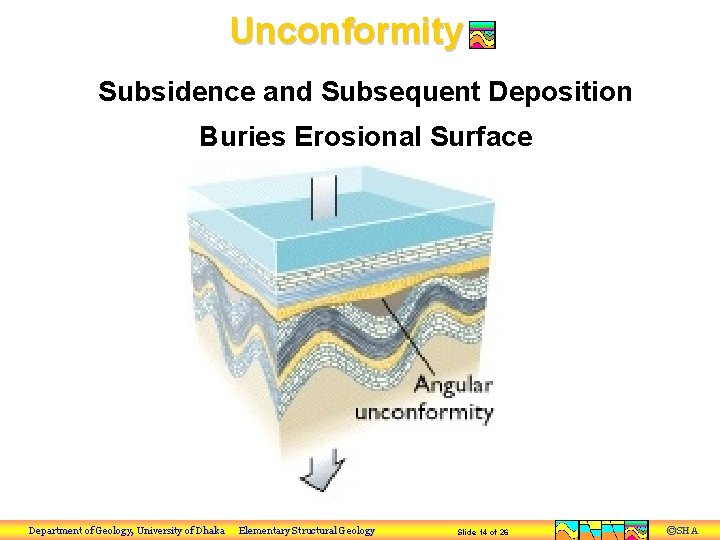
Unconformity Subsidence and Subsequent Deposition Buries Erosional Surface Department of Geology, University of Dhaka Elementary Structural Geology Slide 14 of 26 ©SHA
Unconformity Formation of an Angular Unconformity Department of Geology, University of Dhaka Elementary Structural Geology Slide 15 of 26 ©SHA
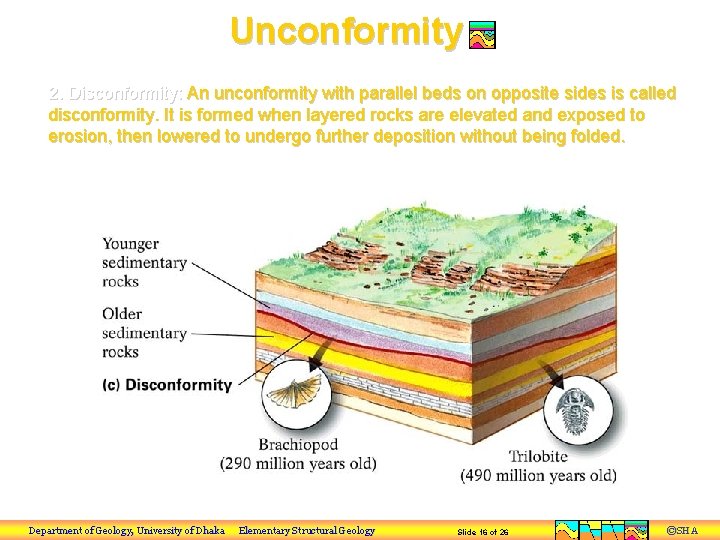
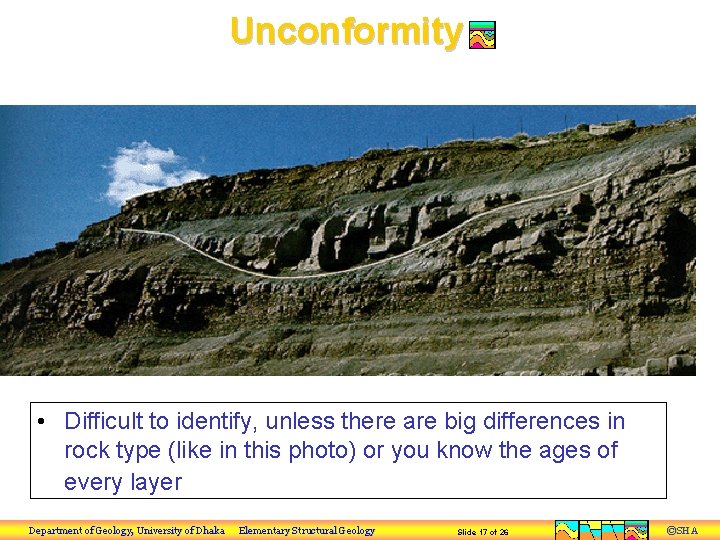
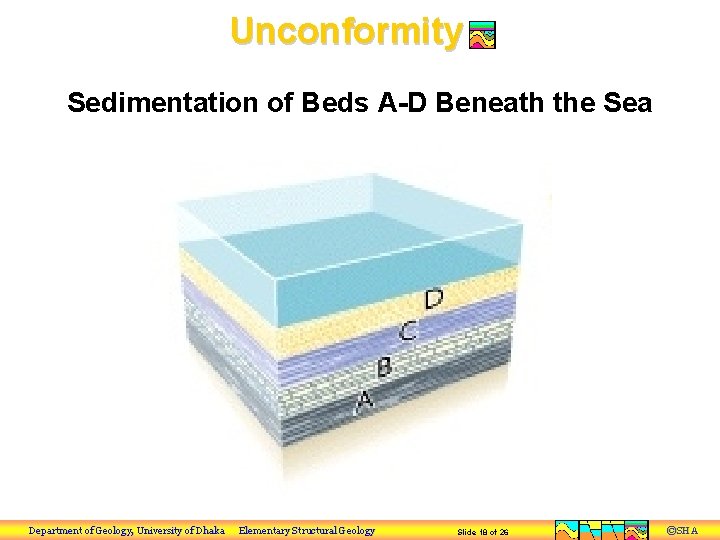
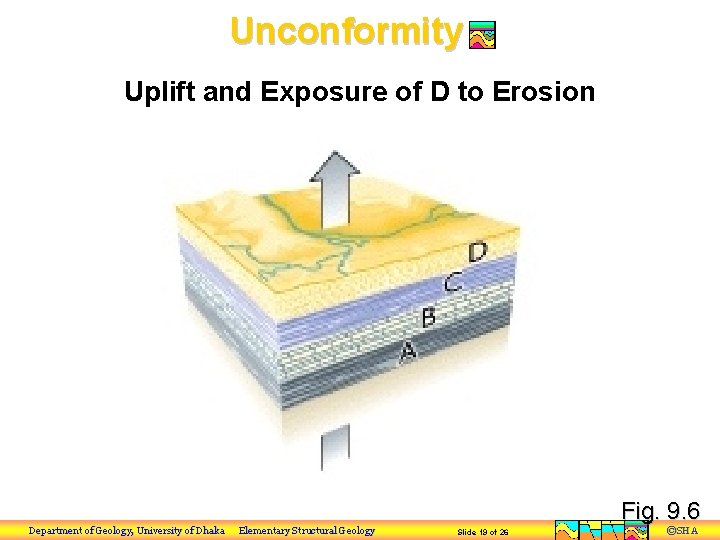
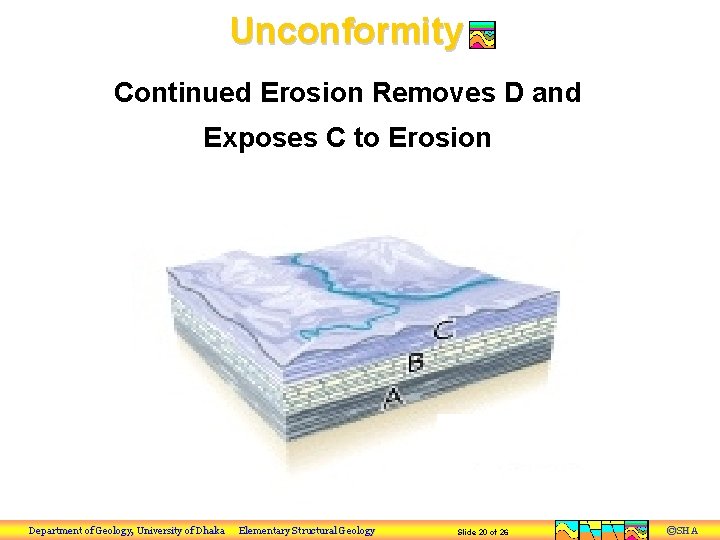
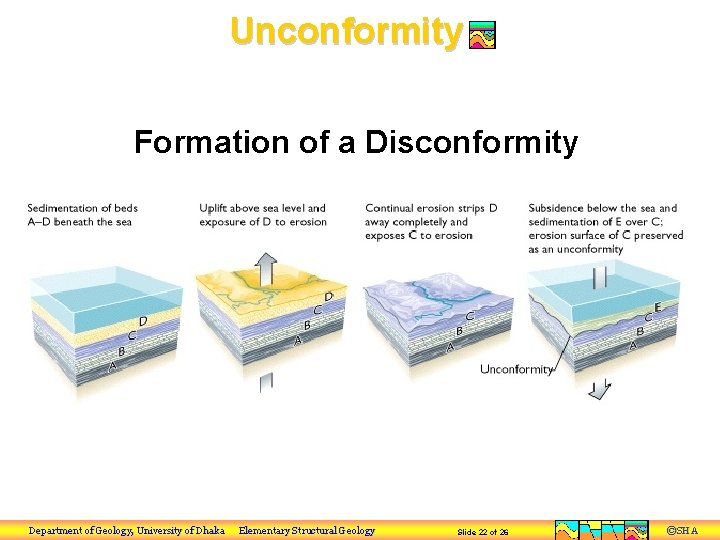
Unconformity 2. Disconformity: An unconformity with parallel beds on opposite sides is called disconformity. It is formed when layered rocks are elevated and exposed to erosion, then lowered to undergo further deposition without being folded. Department of Geology, University of Dhaka Elementary Structural Geology Slide 16 of 26 ©SHA
Unconformity • Difficult to identify, unless there are big differences in rock type (like in this photo) or you know the ages of every layer Department of Geology, University of Dhaka Elementary Structural Geology Slide 17 of 26 ©SHA
Unconformity Sedimentation of Beds A-D Beneath the Sea Department of Geology, University of Dhaka Elementary Structural Geology Slide 18 of 26 ©SHA
Unconformity Uplift and Exposure of D to Erosion Department of Geology, University of Dhaka Elementary Structural Geology Fig. 9. 6 Slide 19 of 26 ©SHA
Unconformity Continued Erosion Removes D and Exposes C to Erosion Department of Geology, University of Dhaka Elementary Structural Geology Slide 20 of 26 ©SHA
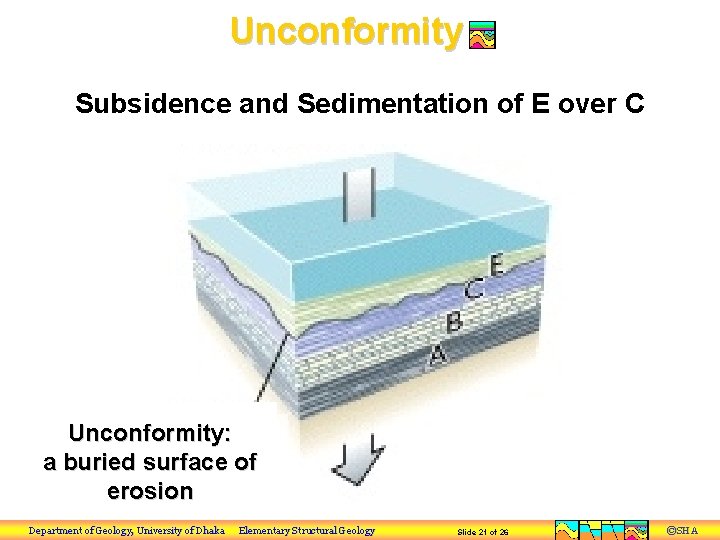
Unconformity Subsidence and Sedimentation of E over C Unconformity: a buried surface of erosion Department of Geology, University of Dhaka Elementary Structural Geology Slide 21 of 26 ©SHA
Unconformity Formation of a Disconformity Department of Geology, University of Dhaka Elementary Structural Geology Slide 22 of 26 ©SHA
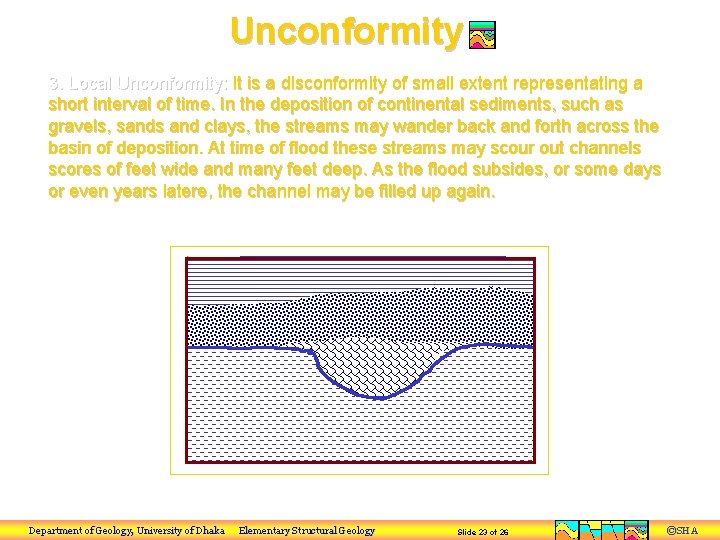
Unconformity 3. Local Unconformity: It is a disconformity of small extent representating a short interval of time. In the deposition of continental sediments, such as gravels, sands and clays, the streams may wander back and forth across the basin of deposition. At time of flood these streams may scour out channels scores of feet wide and many feet deep. As the flood subsides, or some days or even years latere, the channel may be filled up again. Department of Geology, University of Dhaka Elementary Structural Geology Slide 23 of 26 ©SHA
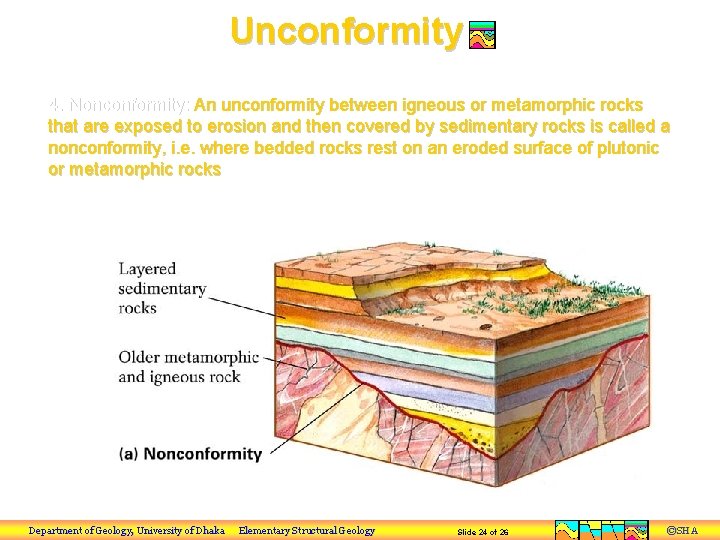
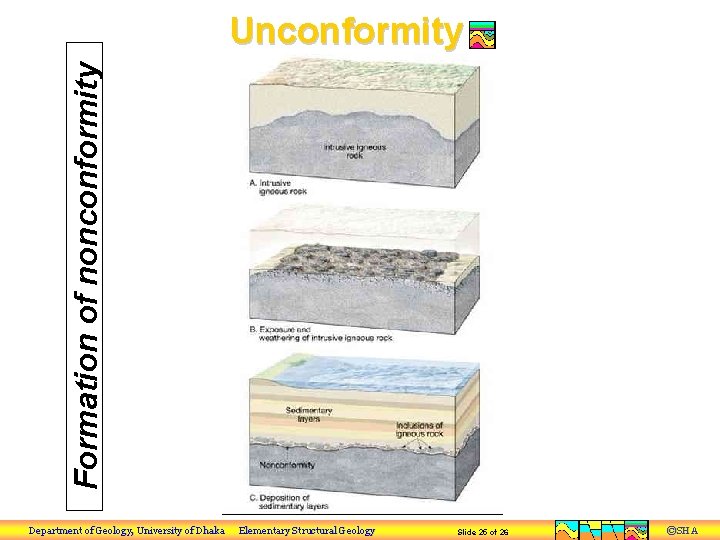
Unconformity 4. Nonconformity: An unconformity between igneous or metamorphic rocks that are exposed to erosion and then covered by sedimentary rocks is called a nonconformity, i. e. where bedded rocks rest on an eroded surface of plutonic or metamorphic rocks Department of Geology, University of Dhaka Elementary Structural Geology Slide 24 of 26 ©SHA
Formation of nonconformity Unconformity Department of Geology, University of Dhaka Elementary Structural Geology Slide 25 of 26 ©SHA
Unconformity Types of Unconformities Angular unconformity Disconformity Nonconformity • Unconformities of regional extent – may change from one type to another • They may not represent the same amount – of geologic time everywhere Department of Geology, University of Dhaka Elementary Structural Geology Slide 26 of 26 ©SHA