
UNCLASSIFIED The Role of Cold Plasma Density in
- Slides: 29
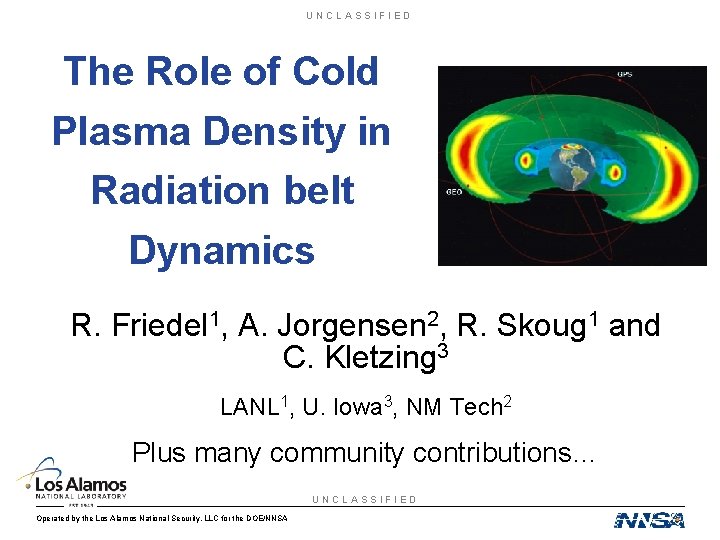
UNCLASSIFIED The Role of Cold Plasma Density in Radiation belt Dynamics R. Friedel 1, A. Jorgensen 2, R. Skoug 1 and C. Kletzing 3 LANL 1, U. Iowa 3, NM Tech 2 Plus many community contributions… UNCLASSIFIED Operated by the Los Alamos National Security, LLC for the DOE/NNSA
10 th European Space Weather Week Antwerp, November 2013 UNCLASSIFIED Contents • “Once upon a time in the radiation belts” – – – Brief History Current Status Dynamics • Inner radiation Belt WP modeling approaches – – – Classes of Models Diffusion coefficient calculations Limits of pure diffusion codes • Role of Proxies – – Background electron density proxy LEO Wave proxy • Summary • Simulation example using proxies (Oct 2012 Storm UNCLASSIFIED Operated by the Los Alamos National Security, LLC for the DOE/NNSA Slide 2 of 29
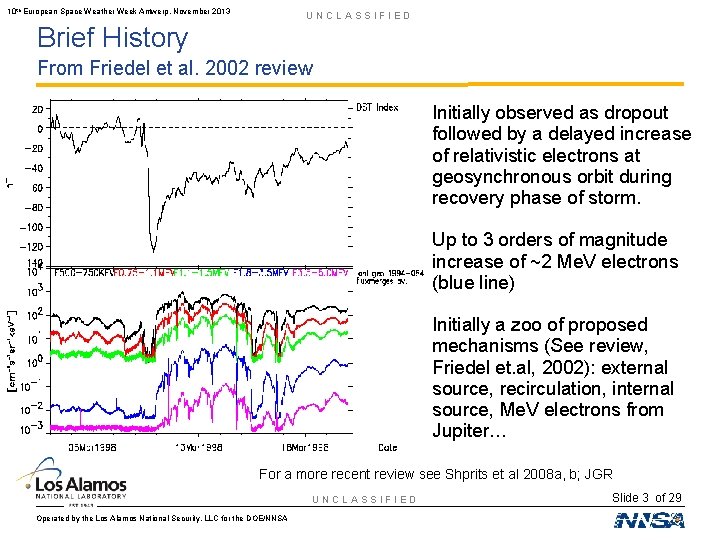
10 th European Space Weather Week Antwerp, November 2013 UNCLASSIFIED Brief History From Friedel et al. 2002 review Initially observed as dropout followed by a delayed increase of relativistic electrons at geosynchronous orbit during recovery phase of storm. Up to 3 orders of magnitude increase of ~2 Me. V electrons (blue line) Initially a zoo of proposed mechanisms (See review, Friedel et. al, 2002): external source, recirculation, internal source, Me. V electrons from Jupiter… For a more recent review see Shprits et al 2008 a, b; JGR UNCLASSIFIED Operated by the Los Alamos National Security, LLC for the DOE/NNSA Slide 3 of 29
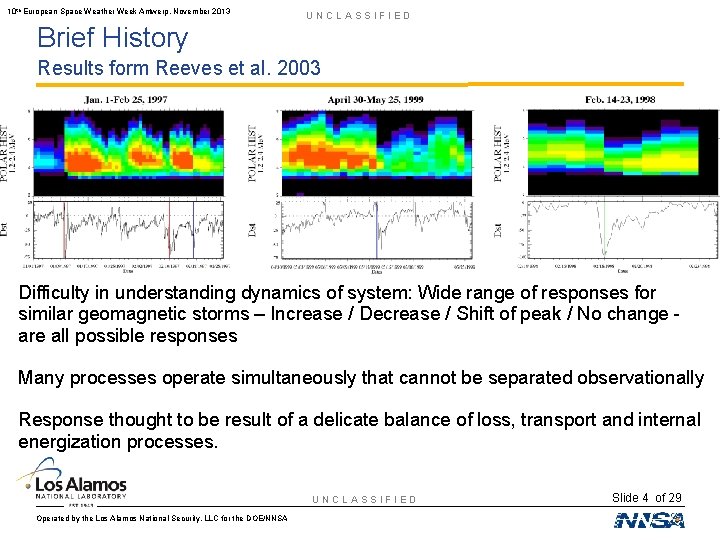
10 th European Space Weather Week Antwerp, November 2013 UNCLASSIFIED Brief History Results form Reeves et al. 2003 Difficulty in understanding dynamics of system: Wide range of responses for similar geomagnetic storms – Increase / Decrease / Shift of peak / No change are all possible responses Many processes operate simultaneously that cannot be separated observationally Response thought to be result of a delicate balance of loss, transport and internal energization processes. UNCLASSIFIED Operated by the Los Alamos National Security, LLC for the DOE/NNSA Slide 4 of 29
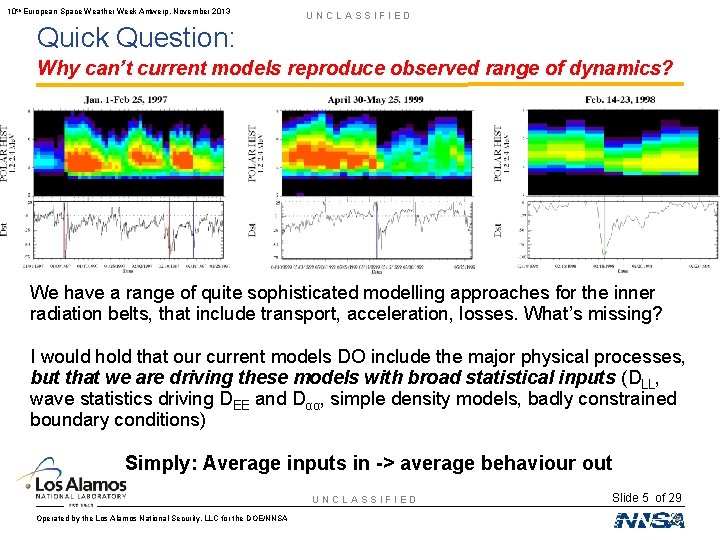
10 th European Space Weather Week Antwerp, November 2013 UNCLASSIFIED Quick Question: Why can’t current models reproduce observed range of dynamics? We have a range of quite sophisticated modelling approaches for the inner radiation belts, that include transport, acceleration, losses. What’s missing? I would hold that our current models DO include the major physical processes, but that we are driving these models with broad statistical inputs (DLL, wave statistics driving DEE and Dαα, simple density models, badly constrained boundary conditions) Simply: Average inputs in -> average behaviour out UNCLASSIFIED Operated by the Los Alamos National Security, LLC for the DOE/NNSA Slide 5 of 29
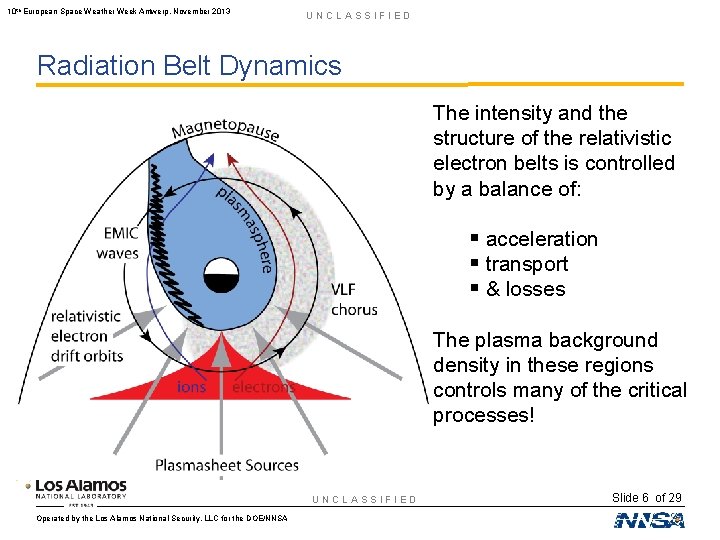
10 th European Space Weather Week Antwerp, November 2013 UNCLASSIFIED Radiation Belt Dynamics The intensity and the structure of the relativistic electron belts is controlled by a balance of: § acceleration § transport § & losses The plasma background density in these regions controls many of the critical processes! UNCLASSIFIED Operated by the Los Alamos National Security, LLC for the DOE/NNSA Slide 6 of 29
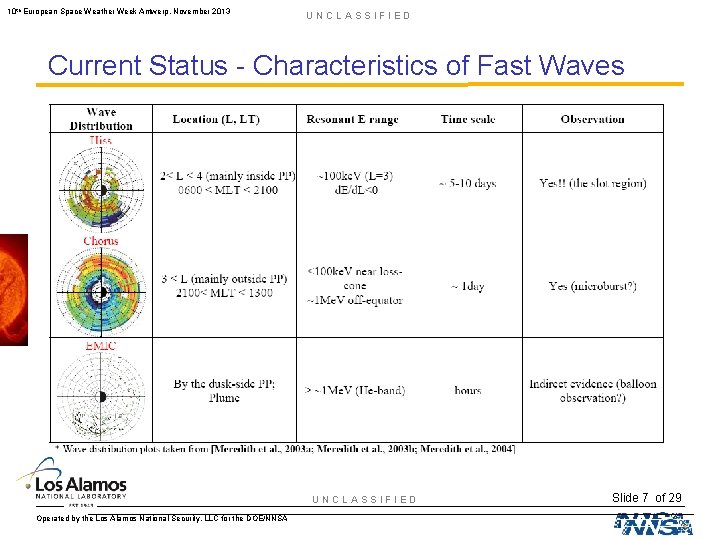
10 th European Space Weather Week Antwerp, November 2013 UNCLASSIFIED Current Status - Characteristics of Fast Waves UNCLASSIFIED Operated by the Los Alamos National Security, LLC for the DOE/NNSA Slide 7 of 29
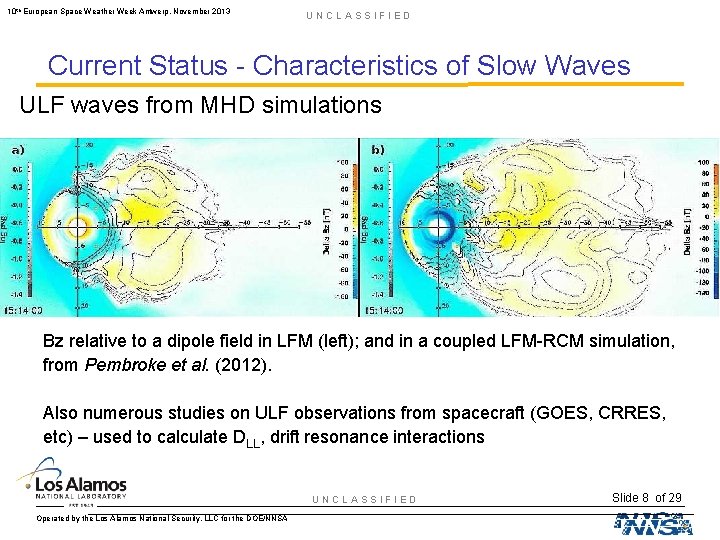
10 th European Space Weather Week Antwerp, November 2013 UNCLASSIFIED Current Status - Characteristics of Slow Waves ULF waves from MHD simulations Bz relative to a dipole field in LFM (left); and in a coupled LFM-RCM simulation, from Pembroke et al. (2012). Also numerous studies on ULF observations from spacecraft (GOES, CRRES, etc) – used to calculate DLL, drift resonance interactions UNCLASSIFIED Operated by the Los Alamos National Security, LLC for the DOE/NNSA Slide 8 of 29
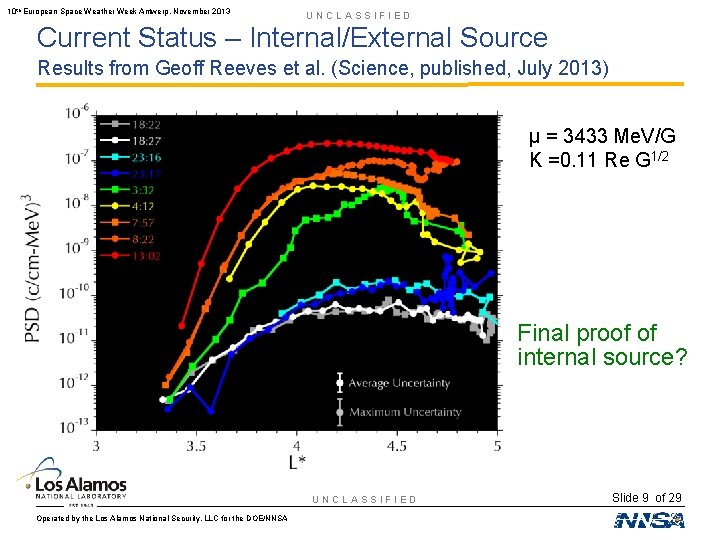
10 th European Space Weather Week Antwerp, November 2013 UNCLASSIFIED Current Status – Internal/External Source Results from Geoff Reeves et al. (Science, published, July 2013) μ = 3433 Me. V/G K =0. 11 Re G 1/2 Final proof of internal source? UNCLASSIFIED Operated by the Los Alamos National Security, LLC for the DOE/NNSA Slide 9 of 29
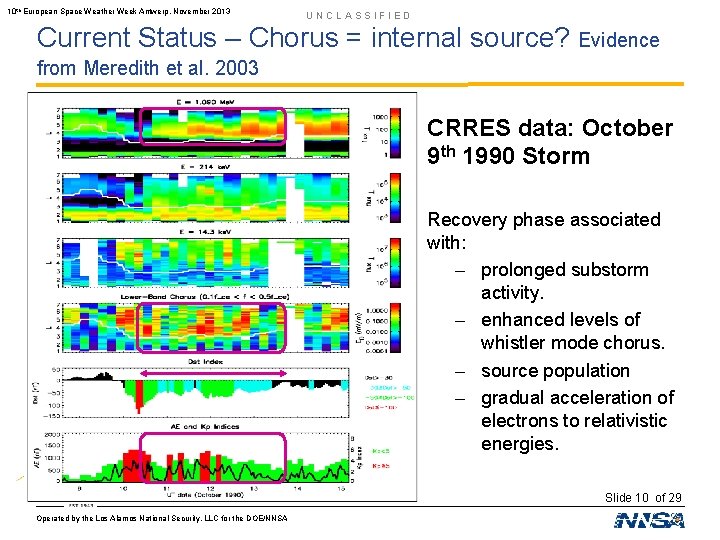
10 th European Space Weather Week Antwerp, November 2013 UNCLASSIFIED Current Status – Chorus = internal source? Evidence from Meredith et al. 2003 CRRES data: October 9 th 1990 Storm Recovery phase associated with: – prolonged substorm activity. – enhanced levels of whistler mode chorus. – source population – gradual acceleration of electrons to relativistic energies. UNCLASSIFIED Operated by the Los Alamos National Security, LLC for the DOE/NNSA Slide 10 of 29
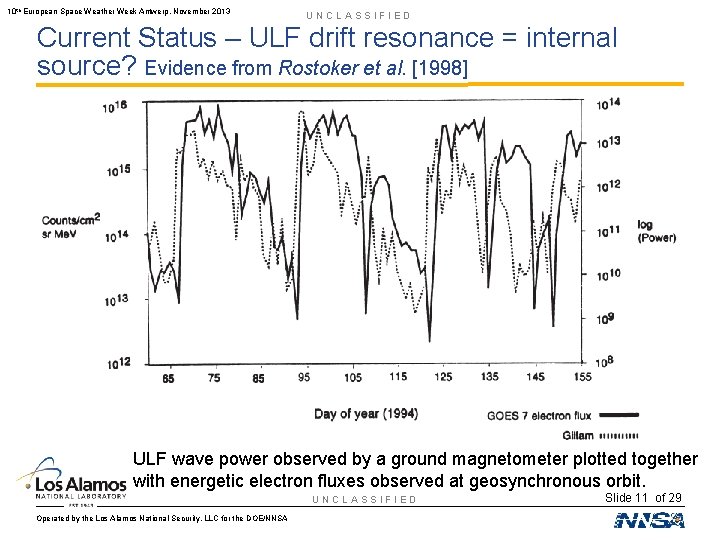
10 th European Space Weather Week Antwerp, November 2013 UNCLASSIFIED Current Status – ULF drift resonance = internal source? Evidence from Rostoker et al. [1998] ULF wave power observed by a ground magnetometer plotted together with energetic electron fluxes observed at geosynchronous orbit. UNCLASSIFIED Operated by the Los Alamos National Security, LLC for the DOE/NNSA Slide 11 of 29
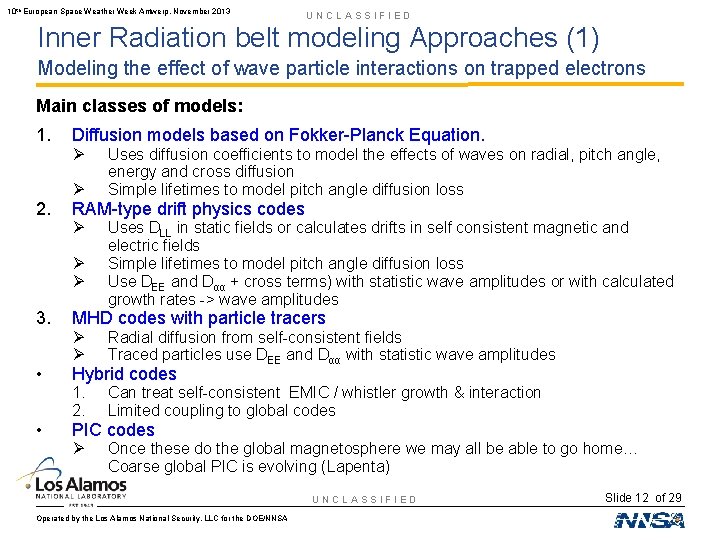
10 th European Space Weather Week Antwerp, November 2013 UNCLASSIFIED Inner Radiation belt modeling Approaches (1) Modeling the effect of wave particle interactions on trapped electrons Main classes of models: 1. 2. Diffusion models based on Fokker-Planck Equation. Ø Ø Uses diffusion coefficients to model the effects of waves on radial, pitch angle, energy and cross diffusion Simple lifetimes to model pitch angle diffusion loss RAM-type drift physics codes Ø Ø Ø Uses DLL in static fields or calculates drifts in self consistent magnetic and electric fields Simple lifetimes to model pitch angle diffusion loss Use DEE and Dαα + cross terms) with statistic wave amplitudes or with calculated growth rates -> wave amplitudes 3. MHD codes with particle tracers • Hybrid codes • Ø Ø Radial diffusion from self-consistent fields Traced particles use DEE and Dαα with statistic wave amplitudes 1. 2. Can treat self-consistent EMIC / whistler growth & interaction Limited coupling to global codes Ø Once these do the global magnetosphere we may all be able to go home… Coarse global PIC is evolving (Lapenta) PIC codes UNCLASSIFIED Operated by the Los Alamos National Security, LLC for the DOE/NNSA Slide 12 of 29
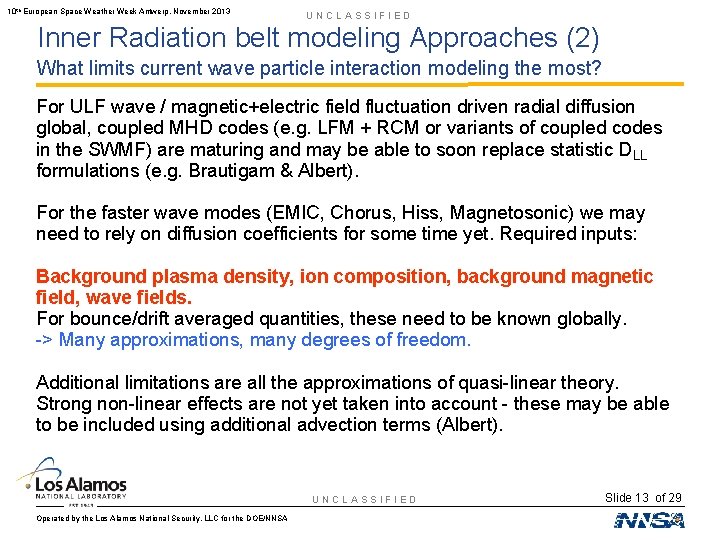
10 th European Space Weather Week Antwerp, November 2013 UNCLASSIFIED Inner Radiation belt modeling Approaches (2) What limits current wave particle interaction modeling the most? For ULF wave / magnetic+electric field fluctuation driven radial diffusion global, coupled MHD codes (e. g. LFM + RCM or variants of coupled codes in the SWMF) are maturing and may be able to soon replace statistic DLL formulations (e. g. Brautigam & Albert). For the faster wave modes (EMIC, Chorus, Hiss, Magnetosonic) we may need to rely on diffusion coefficients for some time yet. Required inputs: Background plasma density, ion composition, background magnetic field, wave fields. For bounce/drift averaged quantities, these need to be known globally. -> Many approximations, many degrees of freedom. Additional limitations are all the approximations of quasi-linear theory. Strong non-linear effects are not yet taken into account - these may be able to be included using additional advection terms (Albert). UNCLASSIFIED Operated by the Los Alamos National Security, LLC for the DOE/NNSA Slide 13 of 29
10 th European Space Weather Week Antwerp, November 2013 UNCLASSIFIED Inner Radiation belt modeling Approaches (3) Diffusion coefficient calculation (Glauert et al, Summers et al, Albert etc) Diffusion coefficient calculations based on quasi-linear theory are computationally expensive and the community has spent a lot of effort to perform these calculations with varying degrees of approximations: For background environmental conditions: - - Dipole magnetic field Some dynamic field models Simple background density models – affect resonance conditions and wave propagation Simple ion composition models For the waves: - First order resonances only Parallel propagation of waves only Assumed k-distribution of waves (guided by data) Assumed frequency distribution of waves (guided by data) Fixed K-distribution along field lines No feedback of particles on waves, no damping Currently parameterized by wave power only UNCLASSIFIED Operated by the Los Alamos National Security, LLC for the DOE/NNSA For global wave power distribution: - We never have global insitu wave data Simple statistics based on geomagnetic activity indices Assumes instantaneous MLT distribution = statistical MLT distribution Slide 14 of 29
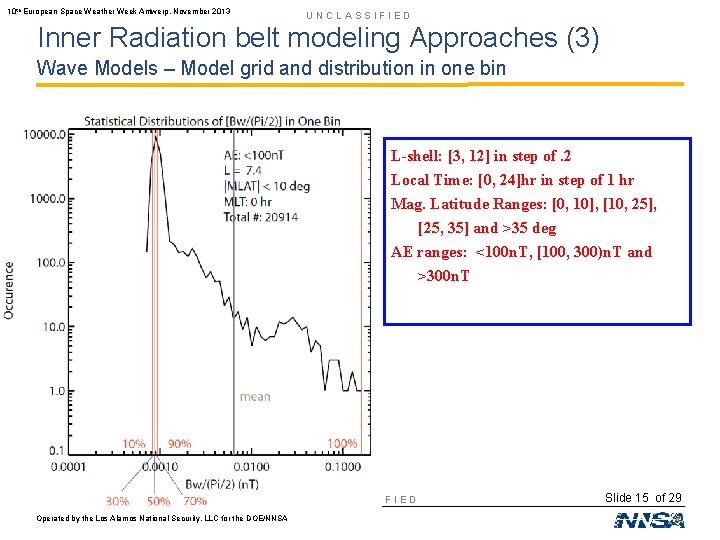
10 th European Space Weather Week Antwerp, November 2013 UNCLASSIFIED Inner Radiation belt modeling Approaches (3) Wave Models – Model grid and distribution in one bin L-shell: [3, 12] in step of. 2 Local Time: [0, 24]hr in step of 1 hr Mag. Latitude Ranges: [0, 10], [10, 25], [25, 35] and >35 deg AE ranges: <100 n. T, [100, 300)n. T and >300 n. T UNCLASSIFIED Operated by the Los Alamos National Security, LLC for the DOE/NNSA Slide 15 of 29
10 th European Space Weather Week Antwerp, November 2013 UNCLASSIFIED Specifying needed inputs for wave-particle interaction modeling through proxies • Space Physics abounds in the use of proxies, e. g. Dst for the ring current, AE for the electrojet currents, ABI (auroral boundary index from DMSP) for auroral activity, etc… • Advantages: Cheap, often based on simple instrumentation, ground based or based on programmatic missions, can be global and available 24/7, long term availability. Can form a reliable operational input to radiation belt models. • Disadvantages: Often coarse (integrative), may respond to multiple physical processes, mapping to high altitude magnetosphere often problematic. UNCLASSIFIED Operated by the Los Alamos National Security, LLC for the DOE/NNSA Slide 16 of 29
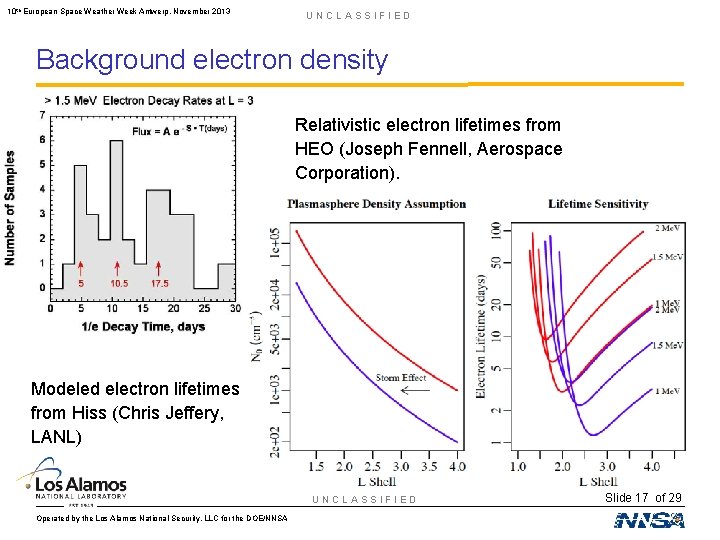
10 th European Space Weather Week Antwerp, November 2013 UNCLASSIFIED Background electron density Relativistic electron lifetimes from HEO (Joseph Fennell, Aerospace Corporation). Modeled electron lifetimes from Hiss (Chris Jeffery, LANL) UNCLASSIFIED Operated by the Los Alamos National Security, LLC for the DOE/NNSA Slide 17 of 29
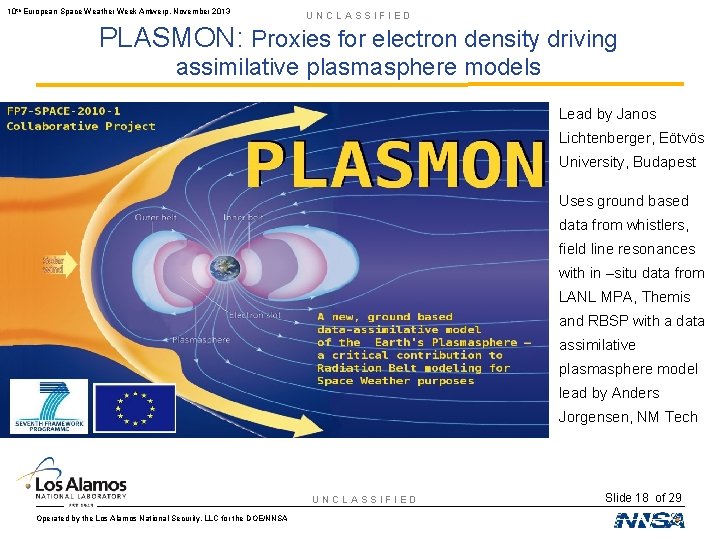
10 th European Space Weather Week Antwerp, November 2013 UNCLASSIFIED PLASMON: Proxies for electron density driving assimilative plasmasphere models Lead by Janos Lichtenberger, Eötvös University, Budapest Uses ground based data from whistlers, field line resonances with in –situ data from LANL MPA, Themis and RBSP with a data assimilative plasmasphere model lead by Anders Jorgensen, NM Tech UNCLASSIFIED Operated by the Los Alamos National Security, LLC for the DOE/NNSA Slide 18 of 29
10 th European Space Weather Week Antwerp, November 2013 UNCLASSIFIED Van Allen Probes Mission: EMFISIS Density • Density is determined from the upper hybrid line or continuum cutoff depending on region. • Standard cadence is one measurement every six seconds. • Process is being automated, but still requires significant manual checking. • Level 4 public is expected to be available in the next few months on a regular basis. • Requests for density data should be sent to Bill Kurth with copy to Craig Kletzing. • Have constructed a list of of PLASMON whistler station data during conjunctions with RBSP spacecraft which is being submitted to EMFISIS team. UNCLASSIFIED Operated by the Los Alamos National Security, LLC for the DOE/NNSA Slide 19 of 29
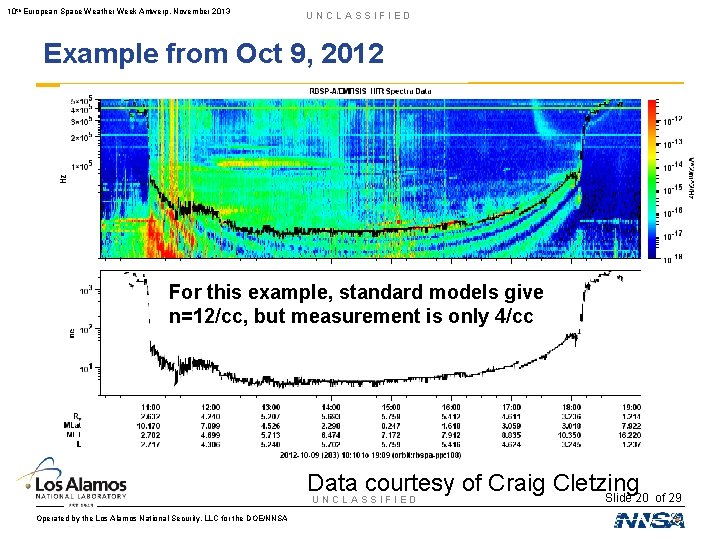
10 th European Space Weather Week Antwerp, November 2013 UNCLASSIFIED Example from Oct 9, 2012 For this example, standard models give n=12/cc, but measurement is only 4/cc Data courtesy of Craig Cletzing Slide 20 of 29 UNCLASSIFIED Operated by the Los Alamos National Security, LLC for the DOE/NNSA
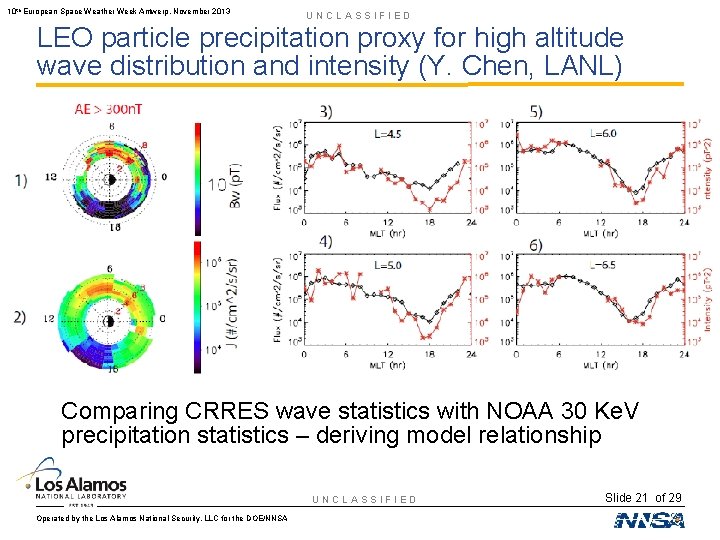
10 th European Space Weather Week Antwerp, November 2013 UNCLASSIFIED LEO particle precipitation proxy for high altitude wave distribution and intensity (Y. Chen, LANL) Comparing CRRES wave statistics with NOAA 30 Ke. V precipitation statistics – deriving model relationship UNCLASSIFIED Operated by the Los Alamos National Security, LLC for the DOE/NNSA Slide 21 of 29
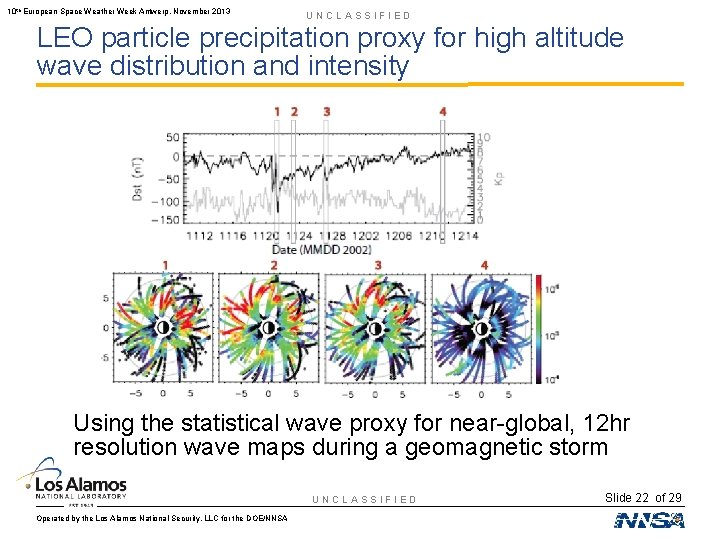
10 th European Space Weather Week Antwerp, November 2013 UNCLASSIFIED LEO particle precipitation proxy for high altitude wave distribution and intensity Using the statistical wave proxy for near-global, 12 hr resolution wave maps during a geomagnetic storm UNCLASSIFIED Operated by the Los Alamos National Security, LLC for the DOE/NNSA Slide 22 of 29
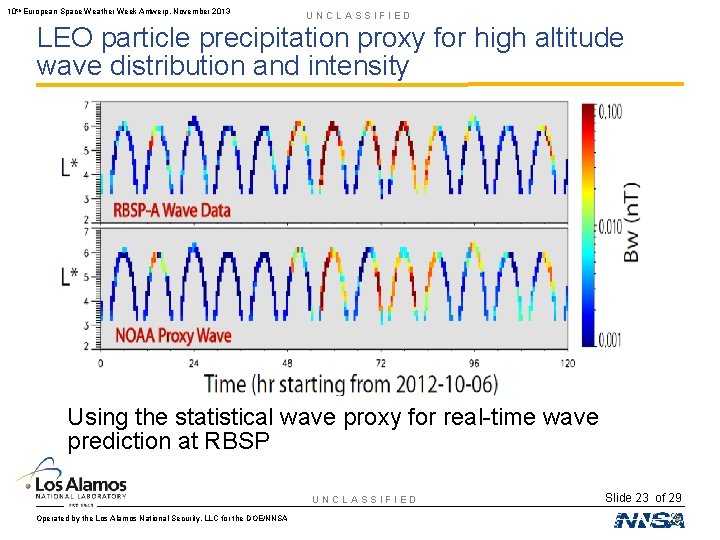
10 th European Space Weather Week Antwerp, November 2013 UNCLASSIFIED LEO particle precipitation proxy for high altitude wave distribution and intensity Using the statistical wave proxy for real-time wave prediction at RBSP UNCLASSIFIED Operated by the Los Alamos National Security, LLC for the DOE/NNSA Slide 23 of 29
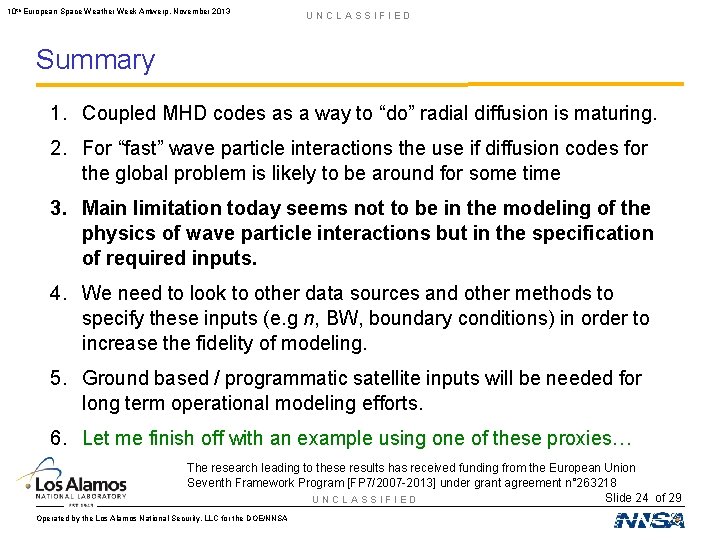
10 th European Space Weather Week Antwerp, November 2013 UNCLASSIFIED Summary 1. Coupled MHD codes as a way to “do” radial diffusion is maturing. 2. For “fast” wave particle interactions the use if diffusion codes for the global problem is likely to be around for some time 3. Main limitation today seems not to be in the modeling of the physics of wave particle interactions but in the specification of required inputs. 4. We need to look to other data sources and other methods to specify these inputs (e. g n, BW, boundary conditions) in order to increase the fidelity of modeling. 5. Ground based / programmatic satellite inputs will be needed for long term operational modeling efforts. 6. Let me finish off with an example using one of these proxies… The research leading to these results has received funding from the European Union Seventh Framework Program [FP 7/2007 -2013] under grant agreement n° 263218 Slide 24 of 29 UNCLASSIFIED Operated by the Los Alamos National Security, LLC for the DOE/NNSA
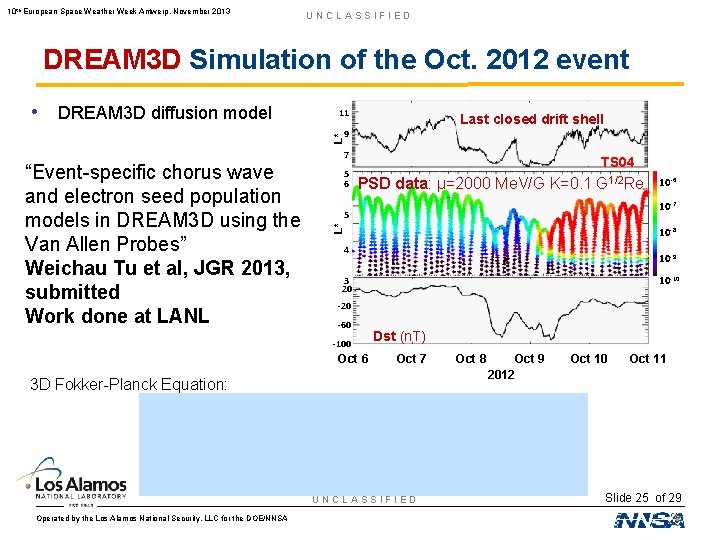
10 th European Space Weather Week Antwerp, November 2013 UNCLASSIFIED DREAM 3 D Simulation of the Oct. 2012 event • DREAM 3 D diffusion model 11 Last closed drift shell L* 9 7 5 6 TS 04 PSD data: µ=2000 Me. V/G K=0. 1 G 1/2 Re 10 -8 4 10 -9 10 -10 3 20 -60 -100 Oct 6 Dst (n. T) Oct 7 Oct 8 Oct 9 Oct 10 Oct 11 2012 3 D Fokker-Planck Equation: UNCLASSIFIED Operated by the Los Alamos National Security, LLC for the DOE/NNSA 10 -6 10 -7 5 L* “Event-specific chorus wave and electron seed population models in DREAM 3 D using the Van Allen Probes” Weichau Tu et al, JGR 2013, submitted Work done at LANL Slide 25 of 29
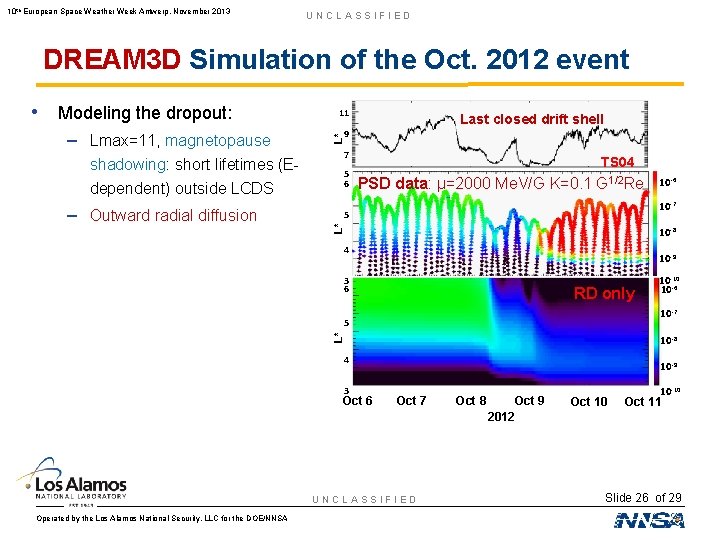
10 th European Space Weather Week Antwerp, November 2013 UNCLASSIFIED DREAM 3 D Simulation of the Oct. 2012 event shadowing: short lifetimes (Edependent) outside LCDS – Outward radial diffusion Last closed drift shell 9 L* – Lmax=11, magnetopause 11 7 5 6 TS 04 PSD data: µ=2000 Me. V/G K=0. 1 G 1/2 Re 10 -6 10 -7 5 L* • Modeling the dropout: 10 -8 4 10 -9 3 6 RD only 10 -10 10 -6 10 -7 L* 5 10 -8 4 3 Oct 6 10 -9 Oct 7 Oct 8 Oct 9 Oct 10 10 -10 Oct 11 2012 UNCLASSIFIED Operated by the Los Alamos National Security, LLC for the DOE/NNSA Slide 26 of 29
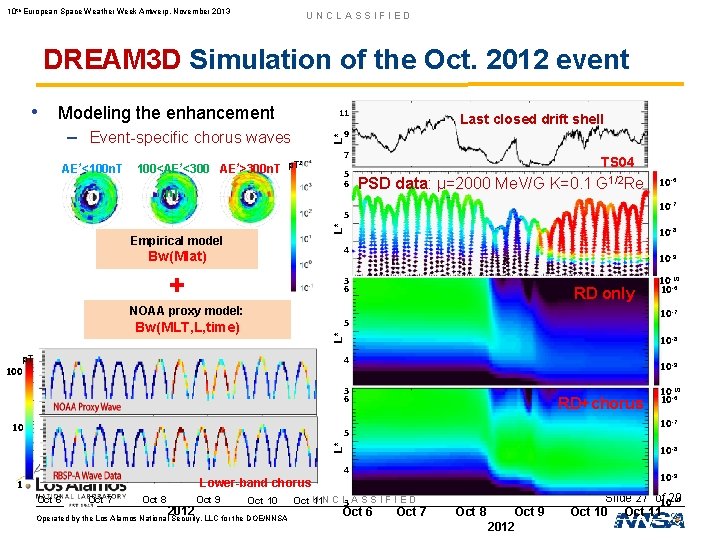
10 th European Space Weather Week Antwerp, November 2013 UNCLASSIFIED DREAM 3 D Simulation of the Oct. 2012 event • Modeling the enhancement 11 – Event-specific chorus waves AE*<100 n. T 100<AE*<300 AE*>300 n. T Last closed drift shell L* 9 p. T 2 n. T 7 5 6 TS 04 PSD data: µ=2000 Me. V/G K=0. 1 G 1/2 Re 10 -7 L* 5 Empirical model 10 -8 4 Bw(Mlat) + 10 -9 3 6 NOAA proxy model: RD only L* p. T 100 10 -8 4 10 -9 3 6 10 RD+chorus L* 10 -8 4 10 -9 Lower-band chorus Oct 6 Oct 7 Oct 8 2012 Oct 9 Oct 10 Operated by the Los Alamos National Security, LLC for the DOE/NNSA 10 -10 10 -6 10 -7 5 1 10 -10 10 -6 10 -7 5 Bw(MLT, L, time) 10 -6 Oct U 11 N C L 3 A S S I F I E D Oct 6 Oct 7 Oct 8 Oct 9 2012 Slide 27 of 1029 -10 Oct 11
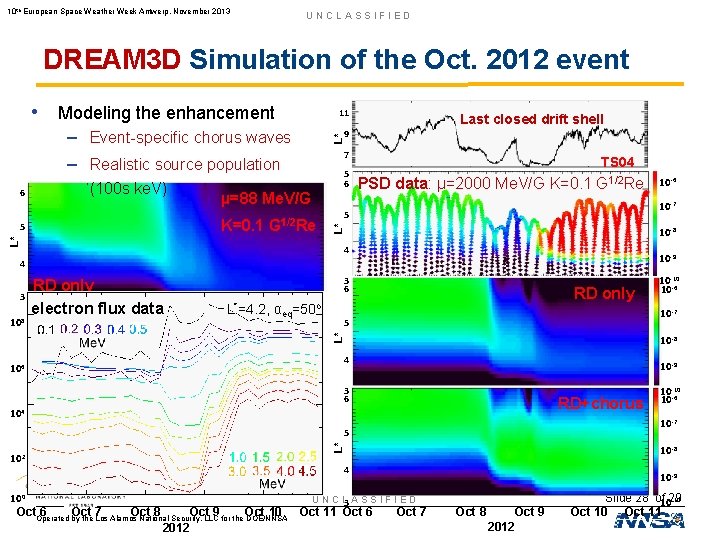
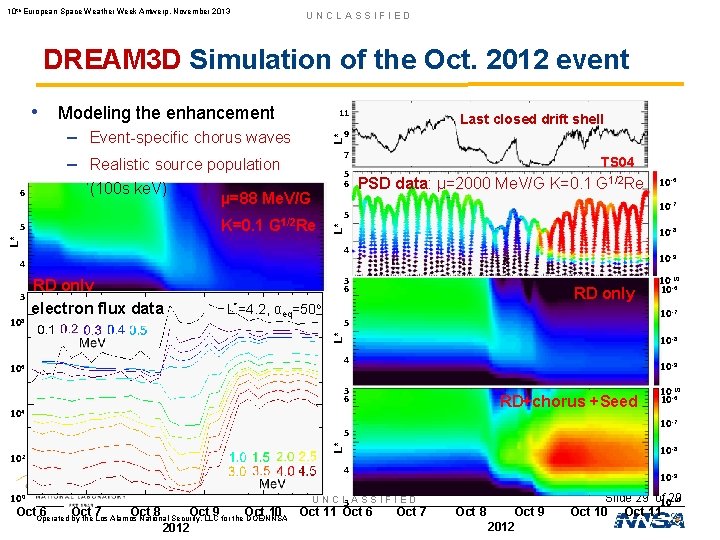
10 th European Space Weather Week Antwerp, November 2013 UNCLASSIFIED DREAM 3 D Simulation of the Oct. 2012 event • Modeling the enhancement 11 – Event-specific chorus waves L* 7 – Realistic source population 5 6 µ=88 Me. V/G K=0. 1 G 1/2 Re PSD data: µ=2000 Me. V/G K=0. 1 G 1/2 Re 10 -8 4 10 -9 4 3 3 6 L*=4. 2, αeq=50 o RD only 10 -8 4 106 10 -9 3 6 RD+chorus 104 100 Oct. Operated 6 Oct 7 Oct 8 Oct 9 Oct 10 by the Los Alamos National Security, LLC for the DOE/NNSA 2012 10 -10 10 -6 10 -7 L* 5 102 10 -10 10 -6 10 -7 5 L* 108 RD only electron flux data 10 -6 10 -7 5 L* 5 TS 04 L* 6 (100 s ke. V) Last closed drift shell 9 10 -8 4 10 -9 U N C L 3 A S S I F I E D Oct 11 Oct 6 Oct 7 Oct 8 Oct 9 2012 Slide 28 of 1029 -10 Oct 11
10 th European Space Weather Week Antwerp, November 2013 UNCLASSIFIED DREAM 3 D Simulation of the Oct. 2012 event • Modeling the enhancement 11 – Event-specific chorus waves L* 7 – Realistic source population 5 6 µ=88 Me. V/G K=0. 1 G 1/2 Re PSD data: µ=2000 Me. V/G K=0. 1 G 1/2 Re 10 -8 4 10 -9 4 3 3 6 L*=4. 2, αeq=50 o RD only 10 -8 4 106 10 -9 3 6 RD+chorus +Seed 104 100 Oct. Operated 6 Oct 7 Oct 8 Oct 9 Oct 10 by the Los Alamos National Security, LLC for the DOE/NNSA 2012 10 -10 10 -6 10 -7 L* 5 102 10 -10 10 -6 10 -7 5 L* 108 RD only electron flux data 10 -6 10 -7 5 L* 5 TS 04 L* 6 (100 s ke. V) Last closed drift shell 9 10 -8 4 10 -9 U N C L 3 A S S I F I E D Oct 11 Oct 6 Oct 7 Oct 8 Oct 9 2012 Slide 29 of 1029 -10 Oct 11