
UNCLASSIFIED National Positioning Navigation and Timing Architecture Civil
- Slides: 18
UNCLASSIFIED • National Positioning Navigation and Timing • Architecture • Civil GPS Service Interface Committee Meeting • • Karen Van Dyke, DOT/RITA/Volpe Center Lt Col Patrick Huested, National Security Space Office • 15 September 2008
UNCLASSIFIED Overview • PNT Architecture Background • Architecture Development • Guiding Principles • Recommendations • Next Steps 2
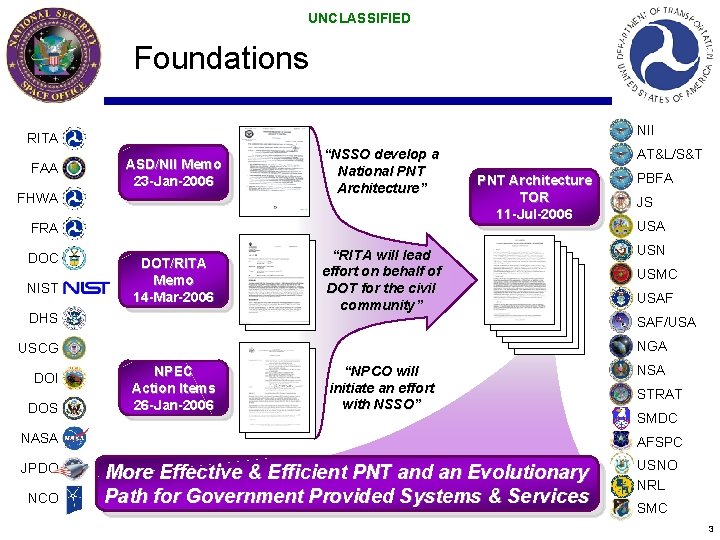
UNCLASSIFIED Foundations NII RITA FAA ASD/NII Memo 23 -Jan-2006 FHWA “NSSO develop a National PNT Architecture” FRA DOC NIST DOT/RITA Memo 14 -Mar-2006 DHS AT&L/S&T PNT Architecture TOR 11 -Jul-2006 “RITA will lead effort on behalf of DOT for the civil community” DOS NCO USA USN USMC USAF NGA NPEC Action Items 26 -Jan-2006 “NPCO will initiate an effort with NSSO” NASA JPDO JS SAF/USA USCG DOI PBFA NSA STRAT SMDC AFSPC More Effective & Efficient PNT and an Evolutionary Path for Government Provided Systems & Services USNO NRL SMC 3
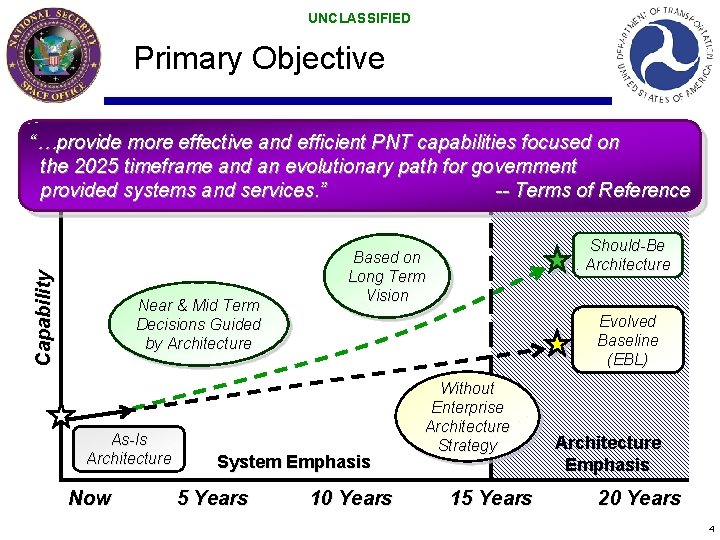
UNCLASSIFIED Primary Objective Capability “…provide more effective and efficient PNT capabilities focused on the 2025 timeframe and an evolutionary path for government provided systems and services. ” -- Terms of Reference Near & Mid Term Decisions Guided by Architecture As-Is Architecture Now Evolved Baseline (EBL) System Emphasis 5 Years Should-Be Architecture Based on Long Term Vision 10 Years Without Enterprise Architecture Strategy 15 Years Architecture Emphasis 20 Years 4
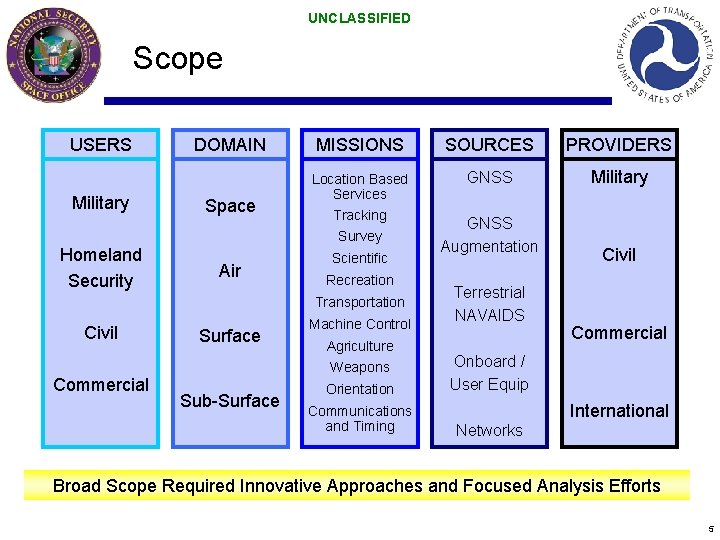
UNCLASSIFIED Scope USERS Military DOMAIN MISSIONS SOURCES PROVIDERS GNSS Military Space Location Based Services Tracking Survey Homeland Security Air Scientific Recreation Transportation Civil Commercial Surface Machine Control Agriculture Weapons Sub-Surface Orientation Communications and Timing GNSS Augmentation Terrestrial NAVAIDS Civil Commercial Onboard / User Equip International Networks Broad Scope Required Innovative Approaches and Focused Analysis Efforts 5
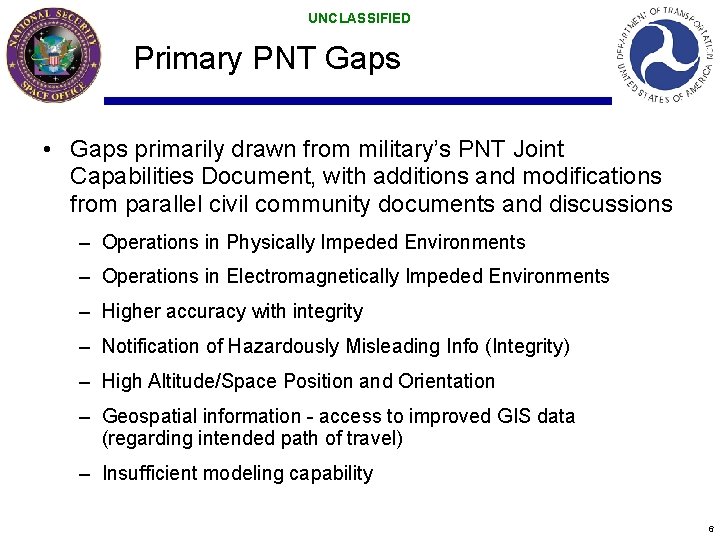
UNCLASSIFIED Primary PNT Gaps • Gaps primarily drawn from military’s PNT Joint Capabilities Document, with additions and modifications from parallel civil community documents and discussions – Operations in Physically Impeded Environments – Operations in Electromagnetically Impeded Environments – Higher accuracy with integrity – Notification of Hazardously Misleading Info (Integrity) – High Altitude/Space Position and Orientation – Geospatial information - access to improved GIS data (regarding intended path of travel) – Insufficient modeling capability 6
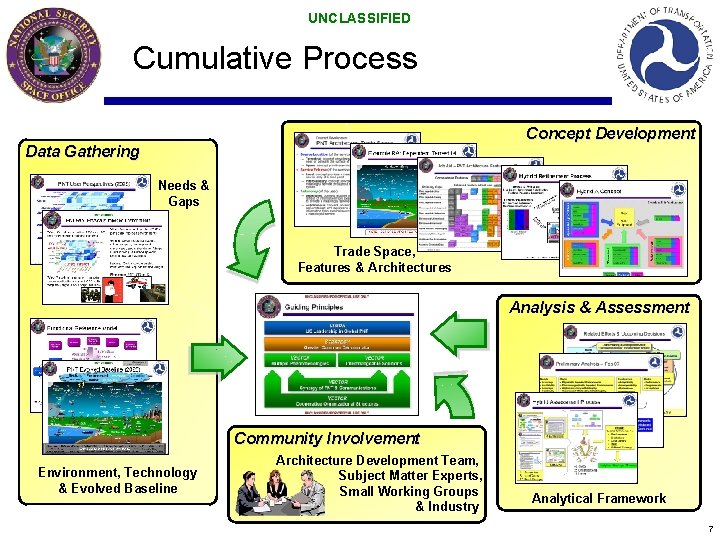
UNCLASSIFIED Cumulative Process Concept Development Data Gathering Needs & Gaps Trade Space, Features & Architectures Analysis & Assessment Community Involvement Environment, Technology & Evolved Baseline Architecture Development Team, Subject Matter Experts, Small Working Groups & Industry Analytical Framework 7
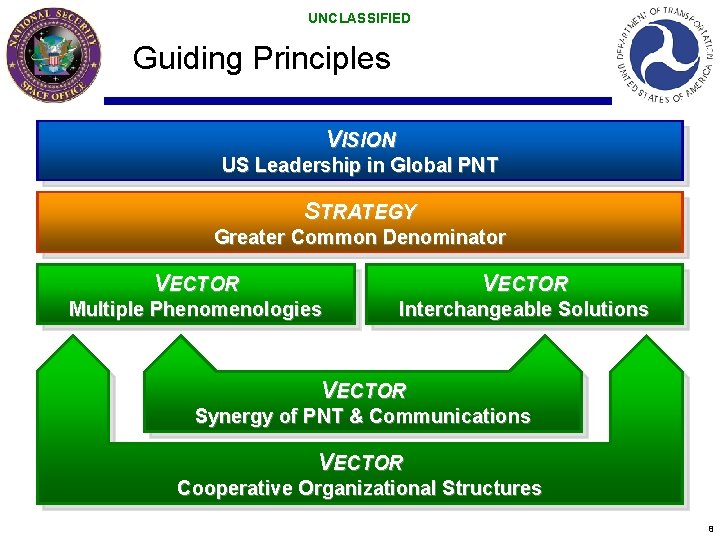
UNCLASSIFIED Guiding Principles VISION US Leadership in Global PNT STRATEGY Greater Common Denominator VECTOR Multiple Phenomenologies Interchangeable Solutions VECTOR Synergy of PNT & Communications VECTOR Cooperative Organizational Structures 8
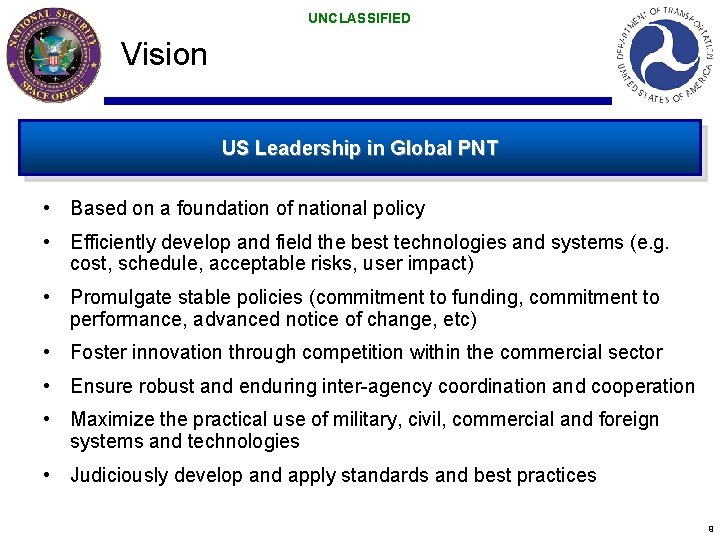
UNCLASSIFIED Vision US Leadership in Global PNT • Based on a foundation of national policy • Efficiently develop and field the best technologies and systems (e. g. cost, schedule, acceptable risks, user impact) • Promulgate stable policies (commitment to funding, commitment to performance, advanced notice of change, etc) • Foster innovation through competition within the commercial sector • Ensure robust and enduring inter-agency coordination and cooperation • Maximize the practical use of military, civil, commercial and foreign systems and technologies • Judiciously develop and apply standards and best practices 9
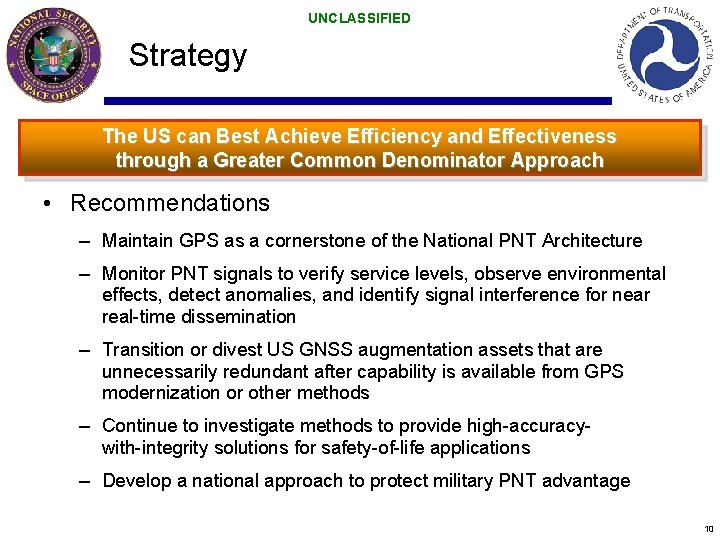
UNCLASSIFIED Strategy The US can Best Achieve Efficiency and Effectiveness through a Greater Common Denominator Approach • Recommendations – Maintain GPS as a cornerstone of the National PNT Architecture – Monitor PNT signals to verify service levels, observe environmental effects, detect anomalies, and identify signal interference for near real-time dissemination – Transition or divest US GNSS augmentation assets that are unnecessarily redundant after capability is available from GPS modernization or other methods – Continue to investigate methods to provide high-accuracywith-integrity solutions for safety-of-life applications – Develop a national approach to protect military PNT advantage 10
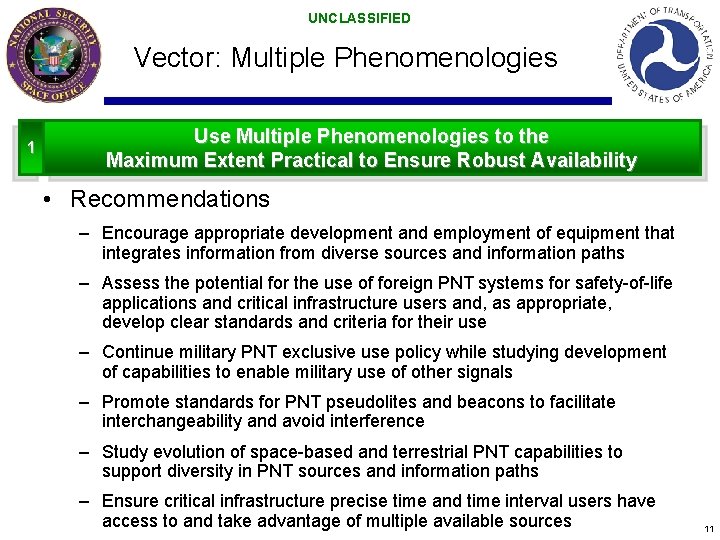
UNCLASSIFIED Vector: Multiple Phenomenologies 1 Use Multiple Phenomenologies to the Maximum Extent Practical to Ensure Robust Availability • Recommendations – Encourage appropriate development and employment of equipment that integrates information from diverse sources and information paths – Assess the potential for the use of foreign PNT systems for safety-of-life applications and critical infrastructure users and, as appropriate, develop clear standards and criteria for their use – Continue military PNT exclusive use policy while studying development of capabilities to enable military use of other signals – Promote standards for PNT pseudolites and beacons to facilitate interchangeability and avoid interference – Study evolution of space-based and terrestrial PNT capabilities to support diversity in PNT sources and information paths – Ensure critical infrastructure precise time and time interval users have access to and take advantage of multiple available sources 11
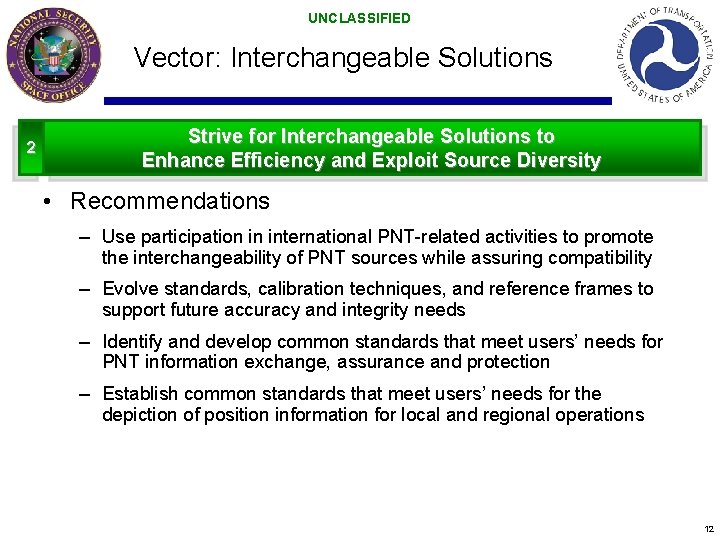
UNCLASSIFIED Vector: Interchangeable Solutions 2 Strive for Interchangeable Solutions to Enhance Efficiency and Exploit Source Diversity • Recommendations – Use participation in international PNT-related activities to promote the interchangeability of PNT sources while assuring compatibility – Evolve standards, calibration techniques, and reference frames to support future accuracy and integrity needs – Identify and develop common standards that meet users’ needs for PNT information exchange, assurance and protection – Establish common standards that meet users’ needs for the depiction of position information for local and regional operations 12
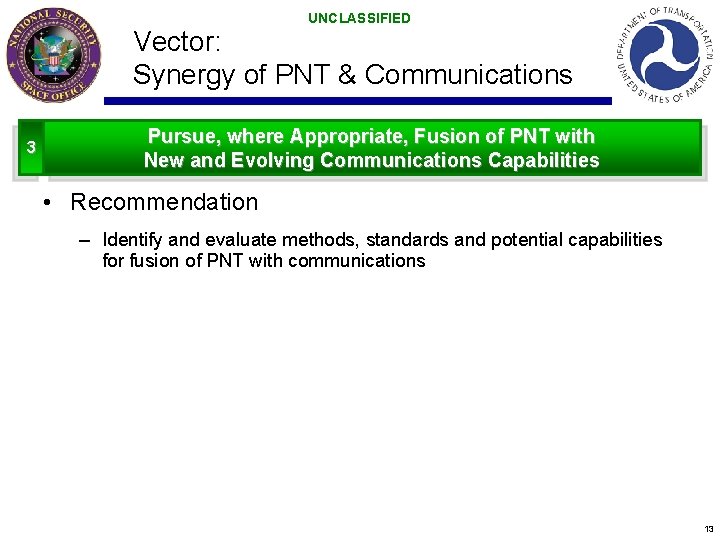
UNCLASSIFIED Vector: Synergy of PNT & Communications 3 Pursue, where Appropriate, Fusion of PNT with New and Evolving Communications Capabilities • Recommendation – Identify and evaluate methods, standards and potential capabilities for fusion of PNT with communications 13
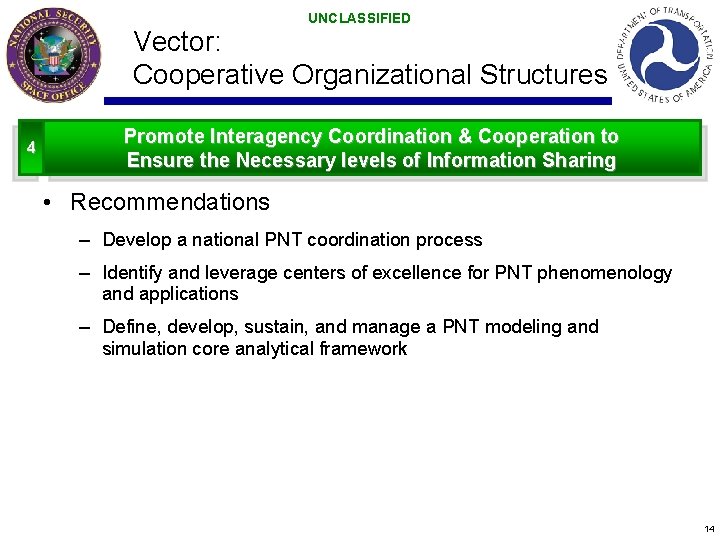
UNCLASSIFIED Vector: Cooperative Organizational Structures 4 Promote Interagency Coordination & Cooperation to Ensure the Necessary levels of Information Sharing • Recommendations – Develop a national PNT coordination process – Identify and leverage centers of excellence for PNT phenomenology and applications – Define, develop, sustain, and manage a PNT modeling and simulation core analytical framework 14
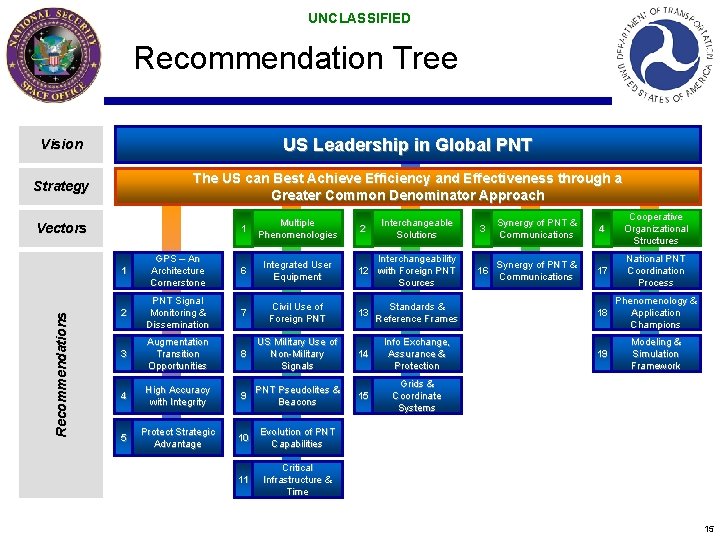
UNCLASSIFIED Recommendation Tree Vision US Leadership in Global PNT Strategy The US can Best Achieve Efficiency and Effectiveness through a Greater Common Denominator Approach Recommendations Vectors 1 Multiple Phenomenologies 2 Interchangeable Solutions Interchangeability 12 with Foreign PNT Sources 3 Synergy of PNT & Communications 4 Cooperative Organizational Structures 16 Synergy of PNT & Communications 17 National PNT Coordination Process 1 GPS – An Architecture Cornerstone 6 Integrated User Equipment 2 PNT Signal Monitoring & Dissemination 7 Civil Use of Foreign PNT 13 Standards & Reference Frames 18 Phenomenology & Application Champions 3 Augmentation Transition Opportunities 8 US Military Use of Non-Military Signals 14 Info Exchange, Assurance & Protection 19 Modeling & Simulation Framework 4 High Accuracy with Integrity 9 PNT Pseudolites & Beacons 15 Grids & Coordinate Systems 5 Protect Strategic Advantage 10 Evolution of PNT Capabilities 11 Critical Infrastructure & Time 15
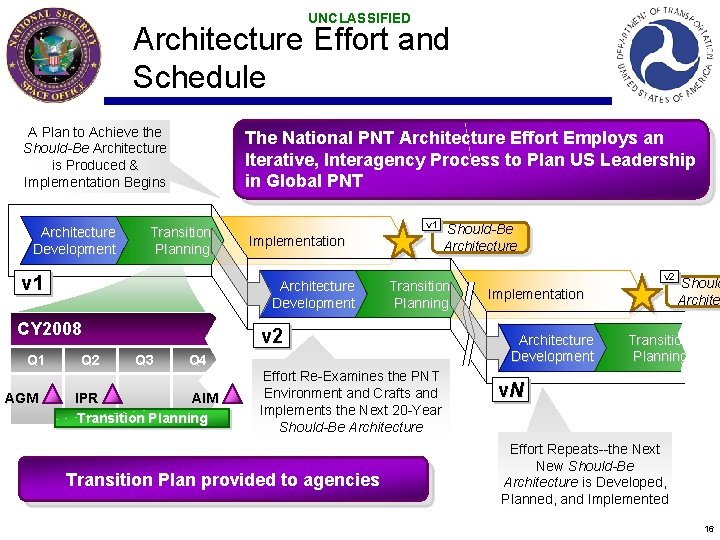
UNCLASSIFIED Architecture Effort and Schedule A Plan to Achieve the Should-Be Architecture is Produced & Implementation Begins Architecture Development The National PNT Architecture Effort Employs an Iterative, Interagency Process to Plan US Leadership in Global PNT Transition Planning Architecture Development CY 2008 AGM Implementation Q 2 Should-Be Architecture On-Going Transition Process. Planning v 1 Q 1 v 2 Q 3 Q 4 IPR AIM Transition Planning Effort Re-Examines the PNT Environment and Crafts and Implements the Next 20 -Year Should-Be Architecture Transition Plan provided to agencies v 2 Implementation Architecture Development Should Archite Transition Planning v. N Effort Repeats--the Next New Should-Be Architecture is Developed, Planned, and Implemented 16
UNCLASSIFIED Next Steps • Workshop(s) to Obtain Public Feedback on Recommendations – First “Industry Day” session in conjunction with the 2008 Institute of Navigation (ION) Global Navigation Satellite System (GNSS) conference. • Date: September 16 • Time: 1 PM – 4 PM, starting with a presentation by NSSO • Location: Savannah International Trade and Convention Center, Rooms 105 & 106 • Influence update to PNT planning documents – Federal Radionavigation Plan – Five-Year National Space-Based PNT Plan • Architecture Transition Plan – Event-based implementation timeline – Coordinate through Decision Coordination Group members and co-sponsors as appropriate 17
UNCLASSIFIED Points of Contact • National Security Space Office – CAPT Milton Abner – NSSO. PNT@osd. mil – Website: http: //www. acq. osd. mil/nsso/pnt. htm • OASD/NII – Mr. Ray Swider – raymond. swider@osd. mil • DOT RITA, Volpe Center – Ms. Karen Van Dyke – Karen. Van. Dyke@dot. gov 18