
UNCLASSIFIED Missouri Agribusiness Development Team MO ADT UNCLASSIFIED

UNCLASSIFIED Missouri Agri-business Development Team (MO ADT) UNCLASSIFIED
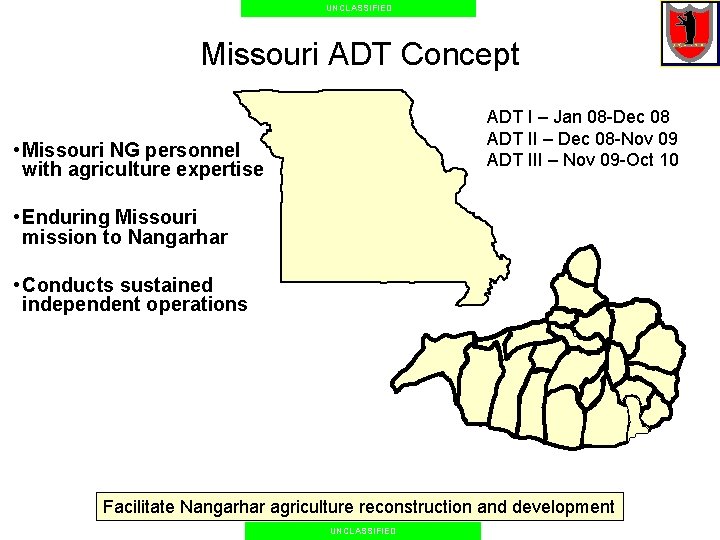
UNCLASSIFIED Missouri ADT Concept ADT I – Jan 08 -Dec 08 ADT II – Dec 08 -Nov 09 ADT III – Nov 09 -Oct 10 • Missouri NG personnel with agriculture expertise • Enduring Missouri mission to Nangarhar • Conducts sustained independent operations Facilitate Nangarhar agriculture reconstruction and development UNCLASSIFIED
UNCLASSIFIED Mission – Intent – End State MISSION Missouri Agri-business Development Team (ADT) deploys to Nangarhar Province, Afghanistan and integrates non-kinetic agriculture reconstruction and development activities into 4 th Brigade Combat Team, 4 th Infantry Division counterinsurgency (COIN) operations to support the Government of the Islamic Republic of Afghanistan. INTENT Begin reconstruction efforts at a pace that begins to: - Provide basic agricultural needs and services - Secure the safety of the food and fiber produced and consumed by the people - Assist in the development of sustainable value added enterprises that increase the economic well-being of the people END STATE The government of Afghanistan has capacity to provide support to farmers in Nangarhar Province as the agricultural sector grows to become a viable participant in the world market for legitimate agricultural products. UNCLASSIFIED
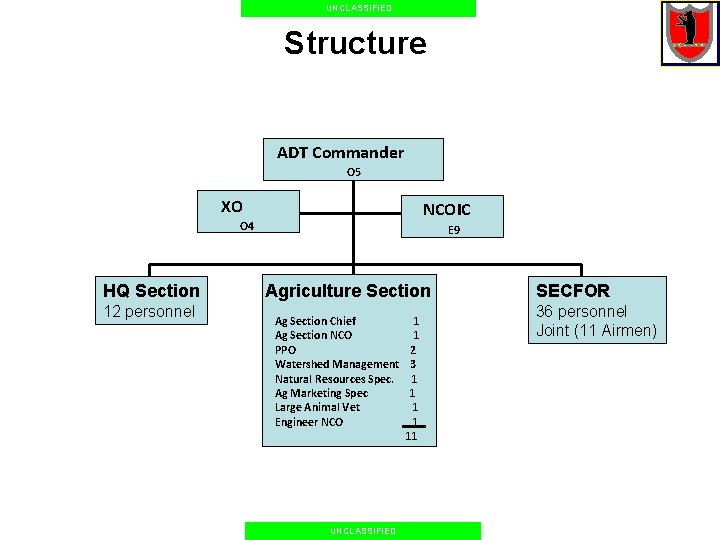
UNCLASSIFIED Structure ADT Commander O 5 XO NCOIC O 4 HQ Section 12 personnel E 9 Agriculture Section Ag Section Chief Ag Section NCO PPO Watershed Management Natural Resources Spec. Ag Marketing Spec Large Animal Vet Engineer NCO UNCLASSIFIED 1 1 2 3 1 1 11 SECFOR 36 personnel Joint (11 Airmen)
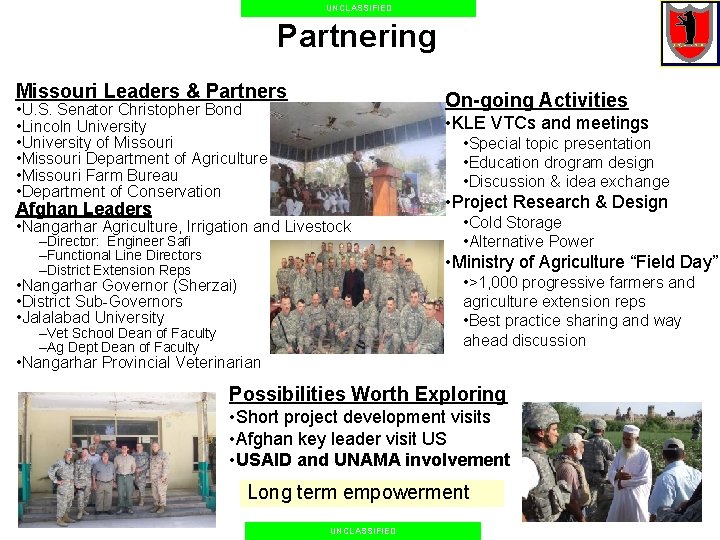
UNCLASSIFIED Partnering Missouri Leaders & Partners On-going Activities • U. S. Senator Christopher Bond • Lincoln University • University of Missouri • Missouri Department of Agriculture • Missouri Farm Bureau • Department of Conservation • KLE VTCs and meetings • Special topic presentation • Education drogram design • Discussion & idea exchange • Project Research & Design Afghan Leaders • Nangarhar Agriculture, Irrigation and Livestock –Director: Engineer Safi –Functional Line Directors –District Extension Reps • Cold Storage • Alternative Power • Ministry of Agriculture “Field Day” • >1, 000 progressive farmers and agriculture extension reps • Best practice sharing and way ahead discussion • Nangarhar Governor (Sherzai) • District Sub-Governors • Jalalabad University –Vet School Dean of Faculty –Ag Dept Dean of Faculty • Nangarhar Provincial Veterinarian Possibilities Worth Exploring • Short project development visits • Afghan key leader visit US • USAID and UNAMA involvement Long term empowerment UNCLASSIFIED
UNCLASSIFIED The Way Ahead Focus Areas: • Address water and Irrigation in rural communities to increase production capacity Methods: • Exploit success of first Missouri ADT • Address rural power for valueadded processing to increase market capacity • Broaden project base –Check Dam Watersheds –Solar Wells –Key Leader Engagement –Wheat Seed Distribution • Address Key Leader Engagement and education programs to develop Afghan “ownership” and sustainment capability • Address product sanitation and quality to improve market viability –Micro Value Added Facilities §Cold Storage (Root Cellar) §Juicing and Canning §Slaughter §Rice Hulling §Grain Mill §Sugar Cane Refining –Karize reconstruction –Reforestation –Lower Watershed Check Dam Reservoirs –Apiaries • Complement other programs –PRT/STB CERP –USAID (LSI) –CNAT UNCLASSIFIED
UNCLASSIFIED Campaign Plan Last 150 Days Key Tasks Main Effort • • June- September: Packet Submission & Quality Assurance • October: Quality Assurance & RIP Preparation • November: TOA Packet Creation – Water management • Lower Watershed Chek Dam Reservoirs • Karize Restorations – Rural value-added processing • Cold Storage Facilities – Special projects • Wheat Seed and Fertilizer • Livestock De-worming – Employment Creation • • • NVDA Olive Farms NVDA Citrus Farms Grand Canal Sub-canal Repair Self-help Projects Quality Assurance Leave for ADT III • • UNCLASSIFIED Upper Watershed Check Dams – round II Micro-Hydro Grain Mills – next set Slaughter Facilities – next set Green Houses – next set Sugar Refining Facilities – beyond design Dairy Collection Apiaries Poultry
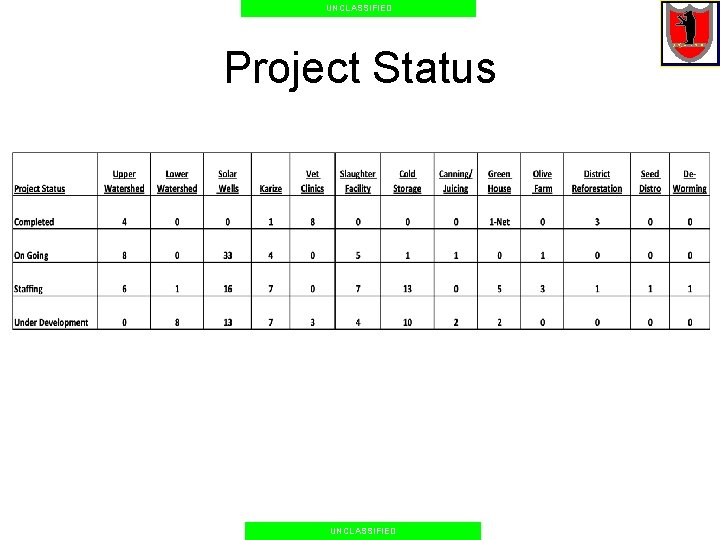
UNCLASSIFIED Project Status UNCLASSIFIED
UNCLASSIFIED The Numbers • • 17 projects completed: $3, 558, 929 58 projects under construction: $6, 574, 526 61 projects in staffing : $11, 899, 163 60 projects under development : approx. $15 million UNCLASSIFIED
UNCLASSIFIED Water Management • Most basic of three essential elements for near term Nangarhar agriculture development – water, power, roads • Projects are: • Mutually supporting • Environmentally friendly • Culturally – village and locality – sensitive • Building blocks for other programs and projects • Sustainable • Project Types • Upper watershed check-dams • Lower watershed check-dam reservoirs • Karize restoration • Irrigation Solar Wells UNCLASSIFIED
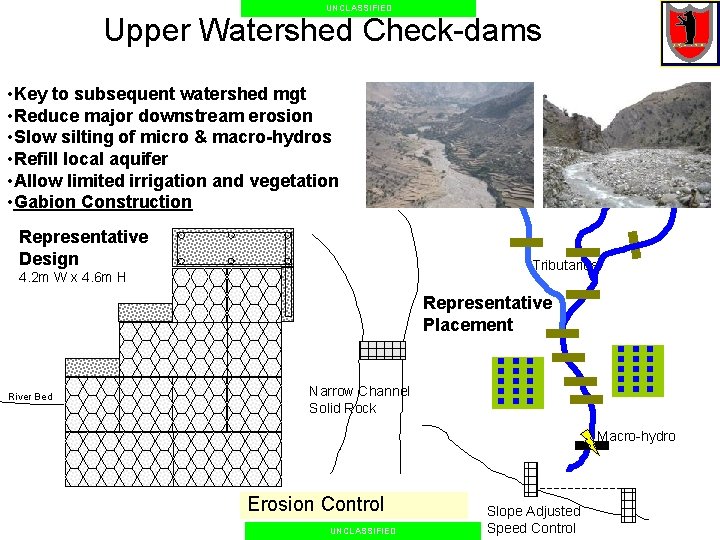
UNCLASSIFIED Upper Watershed Check-dams • Key to subsequent watershed mgt • Reduce major downstream erosion • Slow silting of micro & macro-hydros • Refill local aquifer • Allow limited irrigation and vegetation • Gabion Construction Representative Design Tributaries 4. 2 m W x 4. 6 m H Representative Placement River Bed Narrow Channel Solid Rock Macro-hydro Erosion Control UNCLASSIFIED Slope Adjusted Speed Control
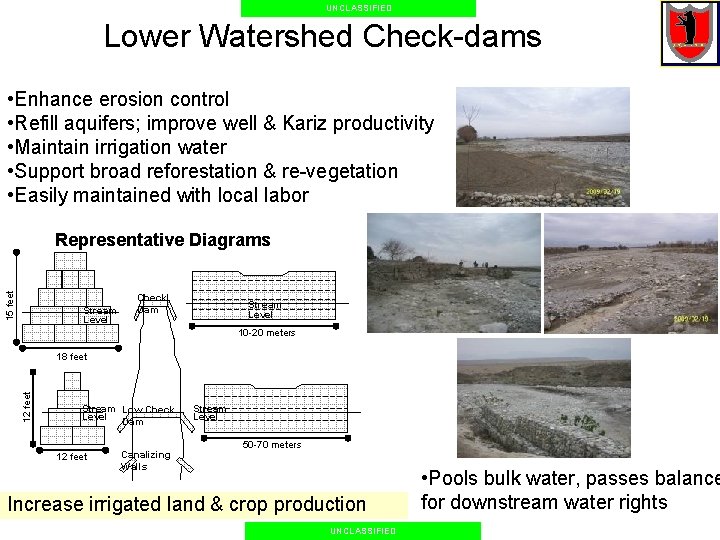
UNCLASSIFIED Lower Watershed Check-dams • Enhance erosion control • Refill aquifers; improve well & Kariz productivity • Maintain irrigation water • Support broad reforestation & re-vegetation • Easily maintained with local labor 15 feet Representative Diagrams Stream Level Check Dam Stream Level 10 -20 meters 12 feet 18 feet Stream Low Check Level Dam 12 feet Canalizing Walls Stream Level 50 -70 meters Increase irrigated land & crop production UNCLASSIFIED • Pools bulk water, passes balance for downstream water rights
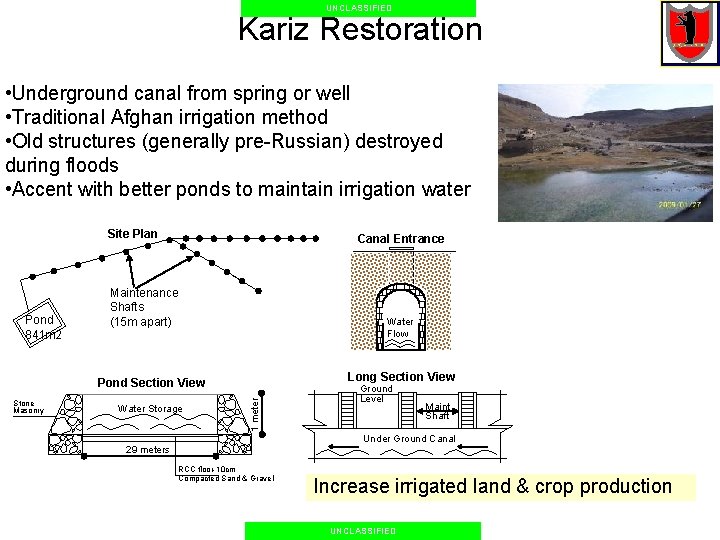
UNCLASSIFIED Kariz Restoration • Underground canal from spring or well • Traditional Afghan irrigation method • Old structures (generally pre-Russian) destroyed during floods • Accent with better ponds to maintain irrigation water Site Plan Pond 841 m 2 Canal Entrance Maintenance Shafts (15 m apart) Water Flow Long Section View Stone Masonry Water Storage 1 meter Pond Section View Ground Level Maint Shaft Under Ground Canal 29 meters RCC floor-10 cm Compacted Sand & Gravel Increase irrigated land & crop production UNCLASSIFIED
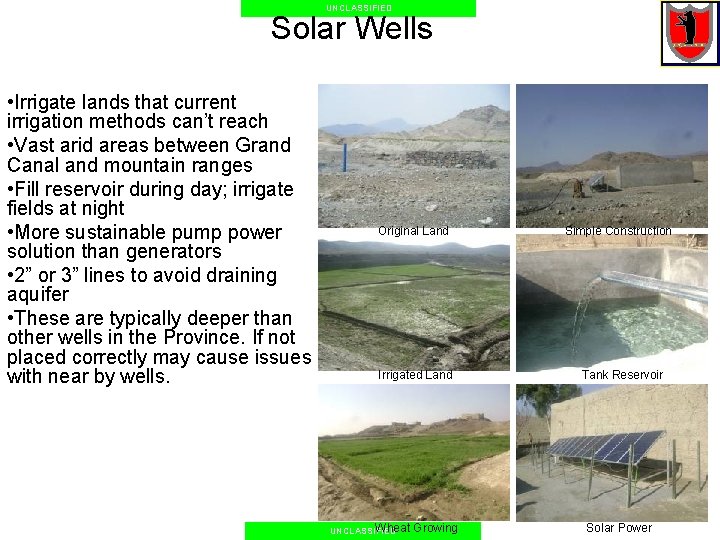
UNCLASSIFIED Solar Wells • Irrigate lands that current irrigation methods can’t reach • Vast arid areas between Grand Canal and mountain ranges • Fill reservoir during day; irrigate fields at night • More sustainable pump power solution than generators • 2” or 3” lines to avoid draining aquifer • These are typically deeper than other wells in the Province. If not placed correctly may cause issues with near by wells. Original Land Irrigated Land Simple Construction Tank Reservoir Well Wheat Growing UNCLASSIFIED Solar Power
UNCLASSIFIED Micro-Value Added Facilities • Solar or micro-hydro powered • Rural community sized and located –COIN fight now –Targeted at community capabilities –Expandable indefinitely –Facilitates skills and entrepreneurial development –Fits within local community cultural and market framework • Project Types –Grain mills (current) –Enhance root cellar cold storage facilities (current) –Canning and juicing facilities (current) –Rice hulling facilities (future) –Sugar cane processing facilities (future) –Wheat seed cleaning and storage facilities (future) UNCLASSIFIED
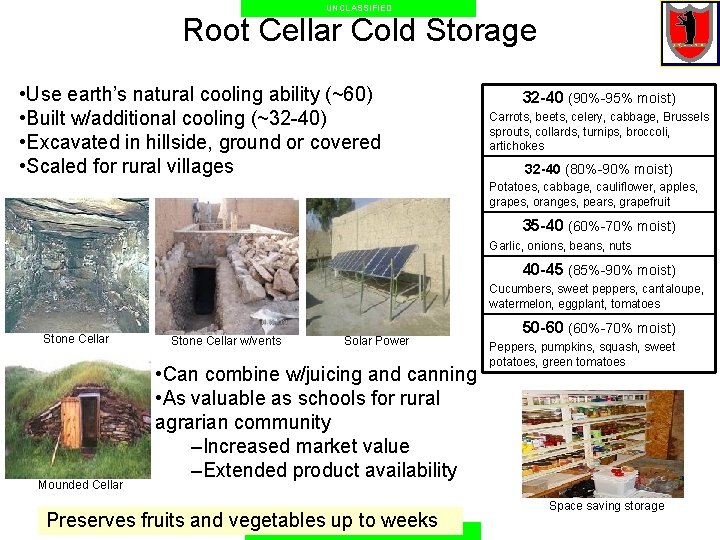
UNCLASSIFIED Root Cellar Cold Storage • Use earth’s natural cooling ability (~60) • Built w/additional cooling (~32 -40) • Excavated in hillside, ground or covered • Scaled for rural villages 32 -40 (90%-95% moist) Carrots, beets, celery, cabbage, Brussels sprouts, collards, turnips, broccoli, artichokes 32 -40 (80%-90% moist) Potatoes, cabbage, cauliflower, apples, grapes, oranges, pears, grapefruit 35 -40 (60%-70% moist) Garlic, onions, beans, nuts 40 -45 (85%-90% moist) Cucumbers, sweet peppers, cantaloupe, watermelon, eggplant, tomatoes Stone Cellar Mounded Cellar Stone Cellar w/vents Solar Power • Can combine w/juicing and canning • As valuable as schools for rural agrarian community –Increased market value –Extended product availability Preserves fruits and vegetables up to weeks UNCLASSIFIED 50 -60 (60%-70% moist) Peppers, pumpkins, squash, sweet potatoes, green tomatoes Space saving storage
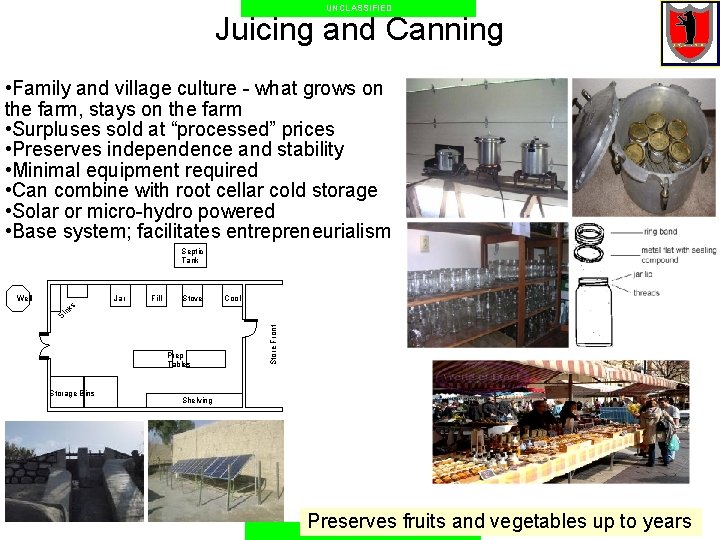
UNCLASSIFIED Juicing and Canning • Family and village culture - what grows on the farm, stays on the farm • Surpluses sold at “processed” prices • Preserves independence and stability • Minimal equipment required • Can combine with root cellar cold storage • Solar or micro-hydro powered • Base system; facilitates entrepreneurialism Septic Tank Well ks Jar Fill Stove Cool Prep Tables Storage Bins Store Front n Si Shelving Preserves fruits and vegetables up to years UNCLASSIFIED
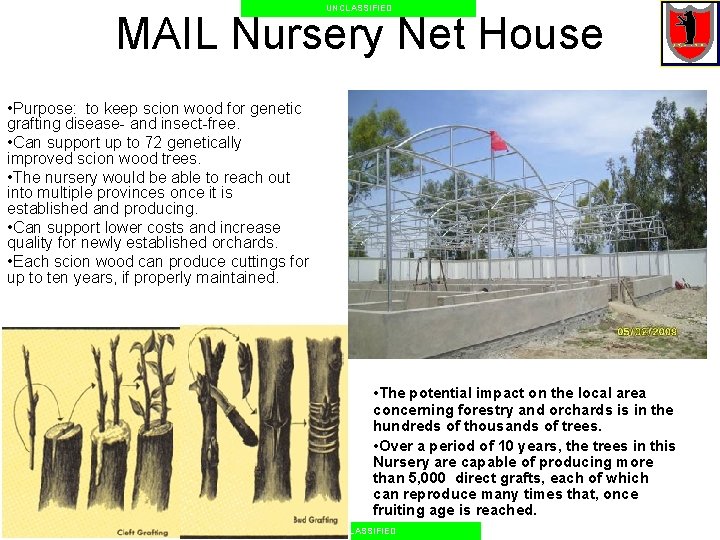
UNCLASSIFIED MAIL Nursery Net House • Purpose: to keep scion wood for genetic grafting disease- and insect-free. • Can support up to 72 genetically improved scion wood trees. • The nursery would be able to reach out into multiple provinces once it is established and producing. • Can support lower costs and increase quality for newly established orchards. • Each scion wood can produce cuttings for up to ten years, if properly maintained. • The potential impact on the local area concerning forestry and orchards is in the hundreds of thousands of trees. • Over a period of 10 years, the trees in this Nursery are capable of producing more than 5, 000 direct grafts, each of which can reproduce many times that, once fruiting age is reached. UNCLASSIFIED
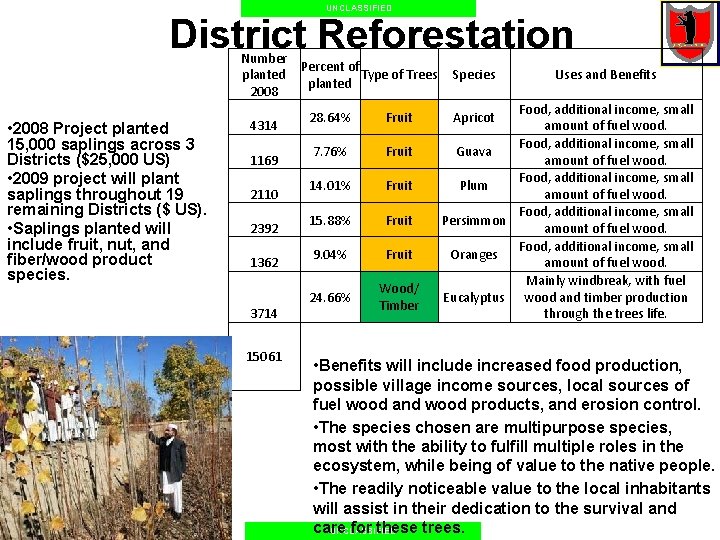
UNCLASSIFIED District Reforestation Number Percent of Type of Trees planted 2008 • 2008 Project planted 15, 000 saplings across 3 Districts ($25, 000 US) • 2009 project will plant saplings throughout 19 remaining Districts ($ US). • Saplings planted will include fruit, nut, and fiber/wood product species. 4314 1169 2110 2392 1362 3714 15061 28. 64% Fruit 7. 76% Fruit 14. 01% Fruit 15. 88% Fruit 9. 04% Fruit 24. 66% Wood/ Timber Species Uses and Benefits Food, additional income, small amount of fuel wood. Food, additional income, small Guava amount of fuel wood. Food, additional income, small Plum amount of fuel wood. Food, additional income, small Persimmon amount of fuel wood. Food, additional income, small Oranges amount of fuel wood. Mainly windbreak, with fuel Eucalyptus wood and timber production through the trees life. Apricot • Benefits will include increased food production, possible village income sources, local sources of fuel wood and wood products, and erosion control. • The species chosen are multipurpose species, most with the ability to fulfill multiple roles in the ecosystem, while being of value to the native people. • The readily noticeable value to the local inhabitants will assist in their dedication to the survival and care for these trees. UNCLASSIFIED
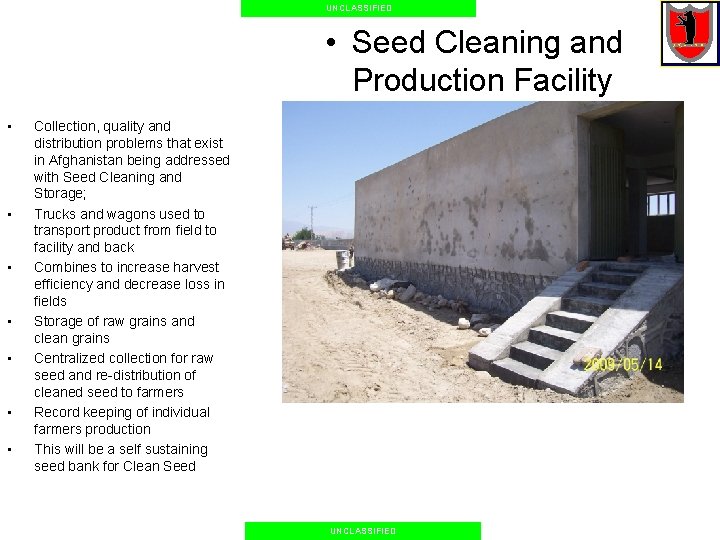
UNCLASSIFIED • Seed Cleaning and Production Facility • • Collection, quality and distribution problems that exist in Afghanistan being addressed with Seed Cleaning and Storage; Trucks and wagons used to transport product from field to facility and back Combines to increase harvest efficiency and decrease loss in fields Storage of raw grains and clean grains Centralized collection for raw seed and re-distribution of cleaned seed to farmers Record keeping of individual farmers production This will be a self sustaining seed bank for Clean Seed UNCLASSIFIED
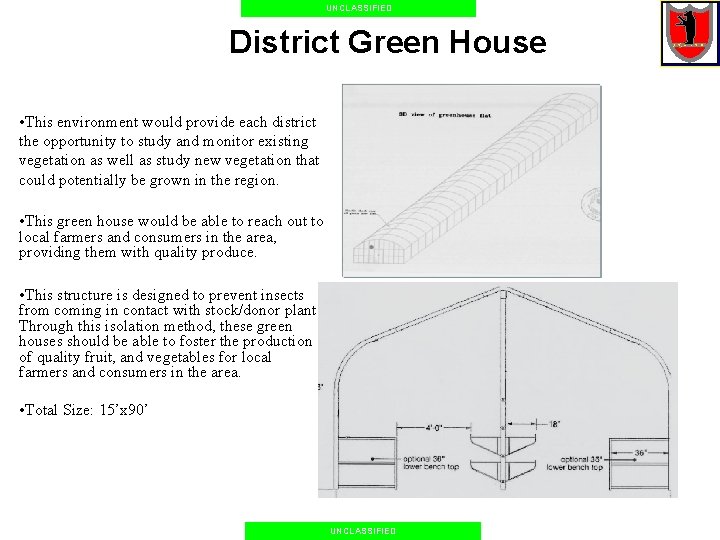
UNCLASSIFIED District Green House • This environment would provide each district the opportunity to study and monitor existing vegetation as well as study new vegetation that could potentially be grown in the region. • This green house would be able to reach out to local farmers and consumers in the area, providing them with quality produce. • This structure is designed to prevent insects from coming in contact with stock/donor plants. Through this isolation method, these green houses should be able to foster the production of quality fruit, and vegetables for local farmers and consumers in the area. • Total Size: 15’x 90’ UNCLASSIFIED
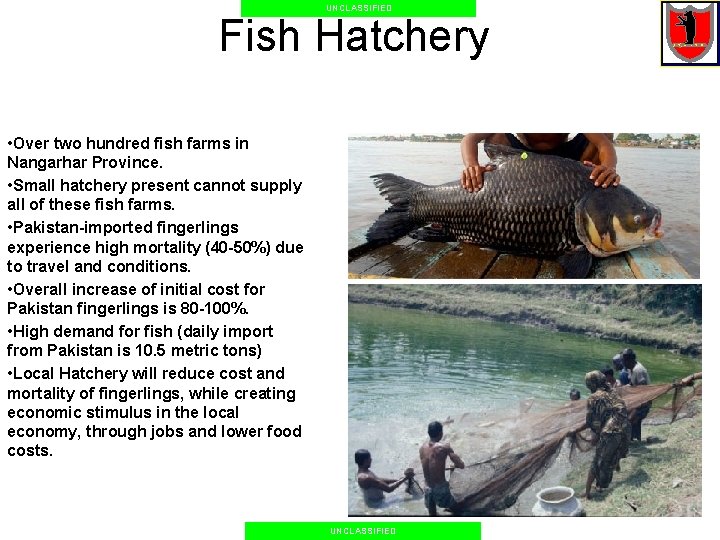
UNCLASSIFIED Fish Hatchery • Over two hundred fish farms in Nangarhar Province. • Small hatchery present cannot supply all of these fish farms. • Pakistan-imported fingerlings experience high mortality (40 -50%) due to travel and conditions. • Overall increase of initial cost for Pakistan fingerlings is 80 -100%. • High demand for fish (daily import from Pakistan is 10. 5 metric tons) • Local Hatchery will reduce cost and mortality of fingerlings, while creating economic stimulus in the local economy, through jobs and lower food costs. UNCLASSIFIED
UNCLASSIFIED Health and Sanitation Projects • Micro-Slaughter facilities • Vet Clinics • De-worming of Livestock UNCLASSIFIED
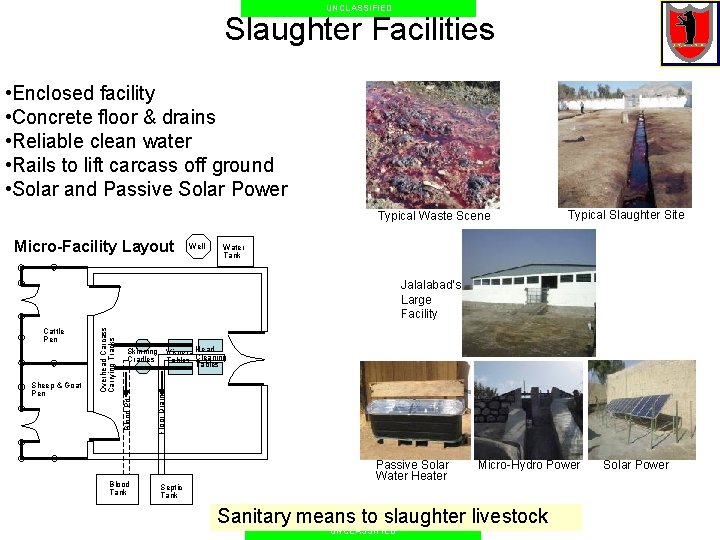
UNCLASSIFIED Slaughter Facilities • Enclosed facility • Concrete floor & drains • Reliable clean water • Rails to lift carcass off ground • Solar and Passive Solar Power Typical Waste Scene Micro-Facility Layout Well Typical Slaughter Site Water Tank Blood Tank Floor Drain Sheep & Goat Pen Viscera Head Tables Cleaning Tables Skinning Cradles Blood Pit Cattle Pen Overhead Carcass Carrying Tracks Jalalabad’s Large Facility Septic Tank Passive Solar Water Heater Micro-Hydro Power Sanitary means to slaughter livestock UNCLASSIFIED Solar Power
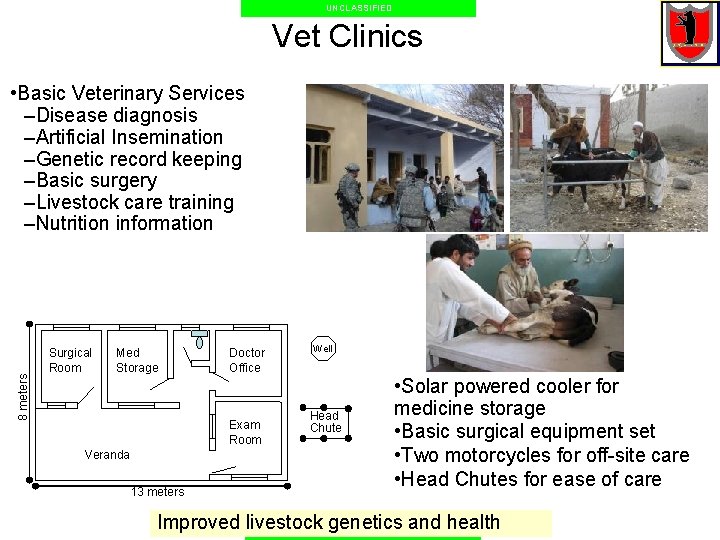
UNCLASSIFIED Vet Clinics 8 meters • Basic Veterinary Services –Disease diagnosis –Artificial Insemination –Genetic record keeping –Basic surgery –Livestock care training –Nutrition information Surgical Room Med Storage Doctor Office Exam Room Veranda 13 meters Well Head Chute • Solar powered cooler for medicine storage • Basic surgical equipment set • Two motorcycles for off-site care • Head Chutes for ease of care Improved livestock genetics and health UNCLASSIFIED
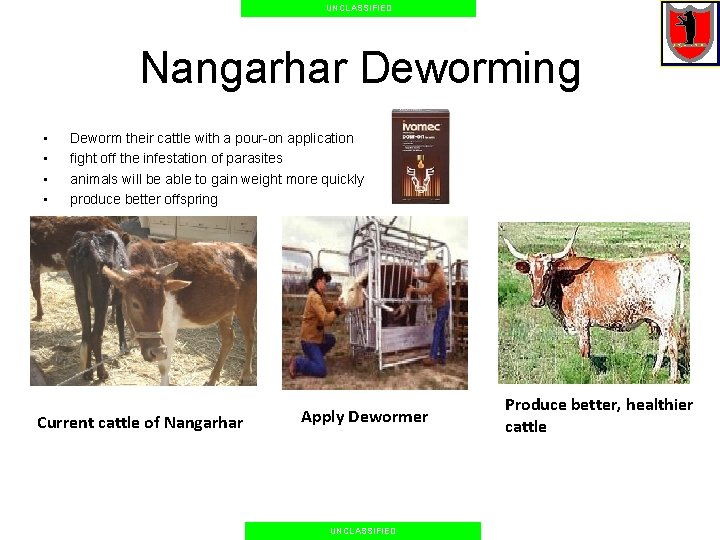
UNCLASSIFIED Nangarhar Deworming • • Deworm their cattle with a pour-on application fight off the infestation of parasites animals will be able to gain weight more quickly produce better offspring Current cattle of Nangarhar Apply Dewormer UNCLASSIFIED Produce better, healthier cattle
UNCLASSIFIED Questions and Discussion UNCLASSIFIED
- Slides: 27