
UNCLASSIFIED Joint Requirements Office for Chemical Biological Radiological
UNCLASSIFIED Joint Requirements Office for Chemical, Biological, Radiological, and Nuclear Defense World Wide Chemical Conference October 23, 2003 UNCLASSIFIED
UNCLASSIFIED Agenda • JRO - Overview • JRO - Today • Changes and Evolutions • The Way Ahead UNCLASSIFIED
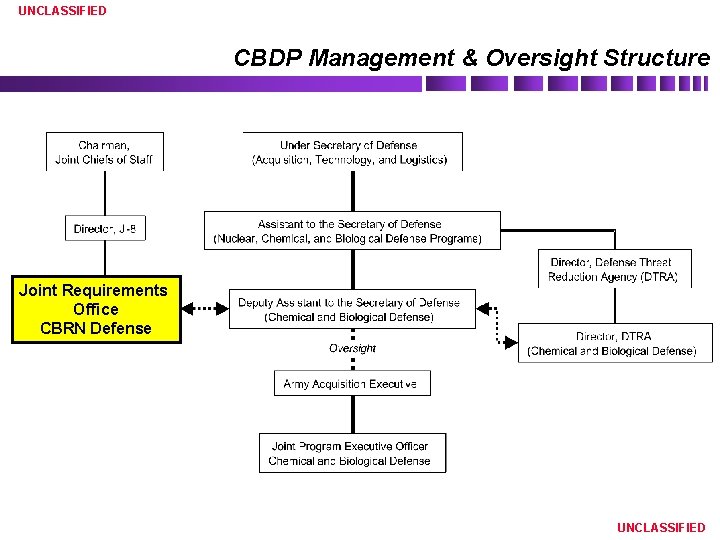
UNCLASSIFIED CBDP Management & Oversight Structure Joint Requirements Office CBRN Defense UNCLASSIFIED
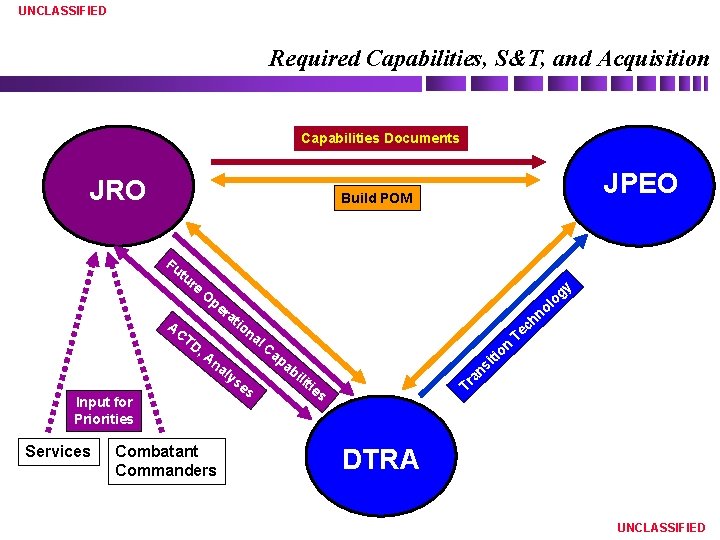
UNCLASSIFIED Required Capabilities, S&T, and Acquisition Capabilities Documents JRO JPEO Build POM Fu tu re gy O pe ra AC TD tio na l. C , A na ap ly se Input for Priorities Services Combatant Commanders o ol s on hn c e T ti ab ili si n ra tie T s DTRA UNCLASSIFIED
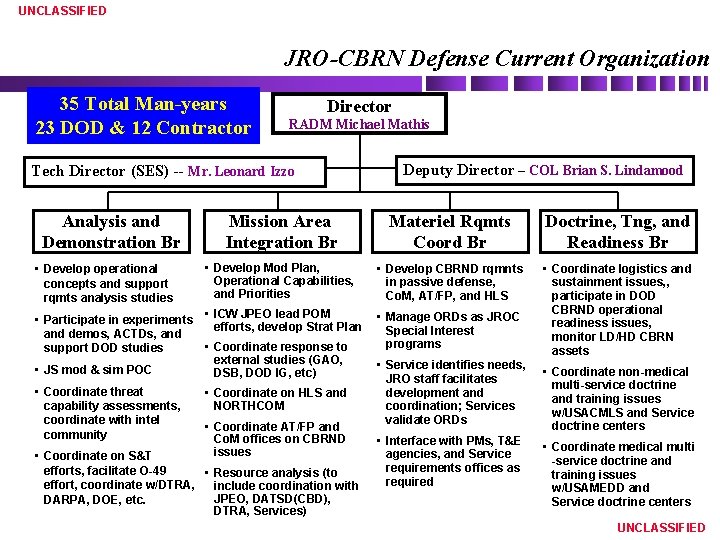
UNCLASSIFIED JRO-CBRN Defense Current Organization 35 Total Man-years 23 DOD & 12 Contractor Director RADM Michael Mathis Tech Director (SES) -- Mr. Leonard Izzo Analysis and Demonstration Br • Develop operational concepts and support rqmts analysis studies Deputy Director – COL Brian S. Lindamood Mission Area Integration Br Materiel Rqmts Coord Br Doctrine, Tng, and Readiness Br • Develop Mod Plan, Operational Capabilities, and Priorities • Develop CBRND rqmnts in passive defense, Co. M, AT/FP, and HLS • Coordinate logistics and sustainment issues, , participate in DOD CBRND operational readiness issues, monitor LD/HD CBRN assets • Participate in experiments • ICW JPEO lead POM efforts, develop Strat Plan and demos, ACTDs, and • Coordinate response to support DOD studies external studies (GAO, • JS mod & sim POC DSB, DOD IG, etc) • Coordinate threat • Coordinate on HLS and capability assessments, NORTHCOM coordinate with intel • Coordinate AT/FP and community Co. M offices on CBRND issues • Coordinate on S&T efforts, facilitate O-49 • Resource analysis (to effort, coordinate w/DTRA, include coordination with JPEO, DATSD(CBD), DARPA, DOE, etc. DTRA, Services) • Manage ORDs as JROC Special Interest programs • Service identifies needs, JRO staff facilitates development and coordination; Services validate ORDs • Interface with PMs, T&E agencies, and Service requirements offices as required • Coordinate non-medical multi-service doctrine and training issues w/USACMLS and Service doctrine centers • Coordinate medical multi -service doctrine and training issues w/USAMEDD and Service doctrine centers UNCLASSIFIED
UNCLASSIFIED JRO – CBRN Defense Charter • Single office within DOD responsible for the planning, coordination, and oversight of joint CBRN defense operational requirements – Develop and maintain the CBRN defense Overarching Operational Concept and the CBRND Modernization Plan – Represent the Services and Combatant Commanders in the capabilities generation process and act as their proponent for coordinating and integrating CBRND operational capabilities for materiel and non-materiel solutions – Develop DOD CBD POM with acquisition community support – Facilitate the development of joint doctrine and training and sponsor the development of multi-service doctrine • Serve as the CJCS’ single source of expertise to address all issues involving CBRN defense within passive defense, consequence management, force protection, and homeland security UNCLASSIFIED
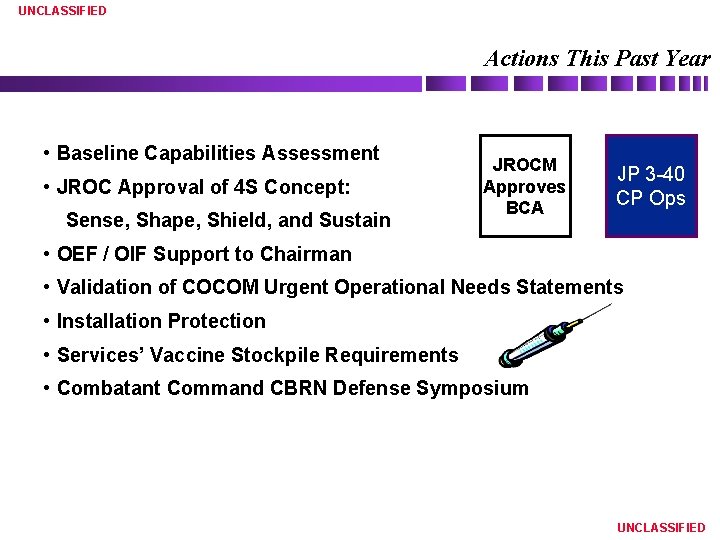
UNCLASSIFIED Actions This Past Year • Baseline Capabilities Assessment • JROC Approval of 4 S Concept: Sense, Shape, Shield, and Sustain JROCM Approves BCA JP 3 -40 CP Ops • OEF / OIF Support to Chairman • Validation of COCOM Urgent Operational Needs Statements • Installation Protection • Services’ Vaccine Stockpile Requirements • Combatant Command CBRN Defense Symposium UNCLASSIFIED

UNCLASSIFIED Joint CBRN Defense Functional Concept – Operational Attributes SH N AI ST SU • SHIELD –The capability to shield the force from harm caused by CBRN hazards by preventing or reducing individual and collective exposures, applying prophylaxis to prevent or mitigate negative physiological effects, and protecting critical equipment IE LD • SHAPE – Provides the ability to characterize the CBRN hazard to the force commander - develop a clear understanding of the current and predicted CBRN situation; collect, query, and assimilate info from sensors, intelligence, medical, etc. , in near real time to inform personnel, provide actual and potential impacts of CBRN hazards; envision critical SENSE, SHIELD and SUSTAIN end states (preparation for operations); visualize the sequence of events that moves the force from its current state to those end states. SHAPE • SUSTAIN – The ability to conduct decontamination and medical actions that enable the quick restoration of combat power, maintain/recover essential functions that are free from the effects of CBRN hazards, and facilitate the return to preincident operational capability as soon as possible. SENSE • SENSE – The capability to continually provide the information about the CBRN situation at a time and place by detecting, identifying, and quantifying CBRN hazards in air, water, on land, on personnel, equipment or facilities. This capability includes detecting, identifying, and quantifying those CBRN hazards in all physical states (solid, liquid, gas). UNCLASSIFIED
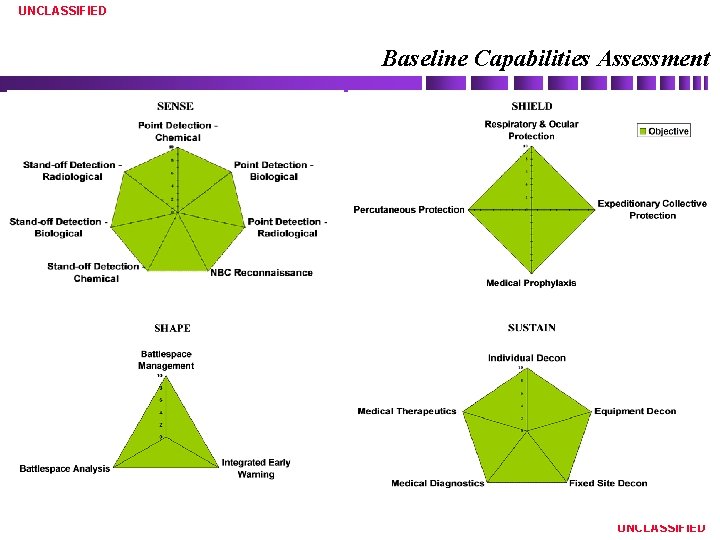
UNCLASSIFIED Baseline Capabilities Assessment UNCLASSIFIED
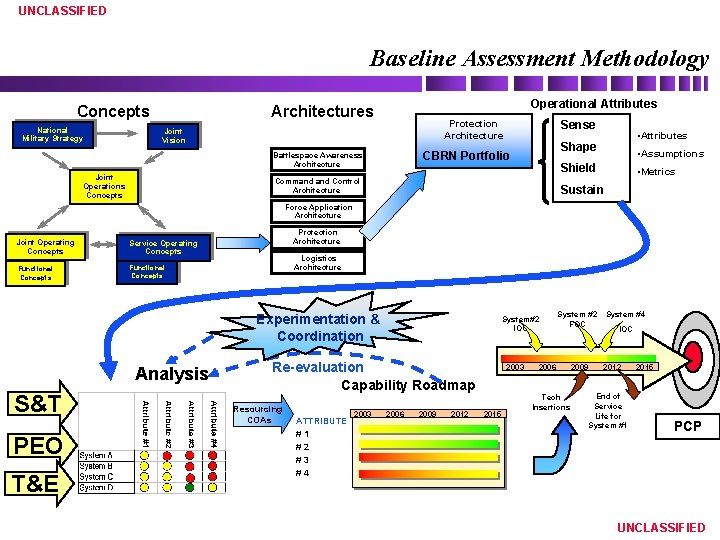
UNCLASSIFIED Baseline Assessment Methodology Concepts National Military Strategy Operational Attributes Architectures Protection Architecture Joint Vision DM Battlespace Awareness Architecture Joint Operations Concepts Sense • Attributes Shape CBRN Portfolio • Assumptions Shield Command Control Architecture • Metrics Sustain Force Application Architecture Joint Operating Concepts Service Operating Concepts Functional Concepts Protection Architecture Logistics Architecture Experimentation & Coordination Analysis S&T PEO T&E System#2 IOC Re-evaluation Capability Roadmap Resourcing COAs ATTRIBUTE #1 #2 #3 #4 2003 2006 2009 2012 2003 2015 System #2 FOC 2006 Tech Insertions 2009 System #4 IOC 2012 End of Service Life for System #1 2015 PCP UNCLASSIFIED
UNCLASSIFIED Installation Protection • Developed a priority list of 200 installations to receive CB protection • Developed a “Do. D Concepts of Operation for CBRNE Defense Supporting US Military Installations and Facility Preparedness” – Establishes a single foundation for Services, COCOMs, and Do. D agencies to tailor their CONOPS • Developed “Standards for US Military Installations and Facility CBRNE Defense” as directed by DEPSECDEF – Leverages CBRN Defense standards with current Do. D AT standards • Developed ONS to implement the CB Installation Force Protection Program (Guardian) UNCLASSIFIED
UNCLASSIFIED Training and Doctrine • Training & Education – Combatant Command Support • Joint Staff Officer NBCD Familiarization Course • Exercise Support (4 Phases of JTS, Red Team Training) • CBRN Defense Senior Leader Seminars – Professional Military Education Support • Curriculum Assistance and Development • Faculty Training & Guest Speaker Program • Wargame Support • Doctrine – CBRND MTTP Program • 11 Non-Medical & 4 Medical Manuals – Act as the Joint Staff sponsor to support the development of joint CBRN defense doctrine and MTTP – Joint Doctrine Reviews – RESTOPS Transition IPT CONOPS/TTP WG UNCLASSIFIED
UNCLASSIFIED Exercises • JFCOM – CBRN Defense Technical Assistance to a Capability Initiative Improvement Team (CIIT) • NORTHCOM Determine Promise-04 – CBRN Defense Support to 4 Phases of Joint Training System (Requirements, Plans Execution, Analysis) • PACOM Counter-Bio Initiative UNCLASSIFIED
UNCLASSIFIED Materiel Requirements • New Joint Capabilities Integration and Development System – CJCSM 3170. 01 and CJCSI 3170. 01 C, 24 Jun 03 – Drive “jointness” from the top-down, strengthening joint warfighting capabilities – Links strategic direction to strategic investment decision making and acquisition policy – Enables a more responsive acquisition system – Provides an engine force transformation – Integrates material and non-material solutions to capability gaps and shortfalls – Frames discussions of alternatives using common language of metrics UNCLASSIFIED
UNCLASSIFIED ACTD Support • Restoration of Operations (Rest. Ops) – Purpose – Mitigate fixed site CB vulnerability, restore critical operations to minimize impact on the warfight (FY 01 -05) – Sponsor – US Pacific Command (PACOM) – Final Demo – Feb 03, Osan Air Force Base, Korea; Residual and Transition Phase – Apr 03 -Apr 05 – Transition Integrated Process Team (IPT) Co-chairs – Joint Requirements Office (JRO) and US Air Force • Contamination Avoidance at Sea Ports of Debarkation (CASPOD) – Purpose – Mitigate SPOD CB or toxic industrial material (TIM) vulnerability, minimize impact on force flow and operational tempo during the initial stages of power projection (FY 02 -06) – Sponsor – US Central Command (CENTCOM) – Prelim Demo – Aug/Sep 03, Naval Weapons Station Charleston, SC; Final Demo – Sep 04, TBD – Transition IPT Chair – Joint Program Executive Office (JPEO-CBD), with JRO support UNCLASSIFIED
UNCLASSIFIED Studies & Analyses • Front End Analysis (FEA) of Joint CBRN Defense Concept Experimentation – Develop a strategy for the CBRN Defense enabling concept • CBRN Defense Medical Training and Doctrine Analysis – Analyze gaps, redundancies, inconsistencies • CBRN Functional Area Analysis (FAA), Functional Needs Analysis (FNA) and Functional Solution Analysis (FSA) – Analysis to transition from “requirements” to “capabilities” • Challenge Levels of Chemical and Biological Agents – Evaluate threat agent levels in time, space, and quantity • CBR Sensor Mix and Distribution – Examine optimum sensor mix across a set of vignettes • Biological Operations Assessment – Develop detailed tabletop exercises to examine responses UNCLASSIFIED
UNCLASSIFIED Internal Initiatives • Improving communication with Services and COCOMs • Integration of US Coast Guard • Expanding the Counterproliferation portfolio to include other aspects of the national strategy: - Active defense - Proliferation Security Initiative - Consequence management • Focus S&T on prioritized capabilities gaps • Joint Experimentation Program • Department of Homeland Security UNCLASSIFIED
UNCLASSIFIED Supporting Combatant Commands and Services • Materiel and Non-Materiel Solutions – Validation of ONS – Training & Doctrine – Exercises – Lessons Learned Library • Enhanced Information Exchange – Web-based interactive info sharing – Designated POCs in JRO – Conferences / working teams We serve the Combatant Commands and Services as their advocate in CBRN Defense issues. UNCLASSIFIED
UNCLASSIFIED Combatant Command CBRN Defense Symposium • Fourth Annual Symposium held June 2003 • CBDP Overview • Combatant Command Issues • Passive Defense • Force Protection • Consequence Management • Guest speaker: GEN (Ret) Barry Mc. Caffrey UNCLASSIFIED
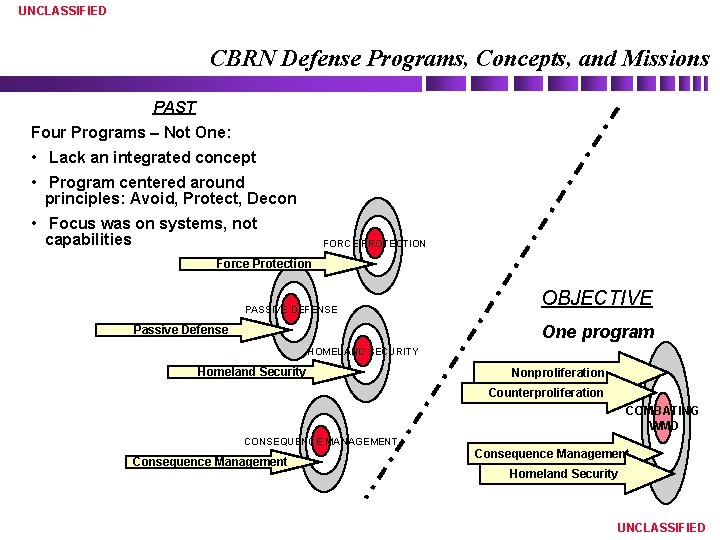
UNCLASSIFIED CBRN Defense Programs, Concepts, and Missions PAST Four Programs – Not One: • Lack an integrated concept • Program centered around principles: Avoid, Protect, Decon • Focus was on systems, not capabilities FORCE PROTECTION Force Protection PASSIVE DEFENSE OBJECTIVE One program Passive Defense HOMELAND SECURITY Homeland Security Nonproliferation Counterproliferation COMBATING WMD CONSEQUENCE MANAGEMENT Consequence Management Homeland Security UNCLASSIFIED
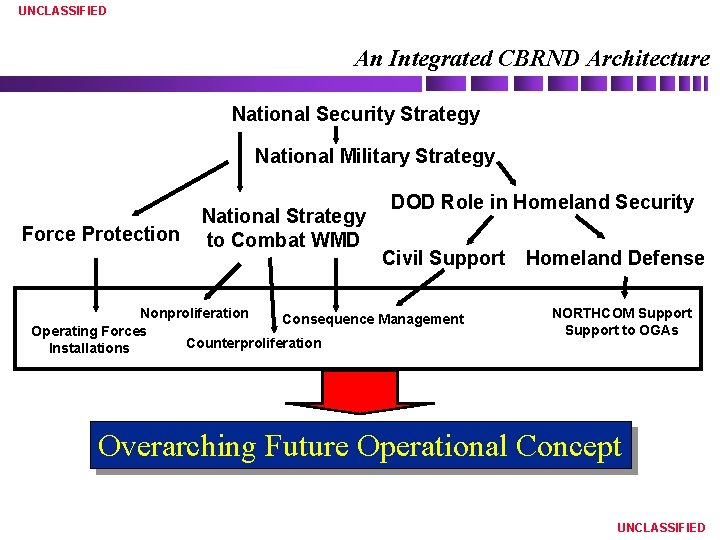
UNCLASSIFIED An Integrated CBRND Architecture National Security Strategy National Military Strategy Force Protection National Strategy to Combat WMD DOD Role in Homeland Security Civil Support Homeland Defense Nonproliferation Consequence Management Operating Forces Counterproliferation Installations NORTHCOM Support to OGAs Overarching Future Operational Concept UNCLASSIFIED
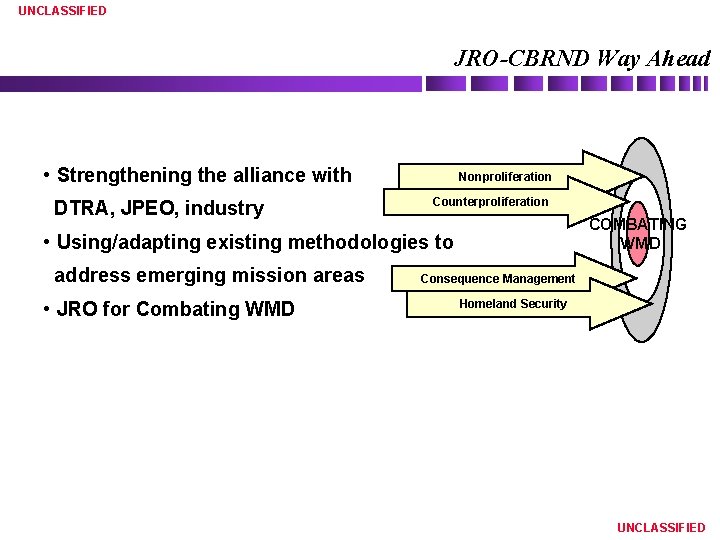
UNCLASSIFIED JRO-CBRND Way Ahead • Strengthening the alliance with DTRA, JPEO, industry Nonproliferation Counterproliferation COMBATING WMD • Using/adapting existing methodologies to address emerging mission areas • JRO for Combating WMD Consequence Management Homeland Security UNCLASSIFIED
- Slides: 22