
Unclassified Global Force Management Data Initiative Joint Staff
Unclassified Global Force Management Data Initiative Joint Staff, J-8 14 December 2004 1 Unclassified
Unclassified Global Force Management Purpose To provide a high level overview of the Global Force Management (GFM) and the Force Structure Construct (FSC), specifically: – Documentation of the Do. D Force Structure – The unique identification of force structure elements across the GIG, and – The data dissemination processes 2 Unclassified

Unclassified GFM Bottom Line • Force structure pulls everything together – Readiness reporting – Resources (including personnel & equipment) – Capabilities • Devil’s in the details – Need commonality between Services – Need common naming (Enterprise-Wide Identifiers) – Default operational force structures • Starting point for any joint task organization • Readiness – Reporting is based on force structure – Personnel & Materiel are tied in below the UIC level – Reporting must be rigorous for any task organization 3 Unclassified
Unclassified Global Force Management Direction • Document the “Authorized” force structure in a single, authoritative data source (ADS) • Improve the Sec. Def's ability to manage risk across current worldwide operations, warfighting capabilities, and future force capability needs (i. e. , Assignment, Allocation, and Apportionment) • Make net-centric GFM data transparent, easily accessible to all users, and shared using common standards and resources • GFM is referred to two distinct ways: – The GFM Process – GFM Data 4 Unclassified
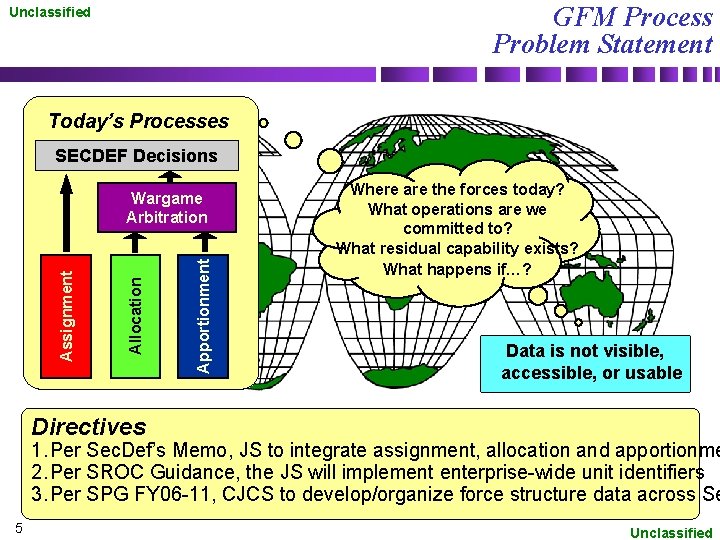
GFM Process Problem Statement Unclassified Today’s Processes SECDEF Decisions Apportionment Allocation Assignment Wargame Arbitration Where are the forces today? What operations are we committed to? What residual capability exists? What happens if…? Data is not visible, accessible, or usable Directives 1. Per Sec. Def’s Memo, JS to integrate assignment, allocation and apportionme 2. Per SROC Guidance, the JS will implement enterprise-wide unit identifiers 3. Per SPG FY 06 -11, CJCS to develop/organize force structure data across Se 5 Unclassified
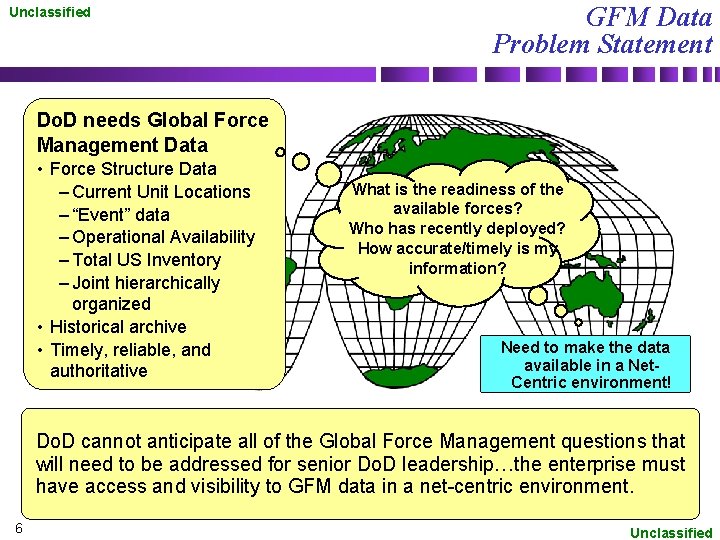
Unclassified GFM Data Problem Statement Do. D needs Global Force Management Data • Force Structure Data – Current Unit Locations – “Event” data – Operational Availability – Total US Inventory – Joint hierarchically organized • Historical archive • Timely, reliable, and authoritative What is the readiness of the available forces? Who has recently deployed? How accurate/timely is my information? Need to make the data available in a Net. Centric environment! Do. D cannot anticipate all of the Global Force Management questions that will need to be addressed for senior Do. D leadership…the enterprise must have access and visibility to GFM data in a net-centric environment. 6 Unclassified
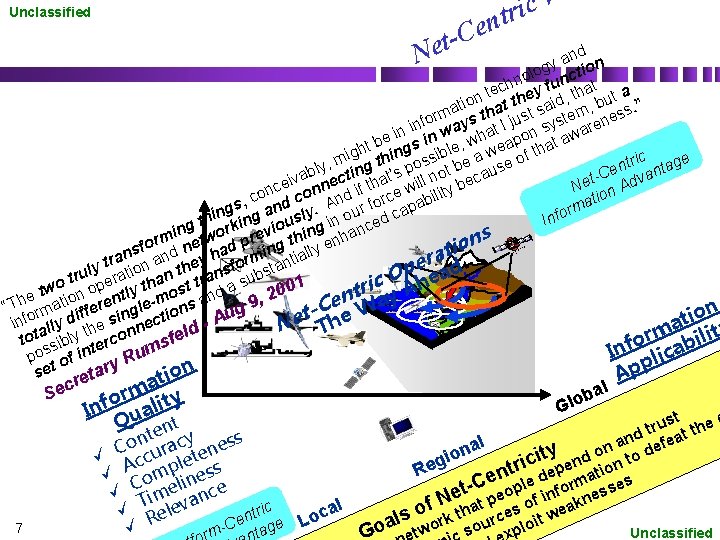
c i r t en Unclassified -C t e N and n y log nctio o n h u tec hey f , that ut a n tio at t said m, b s. ” a m th just ste r es o s n f y y e n I in i in wa what pon s awar e ht b ings ible, wea f that g i tric tage , m ng th poss t be a use o n y l e t-C Advan vab necti that's ill no beca i e e N onc con nd if rce w bility c tion , a o a d A f s orm ing ng an usly. in our d cap f h n I t i e ing twork revio hing hanc s m t r ne n n p e o g o f d i y n t a ans n and ey ha ormi ntiall r r t e p ead uly ratio an th ransf ubsta r O t s e t 1 ic Ah r two on op ntly th ost nd a , 200 t e y n a e “Th rmati ffere gle-m ons a ug 9 C n - e. W o n cti i t o i i f d A e t s n i a N Th ally ly the onne feld m t it r l o i t c b o r i s f b s te In lica um pos of in R p n ry p a o set t i A e t 61 r c e S 7 a m r y o Inf ualit Q ent s y nt Co curac tenes ü Ac le s p ü Com lines ü Time ance al ric ü Relev t c n o e e L ü m-C tag ter Thea el. MBR ent t en Hz em em 8 G 4 elel A 64 2548 RAP 4 TP T MB / Hz. 2 7 G el 169 0 l ba o l G ust the e r t d at n e l a f y d on to de t ona i i c g ri epen tion t Re n e le d rma es C t e t peop f info kness N f tha es o ea o w s c oal twork sour ploit Unclassified
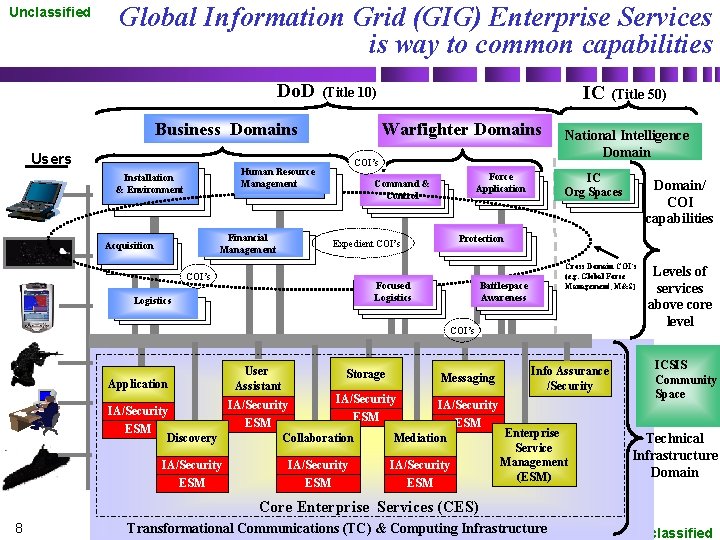
Unclassified Global Information Grid (GIG) Enterprise Services is way to common capabilities Do. D Warfighter Domains Business Domains Users Human Resource Management Installation & Environment Financial Management Acquisition COI’s IC (Title 10) COI’s Force Application Command & Control Expedient COI’s National Intelligence Domain IC Org Spaces Cross Domain COI’s (e. g. Global Force Management, M&S) Battlespace Awareness COI’s Application User Assistant Storage Domain/ COI capabilities COI’ Protection s Focused Logistics (Title 50) Messaging Info Assurance /Security IA/Security ESM ESM Enterprise Discovery Collaboration Mediation Service Management IA/Security (ESM) ESM ESM Levels of services above core level ICSIS Community Space Technical Infrastructure Domain Core Enterprise Services (CES) 8 Transformational Communications (TC) & Computing Infrastructure Unclassified
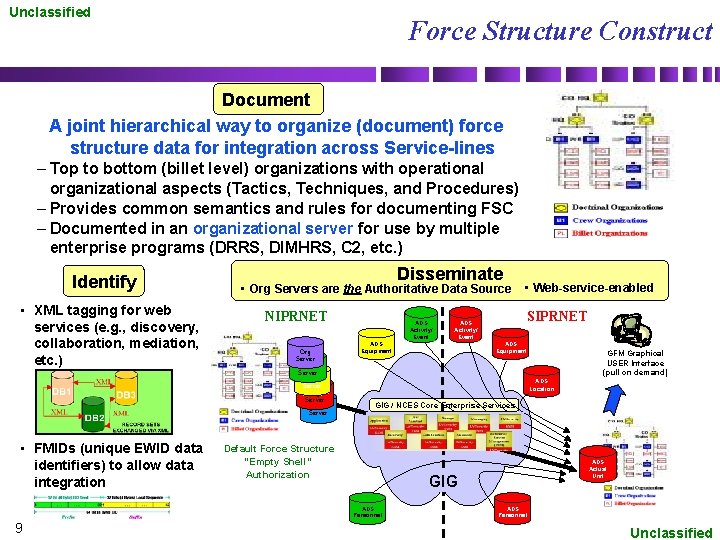
Unclassified Force Structure Construct Document A joint hierarchical way to organize (document) force structure data for integration across Service-lines – Top to bottom (billet level) organizations with operational organizational aspects (Tactics, Techniques, and Procedures) – Provides common semantics and rules for documenting FSC – Documented in an organizational server for use by multiple enterprise programs (DRRS, DIMHRS, C 2, etc. ) Identify • XML tagging for web services (e. g. , discovery, collaboration, mediation, etc. ) • FMIDs (unique EWID data identifiers) to allow data integration Disseminate • Org Servers are the Authoritative Data Source NIPRNET Org Server Org Server ADS Equipment ADS Activity/ Event SIPRNET ADS Equipment GFM Graphical USER Interface (pull on demand) ADS Location GIG / NCES Core Enterprise Services Default Force Structure “Empty Shell” Authorization ADS Actual Unit GIG ADS Personnel 9 ADS Activity/ Event • Web-service-enabled ADS Personnel Unclassified
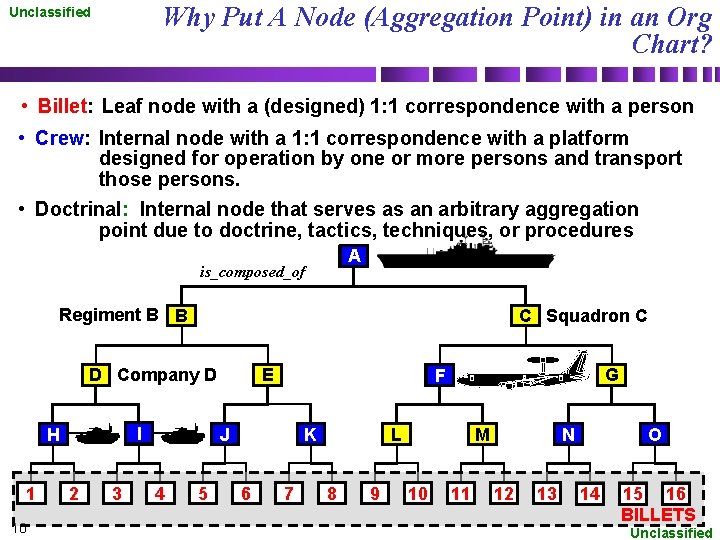
Why Put A Node (Aggregation Point) in an Org Chart? Unclassified • Billet: Leaf node with a (designed) 1: 1 correspondence with a person • Crew: Internal node with a 1: 1 correspondence with a platform designed for operation by one or more persons and transport those persons. • Doctrinal: Internal node that serves as an arbitrary aggregation point due to doctrine, tactics, techniques, or procedures A is_composed_of Regiment B B C Squadron C D Company D I H 1 10 2 3 E F J 4 5 K 6 7 G L 8 9 N M 10 11 12 13 O 14 15 16 BILLETS Unclassified
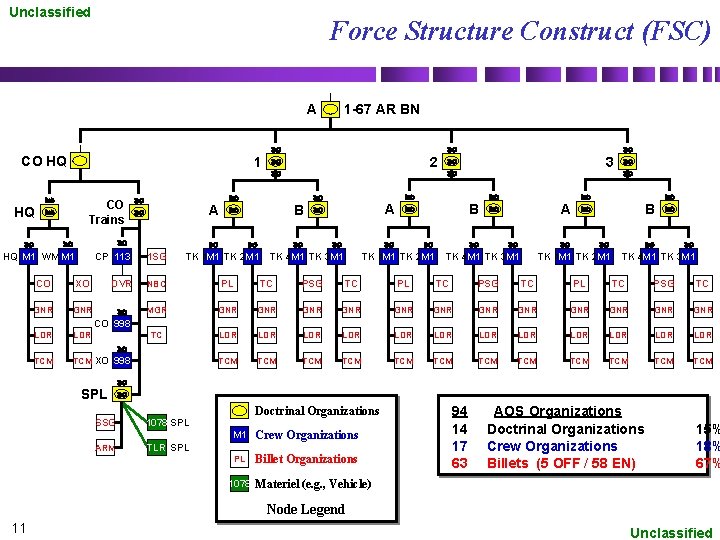
Unclassified Force Structure Construct (FSC) | A | CO HQ HQ 1 CO Trains HQ M 1 WM M 1 A 1 -67 AR BN 2 B A 3 B A B CP 113 1 SG DVR NBC PL TC PSG TC CO 998 MGR GNR GNR GNR TC LDR LDR LDR TCM TCM TCM CO XO GNR LDR TCM XO 998 SPL SSG ARM TK 1 M 1 TK 2 M 1 TK 4 M 1 TK 3 M 1 Doctrinal Organizations 1078 SPL M 1 Crew Organizations PL Billet Organizations TLR SPL 1078 94 14 17 63 AOS Organizations Doctrinal Organizations Crew Organizations Billets (5 OFF / 58 EN) 15% 18% 67% Materiel (e. g. , Vehicle) Node Legend 11 Unclassified
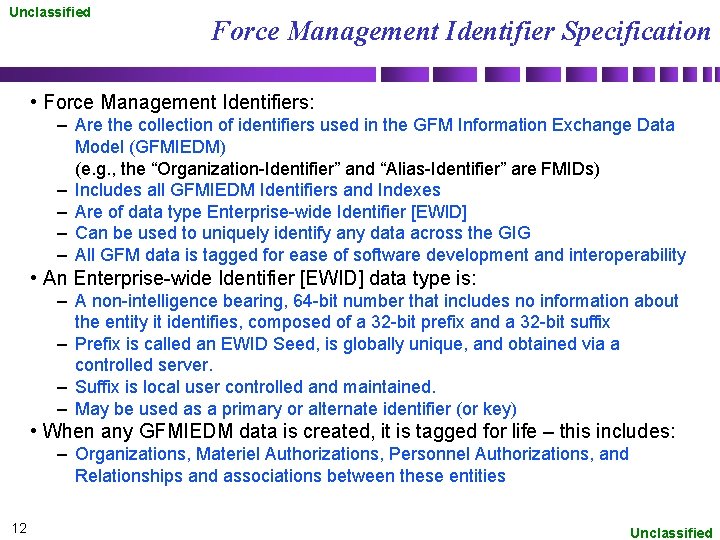
Unclassified Force Management Identifier Specification • Force Management Identifiers: – Are the collection of identifiers used in the GFM Information Exchange Data Model (GFMIEDM) (e. g. , the “Organization-Identifier” and “Alias-Identifier” are FMIDs) – Includes all GFMIEDM Identifiers and Indexes – Are of data type Enterprise-wide Identifier [EWID] – Can be used to uniquely identify any data across the GIG – All GFM data is tagged for ease of software development and interoperability • An Enterprise-wide Identifier [EWID] data type is: – A non-intelligence bearing, 64 -bit number that includes no information about the entity it identifies, composed of a 32 -bit prefix and a 32 -bit suffix – Prefix is called an EWID Seed, is globally unique, and obtained via a controlled server. – Suffix is local user controlled and maintained. – May be used as a primary or alternate identifier (or key) • When any GFMIEDM data is created, it is tagged for life – this includes: – Organizations, Materiel Authorizations, Personnel Authorizations, and Relationships and associations between these entities 12 Unclassified
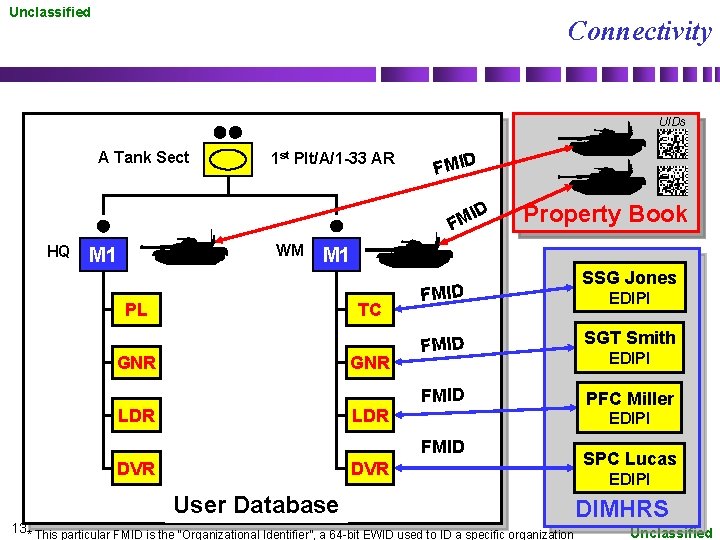
Unclassified Connectivity UIDs A Tank Sect 1 st Plt/A/1 -33 AR FMID ID FM HQ WM M 1 Property Book M 1 PL TC GNR LDR FMID SSG Jones TC FMID SGT Smith GNR FMID PFC Miller LDR EDIPI FMID DVR EDIPI DVR User Org. Database Server 13* This particular FMID is the “Organizational Identifier”, a 64 -bit EWID used to ID a specific organization SPC Lucas DVR EDIPI DIMHRS Unclassified
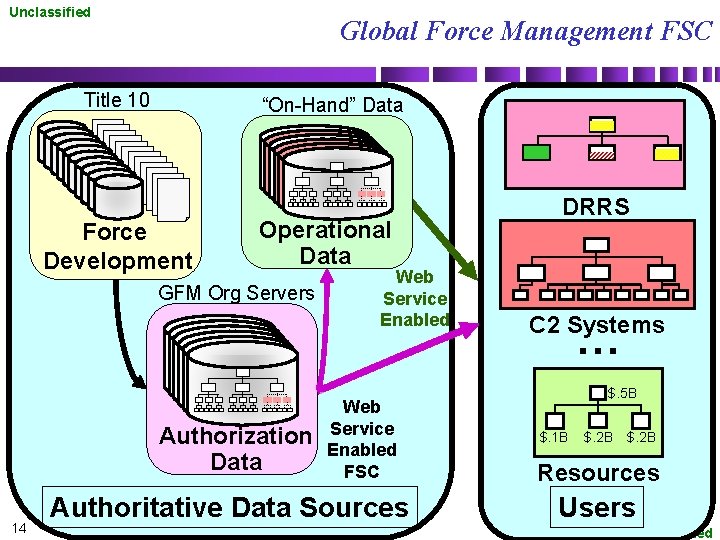
Unclassified Global Force Management FSC Title 10 “On-Hand” Data Force Development Operational Data GFM Org Servers Authorization Data 14 Web Service Enabled FSC Authoritative Data Sources DRRS C 2 Systems … $. 5 B $. 1 B $. 2 B Resources Users Unclassified
Unclassified GFM Data Prototype Effort • Preparing a “Combat Slice” from each of the Services and putting it into GFMIEDM format – Navy – Expeditionary Strike Group (ESG) – USMC – Marine Expeditionary Unit (MEU) – Army – Unit of Action (UA) – Air Force – 4 th Fighter Wing • Simultaneously preparing the Concept of the Operations (CONOPS) in three areas: – Organization Server Operations – Allocation, Assignment & Apportionment process – GFM in a net-centric environment 15 Unclassified
Unclassified Summary • Force Structure is the central integrating theme (i. e. , the “foundation”) for Global Force Management • The GFM Force Structure Construct is an organizational way to electronically document force structure data – A fully-articulated, hierarchal, default force structure that will be the authoritative source for authorized force structure data for use by all systems within the Do. D enterprise – A net-centric means of accessing this information (XML & Web Service enabling) – Enterprise-Wide Identifiers (EWID) for tagging data for organizations, manpower, and equipment authorizations within Do. D • POC is Mike Boller (SAIC, ISO Joint Staff, J-8, MASO) – (703) 614 -6772 michael. boller@js. pentagon. mil 16 Unclassified
Unclassified Back-Up Slides 17 Unclassified
- Slides: 17