
UNCLASSIFIED Assistant Deputy Minister Infrastructure Environment Rob Chambers
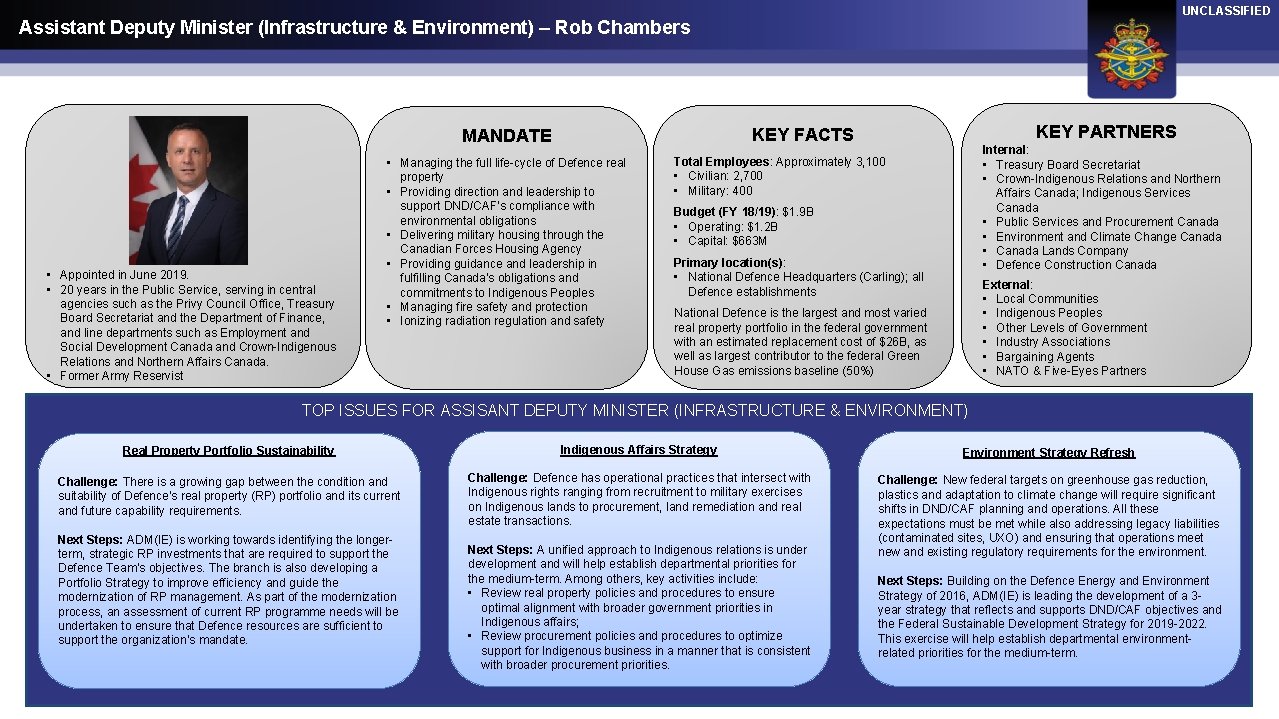
UNCLASSIFIED Assistant Deputy Minister (Infrastructure & Environment) – Rob Chambers L 1 picture • Appointed in June 2019. • 20 years in the Public Service, serving in central agencies such as the Privy Council Office, Treasury Board Secretariat and the Department of Finance, and line departments such as Employment and Social Development Canada and Crown-Indigenous Relations and Northern Affairs Canada. • Former Army Reservist KEY PARTNERS KEY FACTS MANDATE • Managing the full life-cycle of Defence real property • Providing direction and leadership to support DND/CAF’s compliance with environmental obligations • Delivering military housing through the Canadian Forces Housing Agency • Providing guidance and leadership in fulfilling Canada’s obligations and commitments to Indigenous Peoples • Managing fire safety and protection • Ionizing radiation regulation and safety Internal: • Treasury Board Secretariat • Crown-Indigenous Relations and Northern Affairs Canada; Indigenous Services Canada • Public Services and Procurement Canada • Environment and Climate Change Canada • Canada Lands Company • Defence Construction Canada Total Employees: Approximately 3, 100 • Civilian: 2, 700 • Military: 400 Budget (FY 18/19): $1. 9 B • Operating: $1. 2 B • Capital: $663 M Primary location(s): • National Defence Headquarters (Carling); all Defence establishments External: • Local Communities • Indigenous Peoples • Other Levels of Government • Industry Associations • Bargaining Agents • NATO & Five-Eyes Partners National Defence is the largest and most varied real property portfolio in the federal government with an estimated replacement cost of $26 B, as well as largest contributor to the federal Green House Gas emissions baseline (50%) TOP ISSUES FOR ASSISANT DEPUTY MINISTER (INFRASTRUCTURE & ENVIRONMENT) Real Property Portfolio Sustainability Indigenous Affairs Strategy Environment Strategy Refresh Challenge: There is a growing gap between the condition and suitability of Defence’s real property (RP) portfolio and its current and future capability requirements. Challenge: Defence has operational practices that intersect with Indigenous rights ranging from recruitment to military exercises on Indigenous lands to procurement, land remediation and real estate transactions. Challenge: New federal targets on greenhouse gas reduction, plastics and adaptation to climate change will require significant shifts in DND/CAF planning and operations. All these expectations must be met while also addressing legacy liabilities (contaminated sites, UXO) and ensuring that operations meet new and existing regulatory requirements for the environment. Next Steps: ADM(IE) is working towards identifying the longerterm, strategic RP investments that are required to support the Defence Team’s objectives. The branch is also developing a Portfolio Strategy to improve efficiency and guide the modernization of RP management. As part of the modernization process, an assessment of current RP programme needs will be undertaken to ensure that Defence resources are sufficient to support the organization’s mandate. Next Steps: A unified approach to Indigenous relations is under development and will help establish departmental priorities for the medium-term. Among others, key activities include: • Review real property policies and procedures to ensure optimal alignment with broader government priorities in Indigenous affairs; • Review procurement policies and procedures to optimize support for Indigenous business in a manner that is consistent with broader procurement priorities. Next Steps: Building on the Defence Energy and Environment Strategy of 2016, ADM(IE) is leading the development of a 3 year strategy that reflects and supports DND/CAF objectives and the Federal Sustainable Development Strategy for 2019 -2022. This exercise will help establish departmental environmentrelated priorities for the medium-term.
- Slides: 1