
UNCERTAINTY QUANTIFICATION WITH MONTE CARLO DROPOUT FOR SRF



- Slides: 29
UNCERTAINTY QUANTIFICATION WITH MONTE CARLO DROPOUT FOR SRF CAVITY AND FAULT CLASSIFICATION LASITHA VIDYARATNE 1
OUTLINE • SRF cavity and fault classification task § Problem definition § Data § DRL model • Background § Monte-Carlo Dropout • Cavity and fault classification with UQ § MC dropout implementation • Preliminary results and observations • Summary 2
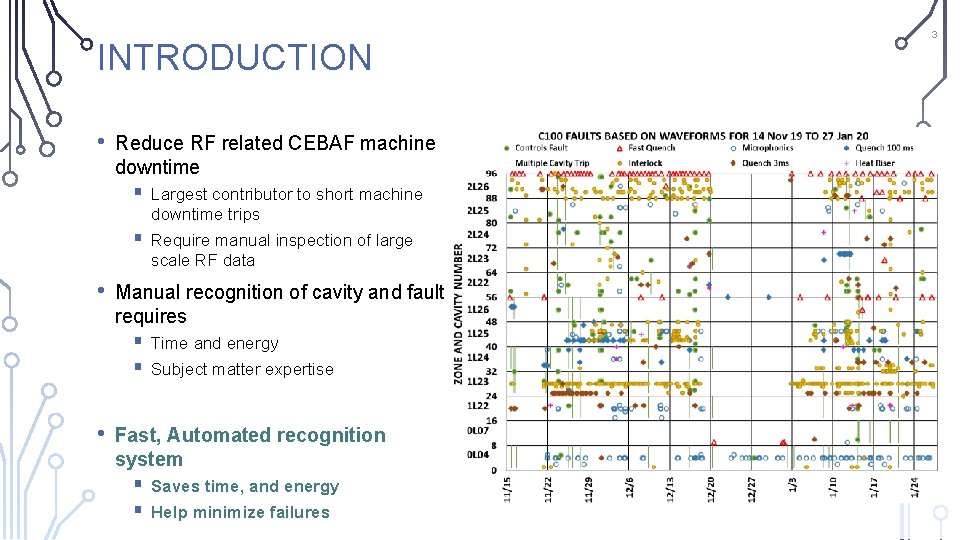
INTRODUCTION • Reduce RF related CEBAF machine downtime § § • Manual recognition of cavity and fault requires § § • Largest contributor to short machine downtime trips Require manual inspection of large scale RF data Time and energy Subject matter expertise Fast, Automated recognition system § § Saves time, and energy Help minimize failures 3
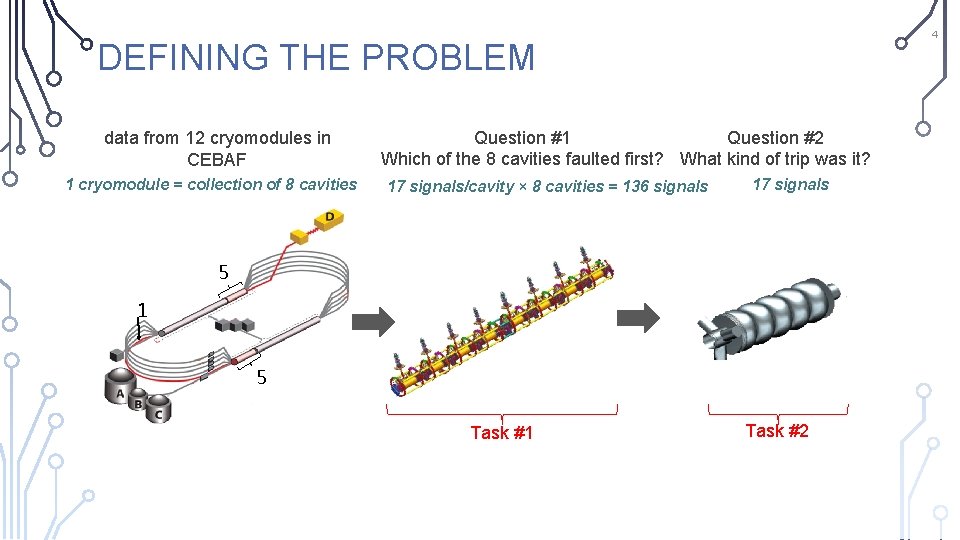
4 DEFINING THE PROBLEM data from 12 cryomodules in CEBAF 1 cryomodule = collection of 8 cavities Question #1 Question #2 Which of the 8 cavities faulted first? What kind of trip was it? 17 signals/cavity × 8 cavities = 136 signals 17 signals 5 1 5 Task #1 Task #2
5 DATA ACQUISITION • Waveform harvester captures RF time-series signals after a fault § 17 waveform signals for each cavity o Each 8, 192 time points long § 94% of recorded data precedes the fault and 6% after fault event … … 8, 192 samples × 0. 2 ms/sample = 1. 64 seconds
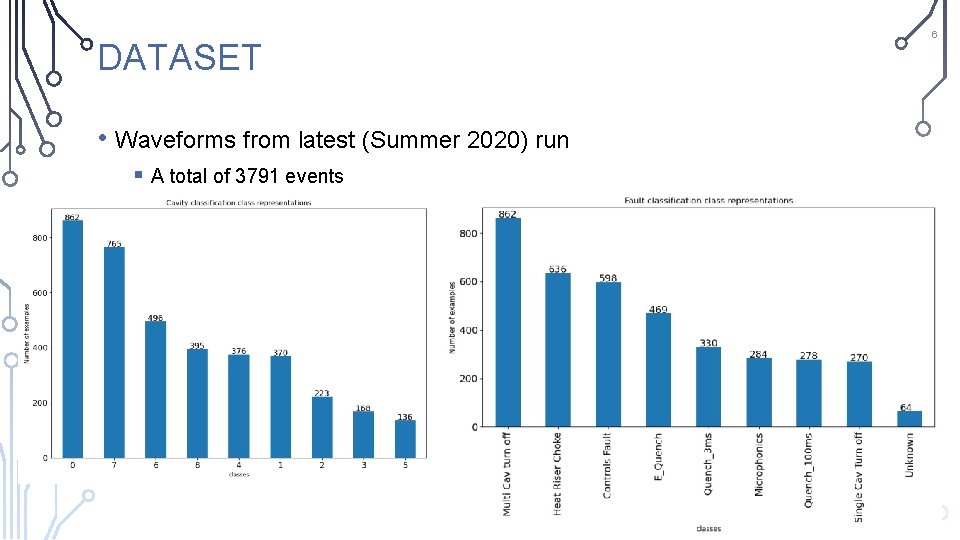
DATASET • Waveforms from latest (Summer 2020) run § A total of 3791 events 6
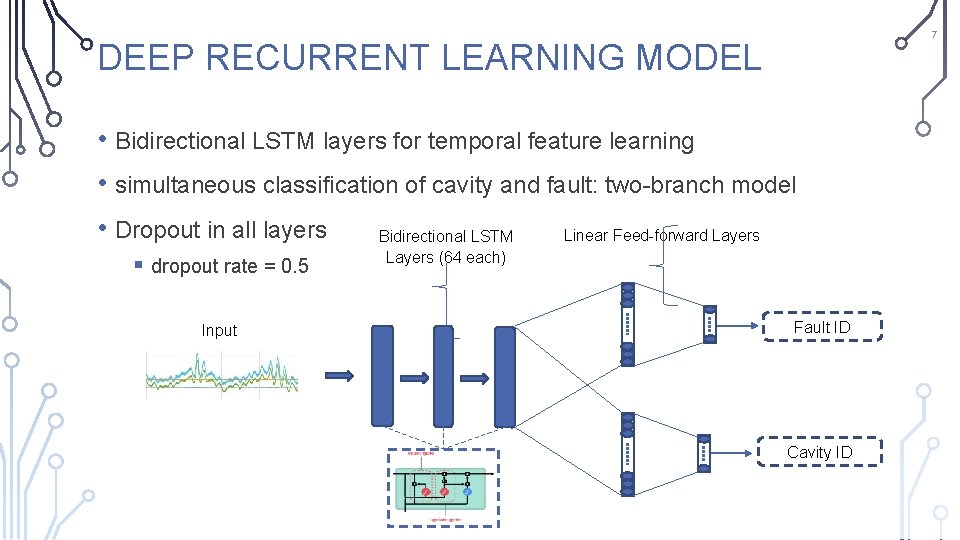
7 DEEP RECURRENT LEARNING MODEL • Bidirectional LSTM layers for temporal feature learning • simultaneous classification of cavity and fault: two-branch model • Dropout in all layers Linear Feed-forward Layers Bidirectional LSTM § dropout rate = 0. 5 Input Layers (64 each) Fault ID Cavity ID
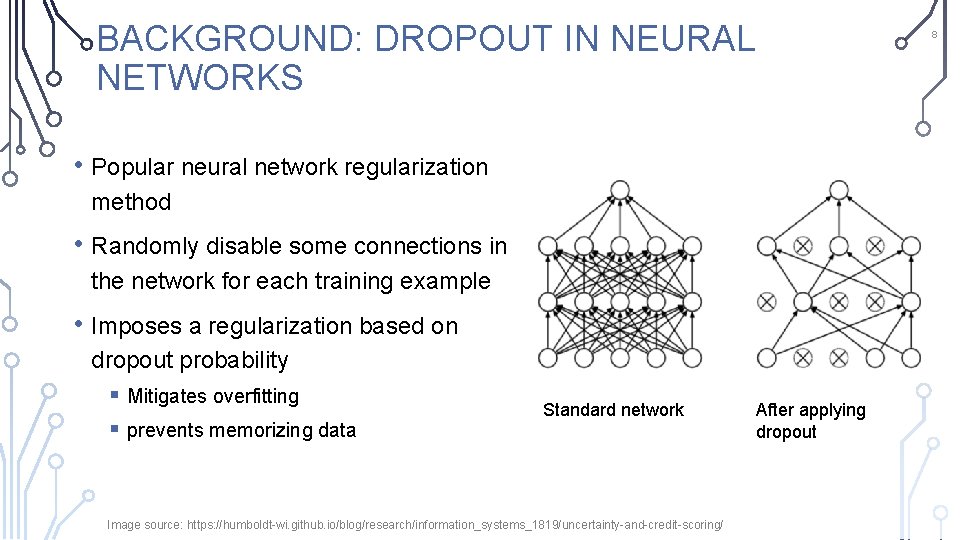
BACKGROUND: DROPOUT IN NEURAL NETWORKS 8 • Popular neural network regularization method • Randomly disable some connections in the network for each training example • Imposes a regularization based on dropout probability § Mitigates overfitting § prevents memorizing data Standard network Image source: https: //humboldt-wi. github. io/blog/research/information_systems_1819/uncertainty-and-credit-scoring/ After applying dropout
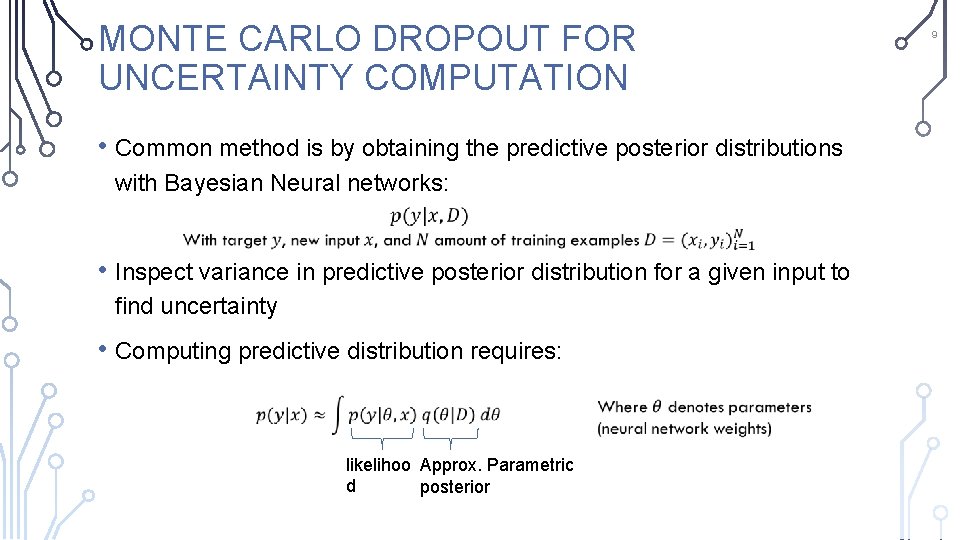
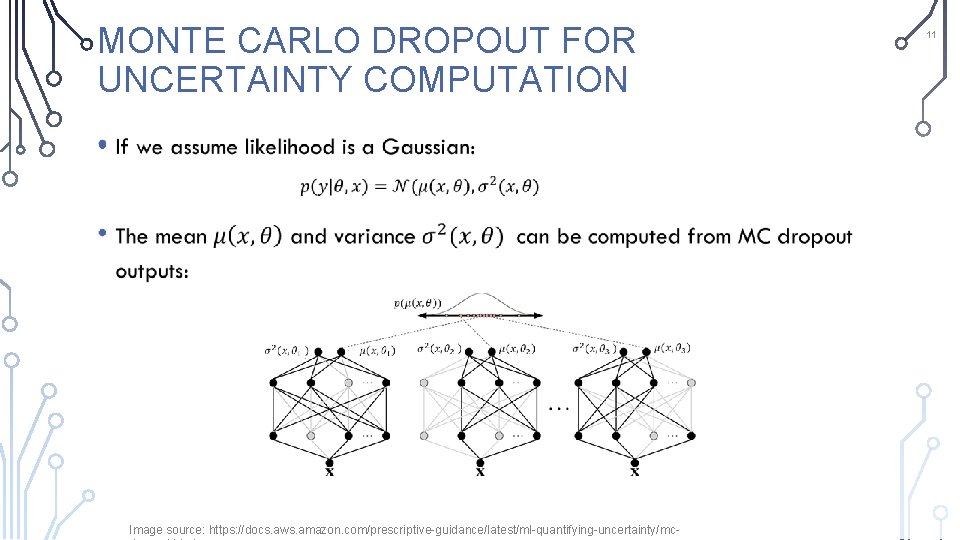
MONTE CARLO DROPOUT FOR UNCERTAINTY COMPUTATION • Common method is by obtaining the predictive posterior distributions with Bayesian Neural networks: • Inspect variance in predictive posterior distribution for a given input to find uncertainty • Computing predictive distribution requires: likelihoo Approx. Parametric d posterior 9
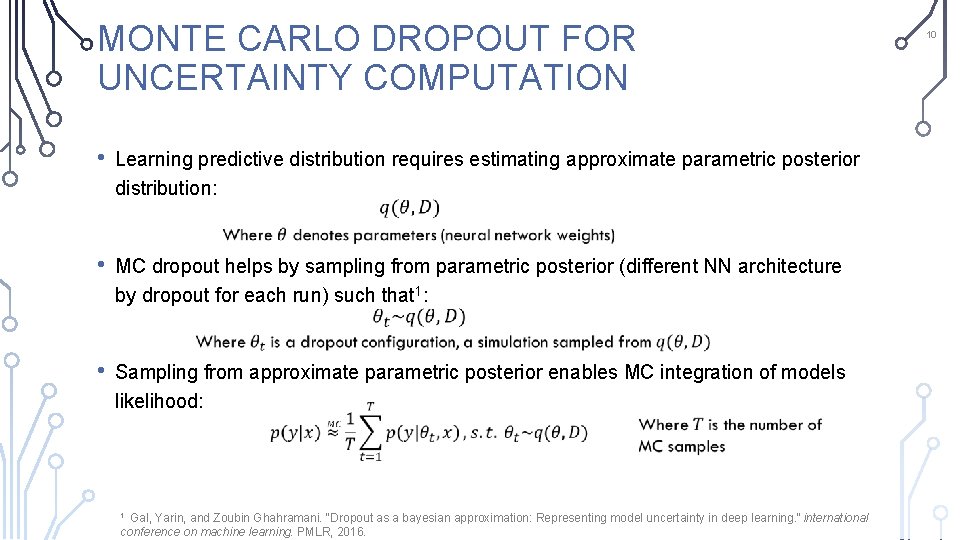
MONTE CARLO DROPOUT FOR UNCERTAINTY COMPUTATION • Learning predictive distribution requires estimating approximate parametric posterior distribution: • MC dropout helps by sampling from parametric posterior (different NN architecture by dropout for each run) such that 1: • Sampling from approximate parametric posterior enables MC integration of models likelihood: Gal, Yarin, and Zoubin Ghahramani. "Dropout as a bayesian approximation: Representing model uncertainty in deep learning. " international conference on machine learning. PMLR, 2016. 1 10
MONTE CARLO DROPOUT FOR UNCERTAINTY COMPUTATION • Image source: https: //docs. aws. amazon. com/prescriptive-guidance/latest/ml-quantifying-uncertainty/mc- 11
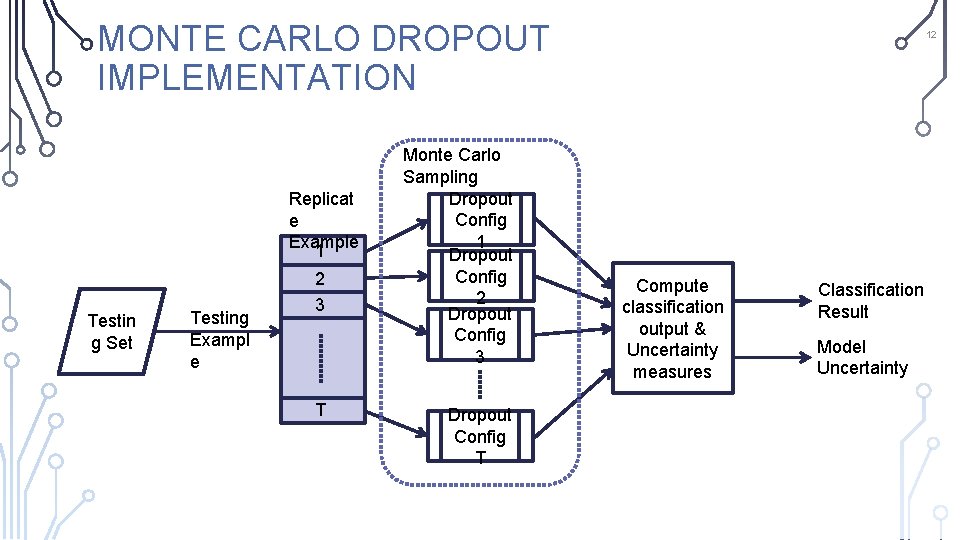
MONTE CARLO DROPOUT IMPLEMENTATION Replicat e Example 1 Testin g Set Testing Exampl e 2 3 T Monte Carlo Sampling Dropout Config 1 Dropout Config 2 Dropout Config 3 Dropout Config T 12 Compute classification output & Uncertainty measures Classification Result Model Uncertainty
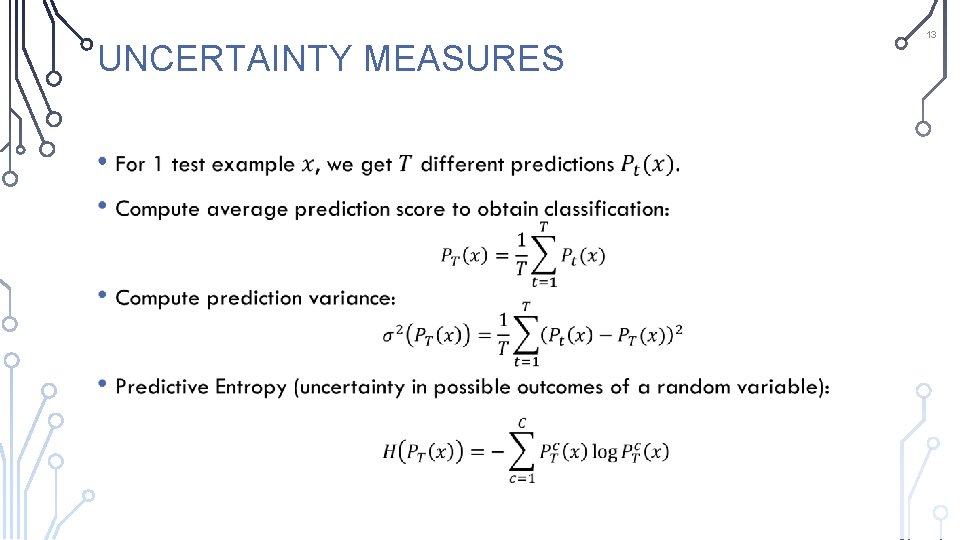
UNCERTAINTY MEASURES • 13
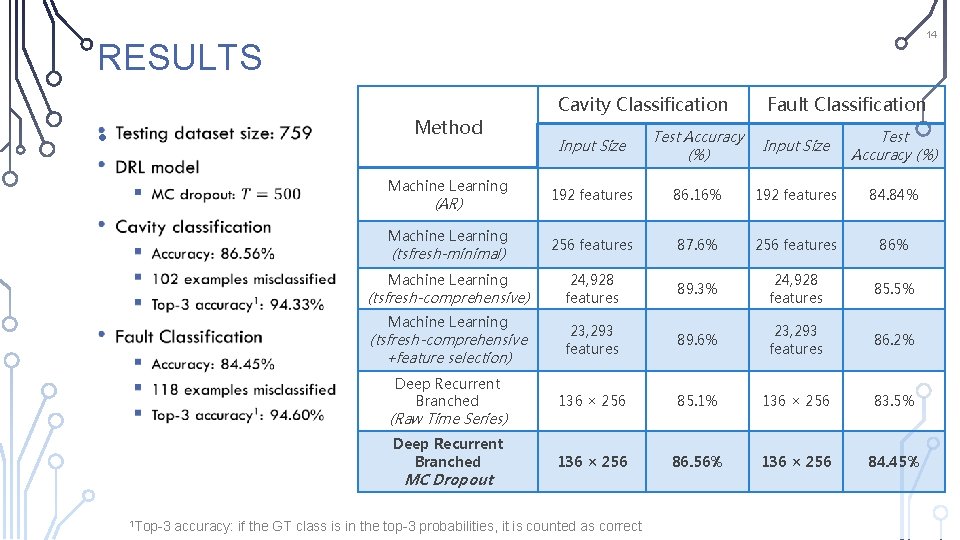
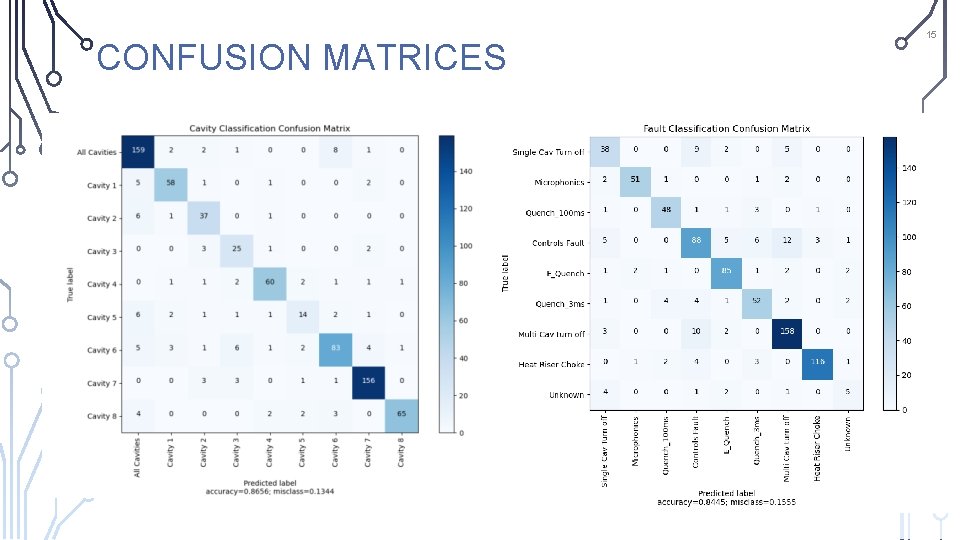
14 RESULTS Method • Fault Classification Input Size Test Accuracy (%) 192 features 86. 16% 192 features 84. 84% 256 features 87. 6% 256 features 86% 24, 928 features 89. 3% 24, 928 features 85. 5% 23, 293 features 89. 6% 23, 293 features 86. 2% Deep Recurrent Branched 136 × 256 85. 1% 136 × 256 83. 5% Deep Recurrent Branched 136 × 256 86. 56% 136 × 256 84. 45% Machine Learning (AR) Machine Learning (tsfresh-minimal) Machine Learning (tsfresh-comprehensive +feature selection) (Raw Time Series) MC Dropout 1 Top-3 Cavity Classification accuracy: if the GT class is in the top-3 probabilities, it is counted as correct
CONFUSION MATRICES 15
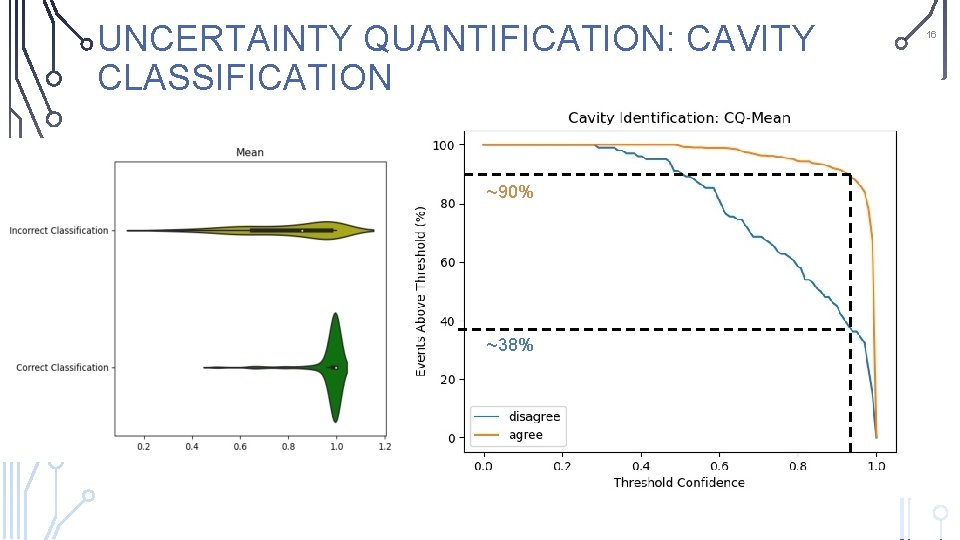
UNCERTAINTY QUANTIFICATION: CAVITY CLASSIFICATION ~90% ~38% 16
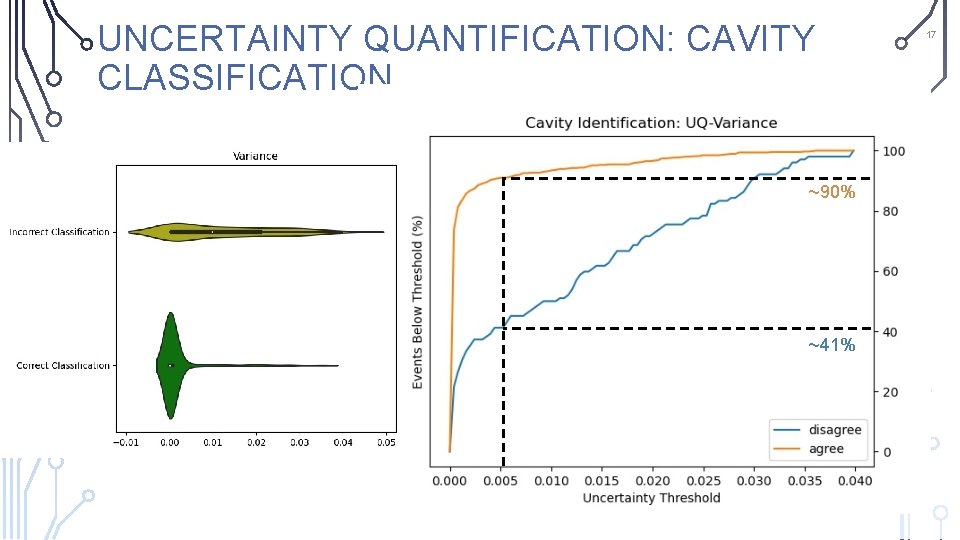
UNCERTAINTY QUANTIFICATION: CAVITY CLASSIFICATION ~90% ~41% 17
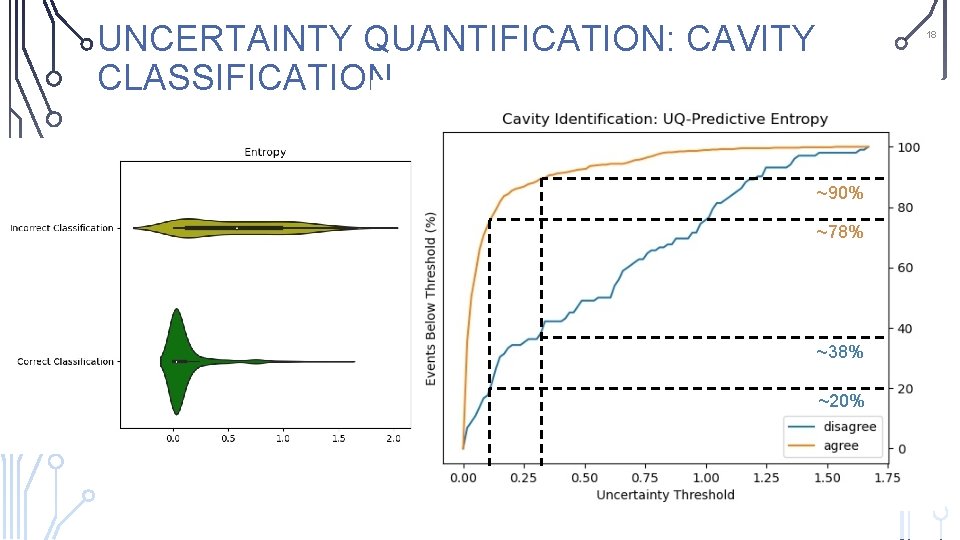
UNCERTAINTY QUANTIFICATION: CAVITY CLASSIFICATION 18 ~90% ~78% ~38% ~20%
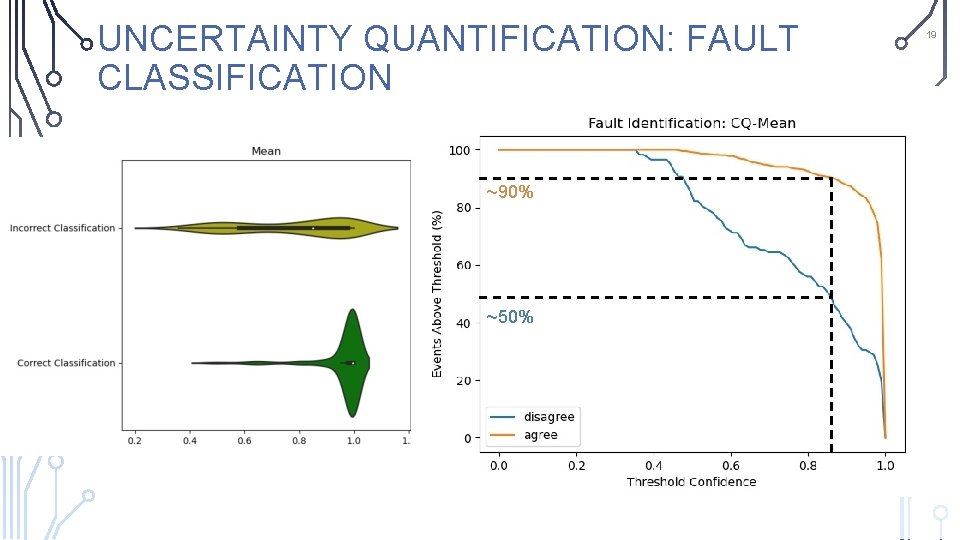
UNCERTAINTY QUANTIFICATION: FAULT CLASSIFICATION ~90% ~50% 19
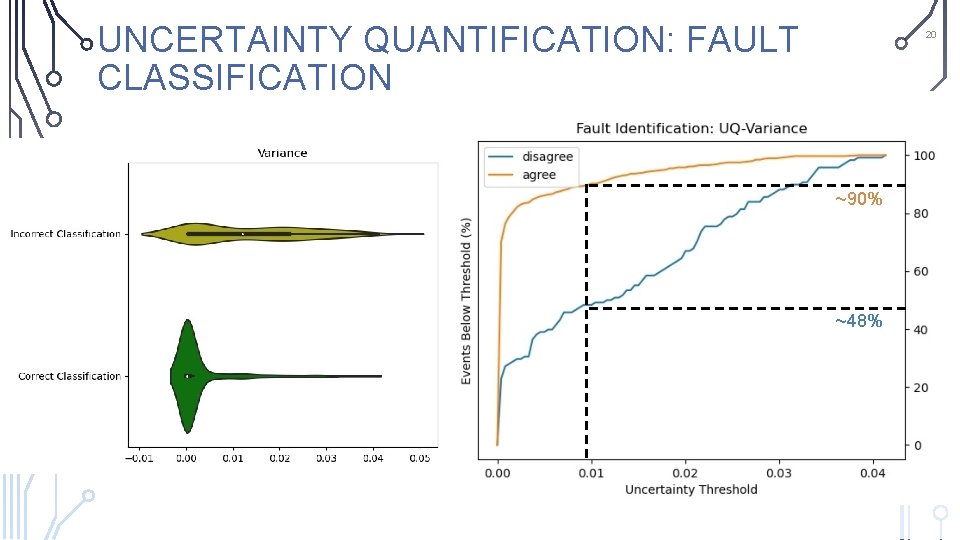
UNCERTAINTY QUANTIFICATION: FAULT CLASSIFICATION 20 ~90% ~48%
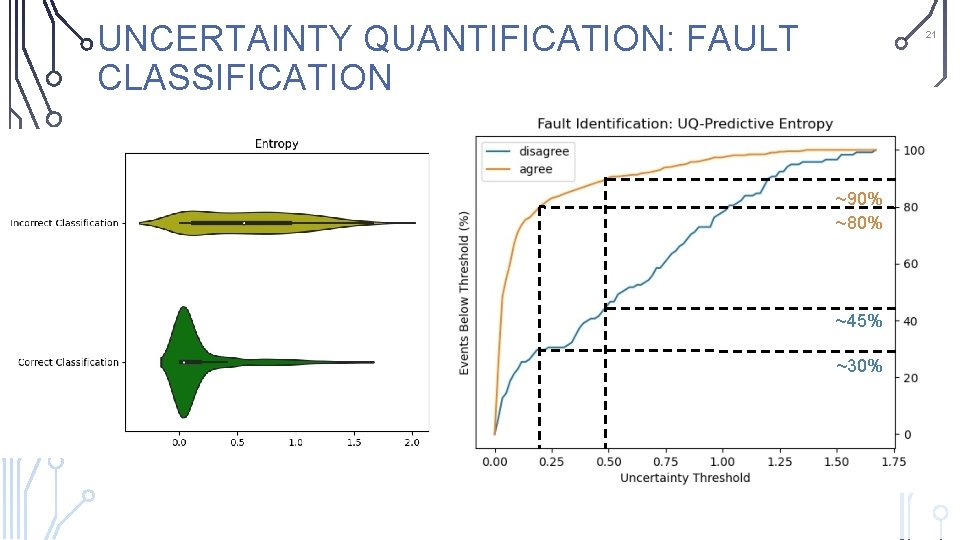
UNCERTAINTY QUANTIFICATION: FAULT CLASSIFICATION 21 ~90% ~80% ~45% ~30%
22 SUMMARY • Preliminary analysis of model (epistemic) uncertainty quantification § Monte Carlo Dropout implementation o Applicable to existing DL models o Straight forward implementation § Different uncertainty measures o Setting uncertainty based thresholds to filter decisions • Future plans § Bayesian (recurrent) neural networks § Ensemble models
23 THANK YOU!
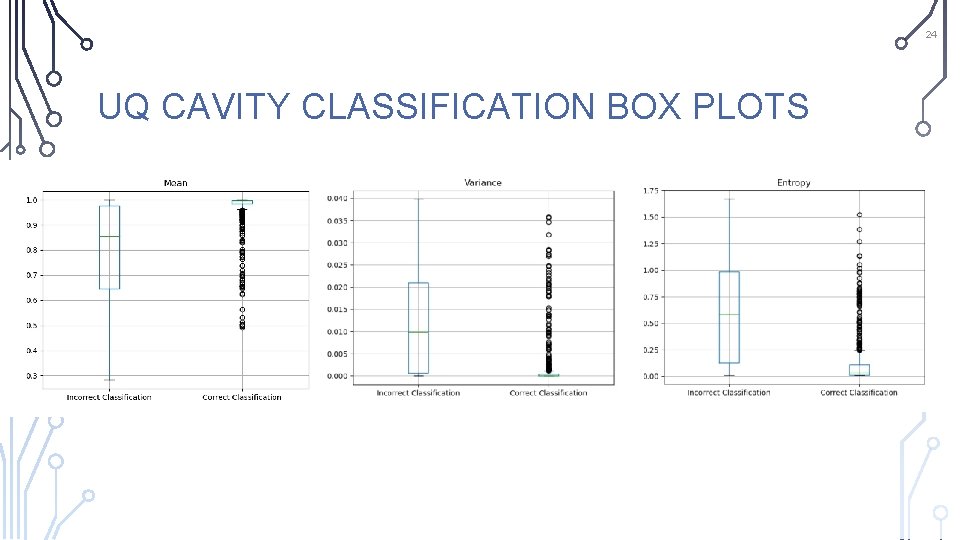
24 UQ CAVITY CLASSIFICATION BOX PLOTS
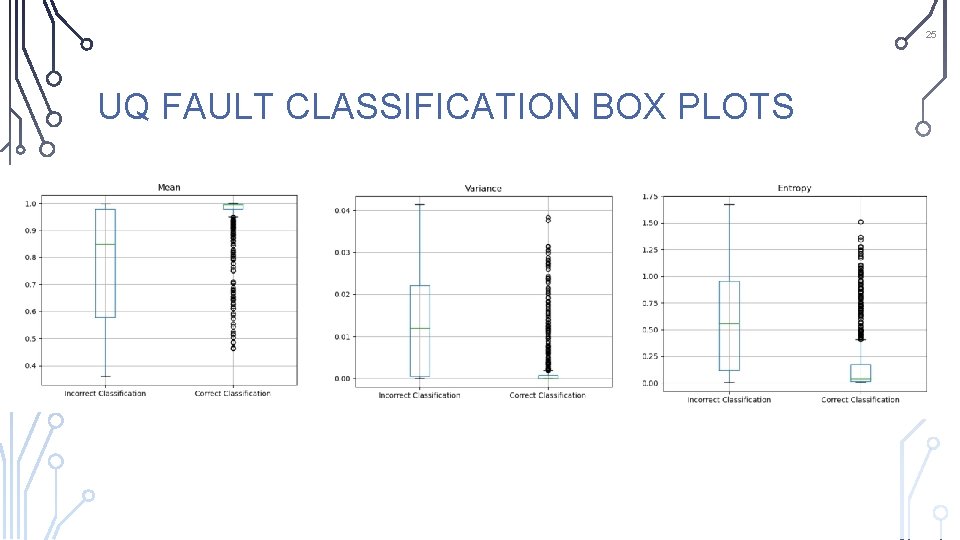
25 UQ FAULT CLASSIFICATION BOX PLOTS
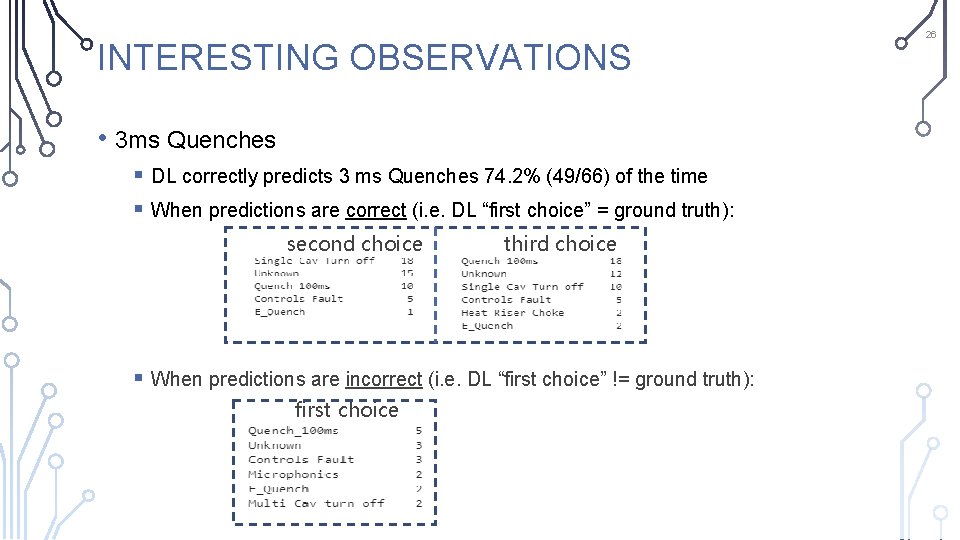
INTERESTING OBSERVATIONS • 3 ms Quenches § DL correctly predicts 3 ms Quenches 74. 2% (49/66) of the time § When predictions are correct (i. e. DL “first choice” = ground truth): second choice third choice § When predictions are incorrect (i. e. DL “first choice” != ground truth): first choice 26
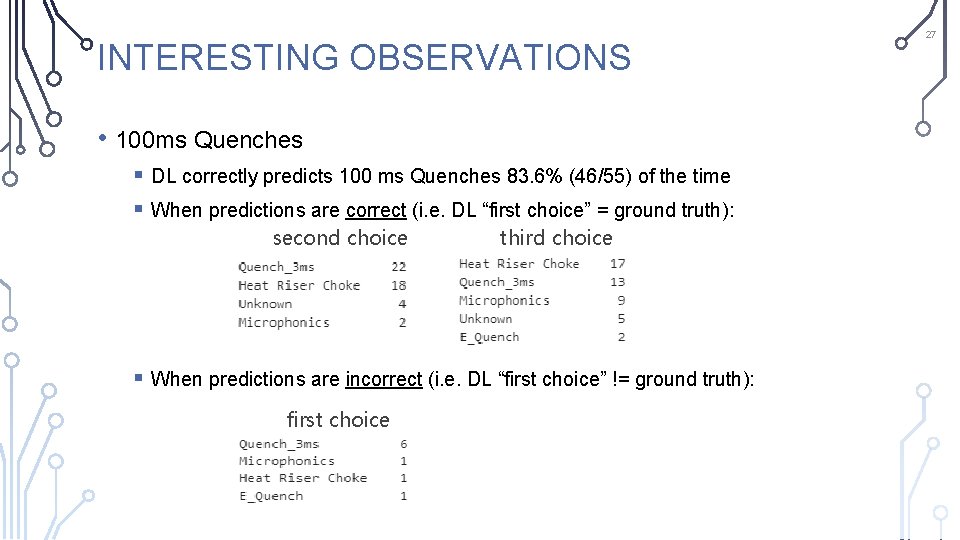
INTERESTING OBSERVATIONS • 100 ms Quenches § DL correctly predicts 100 ms Quenches 83. 6% (46/55) of the time § When predictions are correct (i. e. DL “first choice” = ground truth): second choice third choice § When predictions are incorrect (i. e. DL “first choice” != ground truth): first choice 27
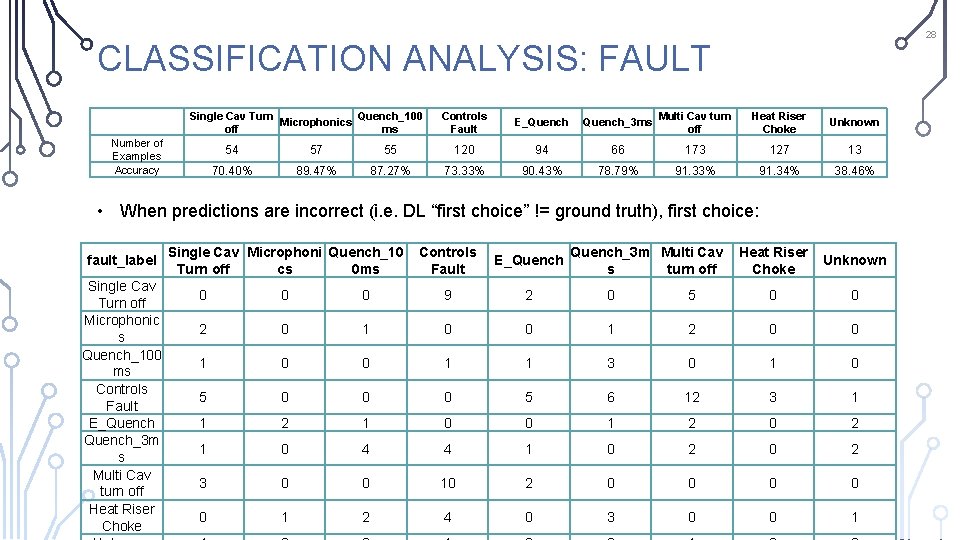
28 CLASSIFICATION ANALYSIS: FAULT Single Cav Turn Quench_100 Microphonics off ms Number of Examples Accuracy Controls Fault E_Quench_3 ms Multi Cav turn off Heat Riser Choke Unknown 54 57 55 120 94 66 173 127 13 70. 40% 89. 47% 87. 27% 73. 33% 90. 43% 78. 79% 91. 33% 91. 34% 38. 46% • When predictions are incorrect (i. e. DL “first choice” != ground truth), first choice: fault_label Single Cav Turn off Microphonic s Quench_100 ms Controls Fault E_Quench_3 m s Multi Cav turn off Heat Riser Choke Single Cav Microphoni Quench_10 Turn off cs 0 ms Controls Fault E_Quench_3 m Multi Cav s turn off Heat Riser Choke Unknown 0 0 0 9 2 0 5 0 0 2 0 1 0 0 1 2 0 0 1 1 3 0 1 0 5 0 0 0 5 6 12 3 1 1 2 1 0 0 1 2 0 2 1 0 4 4 1 0 2 3 0 0 10 2 0 0 0 1 2 4 0 3 0 0 1
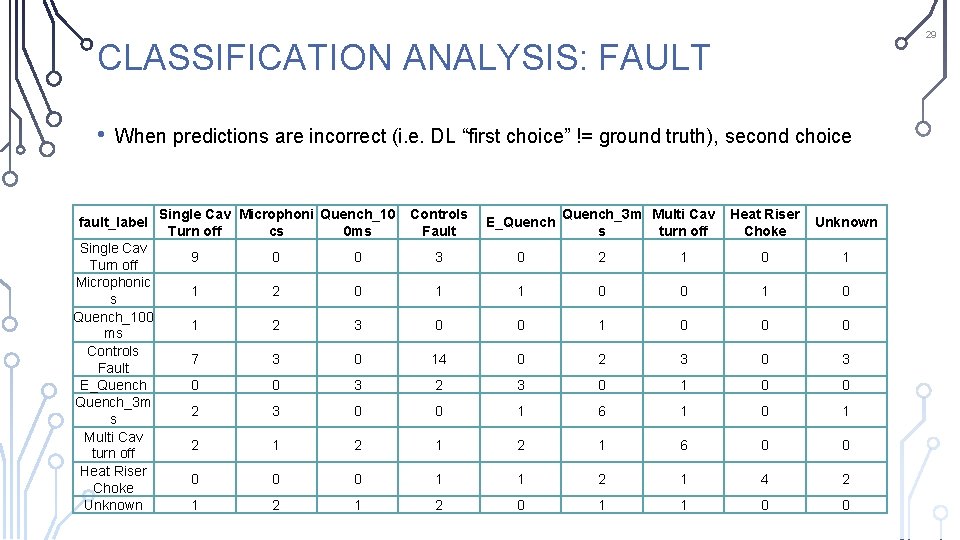
29 CLASSIFICATION ANALYSIS: FAULT • When predictions are incorrect (i. e. DL “first choice” != ground truth), second choice fault_label Single Cav Turn off Microphonic s Quench_100 ms Controls Fault E_Quench_3 m s Multi Cav turn off Heat Riser Choke Unknown Single Cav Microphoni Quench_10 Turn off cs 0 ms Controls Fault E_Quench_3 m Multi Cav s turn off Heat Riser Choke Unknown 9 0 0 3 0 2 1 0 1 1 2 0 1 1 0 0 1 2 3 0 0 1 0 0 0 7 3 0 14 0 2 3 0 0 3 2 3 0 1 0 0 2 3 0 0 1 6 1 0 1 2 1 2 1 6 0 0 0 1 1 2 1 4 2 1 2 0 1 1 0 0