
Uncertainty Quantification in Climate Modeling and Projection Objective
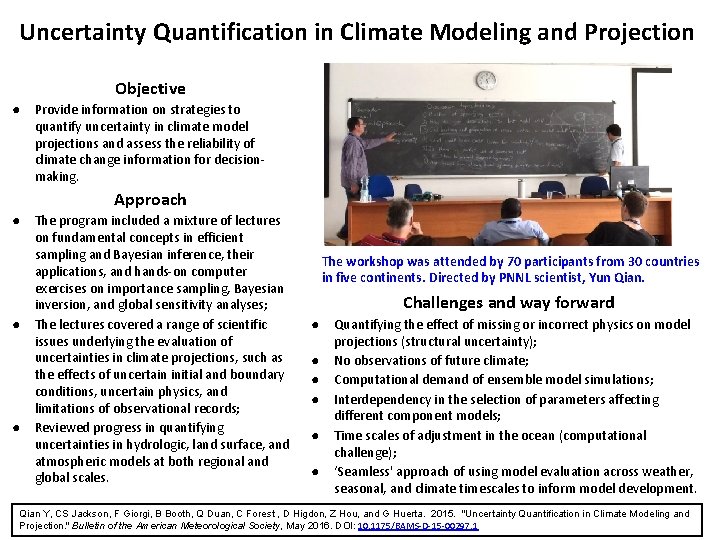
Uncertainty Quantification in Climate Modeling and Projection Objective ● Provide information on strategies to quantify uncertainty in climate model projections and assess the reliability of climate change information for decisionmaking. Approach ● The program included a mixture of lectures on fundamental concepts in efficient sampling and Bayesian inference, their applications, and hands-on computer exercises on importance sampling, Bayesian inversion, and global sensitivity analyses; ● The lectures covered a range of scientific issues underlying the evaluation of uncertainties in climate projections, such as the effects of uncertain initial and boundary conditions, uncertain physics, and limitations of observational records; ● Reviewed progress in quantifying uncertainties in hydrologic, land surface, and atmospheric models at both regional and global scales. The workshop was attended by 70 participants from 30 countries in five continents. Directed by PNNL scientist, Yun Qian. Challenges and way forward ● Quantifying the effect of missing or incorrect physics on model projections (structural uncertainty); ● No observations of future climate; ● Computational demand of ensemble model simulations; ● Interdependency in the selection of parameters affecting different component models; ● Time scales of adjustment in the ocean (computational challenge); ● ‘Seamless' approach of using model evaluation across weather, seasonal, and climate timescales to inform model development. Qian Y, CS Jackson, F Giorgi, B Booth, Q Duan, C Forest , D Higdon, Z Hou, and G Huerta. 2015. "Uncertainty Quantification in Climate Modeling and Projection. " Bulletin of the American Meteorological Society, May 2016. DOI: 10. 1175/BAMS-D-15 -00297. 1
- Slides: 1