
UNCERTAINTY PRINCIPLE I by Robert Nemiroff Michigan Technological
UNCERTAINTY PRINCIPLE I by Robert Nemiroff Michigan Technological University

Physics X: About This Course • Pronounced "Fiziks Ecks" • Reviews the coolest concepts in physics • Being taught for credit at Michigan Tech o o Michigan Tech course PH 4999 Aimed at upper level physics majors Light on math, heavy on concepts Anyone anywhere is welcome o Wikipedia, web links, and lectures only • No textbook required
UNCERTAINTY PRINCIPLE: SINGLE SLIT EXPERIMENT Experiment: A photon goes through a narrow slit and then moves toward an image screen. Is it possible, even in principle, to predict exactly where this photon will then impact an image screen? 1. Yes. 2. No.
UNCERTAINTY PRINCIPLE: SINGLE SLIT EXPERIMENT 2. No. Comment: This is the heart of the "uncertainty principle. " This is why quantum mechanics is conceptually different than classical mechanics. An illuminating case is when the wavelength of the photon is about the same size as the width of the slit.
UNCERTAINTY PRINCIPLE: SINGLE SLIT EXPERIMENT Experiment: A photon goes through a narrow slit and then impacts an image screen. Is it possible, even in principle, to reconstruct both the position and the momentum the photon had when it passed the slit? 1. Yes. 2. No.
UNCERTAINTY PRINCIPLE: SINGLE SLIT EXPERIMENT 1. Yes. "It is quite true that we can receive a particle, and on reception determine what its position is and its momentum would have to have been to have gotten there. That is true, but that is not what the uncertainty relation refers to. The uncertainty relation refers to the predictability of a situation, not remarks about the past. " - Feynman
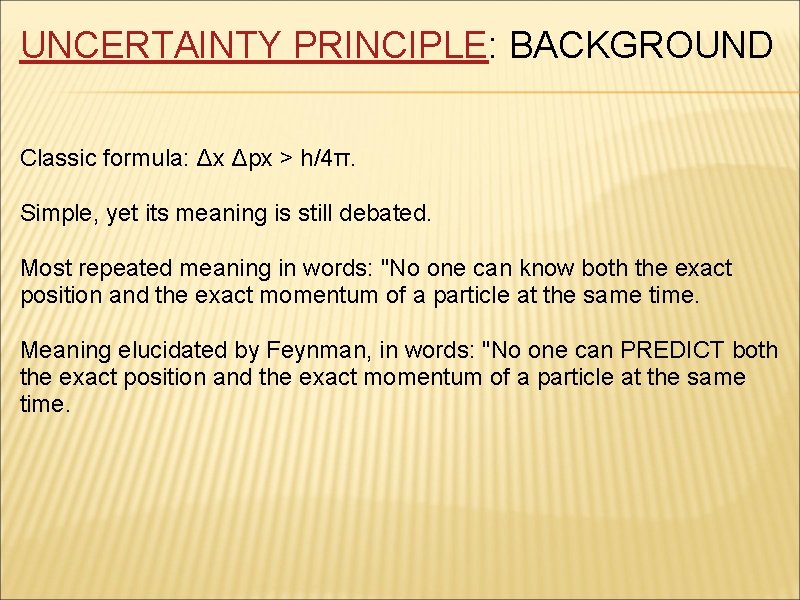
UNCERTAINTY PRINCIPLE: BACKGROUND Classic formula: Δx Δpx > h/4π. Simple, yet its meaning is still debated. Most repeated meaning in words: "No one can know both the exact position and the exact momentum of a particle at the same time. Meaning elucidated by Feynman, in words: "No one can PREDICT both the exact position and the exact momentum of a particle at the same time.
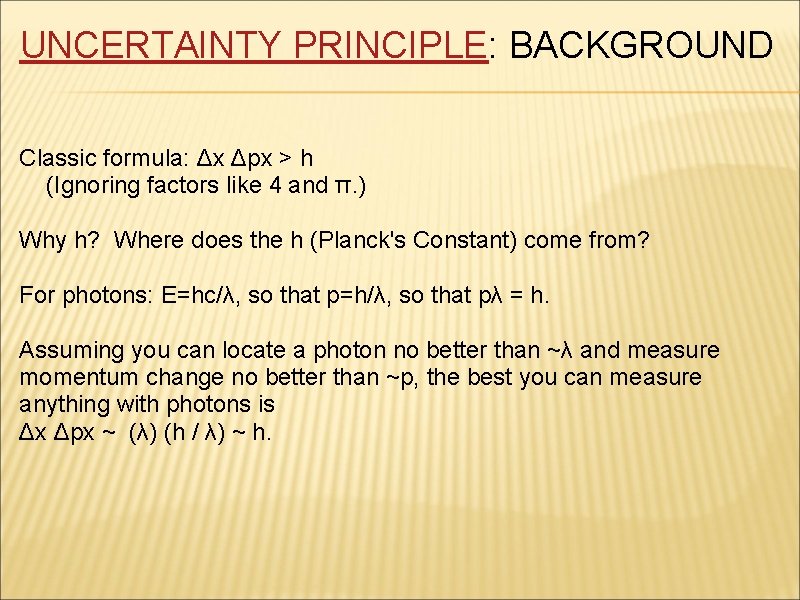
UNCERTAINTY PRINCIPLE: BACKGROUND Classic formula: Δx Δpx > h (Ignoring factors like 4 and π. ) Why h? Where does the h (Planck's Constant) come from? For photons: E=hc/λ, so that p=h/λ, so that pλ = h. Assuming you can locate a photon no better than ~λ and measure momentum change no better than ~p, the best you can measure anything with photons is Δx Δpx ~ (λ) (h / λ) ~ h.
UNCERTAINTY PRINCIPLE: PRINCIPLE OF COMPLEMENTARITY Objects can act as waves and particles at the same time, but the measured limitation of one type of behavior must come at the expense of the fundamental predictability of a complementary type of behavior.
UNCERTAINTY PRINCIPLE: OBSERVER EFFECTS Is uncertainty due solely to the act of observing? 1. 2. Yes. When you observe something, you must disturb it. No. You can observe something without disturbing it.
UNCERTAINTY PRINCIPLE: OBSERVER EFFECTS 2. No. You can observe something without disturbing it. • Uncertainty principle once thought to be disturbance-related by many including Heisenberg o o • A root of the Einstein-Bohr debates In many cases observing does create uncertainty, even of the right magnitude! Entangled particles one way to disprove this o o o Can measure only one of two entangled particles Can learn about other particle without direct measurement Other particle still obeys uncertainty principle anyway.
UNCERTAINTY PRINCIPLE: RENNINGER NEGATIVE-RESULT EXPERIMENT An alpha particle decays in a random direction. It is surrounded by two half spheres, one small, and one large. After the decay, the particle does NOT hit the nearby half sphere. Therefore, it must eventually hit the far half sphere. At this time, the wave function of the particle has been constrained to a half sphere WITHOUT an experimental measurement of the particle.
- Slides: 12