
Uncertainty and risk in decision making Management Level
- Slides: 44
Uncertainty and risk in decision making Management Level – Paper P 2 Advanced Management Accounting Lecture - 26 Vidya Rajawasam ACMA CGMA MBA
Uncertainty and risk in decision making In the previous lectures we have discussed § Market based pricing strategies
Uncertainty and risk in decision making In this lecture we will discuss § Risk and Uncertainty § Research techniques use to reduce uncertainty § Quantitative methods of incorporating risk and uncertainty
Uncertainty and risk in decision making Risk and uncertainty All businesses face risk. However, given that most investors are risk-averse, firms should only take on board extra risk if they expect a higher return to compensate. This page looks as quantitative techniques to incorporate risk into decision making.
Uncertainty and risk in decision making Risk and uncertainty All businesses face risk. However, given that most investors are risk-averse, firms should only take on board extra risk if they expect a higher return to compensate. This page looks as quantitative techniques to incorporate risk into decision making.
Uncertainty and risk in decision making Risk and uncertainty Defining the Risk The simplest definition of risk is that it is the variability of possible returns. For example, we cannot predict future sales with certainty. An important aspect of this definition is that the actual outcome could be better or worse than expected - sales could be higher or lower than our best guess.
Uncertainty and risk in decision making Risk and uncertainty Defining the Risk We can thus talk about downside risk exposure and upside potential. Note that some authors define "true risk" as only considering the downside. Another popular definition is that Risk = probability × impact
Uncertainty and risk in decision making Risk and uncertainty Defining the Risk This definition emphasizes an important aspect of risk management - i. e. that we need to identify and assess potential sources of risk both in terms of their potential impact on the business and how likely they are.
Uncertainty and risk in decision making Risk and uncertainty Some authors make a distinction between risk and uncertainty: • Risk is where there a number of possible outcomes and the probability of each outcome is known. For example, based on past experience of digging for oil in a particular area, an oil company may estimate that they have a 60% chance of finding oil and a 40% chance of not finding oil.
Uncertainty and risk in decision making Risk and uncertainty Uncertainty occurs when there a number of possible outcomes but the probability of each outcome is not known. For example, the same oil company may dig for oil in a previously unexplored area. The company knows that it is possible for them to either find or not find oil, but it does not know the probabilities of each of these outcomes.
Uncertainty and risk in decision making Risk and uncertainty Uncertainty occurs when there a number of possible outcomes but the probability of each outcome is not known. For example, the same oil company may dig for oil in a previously unexplored area. The company knows that it is possible for them to either find or not find oil, but it does not know the probabilities of each of these outcomes.
Uncertainty and risk in decision making Research techniques use to reduce uncertainty. Market research is an important means of assessing and reducing uncertainty. For example, about the likely responses of customers to new products, new advertising campaigns and price changes. A number of research techniques are available:
Uncertainty and risk in decision making Research techniques use to reduce uncertainty. A number of research techniques are available: § Focus Groups § Desk research (secondary research). § Field research (primary research). This includes: – motivational and – measurement research.
Uncertainty and risk in decision making Focus groups are a common market research tool involving small groups (typically eight to ten people) selected from the broader population. The group is interviewed through facilitator-led discussions in an informal environment in order to gather their opinions and reactions to a particular subject.
Uncertainty and risk in decision making Focus groups For example, a supermarket may use a focus group before a product launch decision is made in order to gather opinions on a new range of pizzas. Problems with focus groups § Results are qualitative. § The small sample size means that results may not be representative.
Uncertainty and risk in decision making Focus groups Problems with focus groups § Individuals may feel under pressure to agree with other members or to give a 'right' answer. § Their cost and logistical complexity is frequently cited as a barrier, especially for smaller companies. On-line focus groups are becoming more popular and help to address this issue.
Uncertainty and risk in decision making Desk research The information is collected from secondary sources. § It obtains existing data by studying published and other available sources of information. For example, press articles, published accounts, census information. § § It can often eliminate the need for extensive field work.
Uncertainty and risk in decision making Desk research Factors to consider when using desk research § It may not be exactly what the researcher wants and may not be totally up to date or accurate. § However, it is quicker and cheaper than field research.
Uncertainty and risk in decision making Review MCQs The correct meaning of risk is ? a. It is not an important factor related to investment projects. b. Only financial risks are considered as risks. c. It is the variability of possible returns d. Non of the above
Uncertainty and risk in decision making Review MCQs The correct meaning of risk is ? a. It is not an important factor related to investment projects. b. Only financial risks are considered as risks. c. It is the variability of possible returns d. Non of the above
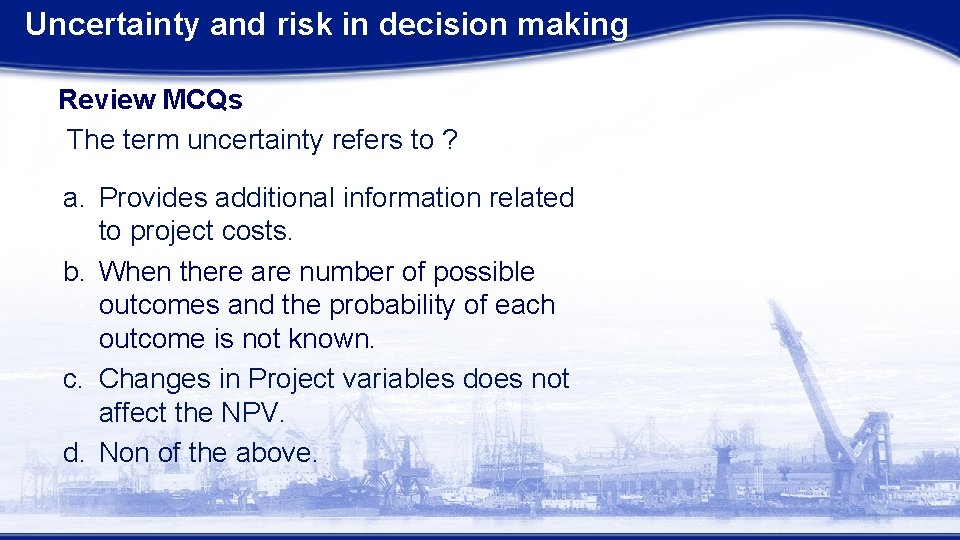
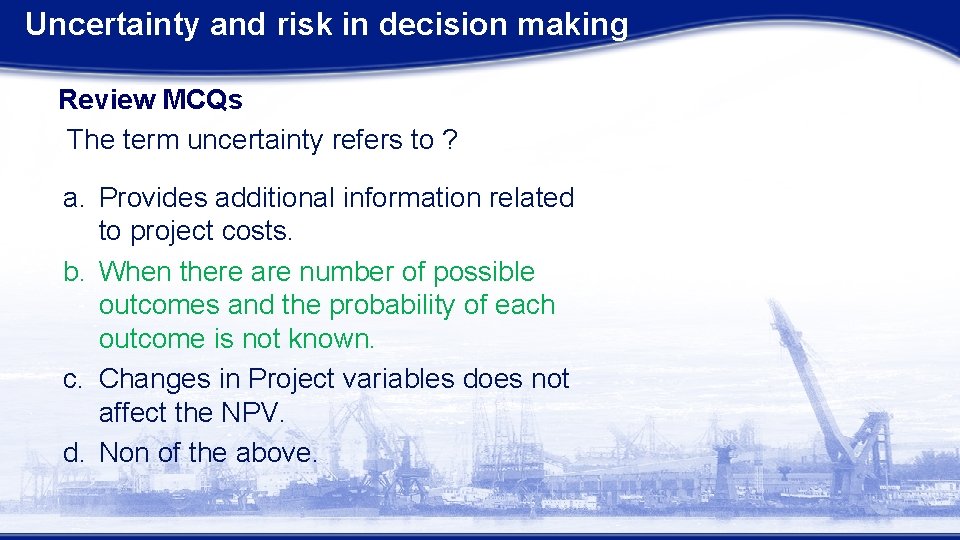
Uncertainty and risk in decision making Review MCQs The term uncertainty refers to ? a. Provides additional information related to project costs. b. When there are number of possible outcomes and the probability of each outcome is not known. c. Changes in Project variables does not affect the NPV. d. Non of the above.
Uncertainty and risk in decision making Review MCQs The term uncertainty refers to ? a. Provides additional information related to project costs. b. When there are number of possible outcomes and the probability of each outcome is not known. c. Changes in Project variables does not affect the NPV. d. Non of the above.
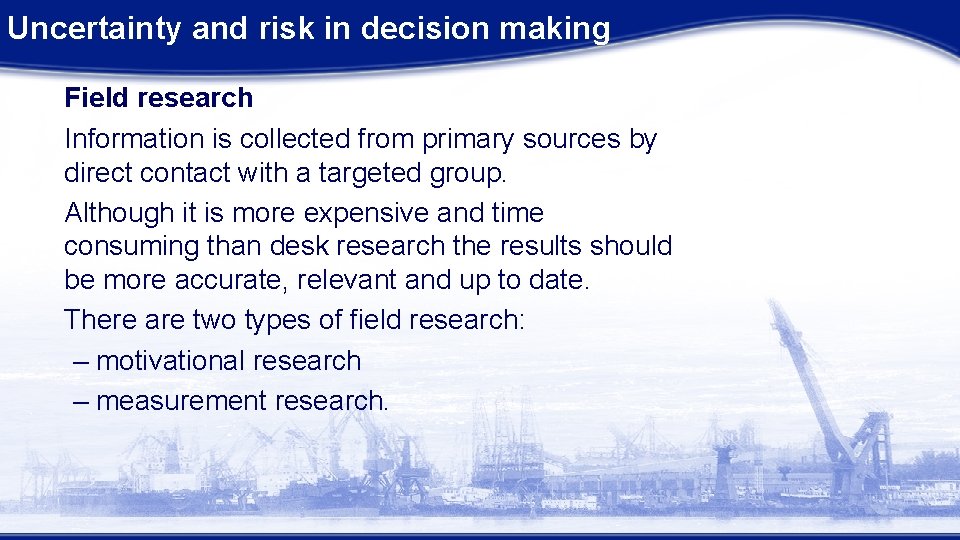
Uncertainty and risk in decision making Field research Information is collected from primary sources by direct contact with a targeted group. Although it is more expensive and time consuming than desk research the results should be more accurate, relevant and up to date. There are two types of field research: – motivational research – measurement research.
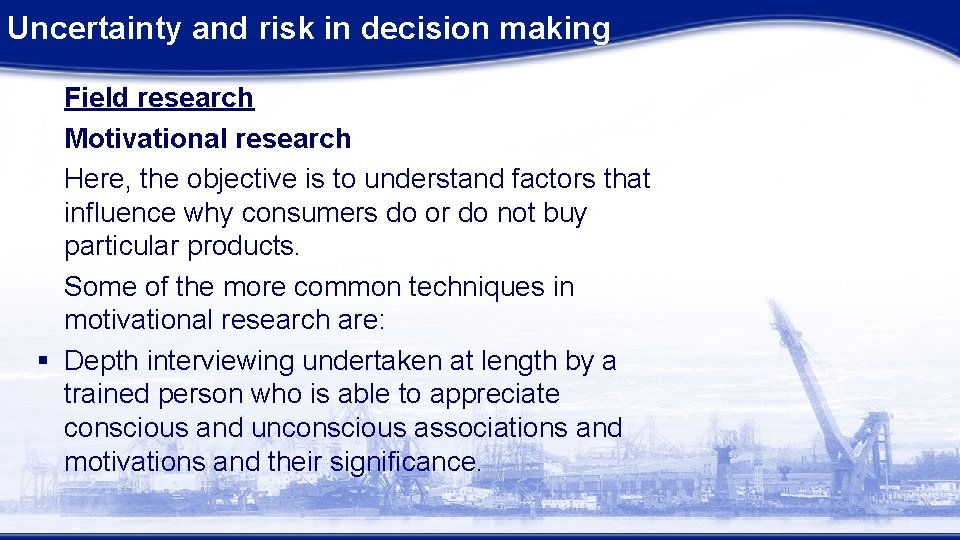
Uncertainty and risk in decision making Field research Motivational research Here, the objective is to understand factors that influence why consumers do or do not buy particular products. Some of the more common techniques in motivational research are: § Depth interviewing undertaken at length by a trained person who is able to appreciate conscious and unconscious associations and motivations and their significance.
Uncertainty and risk in decision making Field research Motivational research Some of the more common techniques in motivational research are: § Group interviewing where between six and ten people are asked to consider the relevant subject (object) under trained supervision. § Word association testing on being given a word by the interviewer, the first word that comes into the mind of the person being tested is noted.
Uncertainty and risk in decision making Field research Motivational research Some of the more common techniques in motivational research are: § Group interviewing where between six and ten people are asked to consider the relevant subject (object) under trained supervision. § Word association testing on being given a word by the interviewer, the first word that comes into the mind of the person being tested is noted.
Uncertainty and risk in decision making Field research Motivational research Some of the more common techniques in motivational research are: § Triad testing where people are asked which out of a given three items they prefer. If the three are brands of a given type of product (or three similar types), replies may show a great deal about which features of a product most influence the buying decision.
Uncertainty and risk in decision making Field research Measurement research The objective here is to build on the motivation research by trying to quantify the issues involved. § Sample surveys are used to find out how many people buy the product, what quantity each type of buyer purchases, and where and when the product is bought.
Uncertainty and risk in decision making Field research Measurement research The objective here is to build on the motivation research by trying to quantify the issues involved. § This sort of information can also be collected in retail environments at the point of sale, for example, through the use of loyalty cards.
Uncertainty and risk in decision making Field research Measurement research It is also possible (less accurately) to assess roughly the importance of some reasons for buying or not buying a product. The main types of measurement are: • Random sampling where each person in the target population has an equal chance of being selected. Such samples are more likely to be representative, making predictions more reliable. However, the technique may be unfeasible in practice.
Uncertainty and risk in decision making Field research Measurement research It is also possible (less accurately) to assess roughly the importance of some reasons for buying or not buying a product. The main types of measurement are: Quota sampling where samples are designed to be representative with respect to pre-selected criteria.
Uncertainty and risk in decision making Field research Measurement research § For example, if the target population is 55% women and 45% men, then a sample of 200 people could be structured so 110 women and 90 men are asked, rather than simply asking 200 people and leaving it up to chance whether or not the gender mix is typical. § The main disadvantage of quota sampling is that samples may still be biased for non-selected criteria.
Uncertainty and risk in decision making Measurement research • Panelling where the sample is kept for subsequent investigations, so trends are easier to spot. • Surveying by post the mail shot method. Unfortunately the sample becomes self-selecting and so may be biased. • Observation e. g. through the use of cameras within supermarkets to examine how long customers spend on reading the nutritional information on food packaging.
Uncertainty and risk in decision making Quantitative methods of incorporating risk and uncertainty In addition to the research techniques discussed, the following methods can be used to address risk or uncertainty. Sensitivity Analysis looks at varying key estimates to see how much safety margin we have before the decision we are making will change. For example, based on a selling price of £ 5 a project is worthwhile but if it drops by more than 10% to below £ 4. 50, then the project should be rejected.
Uncertainty and risk in decision making Quantitative methods of incorporating risk and uncertainty Expected Values (EV) are essentially averages. For example, instead of saying that is an equal probability that sales could be 100, 000 or 150, 000 units (two possibilities) we solve the problem using an average of 125, 000 units (one estimate).
Uncertainty and risk in decision making Quantitative methods of incorporating risk and uncertainty Simulation is a method where random numbers are used to generate different possible scenarios, which can then be solved. The process is re-run many times to then get an idea of the spread of possible outcomes
Uncertainty and risk in decision making Quantitative methods of incorporating risk and uncertainty Maximax, maximin and minimax regret are different perspectives that can be applied to payoff tables. Once we know the different possible outcomes we can identify which decision is best for a particular investor based on their risk aversion.
Uncertainty and risk in decision making Quantitative methods of incorporating risk and uncertainty Decision Trees are a way of representing more complex decisions, probabilities and outcomes.
Uncertainty and risk in decision making Review MCQs The quantitative methods of incorporating risks and uncertainty are ? a. Simulation b. Aggregation c. Maximax, maximin and minimax regret d. Non of the above.
Uncertainty and risk in decision making Review MCQs The quantitative methods of incorporating risks and uncertainty are ? a. Simulation b. Aggregation c. Maximax, maximin and minimax regret d. Non of the above.
Uncertainty and risk in decision making Review MCQs What is true related to the Filed research? a. Consists of measurement research and motivational research. b. Very difficult to obtain information related to industry levels c. There is a lot of confusion with regard to its application. d. Non of the above.
Uncertainty and risk in decision making Review MCQs What is true related to the Filed research? a. Consists of measurement research and motivational research. b. Very difficult to obtain information related to industry levels c. There is a lot of confusion with regard to its application. d. Non of the above.
Uncertainty and risk in decision making Lecture Summary We have discussed the § Risk and Uncertainty § Research techniques use to reduce uncertainty § Quantitative methods of incorporating risk and uncertainty
Uncertainty and risk in decision making Management Level – Paper P 2 Advanced Management Accounting Lecture - 26 Vidya Rajawasam ACMA CGMA MBA