
UN Regulation Development on HeavyVehicles Direct Vision OICAACEA

- Slides: 12
UN Regulation Development on Heavy-Vehicles Direct Vision OICA/ACEA position VRU-PROXI 13 VRU-Proxi-13 -07 Rev
Overview of Contents § OICA / ACEA General View § Understanding the London Direct Vision Standard Approach § Considerations for UN Direct Vision Regulation § VRU Height and Visibility § Eliminating the Blind Spot to the Greatest Possible Extent § Potential Measures to Improve Direct Vision § Arguments for Limitations to Lower Cab Heights § Summary and Conclusions
OICA/ACEA General View § OICA/ACEA supports: ð Safety improvement by increasing direct vision performance of heavy vehicles ð Technically and economically feasible regulation and adapted to technical progress (according UN 58 agreement) ð An objective methodology to evaluate direct vision performance with a feasible baseline level ð Type approval of vehicle / systems based on the worst case vehicle of the family (verified by simulation) ð Any use of a common database for setting parameters for evaluation of threshold values and pass/fail criteria's must be owned and maintained by a neutral party (authority). § Active safety systems will be introduced in EU (2024) addressing VRUs, this will already improve the safety of heavy vehicles long before direct vision will be mandatory. These active safety systems will be further improved in the future.
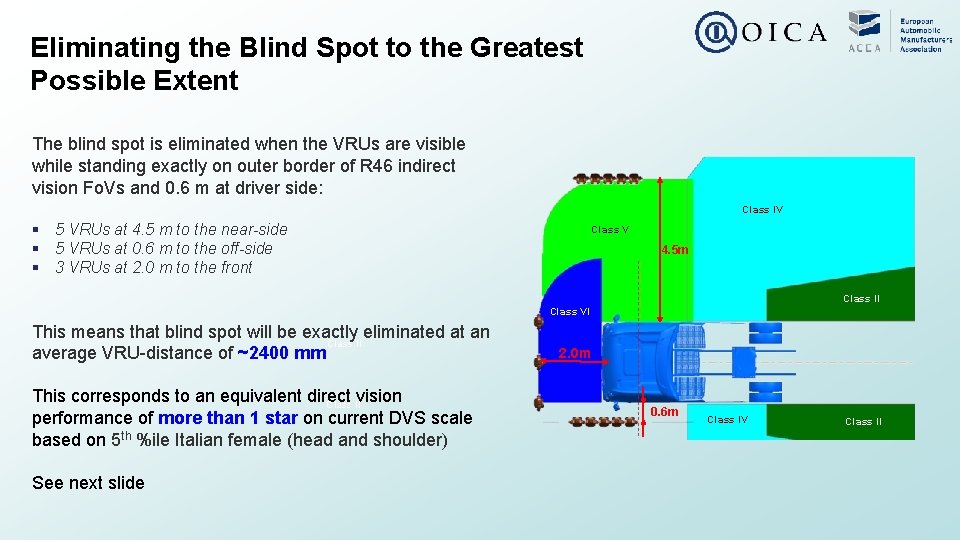
Understanding the London Direct Vision Standard Approach Stature of 5 th %ile Italian female § Scope of Transport for London is trucks that are driving in the City of London (Greater London) § Definition of 1 star on DVS scale: 1 star rating means an average distance of VRUs to be seen by the driver (head and shoulders) at a distance of 4. 5 m to near-side, 2 m to the front and 0. 6 m to the off-side. The VRU chosen was a 5 th %ile Italian female covering 99% of Europeans (Loughborough Design School, VRU-Proxi-10 -07) § Height of 5 th %ile Italian female 1177 mm up to shoulders by using a stick, VRU width not respected § Determinant for 1 star level was existing vehicle (Volvo FE) meeting requirement at least on all sides, this 1 star vehicle fulfils visibility exactly on one side but performs better on the other two sides ð This means 1 star on current DVS scale goes beyond the aim of eliminating the blind spot § 28 of 51 current in EU available vehicle models would be banned, therefore Tf. L Volvo FE (H) determinant for 1 star level
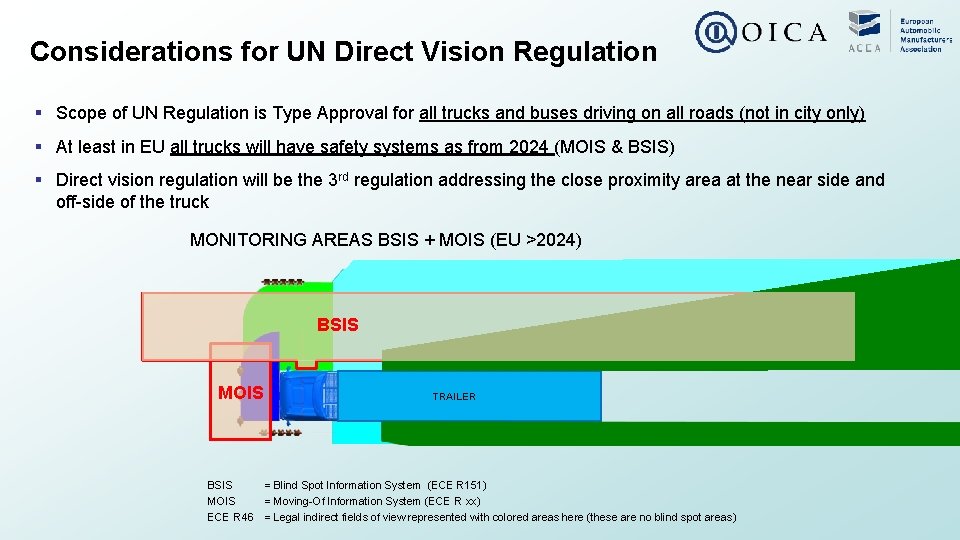
Considerations for UN Direct Vision Regulation § Scope of UN Regulation is Type Approval for all trucks and buses driving on all roads (not in city only) § At least in EU all trucks will have safety systems as from 2024 (MOIS & BSIS) § Direct vision regulation will be the 3 rd regulation addressing the close proximity area at the near side and off-side of the truck MONITORING AREAS BSIS + MOIS (EU >2024) BSIS MOIS TRAILER BSIS = Blind Spot Information System (ECE R 151) MOIS = Moving-Of Information System (ECE R xx) ECE R 46 = Legal indirect fields of view represented with colored areas here (these are no blind spot areas)
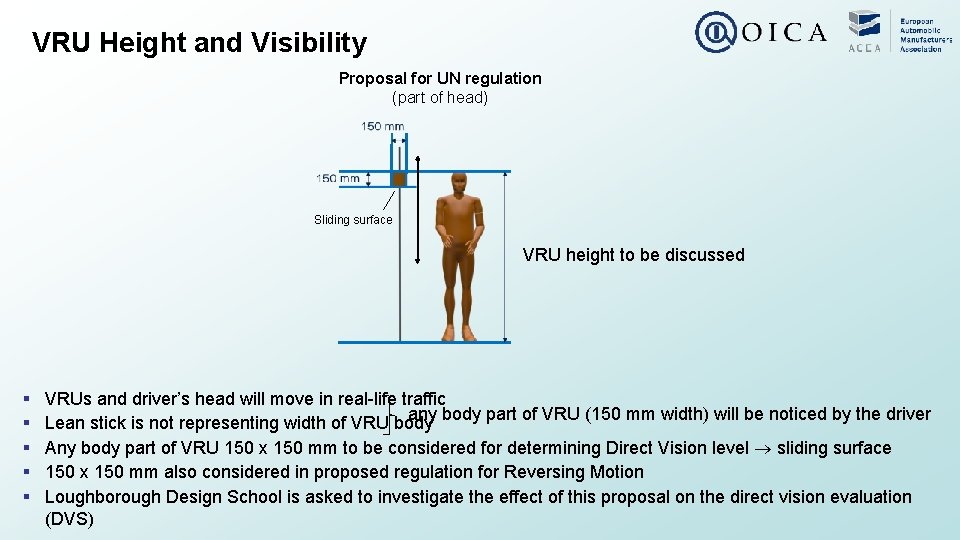
VRU Height and Visibility Proposal for UN regulation (part of head) Sliding surface VRU height to be discussed § § § VRUs and driver’s head will move in real-life traffic any body part of VRU (150 mm width) will be noticed by the driver Lean stick is not representing width of VRU body Any body part of VRU 150 x 150 mm to be considered for determining Direct Vision level sliding surface 150 x 150 mm also considered in proposed regulation for Reversing Motion Loughborough Design School is asked to investigate the effect of this proposal on the direct vision evaluation (DVS)
Eliminating the Blind Spot to the Greatest Possible Extent The blind spot is eliminated when the VRUs are visible while standing exactly on outer border of R 46 indirect vision Fo. Vs and 0. 6 m at driver side: Class IV § 5 VRUs at 4. 5 m to the near-side § 5 VRUs at 0. 6 m to the off-side § 3 VRUs at 2. 0 m to the front Class V 4. 5 m Class II Class VI This means that blind spot will be exactly eliminated at an Class II average VRU-distance of ~2400 mm This corresponds to an equivalent direct vision Class II performance of more than 1 star on current DVS scale based on 5 th %ile Italian female (head and shoulder) See next slide 2. 0 m 0. 6 m Class IV Class II
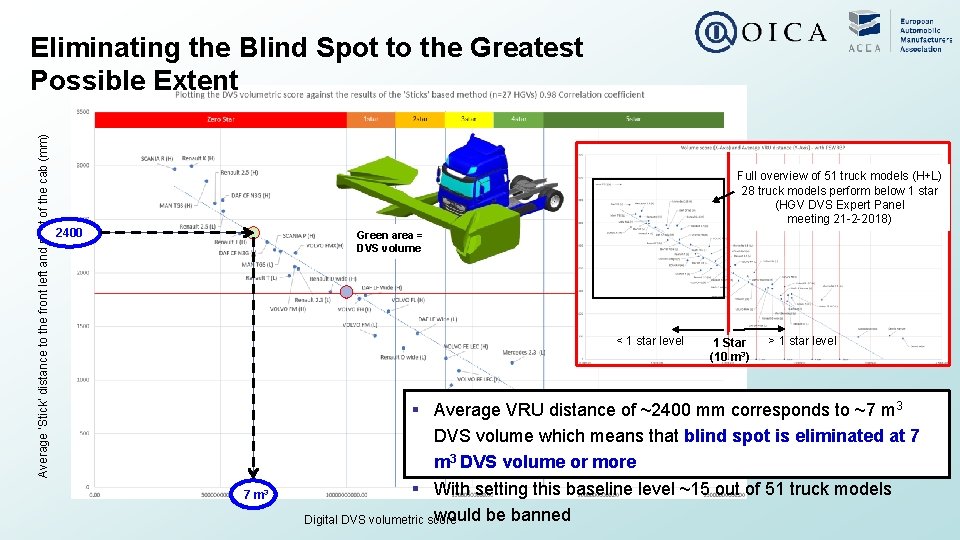
Average ‘Stick’ distance to the front left and right of the cab (mm) Eliminating the Blind Spot to the Greatest Possible Extent Full overview of 51 truck models (H+L) 28 truck models perform below 1 star (HGV DVS Expert Panel meeting 21 -2 -2018) 2400 Green area = DVS volume < 1 star level 7 m 3 1 Star (10 m 3) > 1 star level § Average VRU distance of ~2400 mm corresponds to ~7 m 3 DVS volume which means that blind spot is eliminated at 7 m 3 DVS volume or more § With setting this baseline level ~15 out of 51 truck models would be banned Digital DVS volumetric score
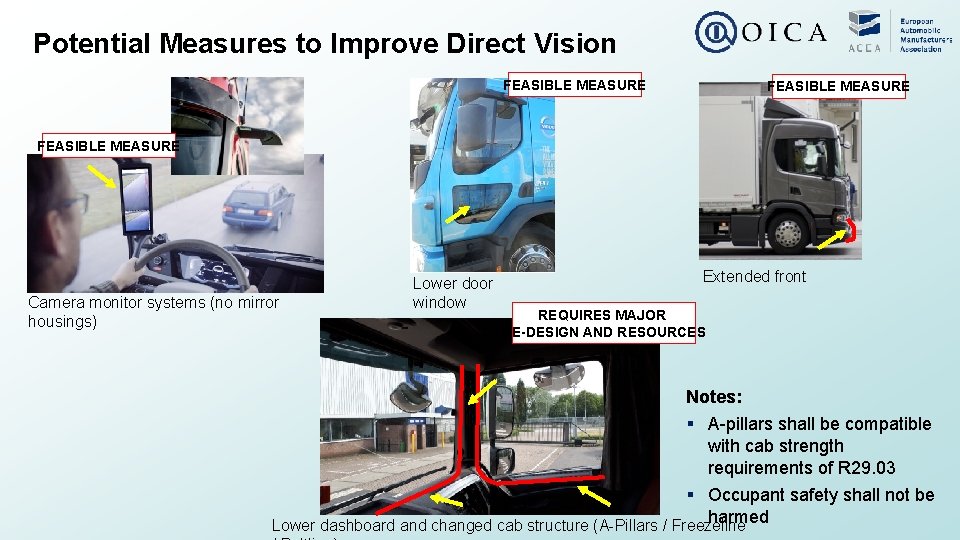
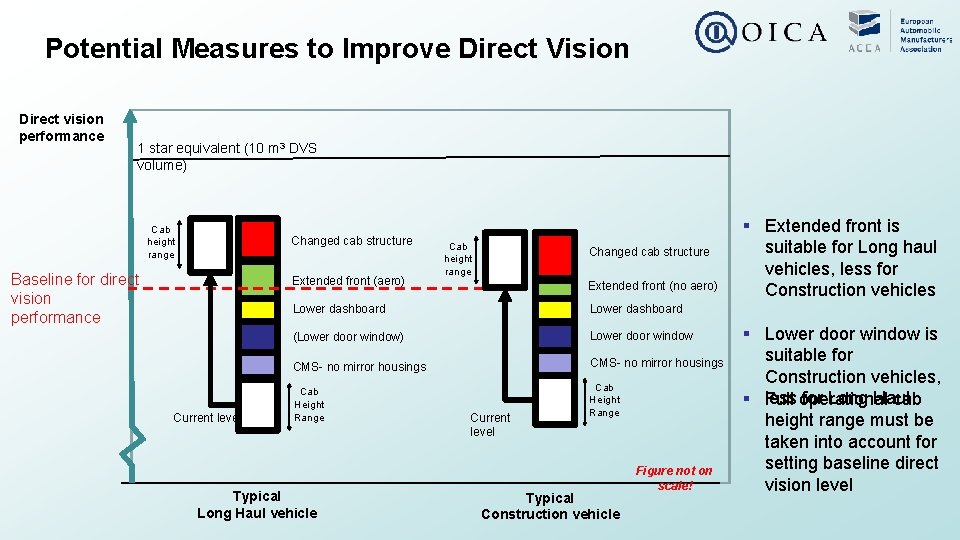
Potential Measures to Improve Direct Vision FEASIBLE MEASURE Camera monitor systems (no mirror housings) Lower door window Extended front REQUIRES MAJOR RE-DESIGN AND RESOURCES Notes: § A-pillars shall be compatible with cab strength requirements of R 29. 03 § Occupant safety shall not be harmed Lower dashboard and changed cab structure (A-Pillars / Freezeline
Potential Measures to Improve Direct Vision Direct vision performance 1 star equivalent (10 m 3 DVS volume) Cab height range Changed cab structure Baseline for direct vision performance Extended front (aero) Current level Cab height range Changed cab structure Extended front (no aero) Lower dashboard (Lower door window) Lower door window CMS- no mirror housings Cab Height Range Typical Long Haul vehicle Current level Typical Construction vehicle Figure not on scale! § Extended front is suitable for Long haul vehicles, less for Construction vehicles § Lower door window is suitable for Construction vehicles, less operational for Long Haul § Full cab height range must be taken into account for setting baseline direct vision level
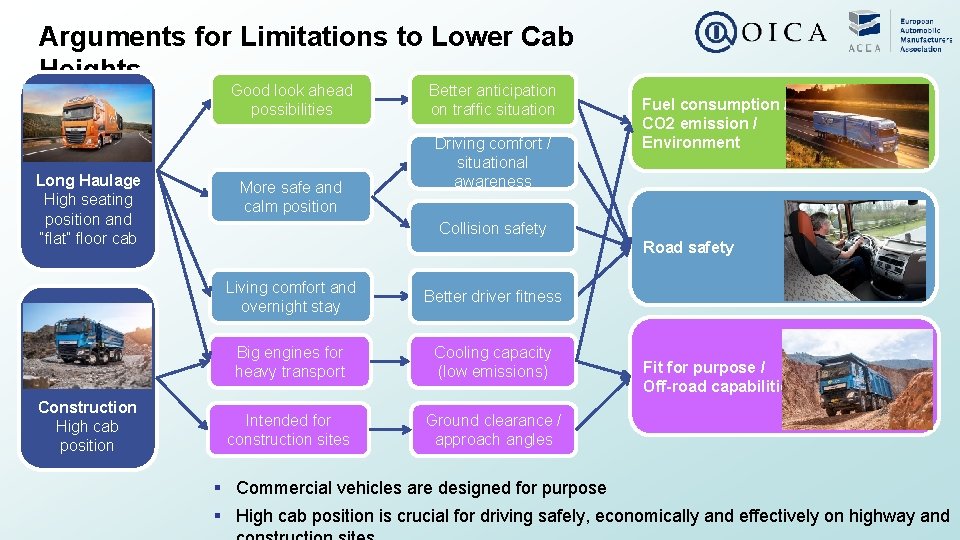
Arguments for Limitations to Lower Cab Heights Good look ahead possibilities Long Haulage High seating position and “flat” floor cab Construction High cab position More safe and calm position Better anticipation on traffic situation Driving comfort / situational awareness Fuel consumption / CO 2 emission / Environment Collision safety Road safety Living comfort and overnight stay Better driver fitness Big engines for heavy transport Cooling capacity (low emissions) Intended for construction sites Ground clearance / approach angles Fit for purpose / Off-road capabilities § Commercial vehicles are designed for purpose § High cab position is crucial for driving safely, economically and effectively on highway and
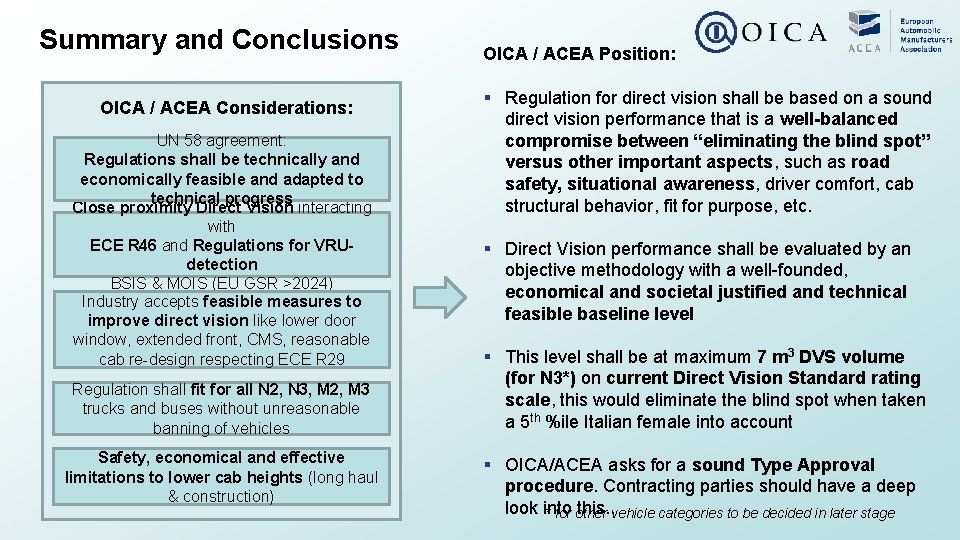
Summary and Conclusions OICA / ACEA Considerations: UN 58 agreement: Regulations shall be technically and economically feasible and adapted to technical progress Close proximity Direct Vision interacting with ECE R 46 and Regulations for VRUdetection BSIS & MOIS (EU GSR >2024) Industry accepts feasible measures to improve direct vision like lower door window, extended front, CMS, reasonable cab re-design respecting ECE R 29 Regulation shall fit for all N 2, N 3, M 2, M 3 trucks and buses without unreasonable banning of vehicles Safety, economical and effective limitations to lower cab heights (long haul & construction) OICA / ACEA Position: § Regulation for direct vision shall be based on a sound direct vision performance that is a well-balanced compromise between “eliminating the blind spot” versus other important aspects, such as road safety, situational awareness, driver comfort, cab structural behavior, fit for purpose, etc. § Direct Vision performance shall be evaluated by an objective methodology with a well-founded, economical and societal justified and technical feasible baseline level § This level shall be at maximum 7 m 3 DVS volume (for N 3*) on current Direct Vision Standard rating scale, this would eliminate the blind spot when taken a 5 th %ile Italian female into account § OICA/ACEA asks for a sound Type Approval procedure. Contracting parties should have a deep look into this. . vehicle categories to be decided in later stage * for other