
UN Peacekeeping Integrated Mission Structures and Planning UN


- Slides: 30
UN Peacekeeping, Integrated Mission Structures and Planning
UN Peacekeeping • Peacekeeping is one among a range of activities undertaken by the United Nations to maintain international peace and security throughout the world. • The other activities are: – Conflict prevention and mediation – Peacemaking – Peace enforcement – Peacebuilding
What is UN Peacekeeping? • Role held by the DPKO • Unique and dynamic instrument developed by the organization as a way to help countries torn by conflict to create the conditions for lasting peace. • Peacebuilding, peacemaking, and peace enforcement "mutually reinforcing" • Overlap between them is frequent in practice.
Change in Nature of Peacekeeping • With the end of the Cold War, the strategic context for UN Peacekeeping changed dramatically. • UN Peacekeeping, originally developed as a means of dealing with inter-State conflict, was increasingly being applied to intra-State conflicts and civil wars. • Rapidly changing and more robust. • Rapid surge in deployment - increasing number of operations & multifunctional in nature. • Mandates range from immediate stabilisation and protection of civilians to supporting humanitarian assistance, organising elections, assisting the development of new political structures, engaging in security sector reform, disarming, demobilising and reintegrating former combatants and laying the foundations of a lasting peace.
Peacekeeping is: • Team effort of diverse components • Supplemented by a variety of partners • Depends on individual awareness
Structures of UN PKO • Commonalities in missions but no mission is the same and there is no “one size fits all” approach or structure to peacekeeping. • Design of individual missions is specific to their context. • Developed through the Integrated Mission Planning Process undertaken following a Strategic Assessment and Technical Assessment Mission (TAM).
“Integrated Mission” • An instrument with which the UN seeks to help countries in the transition from war to lasting peace. • Address similar complex situations that require a systemwide UN response, through subsuming actors and approaches within an overall political-strategic crisis management framework. • No unified definition of the concept, nor templates for integration
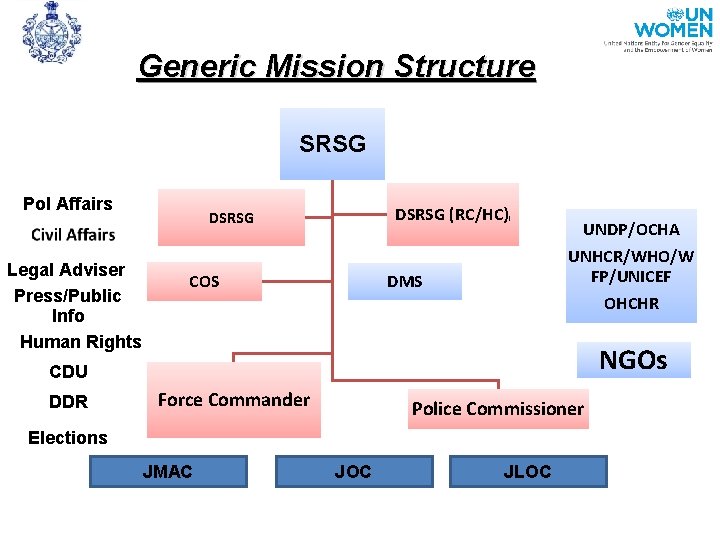
Generic Mission Structure SRSG Pol Affairs Legal Adviser Press/Public Info Human Rights DSRSG (RC/HC) DSRSG COS ) DMS UNDP/OCHA UNHCR/WHO/W FP/UNICEF OHCHR NGOs CDU DDR Force Commander Police Commissioner Elections JMAC JOC JLOC
Theme : • Components for political & civil affairs, law, public information, others • Special units for gender, child protection, discipline, HIV/AIDS • “Clusters” for Rule of Law/Governance, Administration/Management
Integrated Missions and UN Country Team • UNCT brings the different UN agencies, funds and programmes together, ensuring inter-agency coordination and decision-making at the country level. • DSRSG (RC/HC) promotes effective coordination between the mission, UN agencies and external partners. • Arrangements and structures vary according to context and may change depending on the phase of the mission and the situation on the ground.
Integrated Missions and UN Country Team Partners § Operating in a country for several years before the arrival of the mission and will continue to operate following its departure. § Networks of contacts and activities § Understanding of the situation on the ground
External Partners • Major non-UN international actors • Represented at the national rather than subnational level. Include : – – Bilateral national development agencies, Multilateral organizations, International financial institutions, Regional and sub-regional organizations and international NGOs. • Independent agendas, which may not always be aligned with those of the UN mission. • Interacting with non-UN actors is about building relationships and understanding the different rules and mandates that govern each actor’s approach
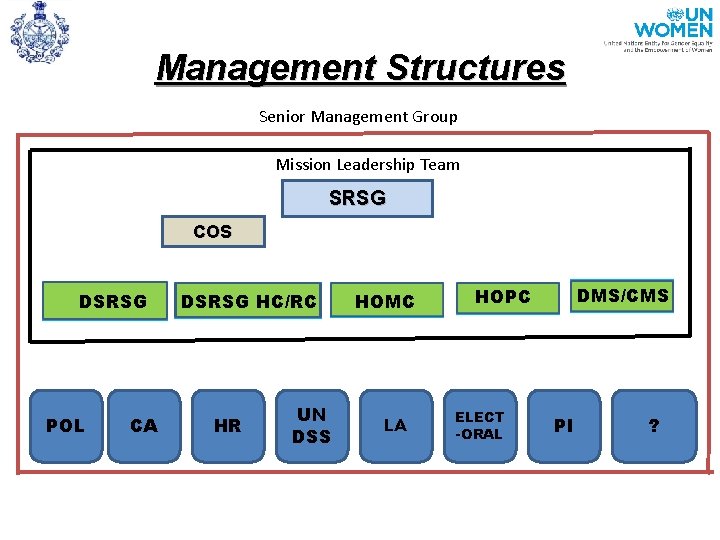
Management Structures Senior Management Group Mission Leadership Team SRSG COS DSRSG POL CA DSRSG HC/RC HR UN DSS HOMC LA DMS/CMS HOPC ELECT -ORAL PI ?
SRSG • • • Leadership and vision Political negotiations Benchmarks of progress Harmony of total effort Good order and discipline Mission safety and security
Political Affairs • Focuses on thorny details of political settlements • Works with host, diplomatic community and partners
Military • Largest component of peacekeeping operations. • Functions depend on the mandate • Primary function is to secure an enabling environment for all aspects of the mission to operate. • Two main points of contact with the military component of the mission – – Senior officer in the location where they are situated – Civil Military Coordination (CIMIC) Officer
Force Commander q Commands military component q Executes the military mandate q Supervises the military bodies in the peace process q Chief interlocutor with warring parties q Responsible for conduct of military personnel
CIMIC Officers • Facilitate the flow of information, provide advice on how the military may assist the civilian components or local authorities. • Liaison with local authorities and coordinate requests to the military. • Military observer assumes the CIMIC function at the local level and serves as the primary interface for civil affairs • Civil Affairs Officers at the local and regional levels provide the military components with advice concerning civilian issues, cultural norms and the broader context of mandate implementation
Police • Mandates – observation, advice, capacity-building and institutional reforms. • IPOs- “experts on mission” and generally unarmed. • Co-locate with their host-state counterparts, working alongside them while promoting change. • FPUs - armed contingents of about 140 police from a single country, assigned to public order management, protection of UN staff and facilities, and high-risk operations. • FPUs : designed for public order management, may also be helpful in providing security to transport and facilities, including humanitarian aid delivery and IDP camps. • UN police work with civil affairs – and other mission partners – in joint protection, rapid response and EW mechanisms
Human Rights • Expertise, guidance and support by the Office of the High Commissioner for Human Rights (OHCHR). • Develop the capacity of national actors and institutions to do the same. • At the local level, Civil Affairs can provide information about the situation at the local level and play a vital role in early warning • Share relevant information and analysis after taking into account concerns about confidentiality. • For technical follow-up should be passed to Human Rights component, which are in a better position to advise on the best course of action, including by referring specific cases to the UN human rights mechanisms
Gender • Multidimensional missions are mandated to mainstream gender in all policies, programmes and activities, and to implement UNSCR 1325 on women, peace and security. • Advise the SRSG and the mission on how to mainstream gender and integrate gender perspectives into all areas of activity • Work with civil society and women’s organizations to support the involvement of women in areas such as: – early warning, – protection of civilians, – community policing.
Disarmament, Demobilization and Reintegration (DDR) • DDR is a complex process with political, military, humanitarian and socio-economic aspects. • Undertake a range of activities aimed at : – Building confidence to foster stabilization and progress, – Serving as enablers for longer term political and security.
Electoral • Mandate to assist or support an electoral process, electoral components or units are established within the mission structure. • Play a technical support role in relation to elections.
Public Information • Explains mandate, publicizes progress • Becomes trusted local news source • Builds confidence in peace process • Change attitudes and perceptions of different groups • Good coordination is essential to ensure the consistency of the messages communicated directly to the public and through the media.
Mission Support • Oversees critical support elements, including administration, human resources and logistics. • Mission support also oversees components that work closely with civil affairs on QIPs, including engineering and finance. • Within a mission, specialized support services are crucial for the effective implementation of mandated tasks
Joint Mission Analysis Centre • Multidisciplinary structure created in 2005 • Military officers, police and international civilians. • Provides an intelligence-collection capability at strategic or operational levels. • Integrated analyses for the senior management of peacekeeping missions. • Support of integrated management of operations • Organizational structure of each JMAC varies for each mission. (JMAC brings together information from across a particular mission and produces analysis to support the strategic activities of the mission)
HUMANTARIAN ASSISTANCE • Mandate for delivery or coordination • Led by Humanitarian Coordinator • Coordinates funds, programmes, agencies • Works with other organizations and external partners
Three Dilemmas in Relation To Integration • Impartiality needed to protect humanitarian space. • Human rights dilemma • Local ownership dilemma relates to the need to root peace processes in the host country’s society and political structures without reinforcing the very structures that led to conflict in the first place.
Challenges of Integration • UN partner agencies : mandate, decision-making structures and funding arrangements • Accountability PK Mission & UN Agencies is different • Timeframes are different: – Humanitarian actors : immediate term – Peacekeepers operate on a political timetable. – Development Agencies look towards longer sustainability. • UNCT and PK Ops have different institutional cultures and management styles.
Thank You