
UMMS Core Competency Initiative in the Workplace People

- Slides: 39
UMMS Core Competency: Initiative in the Workplace “People who end up with the good jobs are the proactive ones who are solutions to problems, not problems themselves, who seize the initiative to do whatever is necessary, consistent with correct principles, to get the job done. ” – Stephen R. Covey
Learning Objectives • • • Overview Initiative – A UMMS Core Competency A Game Changing Habit: Cultivating Initiative What Does Taking Initiative Mean? How to Develop Your Initiative Muscles Asking Good Questions How to Pitch a Proposal or Idea to Your Manager 20 Ways to Take Initiative at Work Benefits of Taking Initiative Things to Consider Before Taking Initiative Common Mistakes with Initiative How Taking Initiative can Impact Your Performance Review | |
Overview What is initiative? The ability to judge what needs to be done and take action, especially without suggestion from other people. ~Cambridge English Dictionary September 26, 2020 3
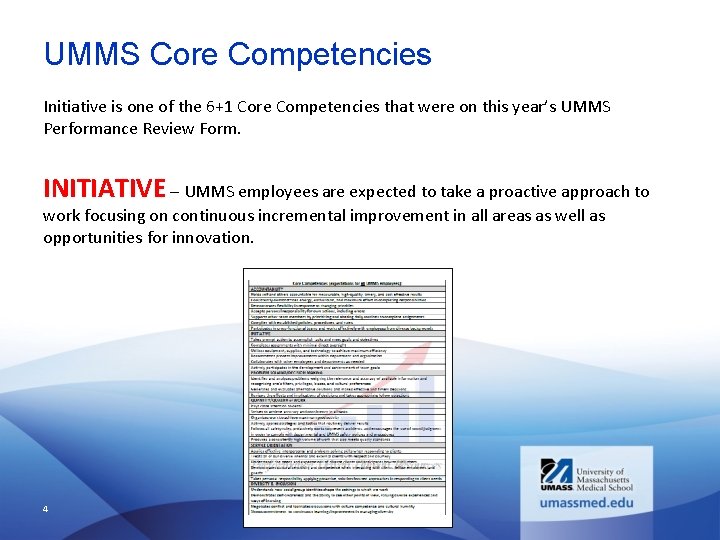
UMMS Core Competencies Initiative is one of the 6+1 Core Competencies that were on this year’s UMMS Performance Review Form. INITIATIVE – UMMS employees are expected to take a proactive approach to work focusing on continuous incremental improvement in all areas as well as opportunities for innovation. 4
A Game Changing Habit: Cultivating Initiative • One crucial skill that can serve you well in your professional life is the ability to show initiative at work. If you wait to be told what to do, then you waited too long. • Initiative entails seeing something that needs to be done and either doing it or figuring out ways to do it. • The key is finding ways to take action, doing something before others do it or before you are told to do it. • Taking initiative shows the hallmarks of a leader in the making. • Developing initiative includes learning to ask the right probing questions which can surface issues that need to be addressed. • Taking initiative helps build and strengthen your decision making and analytical skills where you get to analyze the pros and cons of different courses of action. • Taking initiative strengthens your personal brand. A person who takes initiative will be a role model to others. | |
What Does Taking Initiative Mean? • Taking initiative means going the extra mile or going above and beyond your normal job responsibilities to make things happen. • Taking initiative is the ability to see something that needs to be done and deciding to do it out of your own free will without someone else telling you to do it. • Doing something that needs to be done out of your own personal drive with a desire to make things better than they were before or improve processes and ways of doing things. • Doing more than your normal work duties. • Being proactive instead of reactive, thinking ahead and taking appropriate action. | |
How to Develop Your Initiative Muscles • • • Developing initiative begins by knowing what you want to achieve in your career, what things you have to and are willing to do and how fast you want to achieve your career goals. Learn how things are in the current state and figure out the bottlenecks and efficient ways of doing the work. Look for opportunities in problems. Persevere and be willing to start small. You don’t have to dive into a big project immediately; build your initiative muscles one step at a time. Observe colleagues who are masters at taking initiative. Talk to them, learn from them, work with them, learn their thinking processes and most importantly study how they execute ideas and accomplish goals. Practice speaking up and making your voice heard. You could start by contributing and actively participating in small group meetings then graduate slowly to larger groups. Let people get used to hearing your input. When you consistently offer good ideas, suggestions or recommendations, your opinions will be sought over time. | |
Asking Good Questions • The art of asking good questions is a relevant ingredient in the process of taking initiative. Question why things are the way they are. • In a respectful manner, ask open-ended questions and also follow-up questions. But, don’t ask too many questions at once. • Take good notes. Later on take time to review and reflect on the important points you learned. • Become proficient at gathering data, understanding details, figuring out how things work, identifying the bottlenecks, listening well, paraphrasing, not interrupting, recapping, assessing pros and cons, testing theories and assumptions, and making logical conclusions. • Seek feedback and use it to spur on your initiative efforts. Talk to supervisors and colleagues to learn what you are doing well and should continue doing. | |
How to Pitch a Proposal or Idea to Your Manager • Part of taking initiative at work will entail sharing and pitching your ideas to your manager. • When you have a proposal or a new idea, write down the idea, list the major benefits, drawbacks and disadvantages, explain what resources will be required to implement the idea, how the idea will be executed and implemented, what are the implications if the idea is not implemented and a timeline for implementation. Provide any metrics that will be helpful in making your case. • Prepare a 1 -2 page outline that covers the points above and then schedule a good time to meet with your manager. • Send your manager your proposal in advance. On the day of the actual meeting present your idea confidently, anticipate any questions that might be asked and prepare yourself adequately. | |
How to Pitch a Proposal or Idea to Your Manager (cont’d) • Practice your pitch a few times. Bring copies of your proposal with you. • You might get an answer immediately or you might get it later on. In either case be prepared for either a yes or no answer. • Whichever answer you receive, always graciously thank your manager for taking time to review your proposal. • Seek to gain as much insight and feedback as possible if the answer is no, and use this as a learning lesson for your future pitches. • Get used to some rejection along the way. Cultivate the skill of quickly bouncing back and moving forward. | |
20 Ways to Take Initiative at Work There are many ways and opportunities to take initiative at the workplace. Typical ways to demonstrate or show initiative at work include the following: 1. Seeking more responsibilities. 2. Doing things and projects that others avoid. 3. Training others/sharing knowledge. 4. Helping your coworkers. 5. Providing regular status updates. 6. Building strong working relationships with coworkers. 7. Being innovative/improving systems, processes and procedures. 8. Volunteering to work with different teams and departments. 9. Stepping in when someone is unavailable or absent. 10. Brainstorming ideas to improve the company. | | 11. Offering to mentor others. 12. Volunteering for leadership roles. 13. Helping in the interviewing and hiring process. 14. Tackling challenges/solving problems. 15. Becoming a good team player. 16. Supporting your supervisor or manager’s work efficiently and effectively. 17. Anticipating and preventing problems. 18. Sharing the credit with others who do the work. 19. Maintaining high quality standards. 20. Doing quality control of finished projects.
1 Seeking More Responsibilities • Begin by doing your actual job exceptionally well and then identify areas where you can contribute over and above your normal tasks. • When you have identified specific work-related tasks and projects that you can do, run these by your manager to let them know what you want to work on and reassure them that this will not affect your regular duties and responsibilities. • The next step is to begin working on a few small tasks over and above your normal duties. Keep repeating these tasks until you get comfortable doing them, and then gradually increase the amount of extra work that you are capable of handling. You can also help your manager handle some of his/her priorities. • Over time, you might end up doing a lot of extra tasks that add value to your team and department and you could even end up being considered for a promotion. | |
2 Doing Things and Projects that Others Avoid • In any organization, department or team, there are usually some specific activities or tasks that most people shun from doing. These are typically low priority tasks that when left unattended can turn into major priorities over time. • Examples of these kind of activities can include filing, organizing hardcopy and electronic files, scanning, shredding, archiving old documents, cleaning up data including filling-in incomplete information and removing or merging duplicates, spotlessly cleaning the office fridge or microwave, organizing departmental filing cabinets, etc. • When you have some downtime at work, you can make an effort to quietly complete one of these kinds of projects. | |
3 Training Others/Sharing Knowledge • One way of showing initiative at work is by being a fast learner and training or explaining things to others. • Similarly, share your knowledge through creating internal resource documents such as “how to” manuals, operating guides, flowcharts, standard operating procedures, checklists etc. • You can also create a virtual library of resources and resource manuals for colleagues to use. • When new staff are hired in your team, you can give them an orientation regarding your department and UMMS and help them to settle in quickly. • Additionally, you can deliver department training on areas and skills where you excel in such as: training on advanced spreadsheets, how to use databases, budget preparation and management, report writing, presentation skills, process improvement, basics of project management etc. | |
4 Helping Your Co-Workers • You can empower others by sharing your tips, routines or efficiency methods that work you. • Ways of helping coworkers can include being responsive, helping to clear backlog, assisting in coming up with solutions, helping to explain complicated processes, training them on using new systems and being collaborative in sharing relevant information. Other methods are listening to other view points and opinions, willingness to learn from others, supporting other departments, giving kudos to team members on their accomplishments, participating in office volunteer activities, participating in meetings and voicing your thoughts and comments. • Additionally you can act as an accountability partner to check-in, encourage and motivate a colleague who is working on achieving specific goals. • Demonstrate willingness to pitch in and help others when they run into challenges. If necessary, be willing to roll up your sleeves and do what it takes to help a colleague meet a critical deadline even when it might call for working a few late nights and weekends. | |
5 Providing Regular Status Updates • Aim to provide regular progress updates to both internal stakeholders such as your manager and coworkers while keeping external stakeholders regularly informed as well as other departments, customers, etc. • It helps to be on the same page with your manager regarding your priorities. When you are working on your assignments or when you have been assigned tasks by your manager, aim to give them periodic updates on not only what you are doing but also on your progress. Keep the lines of communication open. • Similarly when collaborating with colleagues on tasks, especially sequential or dependent tasks where one person has to finish their part, in order for the other to start their part, plan to give regular status updates on your progress as well. | |
Building Strong Working Relationships with Co-Workers 6 • One of the great honors in the workplace is being a person that people want to genuinely work with. • Building strong working relationships with co-workers that goes beyond small talk. It requires genuine effort and takes time to achieve. • When you start working in a new department, introduce yourself to others and learn how different people work and interact with each other. • Make a sincere effort to get to know others by asking respectful questions, learning what they do, inviting them for lunch or a walk and getting to know their interests both at work and outside work. • Having strong work bonds and friendships at work can help to increase your morale, job satisfaction and productivity. | |
Being Innovative/Improving Systems, Processes and Procedures 7 • Innovation at work can take the form of coming up with new ways of doing things or improving existing systems and processes. • Ways of developing your innovation skills include the following: questioning the way things are, asking how tasks can be done better, inventing unique solutions to problems, looking at other industries and professions for inspiration, combining ideas to come up with new methods, asking colleagues for tips, suggestions and ideas and dreaming big and visualizing expected outcomes. • Other ways are looking for people to critique your ideas and offer suggestions for improvement, seeking feedback from others, analyzing recurring complaints to identify patterns, setting high goals that stretch your abilities, reading books and watching video tutorials for inspiration and collaborating with others on improving things. | |
Volunteering to Work with Different Teams and Departments 8 • Spread your tentacles across the organization by not only working with your immediate team but also looking for opportunities to work with teams from other departments. • This enables you to learn what other teams do, create new working relationships and raise your visibility at UMMS because others will know who you are and what you do. • Other avenues for participating are to help with planning office activities such as baby showers, annual parties, team lunches, employee appreciation, office contests and games. | |
Stepping in When Someone is Unavailable or Absent 9 • Demonstrate willingness to step in when needed during times when a colleague is unavailable or absent. • Ways of assisting include offering support in doing routine tasks or even during emergencies and acting as a backup when a colleague is on vacation then working with your manager on prioritizing tasks. • Additionally, you can extend your help to support colleagues who work remotely and also those who are out on work related travel or in the field. • A little support from you during these situations goes a long way. | |
10 Brainstorming Ideas to Improve the Organization • One way of taking initiative is through participating actively during brainstorming sessions. • Begin by offering as many ideas as possible, then help in narrowing down the options, identifying the pros and cons of the top solutions, questioning assumptions, connecting the dots and finally selecting the best alternative. • Wherever possible, prepare by doing research ahead of time. • Improve your brainstorming skills by asking questions such as: What are we trying to achieve? How can we make this better? What else has been done? What do we know? What don’t we know? Is there a better way of doing this? | |
11 Offering to Mentor Others • You can volunteer to mentor peers, junior staff or new hires. • As a mentor you can offer a support system for others, help in on-boarding, answer questions about the organization, transfer skills, offer encouragement and help others to grow in their careers. • Additionally, you can motivate others to reach their goals and act as a sounding board to listen to and help refine mentees’ ideas. • Benefits of being a mentor consist of developing your leadership and coaching skills such as giving feedback, becoming better at guiding others and communicating well. • Mentorship enables you to increase your network within UMMS and is likewise a good way of giving back to others. | |
12 Volunteering for Leadership Roles • A good way of showing initiative is volunteering for leadership roles at work such as leading events or meetings, leading planning sessions and working with different teams and departments. • These types of activities help to develop leadership skills such as public speaking, communication, negotiating, decision making, resource allocation, delegating, motivating others, collaboration, team building, mentoring and providing feedback. • It also helps you to assess your areas of weaknesses and proactively work on improving your strengths in these areas. | |
13 Helping in the Interviewing and Hiring Process • When your team or department has a job vacancy, volunteer to help in the initial rounds of interviews to interview future team members. • You can provide value by assessing candidates who can be a good fit and assist in selecting exceptional candidates. • Offer your feedback and opinions to the hiring manager or evaluation team on whether a candidate is a good fit for the job and your evaluation on whether they can succeed in our culture and work environment. • This opportunity gives you a chance to improve your interviewing and listening skills as well as gaining practice in applying consistent standards or criteria for evaluating all candidates. | |
14 Tackling Challenges/Solving Problems • In a typical work setting, problems occur every now and then. It is vital to work on building your skills and confidence in problem solving so that you can identify problems, come up with options and choose the best solution. • The first step in problem solving is to clearly understand the problem so that you can come up with correct solutions. • Some questions to ponder on during the problem solving process include: What is the problem? When did it happen? Why did it happen? What solutions have we tried before? What solutions worked and which ones didn’t? How can we solve this particular problem? How much time do we have? • If the challenge being addressed is big, break it down into smaller pieces and resolve each section at a time. • Each time you come up with a solution for a problem, implement the solution and if it work outs well, this will help to strengthen your problem solving skills. • Some solutions may work and others might not so try to come up with as many good solutions as possible. Brainstorming with others helps to identify options and narrow down the choices. | |
15 Becoming a Good Team Player • Better results are achieved through teamwork and teamwork skills are vital for your success at work. • Ways of being a good team player in the office include communicating clearly, being reliable – someone others can count on, staying committed, being open minded – listening to different opinions without your ego getting in the way and working with others to set and achieve common goals. • Other ways entail celebrating other people’s achievements, listening well and demonstrating understanding by paraphrasing, developing mutual trust, offering solutions, providing regular feedback, being flexible, adapting well to change, keeping others regularly updated, asking questions for input and clarification, collaborating with others in a friendly way and sharing information. | |
16 Supporting Your Supervisor or Manager • Align your priorities with your supervisor. Make it a habit to have regular check-in meetings with your manager where you update them on the activities that you are planning to work on as well as the ones you have completed. • Find out what your manager’s top priorities are and ask how you can help them. • When you run into problems or challenges and need your manager’s help, come up with proposed solutions and run these by them. • This makes their work easier when they have to choose among alternatives rather than figuring things out from scratch. • You can also use this as a discussion of your accomplishments at the Performance Review meeting. | |
17 Anticipating and preventing problems • Become good at thinking ahead, anticipating and preventing problems before they occur. • Draw from your past experience and know what the failure paths were or where mistakes happened to avoid the same errors ahead of time. • Foreseeing challenges is greatly aided by good planning upfront. When working on an activity, set aside some time at the beginning to plan it well. • Think through exactly what you want to accomplish and at the same time visualize areas that could potentially go wrong. • Running out of time to do assignments and missing deadlines could be caused by underestimating the amount of time required to do the work, starting the work late, and discovering that you don’t have all the needed resources or information to do the task. | |
17 Anticipating and preventing problems (Cont’d) • Other reasons are not following up with others you are collaborating with to ensure that work is progressing well and is on time. • Not being on the same page with team members on the project expectations and milestones. • These challenges can be overcome by having good work plans, clearly communicating with others the expectations at the beginning of the project, assessing requirements at the beginning, identifying gaps or missing resources and following up regularly on the progress. | |
18 Sharing the credit • Many activities in the workplace are usually accomplished through teamwork, joint efforts or contributions from various employees. • Acknowledge, recognize and appreciate your colleagues, in a timely manner, who helped, contributed or pitched in on a completed/successful project. • Simple ways of sharing the credit include sending out an email to team members thanking them and acknowledging their contributions, publicly praising colleagues during a meeting or privately thanking a co-worker for their help. • By not being a credit hog, you build up goodwill that makes it easier for others to assist you in the future. • A by-product of sharing the credit is when you appreciate others, they could in turn acknowledge your contributions in other projects to your manager and others thereby raising your profile at UMMS and having a rewarding performance review. | |
19 Maintaining high quality standards • Push yourself to higher limits of excellence and performance. Be known as a professional who not only sets high quality standards but also consistently works to maintain those standards. • Examples of high standards at work can include: setting goals and taking action, planning and prioritizing your work well, always meeting deadlines, being well prepared for meetings, participating and giving valuable contributions during meetings, giving top-notch customer service, having integrity and maintaining a good and positive attitude. • Other examples are submitting well-organized high quality work at all times, not being afraid to repeat work that has been done incorrectly, keeping your commitments, being willing to help others, supporting your manager’s success and always looking for ways to improve your department’s performance. | |
20 Doing Quality Control of Finished Projects • When you finish your work/projects, make it a habit to set aside some time to review the final work output. • A few questions to aid in evaluating your completed tasks include: Does the final project or work output match the original specifications and requirements? Are there any errors? Is there any incomplete work? Are any corrections needed? • If you prepared work plans and checklists when starting the project, these can be used to do the end of project evaluation. • Aspire to get good at not only creating checklists, but also in using them for monitoring finished work and additionally training others on using your checklists and standards. | |
Things to Consider Before Taking Initiative • In as much as taking initiative is to be praised, there are some caveats to take into account before diving into the depths of demonstrating your initiative. • The first item on the checklist is to ensure that you finish your normal tasks before taking on more work. • Your primary responsibility is the job that you were hired to do. Efficiently and effectively handle what is on your plate first. Avoid overcommitting yourself. • The second item on the checklist is to know the limits of your authority. Before taking initiative on matters in a gray area, consult with your manager as appropriate. | |
Things to Consider Before Taking Initiative (Cont’d) • • Work closely with your manager on critical high profile initiatives and obtain your manager’s permission to proceed on your own. Do thorough research before proposing major changes. Taking initiative also means taking risks. Assess your risk tolerance. Know that there is a potential to make mistakes and fail. • Don’t overpromise and under deliver – it affects your credibility. There could be situations where you need to own up and admit your mistakes when you fail. Have resilience and a good attitude. • Additionally, it is possible that your sincere initiative efforts and ideas could be ignored. Reign in your ego when you encounter rejection of your ideas, don’t take it personally. Keep your cool. • Have the ability to bounce back and keep on going with enthusiasm! | |
Benefits of Taking Initiative • You should take initiative because it gives you visibility at work, you stand out, you get recognition, and it enhances your value and personal brand. • Taking initiative improves your potential for promotions at UMMS and career growth. • More problems at work can be solved, valuable time and resources are saved, or are better utilized and processes and services are improved. • Taking initiative and trying different ideas, methods and/or processes can lead to breakthroughs and higher quality work product. • Additionally, relationships with co-workers are strengthened when you help others resulting in stronger team dynamics. | |
Benefits of Taking Initiative (Cont’d) • You are more independent, will have higher morale, your manager will be happy with your contributions, you can become a role model for others, you will stretch your critical thinking skills and challenge your problem solving skills. • Other benefits of taking initiative include: strengthening your people skills, identifying synergies, removing redundancies and duplication in work and improving your self-confidence as you tackle things and obtain results. • Moreover, cultivating the habit of taking initiative will add to your personal happiness and job satisfaction. | |
Common Mistakes with Initiative Things to avoid when taking initiative: • • Not doing the right research up front. Not creating a plan and checklist to keep you on track. Giving the impression you are over-aggressive. Not getting the buy-in from your manager and other key stakeholders. Saying “I don’t care” if everything does not go your way. Poor communication including withholding information and ideas. Letting your deadlines and deliverables slip. Don’t give up! September 26, 2020 37
How Taking Initiative Can Impact Your Performance Review • • • Initiative is one of the core competencies listed on the UMMS Performance Appraisal Form. You will be rated on a scale from 0 -5 on how well you have demonstrated the core competencies including Initiative. Prior to your performance review meeting, fill out the Performance Appraisal Workbook which outlines your goals, significant accomplishments and provides a section where you can rate yourself on the core competencies. There is also a Core Competency Worksheet (included in your workbook) where you can document specific examples on how well you have demonstrated each of the competencies. Remember, by continuing to take initiative and hone these core competency skills, you will not only help reach team/departmental and UMMS goals, but will also keep you on your career development path. The Performance Appraisal Workbook and Core Competency Worksheet can be found on the compensation website: https: //www. umassmed. edu/hr/compensation/. September 26, 2020 38
“Your success is your responsibility. Take the initiative, do the work, and persist to the end. ” – Lorii Myers September 26, 2020 39