
UMLV Sousmots mot suite sur lalphabet A sousmot

UMLV ã Sous-mots mot = suite sur l’alphabet A sous-mot = sous-suite m é d i t e r r a n é e m e r u = u 0 u 1…uk-1 sous-mot de x = x 0 x 1…xm-1 si x = v 0 u 0 v 1 u 1… vkuk-1 vk avec v 0, v 1, …, vk A* « sous-mot de » : relation d'ordre sur A* SC(x, y) = {u sous-mot de x et de y} Problème 1 : Calculer PLSC(x, y) = max { | u | / u SC(x, y) } Problème 2 Déterminer un mot u SC(x, y) tel que | u | = PLSC(x, y) 751

UMLV ã Distance Comparaison de mots par distance d(x, y) = | x | + | y | - 2. PLCS(x, y) d est une distance - d(x, y) 0 - d(x, y) = 0 ssi x = y - d(x, y) = d(y, x) - inégalité triangulaire ? s o u s - s u i t e x s u b s e q u e n c e z u b u e s q u e u = un plcs de x et z v = un plcs de z et y k = nombre d'occurrences de lettres de z communes à u et v y k=3 d(x, z) + d(z, y) = (|x| + |z| - 2. |u|) + (|z| + |y| - 2. |v|) = |x| + |y| + (|z| - |u|) + (|z| - |v|) - |u| - |v| |x| + |y| + (|v| - k) + (|u| - k) - |u| - |v| = |x| + |y| - 2 k d(x, y) 752
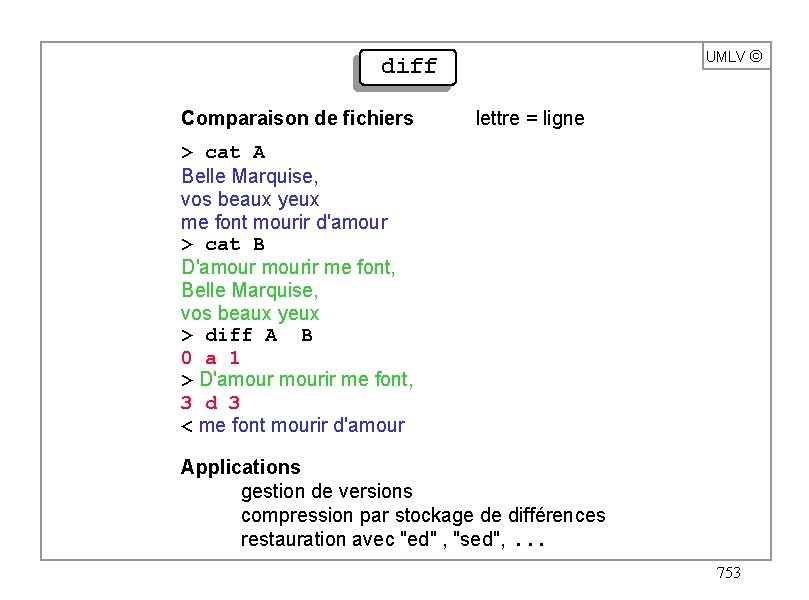
diff UMLV ã Comparaison de fichiers lettre = ligne > cat A Belle Marquise, vos beaux yeux me font mourir d'amour > cat B D'amourir me font, Belle Marquise, vos beaux yeux > diff A B 0 a 1 > D'amourir me font, 3 d 3 < me font mourir d'amour Applications gestion de versions compression par stockage de différences restauration avec "ed" , "sed", . . . 753
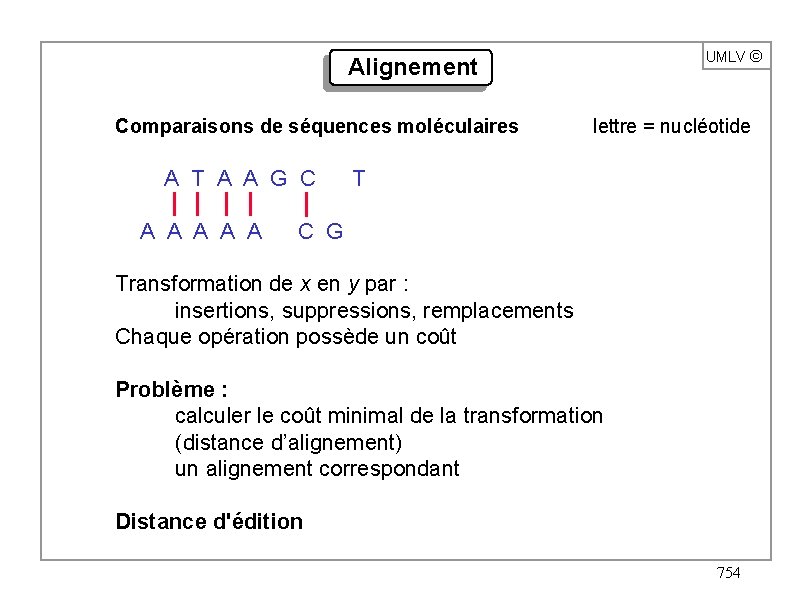
Alignement UMLV ã Comparaisons de séquences moléculaires lettre = nucléotide A T A A G C T A A A C G Transformation de x en y par : insertions, suppressions, remplacements Chaque opération possède un coût Problème : calculer le coût minimal de la transformation (distance d’alignement) un alignement correspondant Distance d'édition 754
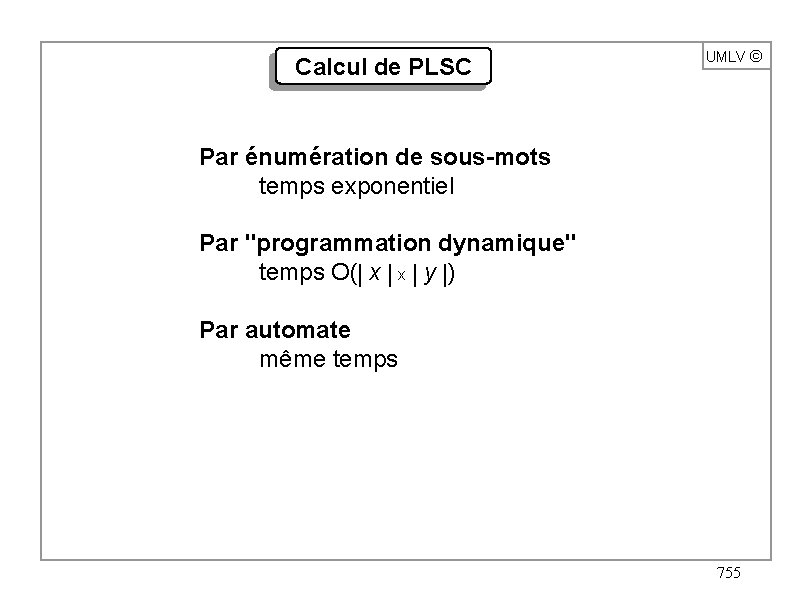
Calcul de PLSC UMLV ã Par énumération de sous-mots temps exponentiel Par "programmation dynamique" temps O(| x | y |) Par automate même temps 755
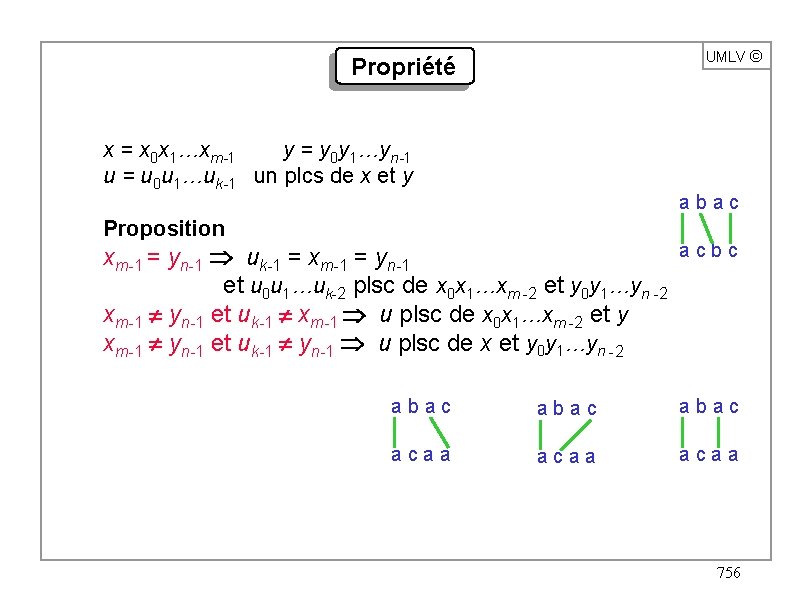
UMLV ã Propriété x = x 0 x 1…xm-1 y = y 0 y 1…yn-1 u = u 0 u 1…uk-1 un plcs de x et y a b a c Proposition a c b c xm-1 = yn-1 Þ uk-1 = xm-1 = yn-1 et u 0 u 1…uk-2 plsc de x 0 x 1…xm -2 et y 0 y 1…yn -2 xm-1 ¹ yn-1 et uk-1 ¹ xm-1 Þ u plsc de x 0 x 1…xm -2 et y xm-1 ¹ yn-1 et uk-1 ¹ yn-1 Þ u plsc de x et y 0 y 1…yn -2 a b a c a a a c a a 756
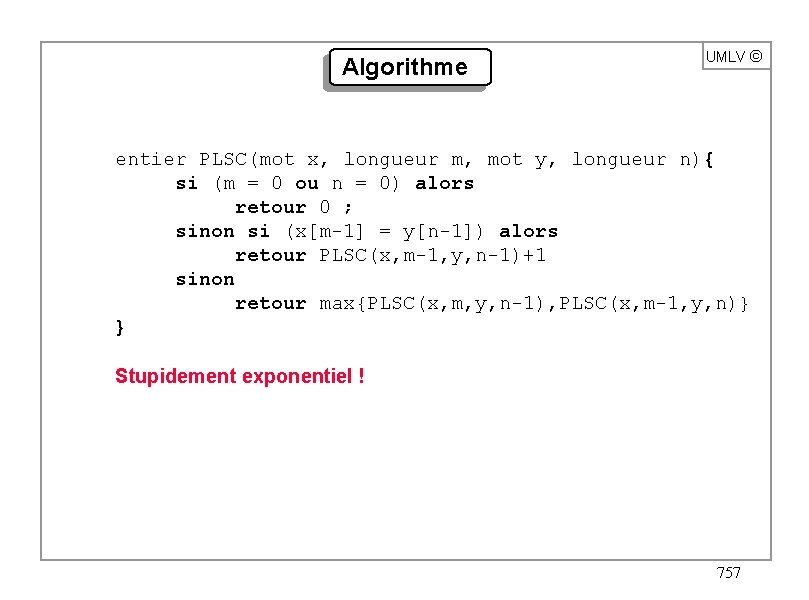
Algorithme UMLV ã entier PLSC(mot x, longueur m, mot y, longueur n){ si (m = 0 ou n = 0) alors retour 0 ; sinon si (x[m-1] = y[n-1]) alors retour PLSC(x, m-1, y, n-1)+1 sinon retour max{PLSC(x, m, y, n-1), PLSC(x, m-1, y, n)} } Stupidement exponentiel ! 757
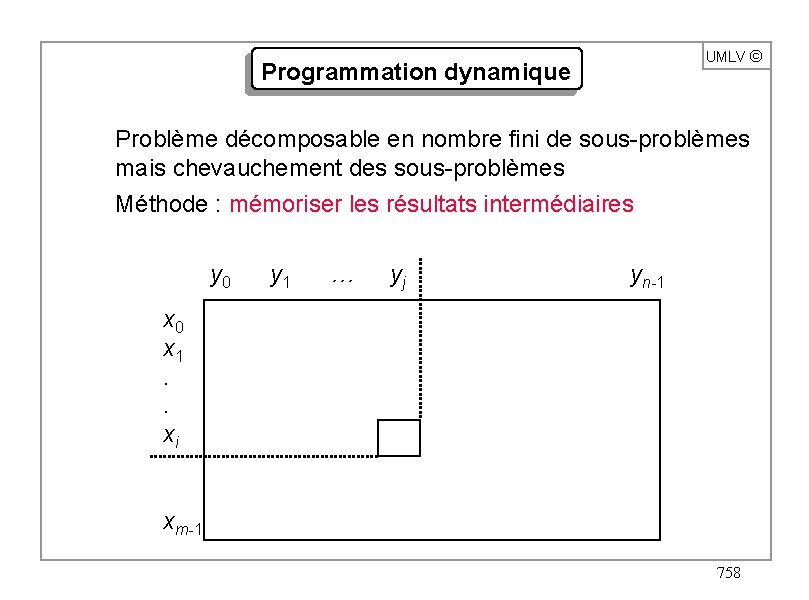
UMLV ã Programmation dynamique Problème décomposable en nombre fini de sous-problèmes mais chevauchement des sous-problèmes Méthode : mémoriser les résultats intermédiaires y 0 y 1 … yj yn-1 x 0 x 1. . xi xm-1 758
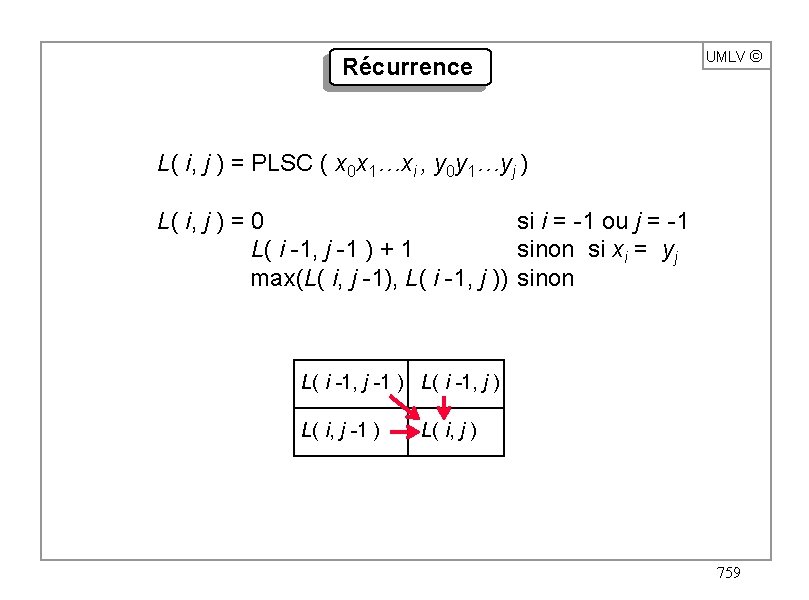
Récurrence UMLV ã L( i, j ) = PLSC ( x 0 x 1…xi , y 0 y 1…yj ) L( i, j ) = 0 si i = -1 ou j = -1 L( i -1, j -1 ) + 1 sinon si xi = yj max(L( i, j -1), L( i -1, j )) sinon L( i -1, j -1 ) L( i -1, j ) L( i, j -1 ) L( i, j ) 759
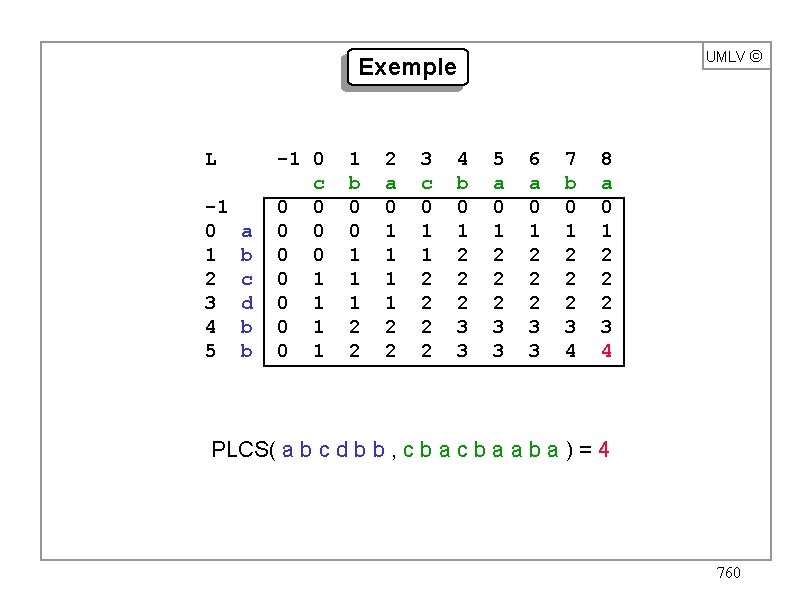
UMLV ã Exemple L -1 0 1 2 3 4 5 a b c d b b -1 0 c 0 0 0 0 1 0 1 1 b 0 0 1 1 1 2 2 2 a 0 1 1 2 2 3 c 0 1 1 2 2 4 b 0 1 2 2 2 3 3 5 a 0 1 2 2 2 3 3 6 a 0 1 2 2 2 3 3 7 b 0 1 2 2 2 3 4 8 a 0 1 2 2 2 3 4 PLCS( a b c d b b , c b a a b a ) = 4 760

Algorithme UMLV ã entier PLSC(mot x, longueur m, mot y, longueur n){ pour i -1 à m-1 faire L[i, 0] 0 ; pour j -1 à n-1 faire L[0, j] 0 ; pour i 0 à m-1 faire pour j 0 à n-1 faire si x[i] = y[j] alors{ L[i, j] L[i-1, j-1]+1 ; P[i, j] '' ; }sinon si L[i-1, j] L[i, j-1] alors{ L[i, j] L[i-1, j] ; P[i, j] ' ' ; }sinon{ L[i, j] L[i, j-1] ; P[i, j] ' ' ; } retour L[m-1, n-1] ; } 761
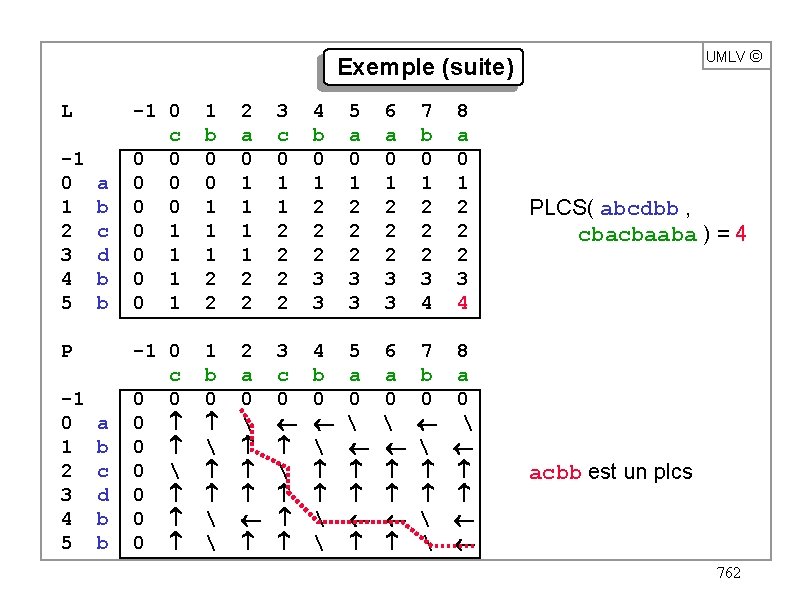
UMLV ã Exemple (suite) L -1 0 1 2 3 4 5 a b c d b b -1 0 c 0 0 0 0 1 0 1 1 b 0 0 1 1 1 2 2 2 a 0 1 1 2 2 3 c 0 1 1 2 2 4 b 0 1 2 2 2 3 3 5 a 0 1 2 2 2 3 3 6 a 0 1 2 2 2 3 3 7 b 0 1 2 2 2 3 4 8 a 0 1 2 2 2 3 4 a b c d b b -1 0 c 0 0 0 0 0 0 0 0 1 b 0 2 a 0 3 c 0 4 b 0 5 a 0 6 a 0 7 b 0 8 a 0 P -1 0 1 2 3 4 5 PLCS( abcdbb , cbacbaaba ) = 4 acbb est un plcs 762
Variantes UMLV ã Problème ouvert calcul de PLSC en temps < O(n 2 / log n) Variantes - calcul de PLSC en espace linéaire [une ligne de L suffit] - calcul d’un plsc en espace linéaire [algorithme de Hirschberg] - utilisation des « dominants » - algorithme rapide en pratique bien que temps maximal = O(n 2 log n) dans certaines implantations de diff [algorithme de Hunt et Szymanski] 763
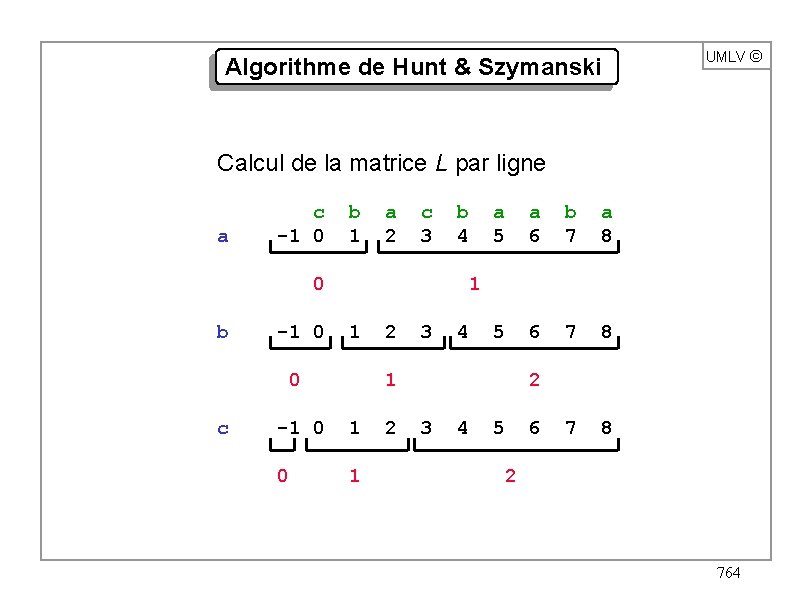
Algorithme de Hunt & Szymanski UMLV ã Calcul de la matrice L par ligne a c -1 0 b 1 a 2 c 3 b 4 0 b -1 0 a 6 b 7 a 8 5 6 7 8 1 1 0 c a 5 2 3 4 1 -1 0 1 2 2 3 4 5 6 2 764
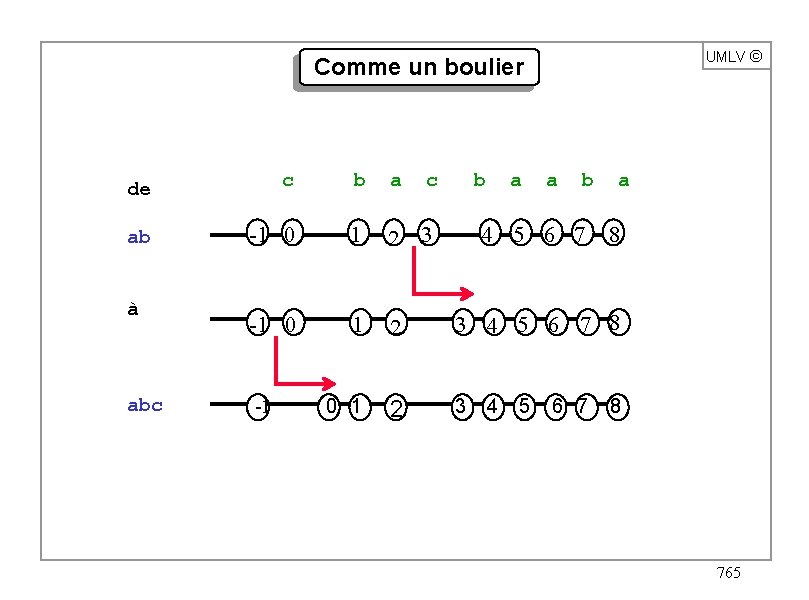
UMLV ã Comme un boulier de c b a ab -1 0 1 2 3 4 5 6 7 8 0 1 2 3 à abc -1 c b a a b 4 5 6 7 a 8 8 765

Algorithme x = x 0 x 1…xm-1 UMLV ã y = y 0 y 1…yn-1 Pos[ a ] = { j | yj = a } pour a A Pour i fixé : J [ k ] = { j | PLSC(x 0 x 1…xi, y 0 y 1…yj) = k } entier PLSC(mot x, longueur m, mot y, longueur n){ J[-1] {-1, 0, 1, …, n-1}; pour k 0 à n-1 faire J[k] ; pour i 0 à m-1 faire pour chaque p Pos[x[i]] en décroissant faire{ k CLASSE(p); si k = CLASSE(p-1) alors{ (J[k], X) PARTAGE(J[k], p); J[k+1] UNION(X, J[k+1]); } } retour CLASSE(n-1); } 766
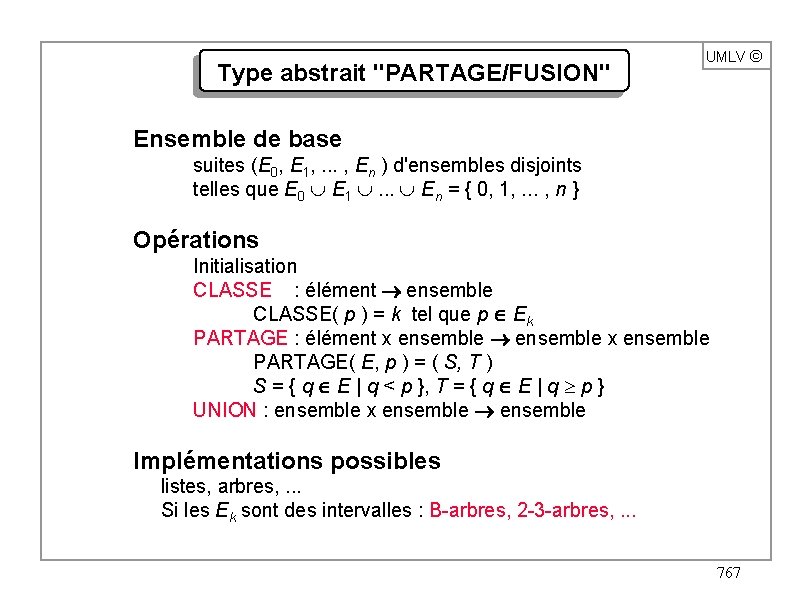
Type abstrait "PARTAGE/FUSION" UMLV ã Ensemble de base suites (E 0, E 1, . . . , En ) d'ensembles disjoints telles que E 0 È E 1 È. . . È En = { 0, 1, . . . , n } Opérations Initialisation CLASSE : élément ® ensemble CLASSE( p ) = k tel que p Ek PARTAGE : élément x ensemble ® ensemble x ensemble PARTAGE( E, p ) = ( S, T ) S = { q E | q < p }, T = { q E | q p } UNION : ensemble x ensemble ® ensemble Implémentations possibles listes, arbres, . . . Si les Ek sont des intervalles : B-arbres, 2 -3 -arbres, . . . 767
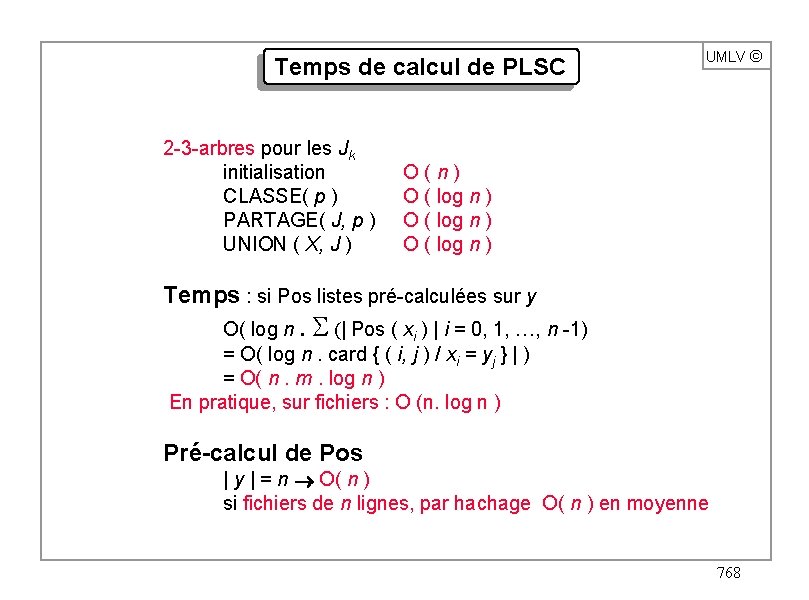
Temps de calcul de PLSC 2 -3 -arbres pour les Jk initialisation CLASSE( p ) PARTAGE( J, p ) UNION ( X, J ) UMLV ã O ( n ) O ( log n ) Temps : si Pos listes pré-calculées sur y O( log n. S (| Pos ( xi ) | i = 0, 1, …, n -1) = O( log n. card { ( i, j ) / xi = yj } | ) = O( n. m. log n ) En pratique, sur fichiers : O (n. log n ) Pré-calcul de Pos | y | = n ® O( n ) si fichiers de n lignes, par hachage O( n ) en moyenne 768
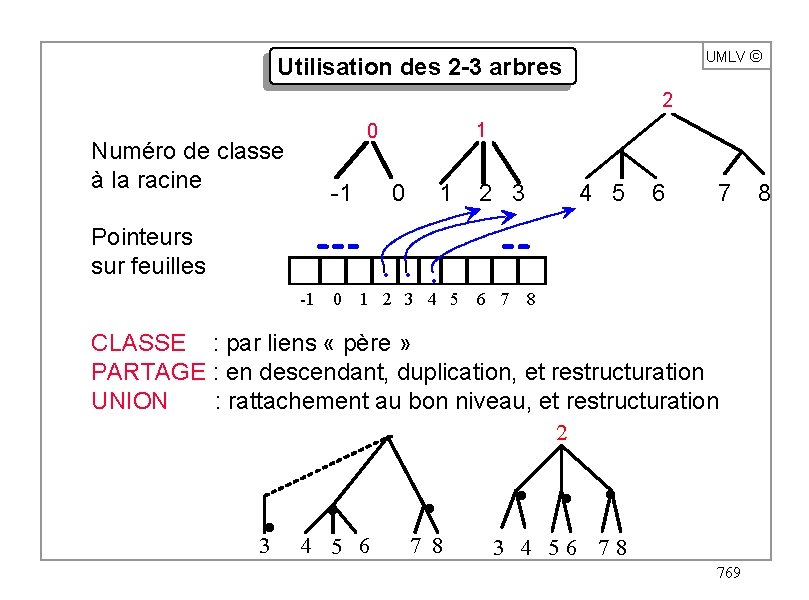
UMLV ã Utilisation des 2 -3 arbres 2 1 0 Numéro de classe à la racine -1 0 1 2 3 4 5 6 7 8 Pointeurs sur feuilles -1 0 . . . 1 2 3 4 5 6 7 8 CLASSE : par liens « père » PARTAGE : en descendant, duplication, et restructuration UNION : rattachement au bon niveau, et restructuration 2 . . . 3 4 5 6 7 8 3 4 56 78 769
- Slides: 19