
UML based expert system generation Using Enterprise Architect
UML based expert system generation Using Enterprise Architect to model and generate a web-based expert system
Aims of research § Using Unified Modelling Language (UML) to model expert systems (ES) § Developing a system that can consume and analyze that model to generate an ES § Using the web as a deployment platform
Reasons for research § ES need maintaining and scaling § ES model should remain accurate § As the system grows, it’s model should still be understandable § ES benefit from portability
Technologies used § Enterprise Architect § UML model development § XML exporting of model § Visual Studio 2010 § Shell development using ASP. NET and C# § Web based user interface
Similar research § Dunstan’s ES generator § Uses XML to output web-based ES related to university courses § XML file contains course information § Prolog interpreter processes the data and outputs web pages § WITS – web-based training ES for SME’s § Uses Java. Script to provide functionality § Easy to use interface
What does this research add? § XML data generation methods § consistency and validity of ES model § accessible web-based ES not reliant on client side scripting § mechanism for both developers and users to access the system
ES Modelling § Relevant UML elements § Activity Diagrams § Activities, objects, decisions, initials and finals § Edges used to link elements with optional guards § Sample ES § Housing Benefit § Income, dependants, housing need define level of housing benefit
KBS and ES Shell components § Knowledge base § The uml model § Development environment § EA § Inference engine §. net shell § User interface § Web page § Explanation facilities § Web page
Mapping UML to ES § Critical factors are determined through activity diagrams § Decisions within the diagrams become rules – for example ‘fixed abode’ § Forward chaining is used to test all decisions against current knowledge base – leading to a goal state. § Uses a blind search
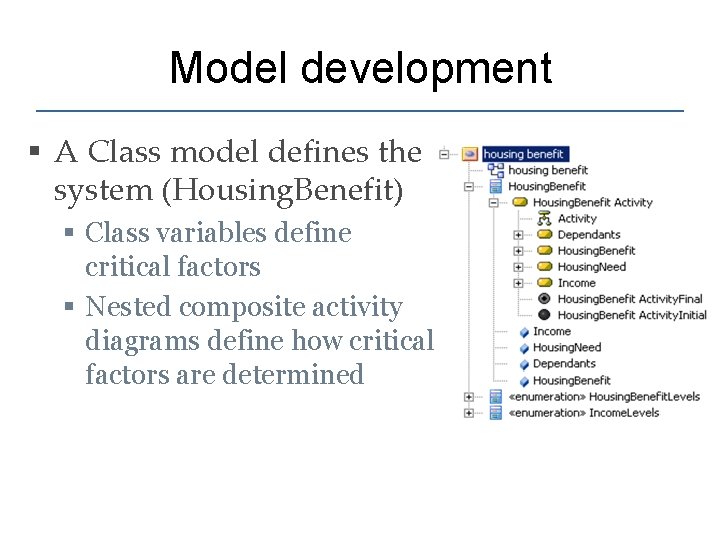
Model development § A Class model defines the system (Housing. Benefit) § Class variables define critical factors § Nested composite activity diagrams define how critical factors are determined
Activity Diagrams § Instances of the class are added to diagrams § Run state of a variable in that instance is set accordingly § Ensures consistency/ integrity of data § Where variables must only hold specific values, enumerations are used § (demo)
ES Generator Classes § Expert. System class § Dictionary containing all the critical factors § Source XML data § Processes the top level activities and outputs the results § Critical. Factor class § Processes the composite activities § Determines the result of each critical factor § Nodes § Process individual elements of an activity diagram
Processing § Loops § Top level loop successively finds all top level activities starting from the first initial node § Sub loop processes discrete elements on each composite activity diagram § (es generator activities)
Determining critical factors § Object node finds the variable § ‘extended. Properties’ subnode of the current node runstate="@VAR; Variable=Housing. Need; Value=true; Op==; @ENDVAR; “ § § Split on ‘; ’ Split on ‘=‘ Get the variable name and value Set the parent _critical. Factor. Result to the value
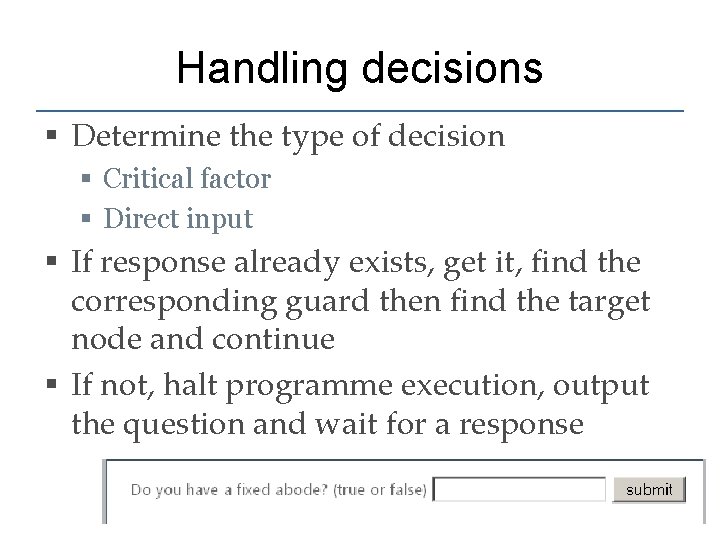
Handling decisions § Determine the type of decision § Critical factor § Direct input § If response already exists, get it, find the corresponding guard then find the target node and continue § If not, halt programme execution, output the question and wait for a response
Output § Once all critical factors have been determined, the goal state is determined § Then results are output § This includes output of determining factors § Thereby providing simple explanation
Limitations Only simple input can be handled Inputs are not validated Not like a traditional ES shell Developers must have knowledge of UML Changes to the system must take place at the correct location § UML based XML data is hard-coded § § §
Advantages § ES model can scale whilst still being logically organised/ understandable § The model is a perfect representation of the implementation § Being web-based it is portable § The shell allows any ES to be developed and deployed on the web § Provided the developer knows UML and has Enterprise Architect.
- Slides: 18