
Umayyad Imperium and Early Abbasid Era Rise Spread
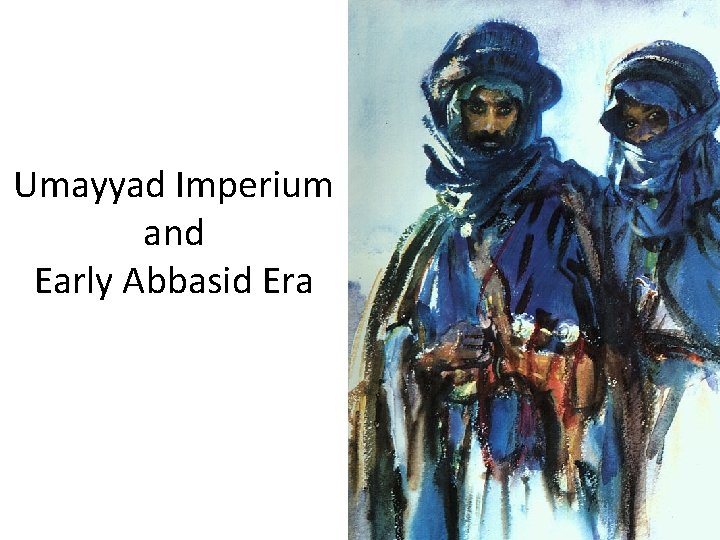
Umayyad Imperium and Early Abbasid Era
Rise & Spread of Islam: Chapter Summary • 7 th century CE (600’s): – Followers of Muhammad surged from Arabian peninsula – Created first global civilization by incorporating elements of Greece, Persia, and Egypt – Provided links for exchange between “civilized” centers – United in belief of Muhammad’s message – Divided by cultural and political rivalries – Strong until 14 th century (1300’s)
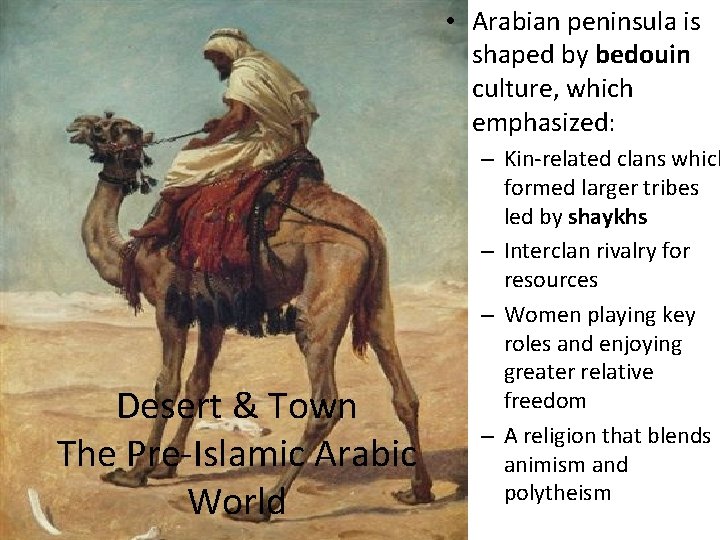
• Arabian peninsula is shaped by bedouin culture, which emphasized: Desert & Town The Pre-Islamic Arabic World – Kin-related clans which formed larger tribes led by shaykhs – Interclan rivalry for resources – Women playing key roles and enjoying greater relative freedom – A religion that blends animism and polytheism
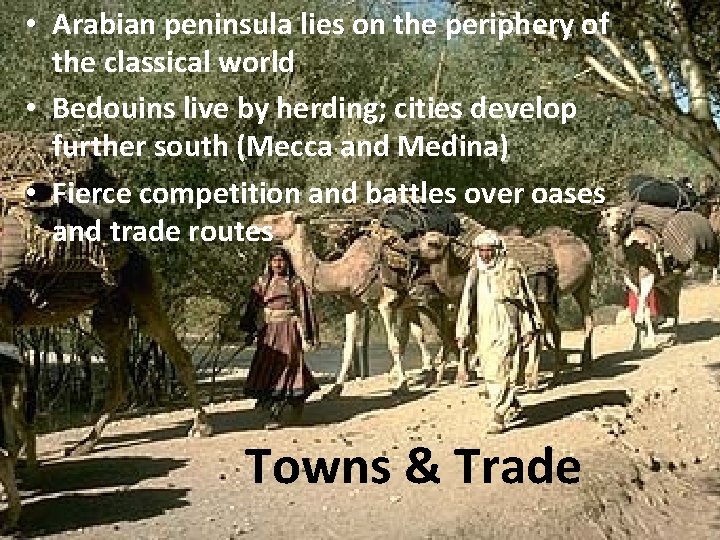
• Arabian peninsula lies on the periphery of the classical world • Bedouins live by herding; cities develop further south (Mecca and Medina) • Fierce competition and battles over oases and trade routes Towns & Trade
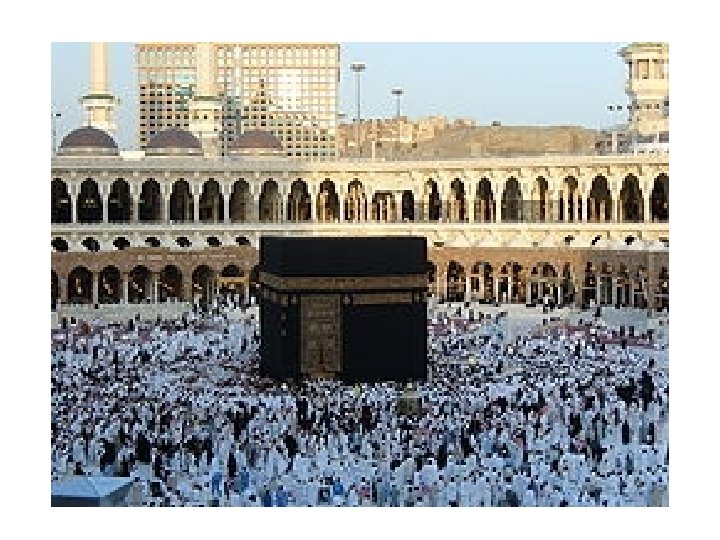
Pre-Islamic Arabian World • Cities developed • Trading system linked Med. to east Asia • Mecca: – Most important city – Founded by Umayyad clan – Site of religious shrine Ka’ba • Medina – Second most important city – Agricultural oasis and commercial center
Pre-Islamic Arabian World • Status of women – Didn’t wear veils – Not secluded – Able to have multiple marriage partners – Men remained superior • Property control, inheritance, and divorce – Did drudge labor – More restricted in urban areas
Pre-Islamic Arabian World • Culture not highly developed due to isolation and environment • Focused on orally transmitted poetry • Religion=blend of animism and polytheism – Some tribes recognized Allah (supreme deity) but largely ignored – Main focus=spirits and nature – Religion and ethics NOT connected
Life of Muhammad • Born approx. 570 CE • Orphan, raised by father’s family • Became merchant – Allowed him to observe society undermining clan unity – Encountered monotheism • Dissatisfied with his life so went into hills to meditate – In 610, he started having his revelations – Later written down in Arabic and collected as Qur’an – Formed basis of Islam • Died in 632 – Unity threatened but reunited in 633 under Umayyad empire
Muhammad and the Birth of Islam • 7 th century C. E. , a new religion arose in the Arabian peninsula. • Built on the revelations received by the prophet Muhammad, Islam won over many camelherding tribes of the peninsula within decades. • Islam united Arabs under an important ethical system. • Islam’s beliefs and practices (including the five pillars) eventually made it one of the great world religions.
Arabs and Islam • Islam provided way to unite Arabs – System of ethics capable of healing social rifts – Strong and wealthy responsible for taking care of weak and poor • Distinct, indigenous monotheism that supplanted and ended clan feuds • Umma=community of the faithful – Transcended old tribal clan boundaries – All believers equal before Allah – All faced last judgment by stern but compassionate God • Profits teachings and Qur’an is basis for laws regulating the Muslim faithful
Universal Elements of Islam • • • Monotheism Legal codes Egalitarianism Strong sense of community Five Pillars – – – Acceptance of Islam Prayer 5 x per day Fasting during month of Ramadan Paying zakat for charity Hajj (pilgrimage to Mecca)
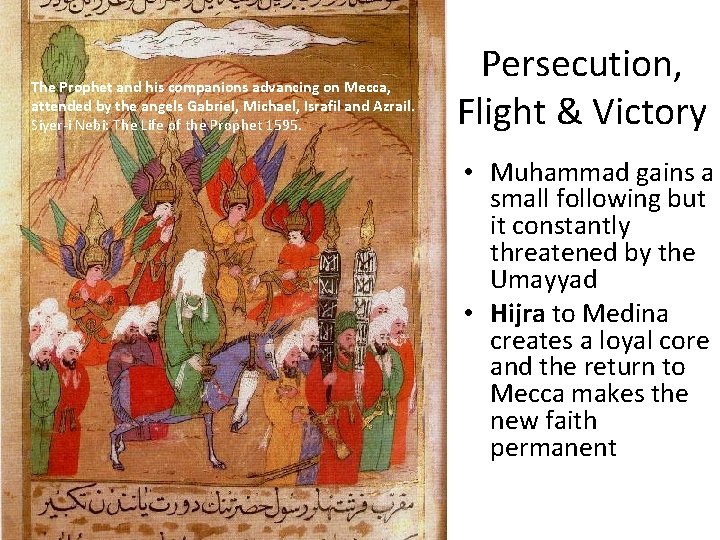
The Prophet and his companions advancing on Mecca, attended by the angels Gabriel, Michael, Israfil and Azrail. Siyer-i Nebi: The Life of the Prophet 1595. Persecution, Flight & Victory • Muhammad gains a small following but it constantly threatened by the Umayyad • Hijra to Medina creates a loyal core and the return to Mecca makes the new faith permanent
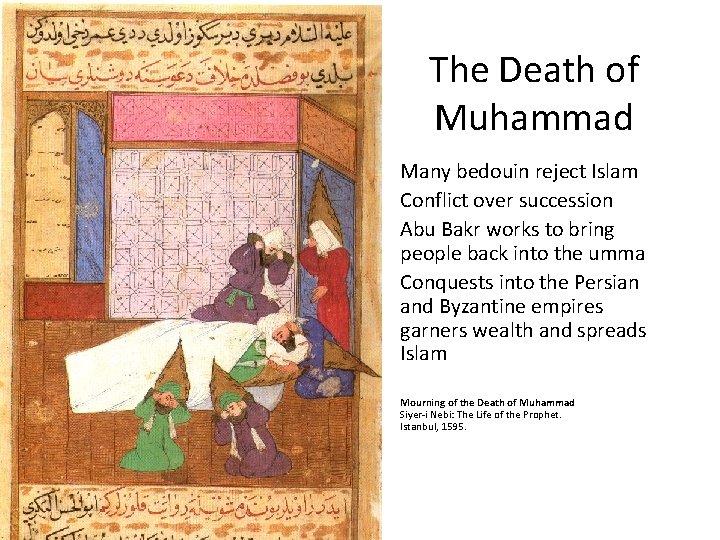
The Death of Muhammad • Many bedouin reject Islam • Conflict over succession • Abu Bakr works to bring people back into the umma • Conquests into the Persian and Byzantine empires garners wealth and spreads Islam • Mourning of the Death of Muhammad Siyer-i Nebi: The Life of the Prophet. Istanbul, 1595.
Umayyad Rule and the Sunni-Shi’a Split • Conflict over successors leads to split, which remains to this day • Umayyad settle internal disputes and pushed forward into central Asia, northwest India, and southwestern Europe. • built an imperial administration with both bureaucracy and military dominated by a Muslim Arab elite.
Problem of Succession • When Muhammad died, he had not established a procedure for selecting a new leader • After a troubled process, Abu Bakr was chosen as caliph • The murder of the third caliph, Uthman, caused a succession struggle • Earliest followers supported Ali, Muhammad’s son-in-law (Shi’a) – Still support the right of his descendents after his murder in 661 • Umayyads were Sunnis • Permanent division within Islam between the Sunnis and Shi’as to this day
Converts and “People of the Book. ” Umayyad policy did not prevent interaction, intermarriage, and conversion between Arabs and their subjects. Converts paid taxes and did not receive a share of booty; they were blocked from important positions in the army or bureaucracy. Most of the conquered peoples were Dhimmis (people of the book). Included Jews and Christians; later Zoroastrians and Hindus. Dhimmis had to pay taxes but could retain their own religious and social organization.
Family and Gender Roles in the Umayyad Age • Initially, favorable status of women • Muhammad and Qur’an stressed moral and ethical dimensions of marriage – Adultery by BOTH partners denounced – Men allowed to have four wives but had to treat them all equally – Strengthened women’s legal rights in inheritance and divorce – Both sexes equal before Allah – Strong status did not endure
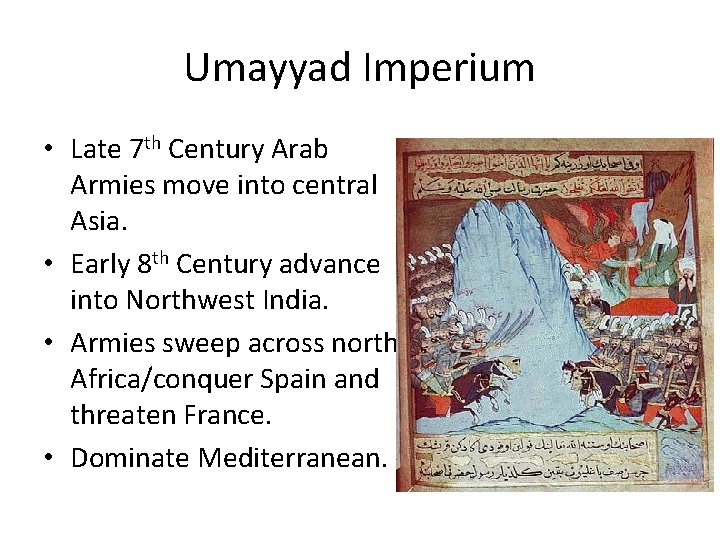
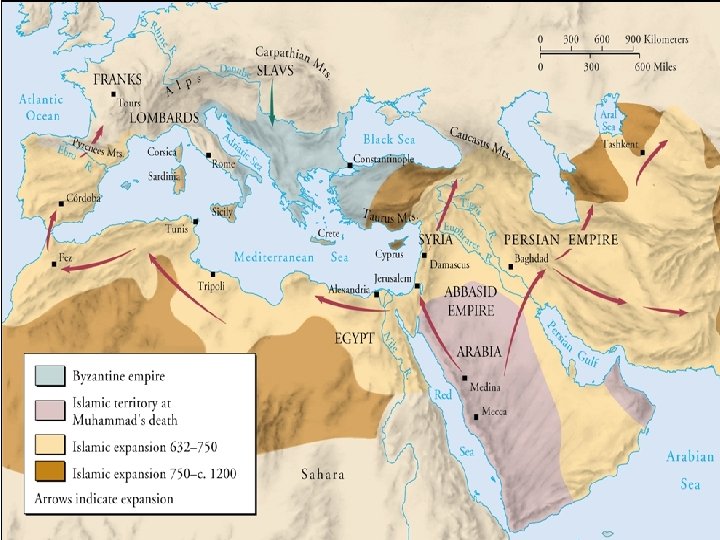
Umayyad Imperium • Late 7 th Century Arab Armies move into central Asia. • Early 8 th Century advance into Northwest India. • Armies sweep across north Africa/conquer Spain and threaten France. • Dominate Mediterranean.
Motivation for Arab Conquest • Sense of common cause • Rich booty and tribute gained often were more of a motivation than spreading the faith – Later, converts were exempt from taxes and shared spoils of victory
The rule of the Umayyads: • Internal factional disputes § moved capital from Mecca to Damascus easier to control expanding territories but Arab Muslims felt it was too far away. § moved away from the simple life of “rightly guided” caliphs and surrounded themselves with wealth, ceremony, even decadence … like non-Muslim rulers, in the eyes of critics. § small Arab and Muslim aristocracy rules over peoples who are neither Arab or Muslim. § Only Muslim Arabs are first class citizens and only they share in conquest booty.
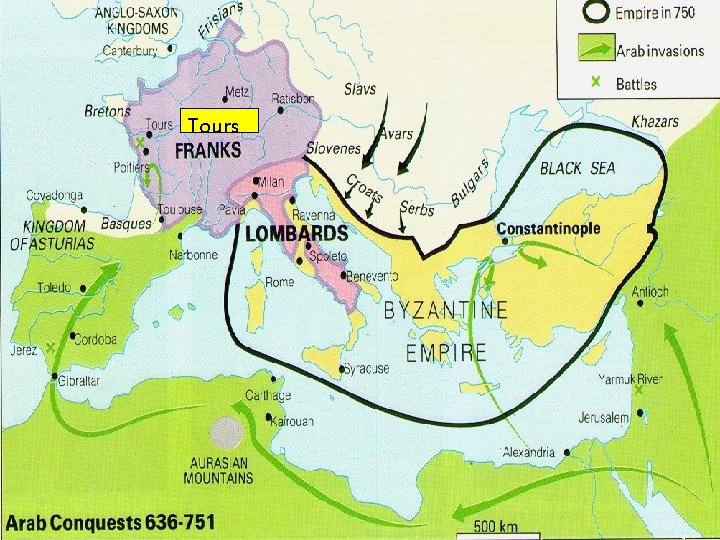
Tours
Converts and “People of the Book” • Populations of the conquered areas voluntarily convert to Islam. • Known as “mawali. ” • Only accepted as clients of the Arabs. • Greatest portion of the Empire’s population were “ dhimmi” – people of the book.
Umayyad Decline • Caliph’s growing addiction to luxury and their aloofness alienate the Muslim faithful. • Revolts throughout the empire. • Warrior s contemptuous of the Umayyads and Damascus elite. • March against the Umayyads under the black banners of the Abbasid party and are supported by the mawali.
The rule of the Abbasids: • Internal rebellion brings down the Umayyad caliphate in 750, when the Abbasids take control of the empire. • The Abbasids murdered all the Umayyad rulers except a prince who escaped to Spain, where he established what would become a distinctively tolerant Islamic culture blending Roman, Germanic and Jewish traditions with those of the Arabs and Berbers Muslims called the Iberian territories here al-Andalus, and it was centered at Cordoba – a culturally rich and thriving city with writers and artists and many more people than elsewhere in Europe.
The rule of the Abbasids: • The Abbasid caliphs brought political, economic, and cultural change to the world of Islam. • They tried to break down distinctions between Arab and non-Arab Muslims all now allowed to hold both civil and military offices, which opened up Islamic culture to the influences of occupied civilizations and thereby becoming more cosmopolitan. • Many Arabs began to intermarry with the people they had conquered, and now many people from North Africa and the eastern Mediterranean began to consider themselves Arab.
The rule of the Abbasids: • In 762 the Abbasids built a new capital city at Baghdad – on the Tigris river much farther to the east than the Umayyad capital at Damascus and more suitable as a nexus for trade – Persian cultural influence came to the fore. • Judges, merchants and government officials now seen as ideal citizens – rather than the previous warrior ideal … which meant that the Abbasids were much less a conquering dynasty than the Umayyads. • In designing their administration, they relied heavily on Persian techniques of statecraft and bureaucracy (they ruled autocratically, more as kings than spiritual leaders) … and this increasingly regal pomp and circumstance was also probably a natural consequence of the growing power and prosperity of the empire.
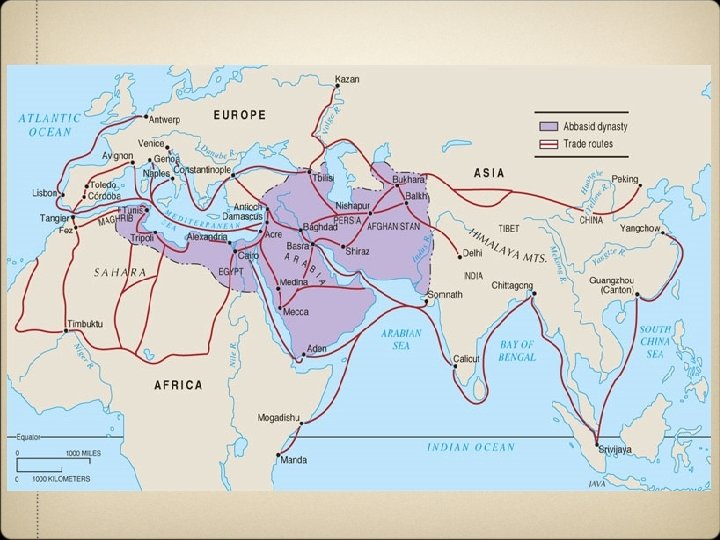
The rule of the Abbasids: • Rise of the mawali paralleled by growth in wealth and social status of the merchant and landlord class. • Arab maritime trading in western Mediterranean to South China Sea. Joint ventures – Muslim, Christian, Jews • Profits from mercantile concerns spent on mosques, religious schools, rest houses, hospitals. • Growth increases handicraft production. • Ayan (Landed elite) –become large estate owners.
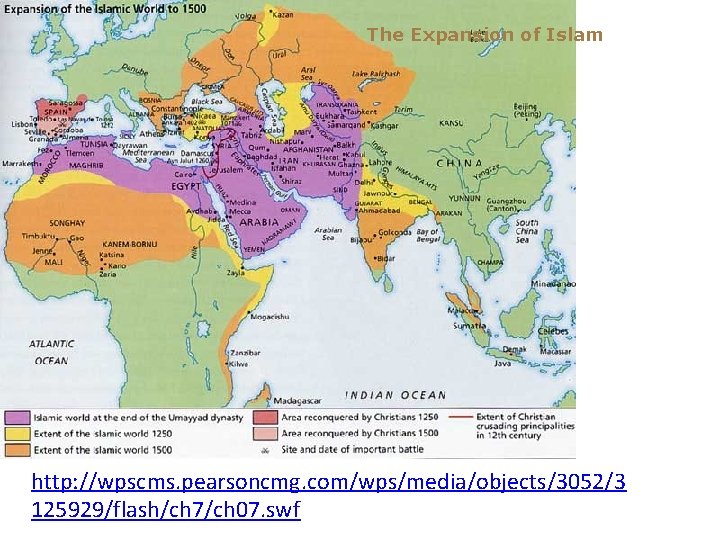
The Expansion of Islam http: //wpscms. pearsoncmg. com/wps/media/objects/3052/3 125929/flash/ch 7/ch 07. swf
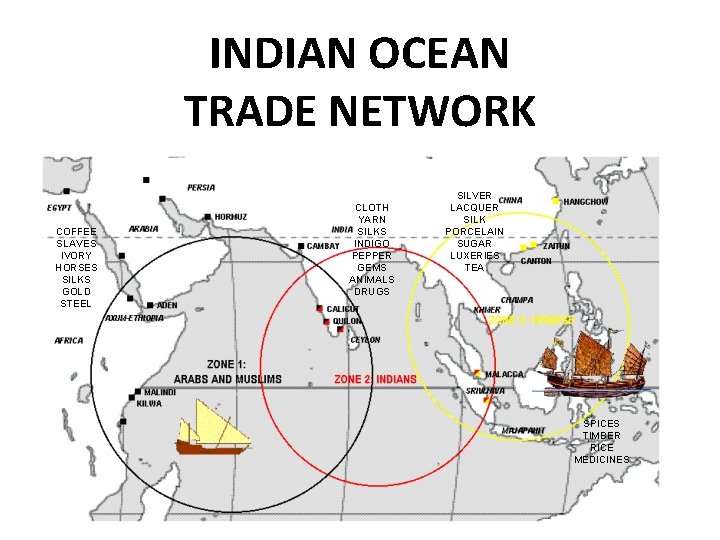
INDIAN OCEAN TRADE NETWORK COFFEE SLAVES IVORY HORSES SILKS GOLD STEEL CLOTH YARN SILKS INDIGO PEPPER GEMS ANIMALS DRUGS SILVER LACQUER SILK PORCELAIN SUGAR LUXERIES TEA SPICES TIMBER RICE MEDICINES
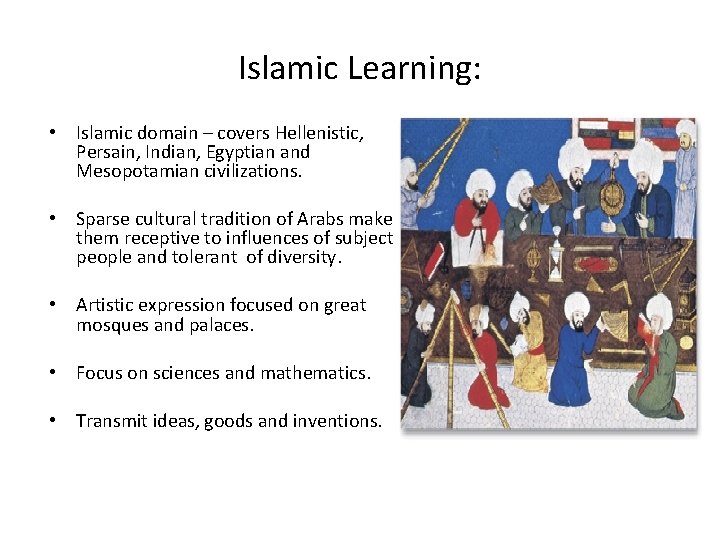
Islamic Learning: • Islamic domain – covers Hellenistic, Persain, Indian, Egyptian and Mesopotamian civilizations. • Sparse cultural tradition of Arabs make them receptive to influences of subject people and tolerant of diversity. • Artistic expression focused on great mosques and palaces. • Focus on sciences and mathematics. • Transmit ideas, goods and inventions.
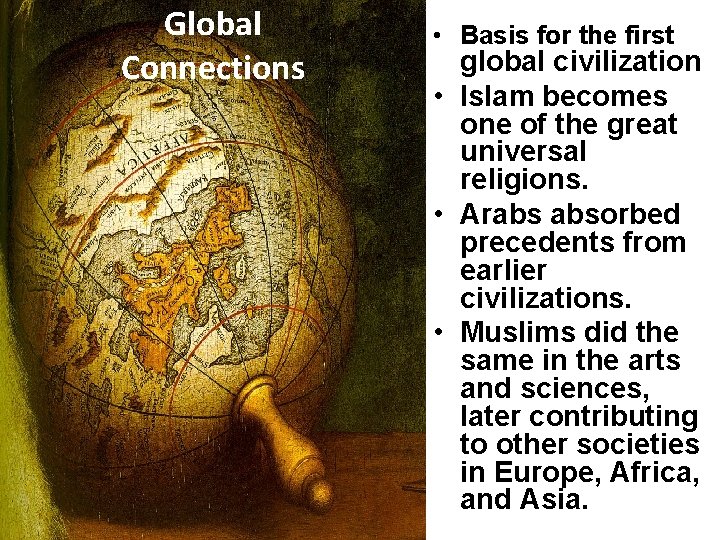
Global Connections • Basis for the first global civilization • Islam becomes one of the great universal religions. • Arabs absorbed precedents from earlier civilizations. • Muslims did the same in the arts and sciences, later contributing to other societies in Europe, Africa, and Asia.
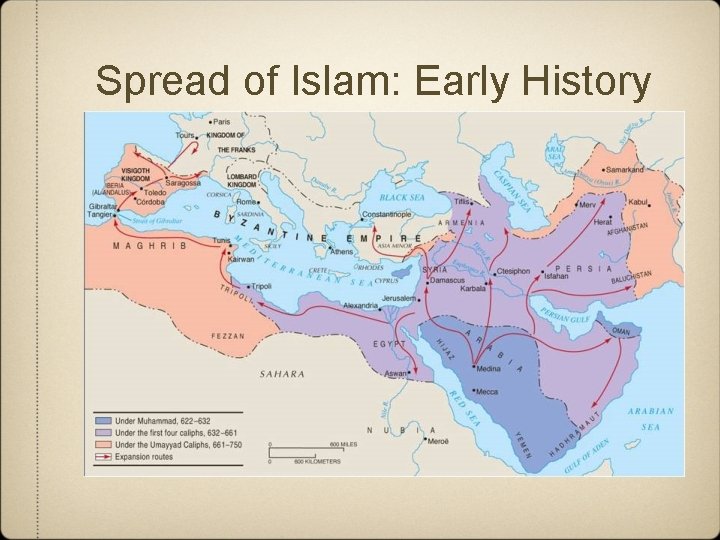
Spread of Islam: Early History
Islamic Heartlands in the Middle and Late Abbasid Eras By mid 9 th century, Abbasid dynasty had begun to lose control over empire (gradual disintegration) Sumptuous living, civil wars drain treasury Shi’a revolts, assassination attempts against Abbasid officials Peasant revolts about increasing taxes Al-Mahdi (3 rd Abbasid caliph) financially drained the empire, luxurious living
The Late Abbasid Era • As early as the third Abbasid Caliph, al-Mahdi (775 -785), issues related to the decline of the Abbasid Caliphate were apparent. • • Somewhat typical pattern: • Caliph abandons frugal ways of predecessors • Caliph does NOT establish clear pattern of succession In many cases, wives/concubines became involved in the various palace intrigues associated with the succession crises.
Islamic Heartlands in the Middle and Late Abbasid Eras Harun al-Rashid (786 -809 CE): most famous and longest lasting Abbasid caliph. Highly dependent on his advisors Reign full of excess and sumptuous living After his death, there were several civil wars over succession.
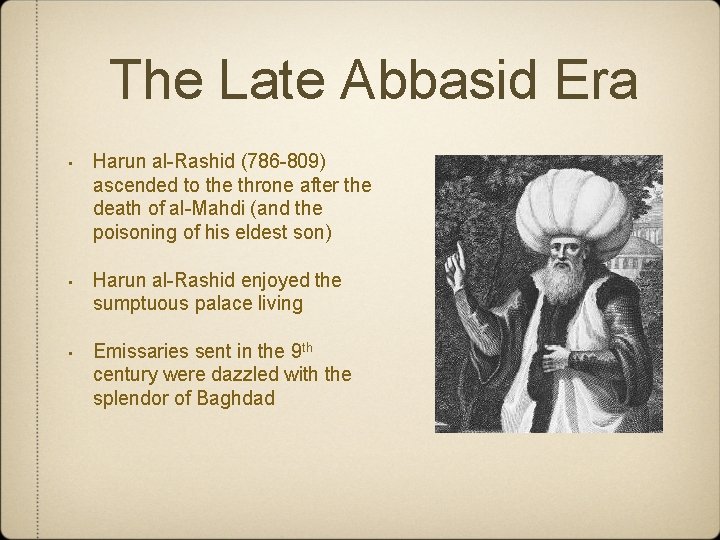
The Late Abbasid Era • Harun al-Rashid (786 -809) ascended to the throne after the death of al-Mahdi (and the poisoning of his eldest son) • Harun al-Rashid enjoyed the sumptuous palace living • Emissaries sent in the 9 th century were dazzled with the splendor of Baghdad
Harun al-Rashid • Power of Royal Advisors grew throughout the rule of Harun al-Rashid. • Caliphs became pawns in the factional royal court battles… • Upon al-Rashid’s death, full-scale civil war broke out amongst those vying for power. • While al-Ma’mum (813 -833) was the victor…what he did next truly changed the nature of the Caliphate…
Slave Armies • Al-Ma’mum was convinced to conscript thousands of mostly Turkic-speaking slaves as his personal bodyguards. • As the number eclipsed 70, 000 the slave regiment became a power center, in its own right. • By 846, they had murdered the reigning caliph, and in the coming decades would murder at least four more
Islamic Heartlands in the Middle and Late Abbasid Eras Increase in mercenary armies. Aggressive; create social unrest Power supporting Abbasids. Money also lost on: Caliphs attempted to build new capitals near Baghdad Agricultural villages, irrigation abandoned
Abbasid Decline • Caliphs struggle to control the Slave Regiments • Some Caliphs want to move capital away from Baghdad turmoil • Increased spending • New irrigation… • Old irrigation and public works fall into disrepair • Spiraling taxation/pillaging, etc… • Abandonment of some of the earlier provinces of the empire.
Islamic Heartlands in the Middle and Late Abbasid Eras Freedom and influence of women declined. Abbasid society was male dominated. Women began to be veiled. Poor women worked but rich women did not. Abbasid wealth generated large demand for concubines and male slaves.
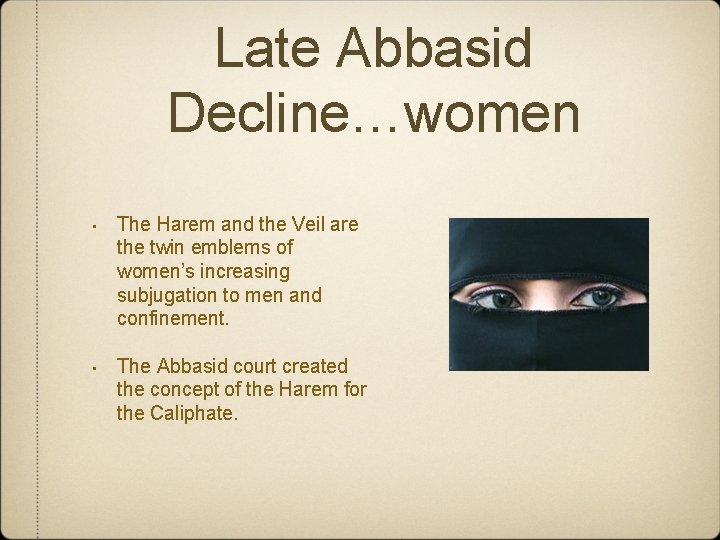
Late Abbasid Decline…women • The Harem and the Veil are the twin emblems of women’s increasing subjugation to men and confinement. • The Abbasid court created the concept of the Harem for the Caliphate.
Further Abbasid Decline • The Abbasids were losing territory quickly… • Egypt and Syria break away from Abbasid rule • In once-provincial areas of the Islamic Caliphate, independent kingdoms had risen to challenge the Abbasids • In 945, the Buyids of Persia invade and capture Baghdad. • Caliphs became puppets controlled by families, like the Buyids. • Buyid leaders took the title of “sultan” meaning “victorious” in Arabic, which will designate Muslim rulers.
Divisions within the Empire Loss of territory and loss of control in outer reaches of empire Independent kingdoms form in areas that were once provinces, aim to supplant Abbasids The Buyids of Persia captured Baghdad in 945 CE. Originate as province turned kingdom Abbasid caliphs / court became powerless Controlled by sultans (Buyid leaders, “victorious”)
Divisions within the Empire In one century, Buyid control is broken The Seljuk Turks defeated the Buyids in 1055 CE. Seljuks were nomadic invaders from Central Asia Sunnis who eliminated the Shi’a officials in the Buyids and any Shi’a influence the Buyids promoted Rival Shi’a Egyptians and Byzantines were defeated by Seljuks
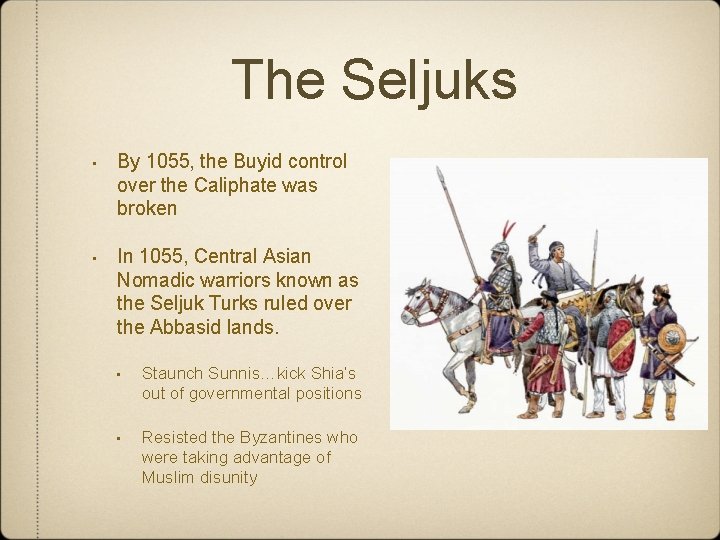
The Seljuks • By 1055, the Buyid control over the Caliphate was broken • In 1055, Central Asian Nomadic warriors known as the Seljuk Turks ruled over the Abbasid lands. • Staunch Sunnis…kick Shia’s out of governmental positions • Resisted the Byzantines who were taking advantage of Muslim disunity
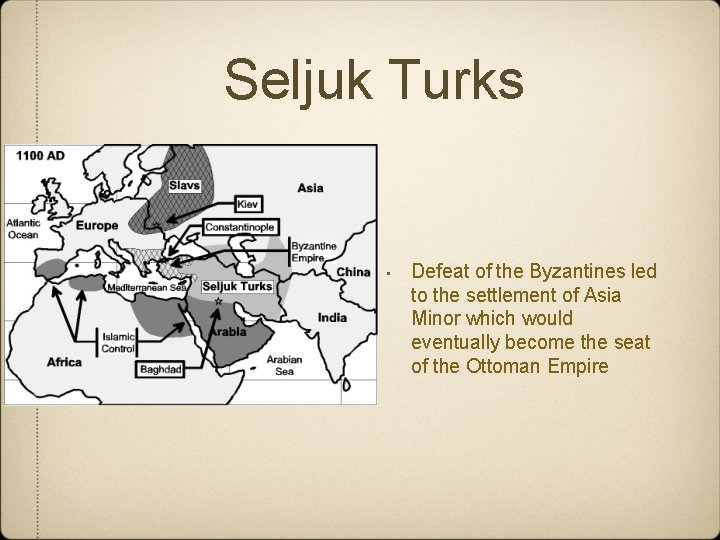
Seljuk Turks • Defeat of the Byzantines led to the settlement of Asia Minor which would eventually become the seat of the Ottoman Empire
Divisions within the Empire 1096 CE- West European Christian crusaders invaded Muslim territory Chaos from Buyids and Seljuks in empire makes crusader invasion easy Goal is to capture the biblical Holy Land Jerusalem (June 1099) Established small, rival warrior kingdoms Most were recaptured (Acre, last to fall in 1291 CE) Europeans borrowed heavily from Muslim civilizations Europeans recovered lost Greek learning Muslim peoples were not very interested in European civilization.
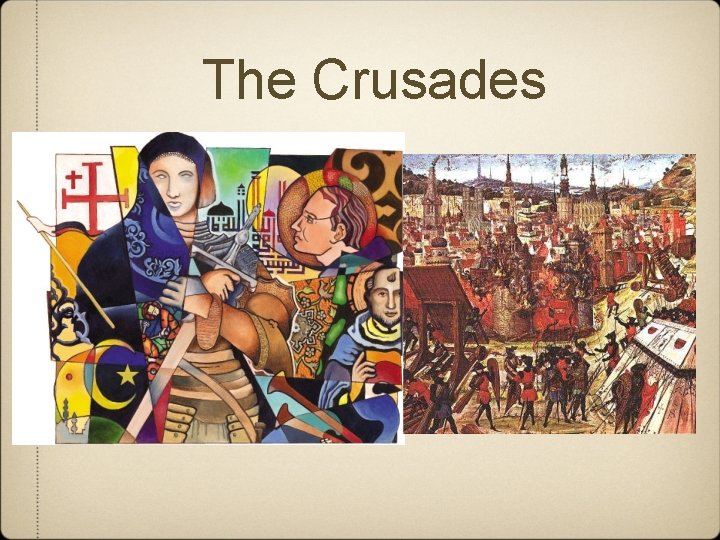
The Crusades
The Crusades • Knights from Western Europe launched crusades to capture portions of the Islamic world that made up the Holy Land of Biblical times. • Muslim divisions and the element of surprise made the first Crusade a Christian success. • 1099: Christian knights took Jerusalem. • Muslim and Jewish inhabitants were massacred
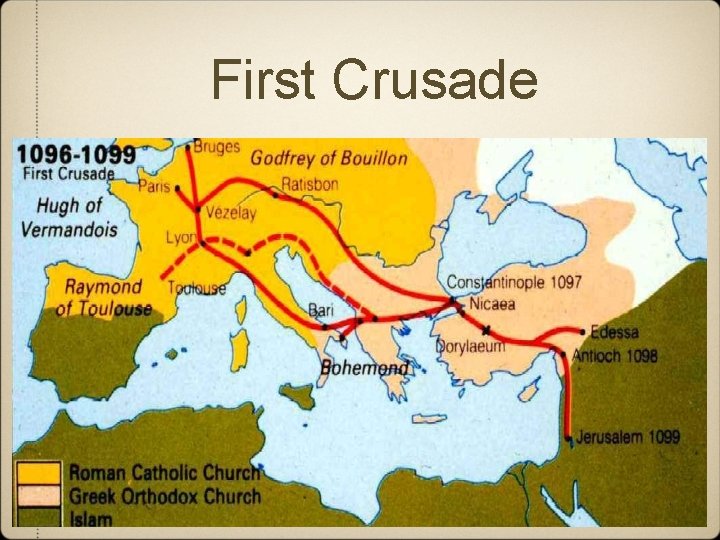
First Crusade
The Crusades • For the next two centuries, Europeans would mount in excess of 8 crusades. • Varying degrees of success • When Muslim were united under powerful rule like Salah-ud-Din (Saladin) they re-conquer most of the lands they lost. • The last crusader kingdom fell in Acre in 1291
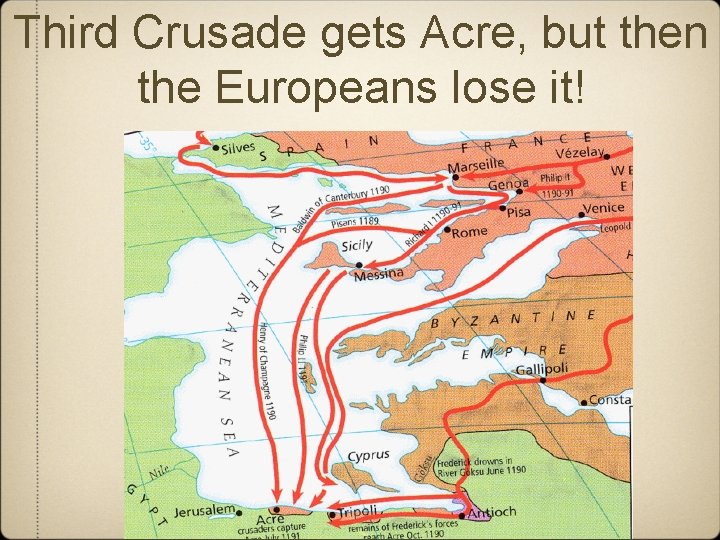
Third Crusade gets Acre, but then the Europeans lose it!
Impact of Crusades • The Crusaders’ experiences in the Eastern Mediterranean intensified European “borrowing” from the Muslim world. • Through increased cultural contacts, Europeans began to recover much of the Greek learning lost during the waves of nomadic invasions after the fall of the Roman Empire
An Age of Learning and Artistic Refinement http: //www. youtube. com/watch? v=KUky. Ojl 4 YJ 4 Political decline and social turmoil were offset for many by the urban affluence, inventiveness, and artistic creativity of the Abbasid Age Increase in trade and intellectual creativity
An Age of Learning and Artistic Refinement Rapid urban growth and prosperity Prosperity persisted until late in the Abbasid era Employment opportunities for skilled individuals remained abundant Merchants remained wealthy; Long-distance trade Artists and artisans created mosques, palaces, tapestries, rugs, bronzes, jewelry, and ceramics.
An Age of Learning and Artistic Refinement Persian replaced Arabic as the written language of the Abbasid court. Arabic becomes the language of religion, law and the natural sciences Persian became the language of “high culture” Great literary tradition emerges in this period Firdawsi’s epic poem, Shah-Nama, a history of Persia from creation to Islamic conquest
An Age of Learning and Artistic Refinement Important advancements in science and math Math= major corrections to theories from ancient Greeks • Major corrections to algebraic and geometric theories • Advances in trigonometry Al-Biruini calculated the exact weight of 18 major minerals Improved astronomical instruments, medicine, hospitals Papermaking, silk weaving, ceramic firing Scholars made some of the world’s best maps
An Age of Learning and Artistic Refinement Ulama (religious scholars) became more conservative and suspicious of non-Muslim influences and scientific thought Disliked Muslims utilizing Greco-Roman knowledge; associated it with the aggressive Crusader culture Sufis are interested in mysticism, sought personal union with Allah through asceticism, meditation, songs, dancing or drugs. Gained reputations as healers and miracle workers.
Muslim Learning and Refinement • Even though the caliphate was steeped in political turmoil, the Muslim Empire still experienced growth and prosperity until late in the Abbasid era. • Declining Revenue • Deteriorating conditions in the countryside/town life • Expansion of the professional classes • Muslim/Jewish/Christian entrepreneurs amass great fortunes supplying cities with staples (grain/barley), essentials (cotton, woolen textiles for clothing), and luxury items. • Long-Distance trade flourishes
Muslim Learning and Refinement • Artists and Artisans benefit • Mosques and palaces became more ornate. • Tapestries and rugs from Persia were in great demand from Europe to China. • Persian becomes the language of “high culture. ” • Arabic remains language of religion, law, and natural sciences • Persian was language of literary expression, administration, and scholarship.
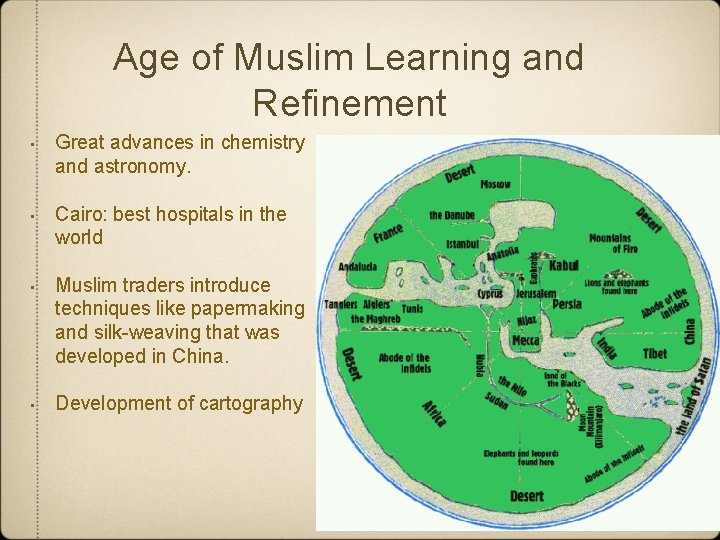
Age of Muslim Learning and Refinement • Great advances in chemistry and astronomy. • Cairo: best hospitals in the world • Muslim traders introduce techniques like papermaking and silk-weaving that was developed in China. • Development of cartography
New Waves of Nomadic Invasions and the End of the Caliphate Mongols were a threat to Islamic lands Central Asian nomadic invaders Chinggis Khan (Ghengis Khan) destroyed the Turkish Persian kingdoms east to Baghdad in 1220 s His grandson, Hulegu, continued the assault in 1250 s on center of Islamic civilization 1258 CE- Last Abbasid ruler (37 th) was killed when Baghdad fell
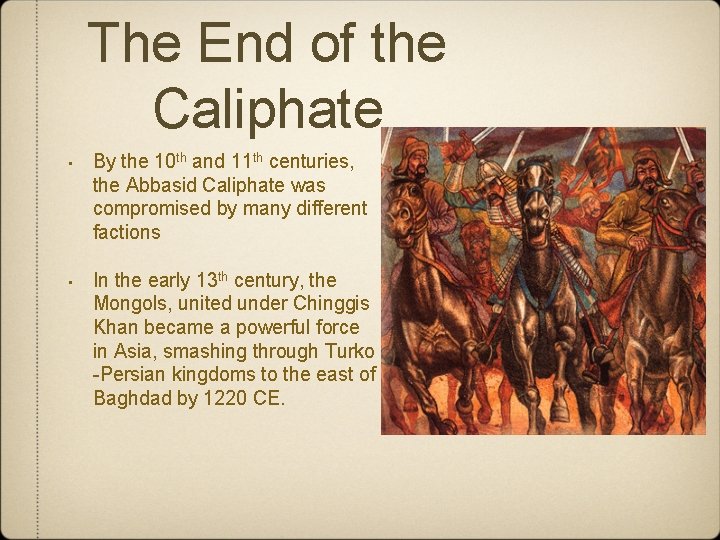
The End of the Caliphate • By the 10 th and 11 th centuries, the Abbasid Caliphate was compromised by many different factions • In the early 13 th century, the Mongols, united under Chinggis Khan became a powerful force in Asia, smashing through Turko -Persian kingdoms to the east of Baghdad by 1220 CE.
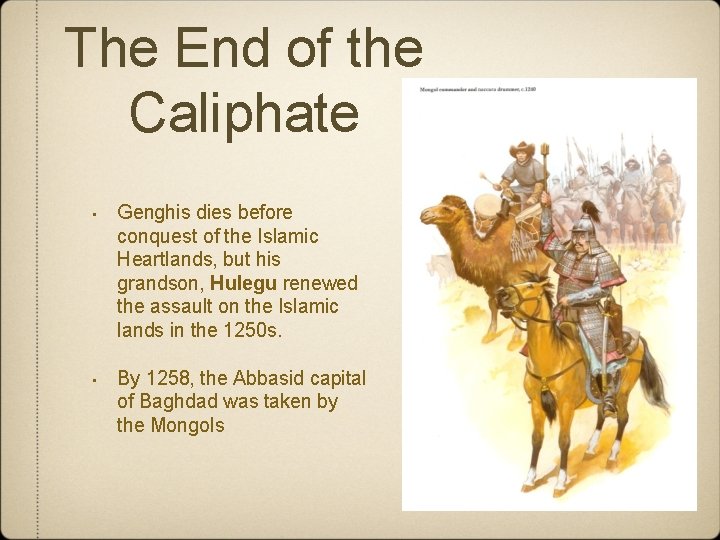
The End of the Caliphate • Genghis dies before conquest of the Islamic Heartlands, but his grandson, Hulegu renewed the assault on the Islamic lands in the 1250 s. • By 1258, the Abbasid capital of Baghdad was taken by the Mongols
The End of the Caliphate • The 37 th and last Abbasid Caliph was put to death by the Mongols. • The Mongol advance was stopped by the Mamluks, or Turkic Slaves who ruled Egypt. • In 1401, Baghdad suffers from another capture and round of pillaging by the forces of Tamerlane. • Baghdad’s glory becomes supplanted by Cairo to the west and Istanbul to the North
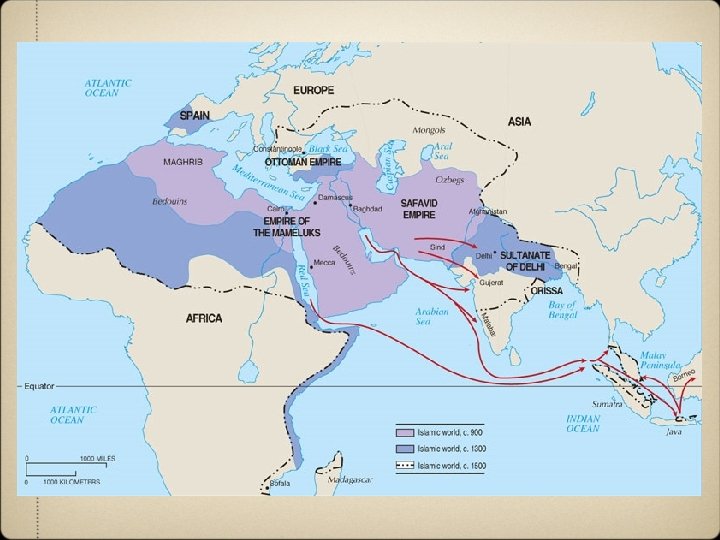
The Coming of Islam to South Asia 7 th c. - Muslim invasions, traders, and migrants carry Islam and Islamic civilization to south Asia Islam added to the complexity of Indian civilization Hinduism= open, tolerant, and inclusive of widely varying forms of religion, caste hierarchy Islam= unflinchingly monotheistic, proselytizing, egalitarian (all equal under God) Society where Muslim rulers governed Hindu subjects, employ Hindus to govern Peaceful commercial and religious exchange, for the most part, periodic tensions and initial violent conflict
Move towards Empire… • Early interactions did little to add territory to the Muslim Empire, and in some cases, lost territory • BUT, in 962 CE, a Turkish slave dynasty seized power in Afghanistan. • • Their third ruler, Mahmud of Ghazni, began two CENTURIES of Muslim raiding and conquest in Northern India Throughout the 11 th century, Mahmud defeated one confederation of Hindu princes after another in the name of Islam.
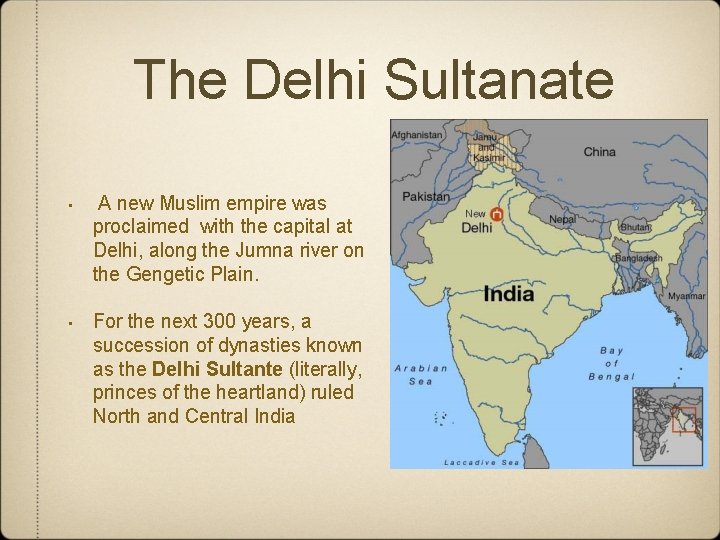
The Delhi Sultanate • A new Muslim empire was proclaimed with the capital at Delhi, along the Jumna river on the Gengetic Plain. • For the next 300 years, a succession of dynasties known as the Delhi Sultante (literally, princes of the heartland) ruled North and Central India
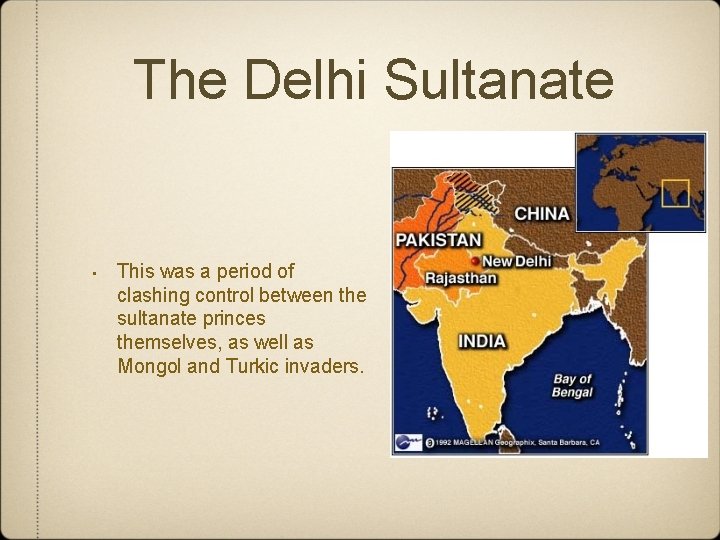
The Delhi Sultanate • This was a period of clashing control between the sultanate princes themselves, as well as Mongol and Turkic invaders.
The Hindu/Islam mix • Early centuries were characterized by violent conflict. • However, a good deal of trade and religious interchange. • In time, peaceful interactions became the norm • There were contacts via traders in the Indian Ocean Trade network as early as 711 CE • Indian overlords who took over land in South Asia brought little change to most inhabitants of the Indian Subcontinent. • Many people welcomed the Arabs because they promised lighter taxation and religious tolerance
Early Muslim encounters in India • Muslim leaders decided to treat Hindus and Buddhists as the dhimmi, or “people of the book” even though they had no connection to the Bible. • • This meant that Hindus and Buddhists had to pay the tax on non-believers, they enjoyed the freedom to worship as they pleased. Little effort was put towards conversion, so most people remained Hindu or Buddhist.
Conversion • • Carriers of the new faith on the subcontinent were often merchants and Sufi mystics • Sufis shared many characteristics with Indian gurus and wandering ascetics. • Belief in magical healing powers • Accepted lower-caste and outcaste groups into Islamic faith Most Muslims were NOT from the Indo-Gangetic centers of the Delhi Sultanate, indicating low forced conversions
Conversion • Most conversions came from low-caste or Buddhist groups. • Buddhism became largely debased as a result of corrupt practices • Buddhist temples and monasteries became lucrative targets for raids, etc. • Many lower-caste, untouchables, animistic tribes, and Buddhists were attracted to the egalitarian nature of Islam
Accommodation • Hindus were convinced that Muslims would soon be absorbed by the superior religions and more sophisticated cultures of India • • Many things pointed that way! • Muslim princes adopted regal styles • Muslim rulers claim divine descent • Muslim rulers mint coins with Hindu images Muslim communities also became socially divided along Caste lines • Violation of the original tenets of Islam!
Islam in South Asia at the end of the Sultanate • Attempts to fuse Hinduism and Islam soon were recognized as impossible. • Brahmans soon denounce Muslim leaders, etc. • • Muslims respond by strengthening their unity within the Indian Muslim community After centuries of political domination though, South Asia remained one of the least converted and integrated of all the areas Islam reached.
The Coming of Islam to South Asia Islamic civilization was enriched by Indian culture. Indian achievements were passed to Arabs Colonies of Arabs settled along India’s coasts, adopted local customs Provided staging points for Islamic expansion
Religious contradictions • Orthodox religious scholars felt that the revival of Greco. Roman philosophical traditions would erode the absolute authority of the Qur’an • Sufi movement… • Sufis are wandering mystics who sought a personal union with Allah • A reaction against the abstract divinity of the Qur’an • Sufis gain reputations as healers and miracle workers…gain sizeable followings • Some led militant bands that spread Islam to nonbelievers
Indian/Muslim cultural diffusion • Muslims inherit the Indian scientific learning, which rivaled the Greeks as the most advanced in the world. • Arabic numerals originated in India • Indian learning was transferred to Baghdad in the age of the Abbasids. • Indian doctors, scientists, etc. • Muslims adopt Indian styles of dress, food, and ride on elephants as the Hindu rajas (kings) did. • Muslims also adopt and infuse Indian architectural styles
The Spread of Islam to Southeast Asia Easy to continue spreading east once Islam is in India 7 th and 8 th centuries= Southeast Asian sailors and ships were active in trade, interact with Islamic trader. 8 th century= Muslims gained control of Indian commerce Islamic culture reached Southeast Asia
The Spread of Islam to Southeast Asia The first conversions occurred in small northern Sumatran ports, Islam enters largely due to trade Islam spread into many islands in southeastern Asia. Coastal cities were most receptive to Islam; most exposed to a variety of things due to interactions with other cultures through trade.
The Spread of Islam to Southeast Asia Sufis were tolerant of Buddhist and Hindu beliefs. Conversions are generally peaceful New believers combine Islamic teaching/rituals with elements of local religion Islamic law ruled legal transactions. Women have a stronger familial and societal position than they had in the Middle East or India (lineage and inheritance through female line)
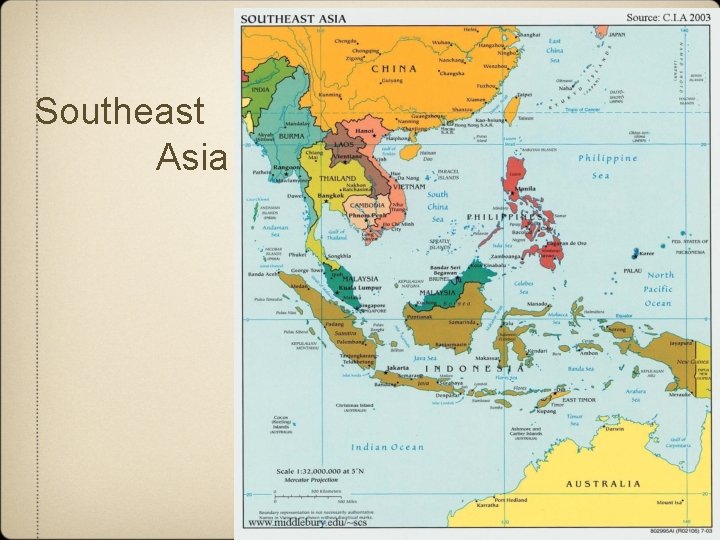
Southeast Asia
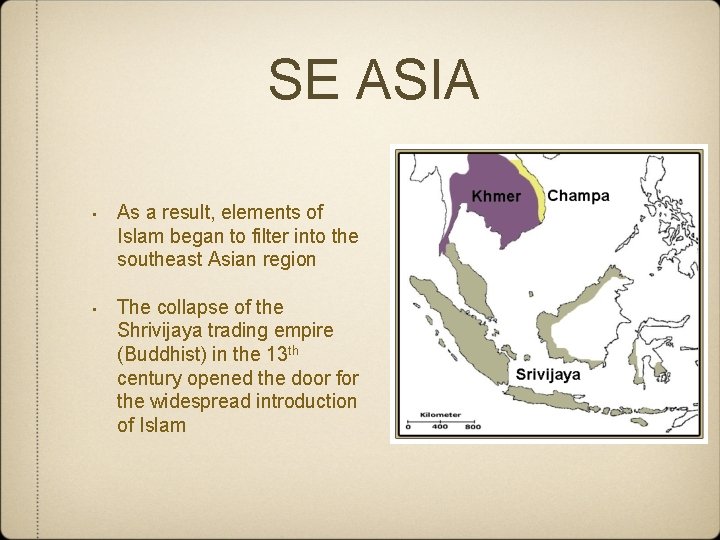
SE ASIA • As a result, elements of Islam began to filter into the southeast Asian region • The collapse of the Shrivijaya trading empire (Buddhist) in the 13 th century opened the door for the widespread introduction of Islam
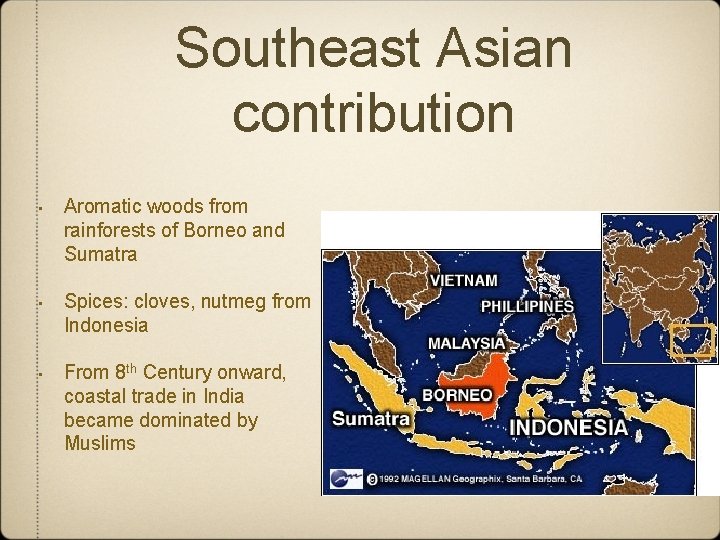
Southeast Asian contribution • Aromatic woods from rainforests of Borneo and Sumatra • Spices: cloves, nutmeg from Indonesia • From 8 th Century onward, coastal trade in India became dominated by Muslims
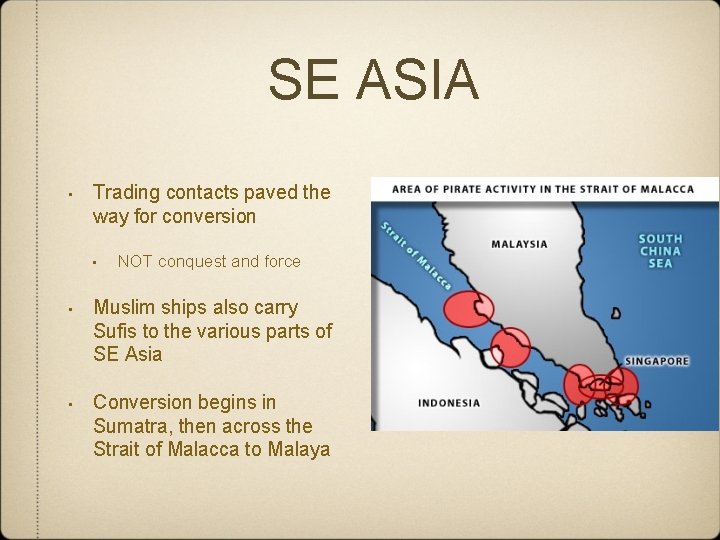
SE ASIA • Trading contacts paved the way for conversion • NOT conquest and force • Muslim ships also carry Sufis to the various parts of SE Asia • Conversion begins in Sumatra, then across the Strait of Malacca to Malaya
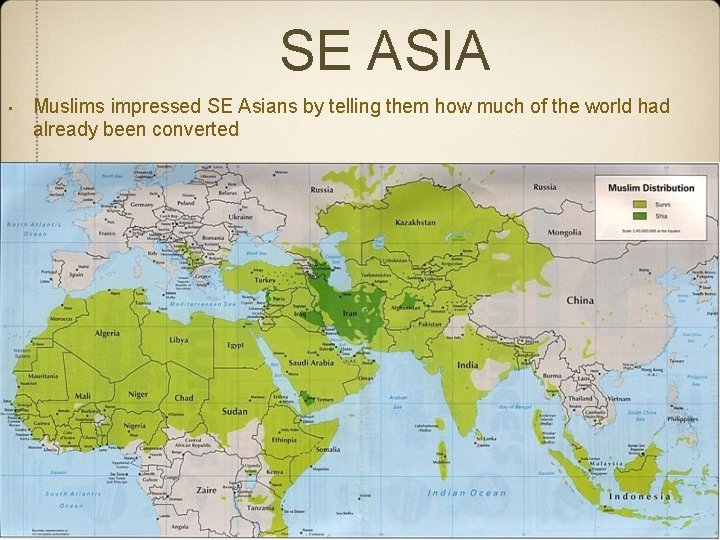
SE ASIA • Muslims impressed SE Asians by telling them how much of the world had already been converted
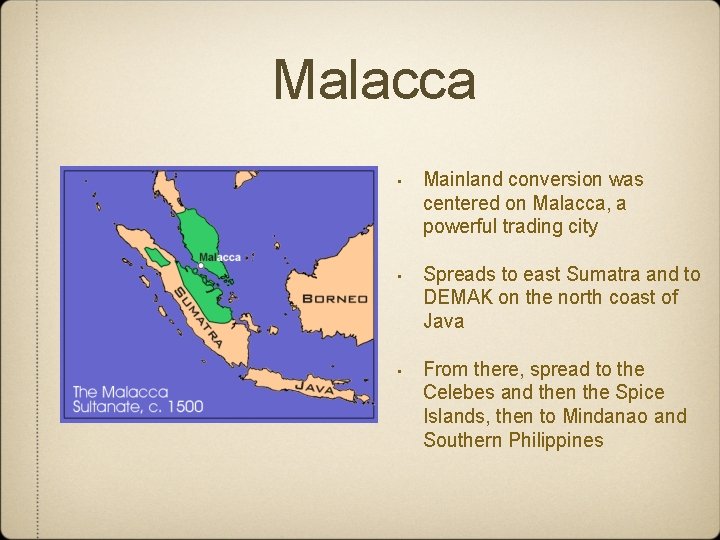
Malacca • Mainland conversion was centered on Malacca, a powerful trading city • Spreads to east Sumatra and to DEMAK on the north coast of Java • From there, spread to the Celebes and then the Spice Islands, then to Mindanao and Southern Philippines
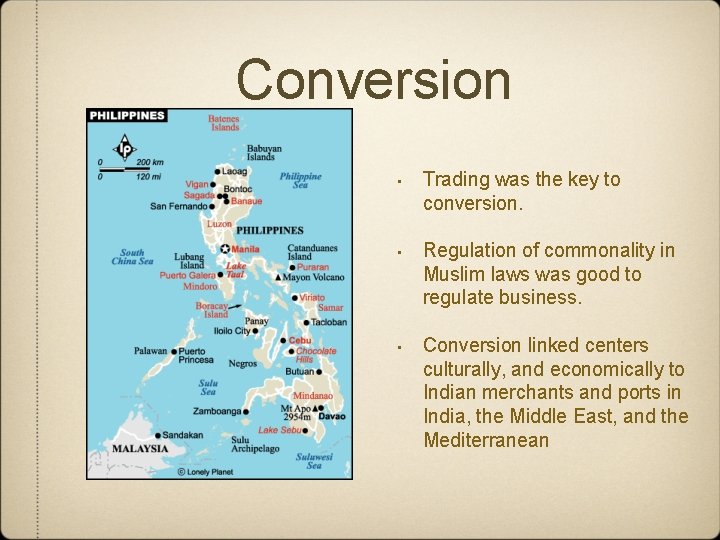
Conversion • Trading was the key to conversion. • Regulation of commonality in Muslim laws was good to regulate business. • Conversion linked centers culturally, and economically to Indian merchants and ports in India, the Middle East, and the Mediterranean
SE Asian Islam • Some areas (like Central Java) saw conversion take longer than others • • Hindu-Buddhist dynasties contested its spread Mainland Southeast Asia did NOT see wholesale conversion, and remained largely Buddhist • Because it was spread primarily by Sufis, SE Asian Islam was more dynamic than orthodox Islam • Infused with mythical strains • Tolerated animist, Hindu, and Buddhist beliefs and rituals. • Magical powers
Women in SE Asian Islamic Society • • Women retained a strong position in the family and the community • Trading in local and regional markets was dominated by small-scale female merchants • As in Western Sumatra, lineage and inheritance was traced through female lines Many cultural elements were blended from SE Asian Culture with Muslim Culture.
Global Connections: Islam Despite the political instability of the Abbasids, Islam’s central position in global history was solidified. Social strife and political divisions VS. expanding trade and intellectual creativity Islam was the civilizer of nomadic peoples in Asia and Africa. The spread of Islam helps to create trade connections Cultural contributions = great cities to universities
- Slides: 96