
UMass Lowell Computer Science 91 504 Advanced Algorithms

- Slides: 32
UMass Lowell Computer Science 91. 504 Advanced Algorithms Computational Geometry Prof. Karen Daniels Spring, 2004 Lecture 1 Course Introduction
Course Introduction What is Computational Geometry?
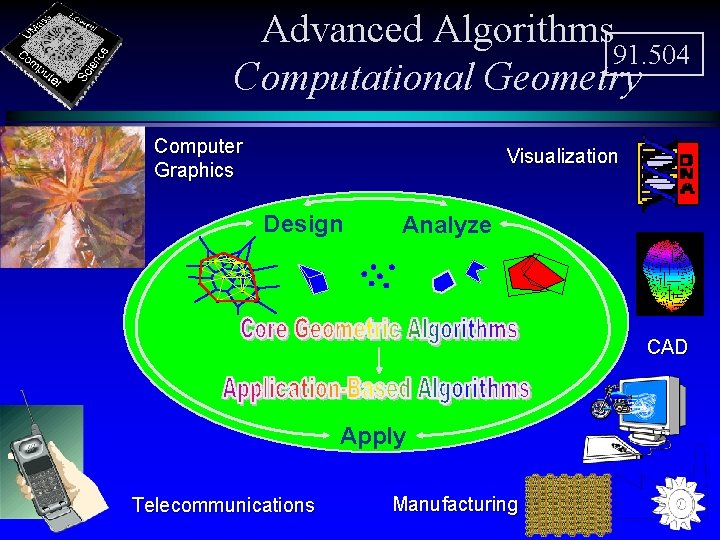
Advanced Algorithms 91. 504 Computational Geometry Computer Graphics Visualization Design Analyze CAD Apply Telecommunications Manufacturing
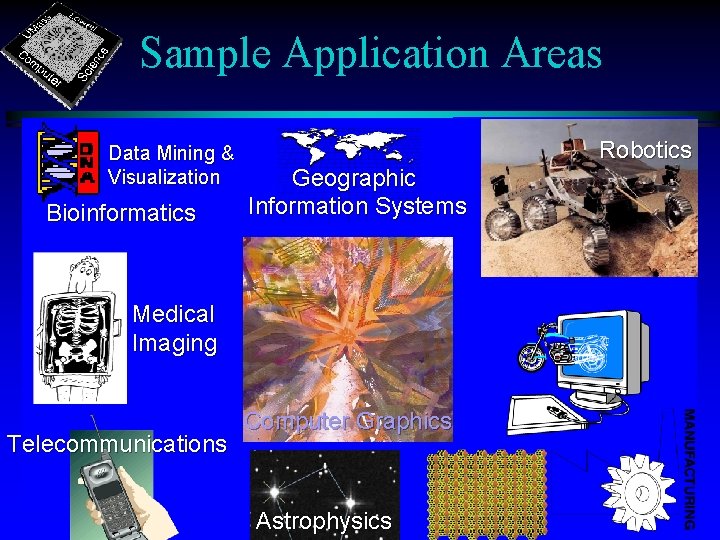
Sample Application Areas Data Mining & Visualization Bioinformatics Geographic Information Systems Medical Imaging Telecommunications Computer Graphics Astrophysics Robotics
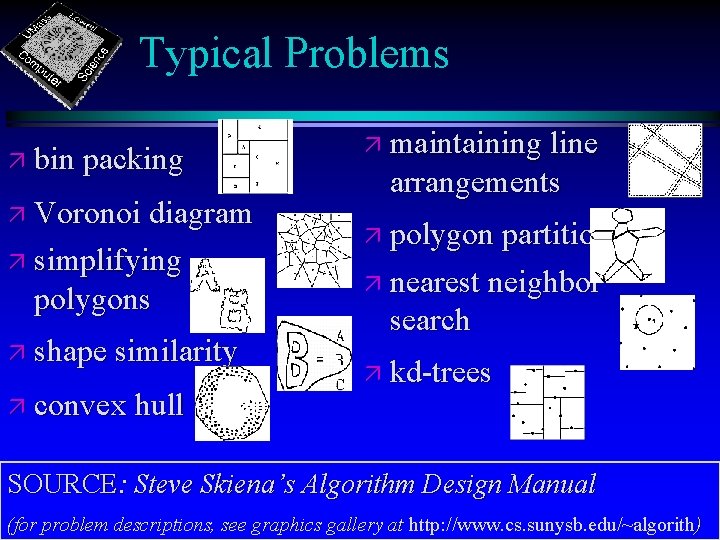
Typical Problems ä bin packing ä Voronoi diagram ä simplifying polygons ä shape similarity ä convex hull ä maintaining line arrangements ä polygon partitioning ä nearest neighbor search ä kd-trees SOURCE: Steve Skiena’s Algorithm Design Manual (for problem descriptions, see graphics gallery at http: //www. cs. sunysb. edu/~algorith)
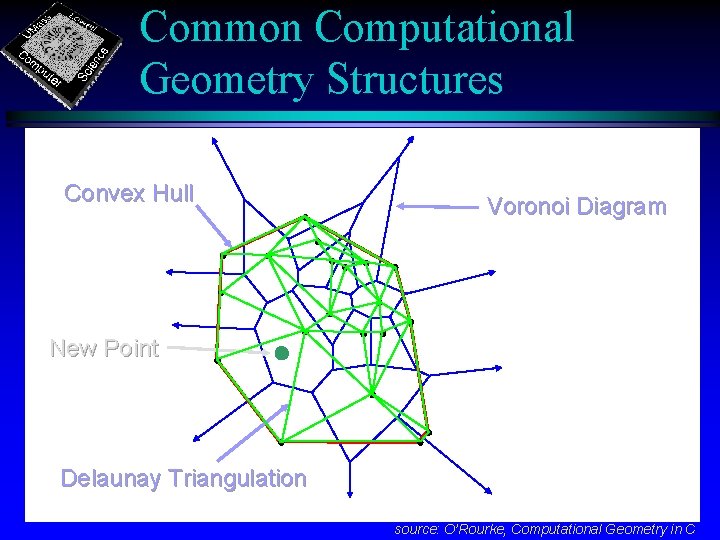
Common Computational Geometry Structures Convex Hull Voronoi Diagram New Point Delaunay Triangulation source: O’Rourke, Computational Geometry in C
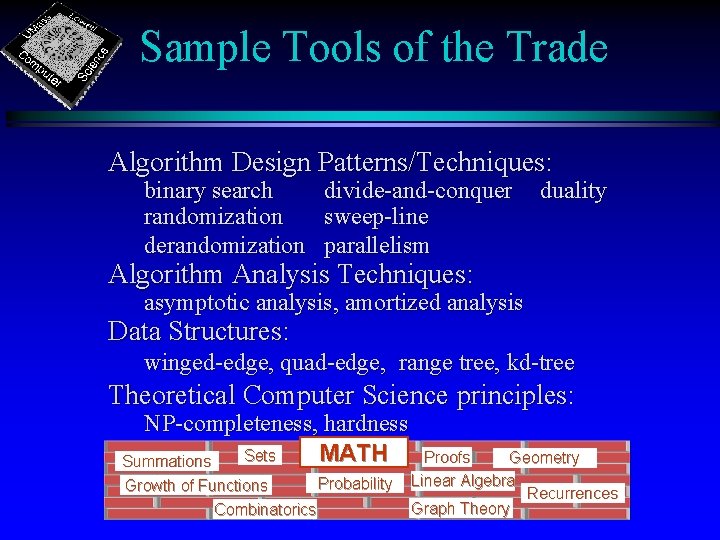
Sample Tools of the Trade Algorithm Design Patterns/Techniques: binary search randomization derandomization divide-and-conquer sweep-line parallelism duality Algorithm Analysis Techniques: asymptotic analysis, amortized analysis Data Structures: winged-edge, quad-edge, range tree, kd-tree Theoretical Computer Science principles: NP-completeness, hardness MATH Sets Summations Probability Growth of Functions Combinatorics Proofs Geometry Linear Algebra Recurrences Graph Theory
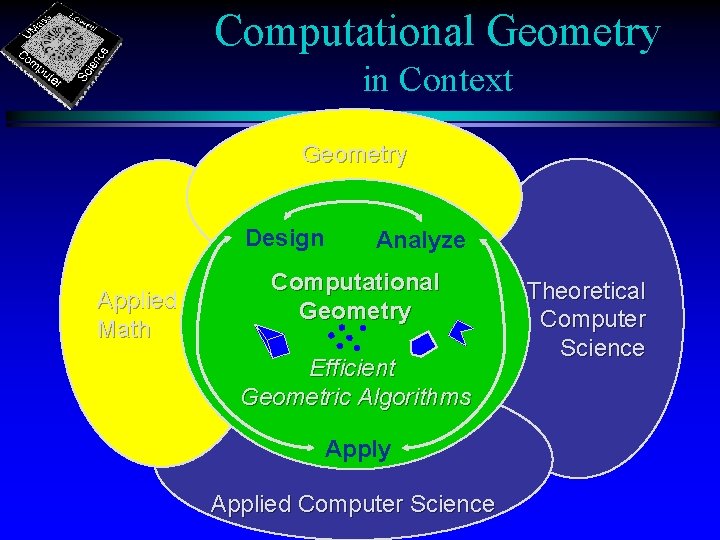
Computational Geometry in Context Geometry Design Applied Math Analyze Computational Geometry Efficient Geometric Algorithms Apply Applied Computer Science Theoretical Computer Science
Course Introduction Course Description
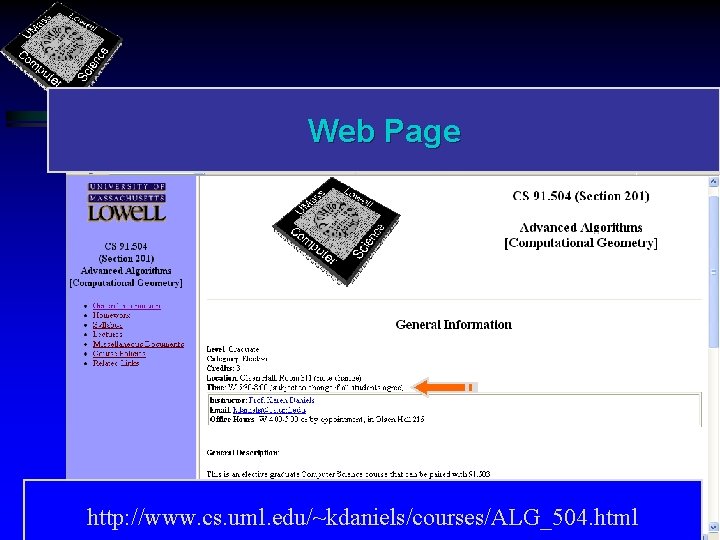
Web Page http: //www. cs. uml. edu/~kdaniels/courses/ALG_504. html
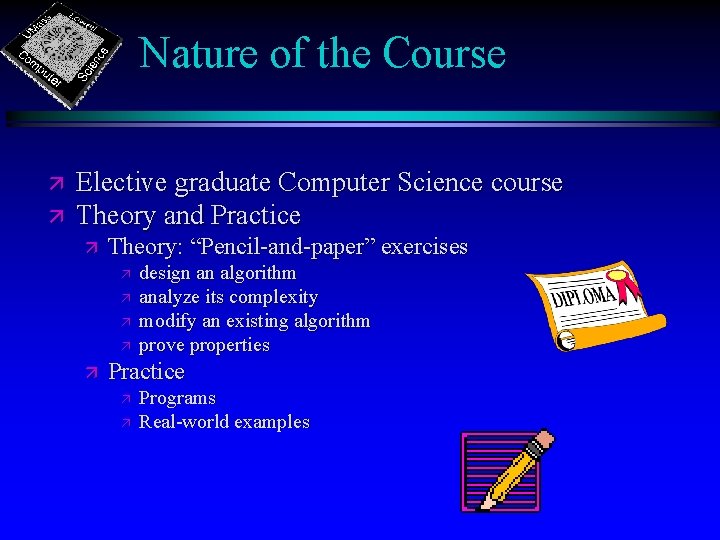
Nature of the Course ä ä Elective graduate Computer Science course Theory and Practice ä Theory: “Pencil-and-paper” exercises ä ä ä design an algorithm analyze its complexity modify an existing algorithm prove properties Practice ä ä Programs Real-world examples
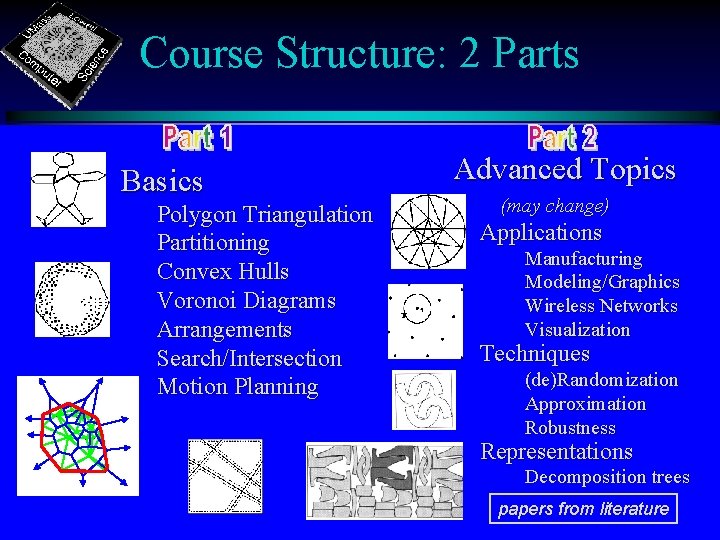
Course Structure: 2 Parts Basics Polygon Triangulation Partitioning Convex Hulls Voronoi Diagrams Arrangements Search/Intersection Motion Planning Advanced Topics (may change) Applications Manufacturing Modeling/Graphics Wireless Networks Visualization Techniques (de)Randomization Approximation Robustness Representations Decomposition trees papers from literature
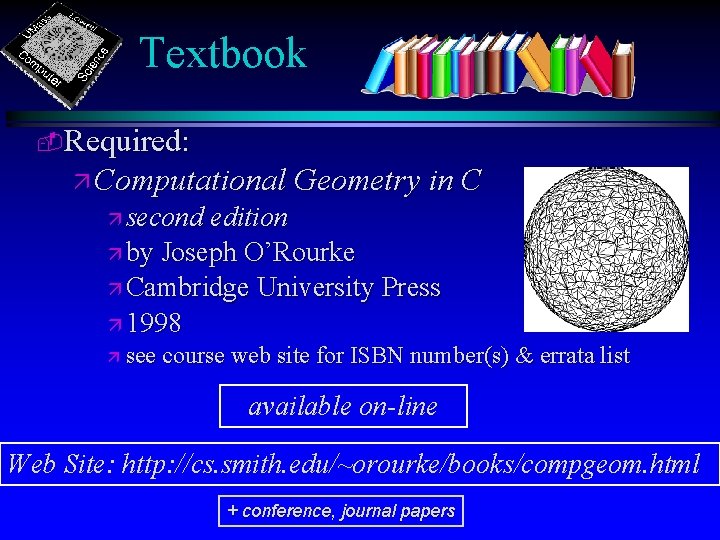
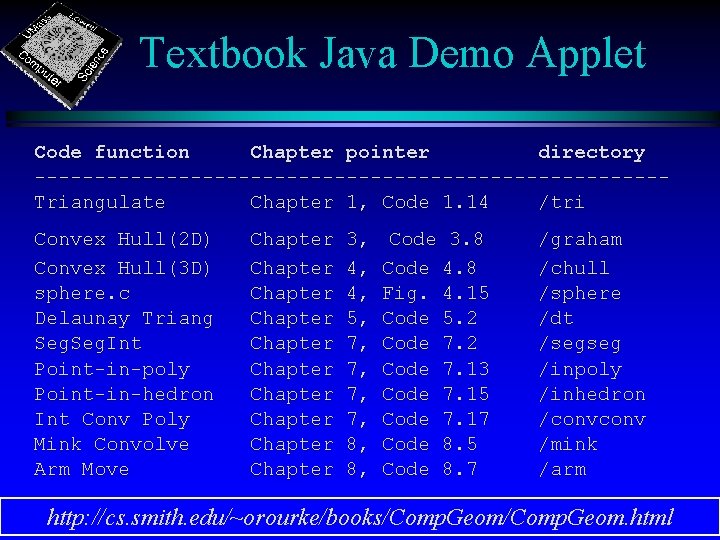
Textbook -Required: ä Computational Geometry in C ä second edition ä by Joseph O’Rourke ä Cambridge University Press ä 1998 ä see course web site for ISBN number(s) & errata list available on-line Web Site: http: //cs. smith. edu/~orourke/books/compgeom. html + conference, journal papers
Textbook Java Demo Applet Code function Chapter pointer directory --------------------------Triangulate Chapter 1, Code 1. 14 /tri Convex Hull(2 D) Convex Hull(3 D) sphere. c Delaunay Triang Seg. Int Point-in-poly Point-in-hedron Int Conv Poly Mink Convolve Arm Move Chapter Chapter Chapter 3, 4, 4, 5, 7, 7, 8, 8, Code 3. 8 Code 4. 8 Fig. 4. 15 Code 5. 2 Code 7. 13 Code 7. 15 Code 7. 17 Code 8. 5 Code 8. 7 /graham /chull /sphere /dt /segseg /inpoly /inhedron /conv /mink /arm http: //cs. smith. edu/~orourke/books/Comp. Geom. html
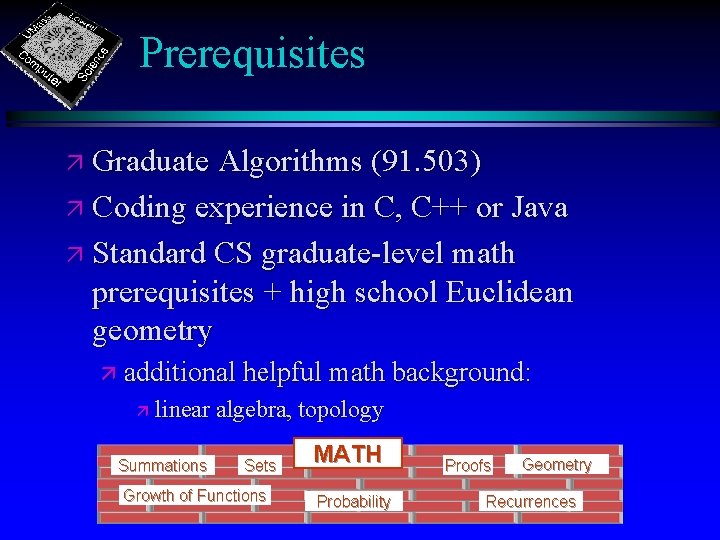
Prerequisites ä Graduate Algorithms (91. 503) ä Coding experience in C, C++ or Java ä Standard CS graduate-level math prerequisites + high school Euclidean geometry ä additional helpful math background: ä linear algebra, topology Summations Sets Growth of Functions MATH Probability Proofs Geometry Recurrences
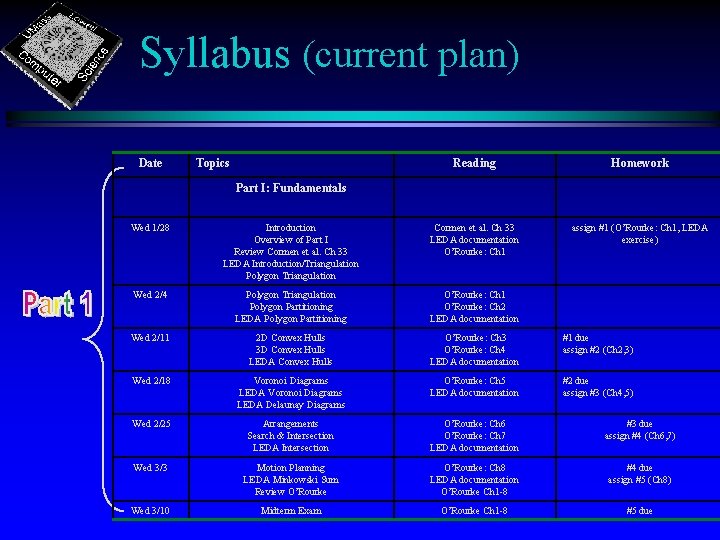
Syllabus (current plan) Date Topics Reading Homework assign #1 (O’Rourke: Ch 1, LEDA exercise) Part I: Fundamentals Wed 1/28 Introduction Overview of Part I Review Cormen et al. Ch 33 LEDA Introduction/Triangulation Polygon Triangulation Cormen et al. Ch 33 LEDA documentation O’Rourke: Ch 1 Wed 2/4 Polygon Triangulation Polygon Partitioning LEDA Polygon Partitioning O’Rourke: Ch 1 O’Rourke: Ch 2 LEDA documentation Wed 2/11 2 D Convex Hulls 3 D Convex Hulls LEDA Convex Hulls O’Rourke: Ch 3 O’Rourke: Ch 4 LEDA documentation #1 due assign #2 (Ch 2, 3) Wed 2/18 Voronoi Diagrams LEDA Delaunay Diagrams O’Rourke: Ch 5 LEDA documentation #2 due assign #3 (Ch 4, 5) Wed 2/25 Arrangements Search & Intersection LEDA Intersection O’Rourke: Ch 6 O’Rourke: Ch 7 LEDA documentation #3 due assign #4 (Ch 6, 7) Wed 3/3 Motion Planning LEDA Minkowski Sum Review O’Rourke: Ch 8 LEDA documentation O’Rourke Ch 1 -8 #4 due assign #5 (Ch 8) Wed 3/10 Midterm Exam O’Rourke Ch 1 -8 #5 due
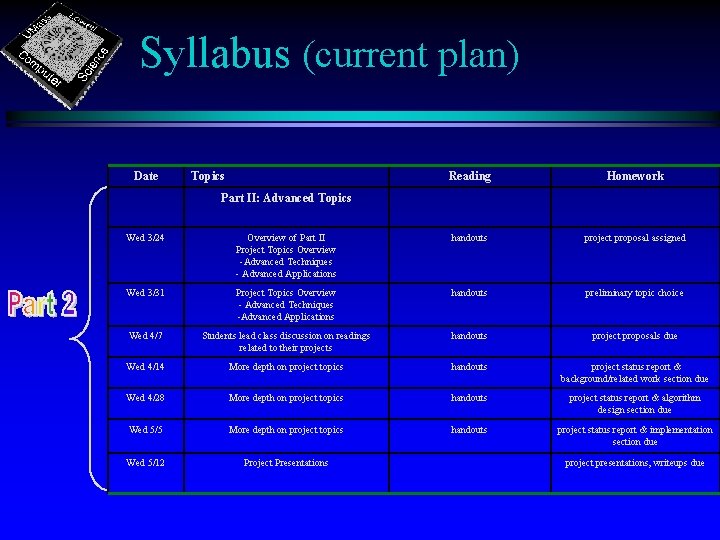
Syllabus (current plan) Date Topics Reading Homework Part II: Advanced Topics Wed 3/24 Overview of Part II Project Topics Overview -Advanced Techniques - Advanced Applications handouts project proposal assigned Wed 3/31 Project Topics Overview - Advanced Techniques -Advanced Applications handouts preliminary topic choice Wed 4/7 Students lead class discussion on readings related to their projects handouts project proposals due Wed 4/14 More depth on project topics handouts project status report & background/related work section due Wed 4/28 More depth on project topics handouts project status report & algorithm design section due Wed 5/5 More depth on project topics handouts project status report & implementation section due Wed 5/12 Project Presentations project presentations, writeups due
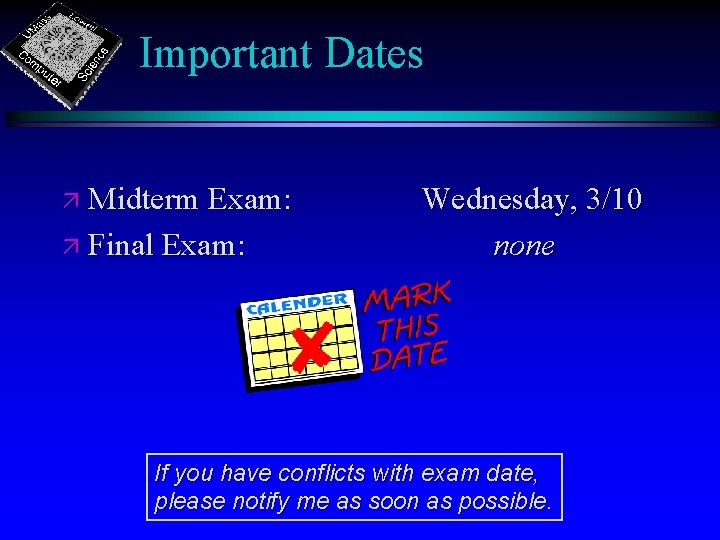
Important Dates ä Midterm Exam: ä Final Exam: Wednesday, 3/10 none If you have conflicts with exam date, please notify me as soon as possible.
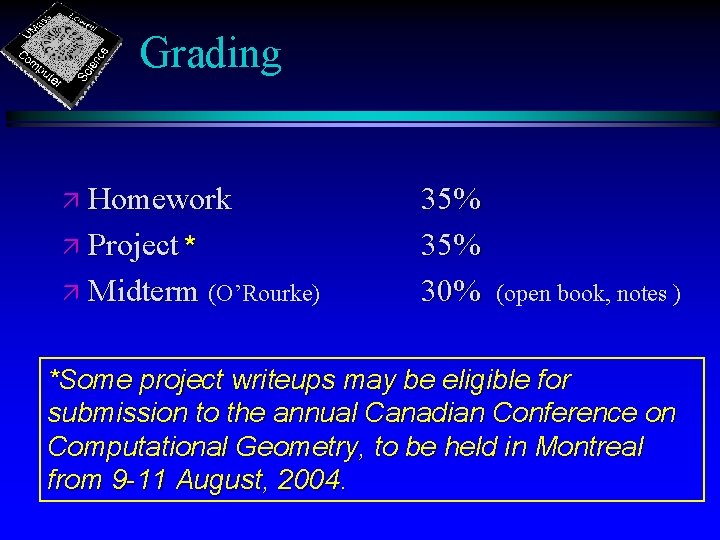
Grading ä Homework ä Project * ä Midterm (O’Rourke) 35% 30% (open book, notes ) *Some project writeups may be eligible for submission to the annual Canadian Conference on Computational Geometry, to be held in Montreal from 9 -11 August, 2004.
Course Introduction My Computational Geometry Research
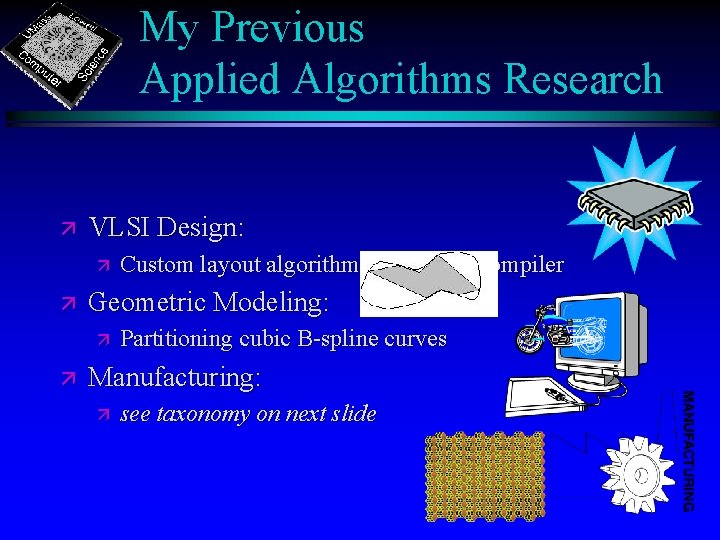
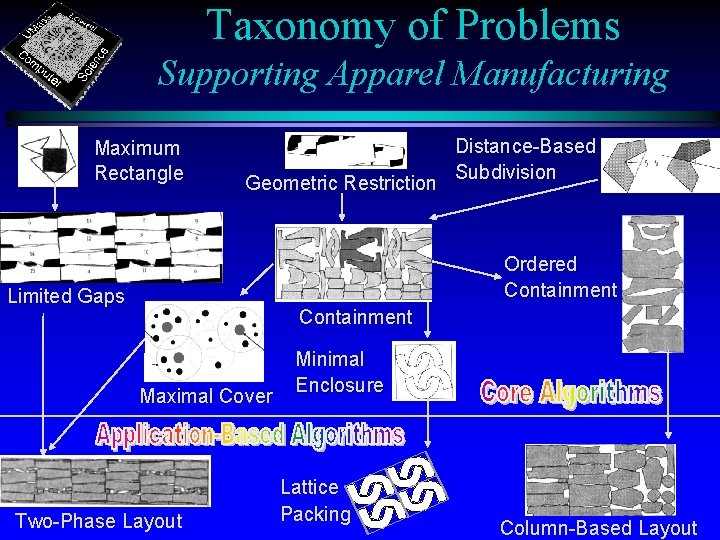
My Previous Applied Algorithms Research ä VLSI Design: ä ä Geometric Modeling: ä ä Custom layout algorithms for silicon compiler Partitioning cubic B-spline curves Manufacturing: ä see taxonomy on next slide
Taxonomy of Problems Supporting Apparel Manufacturing Maximum Rectangle Geometric Restriction Distance-Based Subdivision Ordered Containment Limited Gaps Containment Maximal Cover Two-Phase Layout Minimal Enclosure Lattice Packing Column-Based Layout
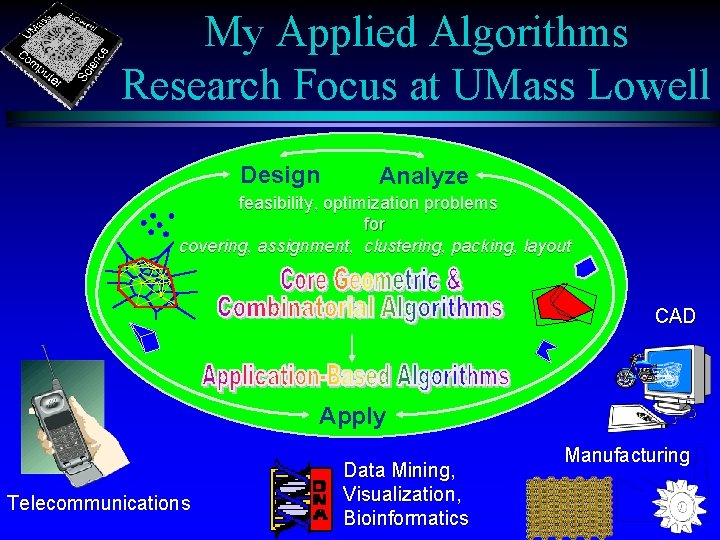
My Applied Algorithms Research Focus at UMass Lowell Design Analyze feasibility, optimization problems for covering, assignment, clustering, packing, layout CAD Apply Telecommunications Data Mining, Visualization, Bioinformatics Manufacturing
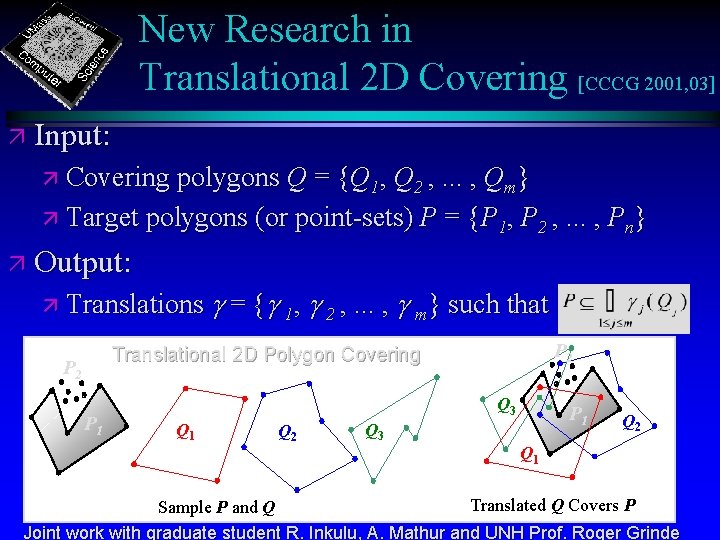
New Research in Translational 2 D Covering [CCCG 2001, 03] ä Input: ä Covering polygons Q = {Q 1, Q 2 , . . . , Qm} ä Target polygons (or point-sets) P = {P 1, P 2 , . . . , Pn} ä Output: ä Translations g = {g 1, g 2 , . . . , g m} such that P 2 Translational 2 D Polygon Covering P 2 P 1 Q 3 Q 1 Q 2 P 1 Q 3 Q 2 Q 1 Translated Q Covers P Sample P and Q Joint work with graduate student R. Inkulu, A. Mathur and UNH Prof. Roger Grinde
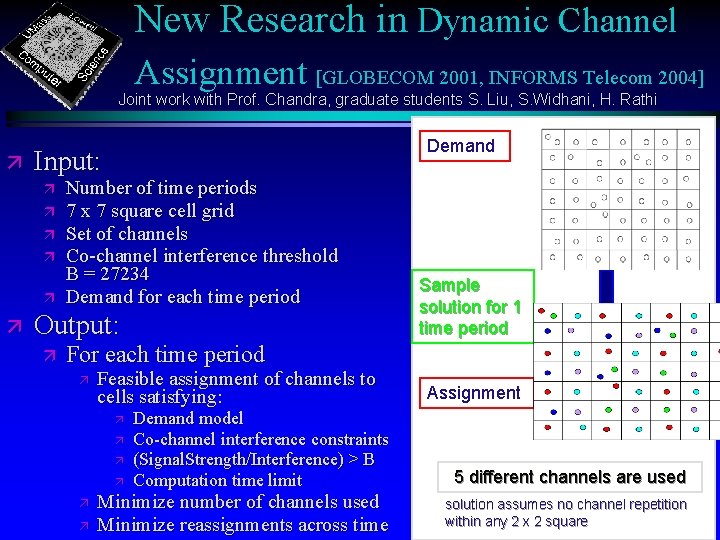
New Research in Dynamic Channel Assignment [GLOBECOM 2001, INFORMS Telecom 2004] Joint work with Prof. Chandra, graduate students S. Liu, S. Widhani, H. Rathi ä Input: ä ä ä Demand Number of time periods 7 x 7 square cell grid Set of channels Co-channel interference threshold B = 27234 Demand for each time period Output: ä Sample solution for 1 time period For each time period ä Feasible assignment of channels to cells satisfying: Demand model Co-channel interference constraints (Signal. Strength/Interference) > B Computation time limit 5 different channels are used Minimize number of channels used Minimize reassignments across time solution assumes no channel repetition within any 2 x 2 square ä ä ä Assignment
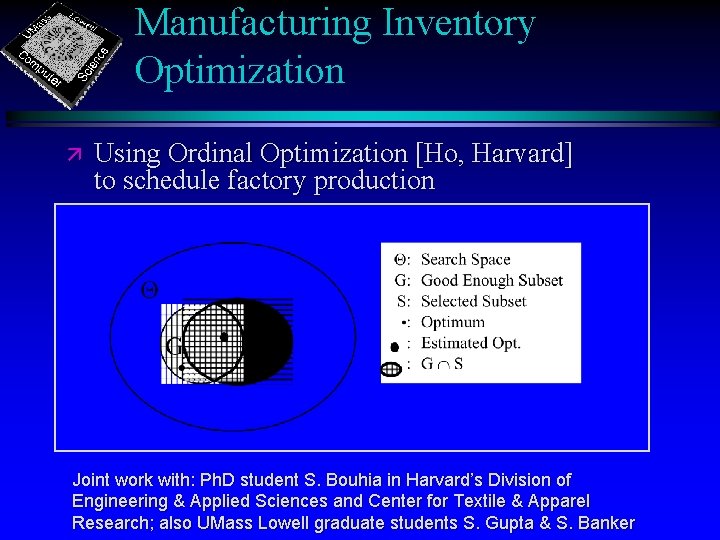
Manufacturing Inventory Optimization ä Using Ordinal Optimization [Ho, Harvard] to schedule factory production Joint work with: Ph. D student S. Bouhia in Harvard’s Division of Engineering & Applied Sciences and Center for Textile & Apparel Research; also UMass Lowell graduate students S. Gupta & S. Banker
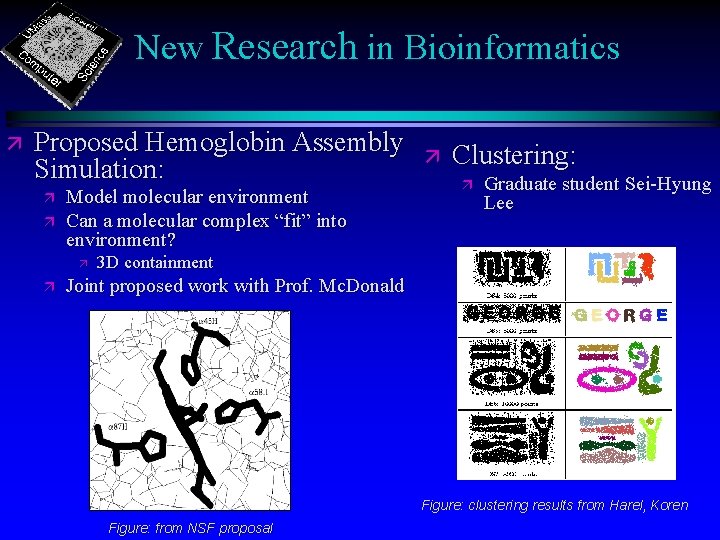
New Research in Bioinformatics ä Proposed Hemoglobin Assembly Simulation: ä ä Model molecular environment Can a molecular complex “fit” into environment? ä ä ä Clustering: ä Graduate student Sei-Hyung Lee 3 D containment Joint proposed work with Prof. Mc. Donald Figure: clustering results from Harel, Koren Figure: from NSF proposal
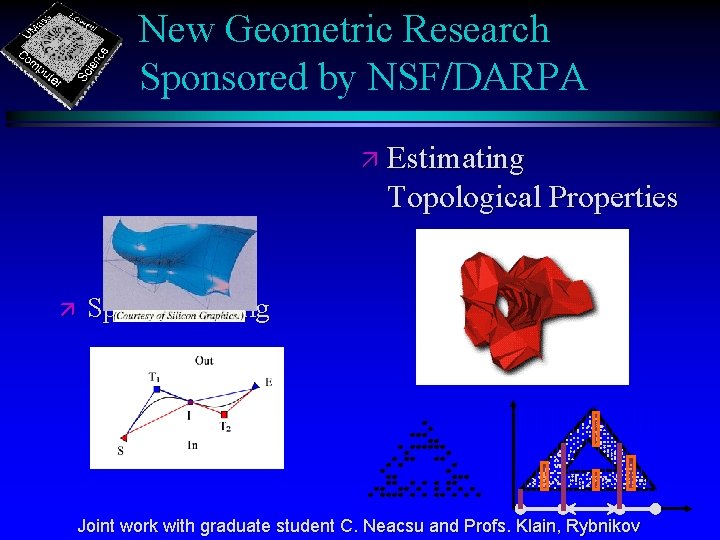
New Geometric Research Sponsored by NSF/DARPA ä Estimating Topological Properties ä Spline Covering Joint work with graduate student C. Neacsu and Profs. Klain, Rybnikov
Sample of Supporting Algorithmic & Math Areas & Techniques ä Computational Geometry ä ä ä Convex hulls Visibility polygons Arrangements Mathematical Programming ä ä ä Linear programming Integer programming Lagrangian relaxation Upper, lower bounding Dynamic Data Structures ä ä ä Algorithm Design Patterns ä ä ä search space subdivision binary search divide-and-conquer sweep-line discrete-event simulation ä NP-completeness, hardness ä ä Minkowski sum Monotone matrices Lattices Set operations: union, intersection, difference Algorithm Analysis Techniques Complexity Theory Discrete Math
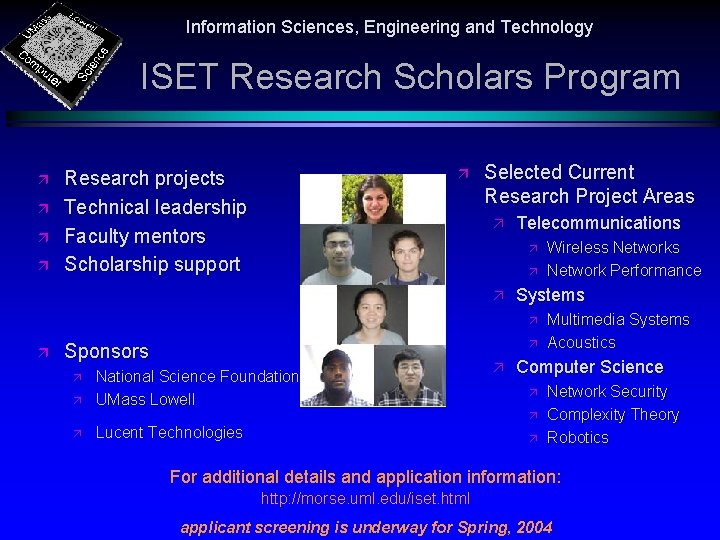
Information Sciences, Engineering and Technology ISET Research Scholars Program ä ä ä Research projects Technical leadership Faculty mentors Scholarship support Selected Current Research Project Areas ä Telecommunications ä ä ä Systems ä ä ä Sponsors ä ä National Science Foundation UMass Lowell ä Lucent Technologies Multimedia Systems Acoustics Computer Science ä ä ä Wireless Network Performance ä Network Security Complexity Theory Robotics For additional details and application information: http: //morse. uml. edu/iset. html applicant screening is underway for Spring, 2004
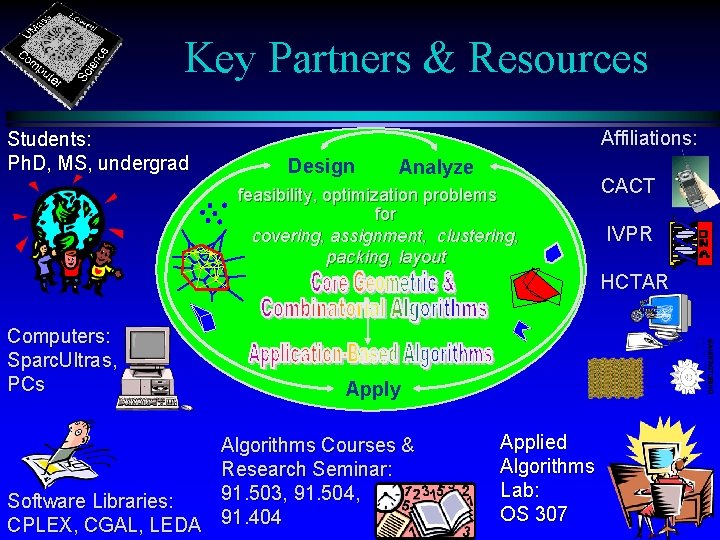
Key Partners & Resources Students: Ph. D, MS, undergrad Affiliations: Design Analyze feasibility, optimization problems for covering, assignment, clustering, packing, layout CACT IVPR HCTAR Computers: Sparc. Ultras, PCs Apply Algorithms Courses & Research Seminar: 91. 503, 91. 504, Software Libraries: CPLEX, CGAL, LEDA 91. 404 Applied Algorithms Lab: OS 307
Machine Accounts ä ä ä Each student will have an account on my machine: minkowski. cs. uml. edu. Username will be the same as your username on CS. Password will be your initials followed by the last 5 digits on the bottom right hand corner of the back of your student id card. To remotely log in, use a secure shell (e. g. ssh). To transfer files, use a secure FTP (e. g. sftp). LEDA and CGAL libraries are on minkowski.