
Umami BRITISH NUTRITION FOUNDATION 2017 Learning objectives To

Umami © BRITISH NUTRITION FOUNDATION 2017

Learning objectives • To be introduced to the term umami. • To learn about how and who discovered umami. • To recognise unfamiliar and familiar umami rich foods. © BRITISH NUTRITION FOUNDATION 2017
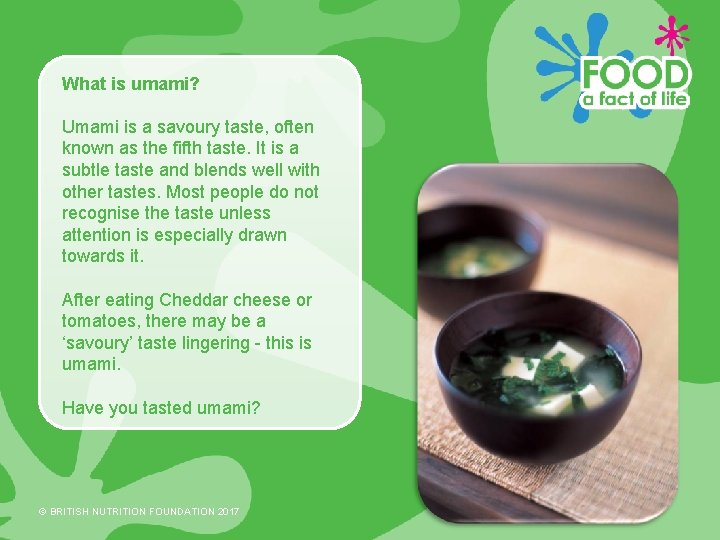
What is umami? Umami is a savoury taste, often known as the fifth taste. It is a subtle taste and blends well with other tastes. Most people do not recognise the taste unless attention is especially drawn towards it. After eating Cheddar cheese or tomatoes, there may be a ‘savoury’ taste lingering - this is umami. Have you tasted umami? © BRITISH NUTRITION FOUNDATION 2017
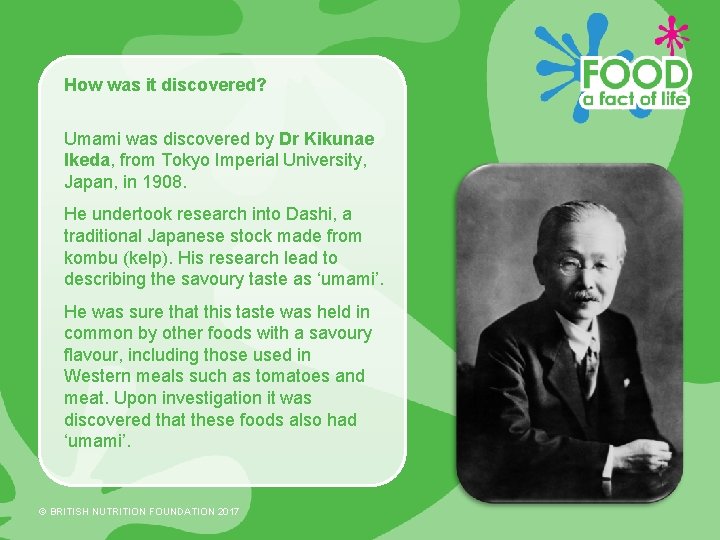
How was it discovered? Umami was discovered by Dr Kikunae Ikeda, from Tokyo Imperial University, Japan, in 1908. He undertook research into Dashi, a traditional Japanese stock made from kombu (kelp). His research lead to describing the savoury taste as ‘umami’. He was sure that this taste was held in common by other foods with a savoury flavour, including those used in Western meals such as tomatoes and meat. Upon investigation it was discovered that these foods also had ‘umami’. © BRITISH NUTRITION FOUNDATION 2017
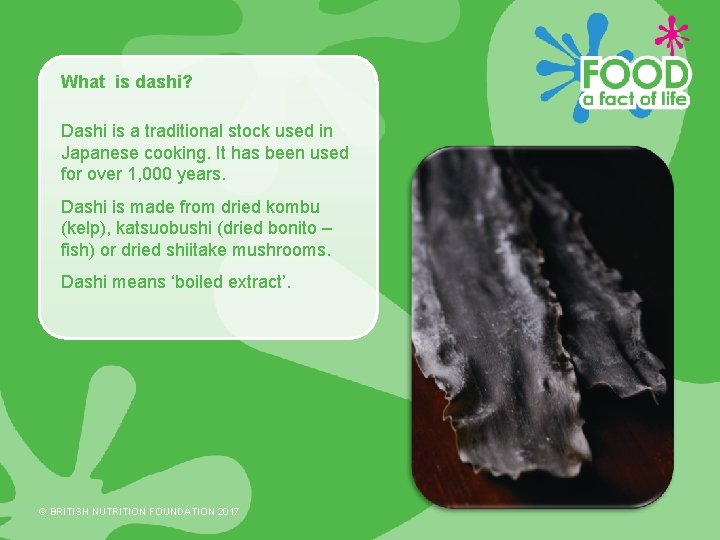
What is dashi? Dashi is a traditional stock used in Japanese cooking. It has been used for over 1, 000 years. Dashi is made from dried kombu (kelp), katsuobushi (dried bonito – fish) or dried shiitake mushrooms. Dashi means ‘boiled extract’. © BRITISH NUTRITION FOUNDATION 2017
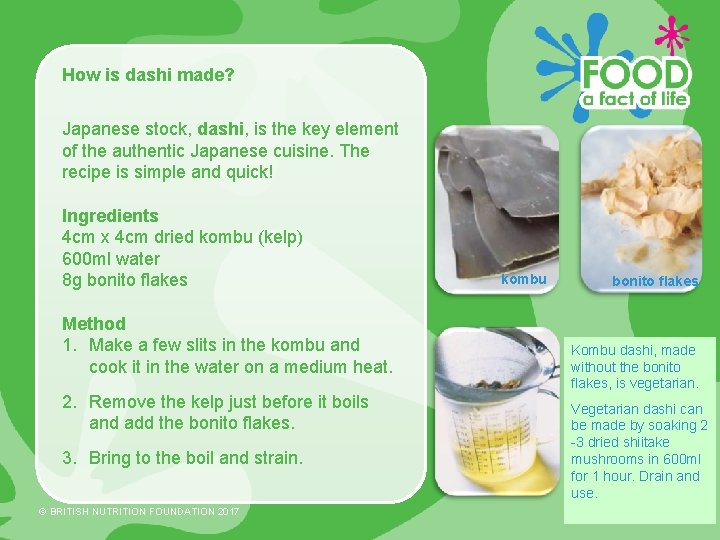
How is dashi made? Japanese stock, dashi, is the key element of the authentic Japanese cuisine. The recipe is simple and quick! Ingredients 4 cm x 4 cm dried kombu (kelp) 600 ml water 8 g bonito flakes Method 1. Make a few slits in the kombu and cook it in the water on a medium heat. 2. Remove the kelp just before it boils and add the bonito flakes. 3. Bring to the boil and strain. © BRITISH NUTRITION FOUNDATION 2017 kombu bonito flakes Kombu dashi, made without the bonito flakes, is vegetarian. Vegetarian dashi can be made by soaking 2 -3 dried shiitake mushrooms in 600 ml for 1 hour. Drain and use.
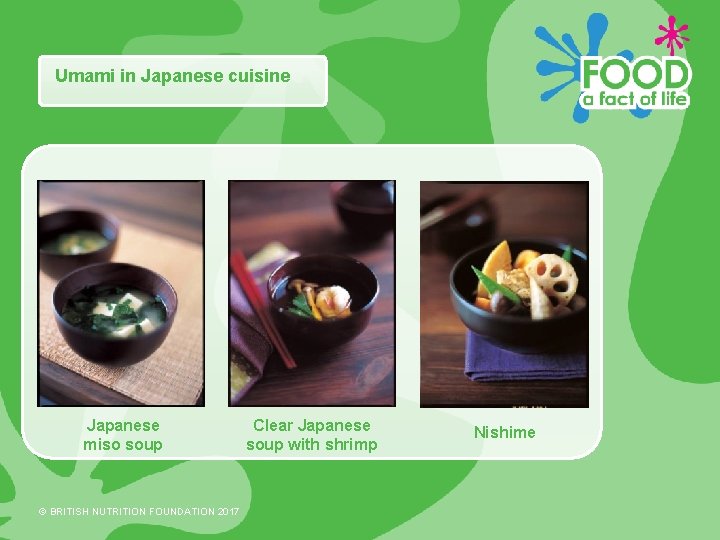
Umami in Japanese cuisine Clear Japanese soup with shrimp Japanese miso soup © BRITISH NUTRITION FOUNDATION 2017 Clear Japanese soup with shrimp Nishime
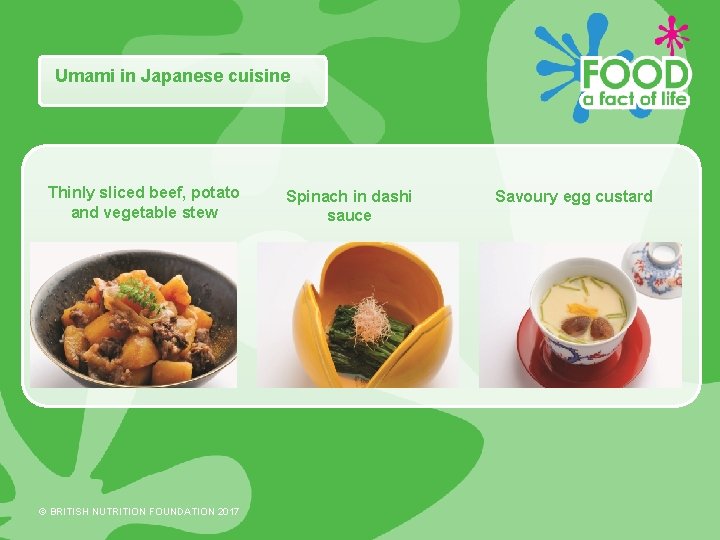
Umami in Japanese cuisine Thinly sliced beef, potato and vegetable stew © BRITISH NUTRITION FOUNDATION 2017 Spinach in dashi sauce Savoury egg custard
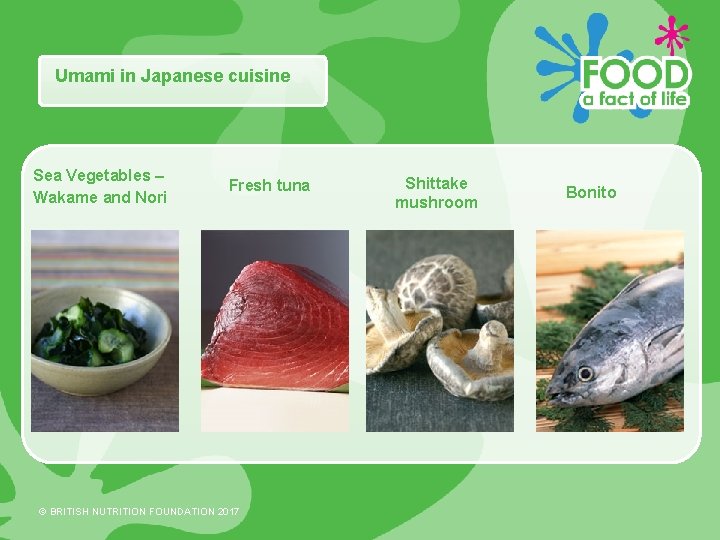
Umami in Japanese cuisine Sea Vegetables – Wakame and Nori Fresh tuna © BRITISH NUTRITION FOUNDATION 2017 Shittake mushroom Bonito
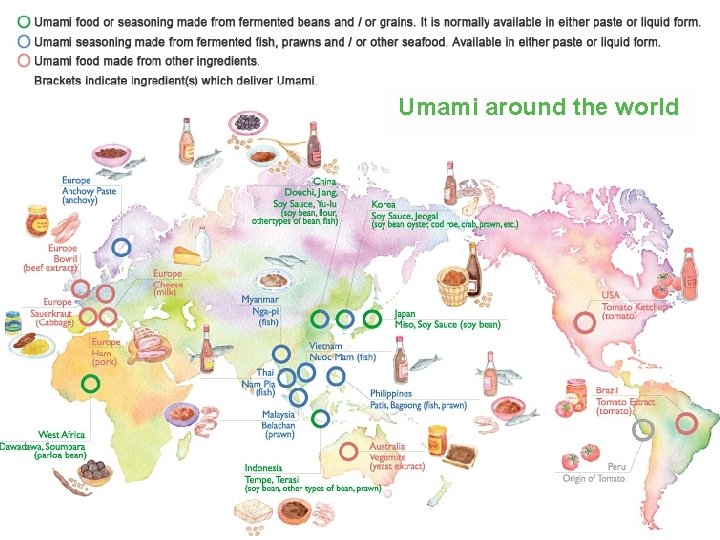
Umami around the world © BRITISH NUTRITION FOUNDATION 2017
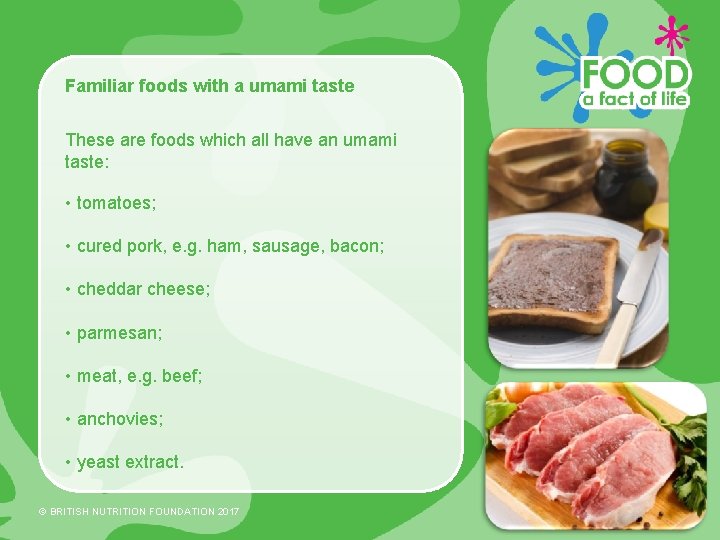
Familiar foods with a umami taste These are foods which all have an umami taste: • tomatoes; • cured pork, e. g. ham, sausage, bacon; • cheddar cheese; • parmesan; • meat, e. g. beef; • anchovies; • yeast extract. © BRITISH NUTRITION FOUNDATION 2017

Cooking and umami Several chefs around the world feature the umami taste in their cooking. In the UK, Heston Blumenthal uses umami-rich Japanese ingredients in Western style preparation in order to deliver a umami hit. Other chefs include Claude Bosi and Sat Bains. However, the umami taste can be delivered using familiar foods, such as yeast extract, Parmesan cheese, ketchup and tomatoes. An umami-rich food is pizza – featuring tomatoes, Parmesan cheese and anchovies. © BRITISH NUTRITION FOUNDATION 2017
Summary • Umami is the 5 th taste – it imparts a savoury flavour. • Umami was discovered by Dr Kikunae Ikeda, from Tokyo Imperial University, Japan, in 1908. • Umami tasting foods are found throughout the world. © BRITISH NUTRITION FOUNDATION 2017

Review of the learning objectives • To be introduced to the term umami. • To learn about how and who discovered umami. • To recognise unfamiliar and familiar umami rich foods. © BRITISH NUTRITION FOUNDATION 2017

British Nutrition Foundation New Derwent House, 69 -73 Theobalds Road, London, WC 1 X 8 TA Email: postbox@nutrition. org. uk Web: www. nutrition. org. uk www. foodafactoflife. org. uk © BRITISH NUTRITION FOUNDATION 2017
- Slides: 15