
Ultraviolet Therapy Ultraviolet Radiation UVR Electromagnetic spectrum 2000

- Slides: 26
Ultraviolet Therapy
Ultraviolet Radiation (UVR) • Electromagnetic spectrum (2000 to 4000 nm) • Divided into three ranges: – UV-A = Near UV (3200 to 4000 nm) • Little or no physiologic effect – UV-B = Middle UV (2900 to 3200 nm) • Sunburn and age-related skin changes – UV-C = Far UV (2000 to 2900 nm) • Bactericidal
Ultraviolet Radiation • Most likely to be used – UV-B or UV-C • UVR depth of penetration is 1 to 2 mm • Physiologic effects are superficial • Used to treat various skin disorders
Effect on Cells • UVR causes chemical excitation of cells • Results in alteration of cell biochemistry and cellular metabolism – Affects synthesis of DNA and RNA • Protein and enzyme production is altered, which may result in cell death
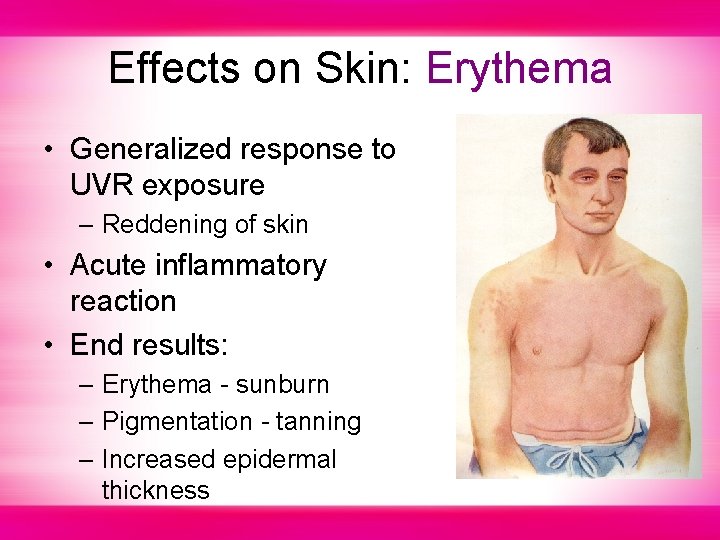
Effects on Skin: Erythema • Generalized response to UVR exposure – Reddening of skin • Acute inflammatory reaction • End results: – Erythema - sunburn – Pigmentation - tanning – Increased epidermal thickness
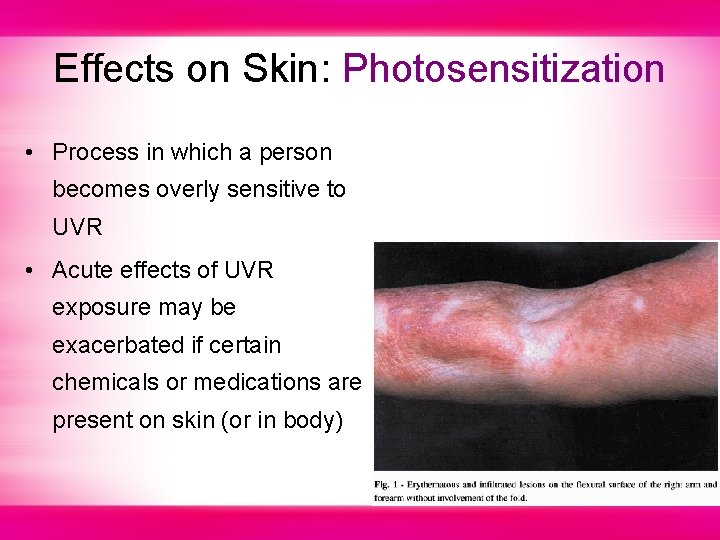
Effects on Skin: Photosensitization • Process in which a person becomes overly sensitive to UVR • Acute effects of UVR exposure may be exacerbated if certain chemicals or medications are present on skin (or in body)
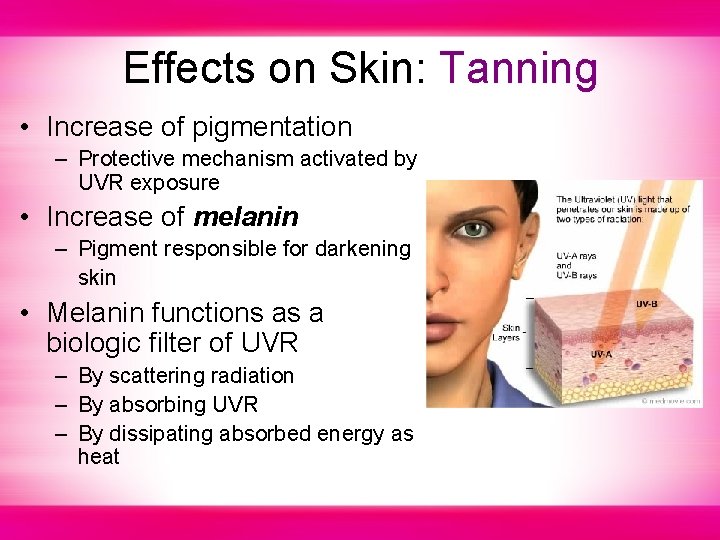
Effects on Skin: Tanning • Increase of pigmentation – Protective mechanism activated by UVR exposure • Increase of melanin – Pigment responsible for darkening skin • Melanin functions as a biologic filter of UVR – By scattering radiation – By absorbing UVR – By dissipating absorbed energy as heat
Effects on Skin: Tanning • Artificial Tanning - produce only UV-A • Production of UV-A is largely unregulated • Effects of long-term exposure to UV-A are unknown
Effects on Skin: Long-term • Premature aging of the skin • Dryness, cracking, and decreased elasticity – Linked to UVR-induced DNA damage • Skin cancer – Most common malignant tumor found in humans • Basal cell carcinoma (rarely metastasizes) • Squamous cell carcinoma (metastasizes in 5%) • Malignant melanoma (usually metastasizes) – Damage to DNA suspected as cause – Rate of cure exceeds 95% with early detection
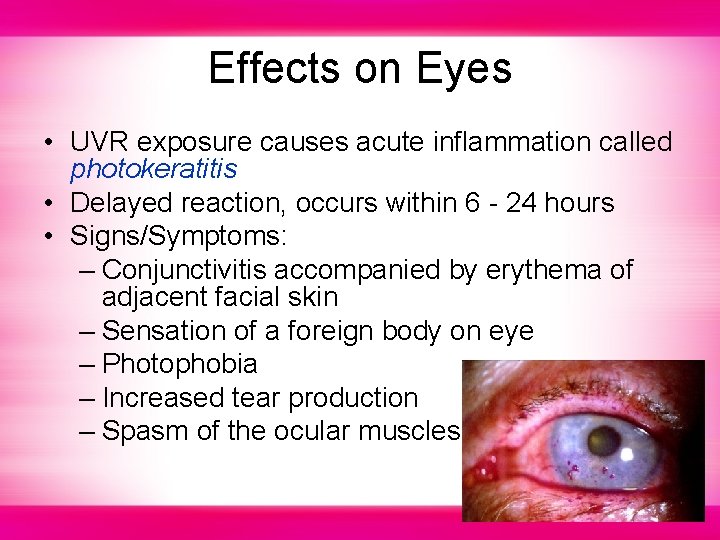
Effects on Eyes • UVR exposure causes acute inflammation called photokeratitis • Delayed reaction, occurs within 6 - 24 hours • Signs/Symptoms: – Conjunctivitis accompanied by erythema of adjacent facial skin – Sensation of a foreign body on eye – Photophobia – Increased tear production – Spasm of the ocular muscles
Systemic Effects • Photosynthesis of vitamin D – Following exposure to UVR in UV-B range • May be used to treat Ca++ and phosphorus disorders – Rickets and tetany • Treatment of choice; however, is dietary supplementation
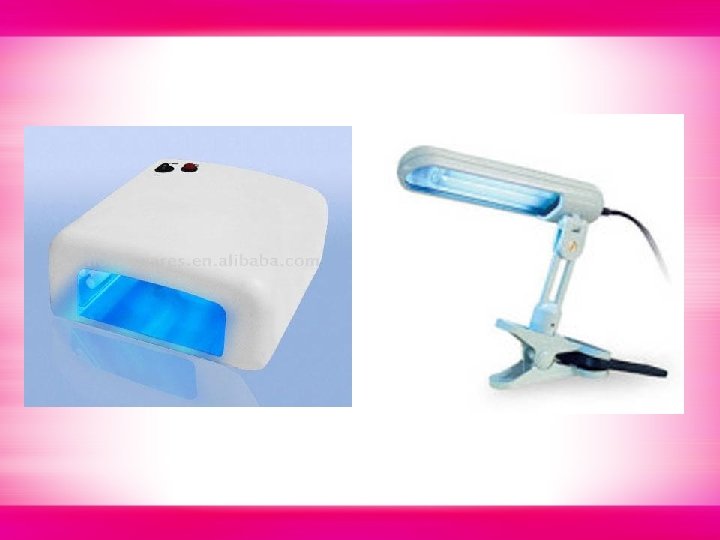
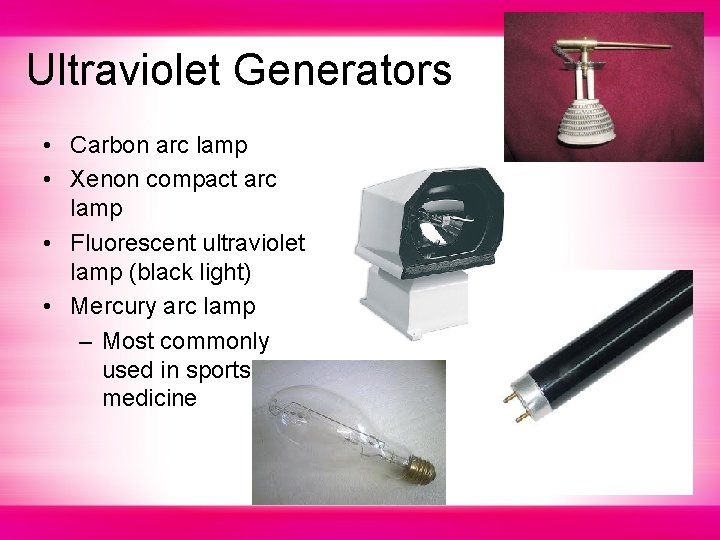
Ultraviolet Generators • Carbon arc lamp • Xenon compact arc lamp • Fluorescent ultraviolet lamp (black light) • Mercury arc lamp – Most commonly used in sports medicine
Mercury Arc Lamp • Mercury contained in a quartz envelope – Heavy metal in a liquid state • At 8000°C, mercury atoms vaporize and become incandescent • Emit ultraviolet, infrared, and visible light
Mercury Arc Lamp • High-pressure lamp = “Hot” lamp • UVR produced falls within UV-B range • Mainly used to produce erythema and accompanying photochemical reactions
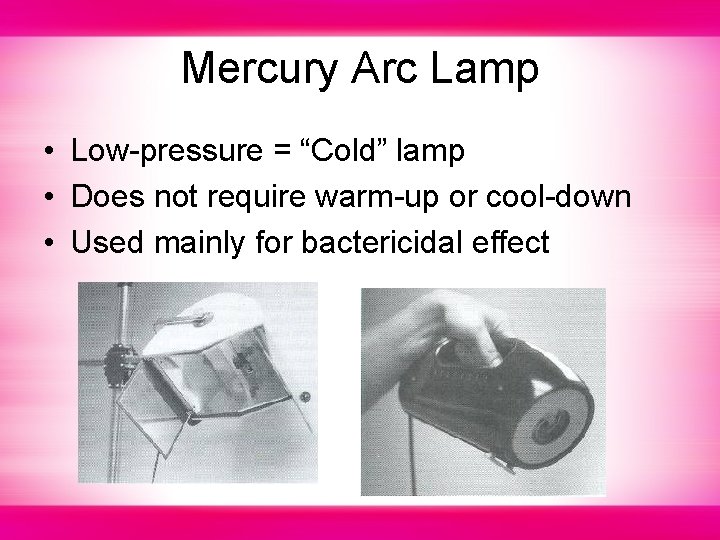
Mercury Arc Lamp • Low-pressure = “Cold” lamp • Does not require warm-up or cool-down • Used mainly for bactericidal effect
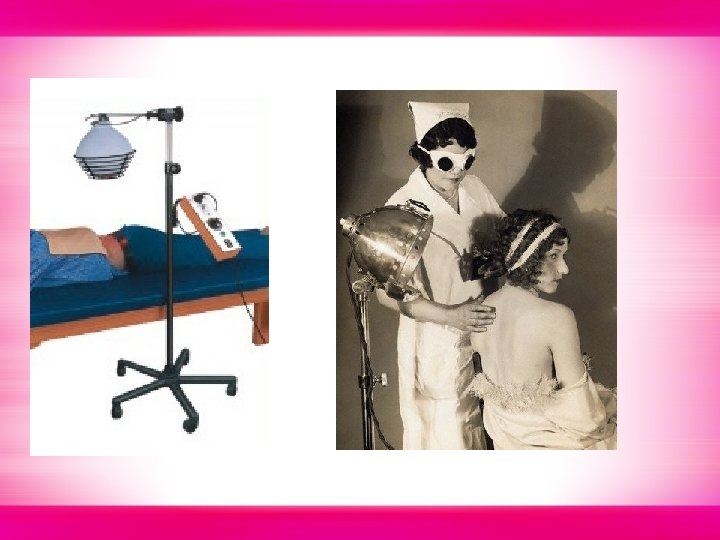
Mercury Arc Lamp • Positioning – Apply cosine law and inverse square law • Distance of lamp must be kept constant if intensity of treatments is to be equal • Standardized at each clinic – Usually ranges between 24 - 40 inches
Techniques of Application • Minimal Erythemal Dose (MED) – Exposure time needed to produce a faint erythema of the skin 24 hours after exposure • Question patient regarding photosensitizing drugs
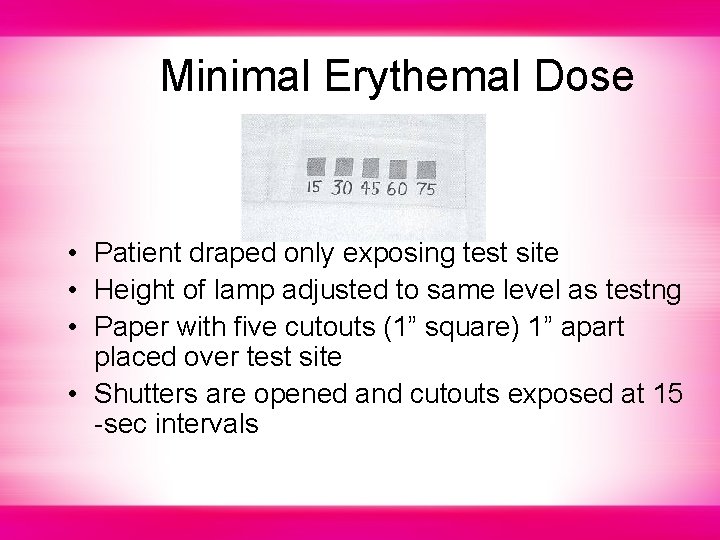
Minimal Erythemal Dose • Patient draped only exposing test site • Height of lamp adjusted to same level as testng • Paper with five cutouts (1” square) 1” apart placed over test site • Shutters are opened and cutouts exposed at 15 -sec intervals
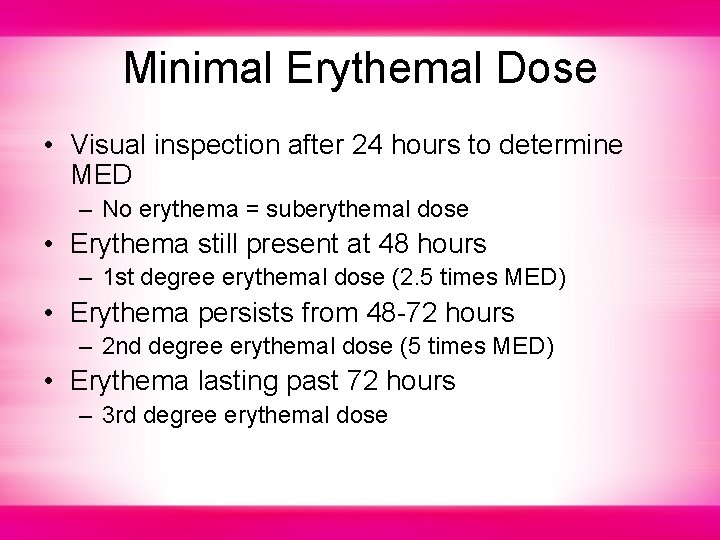
Minimal Erythemal Dose • Visual inspection after 24 hours to determine MED – No erythema = suberythemal dose • Erythema still present at 48 hours – 1 st degree erythemal dose (2. 5 times MED) • Erythema persists from 48 -72 hours – 2 nd degree erythemal dose (5 times MED) • Erythema lasting past 72 hours – 3 rd degree erythemal dose
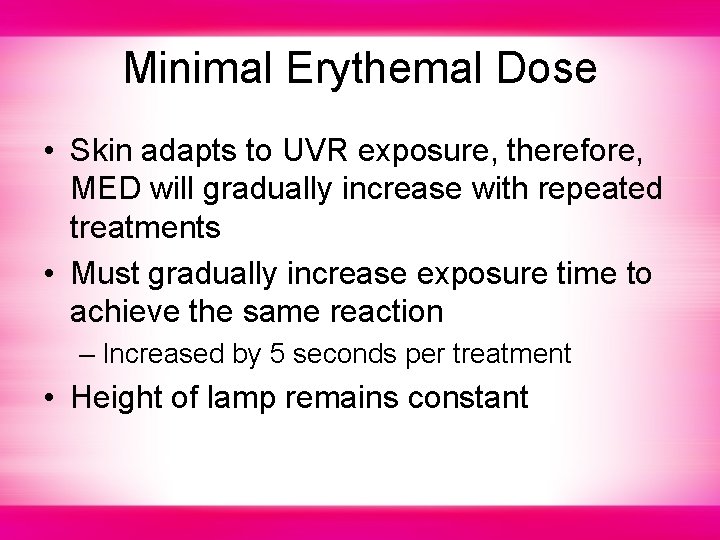
Minimal Erythemal Dose • Skin adapts to UVR exposure, therefore, MED will gradually increase with repeated treatments • Must gradually increase exposure time to achieve the same reaction – Increased by 5 seconds per treatment • Height of lamp remains constant
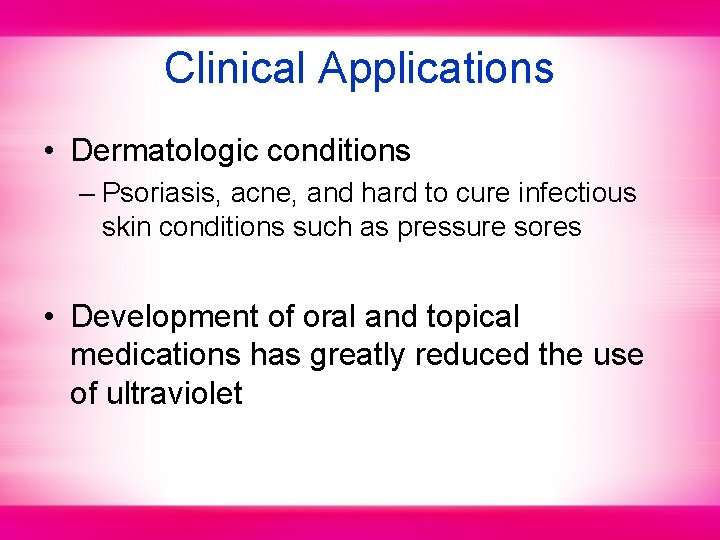
Clinical Applications • Dermatologic conditions – Psoriasis, acne, and hard to cure infectious skin conditions such as pressure sores • Development of oral and topical medications has greatly reduced the use of ultraviolet
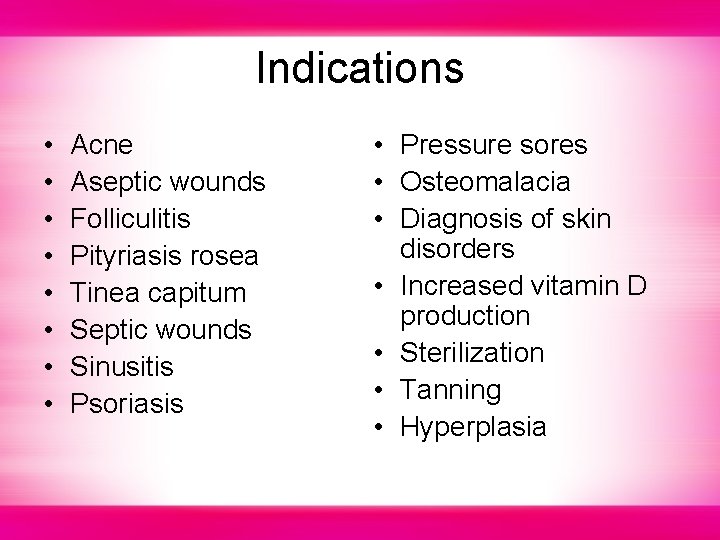
Indications • • Acne Aseptic wounds Folliculitis Pityriasis rosea Tinea capitum Septic wounds Sinusitis Psoriasis • Pressure sores • Osteomalacia • Diagnosis of skin disorders • Increased vitamin D production • Sterilization • Tanning • Hyperplasia
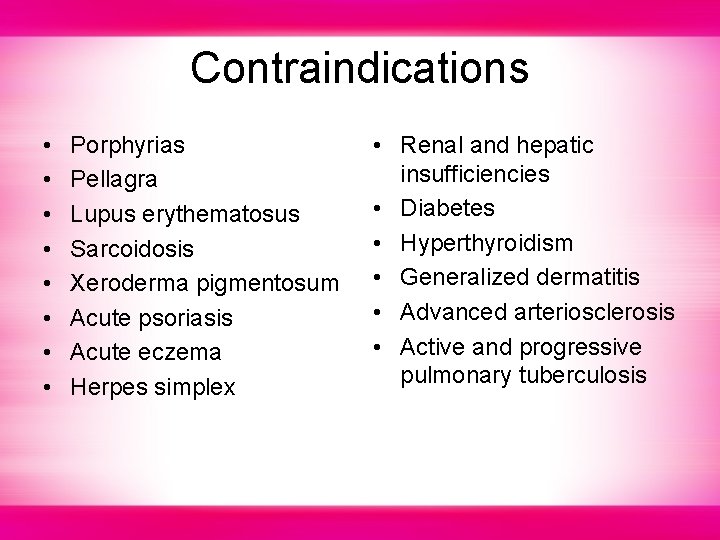
Contraindications • • Porphyrias Pellagra Lupus erythematosus Sarcoidosis Xeroderma pigmentosum Acute psoriasis Acute eczema Herpes simplex • Renal and hepatic insufficiencies • Diabetes • Hyperthyroidism • Generalized dermatitis • Advanced arteriosclerosis • Active and progressive pulmonary tuberculosis
Thank you