
Ultraviolet Imaging of the Hubble Ultradeep Field Harry
Ultraviolet Imaging of the Hubble Ultradeep Field Harry Teplitz (IPAC/Caltech) hit@ipac. caltech. edu Marc Rafelski (IPAC/Caltech), Nicholas Bond (GSFC), Peter Kurczynski (Rutgers), Anton Koekemoer (STSc. I), Rogier Windhorst (ASU), and the UVUDF team
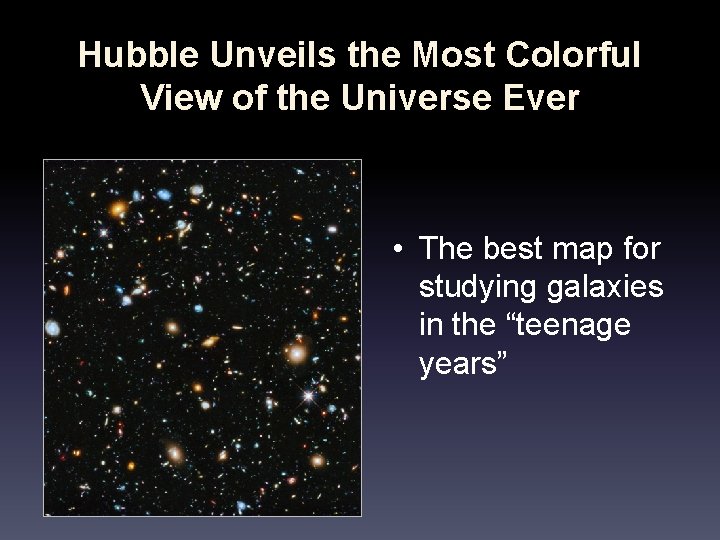
Hubble Unveils the Most Colorful View of the Universe Ever • The best map for studying galaxies in the “teenage years”
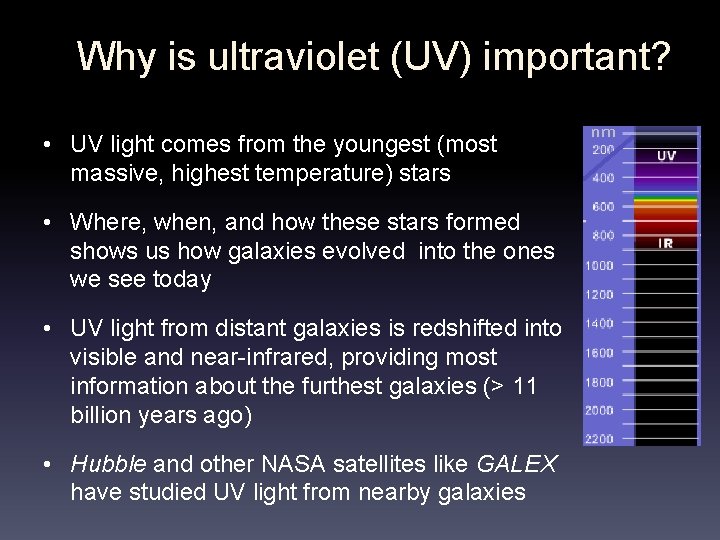
Why is ultraviolet (UV) important? • UV light comes from the youngest (most massive, highest temperature) stars • Where, when, and how these stars formed shows us how galaxies evolved into the ones we see today • UV light from distant galaxies is redshifted into visible and near-infrared, providing most information about the furthest galaxies (> 11 billion years ago) • Hubble and other NASA satellites like GALEX have studied UV light from nearby galaxies nm
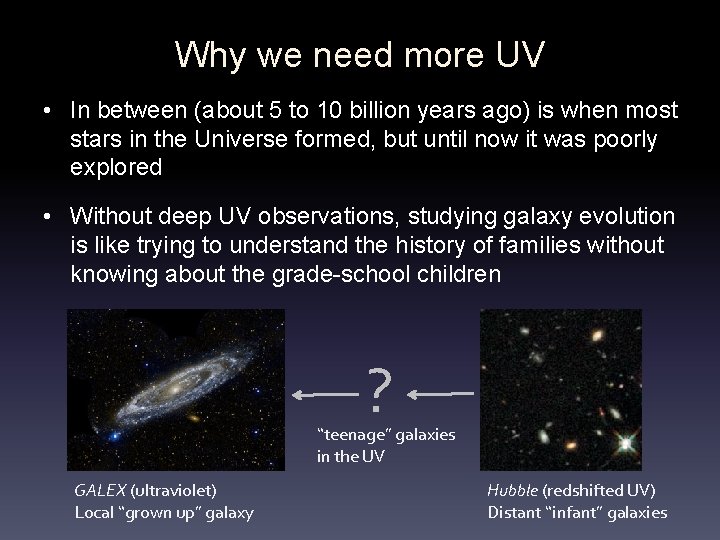
Why we need more UV • In between (about 5 to 10 billion years ago) is when most stars in the Universe formed, but until now it was poorly explored • Without deep UV observations, studying galaxy evolution is like trying to understand the history of families without knowing about the grade-school children ? “teenage” galaxies in the UV GALEX (ultraviolet) Local “grown up” galaxy Hubble (redshifted UV) Distant “infant” galaxies
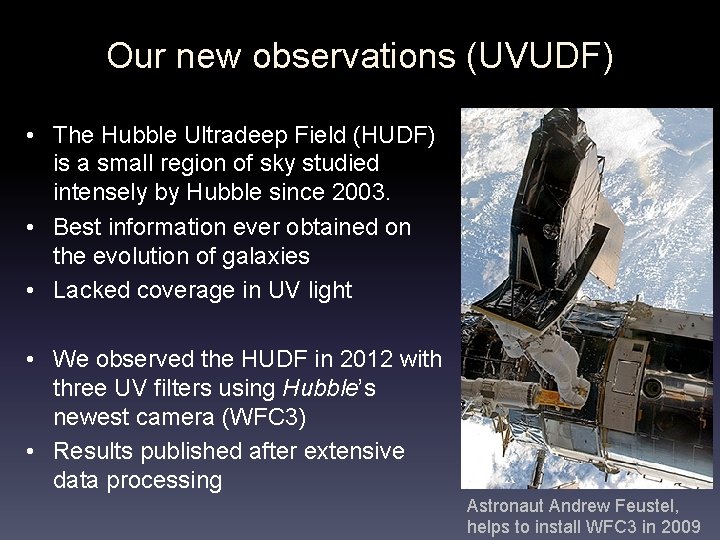
Our new observations (UVUDF) • The Hubble Ultradeep Field (HUDF) is a small region of sky studied intensely by Hubble since 2003. • Best information ever obtained on the evolution of galaxies • Lacked coverage in UV light • We observed the HUDF in 2012 with three UV filters using Hubble’s newest camera (WFC 3) • Results published after extensive data processing Astronaut Andrew Feustel, helps to install WFC 3 in 2009
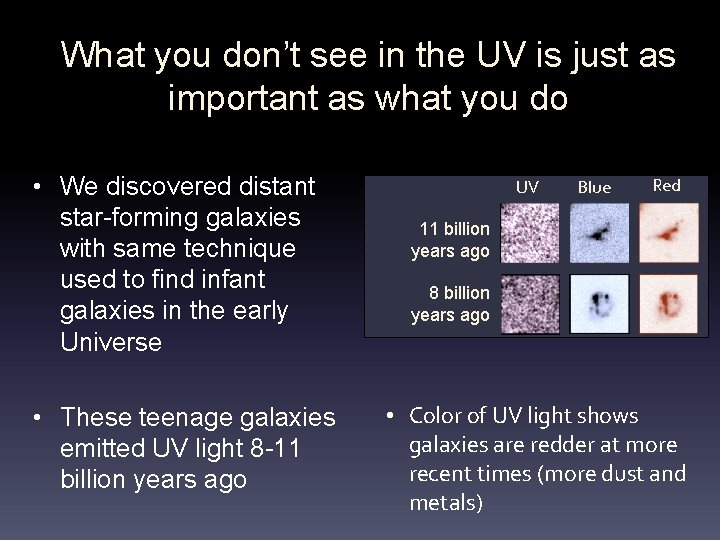
What you don’t see in the UV is just as important as what you do • We discovered distant star-forming galaxies with same technique used to find infant galaxies in the early Universe • These teenage galaxies emitted UV light 8 -11 billion years ago UV Blue Red 11 billion years ago 8 billion years ago • Color of UV light shows galaxies are redder at more recent times (more dust and metals)
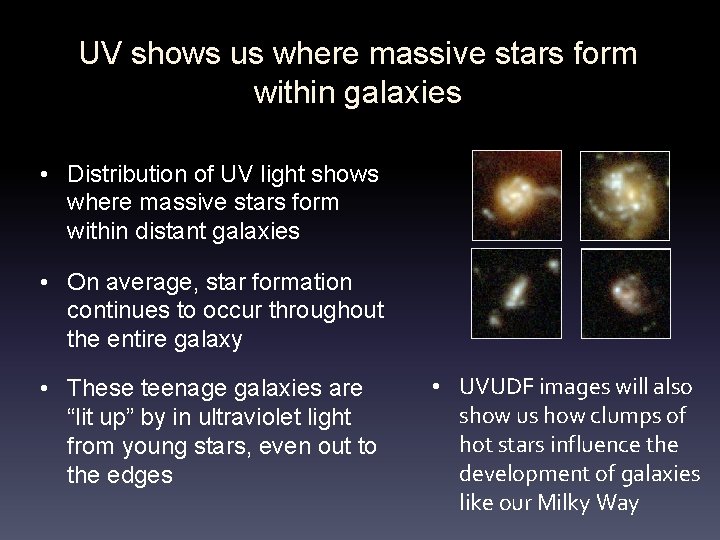
UV shows us where massive stars form within galaxies • Distribution of UV light shows where massive stars form within distant galaxies • On average, star formation continues to occur throughout the entire galaxy • These teenage galaxies are “lit up” by in ultraviolet light from young stars, even out to the edges • UVUDF images will also show us how clumps of hot stars influence the development of galaxies like our Milky Way
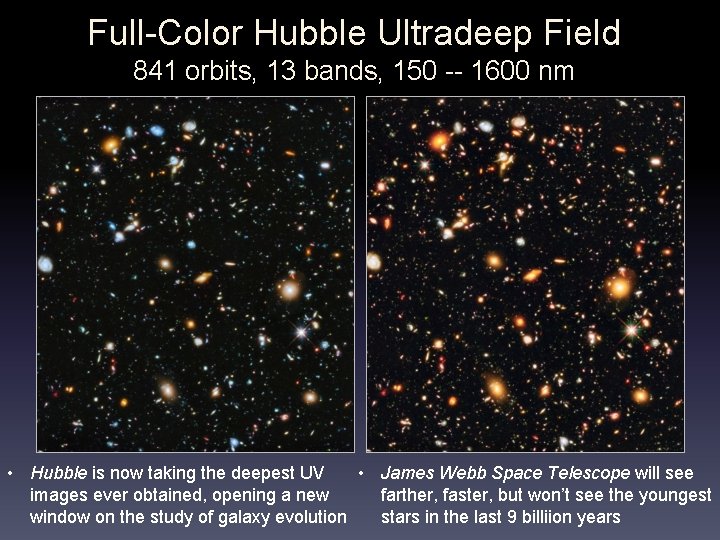
Full-Color Hubble Ultradeep Field 841 orbits, 13 bands, 150 -- 1600 nm • Hubble is now taking the deepest UV • James Webb Space Telescope will see images ever obtained, opening a new farther, faster, but won’t see the youngest window on the study of galaxy evolution stars in the last 9 billiion years
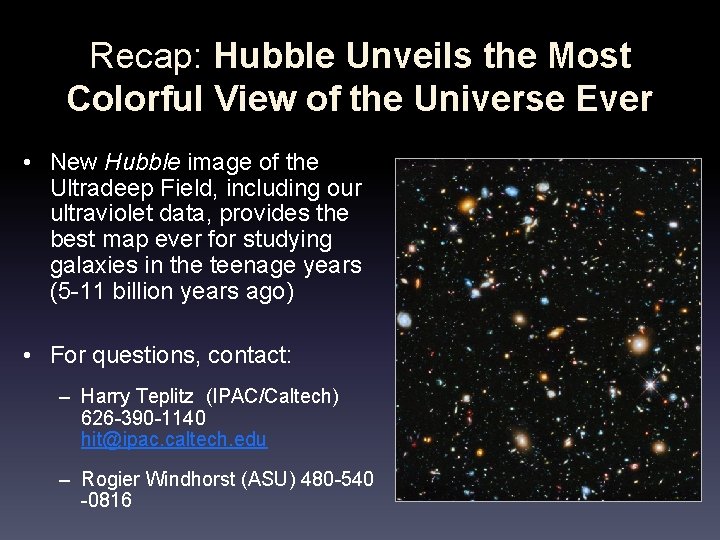
Recap: Hubble Unveils the Most Colorful View of the Universe Ever • New Hubble image of the Ultradeep Field, including our ultraviolet data, provides the best map ever for studying galaxies in the teenage years (5 -11 billion years ago) • For questions, contact: – Harry Teplitz (IPAC/Caltech) 626 -390 -1140 hit@ipac. caltech. edu – Rogier Windhorst (ASU) 480 -540 -0816
- Slides: 9