
ULTRAVIOLET AND INFRARED PHOTODISSOCIATION SPECTROSCOPY OF HYDRATED ANILINIUM

- Slides: 19
ULTRAVIOLET AND INFRARED PHOTODISSOCIATION SPECTROSCOPY OF HYDRATED ANILINIUM ION Itaru KURUSU, Reona YAGI, Yasutoshi KASAHARA, Haruki ISHIKAWA Department of Chemistry, School of Science, Kitasato University
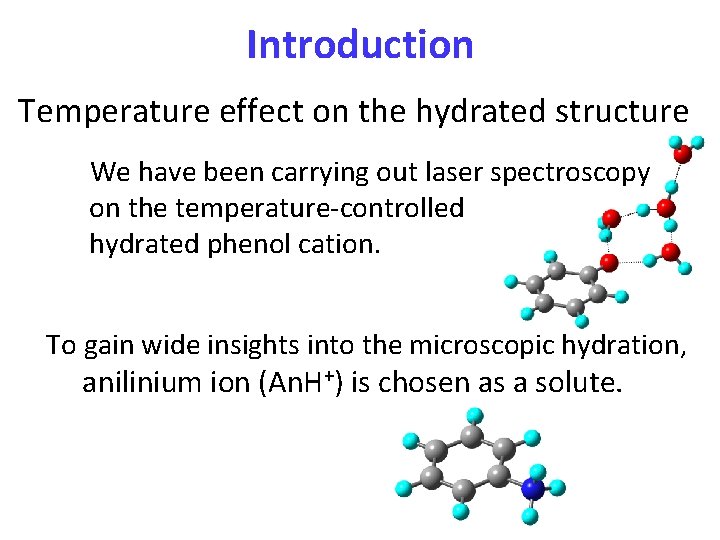
Introduction Temperature effect on the hydrated structure We have been carrying out laser spectroscopy on the temperature-controlled hydrated phenol cation. To gain wide insights into the microscopic hydration, anilinium ion (An. H+) is chosen as a solute.
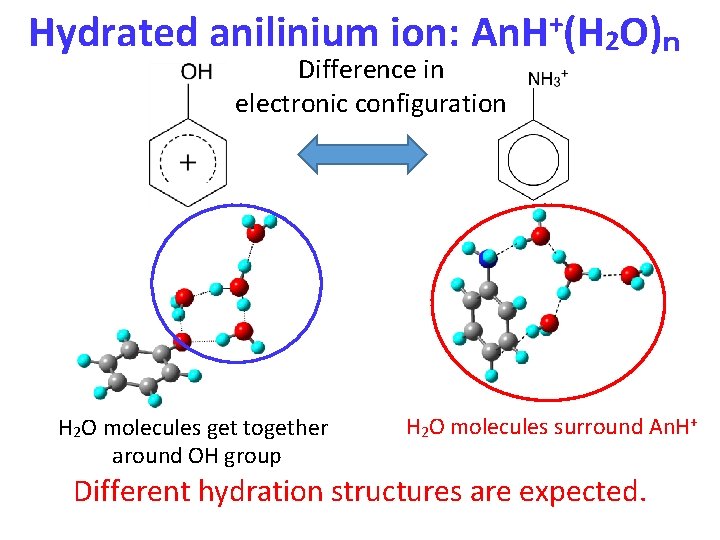
Hydrated anilinium ion: An. H+(H 2 O)n Difference in electronic configuration H 2 O molecules get together around OH group H 2 O molecules surround An. H+ Different hydration structures are expected.
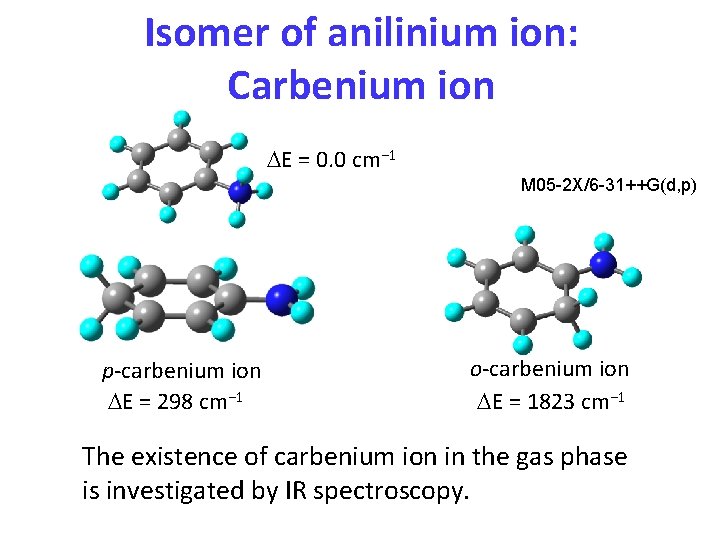
Isomer of anilinium ion: Carbenium ion DE = 0. 0 cm− 1 M 05 -2 X/6 -31++G(d, p) p-carbenium ion DE = 298 cm− 1 o-carbenium ion DE = 1823 cm− 1 The existence of carbenium ion in the gas phase is investigated by IR spectroscopy.
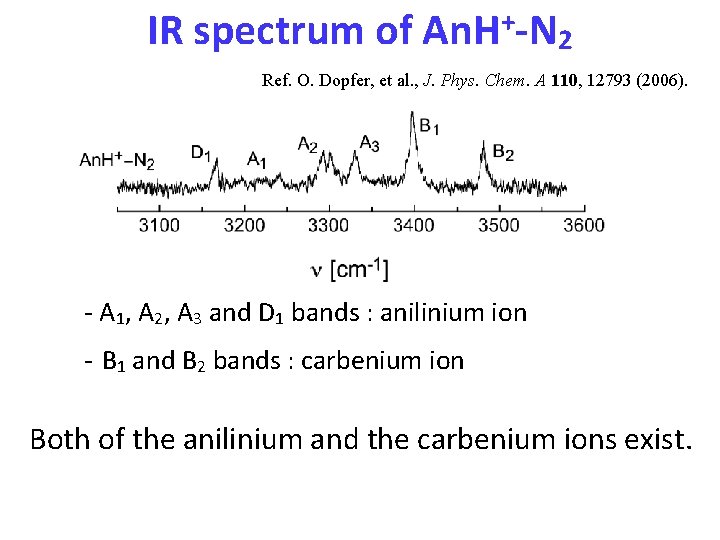
IR spectrum of + An. H -N 2 Ref. O. Dopfer, et al. , J. Phys. Chem. A 110, 12793 (2006). - A 1, A 2, A 3 and D 1 bands : anilinium ion - B 1 and B 2 bands : carbenium ion Both of the anilinium and the carbenium ions exist.
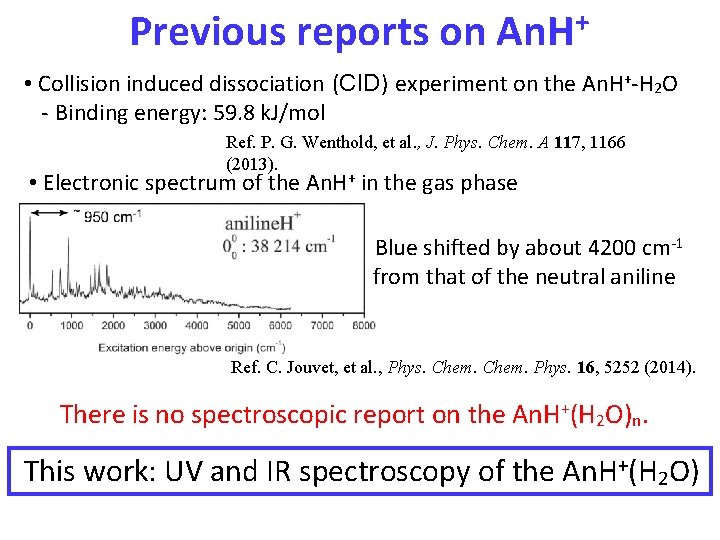
Previous reports on + An. H • Collision induced dissociation (CID) experiment on the An. H+-H 2 O - Binding energy: 59. 8 k. J/mol Ref. P. G. Wenthold, et al. , J. Phys. Chem. A 117, 1166 (2013). • Electronic spectrum of the An. H+ in the gas phase Blue shifted by about 4200 cm-1 from that of the neutral aniline Ref. C. Jouvet, et al. , Phys. Chem. Phys. 16, 5252 (2014). There is no spectroscopic report on the An. H+(H 2 O)n. This work: UV and IR spectroscopy of the An. H+(H 2 O)
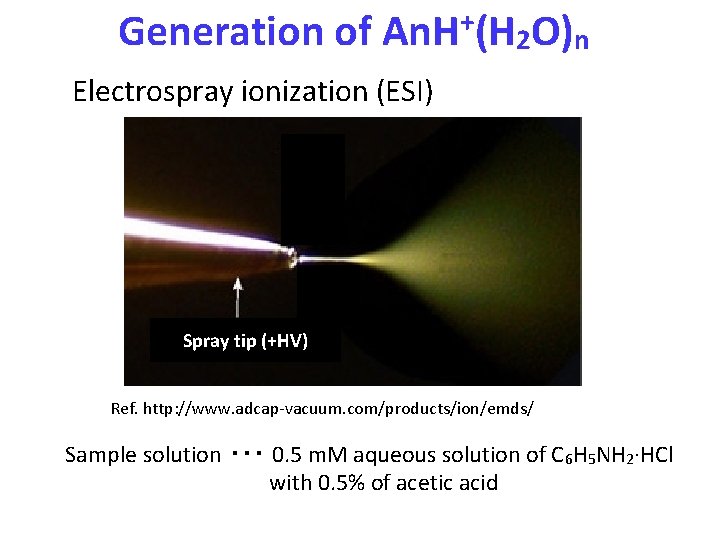
Generation of + An. H (H 2 O)n Electrospray ionization (ESI) 噴煙 Spray tip (+HV) Ref. http: //www. adcap-vacuum. com/products/ion/emds/ Sample solution ・・・ 0. 5 m. M aqueous solution of C 6 H 5 NH 2·HCl with 0. 5% of acetic acid
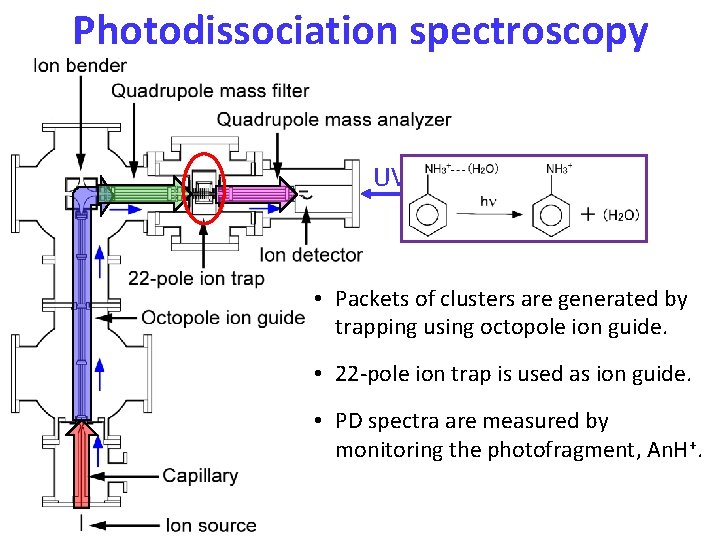
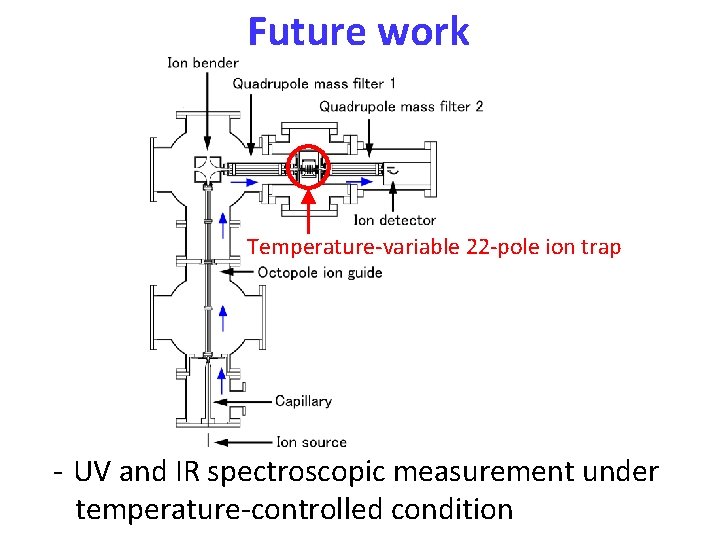
Photodissociation spectroscopy UV or IR • Packets of clusters are generated by trapping using octopole ion guide. • 22 -pole ion trap is used as ion guide. • PD spectra are measured by monitoring the photofragment, An. H+.
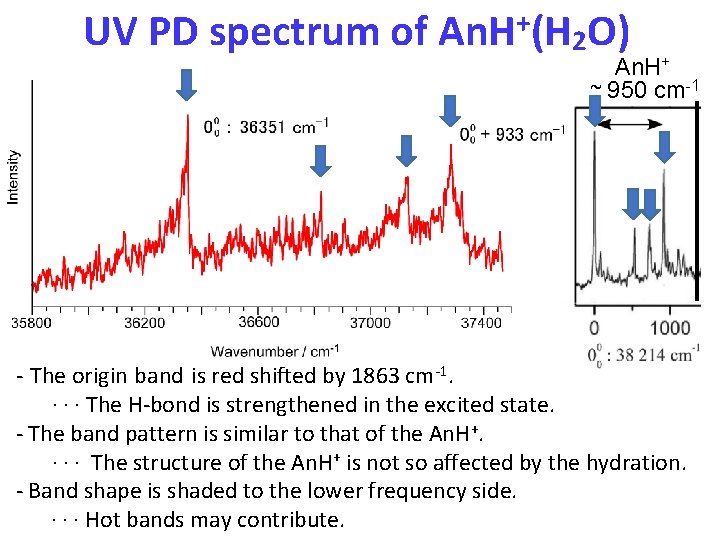
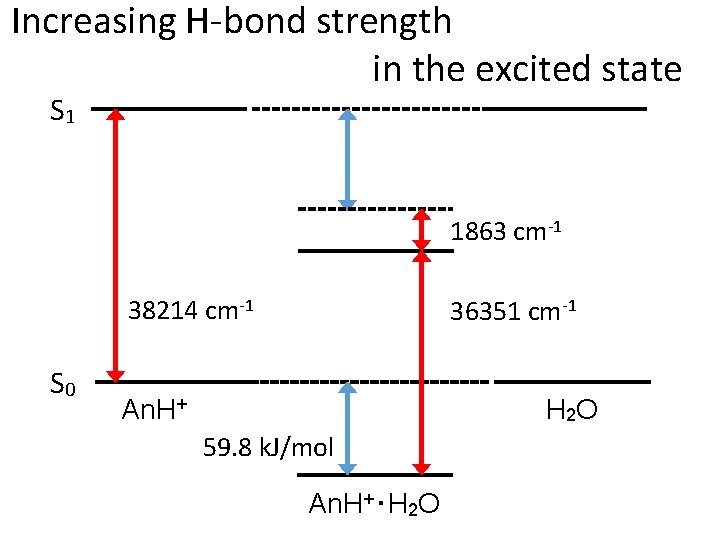
UV PD spectrum of An. H+(H 2 O) An. H+ ~ 950 cm-1 - The origin band is red shifted by 1863 cm-1. · · · The H-bond is strengthened in the excited state. - The band pattern is similar to that of the An. H+. · · · The structure of the An. H+ is not so affected by the hydration. - Band shape is shaded to the lower frequency side. · · · Hot bands may contribute.
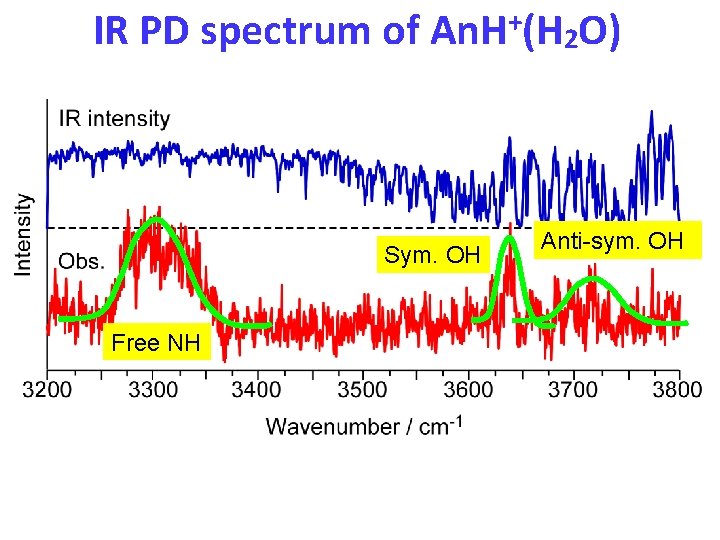
IR PD spectrum of An. H+(H 2 O) Sym. OH Free NH Anti-sym. OH
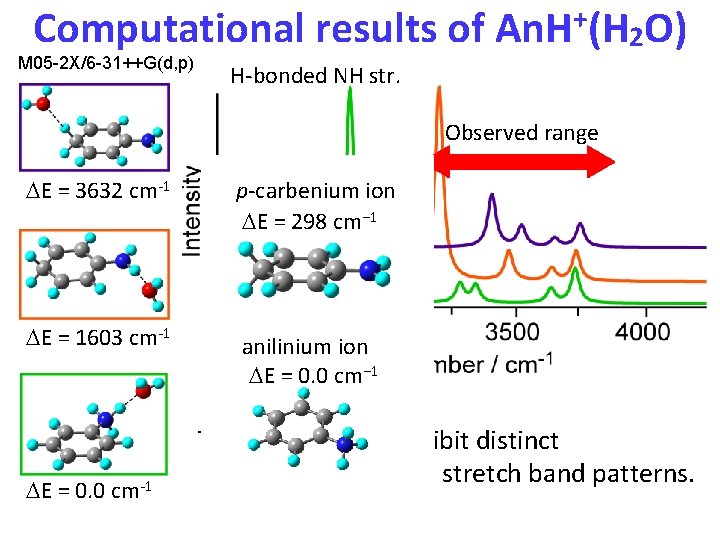
Computational results of An. H+(H 2 O) M 05 -2 X/6 -31++G(d, p) H-bonded NH str. Observed range DE = 3632 cm-1 p-carbenium ion DE = 298 cm− 1 DE = 1603 cm-1 anilinium ion DE = 0. 0 cm− 1 DE = 0. 0 cm-1 Three structures exhibit distinct NH stretch band patterns.
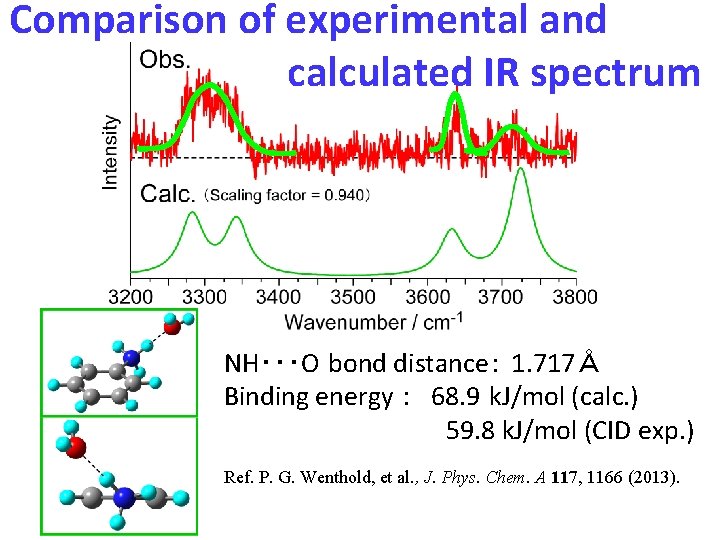
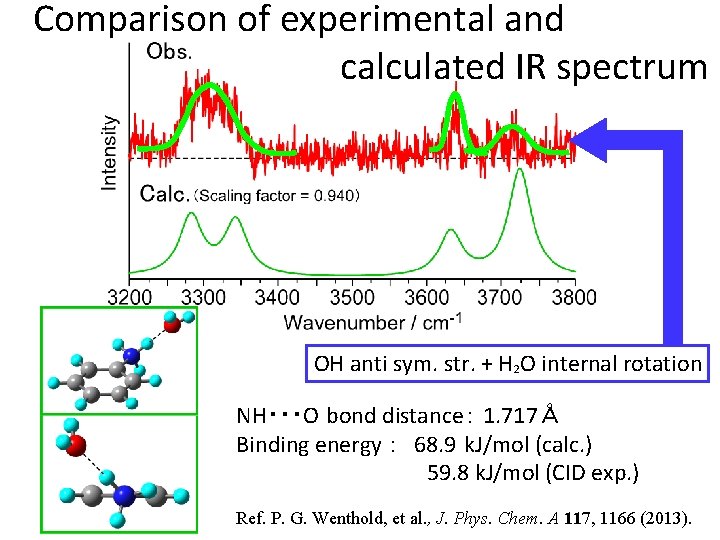
Comparison of experimental and calculated IR spectrum NH・・・O bond distance: 1. 717Å Binding energy : 68. 9 k. J/mol (calc. ) 59. 8 k. J/mol (CID exp. ) Ref. P. G. Wenthold, et al. , J. Phys. Chem. A 117, 1166 (2013).
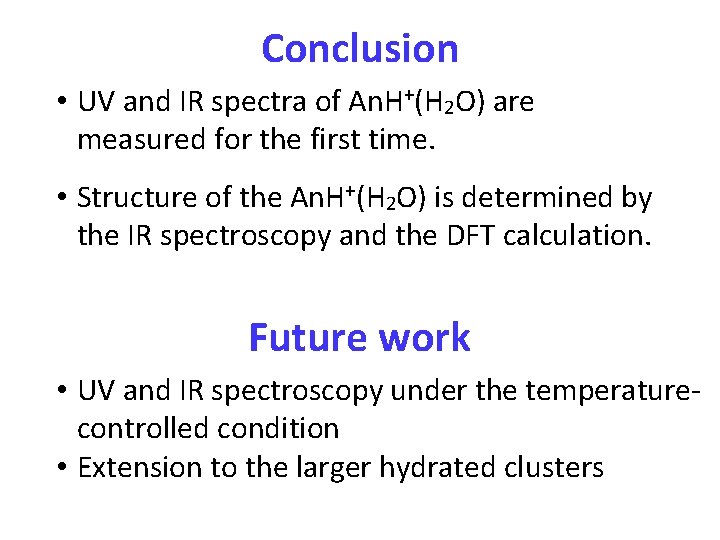
Conclusion • UV and IR spectra of An. H+(H 2 O) are measured for the first time. • Structure of the An. H+(H 2 O) is determined by the IR spectroscopy and the DFT calculation. Future work • UV and IR spectroscopy under the temperaturecontrolled condition • Extension to the larger hydrated clusters
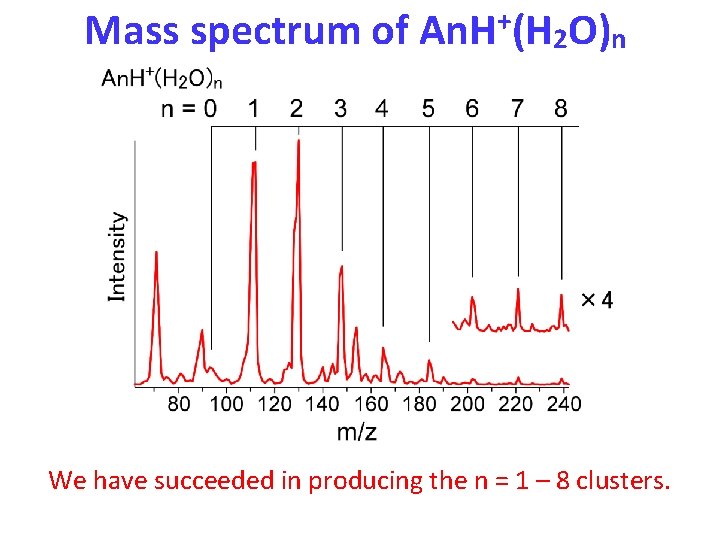
Mass spectrum of An. H+(H 2 O)n We have succeeded in producing the n = 1 – 8 clusters.
Increasing H-bond strength in the excited state S 1 1863 cm-1 38214 cm-1 S 0 36351 cm-1 An. H+ H 2 O 59. 8 k. J/mol An. H+・H 2 O
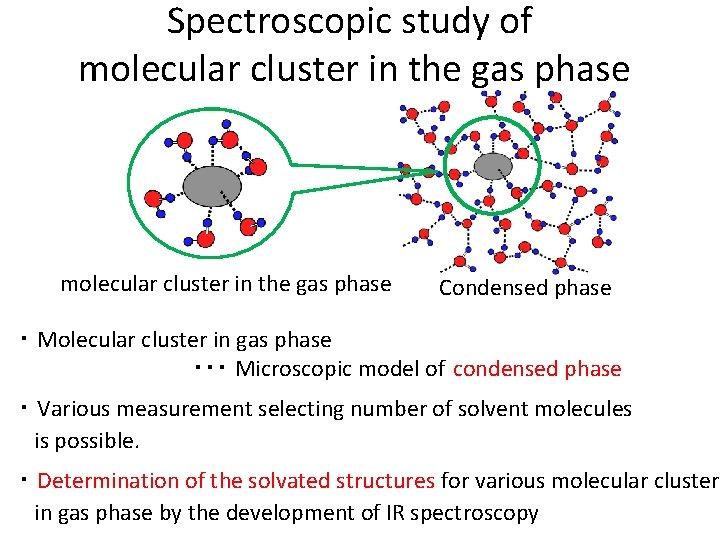
Spectroscopic study of molecular cluster in the gas phase Condensed phase ・ Molecular cluster in gas phase ・・・ Microscopic model of condensed phase ・ Various measurement selecting number of solvent molecules is possible. ・ Determination of the solvated structures for various molecular cluster in gas phase by the development of IR spectroscopy
Comparison of experimental and calculated IR spectrum OH anti sym. str. + H 2 O internal rotation NH・・・O bond distance: 1. 717Å Binding energy : 68. 9 k. J/mol (calc. ) 59. 8 k. J/mol (CID exp. ) Ref. P. G. Wenthold, et al. , J. Phys. Chem. A 117, 1166 (2013).
Future work Temperature-variable 22 -pole ion trap - UV and IR spectroscopic measurement under temperature-controlled condition