
ULTRASOUND THERAPY INTRODUCTION Uses of ultrasound are 1







- Slides: 47
ULTRASOUND THERAPY
INTRODUCTION Uses of ultrasound are 1. Diagnostic 2. Destructive 3. Therapeutic used for imaging Used to produce extreme tissue hyperthermia, tumouricidal effects in cancer patients Most widely used modality in physiotherpy
By definition “Ultrasound refers to mechanical vibration which are essentially the same as sound waves but of higher frequency. Such waves are beyond the range of human hearing and therefore also be called ultrasonic”
FREQUENCY OF US Audible sound range____20 -20, 000 Hz Any range above the audible range is ultrasound Different therapies are employed in the range ____ 0. 5 - 5 MHz Majority US generators are set to____ 1 MHz Some US generators are also set to ___ 3 MHz
PENETRATION 1 MHz____ transmitted through more superficial tissue and absorbed in deeper tissue at the depth of 3 to 5 cm (used in individual with high % of sub cutaneous fats, and deeper effects are required) 3 MHz ____ absorbed in more superficial tissues with a depth of penetration between 1 – 2 cm
PROPERTIES OF WAVES 1 LONGITUDINAL WAVES Sonic waves are a series of compression and rarefaction in the direction of travel of the wave, hence they are called longitudinal waves VELOCITY OF WAVES The speed at which the waves move through the medium Depend on the physical nature of the medium More rapid in solid and liquid(molecules are close together) than in air Air _____ 344 m/s Water _____ 1410 m/s Muscle _____ 1540 m/s Bone _______ 3500 m/s
PRODUCTION OF ULTRA SOUND WAVES For 1 MHz machine a vibrating source with a frequency of one million cycles per second is needed This is achieved by either a quartz or a barium titanate or a lead zirconate or nickle cobalt ferrite crystal. These crystal deform when subjected to a varying potential difference, this is called piezo electric effect APPARATUS Source of high frequency current is conveyed by a coaxial cable to a transducer circuit/treatment head/ applicator/ sound head High frequency current is applied to the crystal being fused to the metal front plate of the treatment head. Any change in the shape of the crystal cause a movement of the metal front plate which in turn produces ultrasonic waves Strict frequency control of high frequency current(1 MHz or 3 MHz) ensures a steady and regular rate of deformation
TRANSMISSION OF ULTRA SOUND WAVES US waves encounter and inter face between two medium and is transmitted, it may be refracted, like light Traveling from a medium with low velocity to medium with high velocity of US, refracted away from the normal path Refraction does not occur when waves strike at right angle to the new medium
ATTENUATION OF ULTRASOUND It is the term used to describe the gradual reduction in intensity of the ultrasonic beam once it has left the treatment head. There are two main factors that contribute to attenuation 1 ABSORPTION US absorbed by the tissue and converted to the heat, contributes to thermal effect of US 2 - SCATTER This occurs normally when US beam is deflected from path by interfaces, bubbles or particles in its path HALF VALUE DISTANCE The depth of soft tissue that reduces the US beam to half its surface intensity 1 MHz____ 4 cm 3 MHz ____ 2 cm
COUPLING MEDIA US are not transmitted by air so some couplant which does transmit them must be interposed between the transducer and patients skin No couplant affords perfect transmission and only the % of original intensity is transmitted to the patient. Reduces the dose by quarter Some coupling medias and their efficiency of transmission are: Aquasonic gel______ 72. 6% Distilled water _____ 59% Petroleum jelly _____ 0% Air _______ 0%
Characteristics of coupling media 1. An acoustic impedance similar to the tissue. 2. High transmisivity for US 3. High viscosity 4. Low suspectibility to bubbles formation 5. A chemical inactive in nature 6. A hypoallergic character 7. Relative sterility 8. Cheap 9. Couplant should also act as a lubricant to allow the treatment head to move smoothly over the skin
TREATMENT PARAMETERS 1. CONTINOUS MODE 2. PULSED MODE
INTENSITY us intensity unit is Watt (on gross measurement of power being emitted)
INTENSITY In US intensity unit is Watt but this is a gross measure of power being emitted by reaction head, so average intensity is normally used Spaced averaged intensity: where the average intensity over a specified area is given, e. g. watts per square cm(W/cm 2) Timed averaged/ space averaged intensity when US is being applied in pulsed mode, and gives the average intensity over the whole treatment time (per second) for a specified area (W/cm) Example; if 0. 5 Wcm-2 is applied pulsed 1: 4 then in one second the average intensity would be 0. 1 Wcm-2
PULSED MARK: SPACE RATIO In pulsed mode, the ratio of time on and time off should be expressed. This is the mark space ratio. The mark being the time of US on, space being the silence, both being measured in milliseconds. Some units have fixed M: S of 2: 8, where as others have variable range, e. g. 1: 1, 1: 4, 1: 7
REFLECTION OF ULTRASOUND Sound waves obeys the laws of reflection and if an ultrasound beam travelling through one medium encounters another medium which will not transmit, reflection takes place Air does not transmit sound waves, reflection takes place, standing waves will generate, damage to the apparatus and to the patient as well, so avoid leaving treatment head open in air when it is on There is always some reflection on each interface that the ultrasound beam encounters Acoustic impedance(Z) The ratio between the reflection and transmission on interface is known as acoustic impedance When the Z is low transmission is high and vise versa
TESTING OF APPARATUS
TECNIQUES AND METHOD OF APPLICATION
Preparation of patient
Examination and testing Inflammatory skin conditions
Preparation and testing of apparatus
Preparation of the part to be relaxed Couplant
Setting up
Instruction and warning
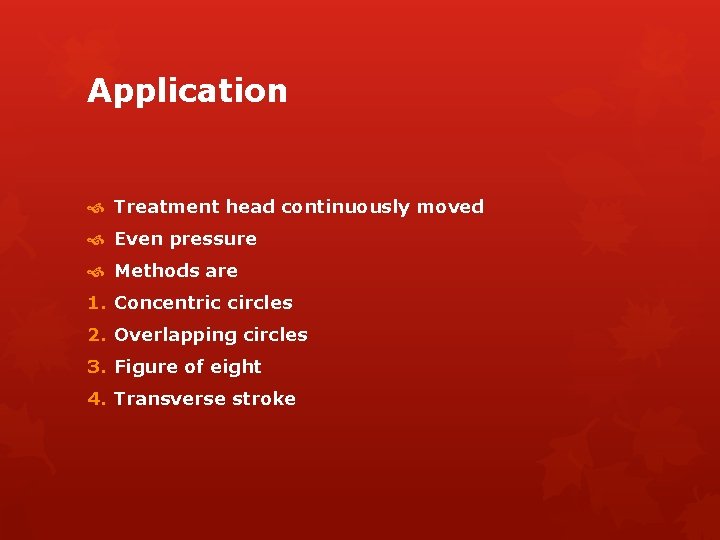
Application Treatment head continuously moved Even pressure Methods are 1. Concentric circles 2. Overlapping circles 3. Figure of eight 4. Transverse stroke
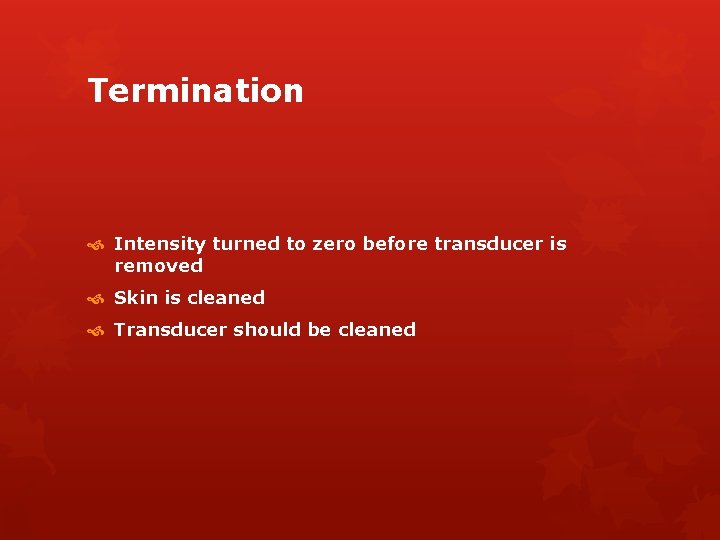
Termination Intensity turned to zero before transducer is removed Skin is cleaned Transducer should be cleaned
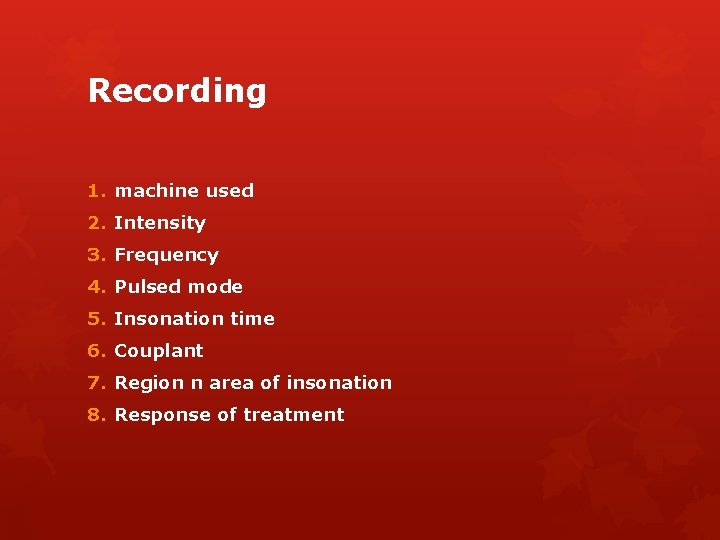
Recording 1. machine used 2. Intensity 3. Frequency 4. Pulsed mode 5. Insonation time 6. Couplant 7. Region n area of insonation 8. Response of treatment
TECHNIQUES OF APPLICATION 1. DIRECT CONTACT METHOD (area 3 times larger than Rx head) 2. WATER BATH METHOD ( 1 cm from the surface to be treated) 3. WATER BAG METHOD
SOLID STERILE GEL AS COUPLANT Polyacrylamide agar gel
DOSAGE Size Depth Nature of lesion
PARAMETERS 1. Mode 2. Frequency 3. Intensity 4. Duration
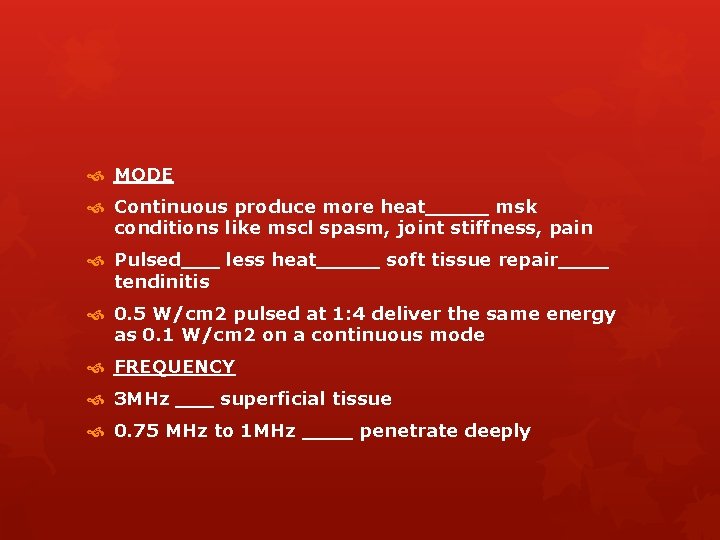
MODE Continuous produce more heat_____ msk conditions like mscl spasm, joint stiffness, pain Pulsed___ less heat_____ soft tissue repair____ tendinitis 0. 5 W/cm 2 pulsed at 1: 4 deliver the same energy as 0. 1 W/cm 2 on a continuous mode FREQUENCY 3 MHz ___ superficial tissue 0. 75 MHz to 1 MHz ____ penetrate deeply
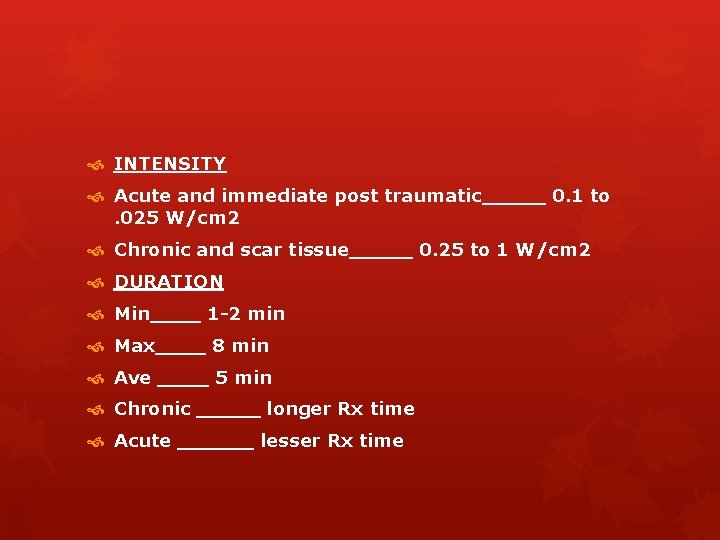
INTENSITY Acute and immediate post traumatic_____ 0. 1 to. 025 W/cm 2 Chronic and scar tissue_____ 0. 25 to 1 W/cm 2 DURATION Min____ 1 -2 min Max____ 8 min Ave ____ 5 min Chronic _____ longer Rx time Acute ______ lesser Rx time
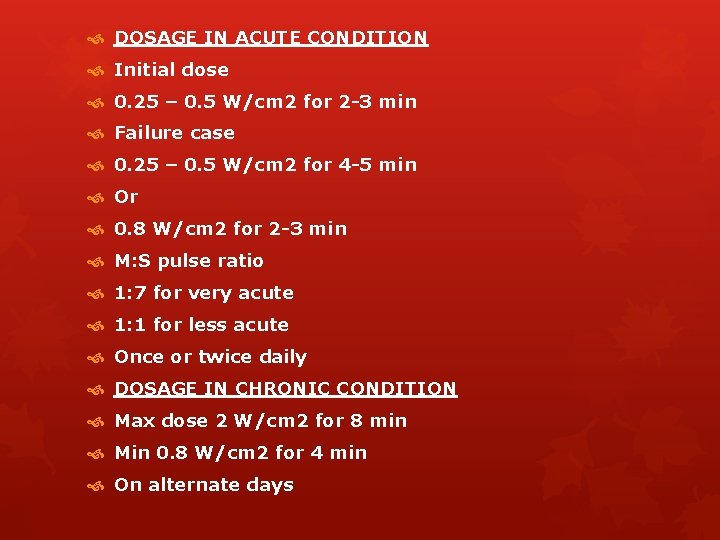
DOSAGE IN ACUTE CONDITION Initial dose 0. 25 – 0. 5 W/cm 2 for 2 -3 min Failure case 0. 25 – 0. 5 W/cm 2 for 4 -5 min Or 0. 8 W/cm 2 for 2 -3 min M: S pulse ratio 1: 7 for very acute 1: 1 for less acute Once or twice daily DOSAGE IN CHRONIC CONDITION Max dose 2 W/cm 2 for 8 min Min 0. 8 W/cm 2 for 4 min On alternate days
PHYSIOLOGICAL EFFECTS
THERMAL EFFECTS NON THERMAL EFFECTS MECHANICAL EFFECTS BIOLOGICAL EFFECTS
THERMAL EFFECTS US absorbed by the tissue they are converted into heat Amount of heat developed depends upon: 1. Absorption of tissue e. g, protien 2. No of times the treatment head passes over the part 3. Efficiency of circulation 4. Continuous US heat directly proportional to the intensity and duration 5. Pulsed mode- less thermal effect 6. Refection _ on bone _ periosteal reaction _ heat doubles_ present as pain USES 1. Accelerate heating 2. Extensibility of collagen is increased by heating, streching of scare or adhesions is easier following US 3. Reduce pain
NON THERMAL EFFECTS CAVITATION This is the oscillatory activity of highly compressible bodies within the tissues such as gas or vapour filled void STABLE CAVITATION When bubbles oscillates to and fro within the US pressure waves, but remains intact, Not dangerous Beneficial micro streaming Microstreaming is the unidirectional movement of fluid around the boundaries of cell , permiability of cell and the chemical flow within cell influenced UNSTABLE AND TRANSIENT CAVITATION Changes in the size of bubble Dangerous as collapse can release intense heating damage to the tissue Avoid: by the movement of treatment head
MECHANICAL EFFECT OF MICROMASSAGES Longitudinal waves of US waves produces compression and rarefaction of cells, affect the movement of tissue fluid in interstitial fluid Help in reducing edema Combined with thermal effect extensibility of adhesion and scar tissue is affected, so streching become easier Possibly also affect in reducing pain
BIOLOGICAL EFFECT Effect all three stages of healing 1. INFLAMMATORY increases the fragility of lysosome, release lysosomal enzymes, which help to clear the area of debris and allow the next stage of healing 2. PROLIFERATIVE fibroblast and myofibroblast may have ca++ ions deriven into them by US, this increases their mobility and encourage their movement toward the site of healing, FIBROBLAST are stimulated to produce collagen fiber for scar formation and MYOFIBROBLAST contract to pull the edges together. 3. REMOLDING US increase the tensile strength of scar by affecting the direction, strength and elasticity of fibers which make up the scar easier
THERAPEUTIC USES OF ULTRASOUND
1. SOFT TISSUE INJURIES: mechanical effect remove exudate and reduce adhesion formation, heating effect reduces pain, accelerate protein synthesis, results in good repair 2. SCAR TISSUE: stretching and unbound from underlying tissues 3. CHRONIC INDURATED EDEMA: Rx it n prevent adhesions 4. VARICOSE ULCERS: pressure ulcers too 5. BLOOD FLOW: not affect 6. BONE INJURIES: increase bone union, early diagnosis of stress fractures, moderate dose_ intense pain, otherwise no pain 7. PLANTER WARTS: common in athletes- wt bearing area of feet, either viral or microtrauma( thrombosed capillaries in a whitish colored soft core covered by hyperketatotic epithelial tissue) effective painless method 8. PLACEBO EFFECT:
DANGERS OF ULTRASOUND 1. BURNS 2. CAVITATION 3. OVERDOSE 4. DANGER TO EQUIPMENT
CONTRAINDICATIONS 1. VASCULAR CONDITIONS: thrombophlebitis 2. ACUTE SEPSIS: septic emboli, sterlisation of Rx head 3. RADIOTHERAPY: 4. TUMOURS: metastasize 5. PREGNANCY: over the uterus, back and abdomen 6. CARDIAC DISEASE: low intensities, cervical ganglion and the vagus nerve are avoided as risk of cardiac stimulation, pacemaker 7. HAEMORRAGE: enlarging haemarthrosis, haematoma, uncontrolled haemophilia 8. SEVERLY ISCHEMIC TISSUES: poor heat transfer, arterial thrombosis 9. NERVOUS: spina bifida 10. SPECIALIZED TISSUES: fluid filled eye, 11. IMPLANTS 12. ANAESTHETIC AREA