
Ultrasound probe use and reprocessing Results from a
Ultrasound probe use and reprocessing: Results from a national survey among U. S. infection preventionists Carrico RM, Furmanek S, English C. Ultrasound probe use and reprocessing: Results from a national survey among U. S. infection preventionists. Am J Infect Control. 2018. doi: 10. 1016/j. ajic. 2018. 03. 025. [Epub ahead of print] Download full text at: https: //doi. org/10. 1016/j. ajic. 2018. 03. 025
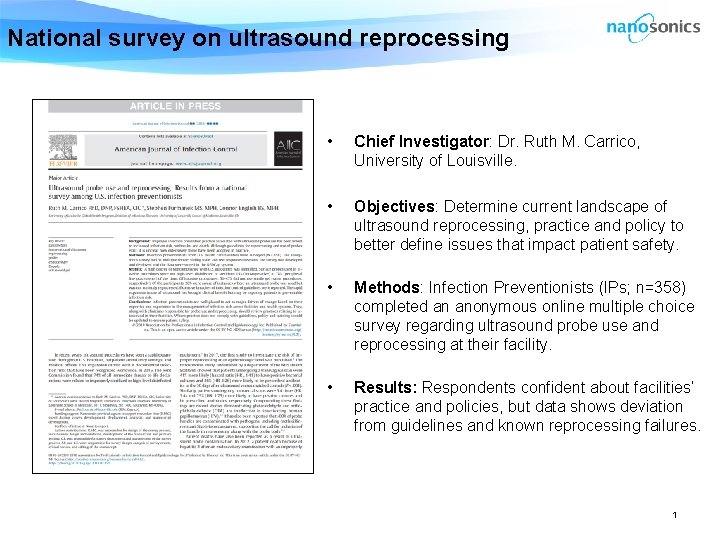
National survey on ultrasound reprocessing • Chief Investigator: Dr. Ruth M. Carrico, University of Louisville. • Objectives: Determine current landscape of ultrasound reprocessing, practice and policy to better define issues that impact patient safety. • Methods: Infection Preventionists (IPs; n=358) completed an anonymous online multiple choice survey regarding ultrasound probe use and reprocessing at their facility. • Results: Respondents confident about facilities’ practice and policies, but data shows deviation from guidelines and known reprocessing failures. 1
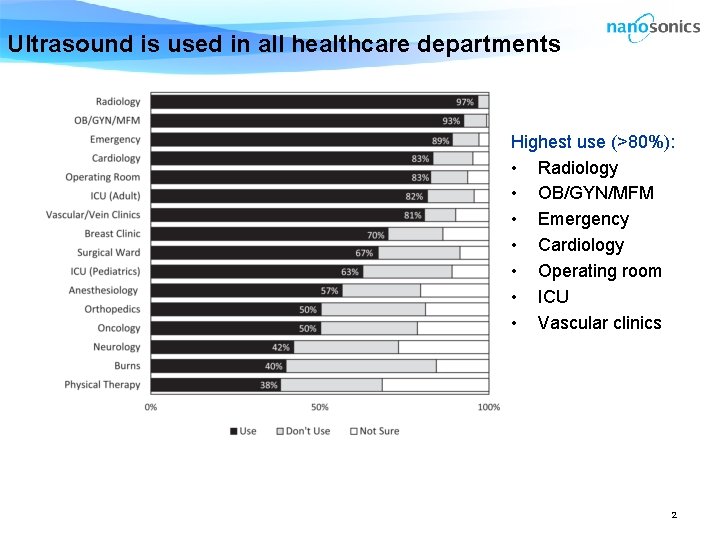
Ultrasound is used in all healthcare departments Highest use (>80%): • Radiology • OB/GYN/MFM • Emergency • Cardiology • Operating room • ICU • Vascular clinics 2
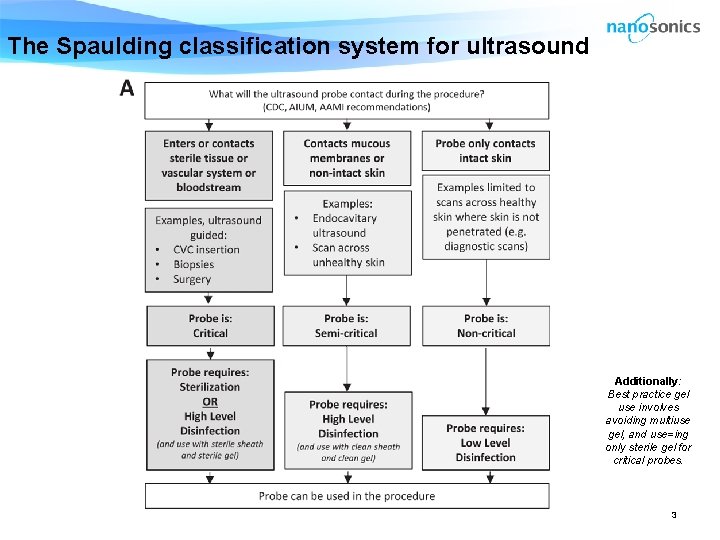
The Spaulding classification system for ultrasound Additionally: Best practice gel use involves avoiding multiuse gel, and use=ing only sterile gel for critical probes. 3
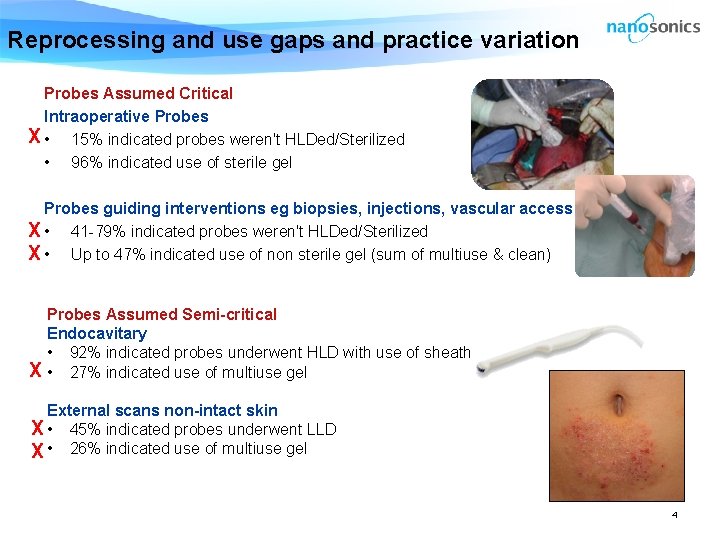
Reprocessing and use gaps and practice variation Probes Assumed Critical Intraoperative Probes X • 15% indicated probes weren't HLDed/Sterilized • 96% indicated use of sterile gel Probes guiding interventions eg biopsies, injections, vascular access X • 41 -79% indicated probes weren't HLDed/Sterilized X • Up to 47% indicated use of non sterile gel (sum of multiuse & clean) Probes Assumed Semi-critical Endocavitary • 92% indicated probes underwent HLD with use of sheath X • 27% indicated use of multiuse gel External scans non-intact skin X • 45% indicated probes underwent LLD X • 26% indicated use of multiuse gel 4
Policy gaps and knowledge of reprocessing failures Policy gaps: • 46% indicated policy unable to identify semi-critical ultrasound probe as one which contacts mucous membranes or non-intact skin • 60% indicated policy unable to identify that critical probes can undergo HLD if used with a sterile sheath Known reprocessing failures: • 20% indicated awareness of instances where an ultrasound was used but not reprocessed correctly • 2. 5% indicated awareness of situations where an ultrasound probe may have implicated or involved in an infection IP Confidence: • Despite widespread gaps, IPs were highly confident about aspects related to ultrasound including locations, identity of staff using/reprocessing, procedures, ability to respond to surveyors and policy followed by staff. 5
Ultrasound reprocessing is complex • Ultrasound has expanded to all healthcare departments and is used by a variety of end users across over a spectrum of invasive and non invasive procedures. • The national survey has highlighted practice gaps and areas for urgent improvement in ultrasound use and reprocessing. • Ultrasound probe reprocessing and use is dependent on its Spaulding classification which is determined by contact site (e. g. if probe contacts needle puncture site, probe is critical). • Facilities should have multidisciplinary teams which examine the level of risk of transmission of infection in there healthcare organizations. 6

www. nanosonics. us MM 01038 -US-PPT
- Slides: 8