
ULTRASOUND GUIDED RETROGRADE ENDOSCOPIC URETERAL STENTING FEASIBILITY IN
ULTRASOUND GUIDED RETROGRADE ENDOSCOPIC URETERAL STENTING: FEASIBILITY IN SELECTED CASES Andrea Fabiani*, Emanuele Iacobone**, Maria Pavia°, Luca Lepri*, Federico Boncagni**, Daniele Elisei**, Lucilla Servi*, Giuseppe Tappatà** *Urology Unit, Surgical Dpt, ASUR MARCHE Area Vasta 3, Macerata (Italy) ° Resident, Department of Urology, Marche Polythecnic University, Ancona (Italy) ** Departmente of Intensive Care, ASUR MARCHE Area Vasta 3, Macerata (Italy)
Impending or actual ureteric obstruction is the most common indication for ureteric stenting and it can be caused by extrinsic or intrinsic compression or by changes of the ureteric wall itself.
Impending or actual ureteric obstruction is the most common indication for ureteric stenting and it can be caused by extrinsic or intrinsic compression or by changes of the ureteric wall itself. In case of malignant ureteral obstruction it has been recently highlighted that the antegrade approach should be the first choice for the stent placement due to the technical success rate

Especially in case of stone- or nonstone-non malignant indications to ureteral catheterism, retrograde stenting is the gold standard of ureteral obstruction reliefe.
Ultrasound guide may be a good practical approach to avoid radiation exposure for the patients and the operators ?
MATERIAL AND METHODS A retrospective review of consecutive patients that underwent ultrasound guided retrograde endoscopic ureteral stenting (UGREUS) from 2014 to 2019 for several non primary oncologic indications was performed. Patient data were exctracted from our internal database. Real time ultrasonic guidance was provided by an expert urologist in ultrasound with fluoroscopy available on stand by. Ultrasound was used to visualize advancement of guidewire (placed into the stent if already in site) and the ureteral stent throught the ureter and up to the renal pelvis. Procedures were performed in sedo-analgesia in the operating room
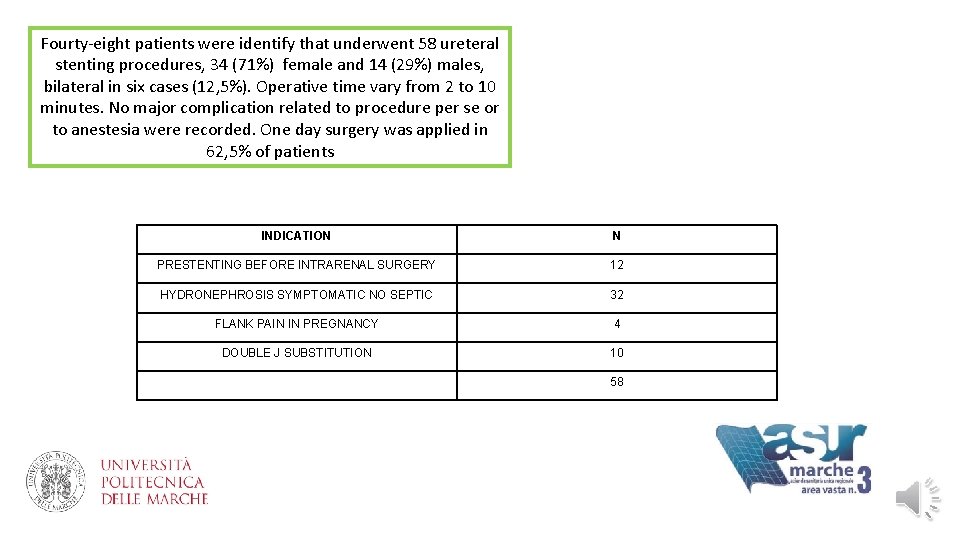
Fourty-eight patients were identify that underwent 58 ureteral stenting procedures, 34 (71%) female and 14 (29%) males, bilateral in six cases (12, 5%). Operative time vary from 2 to 10 minutes. No major complication related to procedure per se or to anestesia were recorded. One day surgery was applied in 62, 5% of patients INDICATION N PRESTENTING BEFORE INTRARENAL SURGERY 12 HYDRONEPHROSIS SYMPTOMATIC NO SEPTIC 32 FLANK PAIN IN PREGNANCY 4 DOUBLE J SUBSTITUTION 10 58
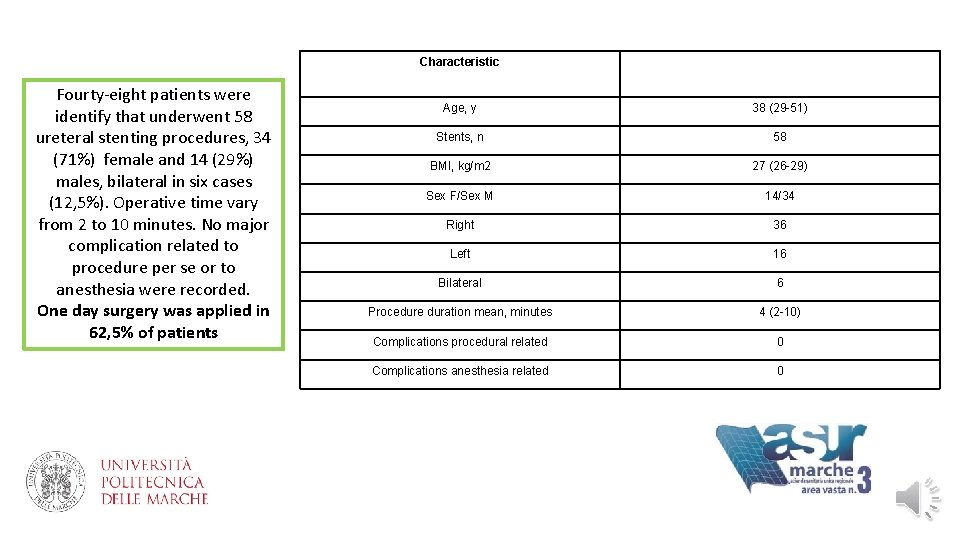
Characteristic Fourty-eight patients were identify that underwent 58 ureteral stenting procedures, 34 (71%) female and 14 (29%) males, bilateral in six cases (12, 5%). Operative time vary from 2 to 10 minutes. No major complication related to procedure per se or to anesthesia were recorded. One day surgery was applied in 62, 5% of patients Age, y 38 (29 -51) Stents, n 58 BMI, kg/m 2 27 (26 -29) Sex F/Sex M 14/34 Right 36 Left 16 Bilateral 6 Procedure duration mean, minutes 4 (2 -10) Complications procedural related 0 Complications anesthesia related 0
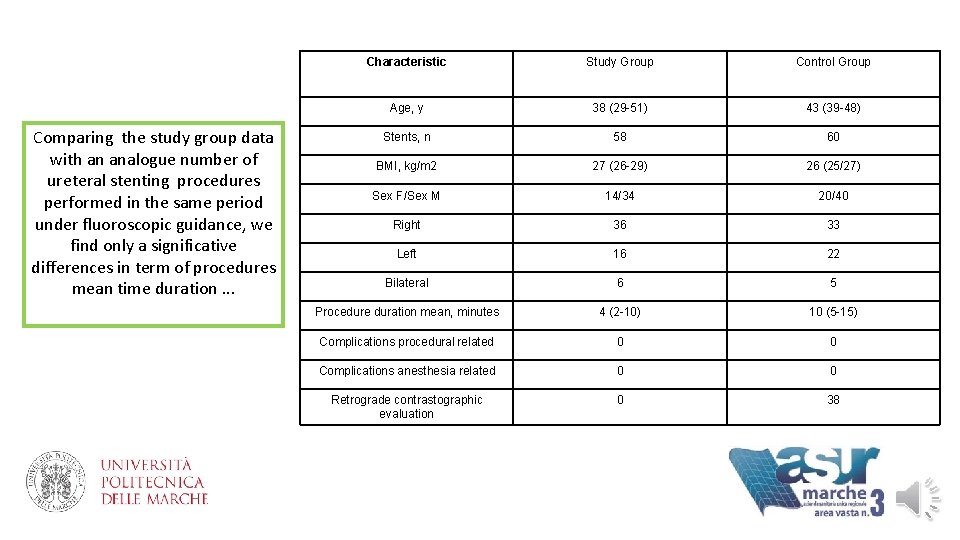
Comparing the study group data with an analogue number of ureteral stenting procedures performed in the same period under fluoroscopic guidance, we find only a significative differences in term of procedures mean time duration. . . Characteristic Study Group Control Group Age, y 38 (29 -51) 43 (39 -48) Stents, n 58 60 BMI, kg/m 2 27 (26 -29) 26 (25/27) Sex F/Sex M 14/34 20/40 Right 36 33 Left 16 22 Bilateral 6 5 Procedure duration mean, minutes 4 (2 -10) 10 (5 -15) Complications procedural related 0 0 Complications anesthesia related 0 0 Retrograde contrastographic evaluation 0 38
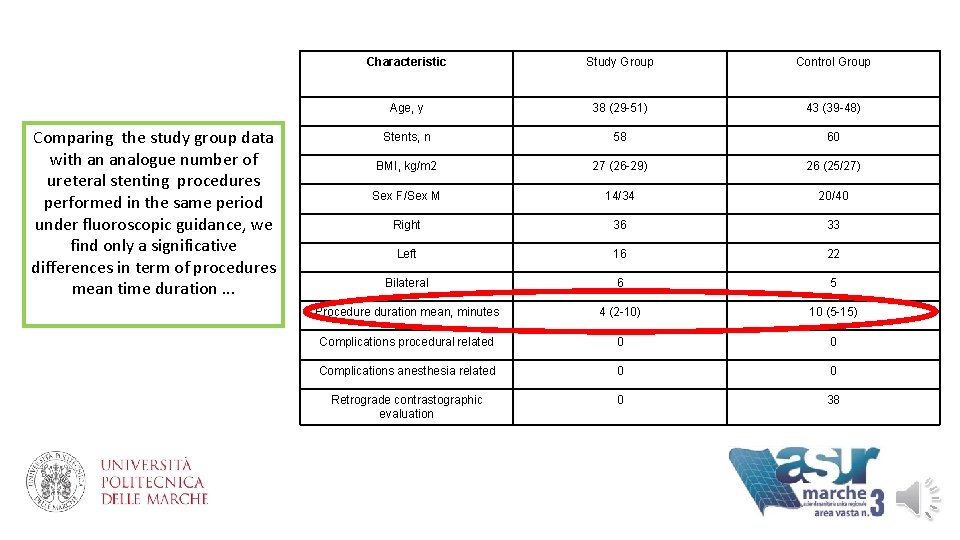
Comparing the study group data with an analogue number of ureteral stenting procedures performed in the same period under fluoroscopic guidance, we find only a significative differences in term of procedures mean time duration. . . Characteristic Study Group Control Group Age, y 38 (29 -51) 43 (39 -48) Stents, n 58 60 BMI, kg/m 2 27 (26 -29) 26 (25/27) Sex F/Sex M 14/34 20/40 Right 36 33 Left 16 22 Bilateral 6 5 Procedure duration mean, minutes 4 (2 -10) 10 (5 -15) Complications procedural related 0 0 Complications anesthesia related 0 0 Retrograde contrastographic evaluation 0 38
Nevertheless a retrograde contrastographic study before inserting the stent is strongly recommended in order to establish the anatomy of the ureter and the collecting system, we thing that this is an optional need, being omitted in case of a patient careful selection. As in our case series, the lack of a retrograde contrastographic of the ureter and collecting system did not lead to any complications in the procedures.
UGREUS is safe and feasible both in the insertion of a guidewire from the ureteric orifice to the kidney and in the monitoring of the final stent correct placement. Ultrasound guide avoid the radiation exposure both for the patient and the operators in operating room.

Thank YOU !
- Slides: 13