
Ultranationalism in Germany News and reminders The term
- Slides: 19
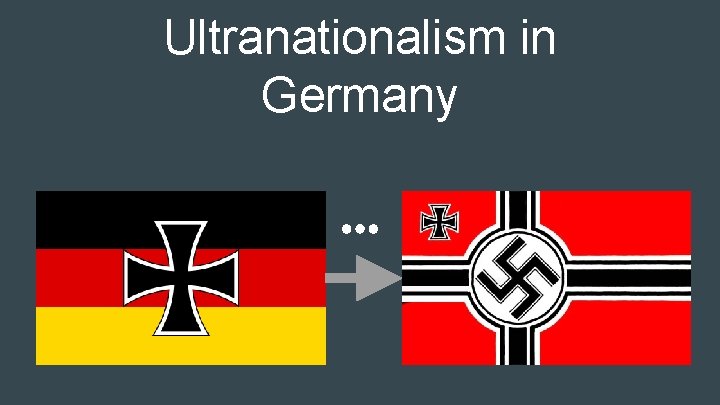
Ultranationalism in Germany
News and reminders - The term is approximately half over. - Not only are notes and slides regularly posted on the website, but also reading suggestions. - The next essay is planned for Monday, April 24 th - all class content is relevant for your preparation. - If you are actually reading this, indicate this by rubbing your forehead. - A quiz on WWI and the Interwar period is being planned for early next week. - The next Unit exam is being planned for very early May.
If you believe Social Studies is: - Not for you - Not easy - A random collection of difficult tests and essays - Meaningless - Boring - Not relevant - Hard to stay awake for Then……. . . you are right. It isn’t difficult to predict what the outcome will likely be.
If you believe Social Studies is: - Flexible - Manageable with effort and open-mindedness - A series of related assignments and assessments - Deeply connected to society and history - Stimulating - Relevant to issues of today - An opportunity to develop thinking, debating & writing skills Then……. . . you are right. It isn’t difficult to predict what the outcome will likely be.
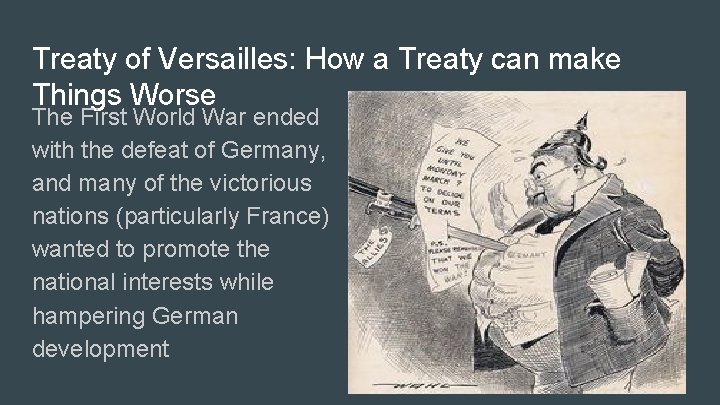
Treaty of Versailles: How a Treaty can make Things Worse The First World War ended with the defeat of Germany, and many of the victorious nations (particularly France) wanted to promote the national interests while hampering German development
How to Guide to Devastate and Demoralize a Nation Terms of the Treaty of Versailles that destroyed the German economy and demoralized the German people: -Surrender of all German colonies -French occupation of the Saar Valley, with France getting all mining rights to the coal mines in the valley -Germany has to pay $33 billion in reparations ($425 billion today!) -Article 231 forced Germany to take sole responsibility for the war
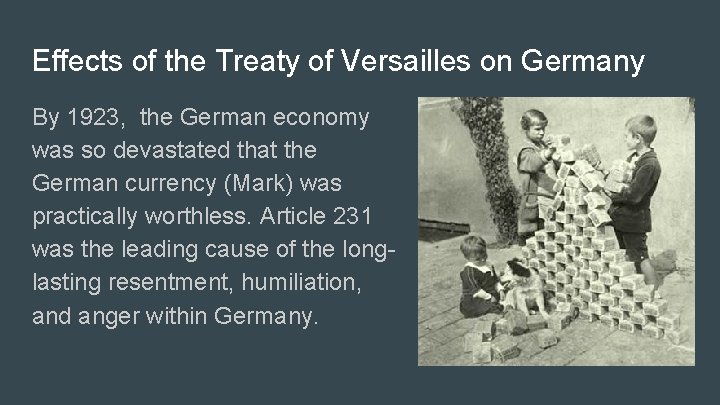
Effects of the Treaty of Versailles on Germany By 1923, the German economy was so devastated that the German currency (Mark) was practically worthless. Article 231 was the leading cause of the longlasting resentment, humiliation, and anger within Germany.
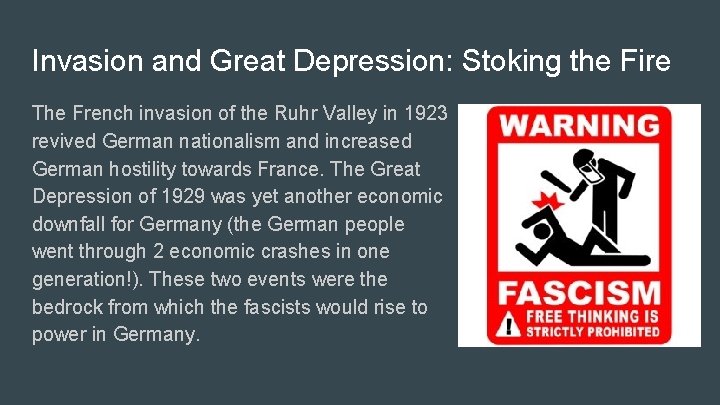
Invasion and Great Depression: Stoking the Fire The French invasion of the Ruhr Valley in 1923 revived German nationalism and increased German hostility towards France. The Great Depression of 1929 was yet another economic downfall for Germany (the German people went through 2 economic crashes in one generation!). These two events were the bedrock from which the fascists would rise to power in Germany.
Adolph Hitler: The Man Who Should have been a Painter Hitler was born in 1889 in the Austro-Hungarian Empire. He tried to enter art school in Vienna but was rejected, and Vienna’s multicultural society shocked Hitler to the point where he became a racial radical. Served in the German Imperial Army during WW 1, performing well as a soldier and earning an Iron Cross. Hitler was not the founder of the Nazi Party, but he led an attempted coup known as the Beer Hall Putsch in 1923, but it failed and Hitler was arrested and jailed. While in prison Hitler dictates to his secretary Rudolf Hess his manifesto “Mein Kampf” (My Struggle). Hitler would be released in 1925, but he and the Nazis would not receive much public support until after the Great Depression begins.
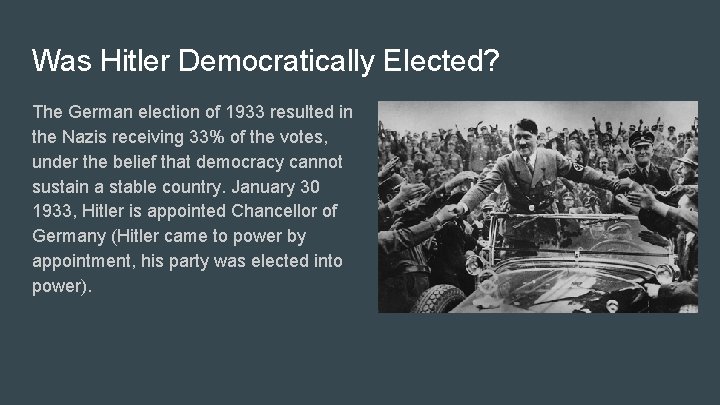
Was Hitler Democratically Elected? The German election of 1933 resulted in the Nazis receiving 33% of the votes, under the belief that democracy cannot sustain a stable country. January 30 1933, Hitler is appointed Chancellor of Germany (Hitler came to power by appointment, his party was elected into power).
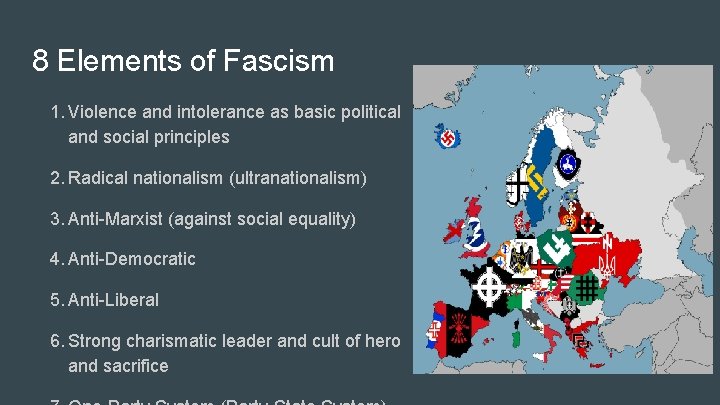
8 Elements of Fascism 1. Violence and intolerance as basic political and social principles 2. Radical nationalism (ultranationalism) 3. Anti-Marxist (against social equality) 4. Anti-Democratic 5. Anti-Liberal 6. Strong charismatic leader and cult of hero and sacrifice
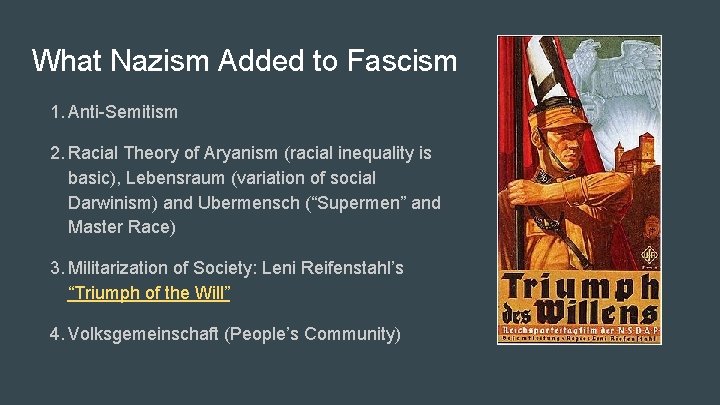
What Nazism Added to Fascism 1. Anti-Semitism 2. Racial Theory of Aryanism (racial inequality is basic), Lebensraum (variation of social Darwinism) and Ubermensch (“Supermen” and Master Race) 3. Militarization of Society: Leni Reifenstahl’s “Triumph of the Will” 4. Volksgemeinschaft (People’s Community)
Germany Expands: Hitler Gets Bold Hitler and the Nazi Party receive wide support for the changes they brought to Germany for the promise to make Germany great again and to liberate it from the Treaty of Versailles. Hitler pulls Germany out of the League of Nations, and his expansionist policies are emboldened by the Lo. N’s inability to stop aggressive actions taken by Japan and Italy. Hitler begins by annexing Austria (Anschluss), next the Sudetenland, and then later the rest of Czechoslovakia. His decision to invade Poland September 1 1939 was the last straw that launched Europe into conflict. Robot Chicken “Little Hitler”
Reflections Questions 1. How did the Treaty of Versailles contribute to the rise of the Nazi Party and Hitler? 2. How did the two economic depressions (Post-War Depression and the Great Depression) contribute to the rise of the Nazis and Hitler? 3. What could have been done to prevent the German people from turning to radicals like the Nazis?
Quick Review of How Germany Became so Radicalized -Treaty of Versailles leaves Germany economically devastated and completely demoralized -Additional offences by nations like France and the Great Depression push Germans to empower the Nazis and Hitler -Hitler and the Nazis promise a return to a strong Germany and begin applying expansionist, nationalist, and racist policies
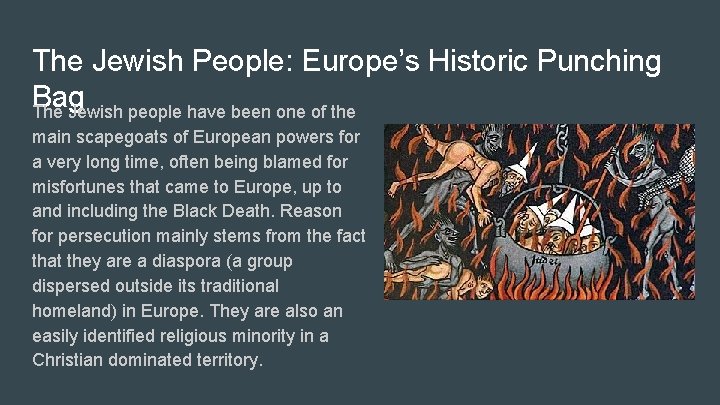
The Jewish People: Europe’s Historic Punching Bag The Jewish people have been one of the main scapegoats of European powers for a very long time, often being blamed for misfortunes that came to Europe, up to and including the Black Death. Reason for persecution mainly stems from the fact that they are a diaspora (a group dispersed outside its traditional homeland) in Europe. They are also an easily identified religious minority in a Christian dominated territory.
The Nazi Ideology of Purity The Nazis wanted to purify Germany, and later the rest of Europe, of all those peoples whom they deemed to be inferior. Peoples considered inferior by the Nazis includes Jews, Slavic peoples, Gypsies, homosexuals, people with mental and/or physical disabilities, and Communists. Nazi Eugenics - Life Unworthy of Life (00: 00 -06: 22) from the documentary “Architecture of Doom”
How Bigotry Becomes Law With anti-semitism already a major part of German society and the rumors spread by the Nazis that the Jews were to blame for many of Germany’s ills, the Nazis codified ethnic/racial persecution through the Nuremberg Laws of 1935 (racial policy of Germany, defining the Jews and others as racially inferior). Kristallnacht (Night of Broken Glass) 1938 Ghettoization of the Jews begins in 1939 and is considered the first solution to the “Jewish Problem”