
Ultraluminous Xray Sources Andrew King University of Leicester
- Slides: 26
Ultraluminous X-ray Sources Andrew King, University of Leicester Penn State 22. 5. 04 ² Lx(apparent) > 1039 erg s-1 = LEdd(10 M¯) ² do ULXs contain intermediate—mass black holes, M » 102 – 104 M¯ (IMBH) ?
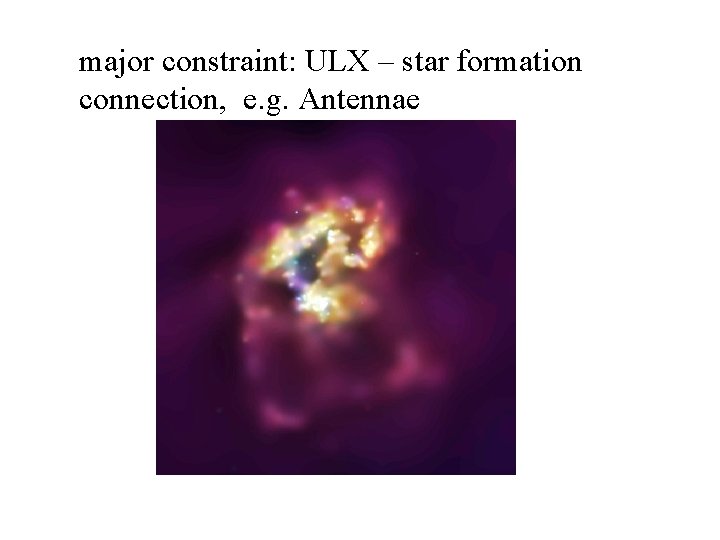
major constraint: ULX – star formation connection, e. g. Antennae
Using IMBH to make ULXs in star-forming galaxies 1. If IMBH are primordial (Pop III), new star clusters must `light up’ accretion: -- unclear how a primordial IMBH acquires a companion star
IMBH formation in dense star clusters? either 2. merge stars, tmerge << t. MS and build up large M (Gurkan et al. 2003; Portegies Zwart et al. , 2004) problem: mass loss in merger? or 3. merge black holes IMBH (Miller & Hamilton, 2002) problem: GR reaction: merged BH lost from cluster with low M
in all 3 cases, any ULX is formed in a cluster ² most ULXs are observed near but outside clusters -- must eject (with companion star? ) ² make at most 1 ULX per cluster, i. e. > 105 M¯ needed to make each ULX
could ULXs instead be an unusual phase of X-ray binary evolution? (King et al. , 2001)
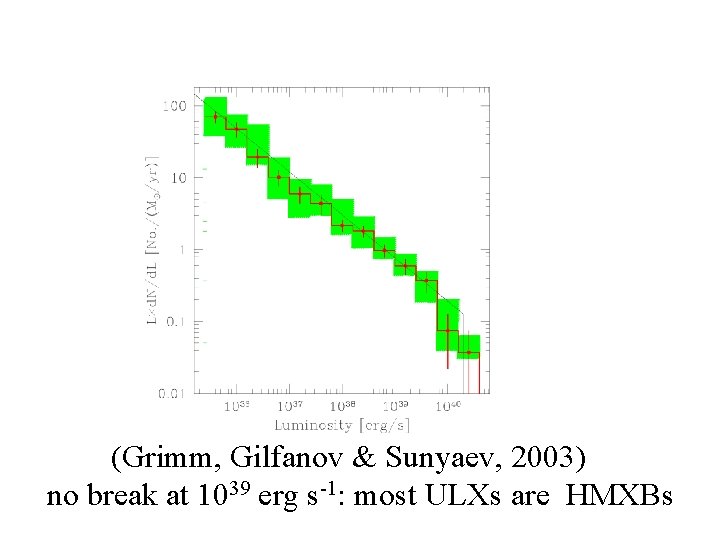
(Grimm, Gilfanov & Sunyaev, 2003) no break at 1039 erg s-1: most ULXs are HMXBs
likely candidates: 2 types (1) high—mass X—ray binaries thermal—timescale mass transfer rate Mdot(tr) » Mdonor/t. KH » 10 -4 - 10 -3 M¯ yr-1 nuclear-timescale mass transfer rates comparable: black hole mass can grow significantly
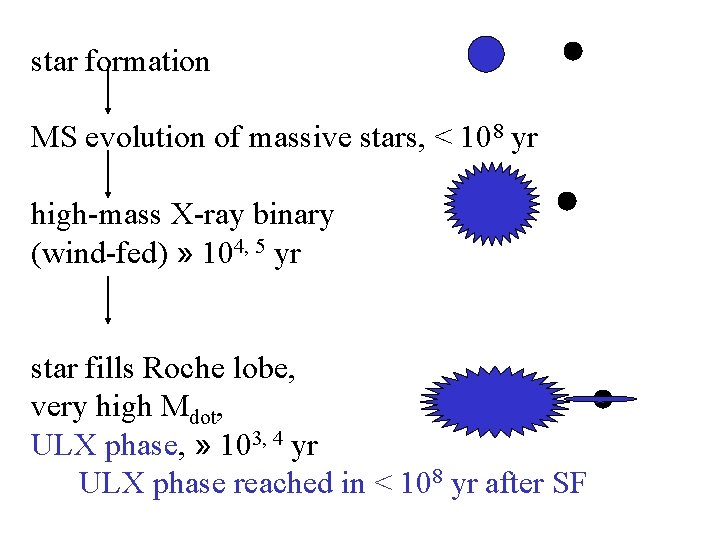
star formation MS evolution of massive stars, < 108 yr high-mass X-ray binary (wind-fed) » 104, 5 yr star fills Roche lobe, very high Mdot, ULX phase, » 103, 4 yr ULX phase reached in < 108 yr after SF
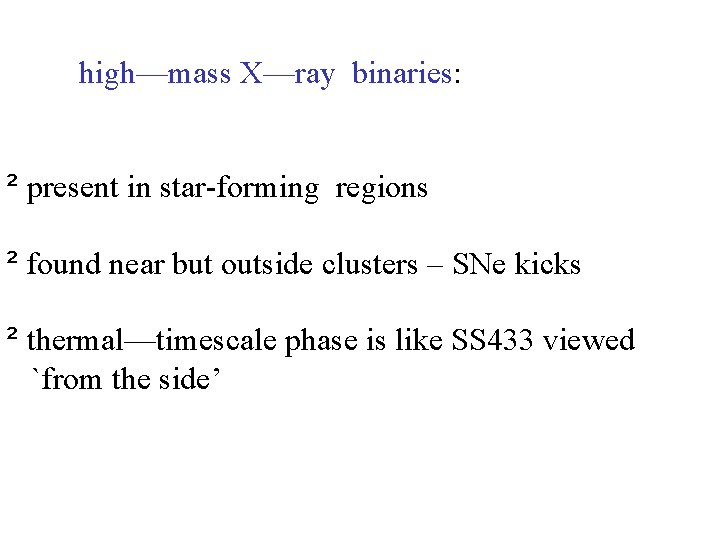
high—mass X—ray binaries: ² present in star-forming regions ² found near but outside clusters – SNe kicks ² thermal—timescale phase is like SS 433 viewed `from the side’
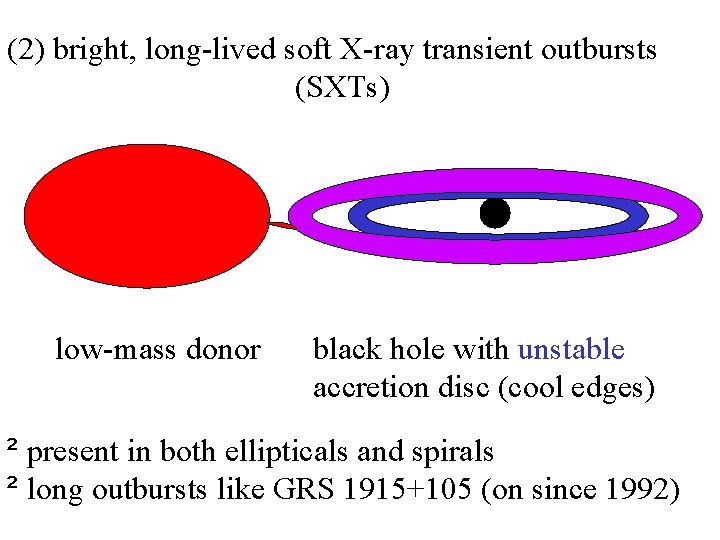
(2) bright, long-lived soft X-ray transient outbursts (SXTs) low-mass donor black hole with unstable accretion disc (cool edges) ² present in both ellipticals and spirals ² long outbursts like GRS 1915+105 (on since 1992)
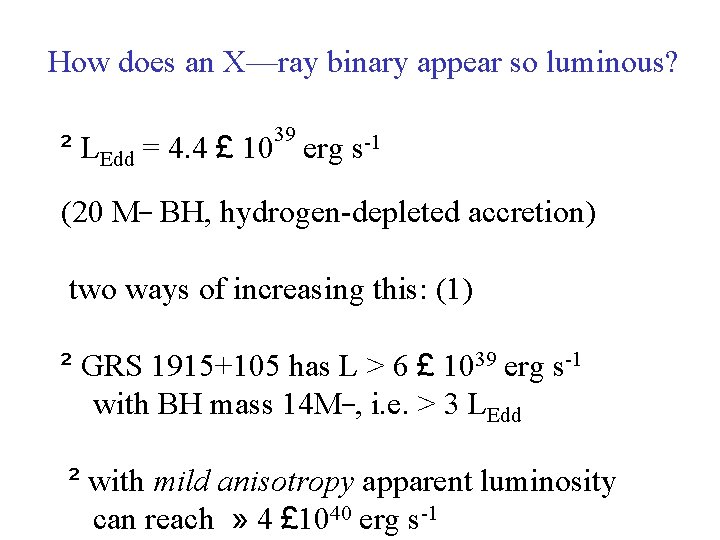
How does an X—ray binary appear so luminous? 39 ² LEdd = 4. 4 £ 10 erg s-1 (20 M¯ BH, hydrogen-depleted accretion) two ways of increasing this: (1) ² GRS 1915+105 has L > 6 £ 1039 erg s-1 with BH mass 14 M¯, i. e. > 3 LEdd ² with mild anisotropy apparent luminosity can reach » 4 £ 1040 erg s-1
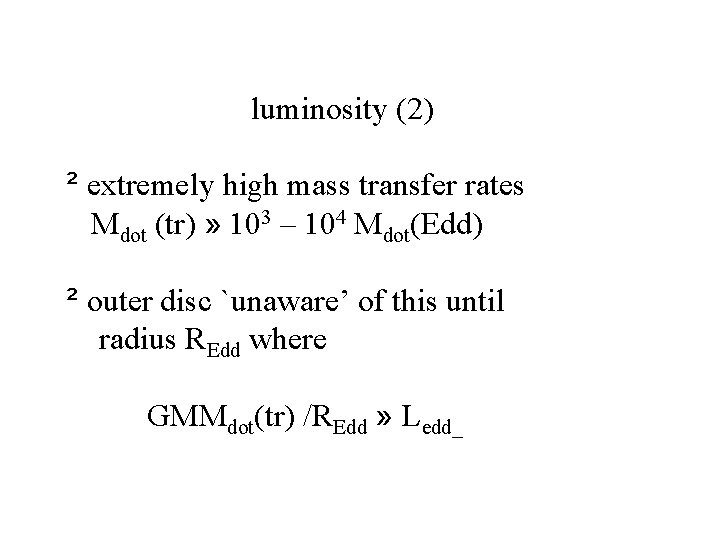
luminosity (2) ² extremely high mass transfer rates Mdot (tr) » 103 – 104 Mdot(Edd) ² outer disc `unaware’ of this until radius REdd where GMMdot(tr) /REdd » Ledd_
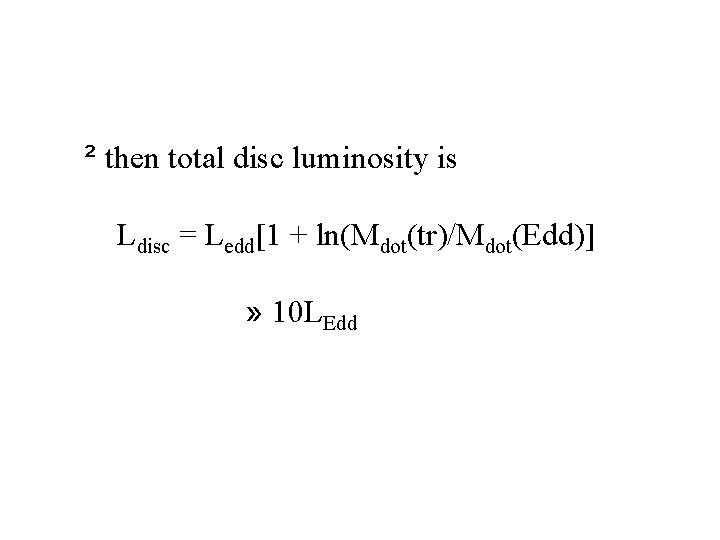
² then total disc luminosity is Ldisc = Ledd[1 + ln(Mdot(tr)/Mdot(Edd)] » 10 LEdd
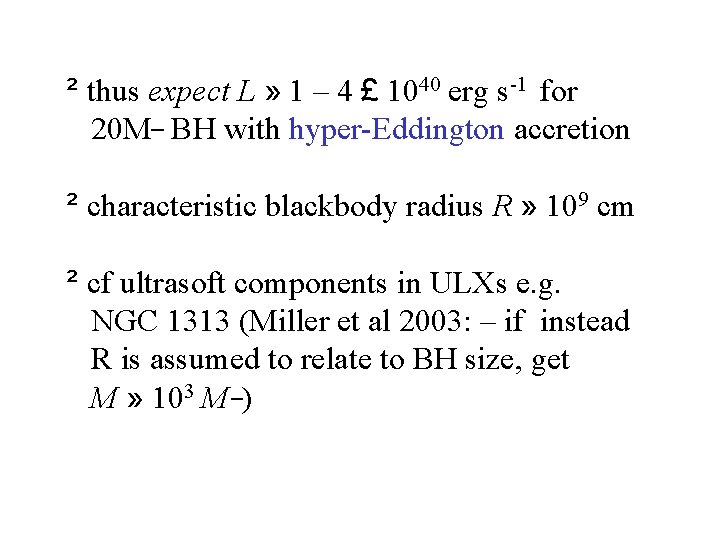
² thus expect L » 1 – 4 £ 1040 erg s-1 for 20 M¯ BH with hyper-Eddington accretion ² characteristic blackbody radius R » 109 cm ² cf ultrasoft components in ULXs e. g. NGC 1313 (Miller et al 2003: – if instead R is assumed to relate to BH size, get M » 103 M¯)
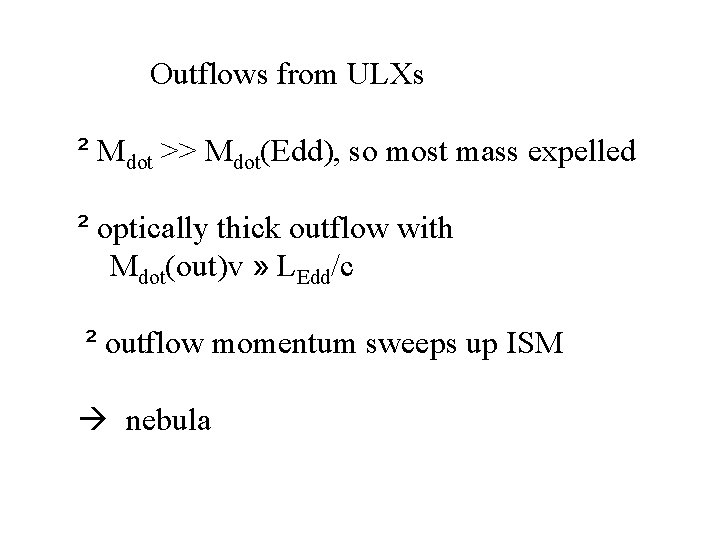
Outflows from ULXs ² Mdot >> Mdot(Edd), so most mass expelled ² optically thick outflow with Mdot(out)v » LEdd/c ² outflow momentum sweeps up ISM nebula
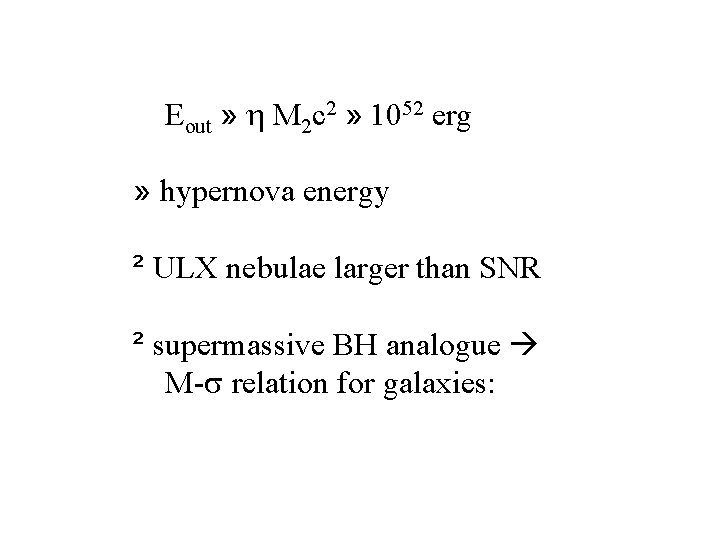
Eout » h M 2 c 2 » 1052 erg » hypernova energy ² ULX nebulae larger than SNR ² supermassive BH analogue M-s relation for galaxies:
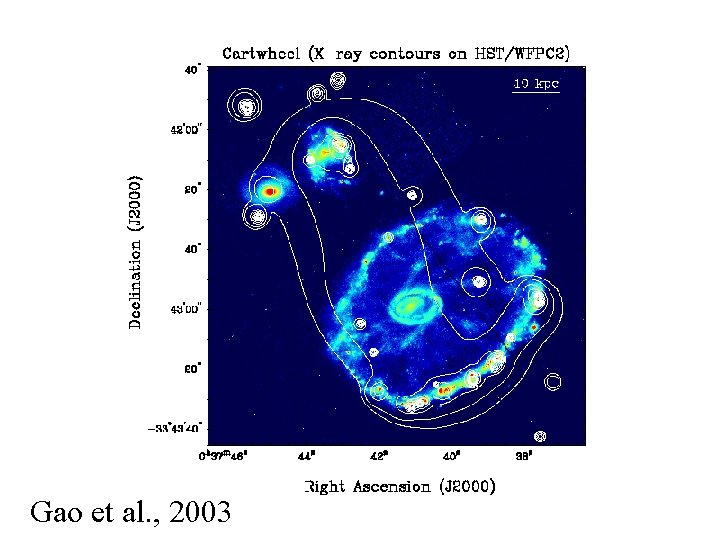
Gao et al. , 2003
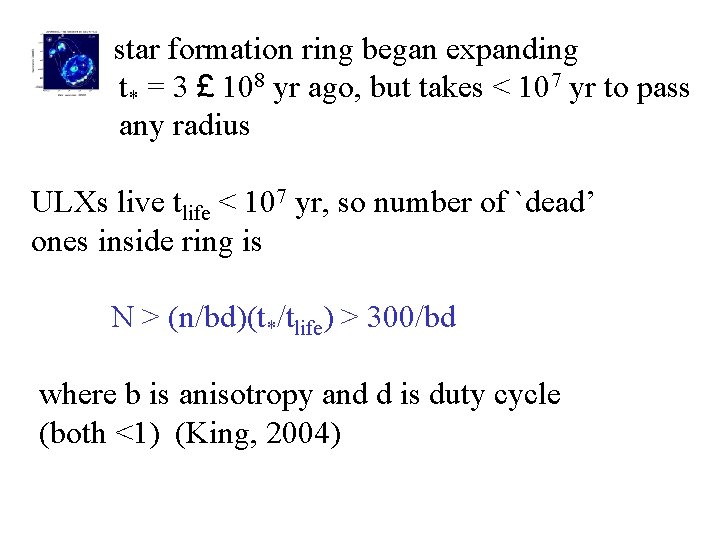
star formation ring began expanding t* = 3 £ 108 yr ago, but takes < 107 yr to pass any radius ULXs live tlife < 107 yr, so number of `dead’ ones inside ring is N > (n/bd)(t*/tlife) > 300/bd where b is anisotropy and d is duty cycle (both <1) (King, 2004)
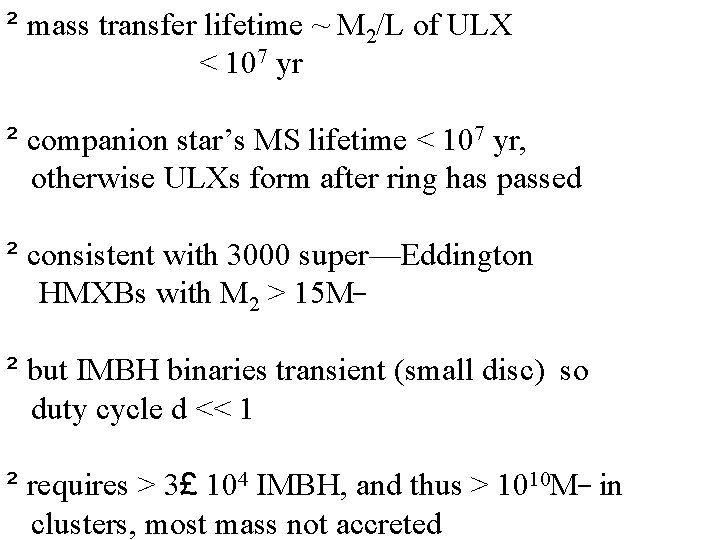
² mass transfer lifetime ~ M 2/L of ULX < 107 yr ² companion star’s MS lifetime < 107 yr, otherwise ULXs form after ring has passed ² consistent with 3000 super—Eddington HMXBs with M 2 > 15 M¯ ² but IMBH binaries transient (small disc) so duty cycle d << 1 ² requires > 3£ 104 IMBH, and thus > 1010 M¯ in clusters, most mass not accreted
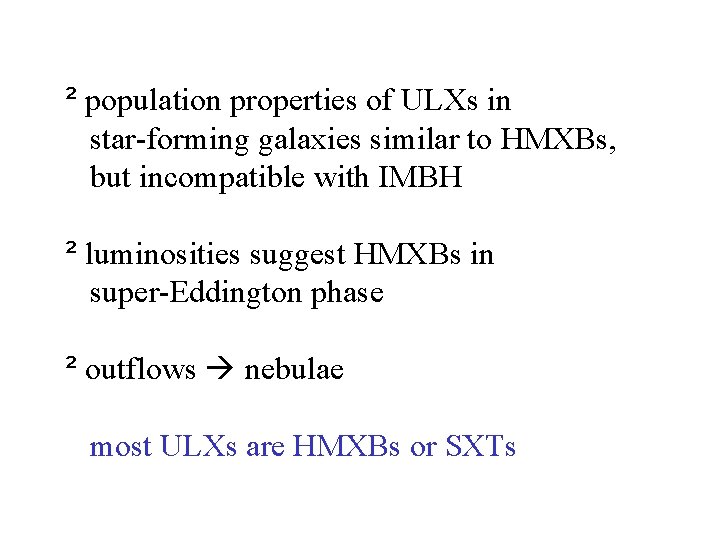
² population properties of ULXs in star-forming galaxies similar to HMXBs, but incompatible with IMBH ² luminosities suggest HMXBs in super-Eddington phase ² outflows nebulae most ULXs are HMXBs or SXTs
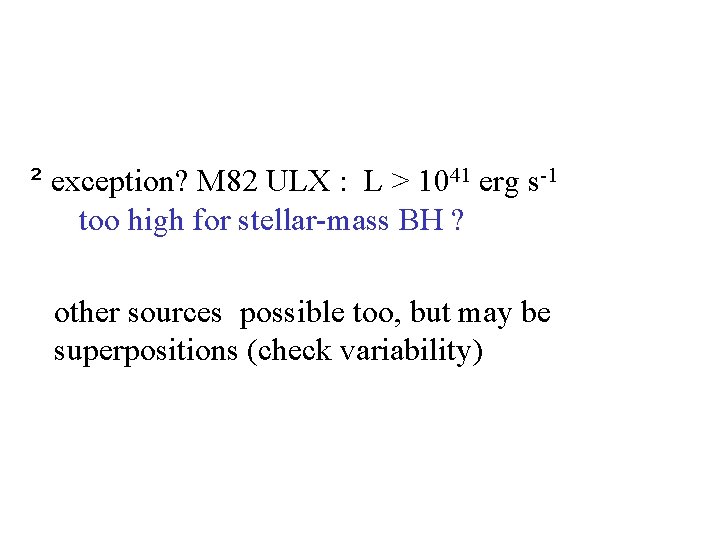
² exception? M 82 ULX : L > 1041 erg s-1 too high for stellar-mass BH ? other sources possible too, but may be superpositions (check variability)
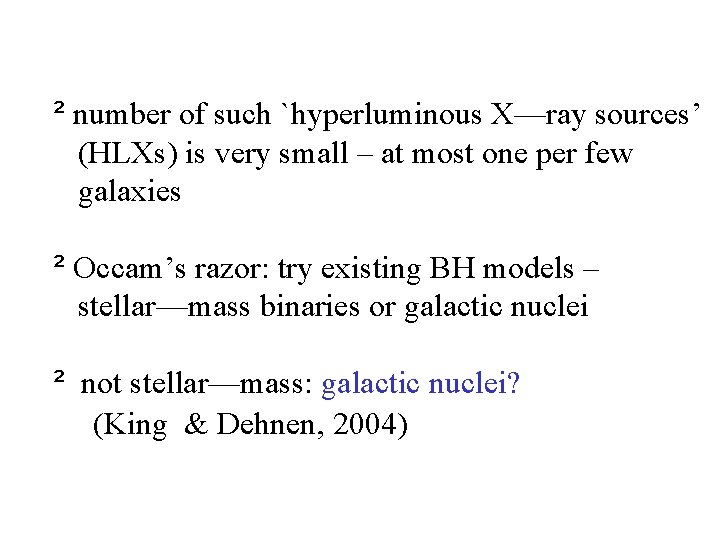
² number of such `hyperluminous X—ray sources’ (HLXs) is very small – at most one per few galaxies ² Occam’s razor: try existing BH models – stellar—mass binaries or galactic nuclei ² not stellar—mass: galactic nuclei? (King & Dehnen, 2004)
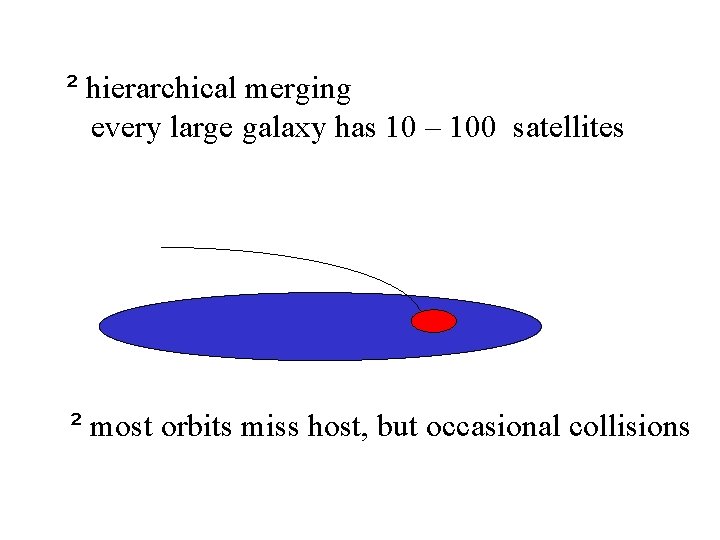
² hierarchical merging every large galaxy has 10 – 100 satellites ² most orbits miss host, but occasional collisions
² if colliding satellite retains central BH and star cluster, tides trigger accretion, just like AGN ² satellite can have BH mass > 104 M¯ ² accretion time << orbital timescale: HLX activity only close to galaxy plane ² passage of satellite stimulates star formation: HLX accompanied by stellar—mass ULXs
Summary ² most ULXs are stellar—mass XRBs rather than IMBHs (L < 1041 erg s-1 ) ² high L from large accretion rate, super—Eddington accretion or anisotropic emission ² HLXs (L > 1041 erg s-1 ) may be captured satellite galaxy nuclei ² ULX – star formation and HLX – galaxy formation links