
Ultralight Particles beyond the Standard Model Laboratory Experiments
Ultra-light Particles beyond the Standard Model: Laboratory Experiments CERN, 27 January 2009 A. Lindner 1
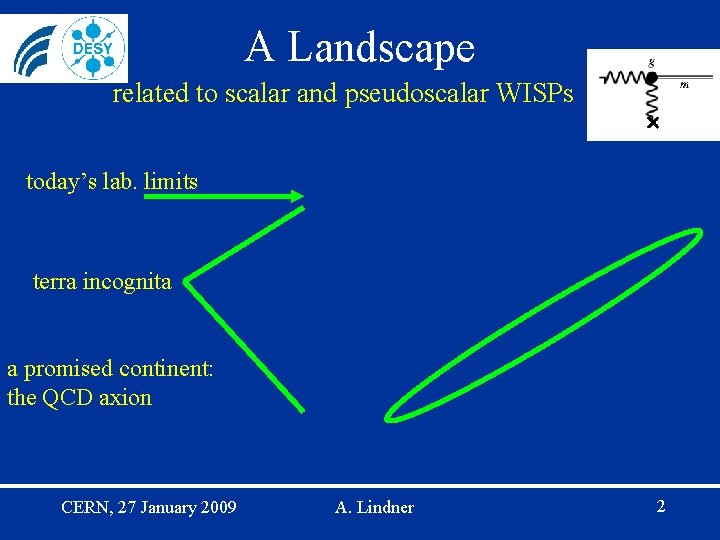
A Landscape related to scalar and pseudoscalar WISPs today’s lab. limits terra incognita a promised continent: the QCD axion CERN, 27 January 2009 A. Lindner 2
A Landscape related to scalar and pseudoscalar WISPs Scales of new physics Te. V Pe. V How to explore this landscape? CERN, 27 January 2009 A. Lindner 3
Low Energy Photon Colliders Interactions involving multiple photons: • Interaction of intense laser light with strong electromagnetic fields. • Schwinger pair production. • Oscillation effects. CERN, 27 January 2009 A. Lindner 4
Low Energy Photon Colliders Interactions involving multiple photons: • Interaction of intense laser light with strong electromagnetic fields. • Schwinger pair production. • Oscillation effects. CERN, 27 January 2009 A. Lindner 5
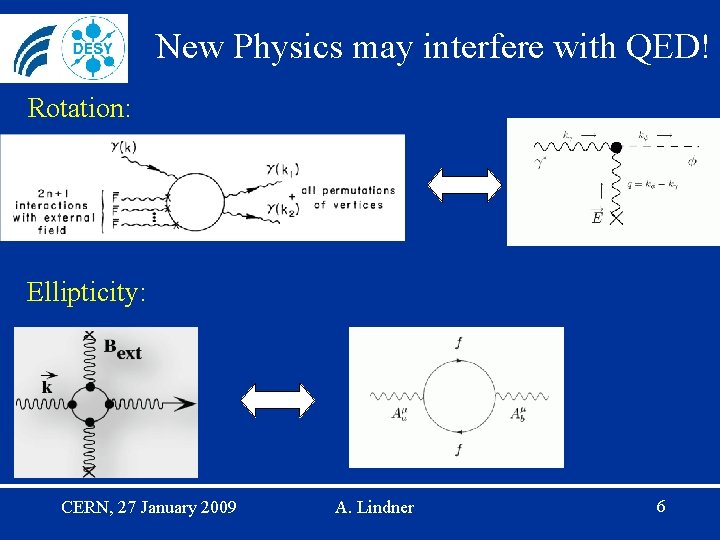
New Physics may interfere with QED! Rotation: Ellipticity: CERN, 27 January 2009 A. Lindner 6
Indirect WISP Search Change of laser light polarization passing a magnetic field rotation: dichroism due to real WISP production ellipticity: birefringence due to virtual WISP production (by M. Ahlers) CERN, 27 January 2009 A. Lindner 7
Indirect WISP Search Experiments • Q&A in Taiwan – ongoing, sensitivity comparable to PVLAS • BMV at Toulouse (France) – starting, aiming for QED prediction of ellipticity due to e+e- loop – also direct search experiments • OSQAR at CERN (using two LHC dipoles) – starting, aiming also for QED-ellipticity – also direct search experiments CERN, 27 January 2009 A. Lindner 8
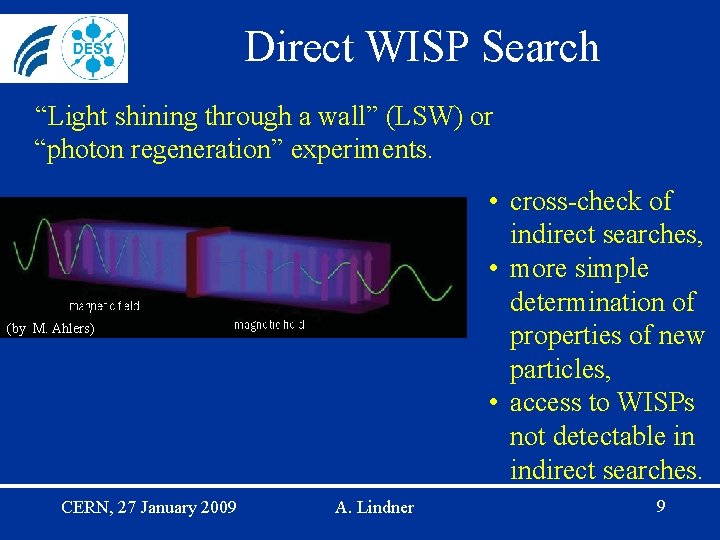
Direct WISP Search “Light shining through a wall” (LSW) or “photon regeneration” experiments. • cross-check of indirect searches, • more simple determination of properties of new particles, • access to WISPs not detectable in indirect searches. (by M. Ahlers) CERN, 27 January 2009 A. Lindner 9
LSW Experiments • BFRT at Brookhaven National Laboratory, finished in 1993 – limits on existence of WISPs • BMV at Toulouse (France) – ongoing, limits published • Gamme. V at Fermilab – ongoing, limits published – most sensitive limits on WISPs • LIPSS at Jefferson Lab. (USA) – ongoing, preliminary results CERN, 27 January 2009 A. Lindner 10
LSW Experiments • PVLAS at INFN Legnaro (Italy) ? • OSQAR at CERN (using two LHC dipoles) – ongoing, preliminary results • ALPS at DESY CERN, 27 January 2009 A. Lindner 11
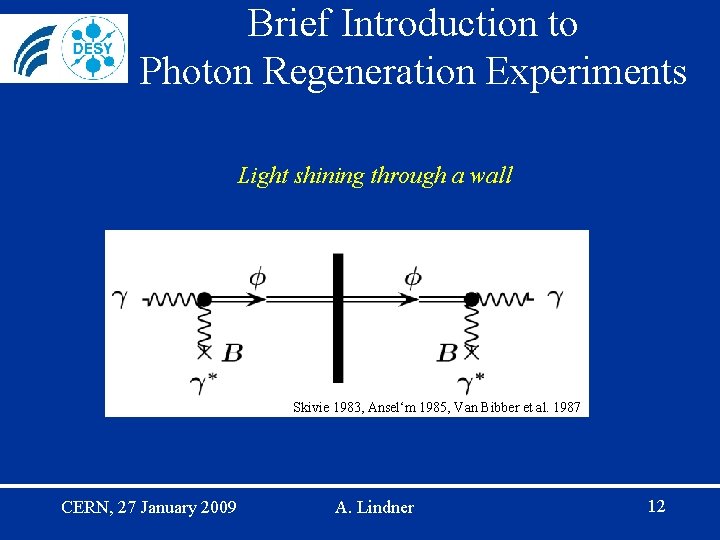
Brief Introduction to Photon Regeneration Experiments Light shining through a wall Skivie 1983, Ansel‘m 1985, Van Bibber et al. 1987 CERN, 27 January 2009 A. Lindner 12
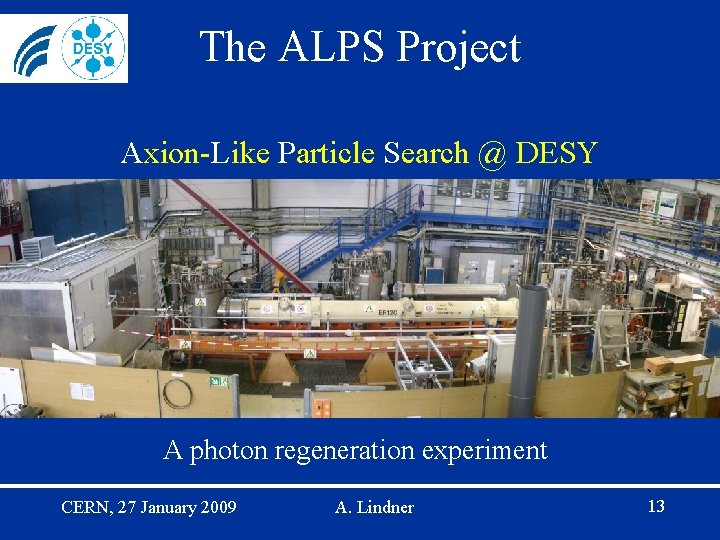
The ALPS Project Axion-Like Particle Search @ DESY A photon regeneration experiment CERN, 27 January 2009 A. Lindner 13
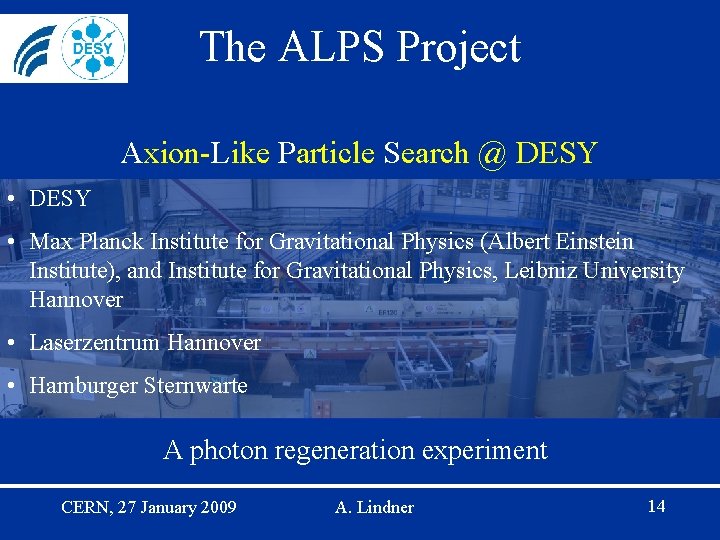
The ALPS Project Axion-Like Particle Search @ DESY • Max Planck Institute for Gravitational Physics (Albert Einstein Institute), and Institute for Gravitational Physics, Leibniz University Hannover • Laserzentrum Hannover • Hamburger Sternwarte A photon regeneration experiment CERN, 27 January 2009 A. Lindner 14
ALPS Sensitivity ALPS prospects Successful and stable operation of a cavity in the generation part! CERN, 27 January 2009 A. Lindner 15
Future Prospects of direct WISP Searches • Increase sensitivity for lower couplings • Extend mass range to higher values. CERN, 27 January 2009 A. Lindner 16
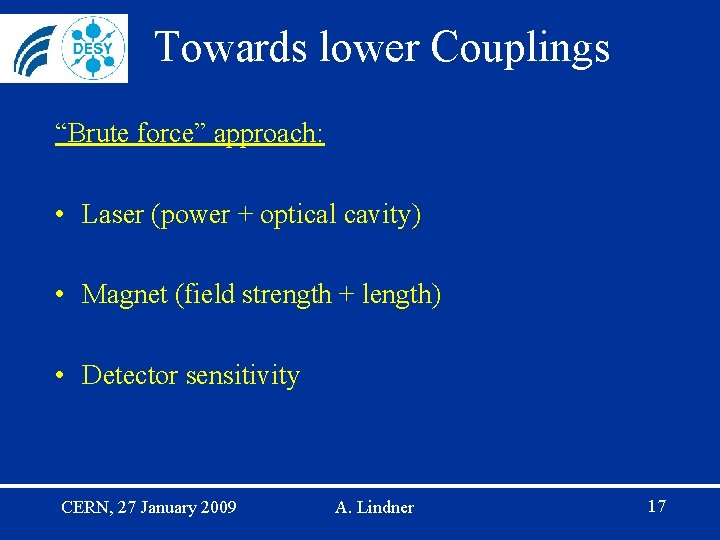
Towards lower Couplings “Brute force” approach: • Laser (power + optical cavity) • Magnet (field strength + length) • Detector sensitivity CERN, 27 January 2009 A. Lindner 17
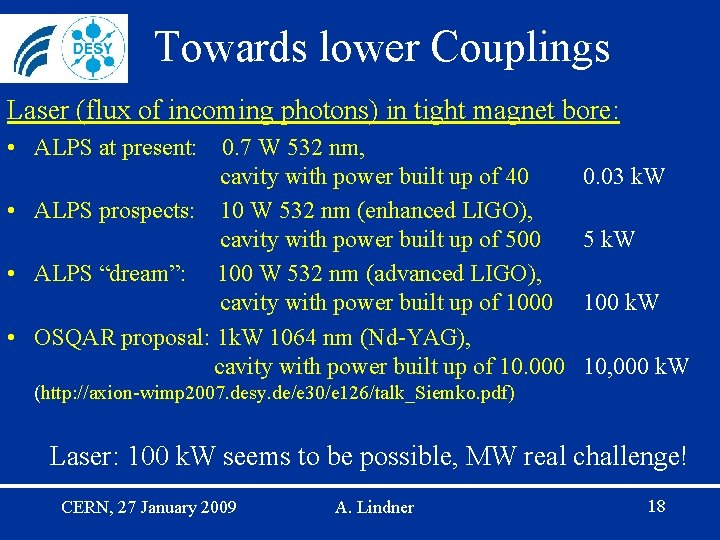
Towards lower Couplings Laser (flux of incoming photons) in tight magnet bore: • ALPS at present: 0. 7 W 532 nm, cavity with power built up of 40 • ALPS prospects: 10 W 532 nm (enhanced LIGO), cavity with power built up of 500 • ALPS “dream”: 100 W 532 nm (advanced LIGO), cavity with power built up of 1000 • OSQAR proposal: 1 k. W 1064 nm (Nd-YAG), cavity with power built up of 10. 000 0. 03 k. W 5 k. W 100 k. W 10, 000 k. W (http: //axion-wimp 2007. desy. de/e 30/e 126/talk_Siemko. pdf) Laser: 100 k. W seems to be possible, MW real challenge! CERN, 27 January 2009 A. Lindner 18
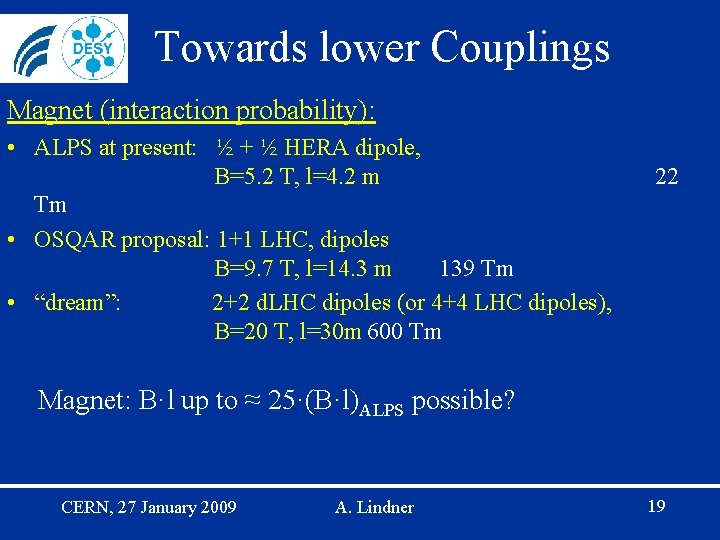
Towards lower Couplings Magnet (interaction probability): • ALPS at present: ½ + ½ HERA dipole, B=5. 2 T, l=4. 2 m Tm • OSQAR proposal: 1+1 LHC, dipoles B=9. 7 T, l=14. 3 m 139 Tm • “dream”: 2+2 d. LHC dipoles (or 4+4 LHC dipoles), B=20 T, l=30 m 600 Tm 22 Magnet: B·l up to ≈ 25·(B·l)ALPS possible? CERN, 27 January 2009 A. Lindner 19
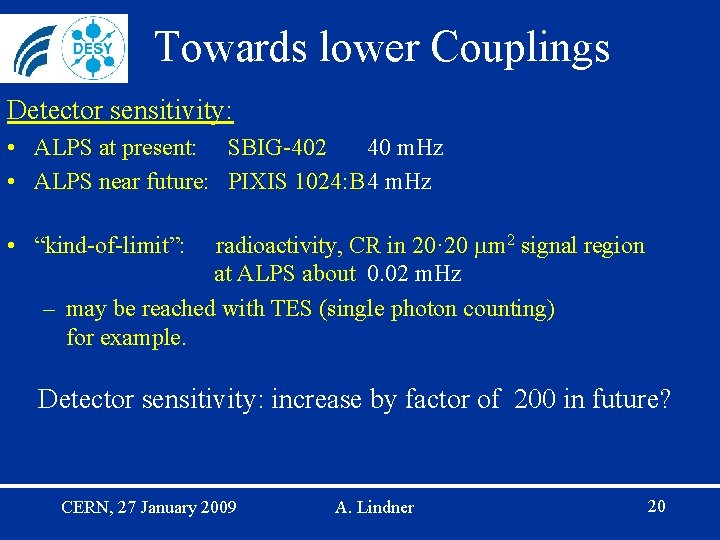
Towards lower Couplings Detector sensitivity: • ALPS at present: SBIG-402 40 m. Hz • ALPS near future: PIXIS 1024: B 4 m. Hz radioactivity, CR in 20· 20 m 2 signal region at ALPS about 0. 02 m. Hz – may be reached with TES (single photon counting) for example. • “kind-of-limit”: Detector sensitivity: increase by factor of 200 in future? CERN, 27 January 2009 A. Lindner 20
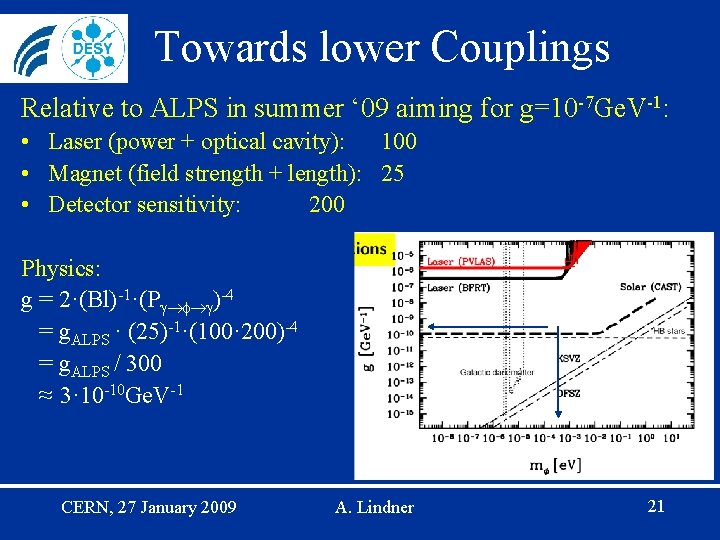
Towards lower Couplings Relative to ALPS in summer ‘ 09 aiming for g=10 -7 Ge. V-1: • Laser (power + optical cavity): 100 • Magnet (field strength + length): 25 • Detector sensitivity: 200 Physics: g = 2·(Bl)-1·(P )-4 = g. ALPS · (25)-1·(100· 200)-4 = g. ALPS / 300 ≈ 3· 10 -10 Ge. V-1 CERN, 27 January 2009 A. Lindner 21
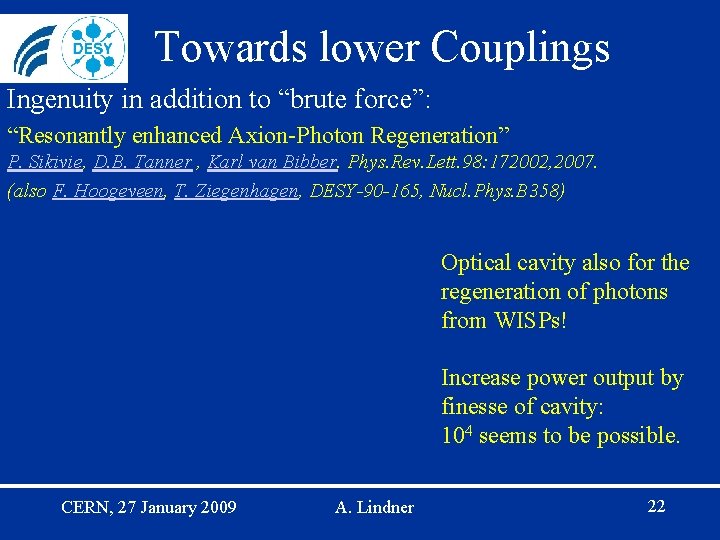
Towards lower Couplings Ingenuity in addition to “brute force”: “Resonantly enhanced Axion-Photon Regeneration” P. Sikivie, D. B. Tanner , Karl van Bibber. Phys. Rev. Lett. 98: 172002, 2007. (also F. Hoogeveen, T. Ziegenhagen, DESY-90 -165, Nucl. Phys. B 358) Optical cavity also for the regeneration of photons from WISPs! Increase power output by finesse of cavity: 104 seems to be possible. CERN, 27 January 2009 A. Lindner 22
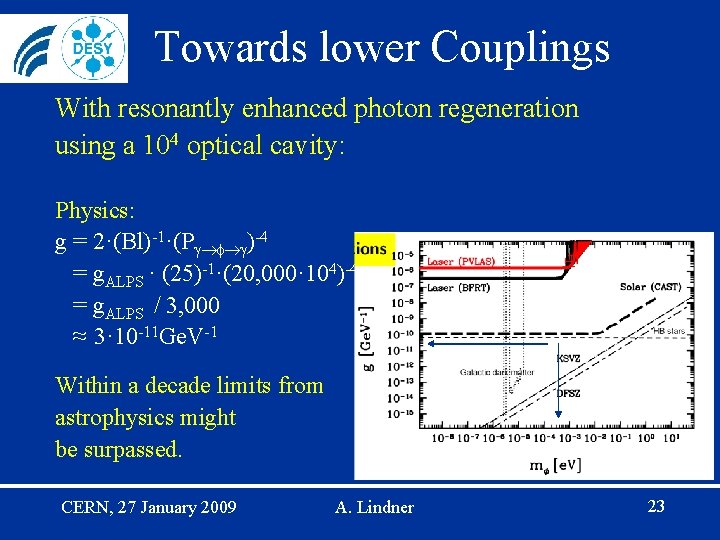
Towards lower Couplings With resonantly enhanced photon regeneration using a 104 optical cavity: Physics: g = 2·(Bl)-1·(P )-4 = g. ALPS · (25)-1·(20, 000· 104)-4 = g. ALPS / 3, 000 ≈ 3· 10 -11 Ge. V-1 Within a decade limits from astrophysics might be surpassed. CERN, 27 January 2009 A. Lindner 23
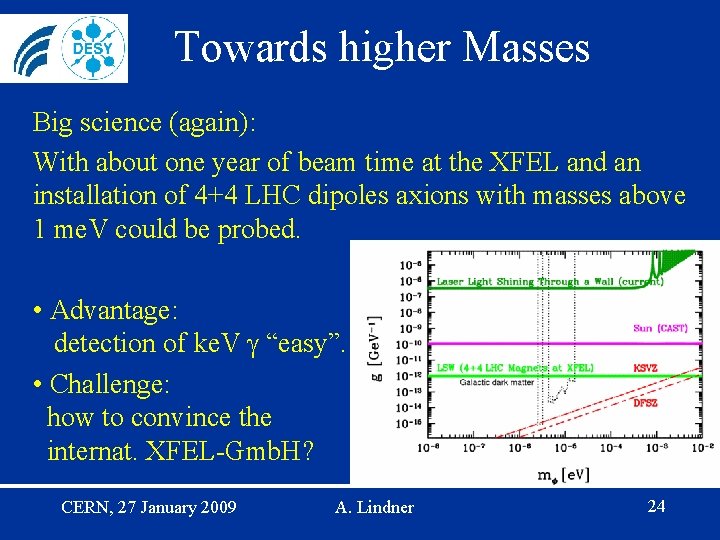
Towards higher Masses Big science (again): With about one year of beam time at the XFEL and an installation of 4+4 LHC dipoles axions with masses above 1 me. V could be probed. • Advantage: detection of ke. V “easy”. • Challenge: how to convince the internat. XFEL-Gmb. H? CERN, 27 January 2009 A. Lindner 24
Low Energy Photon Colliders Interactions involving multiple photons: • Interaction of intense laser light with strong electromagnetic fields. • Schwinger pair production. • Oscillation effects. CERN, 27 January 2009 A. Lindner 25
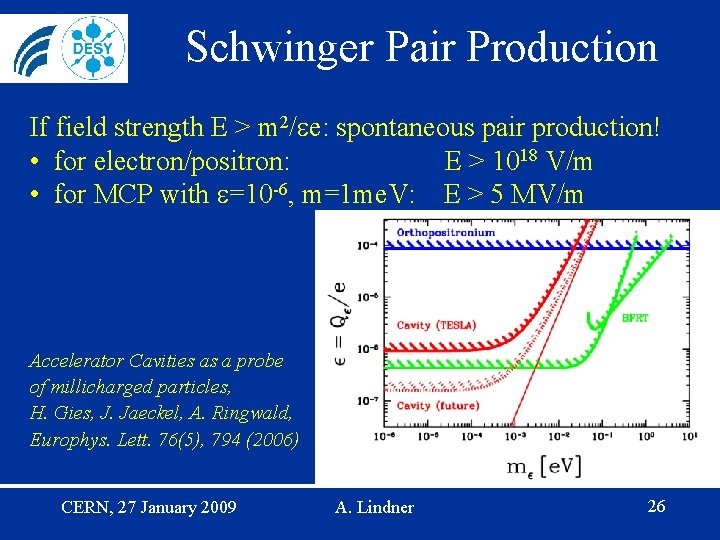
Schwinger Pair Production If field strength E > m 2/ e: spontaneous pair production! • for electron/positron: E > 1018 V/m • for MCP with =10 -6, m=1 me. V: E > 5 MV/m Accelerator Cavities as a probe of millicharged particles, H. Gies, J. Jaeckel, A. Ringwald, Europhys. Lett. 76(5), 794 (2006) CERN, 27 January 2009 A. Lindner 26
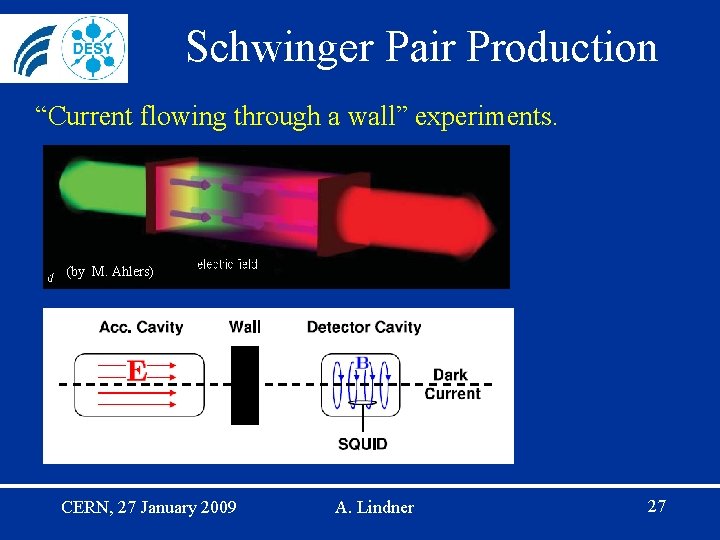
Schwinger Pair Production “Current flowing through a wall” experiments. (by M. Ahlers) CERN, 27 January 2009 A. Lindner 27
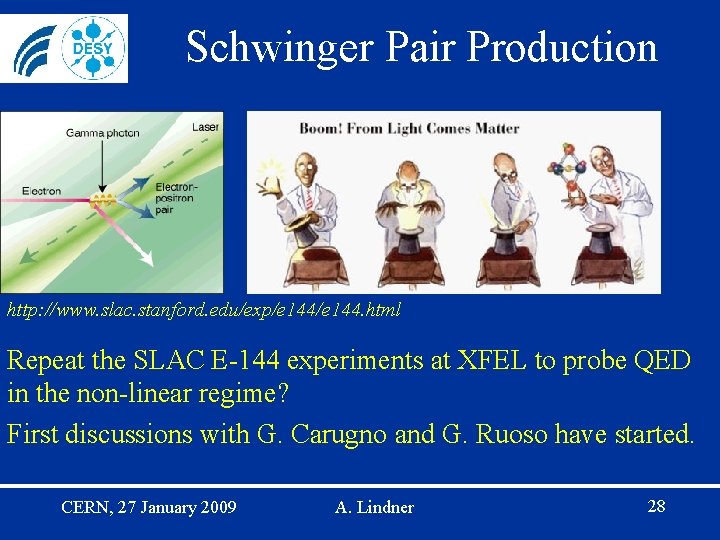
Schwinger Pair Production http: //www. slac. stanford. edu/exp/e 144. html Repeat the SLAC E-144 experiments at XFEL to probe QED in the non-linear regime? First discussions with G. Carugno and G. Ruoso have started. CERN, 27 January 2009 A. Lindner 28
Low Energy Photon Colliders Interactions involving multiple photons: • Interaction of intense laser light with strong electromagnetic fields. • Schwinger pair production. • Oscillation effects. CERN, 27 January 2009 A. Lindner 29
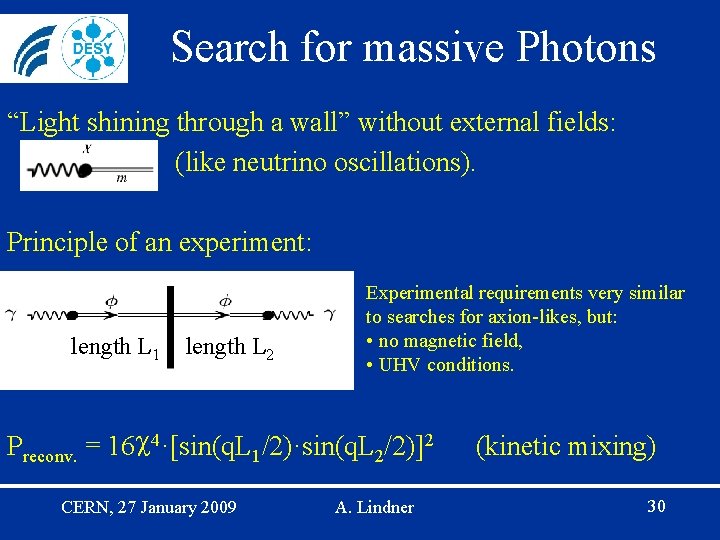
Search for massive Photons “Light shining through a wall” without external fields: (like neutrino oscillations). Principle of an experiment: length L 1 length L 2 Experimental requirements very similar to searches for axion-likes, but: • no magnetic field, • UHV conditions. Preconv. = 16 4·[sin(q. L 1/2)·sin(q. L 2/2)]2 CERN, 27 January 2009 A. Lindner (kinetic mixing) 30
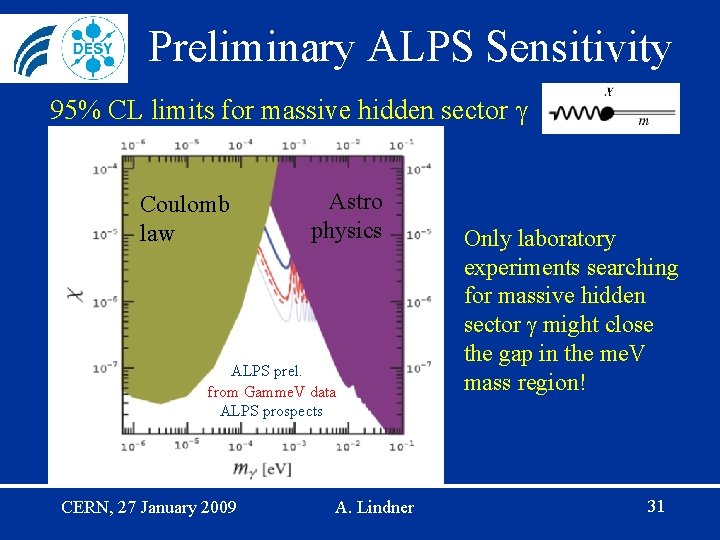
Preliminary ALPS Sensitivity 95% CL limits for massive hidden sector Coulomb law Astro physics ALPS prel. from Gamme. V data ALPS prospects CERN, 27 January 2009 A. Lindner Only laboratory experiments searching for massive hidden sector might close the gap in the me. V mass region! 31
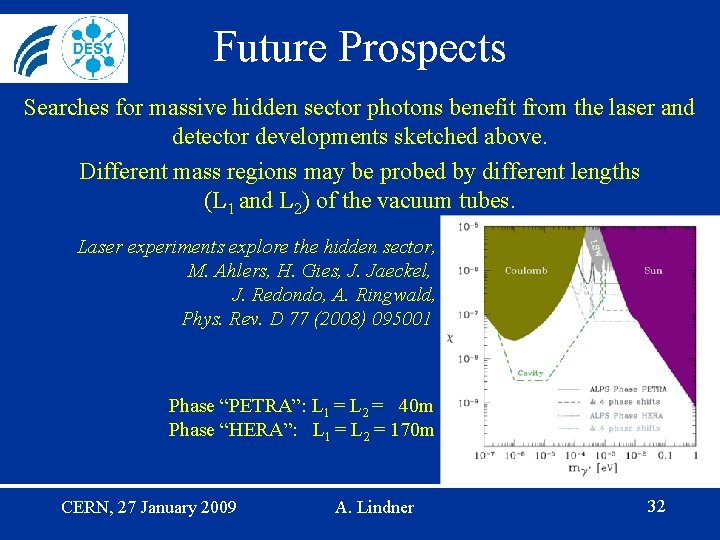
Future Prospects Searches for massive hidden sector photons benefit from the laser and detector developments sketched above. Different mass regions may be probed by different lengths (L 1 and L 2) of the vacuum tubes. Laser experiments explore the hidden sector, M. Ahlers, H. Gies, J. Jaeckel, J. Redondo, A. Ringwald, Phys. Rev. D 77 (2008) 095001 Phase “PETRA”: L 1 = L 2 = 40 m Phase “HERA”: L 1 = L 2 = 170 m CERN, 27 January 2009 A. Lindner 32
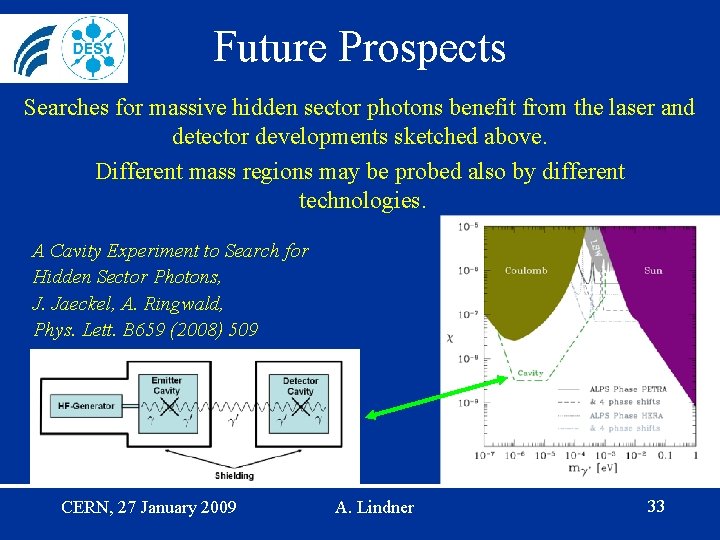
Future Prospects Searches for massive hidden sector photons benefit from the laser and detector developments sketched above. Different mass regions may be probed also by different technologies. A Cavity Experiment to Search for Hidden Sector Photons, J. Jaeckel, A. Ringwald, Phys. Lett. B 659 (2008) 509 CERN, 27 January 2009 A. Lindner 33
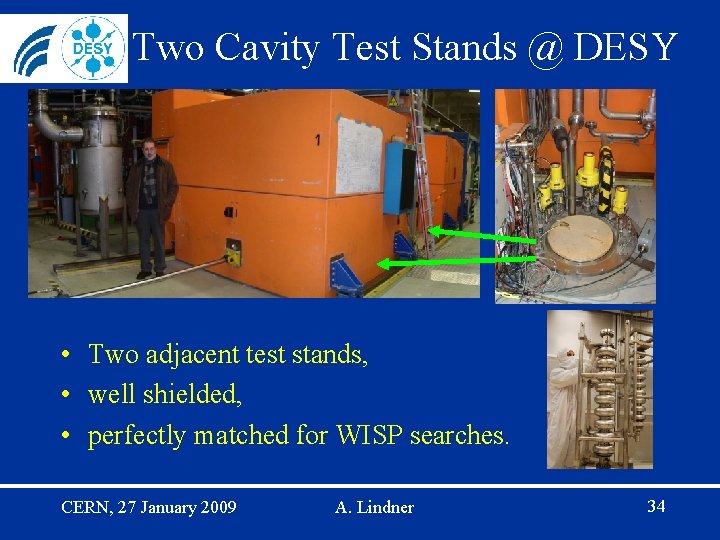
Two Cavity Test Stands @ DESY • Two adjacent test stands, • well shielded, • perfectly matched for WISP searches. CERN, 27 January 2009 A. Lindner 34
Summary • Searching for WISPs in the laboratory is necessary to complement astrophysics experiments. • There is a wealth of different experimental approaches. • Microwave cavities might be minicharged particle factories. • The sensitivity of future experiments will likely surpass present day limits from astrophysics. • Finding the QCD axion remains a challenging target. • The typical size of WISP direct search experiments are perfectly matched to laboratories like DESY / CERN, 27 January 2009 A. Lindner 35
A WISP Future at DESY? The laboratory’s interest: • small scale particle physics experiments on site • exploit possibilities of new light sources (PETRA III, FLASH, XFEL) for particle physics. • help developing the research field further (theory). CERN, 27 January 2009 A. Lindner 36
A WISP Future at DESY? Resources: • Rather limited at present, therefore participation in external experiments unlikely at present. • The situation will be reviewed in autumn 2009 depending – on results achieved at ALPS, – on the outcome of the strategic Helmholtz review in spring 2009 for the funding period 2010 to 2014. Collaboration very welcome! CERN, 27 January 2009 A. Lindner 37
It might look challenging … CERN, 27 January 2009 A. Lindner 38
… but surprises might be close! CERN, 27 January 2009 A. Lindner 39
- Slides: 39