
UltraHigh Brightness electron beams from laser driven plasma
Ultra-High Brightness electron beams from laser driven plasma accelerators Luca Serafini, INFN-Milano (A look at the particle beam beyond the source) • 6 D Phase Space Density of beams produced by self-injection mechanisms (Brightness, Brilliance) • Brightness Degradation due to Chromaticity blow-out in ultra-focused beams (Dp/p> 1% is a danger) • Ultra-high brightness in step density gradient plasma injectors • Fs to As pulses of Coherent X-rays (the AOFEL) Coulomb 09 , Senigallia, 18 -06 -2009
Vittoria Petrillo Università degli Studi, Milano (Italy) Alberto Bacci, Andrea R. Rossi, Luca Serafini, Paolo Tomassini INFN, Milano (Italy) Carlo Benedetti, Pasquale Londrillo, Andrea Sgattoni, Giorgio Turchetti Università and INFN Bologna (Italy) Coulomb 09 , Senigallia, 18 -06 -2009
Figures of Merit for Particle Beams Brightness and Brilliance 5 D and 6 D phase space density Coulomb 09 , Senigallia, 18 -06 -2009
![1018 17 AOFEL 10 I [k. A] Self-Inj 1016 1015 SPARX 1014 X-ray FEL](http://slidetodoc.com/presentation_image_h/b9771a7f3befa94b3a5ef9e09bb0f546/image-4.jpg "1018 17 AOFEL 10 I [k. A] Self-Inj 1016 1015 SPARX 1014 X-ray FEL")
1018 17 AOFEL 10 I [k. A] Self-Inj 1016 1015 SPARX 1014 X-ray FEL @ 1 p. C The Brightness Chart [A/(m. rad)2] Coulomb 09 , Senigallia, 18 -06 -2009 SPARC n [ m] 1013
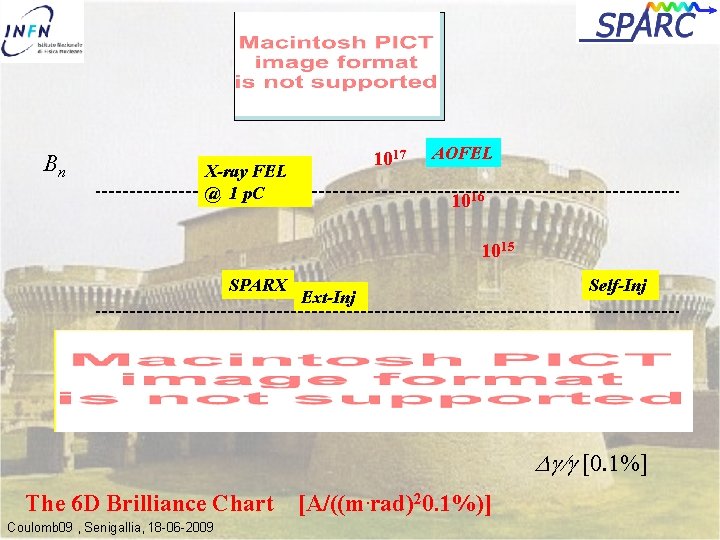
Bn 1017 X-ray FEL @ 1 p. C AOFEL 1016 1015 SPARX SPARC Self-Inj Ext-Inj 1014 D / [0. 1%] The 6 D Brilliance Chart Coulomb 09 , Senigallia, 18 -06 -2009 [A/((m. rad)20. 1%)]
Rapidity Coulomb 09 , Senigallia, 18 -06 -2009

Physical Principles of the Plasma Courtesy of T. Katsouleas Wakefield Accelerator Plasma acceleration experiments with SPARC/X e- beams • Space charge of drive beam displaces plasma electrons -- -- -----+- + + + +-+-- +--+--+ + + + + -+--+--+-+- +++ ++ ++++ +-++-+----+--++- ++++++++++ +++--+--+++ ++++ ++ ------- -- ----- -- - - -- -- -Ez electron beam • Plasma ions exert restoring force => Space charge oscillations • Wake Phase Velocity = Beam Velocity (like wake on a boat) • Wake amplitude • Transformer ratio Coulomb 09 , Senigallia, 18 -06 -2009
• Self-Injection beams seem to have low phase space density but high rapidity (suited for relativistic piston applications) Coulomb 09 , Senigallia, 18 -06 -2009
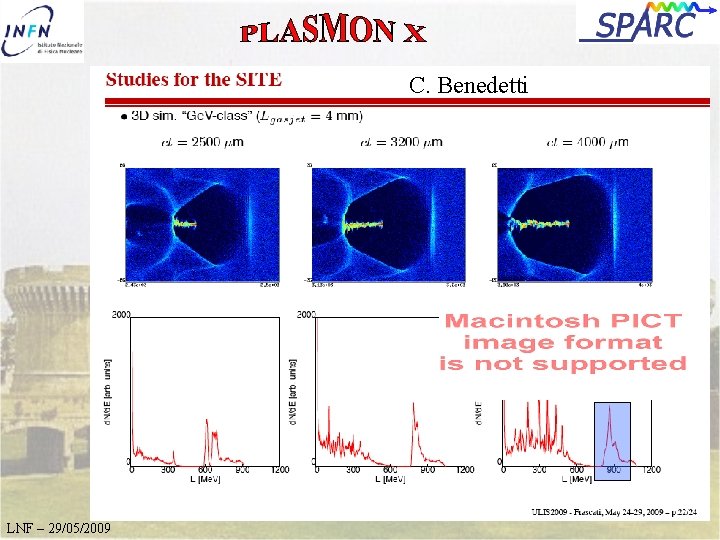
C. Benedetti LNF – 29/05/2009
x envelope and emittance free diffraction in vacuum RETAR (A. Rossi) no description of plasma vacuum interface
Bunch length and average current
Energy spread
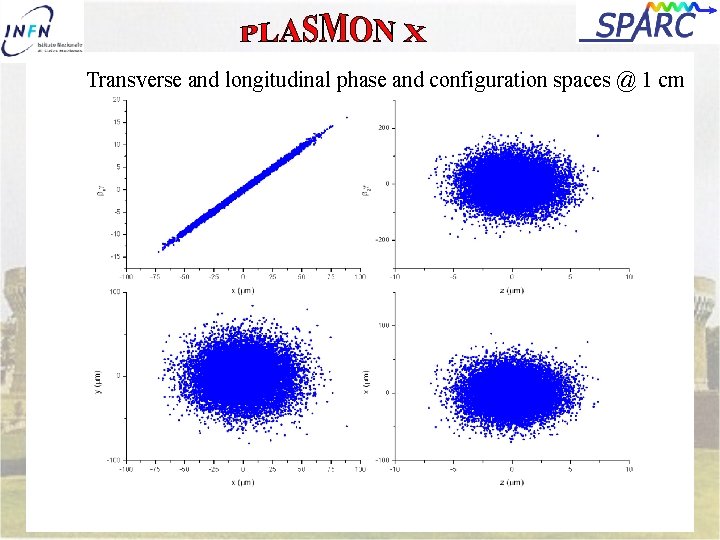
Transverse and longitudinal phase and configuration spaces @ 1 cm
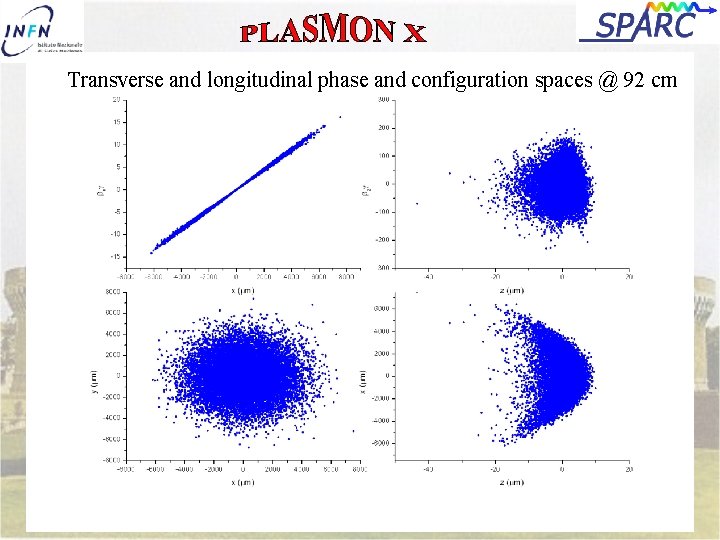
Transverse and longitudinal phase and configuration spaces @ 92 cm
• Emittance Dilution due to Chromatic Effects on a beam emerging from a focus of spot size s 0, drifting to a distance d SPARC n=1 mm. mrad, s 0= 200 m, =300, D / =0. 6%, d=10 m D n =0. 005 mm. mrad Self-Inj n=2 mm. mrad, s 0= 1 m, =2000, D / =2%, d=1 m D n =40 mm. mrad LNF – 29/05/2009
ASTRA (A. Bacci) : LNF – 29/05/2009 matching with a triplet
Space charge energy spread No Space charge energy spread LNF – 29/05/2009
No Space charge No energy spread SPARC beam Space charge energy spread LNF – 29/05/2009
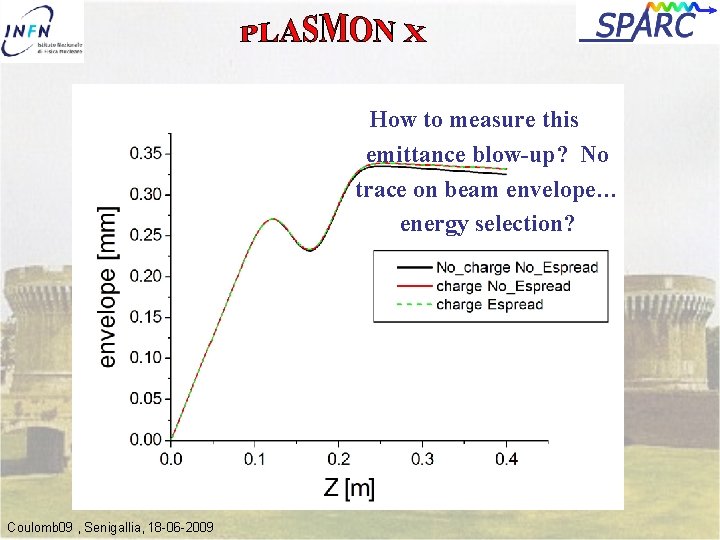
How to measure this emittance blow-up? No trace on beam envelope… energy selection? Coulomb 09 , Senigallia, 18 -06 -2009
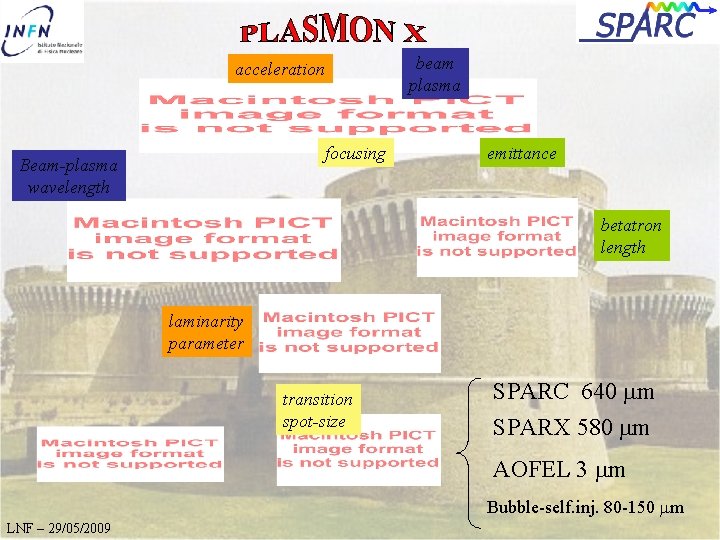
beam plasma acceleration focusing Beam-plasma wavelength emittance betatron length laminarity parameter transition spot-size SPARC 640 m SPARX 580 m AOFEL 3 m Bubble-self. inj. 80 -150 m LNF – 29/05/2009
Coherence and Time Duration Coulomb 09 , Senigallia, 18 -06 -2009
![CO 2 envelope CO 2 focus r m] Ti. Sa envelope Ti. Sa pulse](http://slidetodoc.com/presentation_image_h/b9771a7f3befa94b3a5ef9e09bb0f546/image-22.jpg "CO 2 envelope CO 2 focus r m] Ti. Sa envelope Ti. Sa pulse")
CO 2 envelope CO 2 focus r m] Ti. Sa envelope Ti. Sa pulse plasma e- beam Lsat=10 LG=1. 3 mm ( =0. 002) Z [m] Coulomb 09 , Senigallia, 18 -06 -2009
AOFEL • injection by longitudinal nonlinear breaking of the wave at a density downramp looks one of the most promising since it can produce e-beams having both low energy spread and low transverse emittance. • electromagnetic undulator made by a laser pulse counter propagating respect to the electron beam
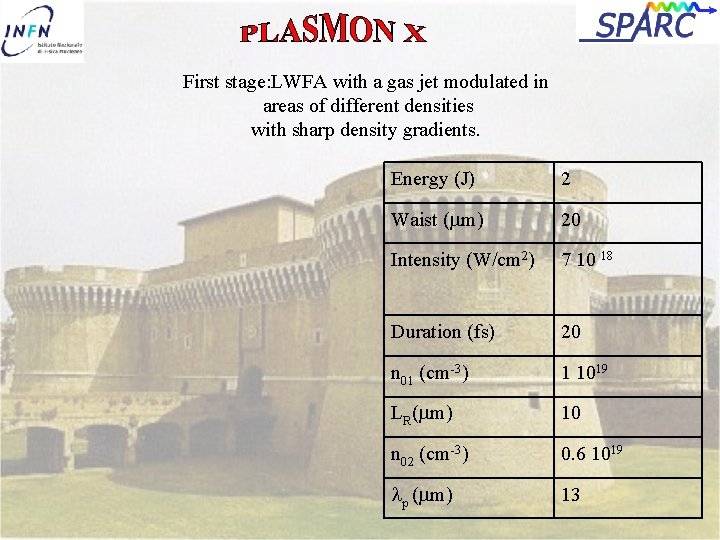
First stage: LWFA with a gas jet modulated in areas of different densities with sharp density gradients. Energy (J) 2 Waist ( m) 20 Intensity (W/cm 2) 7 10 18 Duration (fs) 20 n 01 (cm-3) 1 1019 LR( m) 10 n 02 (cm-3) 0. 6 1019 lp ( m) 13
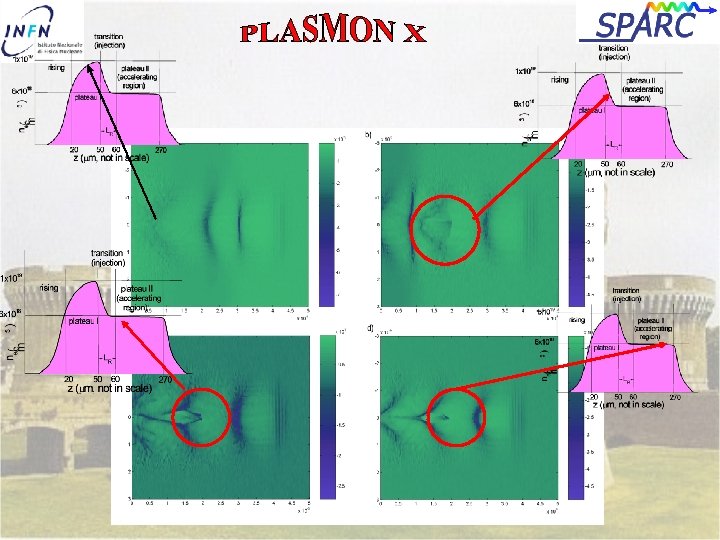
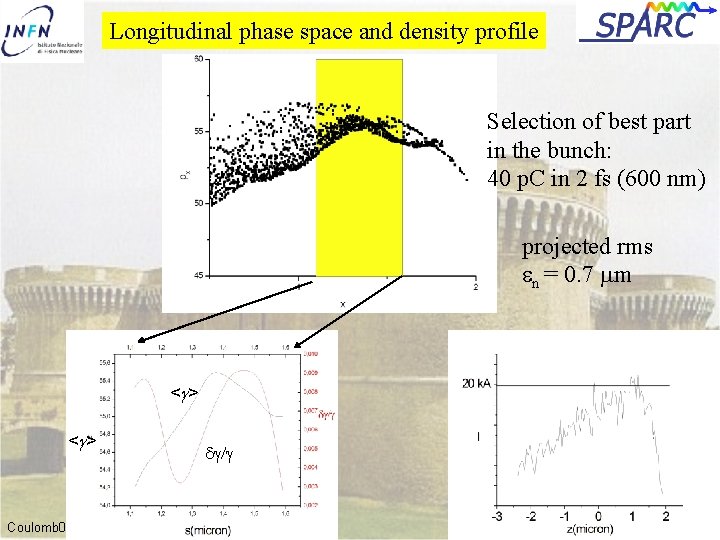
Longitudinal phase space and density profile Selection of best part in the bunch: 40 p. C in 2 fs (600 nm) projected rms n = 0. 7 m < > Coulomb 09 , Senigallia, 18 -06 -2009

Third stage First stage Numerical Modelling Formation of the plasma Formation of the bunch Acceleration stage VORPAL C. Nieter J. R. Cary J. Comp. Phys. 196 448 (2004) Transition Plasma-undulator Astra Retar New results by ALADYN Second stage Beam-CO 2 laser Interaction FEL instability Genesis 1. 3 EURA
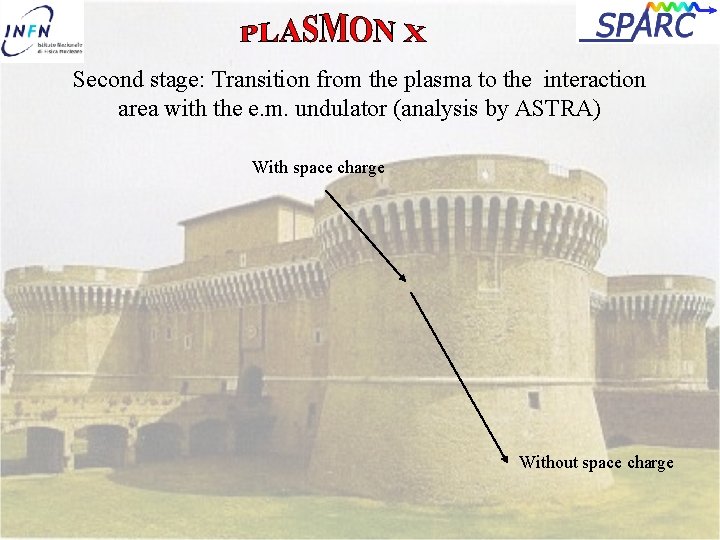
Second stage: Transition from the plasma to the interaction area with the e. m. undulator (analysis by ASTRA) With space charge Without space charge
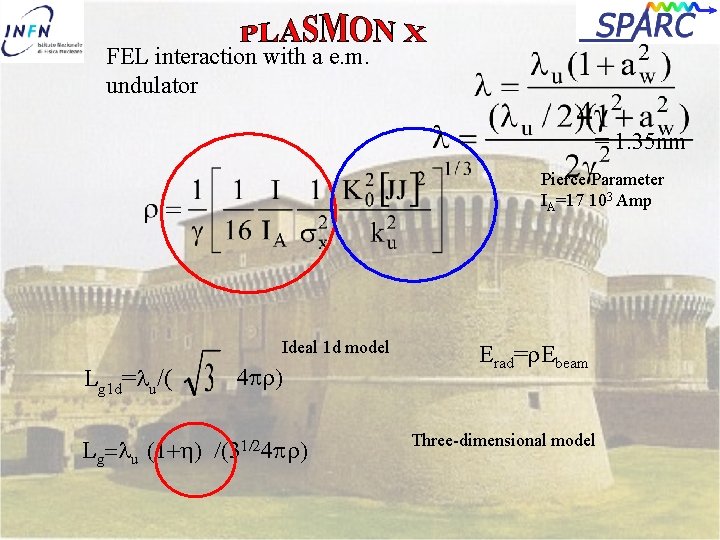
FEL interaction with a e. m. undulator = 1. 35 nm Pierce Parameter IA=17 103 Amp Ideal 1 d model Lg 1 d=lu/( 4 pr) Lg=lu (1+h) (31 24 pr) Erad=r. Ebeam Three-dimensional model
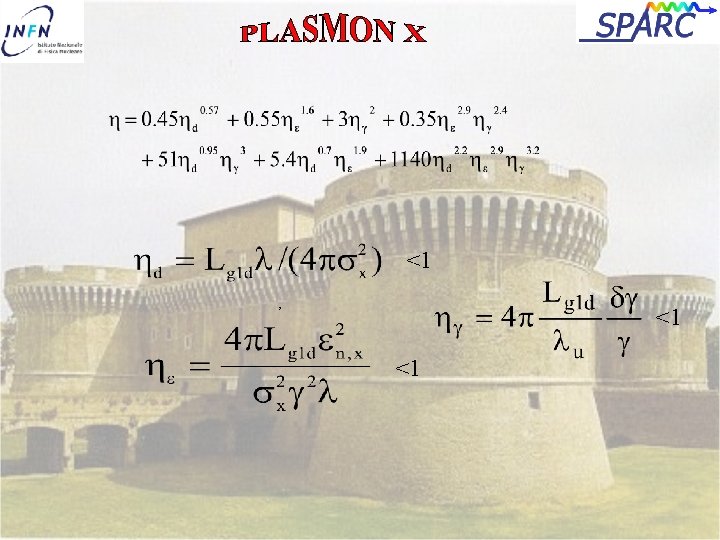
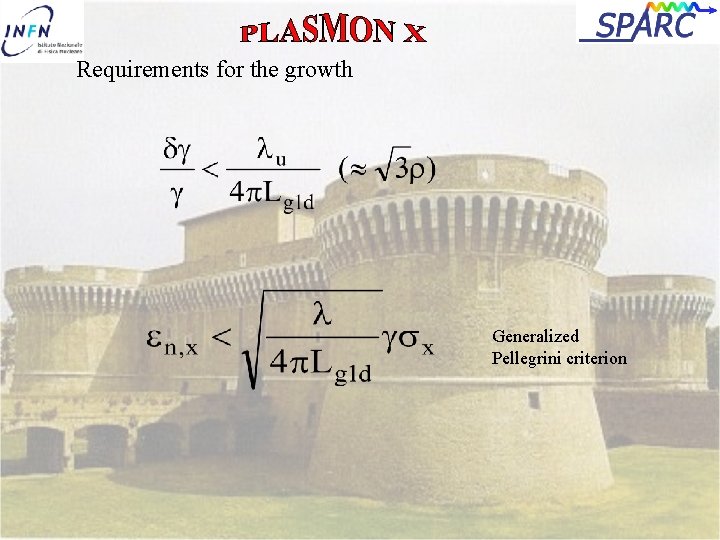
Requirements for the growth Generalized Pellegrini criterion
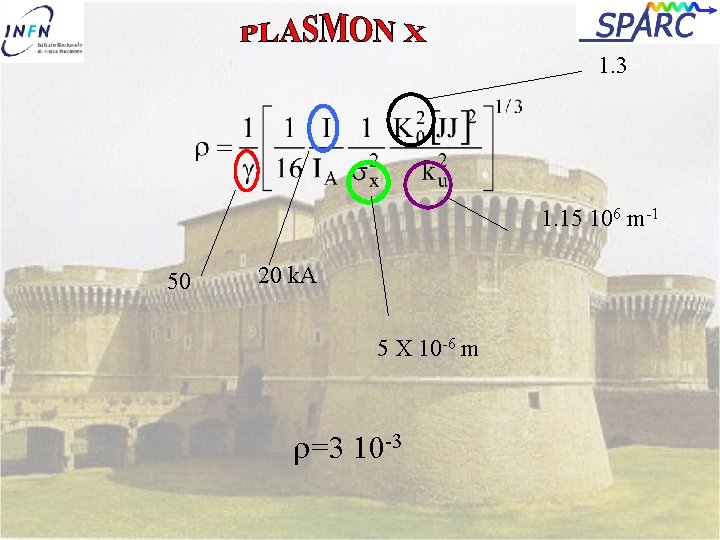
1. 3 1. 15 106 m-1 50 20 k. A 5 X 10 -6 m r=3 10 -3
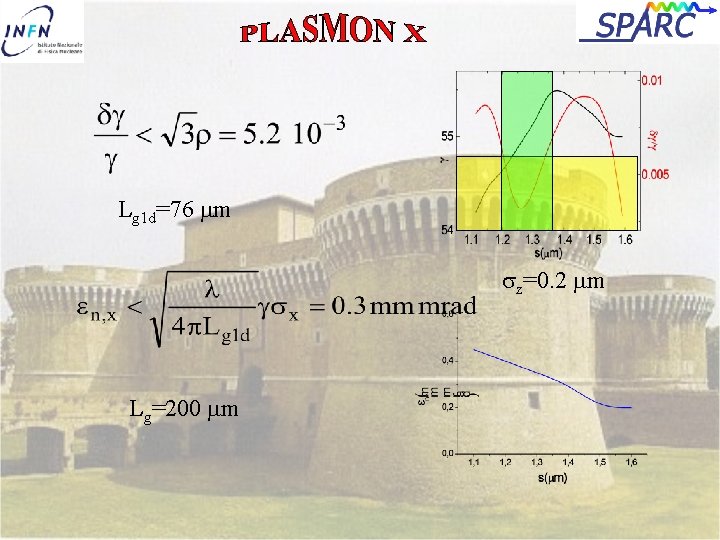
Lg 1 d=76 m z=0. 2 m Lg=200 m
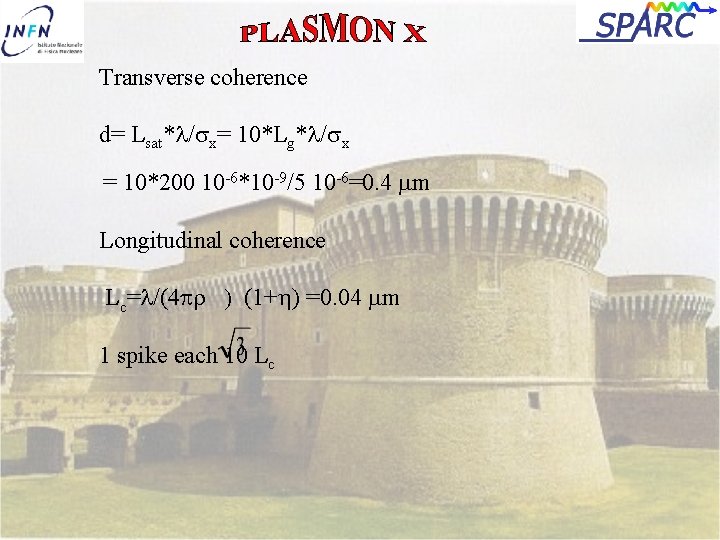
Transverse coherence d= Lsat*l/ x= 10*Lg*l/ x = 10*200 10 -6*10 -9/5 10 -6=0. 4 m Longitudinal coherence Lc=l/(4 pr ) (1+h) =0. 04 m 1 spike each 10 Lc
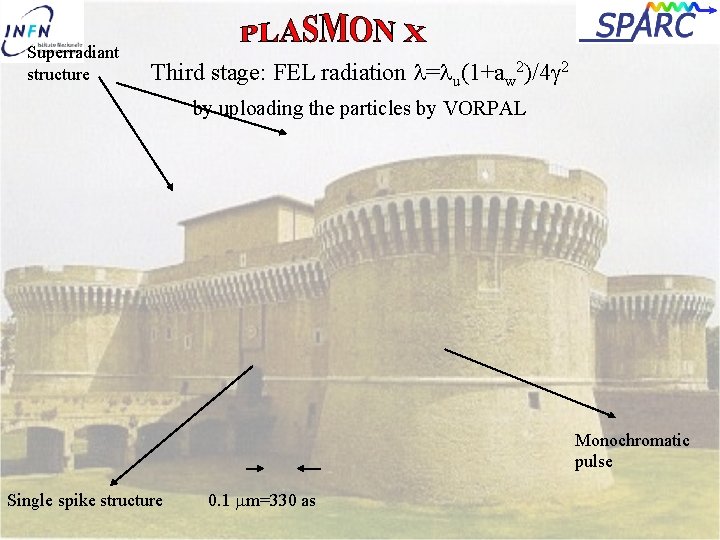
Superradiant structure Third stage: FEL radiation l=lu(1+aw 2)/4 2 by uploading the particles by VORPAL Monochromatic pulse Single spike structure 0. 1 m=330 as
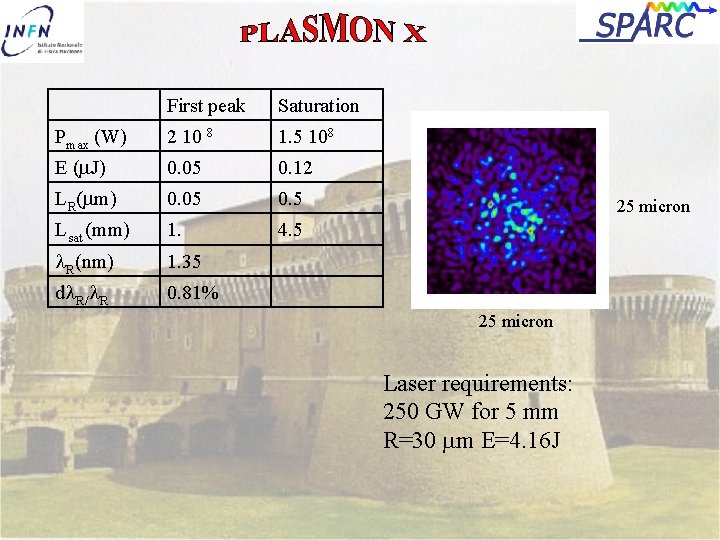
First peak Saturation Pmax (W) 2 10 8 1. 5 108 E ( J) 0. 05 0. 12 LR( m) 0. 05 0. 5 Lsat (mm) 1. 4. 5 l. R(nm) 1. 35 dl. R/l. R 0. 81% 25 micron Laser requirements: 250 GW for 5 mm R=30 m E=4. 16 J
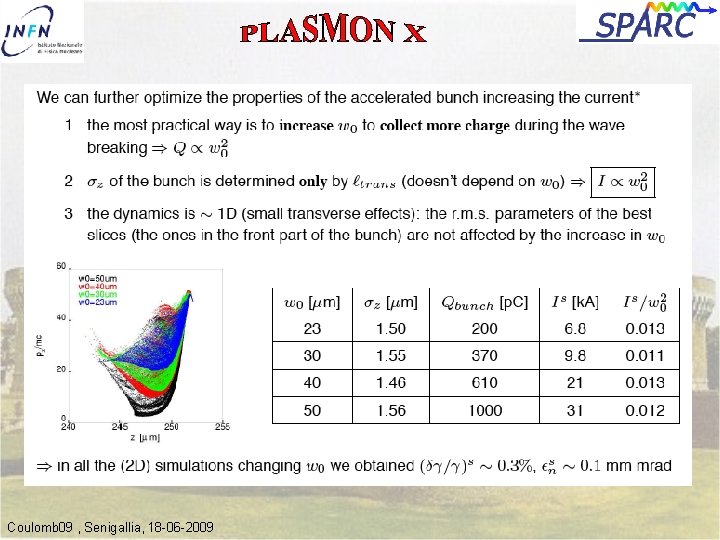
Coulomb 09 , Senigallia, 18 -06 -2009
I=31 KA z=1. 5 m x=0. 6 um n=0. 1 m =45 DE/E=0. 3% a 0=0. 8 l=0. 162 nm

Conclusions • All optical free-electron laser are possible with e-beam produced by LWFA in density downramp + electromagnetic undulators • Characteristics of radiation: small energy/pulse, quasi transverse coherent, very short pulse, longitudinal coherence, monochromaticity • Injection of the beam, control of the exit from the plasma, requirements of power and structure of the e. m. undulator
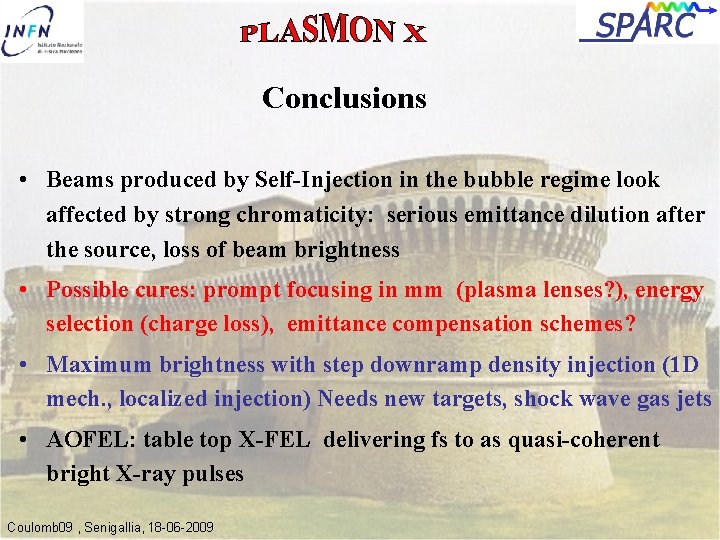
Conclusions • Beams produced by Self-Injection in the bubble regime look affected by strong chromaticity: serious emittance dilution after the source, loss of beam brightness • Possible cures: prompt focusing in mm (plasma lenses? ), energy selection (charge loss), emittance compensation schemes? • Maximum brightness with step downramp density injection (1 D mech. , localized injection) Needs new targets, shock wave gas jets • AOFEL: table top X-FEL delivering fs to as quasi-coherent bright X-ray pulses Coulomb 09 , Senigallia, 18 -06 -2009
Coulomb 09 , Senigallia, 18 -06 -2009
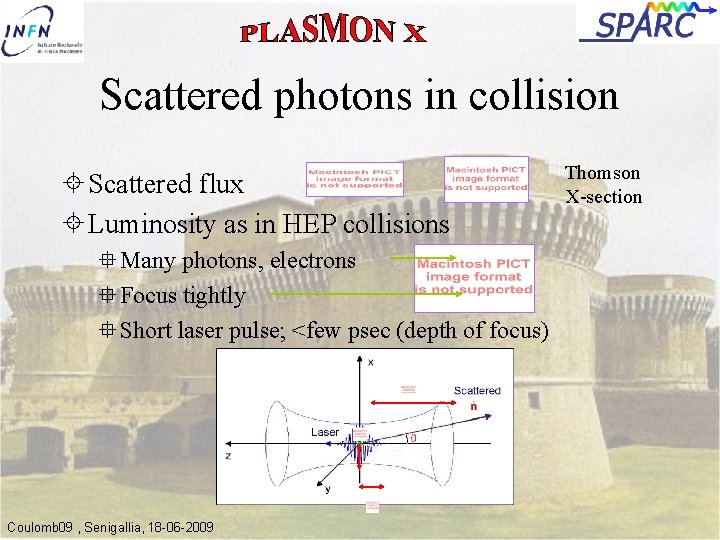
Scattered photons in collision Scattered flux Luminosity as in HEP collisions Many photons, electrons Focus tightly Short laser pulse; <few psec (depth of focus) Coulomb 09 , Senigallia, 18 -06 -2009 Thomson X-section
Rapidity Coulomb 09 , Senigallia, 18 -06 -2009
Coulomb 09 , Senigallia, 18 -06 -2009
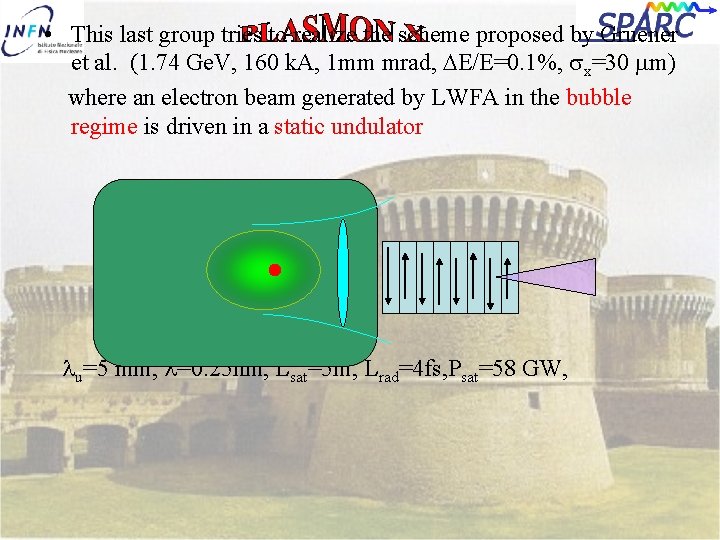
• This last group tries to realize the scheme proposed by Gruener et al. (1. 74 Ge. V, 160 k. A, 1 mm mrad, DE/E=0. 1%, x=30 m) where an electron beam generated by LWFA in the bubble regime is driven in a static undulator lu=5 mm, l=0. 25 nm, Lsat=5 m, Lrad=4 fs, Psat=58 GW,
• The technology of ultra short, high power lasers has permitted the production and the study of highbrightness, stable, low divergence, quasi monoenergetic electron beams by LWFA. • These beams are now an experimental reality (for instance: Faure et al. , Leemans et al. , Jaroszinski et. al, Geddes et al. , ecc. ) • and can be used in applications for driving Freeelectron lasers Last experimental results, see, for instance: • J. Osterhoff et al. PRL 101 085002 (2008) • (mono-energetic fraction: 10 p. C@200 Me. V, divergence=2. 1 mrad FWHM) • Koyama, Hosokai 20 p. C @ 100 Me. V and density downramp • N. Hafz, Jongmin Lee , Nature photonics • THCAU 05 FEL Conf 2008
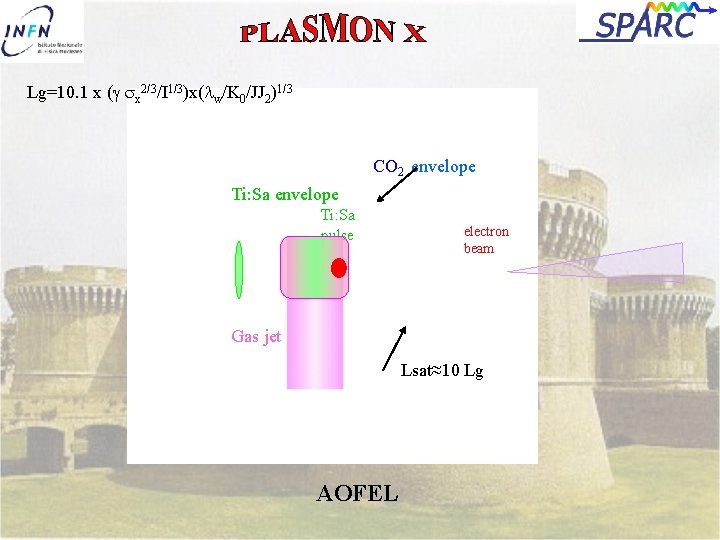
Lg=10. 1 x ( x 2/3/I 1/3)x(lw/K 0/JJ 2)1/3 CO 2 envelope Ti: Sa pulse electron beam Gas jet Lsat≈10 Lg AOFEL
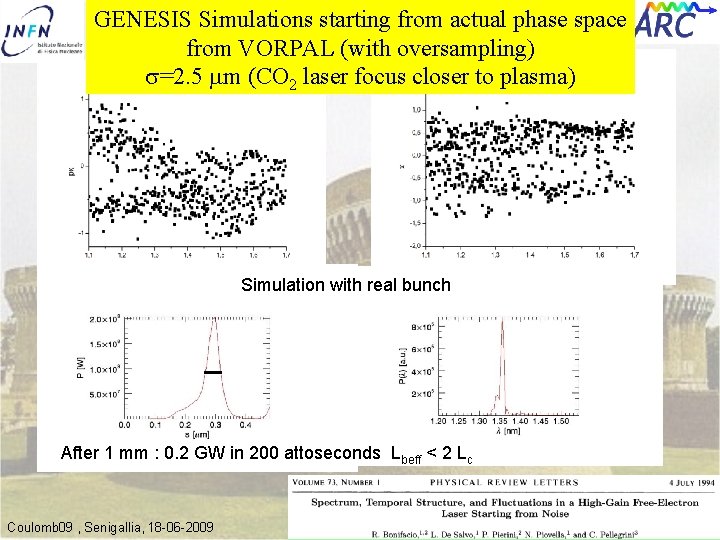
GENESIS Simulations starting from actual phase space from VORPAL (with oversampling) =2. 5 m (CO 2 laser focus closer to plasma) Simulation with real bunch After 1 mm : 0. 2 GW in 200 attoseconds Lbeff < 2 Lc Coulomb 09 , Senigallia, 18 -06 -2009
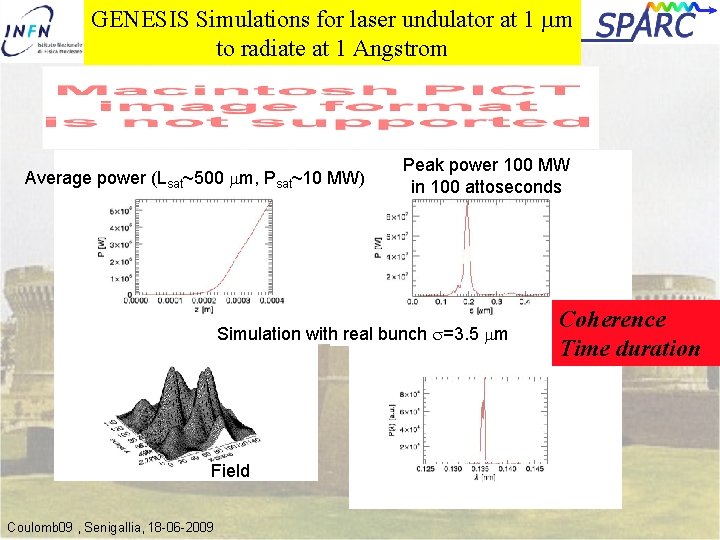
GENESIS Simulations for laser undulator at 1 m to radiate at 1 Angstrom Average power (Lsat~500 m, Psat~10 MW) Peak power 100 MW in 100 attoseconds Simulation with real bunch =3. 5 m Field Coulomb 09 , Senigallia, 18 -06 -2009 Coherence Time duration
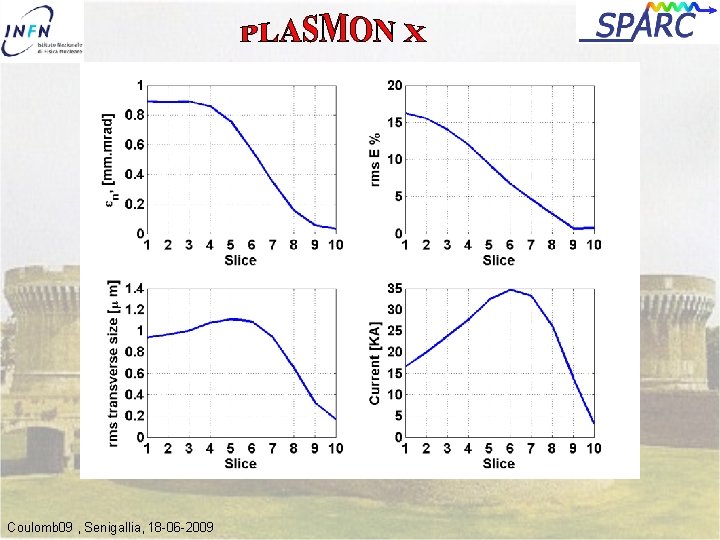
Coulomb 09 , Senigallia, 18 -06 -2009
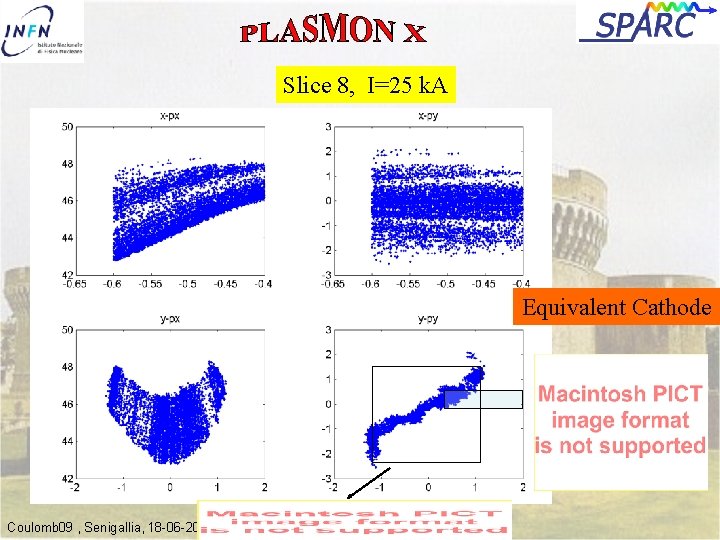
Slice 8, I=25 k. A Equivalent Cathode Coulomb 09 , Senigallia, 18 -06 -2009
- Slides: 51