
Ultrafast Extreme Ultraviolet Spectroscopy of Methylammonium Lead Iodide
- Slides: 17
Ultrafast Extreme Ultraviolet Spectroscopy of Methylammonium Lead Iodide Perovskite for Carrier Specific Photophysics ISMS 2017 Max Verkamp Vura-Weis Group UIUC
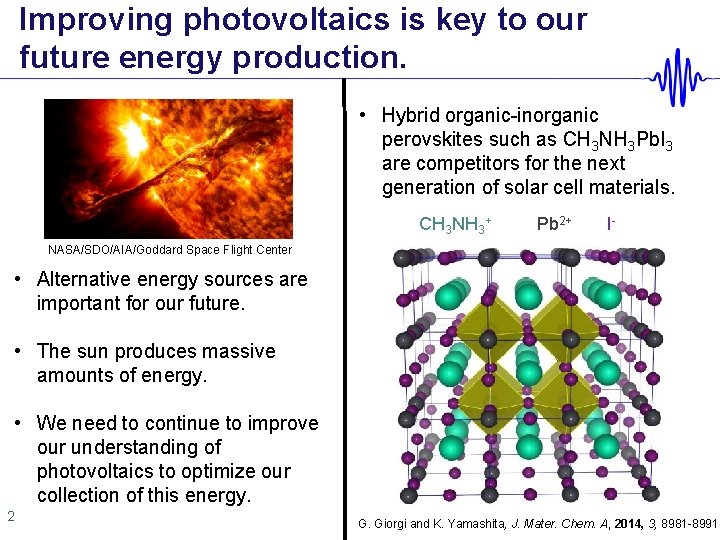
Improving photovoltaics is key to our future energy production. • Hybrid organic-inorganic perovskites such as CH 3 NH 3 Pb. I 3 are competitors for the next generation of solar cell materials. CH 3 NH 3+ Pb 2+ INASA/SDO/AIA/Goddard Space Flight Center • Alternative energy sources are important for our future. • The sun produces massive amounts of energy. • We need to continue to improve our understanding of photovoltaics to optimize our collection of this energy. 2 G. Giorgi and K. Yamashita, J. Mater. Chem. A, 2014, 3, 8981 -8991
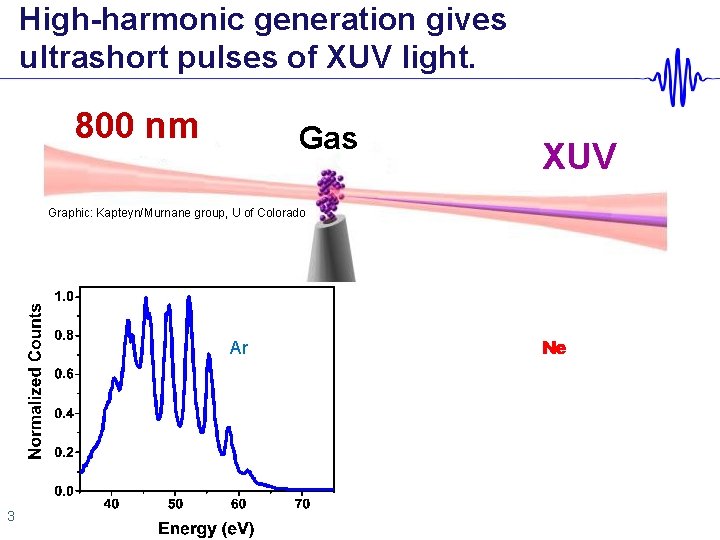
High-harmonic generation gives ultrashort pulses of XUV light. 800 nm Gas XUV Graphic: Kapteyn/Murnane group, U of Colorado Ar 3 Ne Ne
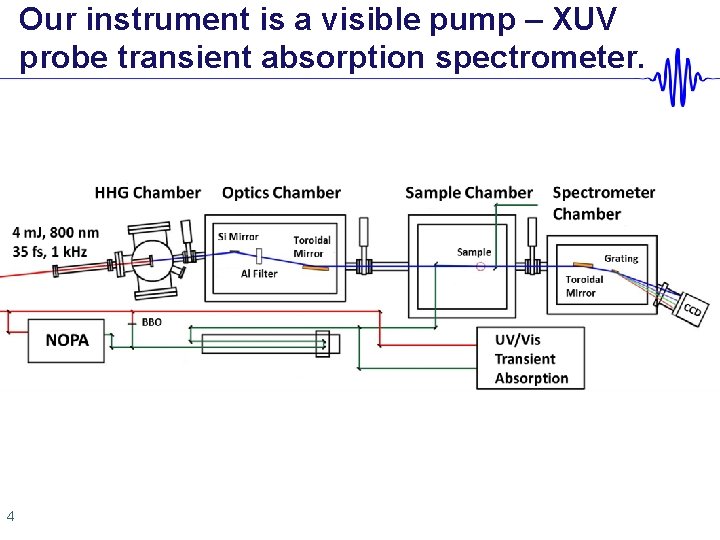
Our instrument is a visible pump – XUV probe transient absorption spectrometer. 4
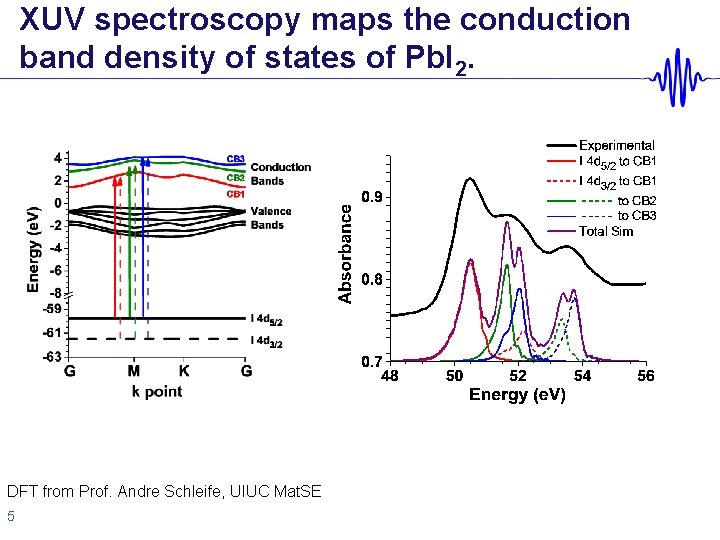
XUV spectroscopy maps the conduction band density of states of Pb. I 2. DFT from Prof. Andre Schleife, UIUC Mat. SE 5
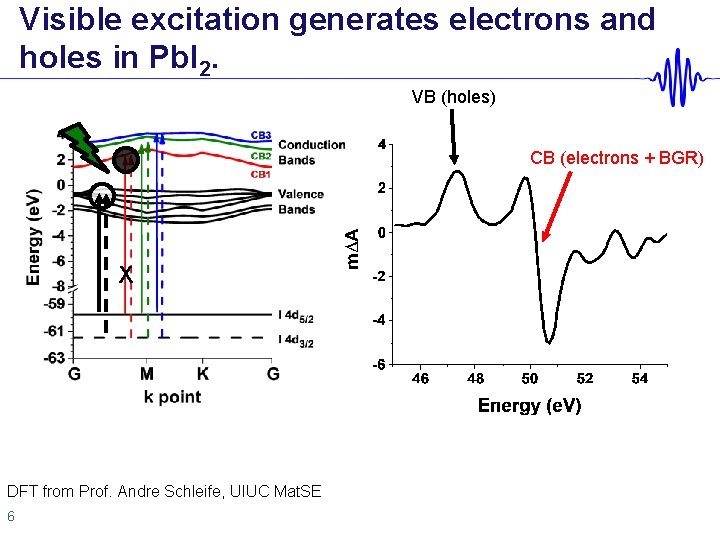
Visible excitation generates electrons and holes in Pb. I 2. VB (holes) CB (electrons + BGR) X DFT from Prof. Andre Schleife, UIUC Mat. SE 6
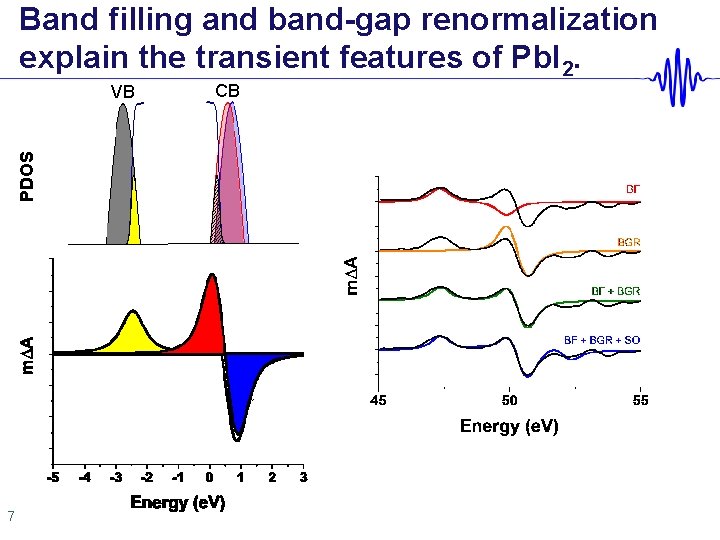
Band filling and band-gap renormalization explain the transient features of Pb. I 2. PDOS VB 7 CB
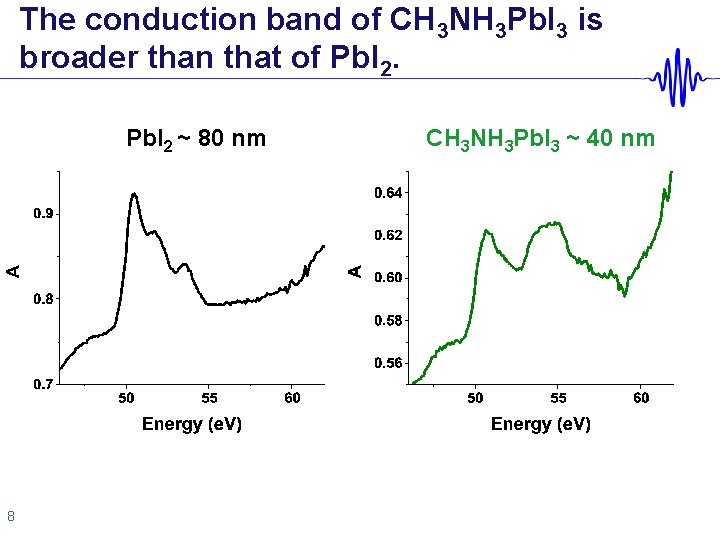
The conduction band of CH 3 NH 3 Pb. I 3 is broader than that of Pb. I 2 ~ 80 nm 8 CH 3 NH 3 Pb. I 3 ~ 40 nm
CH 3 NH 3 Pb. I 3 transient data has three primary features. 9
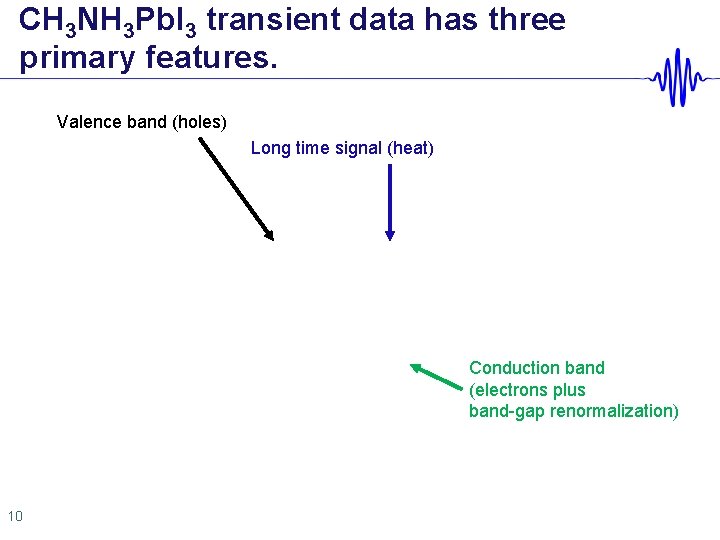
CH 3 NH 3 Pb. I 3 transient data has three primary features. Valence band (holes) Long time signal (heat) Conduction band (electrons plus band-gap renormalization) 10
Comparing the transient and static spectra illustrates the features. 11
The valence band signal narrows and decays. 12
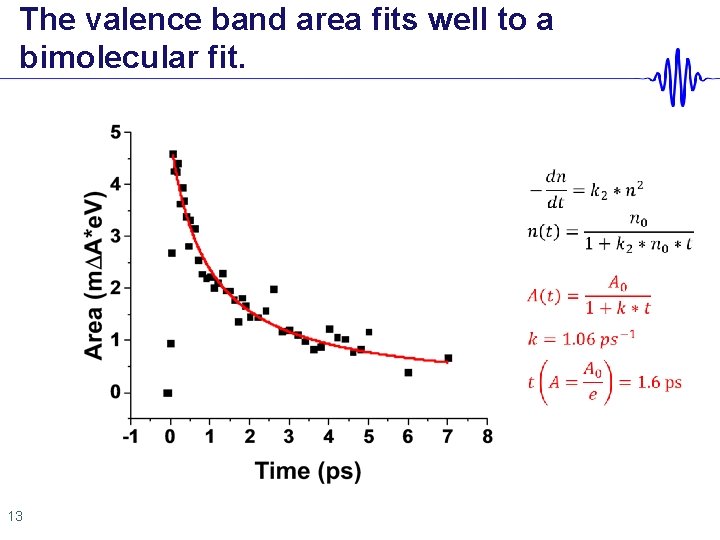
The valence band area fits well to a bimolecular fit. 13
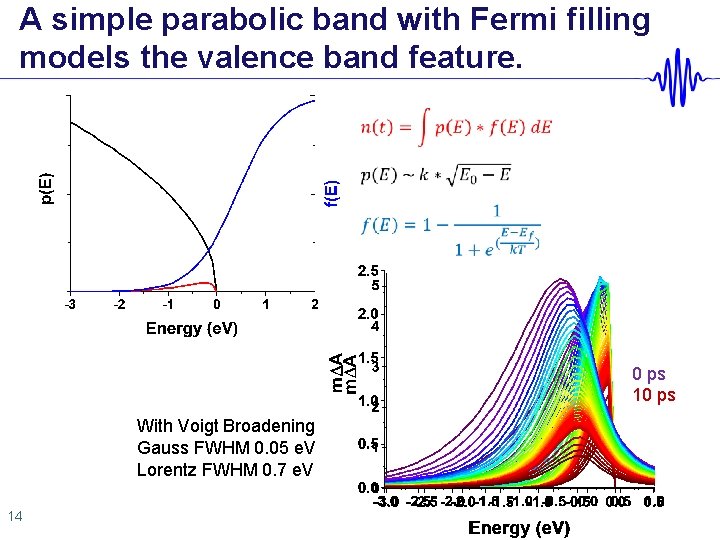
A simple parabolic band with Fermi filling models the valence band feature. 0 ps 10 ps With Voigt Broadening Gauss FWHM 0. 05 e. V Lorentz FWHM 0. 7 e. V 14
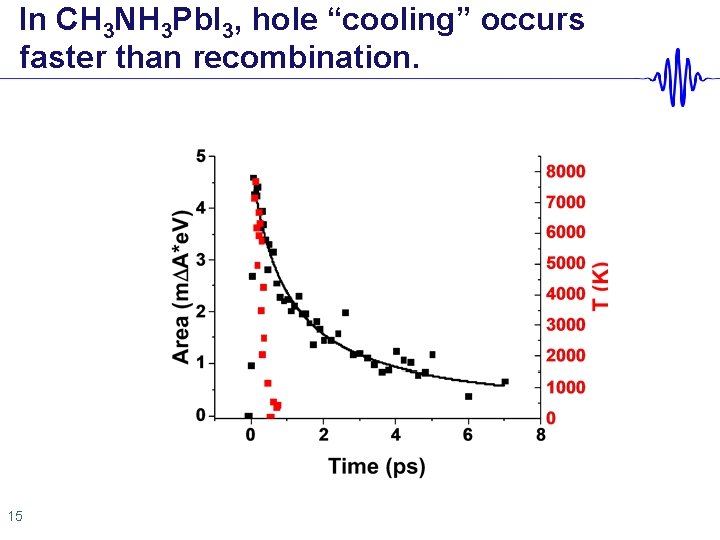
In CH 3 NH 3 Pb. I 3, hole “cooling” occurs faster than recombination. 15
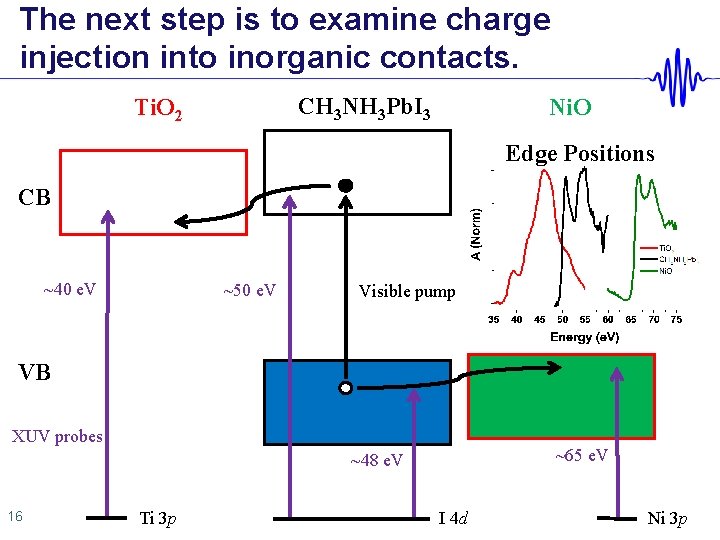
The next step is to examine charge injection into inorganic contacts. CH 3 NH 3 Pb. I 3 Ti. O 2 Ni. O Edge Positions CB ~40 e. V ~50 e. V Visible pump VB XUV probes ~65 e. V ~48 e. V 16 Ti 3 p I 4 d Ni 3 p
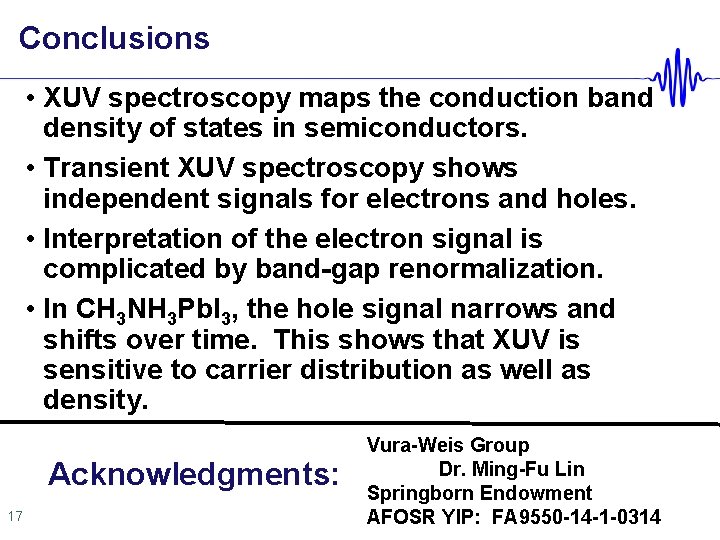
Conclusions • XUV spectroscopy maps the conduction band density of states in semiconductors. • Transient XUV spectroscopy shows independent signals for electrons and holes. • Interpretation of the electron signal is complicated by band-gap renormalization. • In CH 3 NH 3 Pb. I 3, the hole signal narrows and shifts over time. This shows that XUV is sensitive to carrier distribution as well as density. Acknowledgments: 17 Vura-Weis Group Dr. Ming-Fu Lin Springborn Endowment AFOSR YIP: FA 9550 -14 -1 -0314