
Ultrafast Electron Diffraction from Molecules in the Gas

- Slides: 28
Ultrafast Electron Diffraction from Molecules in the Gas Phase Martin Centurion Department of Physics and Astronomy University of Nebraska – Lincoln 1
Outline • Diffraction from aligned molecules: • 3 D molecular images with sub-Angstrom resolution • Imaging of transient structures: Molecules in intense laser fields. • New sources for femtosecond resolution and high current. 2
Ultrafast Molecular Dynamics Group Members • Jie Yang (grad) • Omid Zandi (grad) • Kyle Wilkin (grad) • Matthew Robinson (postdoc) • Alice De. Simone (postdoc) Collaborators • Vinod Kumarappan (KSU). • Cornelis Uiterwaal (UNL). • Xijie Wang (SLAC) • Renkai Li (SLAC) • Markus Guehr (PULSE) 3
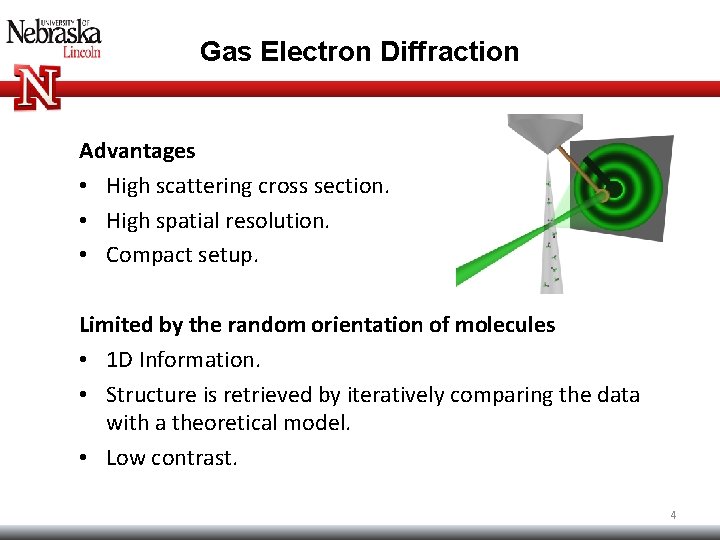
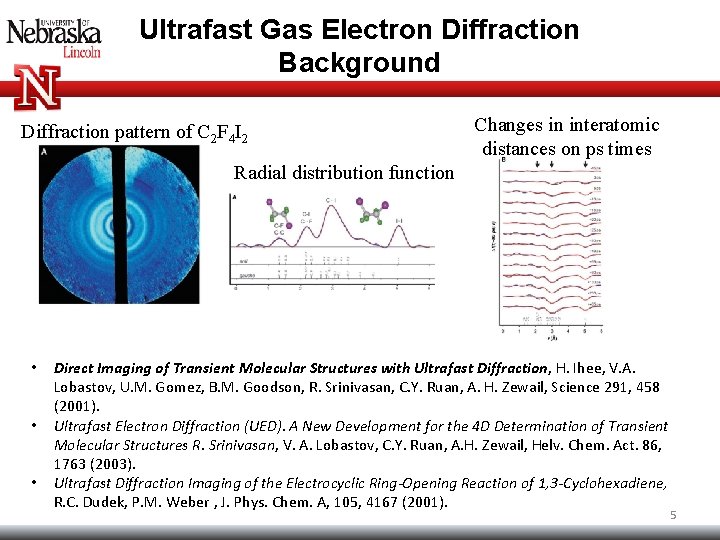
Gas Electron Diffraction Advantages • High scattering cross section. • High spatial resolution. • Compact setup. Limited by the random orientation of molecules • 1 D Information. • Structure is retrieved by iteratively comparing the data with a theoretical model. • Low contrast. 4
Ultrafast Gas Electron Diffraction Background Diffraction pattern of C 2 F 4 I 2 Changes in interatomic distances on ps times Radial distribution function Experiment • • • Direct Imaging of Transient Molecular Structures with Ultrafast Diffraction, H. Ihee, V. A. Lobastov, U. M. Gomez, B. M. Goodson, R. Srinivasan, C. Y. Ruan, A. H. Zewail, Science 291, 458 (2001). Ultrafast Electron Diffraction (UED). A New Development for the 4 D Determination of Transient Molecular Structures R. Srinivasan, V. A. Lobastov, C. Y. Ruan, A. H. Zewail, Helv. Chem. Act. 86, Theory 1763 (2003). Ultrafast Diffraction Imaging of the Electrocyclic Ring-Opening Reaction of 1, 3 -Cyclohexadiene, R. C. Dudek, P. M. Weber , J. Phys. Chem. A, 105, 4167 (2001). 5
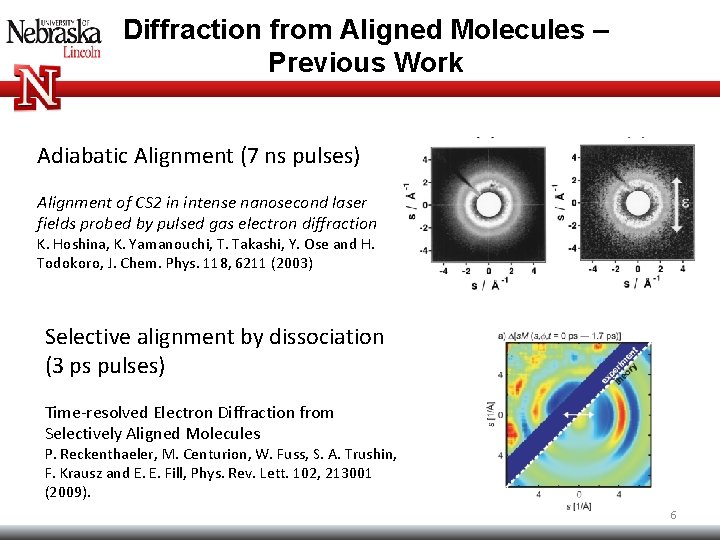
Diffraction from Aligned Molecules – Previous Work Adiabatic Alignment (7 ns pulses) Alignment of CS 2 in intense nanosecond laser fields probed by pulsed gas electron diffraction K. Hoshina, K. Yamanouchi, T. Takashi, Y. Ose and H. Todokoro, J. Chem. Phys. 118, 6211 (2003) Selective alignment by dissociation (3 ps pulses) Time-resolved Electron Diffraction from Selectively Aligned Molecules P. Reckenthaeler, M. Centurion, W. Fuss, S. A. Trushin, F. Krausz and E. E. Fill, Phys. Rev. Lett. 102, 213001 (2009). 6
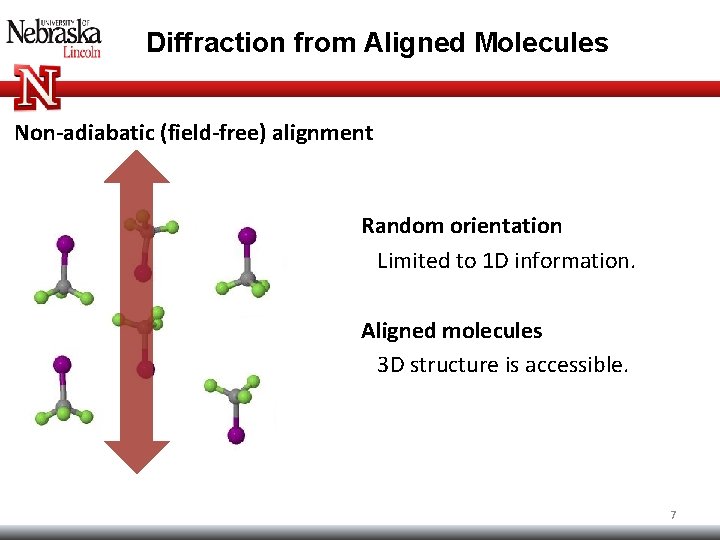
Diffraction from Aligned Molecules Non-adiabatic (field-free) alignment Random orientation Limited to 1 D information. Aligned molecules 3 D structure is accessible. 7
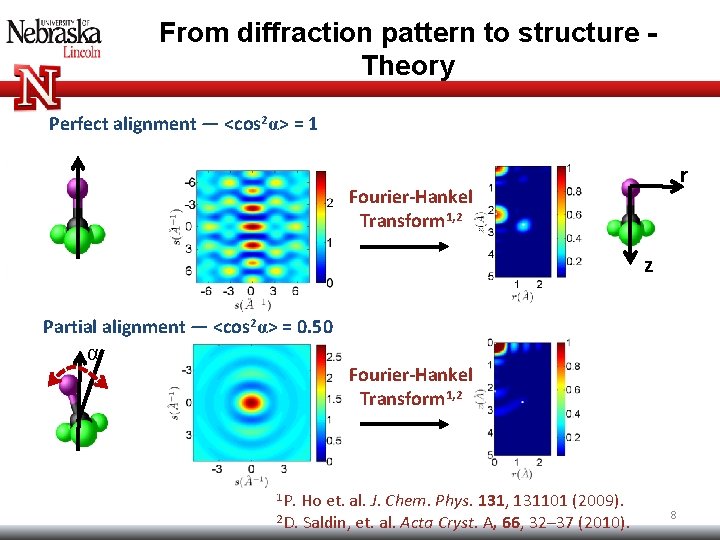
From diffraction pattern to structure Theory Perfect alignment — <cos 2α> = 1 r Fourier-Hankel Transform 1, 2 z Partial alignment — <cos 2α> = 0. 50 α Fourier-Hankel Transform 1, 2 1 P. Ho et. al. J. Chem. Phys. 131, 131101 (2009). 2 D. Saldin, et. al. Acta Cryst. A, 66, 32– 37 (2010). 8
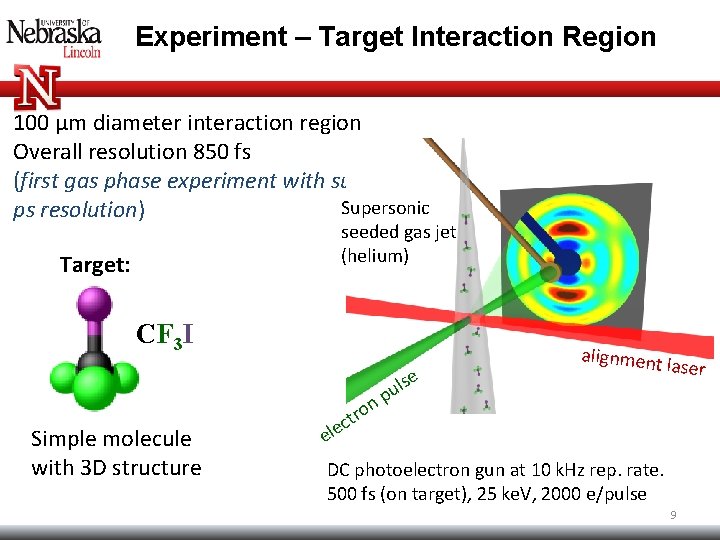
Experiment – Target Interaction Region 100 µm diameter interaction region Overall resolution 850 fs (first gas phase experiment with sub. Supersonic ps resolution) seeded gas jet (helium) Target: CF 3 I lse alignment u Simple molecule with 3 D structure c ele p n ro laser t DC photoelectron gun at 10 k. Hz rep. rate. 500 fs (on target), 25 ke. V, 2000 e/pulse 9
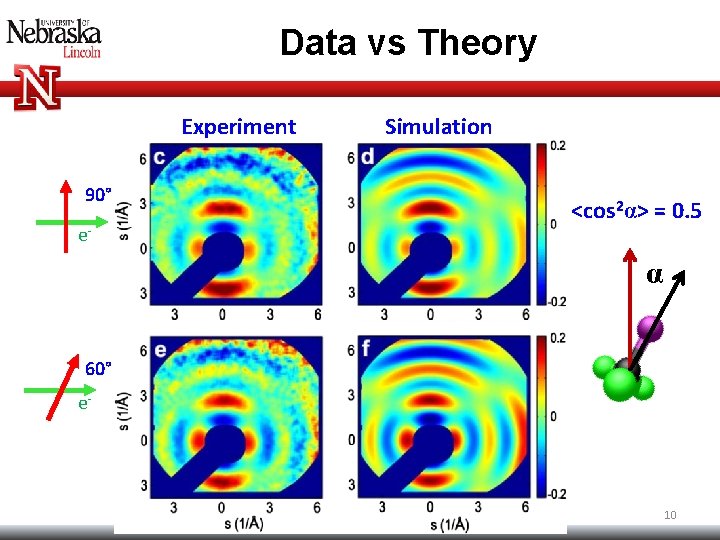
Data vs Theory Experiment 90° e- Simulation <cos 2α> = 0. 5 α 60° e- 10
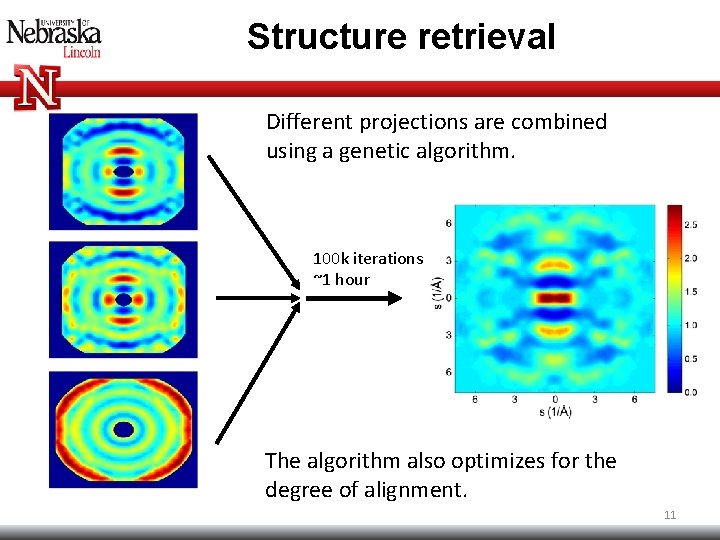
Structure retrieval Different projections are combined using a genetic algorithm. 100 k iterations ~1 hour The algorithm also optimizes for the degree of alignment. 11
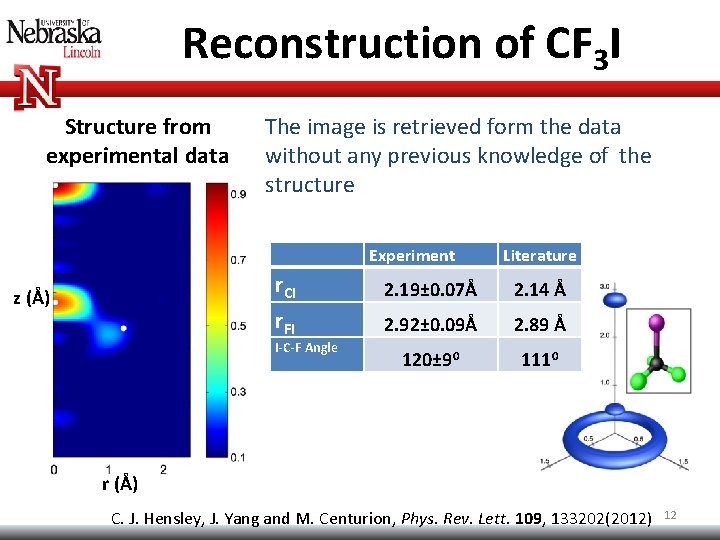
Reconstruction of CF 3 I Structure from experimental data The image is retrieved form the data without any previous knowledge of the structure Experiment r. CI r. FI z (Å) I-C-F Angle Literature 2. 19± 0. 07Å 2. 14 Å 2. 92± 0. 09Å 2. 89 Å 120± 90 1110 r (Å) C. J. Hensley, J. Yang and M. Centurion, Phys. Rev. Lett. 109, 133202(2012) 12
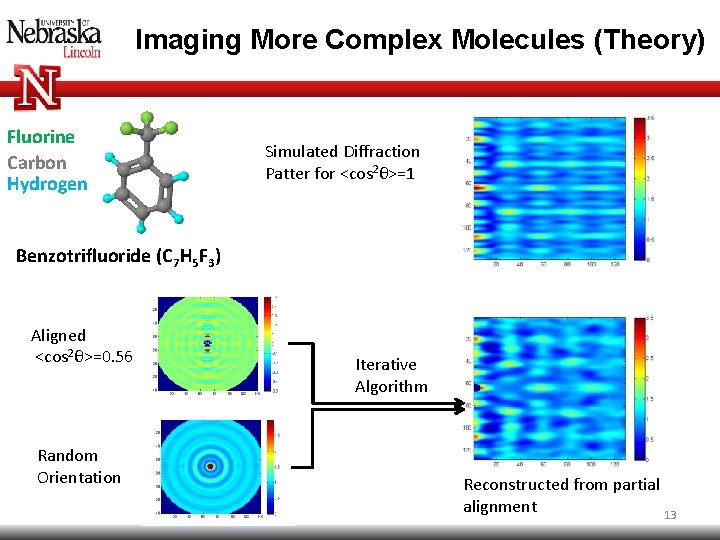
Imaging More Complex Molecules (Theory) Fluorine Carbon Hydrogen Simulated Diffraction Patter for <cos 2θ>=1 Benzotrifluoride (C 7 H 5 F 3) Aligned <cos 2θ>=0. 56 Random Orientation Iterative Algorithm Reconstructed from partial alignment 13
3 D Reconstruction • The structure is reconstructed using a phase retrieval algorithm. • The algorithm uses constraints on the molecular structure (atomicity, size of molecule) and splits the diffraction into cylindrical harmonics. • 3 D isosurface rendering done by combining mulitple harmonics The overlapped blue bars show the frame of the molecule “Reconstruction of three-dimensional molecular structure from diffraction of laser-aligned molecules, ” J. Yang, V. Makhija, V. Kumarappan, M. Centurion, Structural Dynamics 1, 044101 14 (2014);
Outline • Diffraction from aligned molecules: • 3 D molecular images with sub-Angstrom resolution • Imaging of transient structures: Molecules in intense laser fields. • New sources for femtosecond resolution and high current. 15
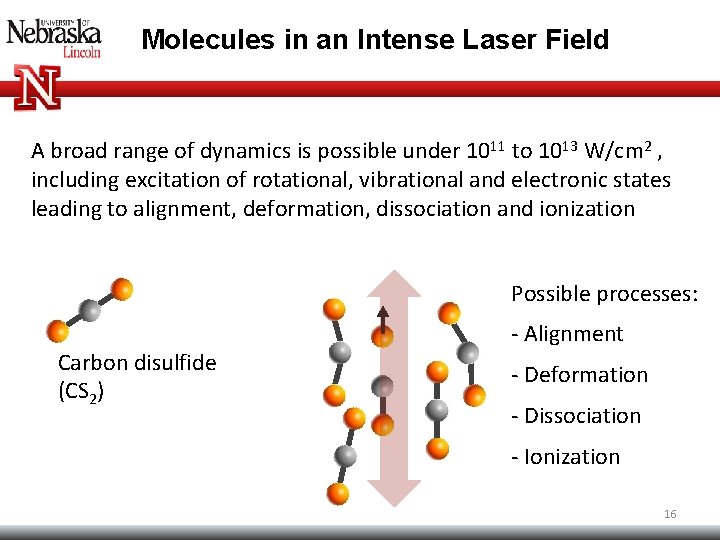
Molecules in an Intense Laser Field A broad range of dynamics is possible under 1011 to 1013 W/cm 2 , including excitation of rotational, vibrational and electronic states leading to alignment, deformation, dissociation and ionization Possible processes: Carbon disulfide (CS 2) - Alignment - Deformation - Dissociation - Ionization 16
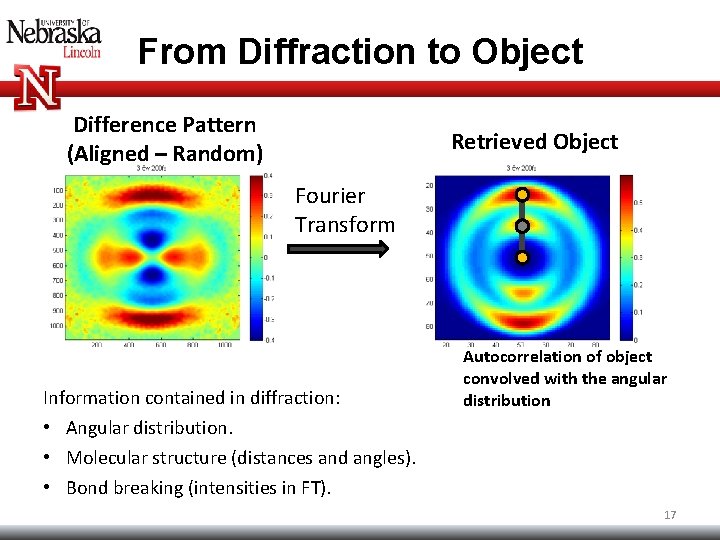
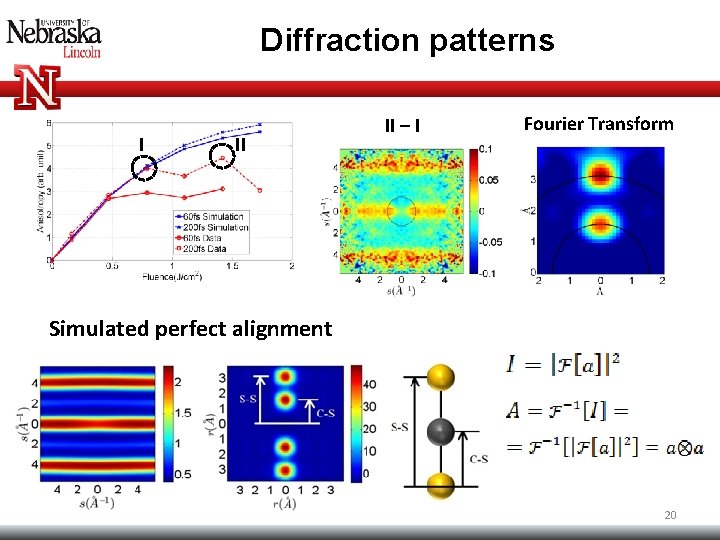
From Diffraction to Object Difference Pattern (Aligned – Random) Retrieved Object Fourier Transform Information contained in diffraction: Autocorrelation of object convolved with the angular distribution • Angular distribution. • Molecular structure (distances and angles). • Bond breaking (intensities in FT). 17
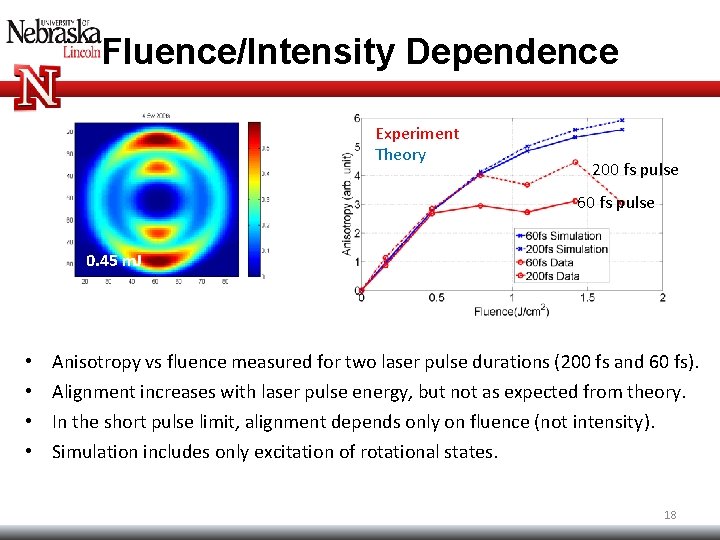
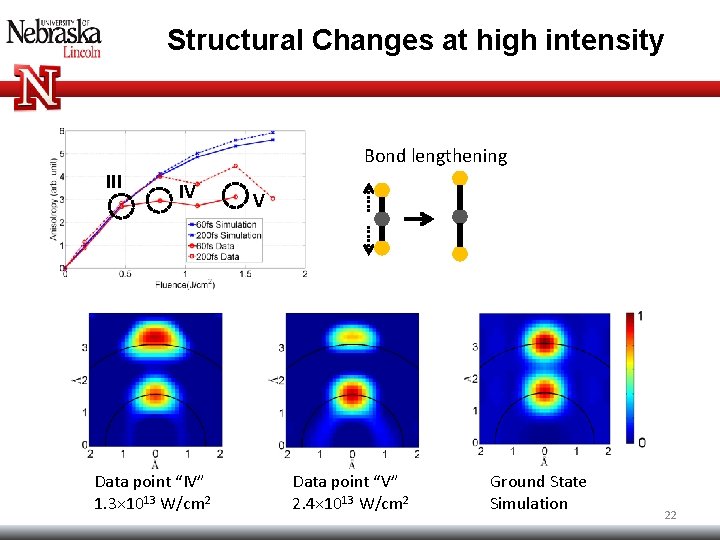
Fluence/Intensity Dependence Experiment Theory 200 fs pulse 60 fs pulse 0. 05 0. 15 0. 25 0. 35 m. J 0. 45 • • Anisotropy vs fluence measured for two laser pulse durations (200 fs and 60 fs). Alignment increases with laser pulse energy, but not as expected from theory. In the short pulse limit, alignment depends only on fluence (not intensity). Simulation includes only excitation of rotational states. 18
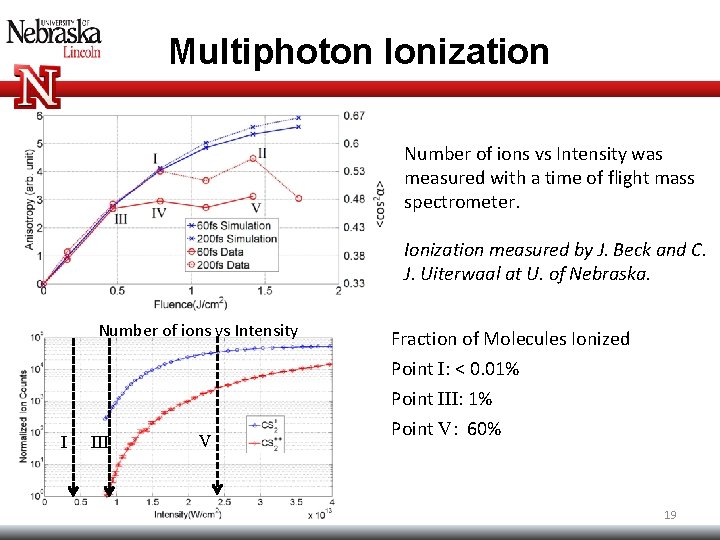
Multiphoton Ionization Number of ions vs Intensity was measured with a time of flight mass spectrometer. Ionization measured by J. Beck and C. J. Uiterwaal at U. of Nebraska. Number of ions vs Intensity I III V Fraction of Molecules Ionized Point I: < 0. 01% Point III: 1% Point V: 60% 19
Diffraction patterns I II II – I Fourier Transform Simulated perfect alignment 20
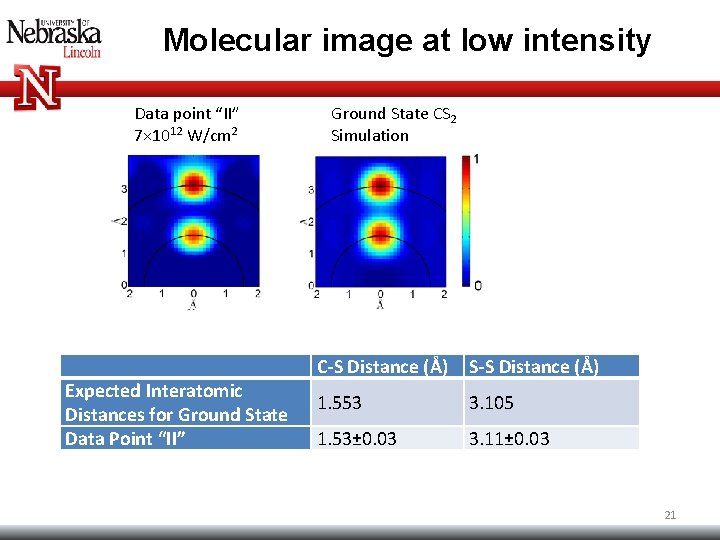
Molecular image at low intensity Data point “II” 7× 10¹² W/cm 2 Expected Interatomic Distances for Ground State Data Point “II” Ground State CS 2 Simulation C-S Distance (Å) S-S Distance (Å) 1. 553 3. 105 1. 53± 0. 03 3. 11± 0. 03 21
Structural Changes at high intensity Bond lengthening III IV V Simulated 1 B Excited state 2 Data point “IV” 1. 3× 10¹³ W/cm 2 Data point “V” 2. 4× 10¹³ W/cm 2 Ground State Simulation 22
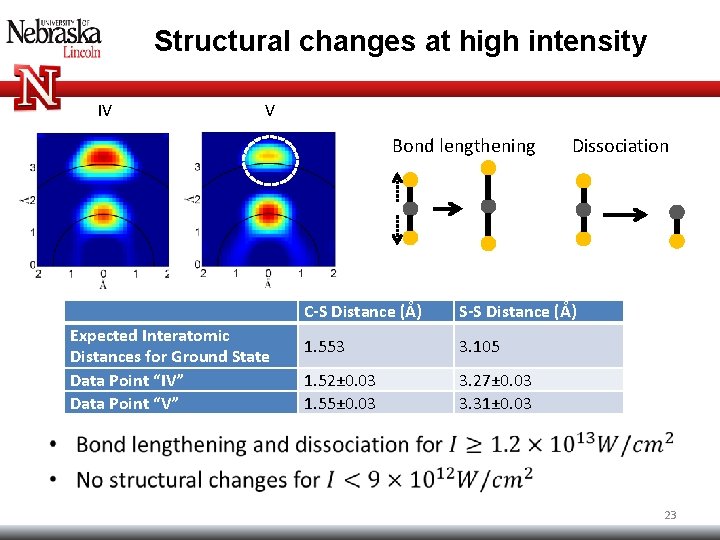
Structural changes at high intensity IV V Bond lengthening Expected Interatomic Distances for Ground State Data Point “IV” Data Point “V” Dissociation C-S Distance (Å) S-S Distance (Å) 1. 553 3. 105 1. 52± 0. 03 1. 55± 0. 03 3. 27± 0. 03 3. 31± 0. 03 23
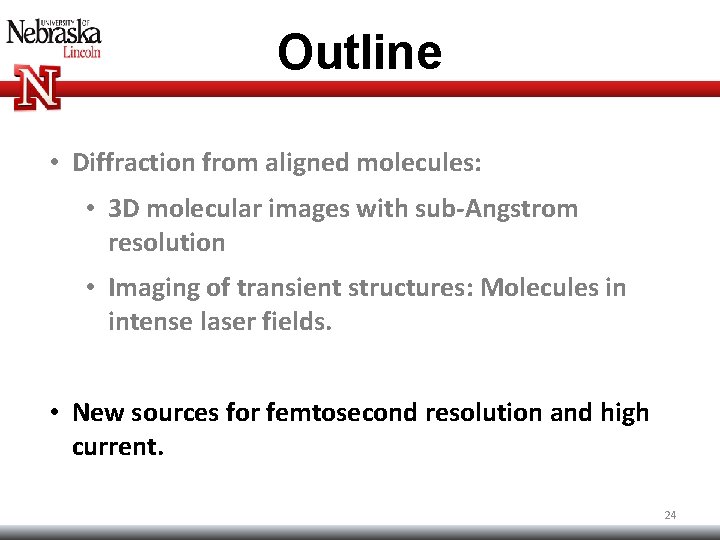
Outline • Diffraction from aligned molecules: • 3 D molecular images with sub-Angstrom resolution • Imaging of transient structures: Molecules in intense laser fields. • New sources for femtosecond resolution and high current. 24
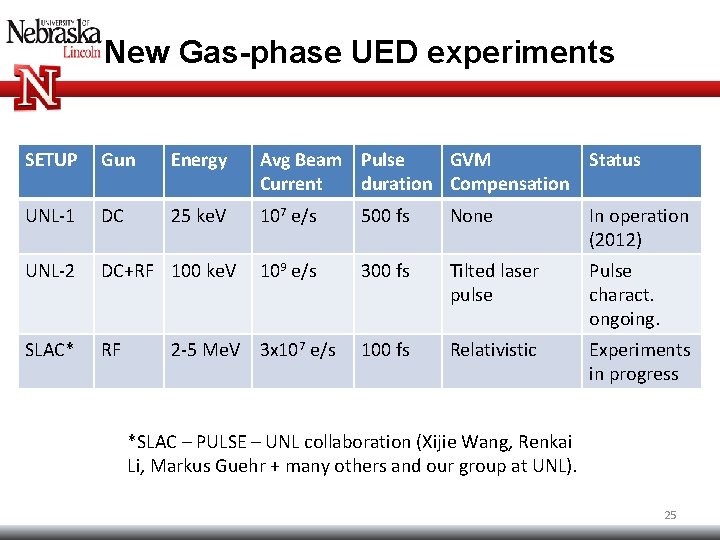
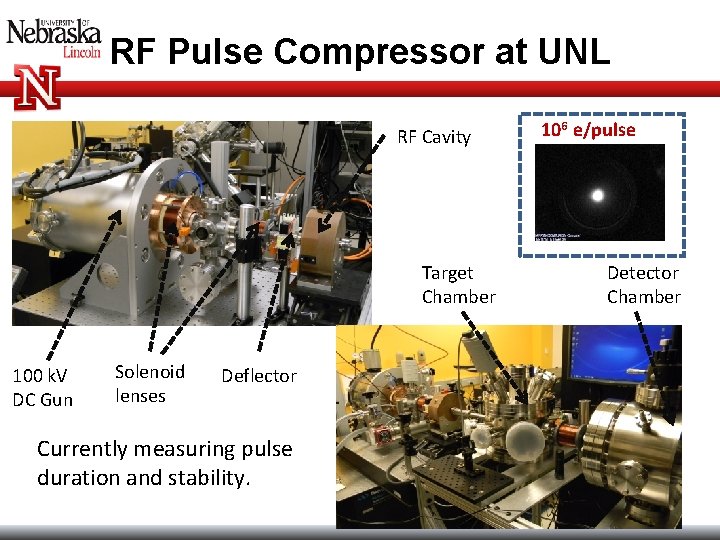
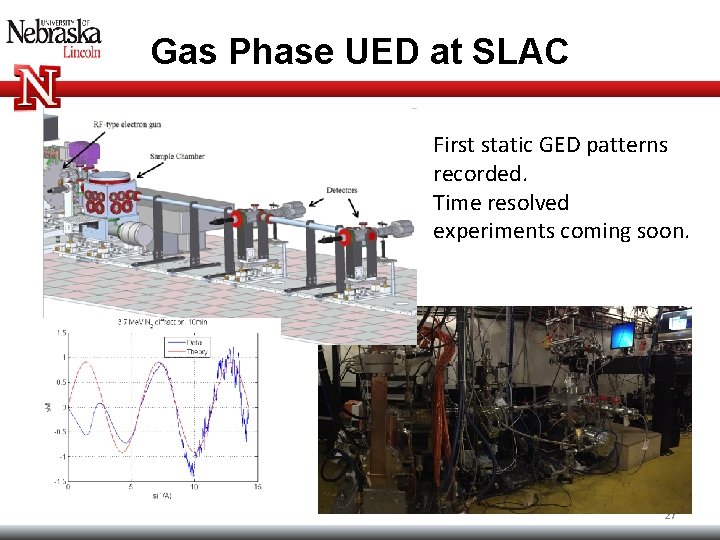
New Gas-phase UED experiments SETUP Gun Energy Avg Beam Pulse GVM Status Current duration Compensation UNL-1 DC 25 ke. V 107 e/s 500 fs None In operation (2012) UNL-2 DC+RF 100 ke. V 109 e/s 300 fs Tilted laser pulse Pulse charact. ongoing. SLAC* RF 100 fs Relativistic Experiments in progress 2 -5 Me. V 3 x 10⁷ e/s *SLAC – PULSE – UNL collaboration (Xijie Wang, Renkai Li, Markus Guehr + many others and our group at UNL). 25
RF Pulse Compressor at UNL RF Cavity Target Chamber 100 k. V DC Gun Solenoid lenses 106 e/pulse Detector Chamber Deflector Currently measuring pulse duration and stability. 26
Gas Phase UED at SLAC First static GED patterns recorded. Time resolved experiments coming soon. 27
Summary • 3 D imaging is possible with laser-aligned molecules. Molecules can be probed in a field free environment. • Imaging of molecular dynamics of CS 2 under high intensity. • Improved spatial and temporal resolution will be available with new sources. This work was supported by the U. S. Department of Energy (DOE), Office of Science, Basic Energy Sciences (BES) under Grant # DESC 0003931 and by the Air Force Office of Scientific Research, Ultrashort Pulse Laser Matter Interaction program, under grant # FA 9550 -12 -1 -0149. . 28