
Ultracold Neutron Fundamental Physics at LANSCE Alexander Saunders
- Slides: 34
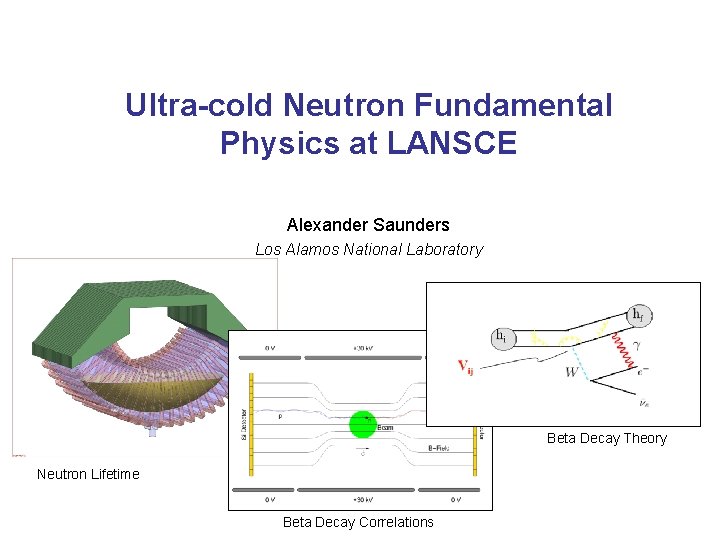
Ultra-cold Neutron Fundamental Physics at LANSCE Alexander Saunders Los Alamos National Laboratory Beta Decay Theory Neutron Lifetime Beta Decay Correlations
Outline • Introduction: why neutron beta decay allows search for physics beyond the Standard Model • Ultra-cold neutrons • UCNA experiment: progress and goals • UCN Lifetime experiment prospects • A UCN user facility at LANSCE • The UCN effort world wide
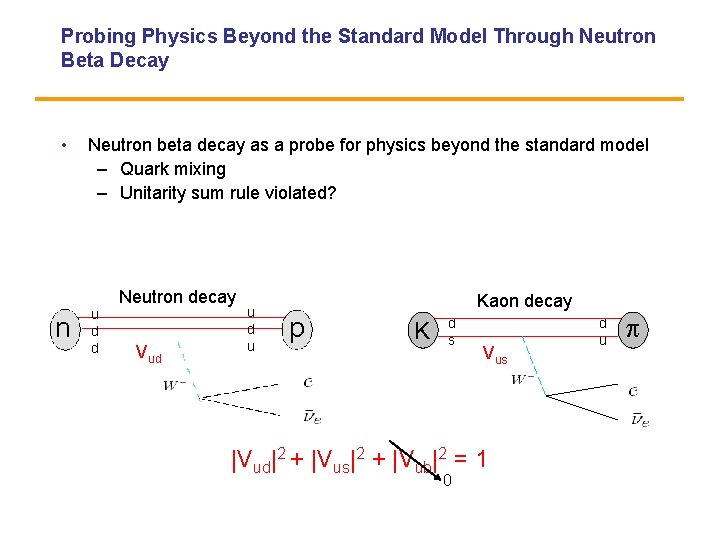
Probing Physics Beyond the Standard Model Through Neutron Beta Decay • n Neutron beta decay as a probe for physics beyond the standard model – Quark mixing – Unitarity sum rule violated? u d d Neutron decay Vud u Kaon decay p K d s Vus |Vud|2 + |Vus|2 + |Vub|2 = 1 0 d u
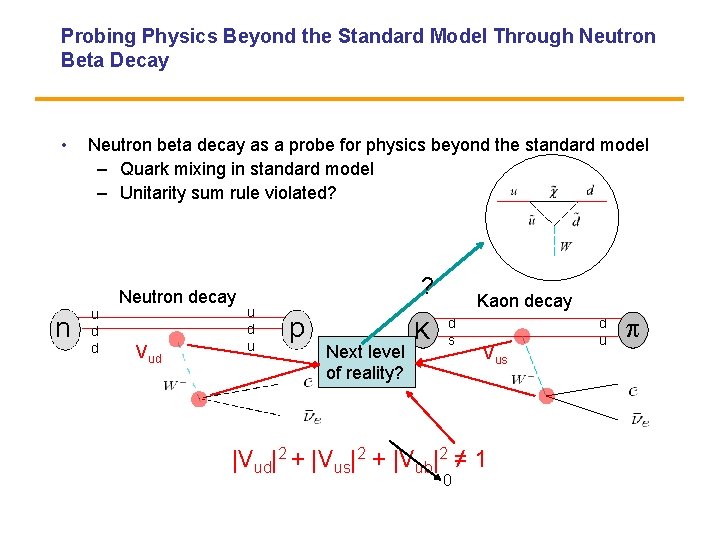
Probing Physics Beyond the Standard Model Through Neutron Beta Decay • n Neutron beta decay as a probe for physics beyond the standard model – Quark mixing in standard model – Unitarity sum rule violated? u d d Neutron decay Vud ? u d u p Next level of reality? K Kaon decay d s Vus |Vud|2 + |Vus|2 + |Vub|2 ≠ 1 0 d u
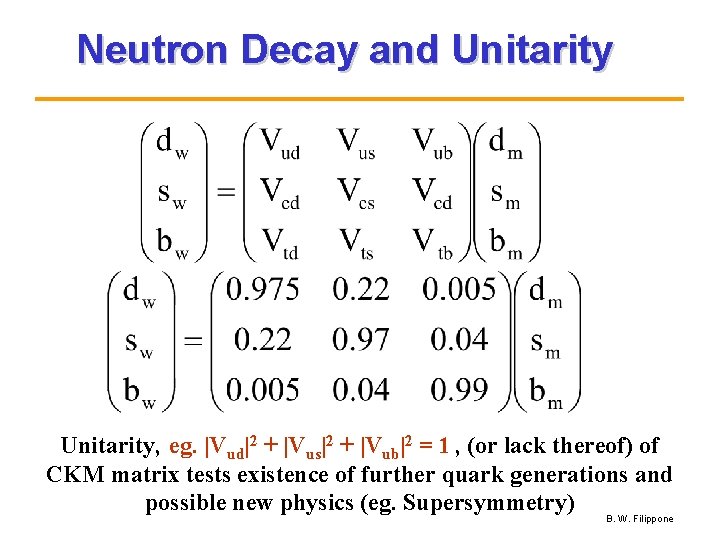
Neutron Decay and Unitarity, eg. |Vud|2 + |Vus|2 + |Vub|2 = 1 , (or lack thereof) of CKM matrix tests existence of further quark generations and possible new physics (eg. Supersymmetry) B. W. Filippone
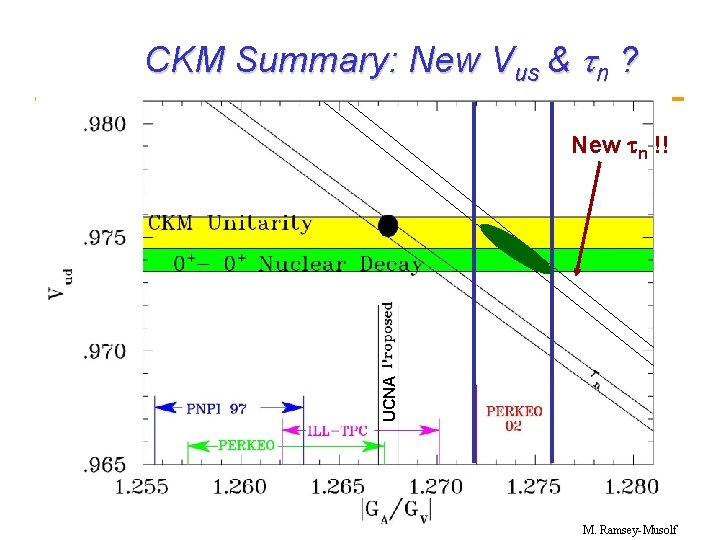
CKM Summary: New Vus & n ? UCNA New tn !! M. Ramsey-Musolf
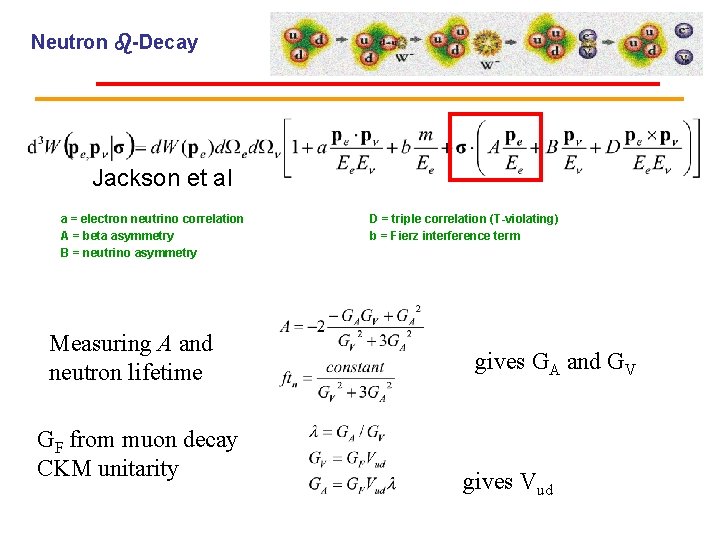
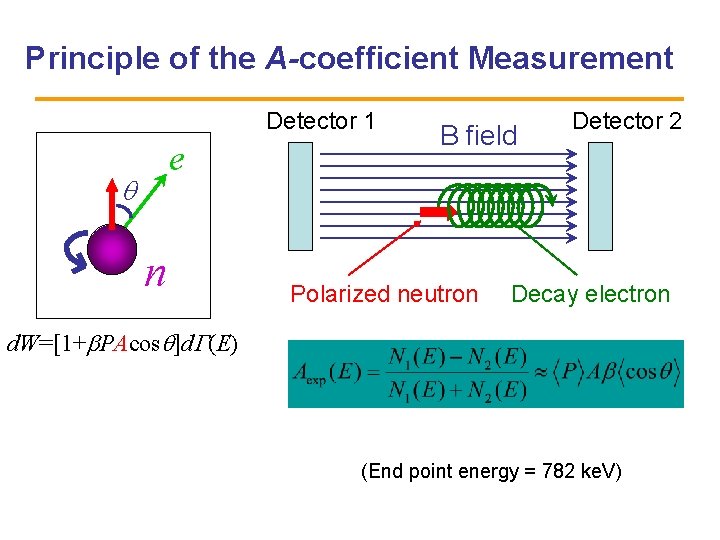
Neutron -Decay Jackson et al a = electron neutrino correlation A = beta asymmetry B = neutrino asymmetry Measuring A and neutron lifetime GF from muon decay CKM unitarity D = triple correlation (T-violating) b = Fierz interference term gives GA and GV gives Vud
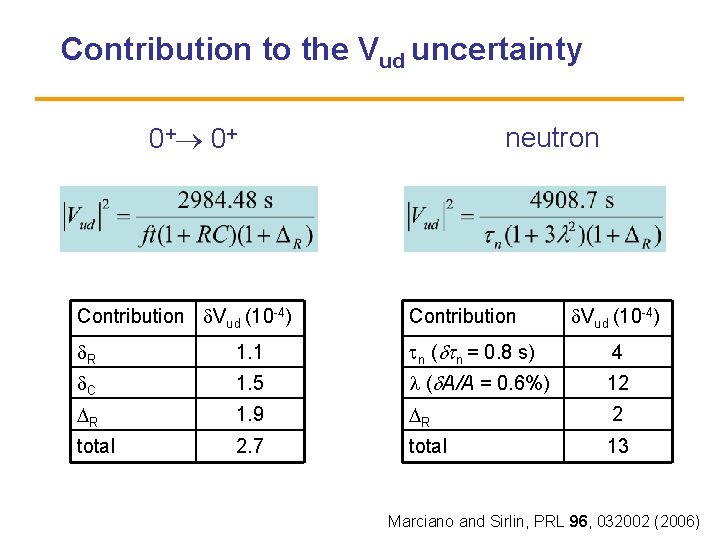
Contribution to the Vud uncertainty 0+ neutron Contribution Vud (10 -4) Contribution Vud (10 -4) R 1. 1 n ( n = 0. 8 s) 4 C 1. 5 ( A/A = 0. 6%) 12 R 1. 9 R 2 total 2. 7 total 13 Marciano and Sirlin, PRL 96, 032002 (2006)
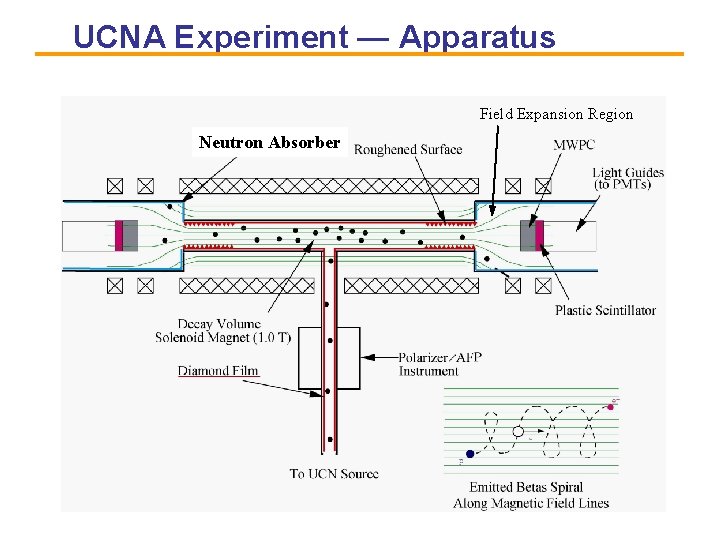
Principle of the A-coefficient Measurement Detector 1 e q n B field Polarized neutron Detector 2 Decay electron d. W=[1+b. PAcosq]d. G(E) (End point energy = 782 ke. V)
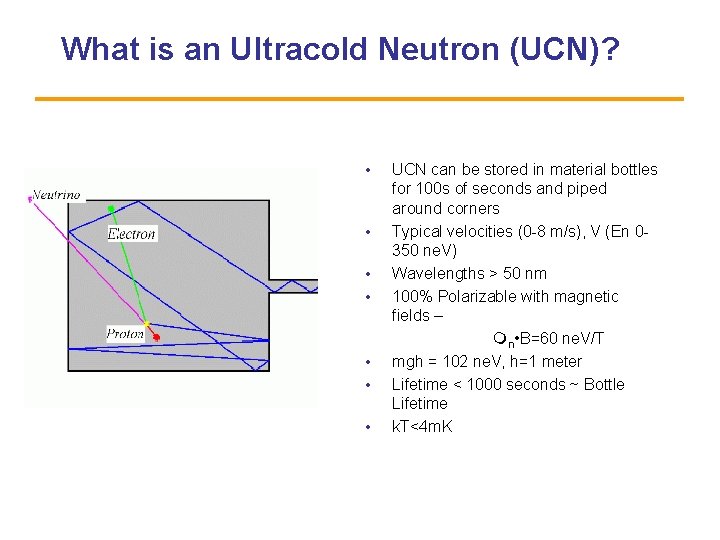
What is an Ultracold Neutron (UCN)? • • UCN can be stored in material bottles for 100 s of seconds and piped around corners Typical velocities (0 -8 m/s), V (En 0350 ne. V) Wavelengths > 50 nm 100% Polarizable with magnetic fields – mn • B=60 ne. V/T mgh = 102 ne. V, h=1 meter Lifetime < 1000 seconds ~ Bottle Lifetime k. T<4 m. K
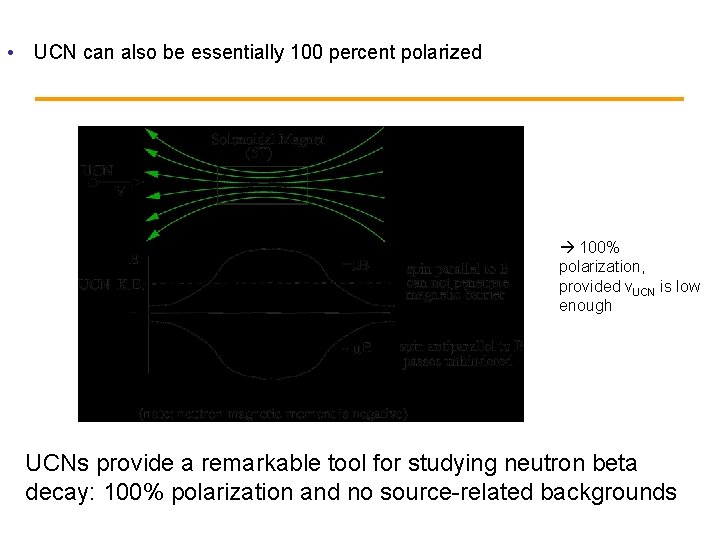
• UCN can also be essentially 100 percent polarized 100% polarization, provided v. UCN is low enough UCNs provide a remarkable tool for studying neutron beta decay: 100% polarization and no source-related backgrounds
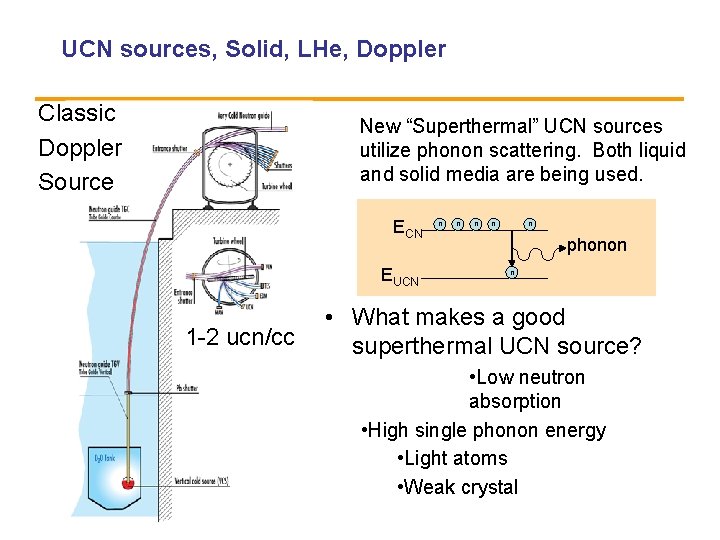
UCN sources, Solid, LHe, Doppler Classic Doppler Source New “Superthermal” UCN sources utilize phonon scattering. Both liquid and solid media are being used. ECN EUCN 1 -2 ucn/cc n n n phonon n • What makes a good superthermal UCN source? • Low neutron absorption • High single phonon energy • Light atoms • Weak crystal
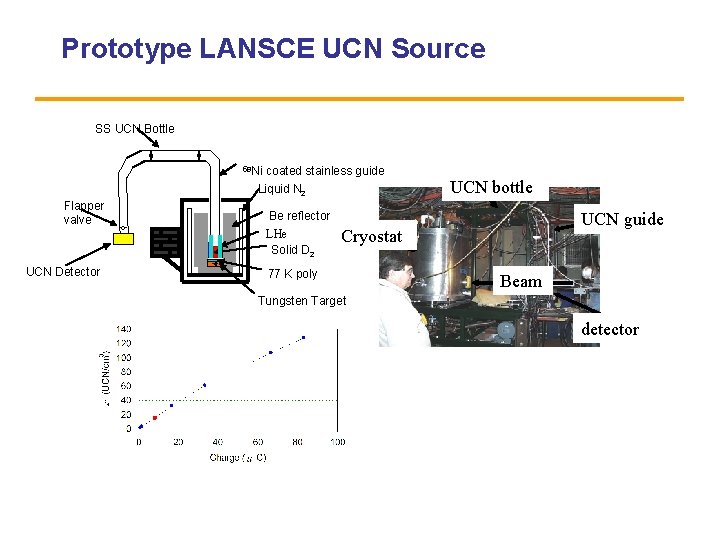
Prototype LANSCE UCN Source SS UCN Bottle 58 Ni coated stainless guide Liquid N 2 Flapper valve UCN guide Be reflector LHe Solid D 2 UCN Detector UCN bottle Cryostat 77 K poly Beam Tungsten Target detector
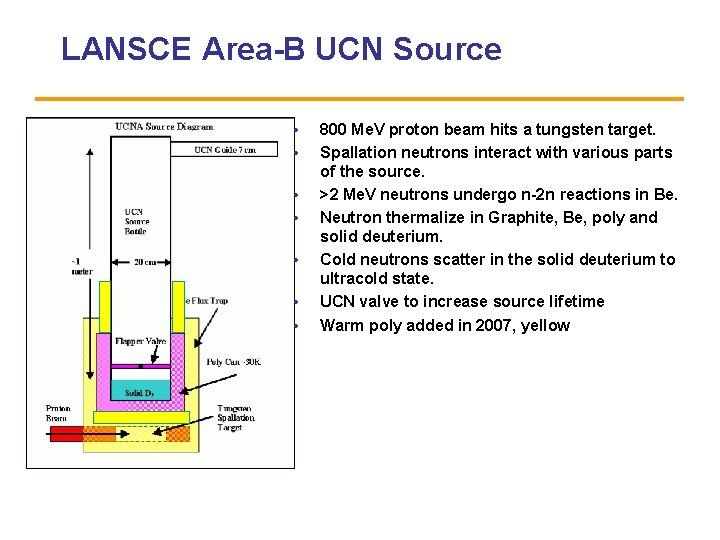
LANSCE Area-B UCN Source • • 800 Me. V proton beam hits a tungsten target. Spallation neutrons interact with various parts of the source. >2 Me. V neutrons undergo n-2 n reactions in Be. Neutron thermalize in Graphite, Be, poly and solid deuterium. Cold neutrons scatter in the solid deuterium to ultracold state. UCN valve to increase source lifetime Warm poly added in 2007, yellow
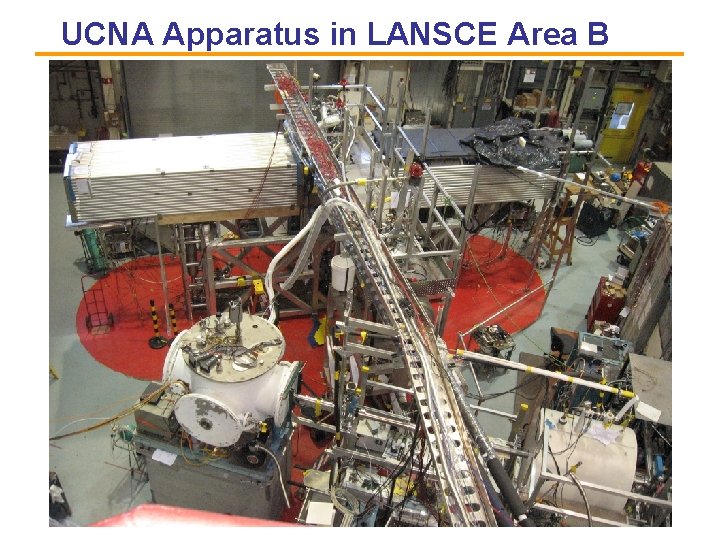
UCNA Experiment — Apparatus Field Expansion Region Neutron Absorber
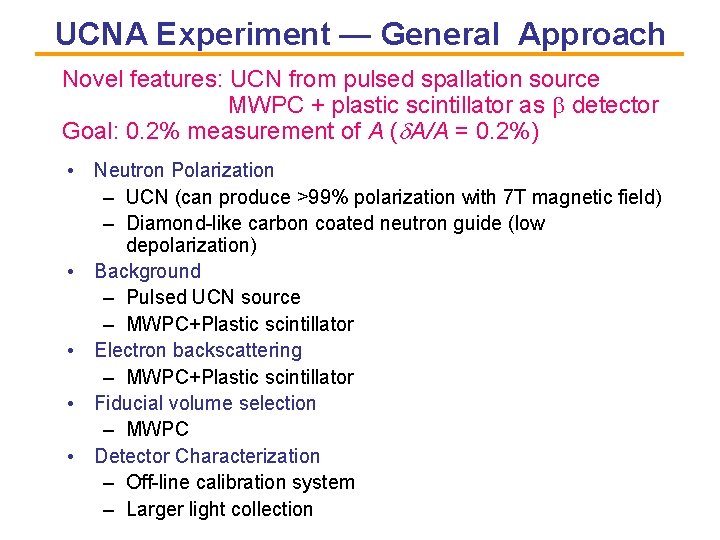
UCNA Experiment — General Approach Novel features: UCN from pulsed spallation source MWPC + plastic scintillator as detector Goal: 0. 2% measurement of A ( A/A = 0. 2%) • Neutron Polarization – UCN (can produce >99% polarization with 7 T magnetic field) – Diamond-like carbon coated neutron guide (low depolarization) • Background – Pulsed UCN source – MWPC+Plastic scintillator • Electron backscattering – MWPC+Plastic scintillator • Fiducial volume selection – MWPC • Detector Characterization – Off-line calibration system – Larger light collection
UCNA Apparatus in LANSCE Area B
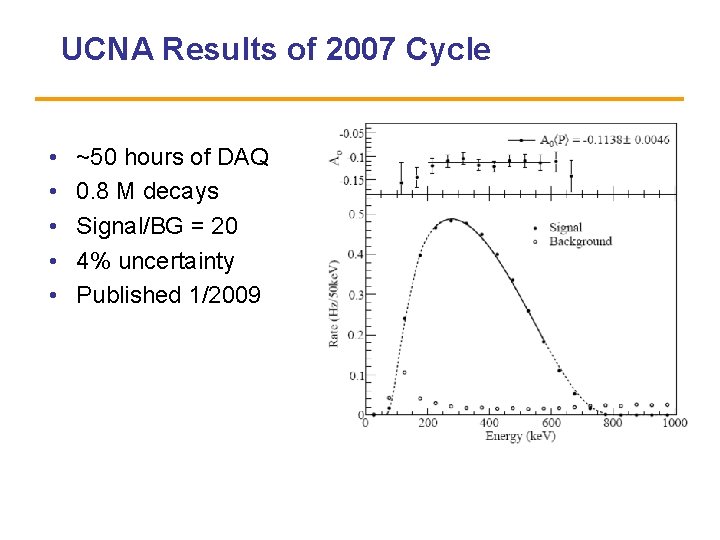
UCNA Results of 2007 Cycle • • • ~50 hours of DAQ 0. 8 M decays Signal/BG = 20 4% uncertainty Published 1/2009
2007 Systematic Uncertainties
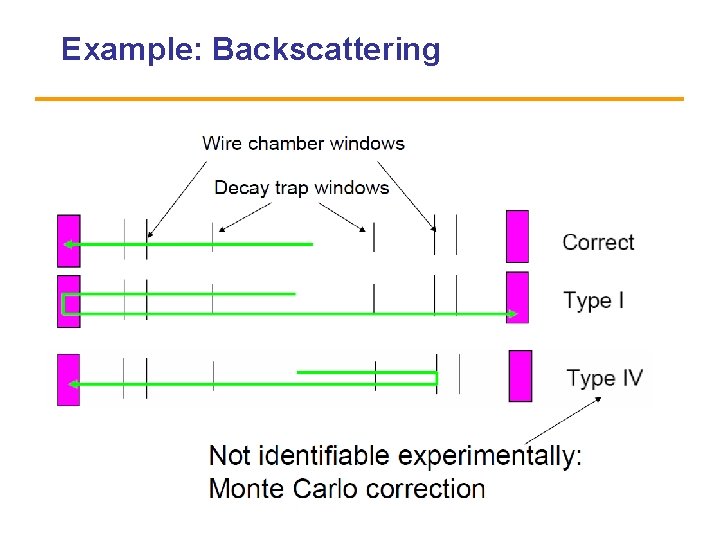
Example: Backscattering
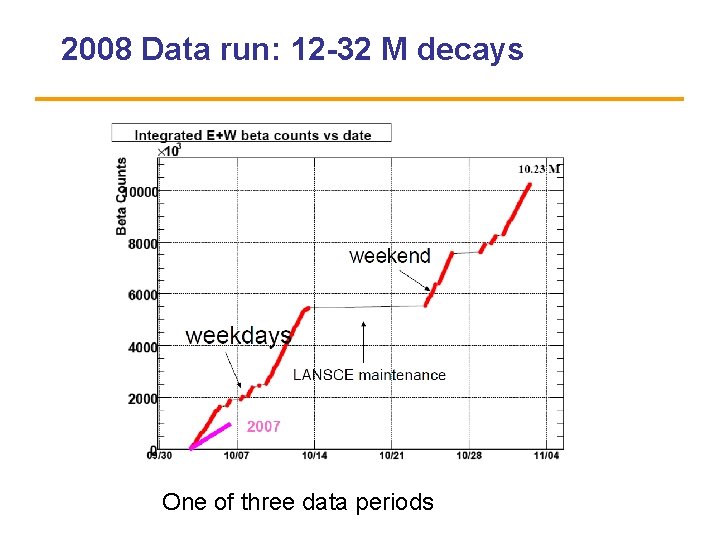
2008 Data run: 12 -32 M decays One of three data periods
A Correlation history UCNA 2007 PDG Value w/ 2. 3 x inflation
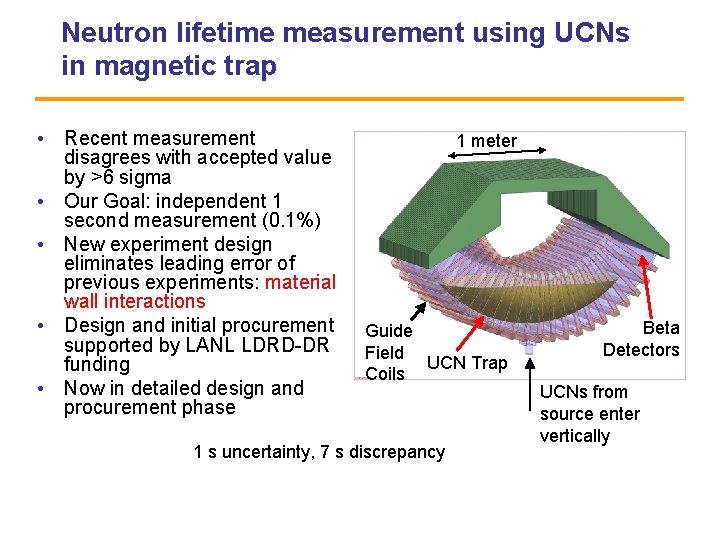
Neutron lifetime measurement using UCNs in magnetic trap • Recent measurement disagrees with accepted value by >6 sigma • Our Goal: independent 1 second measurement (0. 1%) • New experiment design eliminates leading error of previous experiments: material wall interactions • Design and initial procurement supported by LANL LDRD-DR funding • Now in detailed design and procurement phase 1 meter Guide Field UCN Trap Coils 1 s uncertainty, 7 s discrepancy Beta Detectors UCNs from source enter vertically
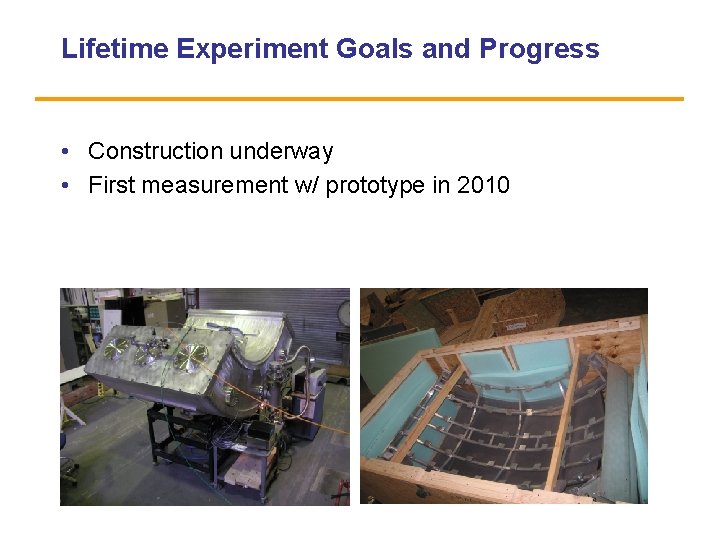
Lifetime Experiment Goals and Progress • Construction underway • First measurement w/ prototype in 2010
The future: a UCN User Facility at LANSCE • • Fundamental physics with UCN in the U. S. – 1995: about 5 active US faculty and staff – 2009: 44 active US faculty and staff – 7 current projects (5 based in the US) UCN Sources in US – Around 1995, only source in world of extracted UCN for experiments – Steyerl rotor at ILL – 1995, superthermal LHe source development began at NIST for dedicated lifetime experiment – no extracted UCN capability – 1998, SD 2 source development began at LANL – 2004, first tests of production SD 2 source at LANL – 2005, SD 2 source development began at PULSTAR: much smaller than LANL source; first tests expected in 2010 – 2007, superthermal LHe source development began at SNS for dedicated EDM experiment – no extracted UCN capability 2009, LANL source remains the only, operational source for extracted UCN in the US
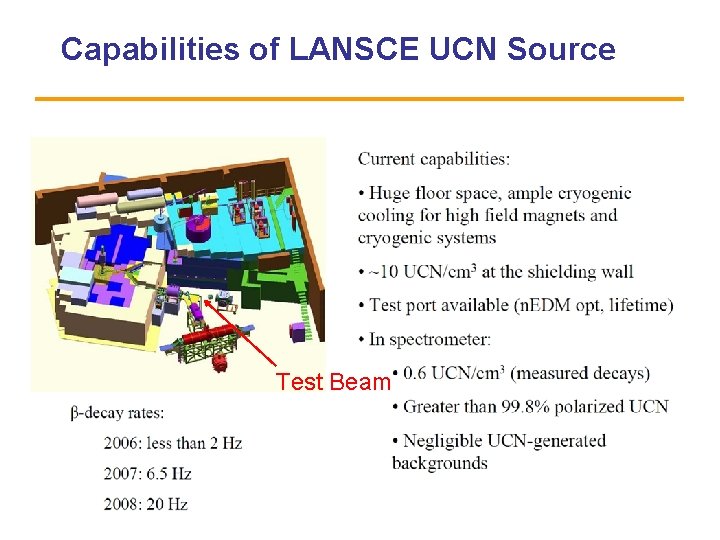
Capabilities of LANSCE UCN Source Test Beam
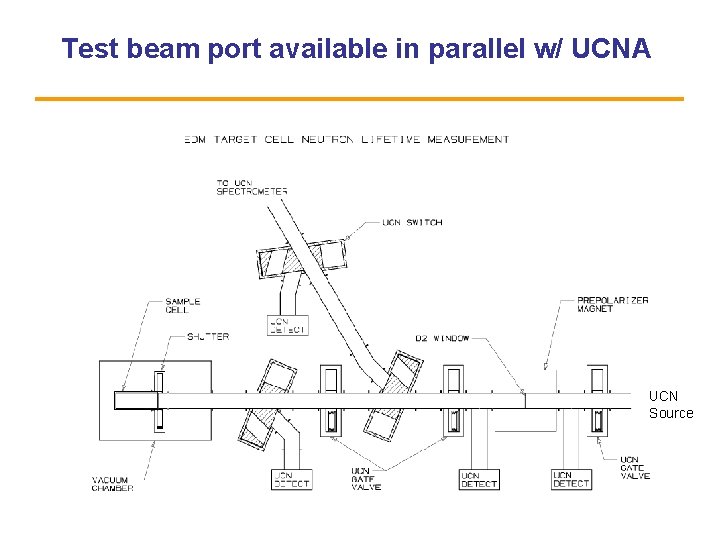
Test beam port available in parallel w/ UCNA UCN Source
Possible Experiments for User Facility • Neutron EDM experiment engineering and optimization (n. EDM collaboration) • Neutron beta decay measurements – Neutron lifetime (Saunders et al. ) – Beta asymmetry measurements (UCNb, ab. BA, UCNB) • Short ranged forces and quantum gravity (Baessler, NIST) • Neutron interactions with surfaces and solids (Korobkina) • NNbar development (NNbar collaboration) • UCN source technology development (Liu et al. )
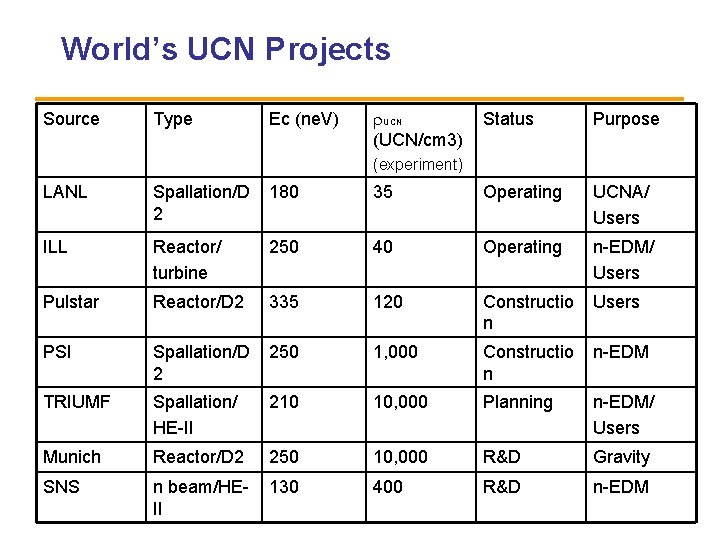
World’s UCN Projects Source Type Ec (ne. V) r. UCN (UCN/cm 3) Status Purpose (experiment) LANL Spallation/D 2 180 35 Operating UCNA/ Users ILL Reactor/ turbine 250 40 Operating n-EDM/ Users Pulstar Reactor/D 2 335 120 Constructio n Users PSI Spallation/D 2 250 1, 000 Constructio n n-EDM TRIUMF Spallation/ HE-II 210 10, 000 Planning n-EDM/ Users Munich Reactor/D 2 250 10, 000 R&D Gravity SNS n beam/HEII 130 400 R&D n-EDM
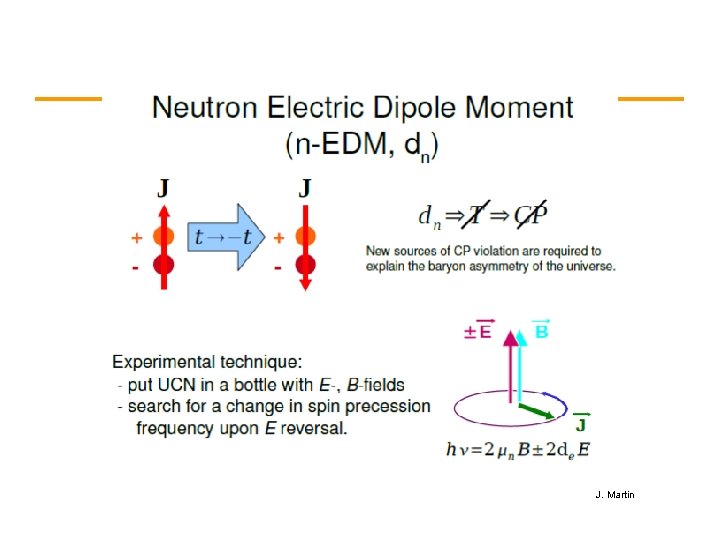
J. Martin
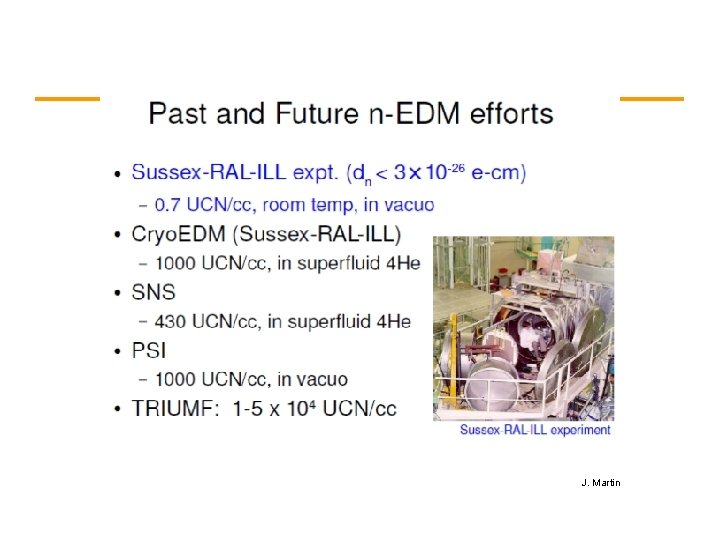
J. Martin
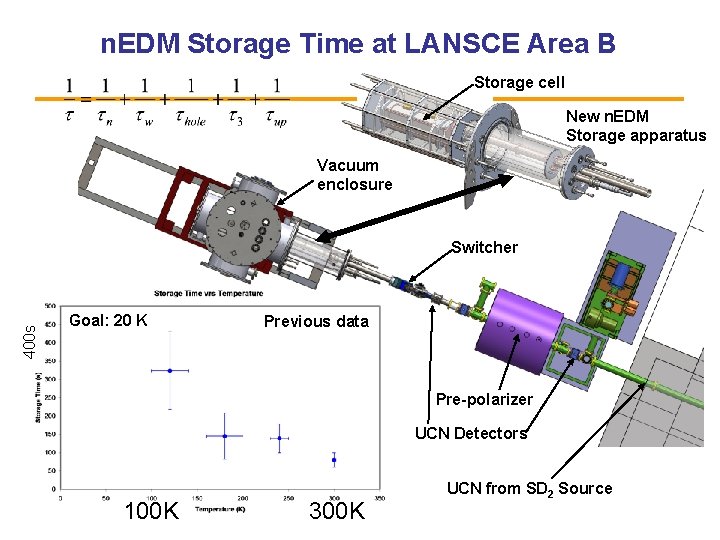
n. EDM Storage Time at LANSCE Area B Storage cell New n. EDM Storage apparatus Vacuum enclosure 400 s Switcher Goal: 20 K Previous data Pre-polarizer UCN Detectors 100 K 300 K UCN from SD 2 Source
Summary • Ultra-cold neutrons provide a unique tool for studying fundamental weak nuclear interactions and searching for physics beyond the standard model • UCNA experiment, in progress, promises world’s best measurement of A correlation parameter • Neutron lifetime experiment will break new ground • UCN facilities are operating or under construction world wide to exploit this growing field
UCNA Collaboration R. W. Pattie, Jr. , 1, 2 J. Anaya, 3 H. O. Back, 1, 2 J. G. Boissevain, 3 T. J. Bowles, 3 L. J. Broussard, 2, 4 R. Carr, 5 D. J. Clark, 3 S. Currie, 3 S. Du, 1 B. W. Filippone, 5 P. Geltenbort, 6 A. García, 7 A. Hawari, 8 K. P. Hickerson, 5 R. Hill, 3 M. Hino, 9 S. A. Hoedl, 7, 10 G. E. Hogan, 3 A. T. Holley, 1 T. M. Ito, 3, 5 T. Kawai, 9 K. Kirch, 3 S. Kitagaki, 11 S. K. Lamoreaux, 3 C. -Y. Liu, 10 J. Liu, 5 M. Makela, 3, 12 R. R. Mammei, 12 J. W. Martin, 5, 13 D. Melconian, 7, 14 N. Meier, 1 M. P. Mendenhall, 5 C. L. Morris, 3 R. Mortensen, 3 A. Pichlmaier, 3 M. L. Pitt, 12 B. Plaster, 5, 15 J. C. Ramsey, 3 R. Rios, 3, 16 K. Sabourov, 1 A. L. Sallaska, 7 A. Saunders, 3 R. Schmid, 5 S. Seestrom, 3 C. Servicky, 1 S. K. L. Sjue, 7 D. Smith, 1 W. E. Sondheim, 3 E. Tatar, 16 W. Teasdale, 3 C. Terai, 1 B. Tipton, 5 M. Utsuro, 9 R. B. Vogelaar, 12 B. W. Wehring, 8 Y. P. Xu, 1 A. R. Young, 1, 2 and J. Yuan 5 1 Department of Physics, North Carolina State University, Raleigh, North Carolina 27695, USA 2 Triangle Universities Nuclear Laboratory, Durham, North Carolina 27708, USA 3 Los Alamos National Laboratory, Los Alamos, New Mexico 87545, USA 4 Department of Physics, Duke University, Durham, North Carolina 27708, USA 5 W. K. Kellogg Radiation Laboratory, California Institute of Technology, Pasadena, California 91125, USA 6 Institut Laue-Langevin, 38042 Grenoble Cedex 9, France 7 Physics Department, University of Washington, Seattle, Washington 98195, USA 8 Department of Nuclear Engineering, North Carolina State University, Raleigh, North Carolina 27695, USA 9 Research Reactor Institute, Kyoto University, Kumatori, Osaka, 590 -0401, Japan 10 Physics Department, Princeton University, Princeton, New Jersey 08544, USA 11 Tohoku University, Sendai 980 -8578, Japan 12 Department of Physics, Virginia Tech, Blacksburg, Virginia 24061, USA 13 Department of Physics, University of Winnipeg, MB R 3 B 2 E 9, Canada 14 Cyclotron Institute, Texas A&M University, College Station, Texas 77843, USA 15 Department of Physics and Astronomy, University of Kentucky, Lexington, Kentucky 40506, USA 16 Department of Physics, Idaho State University, Pocatello, Idaho 83209, USA