
Ultracold and HighBrightness Electron Sources for Science Applications
Ultra-cold and High-Brightness Electron Sources for Science & Applications Swapan Chattopadhyay High Brightness Electron Source Workshop, June 29 - July 1, 2011

Emerging Sciences Driven by “Ultra-cold” and “High-brightness” Electron Beams Atomic, Molecular and Life Sciences Probing with “ultra-cold” electrons directly Probing with “Ultra-fast” and “Ultra-bright” Bursts of Colorful Light produced by the electrons Techniques Single-shot diffraction vs. “stroboscopic” mode of many shots Pump-probe Interrogation
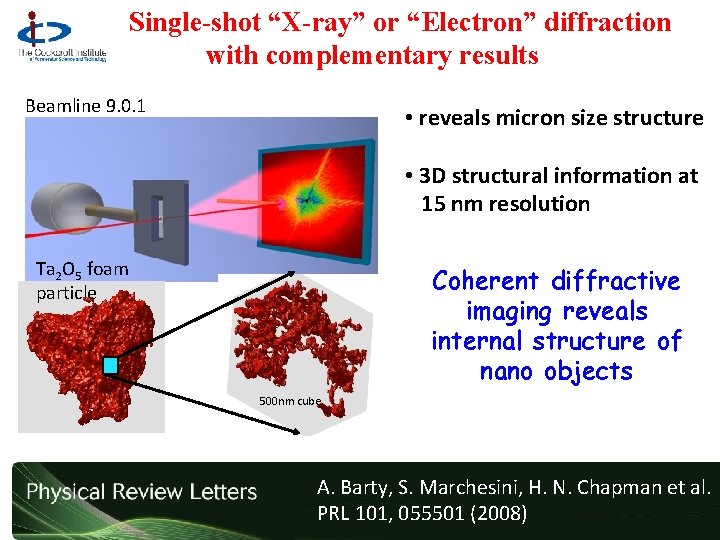
Single-shot “X-ray” or “Electron” diffraction with complementary results Beamline 9. 0. 1 • reveals micron size structure • 3 D structural information at 15 nm resolution Ta 2 O 5 foam particle Coherent diffractive imaging reveals internal structure of nano objects 500 nm cube A. Barty, S. Marchesini, H. N. Chapman et al. PRL 101, 055501 (2008)
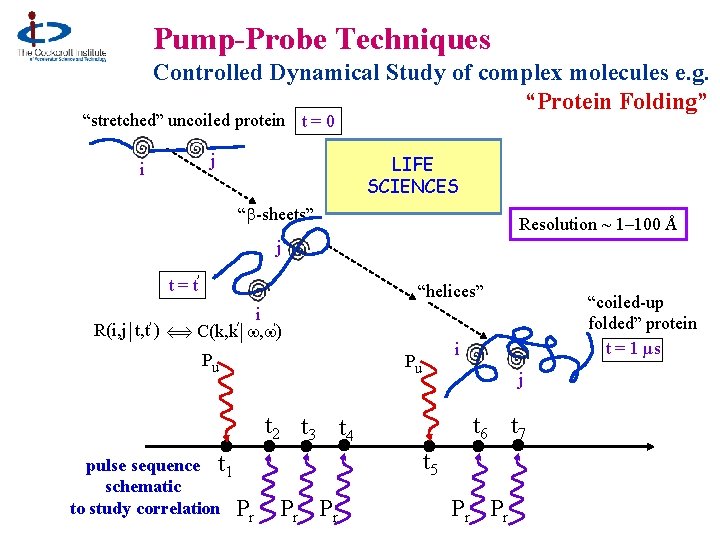
Pump-Probe Techniques Controlled Dynamical Study of complex molecules e. g. “Protein Folding” “stretched” uncoiled protein t = 0 j i LIFE SCIENCES “b-sheets” Resolution ~ 1– 100 Å j t=t R(i, j t, t ) “helices” i C(k, k w, w) Pu Pu t 2 t 3 t 4 pulse sequence t 1 schematic to study correlation Pr i j t 6 t 7 t 5 Pr Pr “coiled-up folded” protein t = 1 µs Pr Pr
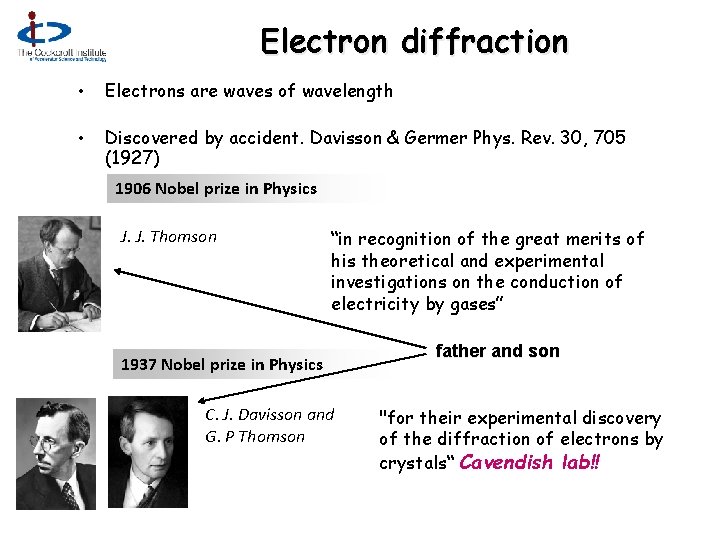
Electron diffraction • Electrons are waves of wavelength • Discovered by accident. Davisson & Germer Phys. Rev. 30, 705 (1927) 1906 Nobel prize in Physics J. J. Thomson “in recognition of the great merits of his theoretical and experimental investigations on the conduction of electricity by gases” 1937 Nobel prize in Physics C. J. Davisson and G. P Thomson father and son "for their experimental discovery of the diffraction of electrons by crystals“ Cavendish lab!!
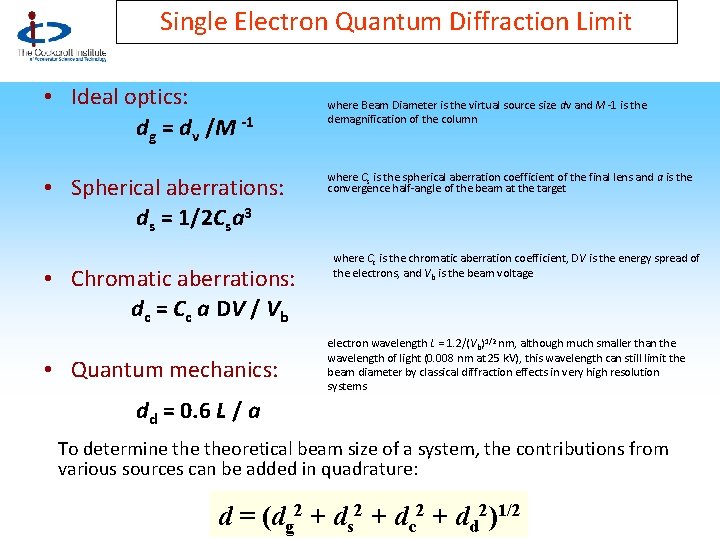
Single Electron Quantum Diffraction Limit • Ideal optics: dg = dv /M -1 • Spherical aberrations: ds = 1/2 Csa 3 • Chromatic aberrations: dc = Cc a DV / Vb • Quantum mechanics: where Beam Diameter is the virtual source size dv and M -1 is the demagnification of the column where Cs is the spherical aberration coefficient of the final lens and a is the convergence half-angle of the beam at the target where Cc is the chromatic aberration coefficient, DV is the energy spread of the electrons, and Vb is the beam voltage electron wavelength L = 1. 2/(Vb)1/2 nm, although much smaller than the wavelength of light (0. 008 nm at 25 k. V), this wavelength can still limit the beam diameter by classical diffraction effects in very high resolution systems dd = 0. 6 L / a To determine theoretical beam size of a system, the contributions from various sources can be added in quadrature: d = (dg 2 + ds 2 + dc 2 + dd 2)1/2
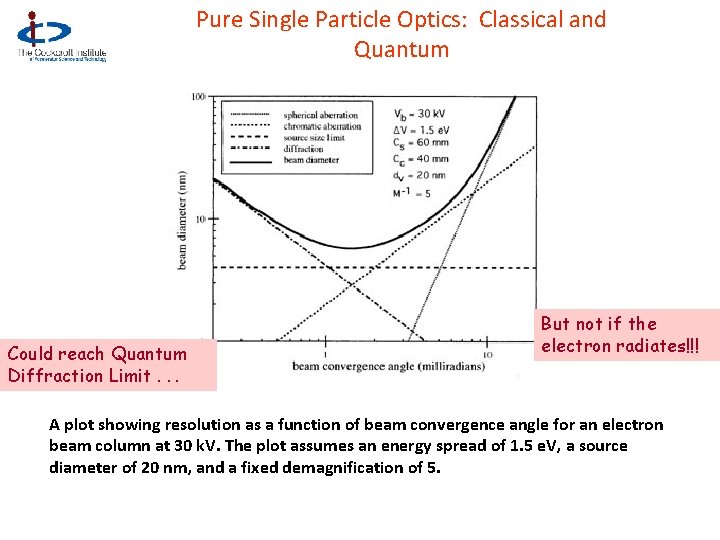
Pure Single Particle Optics: Classical and Quantum Could reach Quantum Diffraction Limit. . . But not if the electron radiates!!! A plot showing resolution as a function of beam convergence angle for an electron beam column at 30 k. V. The plot assumes an energy spread of 1. 5 e. V, a source diameter of 20 nm, and a fixed demagnification of 5.
“Ultra-Cold” Source Parameters for “Single-shot” Electron Diffraction Single pulse that generates an entire diffraction pattern in one shot: how to pack a large no. of electrons in an ultra-fast pulse such that its “transverse coherence length”, when focused to the sample size, is large enough to create a diffraction pattern of sufficient quality. Emittance or effective temperature must be small enough in order for all electrons to contribute to the diffraction pattern at the required coherence length and local electric accelerating field at the source must be substantially larger than Coulomb self-fields in order for the pulse not to be lengthened and transversely distorted. High Brightness Electron Source Workshop, June 29 - July 1, 2011

Example “Ultra-cold” Low Energy (sub. Me. V) Electron Source Characteristics: 6 X 10⁵ electrons (0. 1 p. C) Source size: 50 microns Source divergence: 1 mrad source temperature: 10 0 K Sample size: 100 microns Transverse Coherence length: 20 nm CHALLENGING!! But experiment of a lifetime! High Brightness Electron Source Workshop, June 29 - July 1, 2011

Lowest Temperature Achieved in the Laboratory Temperature Scales: Typical particle beam temperature at cathode is 1 e. V, could eventually be heated up to 1 ke. V Optical Cooling of Electrons/charge d Particle Beams? Atoms Enhanced Evaporative Cooling (BEC 2005)
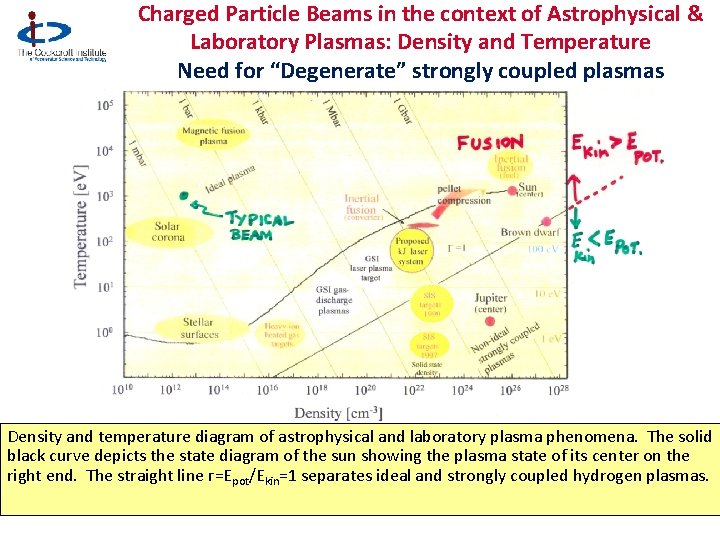
Charged Particle Beams in the context of Astrophysical & Laboratory Plasmas: Density and Temperature Need for “Degenerate” strongly coupled plasmas Density and temperature diagram of astrophysical and laboratory plasma phenomena. The solid black curve depicts the state diagram of the sun showing the plasma state of its center on the right end. The straight line г=Epot/Ekin=1 separates ideal and strongly coupled hydrogen plasmas.

Discovery of X-rays in 1895 Average brilliance of X-ray sources Wilhelm Conrad Röntgen absorption contrast
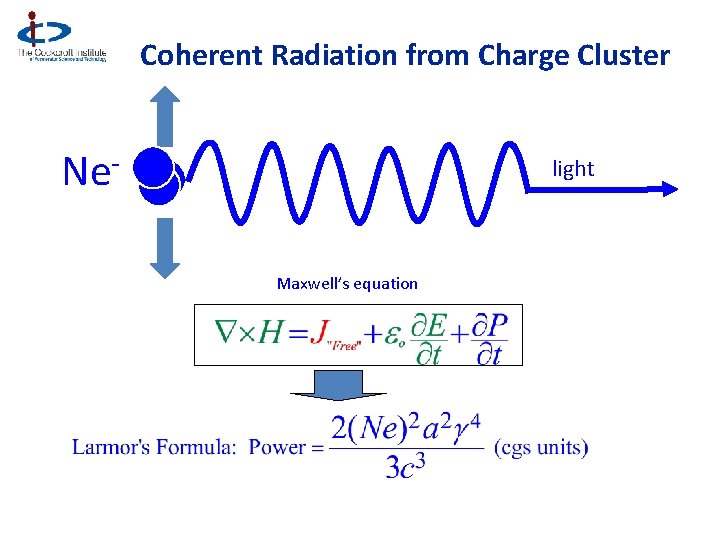
Coherent Radiation from Charge Cluster Ne light Maxwell’s equation

Generic Landscape – Average Brightness

Generic Landscape – Peak Brightness
Advanced X-ray Facilities
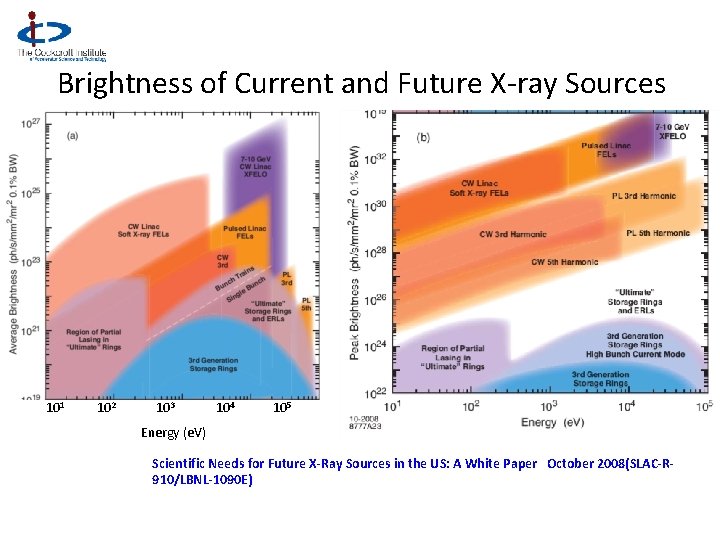
Brightness of Current and Future X-ray Sources 101 102 103 104 105 Energy (e. V) Scientific Needs for Future X-Ray Sources in the US: A White Paper October 2008(SLAC-R 910/LBNL-1090 E)
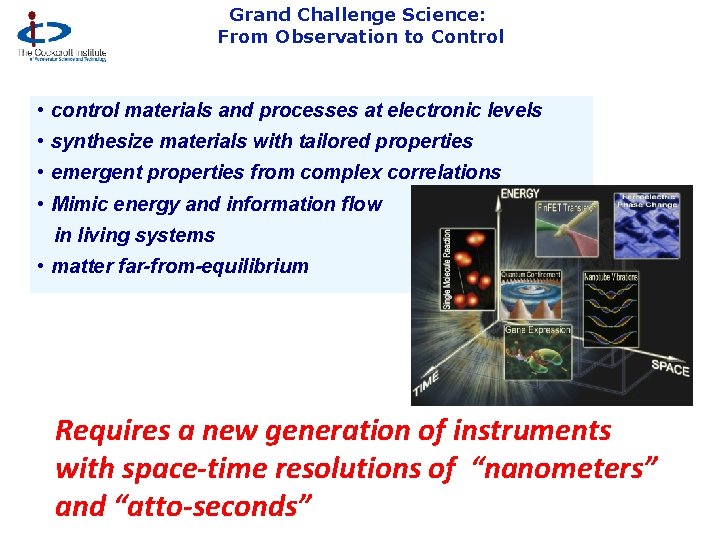
Grand Challenge Science: From Observation to Control • control materials and processes at electronic levels • synthesize materials with tailored properties • emergent properties from complex correlations • Mimic energy and information flow in living systems • matter far-from-equilibrium Requires a new generation of instruments with space-time resolutions of “nanometers” and “atto-seconds”
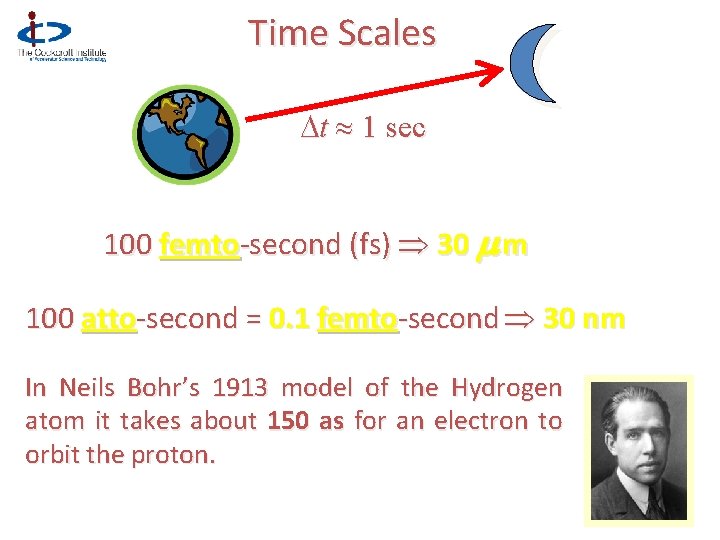
Time Scales Dt 1 sec 100 femto-second (fs) 30 m m 100 atto-second = 0. 1 femto-second 30 nm In Neils Bohr’s 1913 model of the Hydrogen atom it takes about 150 as for an electron to orbit the proton.
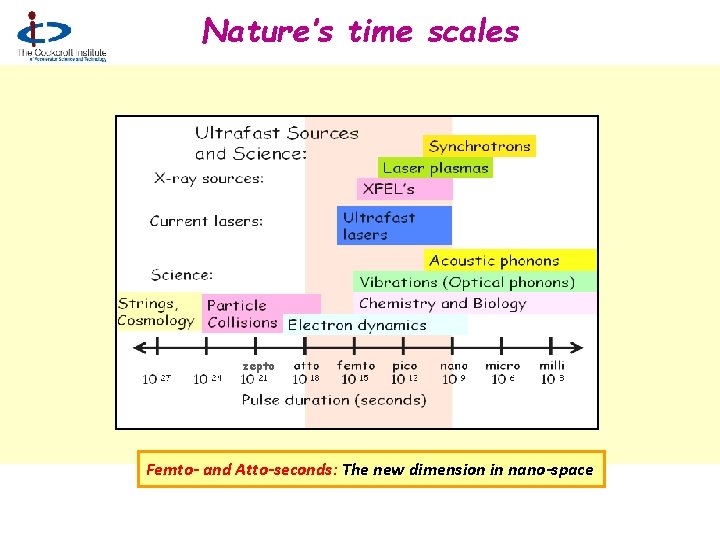
Nature’s time scales zepto Femto- and Atto-seconds: The new dimension in nano-space
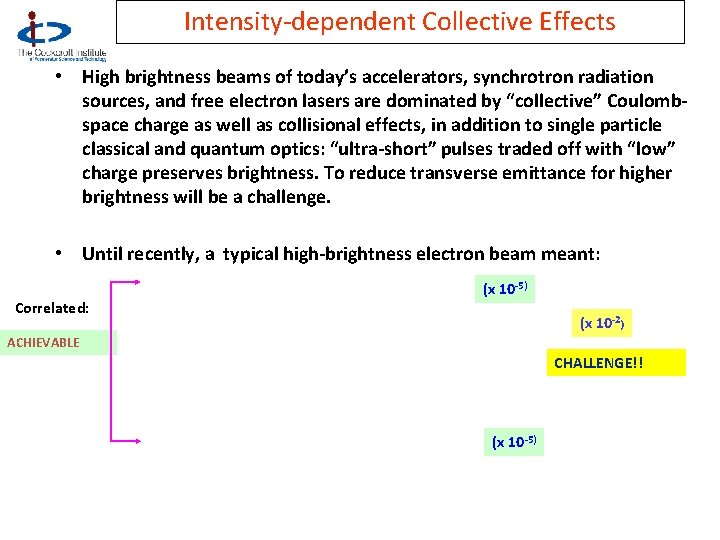
Intensity-dependent Collective Effects • High brightness beams of today’s accelerators, synchrotron radiation sources, and free electron lasers are dominated by “collective” Coulombspace charge as well as collisional effects, in addition to single particle classical and quantum optics: “ultra-short” pulses traded off with “low” charge preserves brightness. To reduce transverse emittance for higher brightness will be a challenge. • Until recently, a typical high-brightness electron beam meant: Correlated: (x 10 -5) (x 10 -2) ACHIEVABLE CHALLENGE!! (x 10 -5)
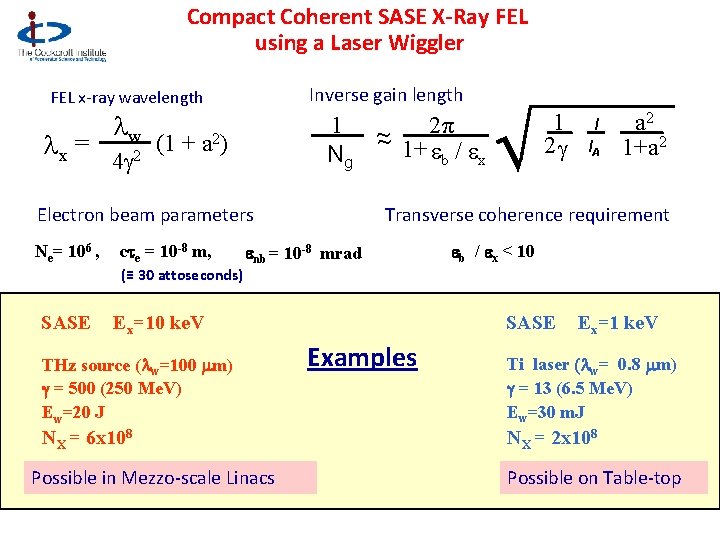
Compact Coherent SASE X-Ray FEL using a Laser Wiggler Inverse gain length FEL x-ray wavelength lx = lw 4 g 2 1 Ng (1 + a 2) Electron beam parameters Ne= 106 , c e = 10 -8 m, (≡ 30 attoseconds) SASE Ex=10 ke. V NX = 6 x 10⁸ Possible in Mezzo-scale Linacs I IA a 2 1+a 2 Transverse coherence requirement nb = 10 -8 mrad THz source ( w=100 m) g = 500 (250 Me. V) Ew=20 J 1 2 g 2π ~ ~ 1+ / b x b / x < 10 SASE Examples Ex=1 ke. V Ti laser ( w= 0. 8 m) g = 13 (6. 5 Me. V) Ew=30 m. J NX = 2 x 10⁸ Possible on Table-top
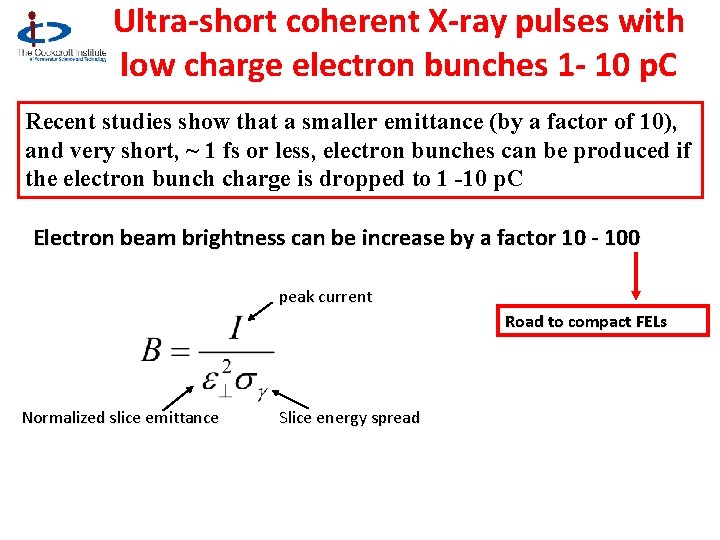
Ultra-short coherent X-ray pulses with low charge electron bunches 1 - 10 p. C Recent studies show that a smaller emittance (by a factor of 10), and very short, ~ 1 fs or less, electron bunches can be produced if the electron bunch charge is dropped to 1 -10 p. C Electron beam brightness can be increase by a factor 10 - 100 peak current Road to compact FELs Normalized slice emittance Slice energy spread
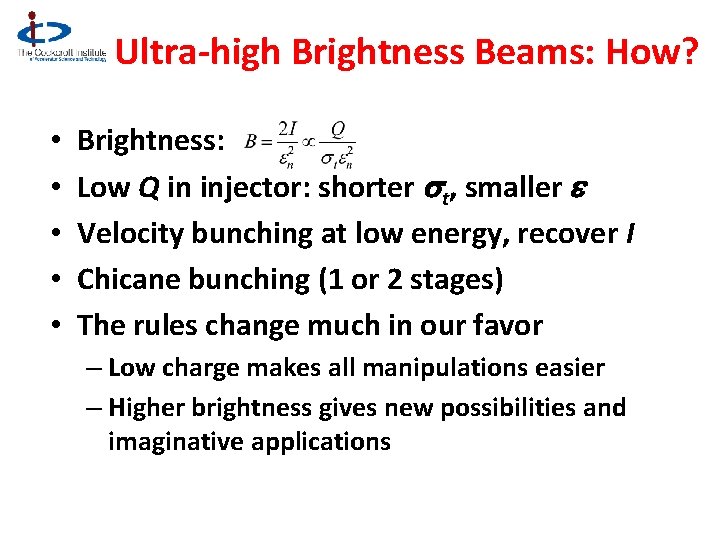
Ultra-high Brightness Beams: How? • • • Brightness: Low Q in injector: shorter st, smaller e Velocity bunching at low energy, recover I Chicane bunching (1 or 2 stages) The rules change much in our favor – Low charge makes all manipulations easier – Higher brightness gives new possibilities and imaginative applications
Ultra-short SASE XFEL pulses • Investigations at atomic electron spatio-temporal scales – Angstroms-nanometers (~Bohr radius) – Femto- to atto-seconds (electronic motion, Bohr period) • 100 fsec accessible using standard techniques • Many methods proposed for the 1 femto-second down to the atto-seconds frontier – Slotted spoiler; ESASE; two stage chirped pulse – Unsatisfactory (noise pedestal, low flux, etc. ) – Still unproven • Use “clean” ultra-short, low-charge, ultra-bright electron beam – Myriad of advantages in FEL and beam physics – Robust in application: XFEL, coherent optical source, beyond…
Example “Ultra-bright” Electron Source Characteristics for compact SASE X-FELs: 6. 2 X 10⁶ electrons (1 p. C) at 1 to 20 Me. V Eventual pulse length: 1 - 30 femto-seconds Normalized Emittance : 0. 01 -0. 03 mm-mrad (at source or after bunch manipulations) Relative Momentum Spread: 10 -3 -10 -4 CHALLENGING!! High Brightness Electron Srce Workshop, June 29 - July 1, 2011
Emerging possibilities: XFEL Oscillators Electron Beam Characteristics: -- Normalized rms emittance < 0. 1 mm-mr – Bunch charge < 40 p. C – Bunch length (rms)= 0. 2 -2 ps (transform-limited spectral width << mirrror bandwidth) Peak current >10 A – Energy spread < 1. 4 M e. V – Bunch rep rate > 1 MHz
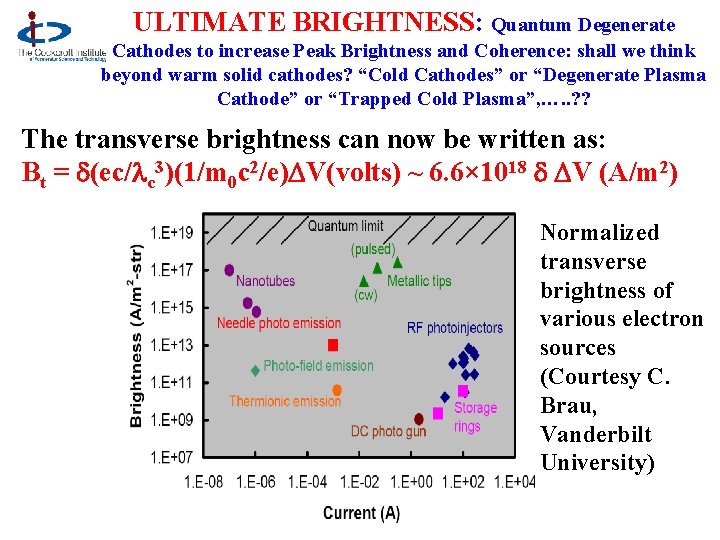
ULTIMATE BRIGHTNESS: Quantum Degenerate Cathodes to increase Peak Brightness and Coherence: shall we think beyond warm solid cathodes? “Cold Cathodes” or “Degenerate Plasma Cathode” or “Trapped Cold Plasma”, …. . ? ? The transverse brightness can now be written as: Bt = d(ec/ c 3)(1/m 0 c 2/e)DV(volts) ~ 6. 6× 10¹⁸ d DV (A/m 2) Normalized transverse brightness of various electron sources (Courtesy C. Brau, Vanderbilt University)
THINK “OUT of the BOX”!!!! High Brightness Electron Source Workshop, June 29 - July 1, 2011
- Slides: 29