
Ultimate Storage Ring Light Sources Design and Performance
- Slides: 22
Ultimate Storage Ring Light Sources: Design and Performance Objectives R. Hettel, SLAC USR Accelerator R&D Workshop Huairou (Beijing), China October 30, 2012
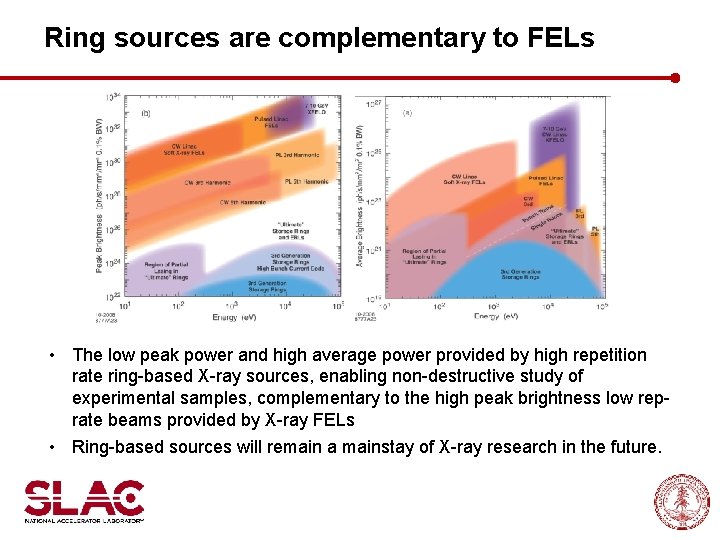
Ring sources are complementary to FELs • The low peak power and high average power provided by high repetition rate ring-based X-ray sources, enabling non-destructive study of experimental samples, complementary to the high peak brightness low reprate beams provided by X-ray FELs • Ring-based sources will remain a mainstay of X-ray research in the future.
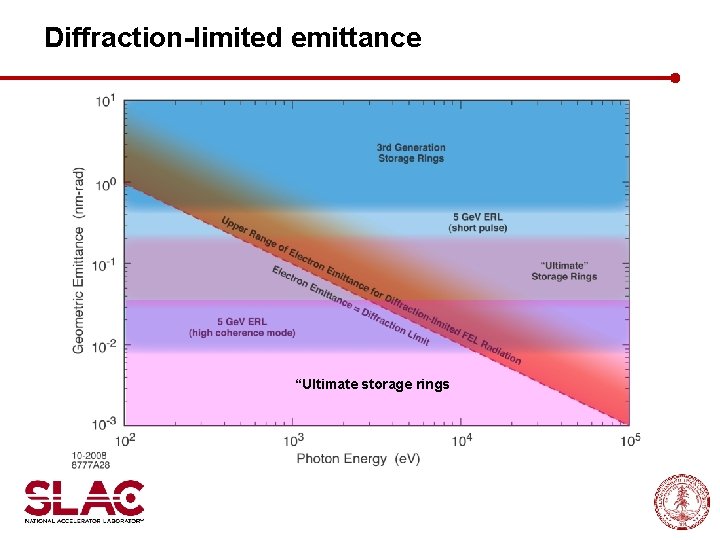
Diffraction-limited emittance “Ultimate storage rings
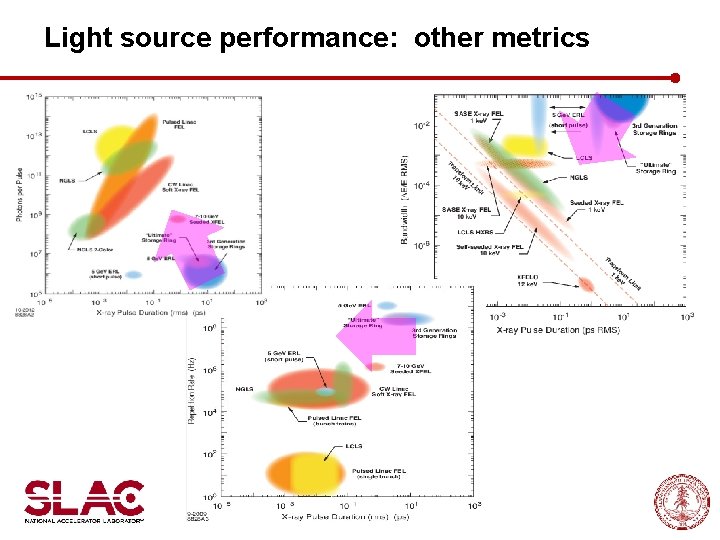
Light source performance: other metrics
USR performance capabilities Performance capabilities are constrained by available ring size, cost and, in the case of ring upgrades (e. g. SPring-8, ESRF, etc. ) by the need to conform to existing beam line geometries and infrastructure Ignoring imposed constraints, what are the potential capabilities of green-field USR implementations?
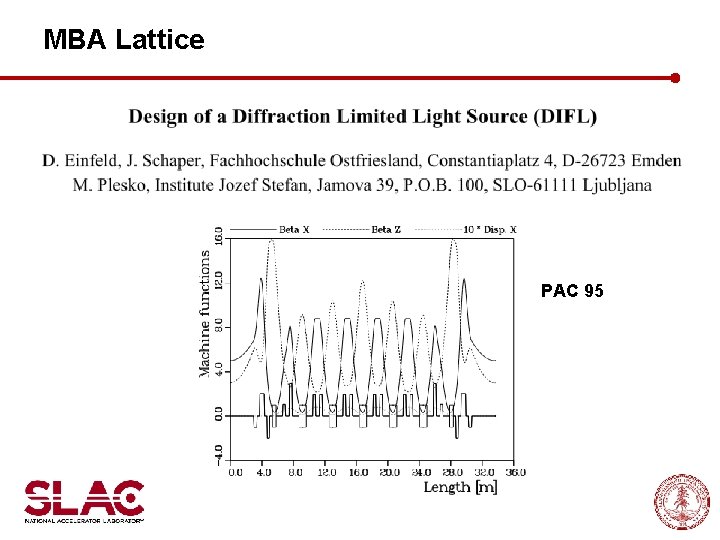
MBA Lattice PAC 95
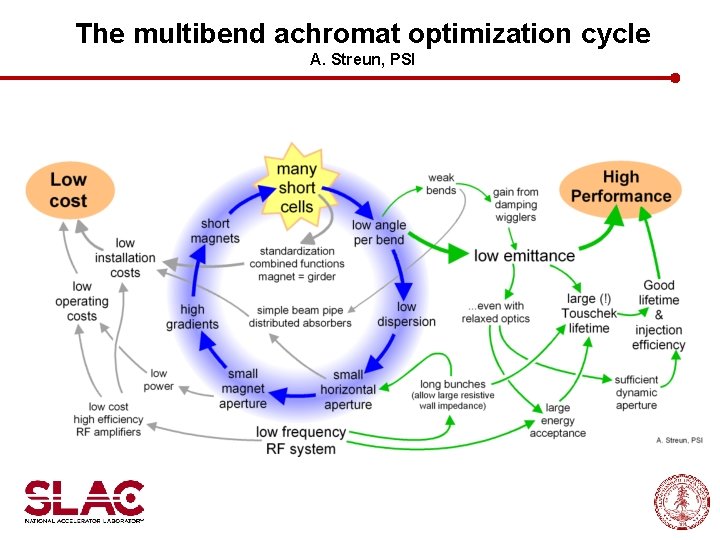
The multibend achromat optimization cycle A. Streun, PSI
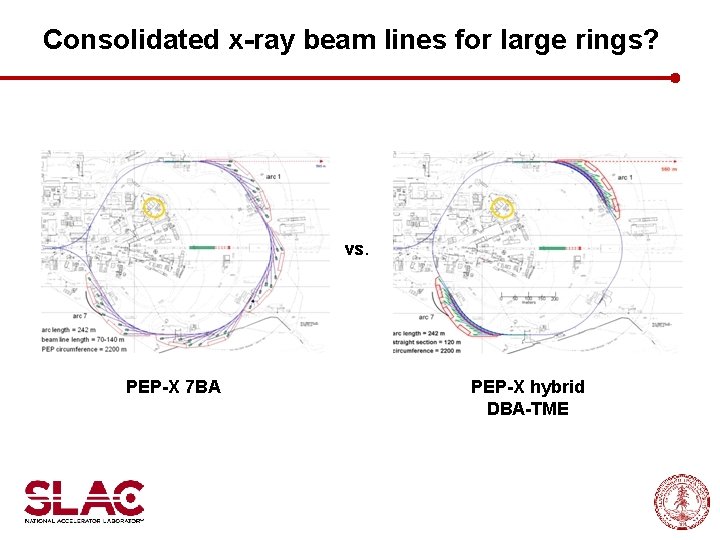
Consolidated x-ray beam lines for large rings? vs. PEP-X 7 BA PEP-X hybrid DBA-TME
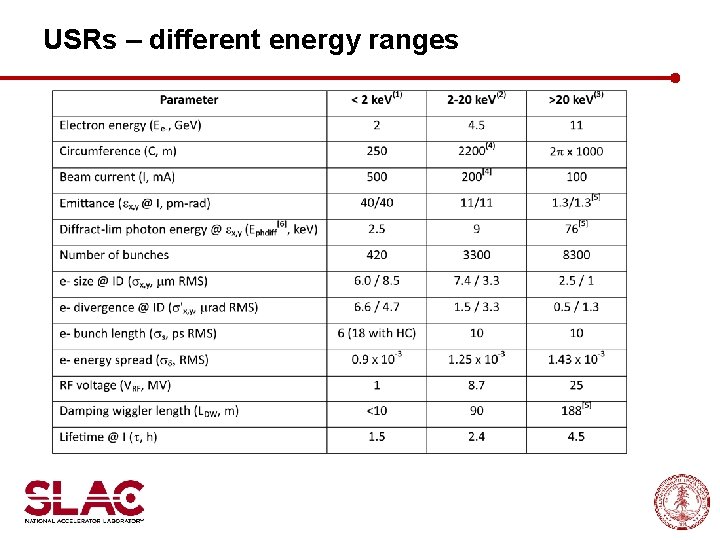
USRs – different energy ranges
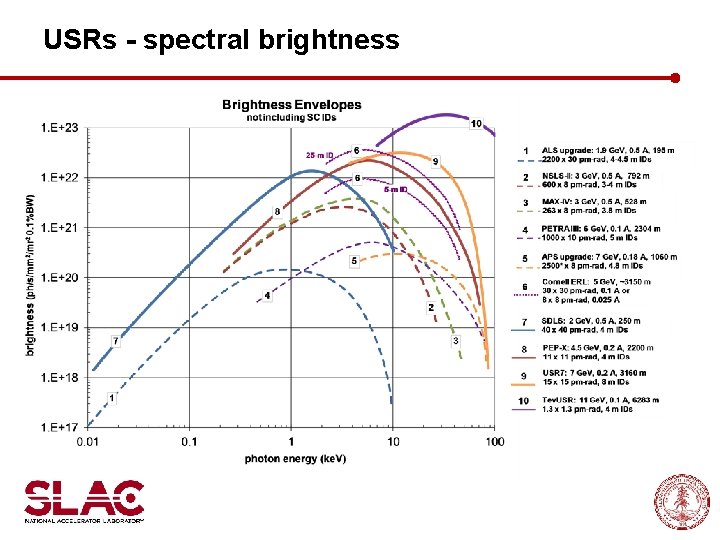
USRs - spectral brightness
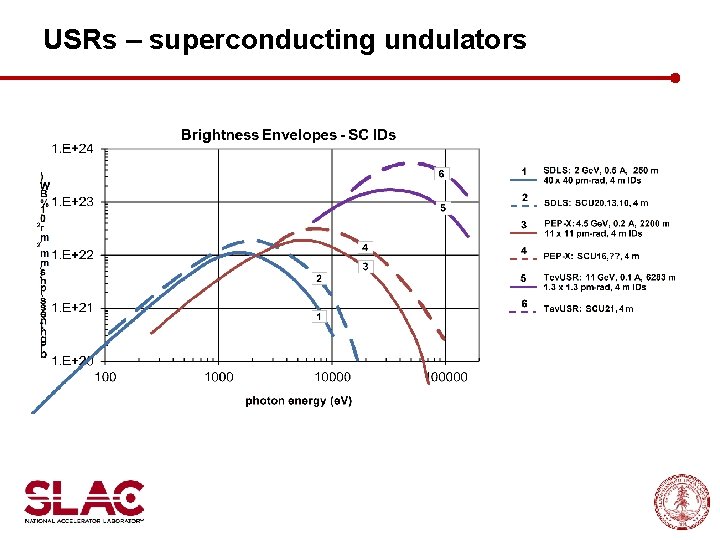
USRs – superconducting undulators
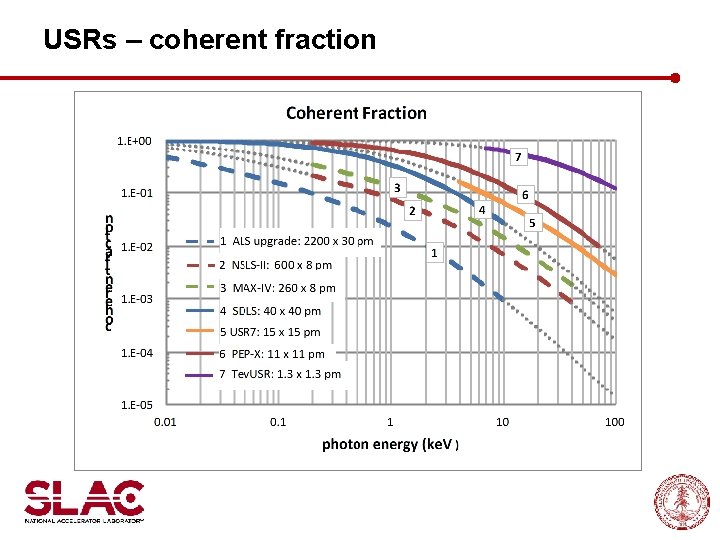
USRs – coherent fraction
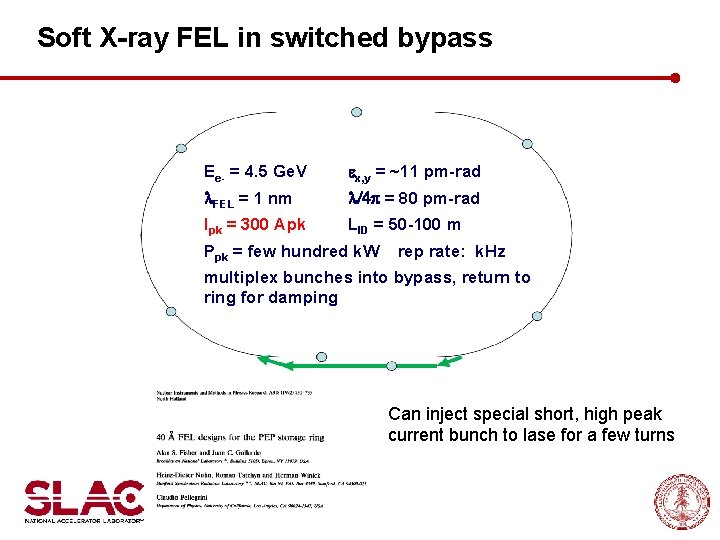
Soft X-ray FEL in switched bypass Ee- = 4. 5 Ge. V ex, y = ~11 pm-rad l. FEL = 1 nm l/4 p = 80 pm-rad Ipk = 300 Apk LID = 50 -100 m Ppk = few hundred k. W rep rate: k. Hz multiplex bunches into bypass, return to ring for damping Can inject special short, high peak current bunch to lase for a few turns
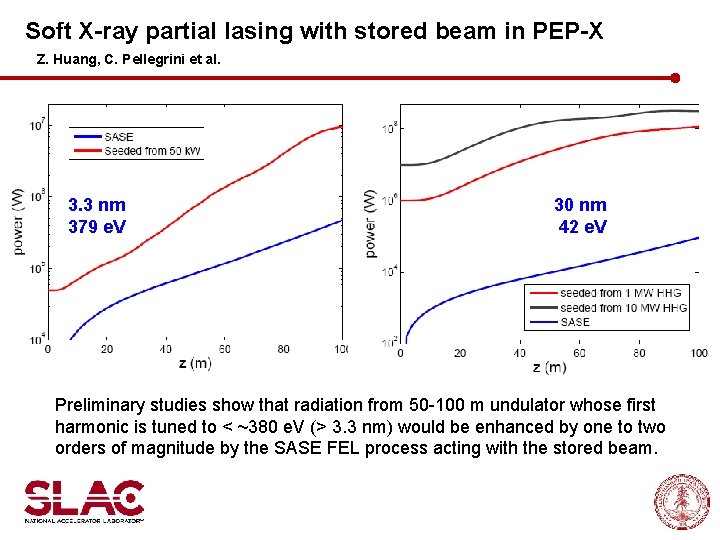
Soft X-ray partial lasing with stored beam in PEP-X Z. Huang, C. Pellegrini et al. 3. 3 nm 379 e. V 30 nm 42 e. V Preliminary studies show that radiation from 50 -100 m undulator whose first harmonic is tuned to < ~380 e. V (> 3. 3 nm) would be enhanced by one to two orders of magnitude by the SASE FEL process acting with the stored beam.
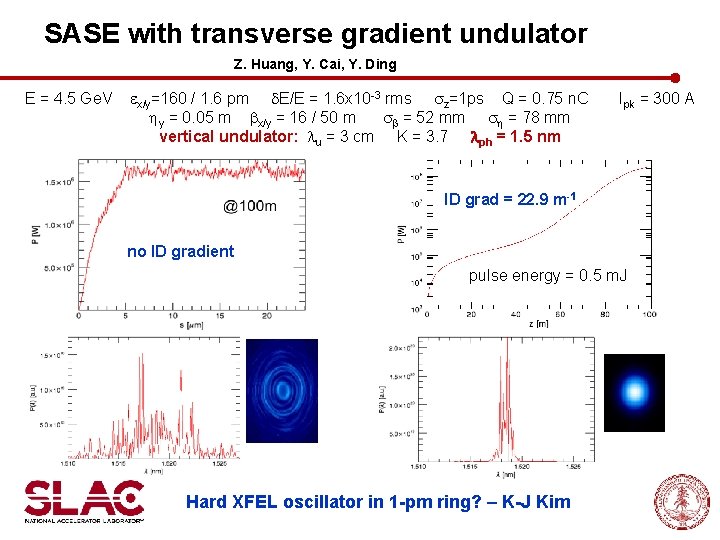
SASE with transverse gradient undulator Z. Huang, Y. Cai, Y. Ding E = 4. 5 Ge. V ex/y=160 / 1. 6 pm d. E/E = 1. 6 x 10 -3 rms sz=1 ps Q = 0. 75 n. C y = 0. 05 m bx/y = 16 / 50 m sb = 52 mm s = 78 mm vertical undulator: lu = 3 cm K = 3. 7 lph = 1. 5 nm Ipk = 300 A ID grad = 22. 9 m-1 no ID gradient pulse energy = 0. 5 m. J Hard XFEL oscillator in 1 -pm ring? – K-J Kim
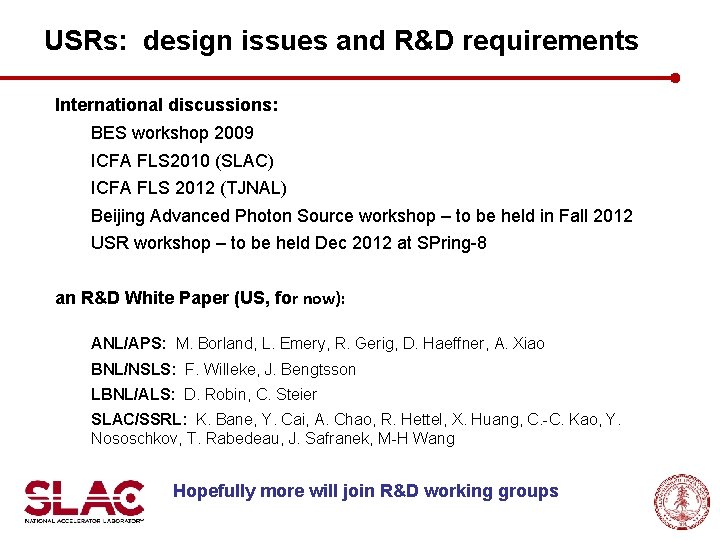
USRs: design issues and R&D requirements International discussions: BES workshop 2009 ICFA FLS 2010 (SLAC) ICFA FLS 2012 (TJNAL) Beijing Advanced Photon Source workshop – to be held in Fall 2012 USR workshop – to be held Dec 2012 at SPring-8 an R&D White Paper (US, for now): ANL/APS: M. Borland, L. Emery, R. Gerig, D. Haeffner, A. Xiao BNL/NSLS: F. Willeke, J. Bengtsson LBNL/ALS: D. Robin, C. Steier SLAC/SSRL: K. Bane, Y. Cai, A. Chao, R. Hettel, X. Huang, C. -C. Kao, Y. Nososchkov, T. Rabedeau, J. Safranek, M-H Wang Hopefully more will join R&D working groups
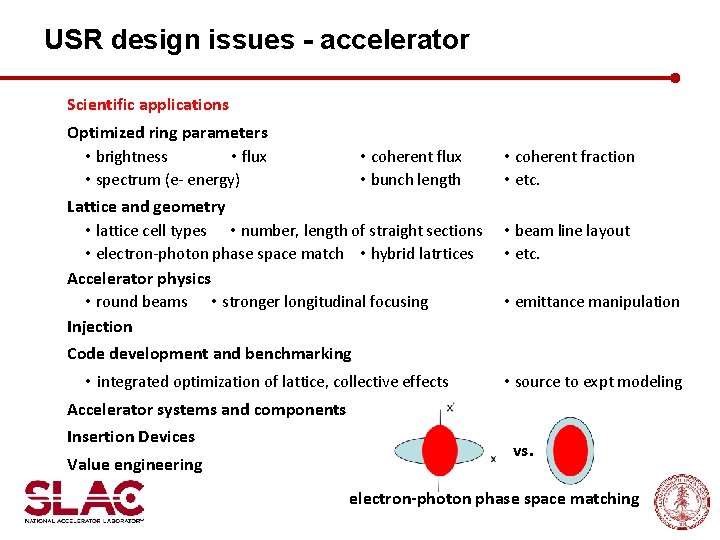
USR design issues - accelerator Scientific applications Optimized ring parameters • brightness • flux • spectrum (e- energy) • coherent flux • bunch length • coherent fraction • etc. Lattice and geometry • lattice cell types • number, length of straight sections • electron-photon phase space match • hybrid latrtices • beam line layout • etc. Accelerator physics • round beams • stronger longitudinal focusing • emittance manipulation Injection Code development and benchmarking • integrated optimization of lattice, collective effects • source to expt modeling Accelerator systems and components Insertion Devices Value engineering vs. electron-photon phase space matching
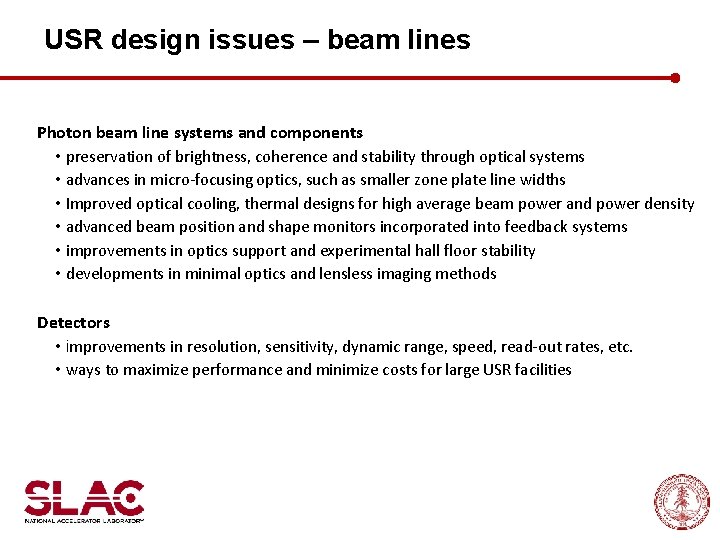
USR design issues – beam lines Photon beam line systems and components • preservation of brightness, coherence and stability through optical systems • advances in micro-focusing optics, such as smaller zone plate line widths • Improved optical cooling, thermal designs for high average beam power and power density • advanced beam position and shape monitors incorporated into feedback systems • improvements in optics support and experimental hall floor stability • developments in minimal optics and lensless imaging methods Detectors • improvements in resolution, sensitivity, dynamic range, speed, read-out rates, etc. • ways to maximize performance and minimize costs for large USR facilities
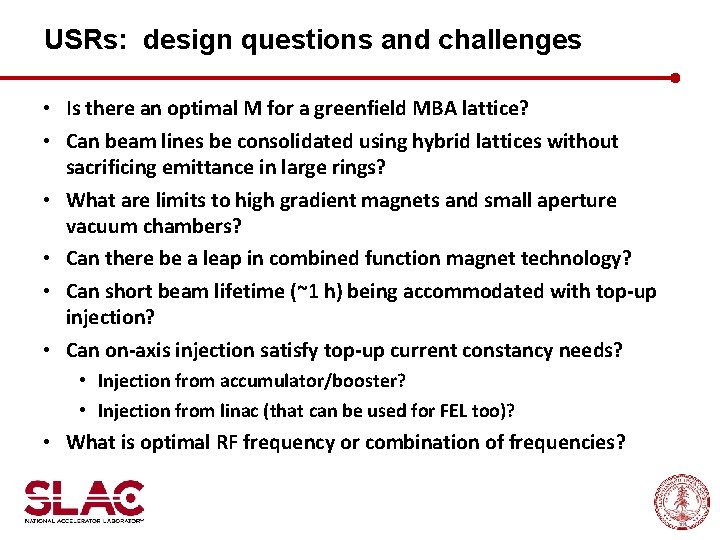
USRs: design questions and challenges • Is there an optimal M for a greenfield MBA lattice? • Can beam lines be consolidated using hybrid lattices without sacrificing emittance in large rings? • What are limits to high gradient magnets and small aperture vacuum chambers? • Can there be a leap in combined function magnet technology? • Can short beam lifetime (~1 h) being accommodated with top-up injection? • Can on-axis injection satisfy top-up current constancy needs? • Injection from accumulator/booster? • Injection from linac (that can be used for FEL too)? • What is optimal RF frequency or combination of frequencies?
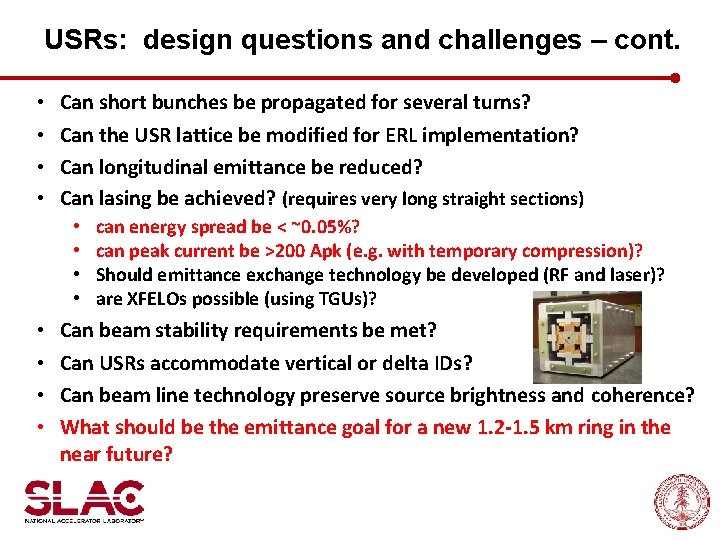
USRs: design questions and challenges – cont. • • Can short bunches be propagated for several turns? Can the USR lattice be modified for ERL implementation? Can longitudinal emittance be reduced? Can lasing be achieved? (requires very long straight sections) • • can energy spread be < ~0. 05%? can peak current be >200 Apk (e. g. with temporary compression)? Should emittance exchange technology be developed (RF and laser)? are XFELOs possible (using TGUs)? Can beam stability requirements be met? Can USRs accommodate vertical or delta IDs? Can beam line technology preserve source brightness and coherence? What should be the emittance goal for a new 1. 2 -1. 5 km ring in the near future?
Looking forward to future diffraction-limited rings! But the workshop may have a problem:
USR features • High coherent fraction • Possibility for “round” beams • Short bunches (~5 -10 ps RMS from low momentum compaction factor) • “Long” lifetime: if the bunch dimensions are small enough Touschek lifetime increases (NSLS-II and MAX-IV may begin to see this effect) • Large circumference for multi-Ge. V rings (km) • Damping wigglers in some cases to reduce emittance by ~x 2 • On-axis injection (maybe) and “swap-out” injection for small dynamic aperture • Special operating modes could include: o few-turn, sub-ps bunch mode o 100 -1000 turn mode with injection from superconducting linac operating without energy recovery (e. g. ~1 m. A @ few Ge. V) o localized bunch compression systems in long straight sections o bunch tailoring with low alpha, non linear momentum compaction o lasing in an FEL located in a switched bypass o partial lasing at soft X-ray wavelengths using the stored beam