
Ulrich Uwer University of Heidelberg LHCb Week May
Ulrich Uwer University of Heidelberg LHCb Week May 27, 2004 Aging Review Report: Outer Tracker Comments
Aging Report Many useful comments: § Safety factor for aging tests § Acceleration factor for aging tests § Material selection § Importance of gas-system validation Many good questions: § Gain uniformity and wire excentricity § Operation gas gain § Operation stability and chamber performance using Ar. CO 2 § Temperature gradient along the modules … but conclusion / recommendations given in the written report are not addressing sufficiently basic results of our aging measurements
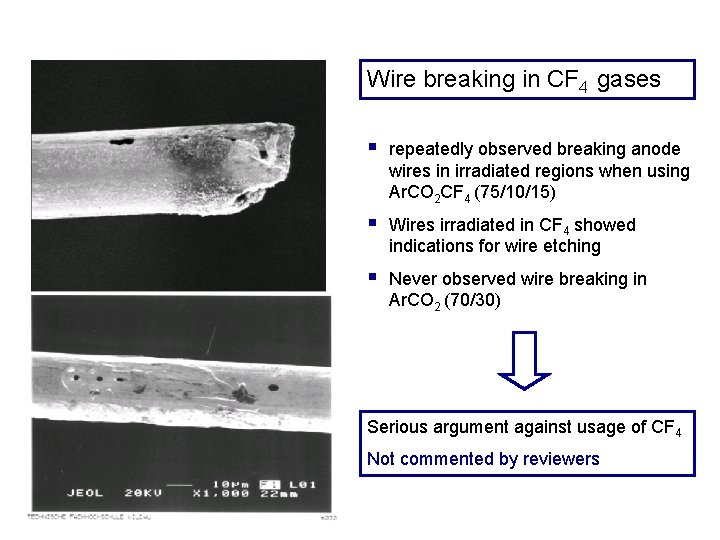
Wire breaking in CF 4 gases § repeatedly observed breaking anode wires in irradiated regions when using Ar. CO 2 CF 4 (75/10/15) § Wires irradiated in CF 4 showed indications for wire etching § Never observed wire breaking in Ar. CO 2 (70/30) Serious argument against usage of CF 4 Not commented by reviewers
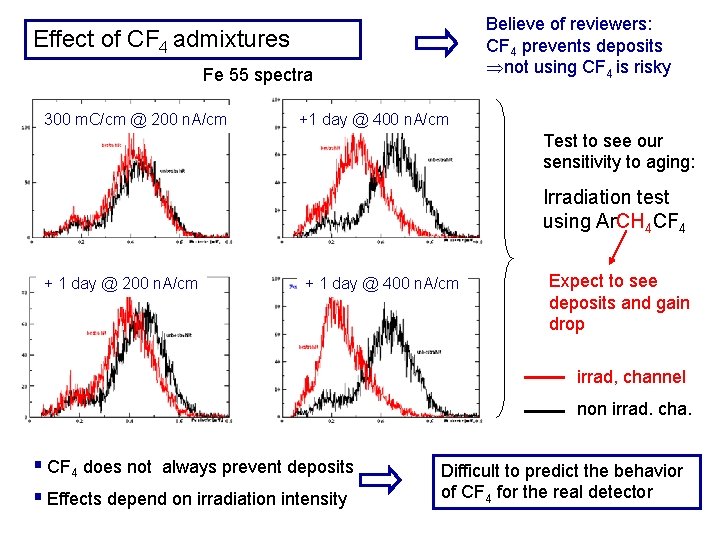
Believe of reviewers: CF 4 prevents deposits not using CF 4 is risky Effect of CF 4 admixtures Fe 55 spectra 300 m. C/cm @ 200 n. A/cm +1 day @ 400 n. A/cm Test to see our sensitivity to aging: Irradiation test using Ar. CH 4 CF 4 + 1 day @ 200 n. A/cm + 1 day @ 400 n. A/cm Expect to see deposits and gain drop irrad, channel non irrad. cha. § CF 4 does not always prevent deposits § Effects depend on irradiation intensity Difficult to predict the behavior of CF 4 for the real detector
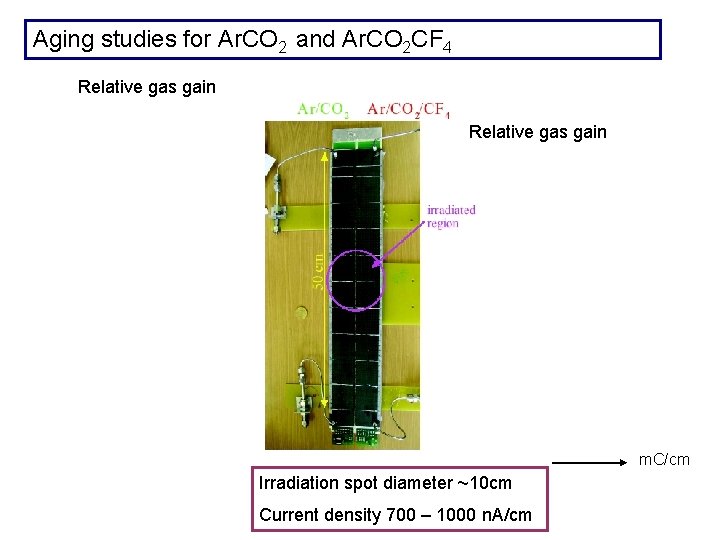
Aging studies for Ar. CO 2 and Ar. CO 2 CF 4 Relative gas gain m. C/cm Irradiation spot diameter ~10 cm Current density 700 – 1000 n. A/cm
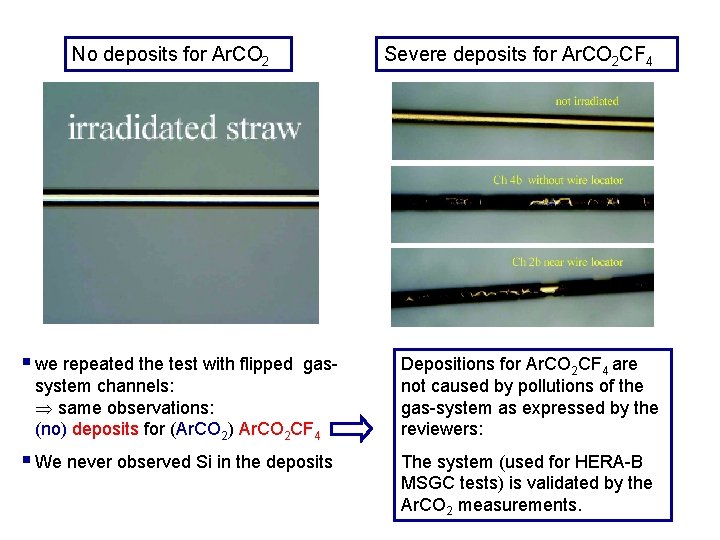
No deposits for Ar. CO 2 § we repeated the test with flipped Severe deposits for Ar. CO 2 CF 4 gas- system channels: same observations: (no) deposits for (Ar. CO 2) Ar. CO 2 CF 4 § We never observed Si in the deposits Depositions for Ar. CO 2 CF 4 are not caused by pollutions of the gas-system as expressed by the reviewers: The system (used for HERA-B MSGC tests) is validated by the Ar. CO 2 measurements.
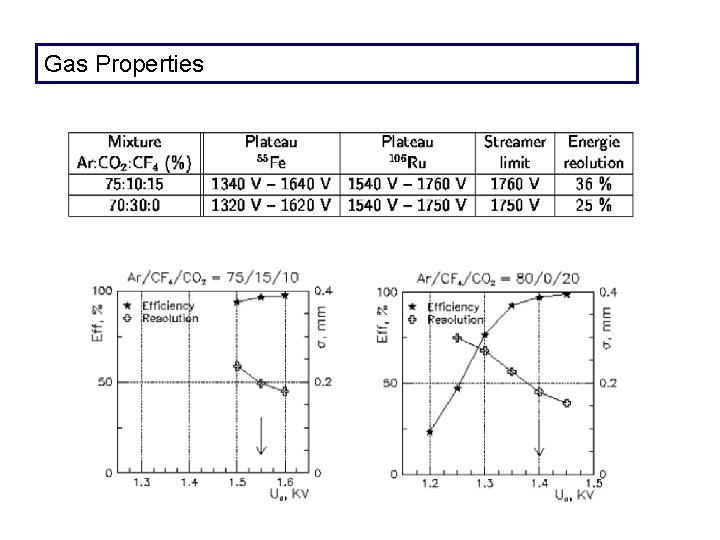
Conclusions § We observed reproducibly wire etching and depositions with Ar. CO 2 CF 4 § Effects depend on irradiation area, intensity and water content § We have not observed aging (gain drop or wire breaking) using Ar. CO 2 when operating with “reasonable” dry gas (water < 500 ppm) we see no guarantee for the magic cleaning property of CF 4 mixtures but all kind a dangerous effects § Aging tests at much higher intensities than at LHC do not prove that effects seen will be present at LHC but there is also no evidence that CF 4 admixtures do not lead to any damage at LHC intensities. Potential risk of CF 4 is large compared to the moderate gain in physics performance: Baseline counting gas is Ar. CO 2
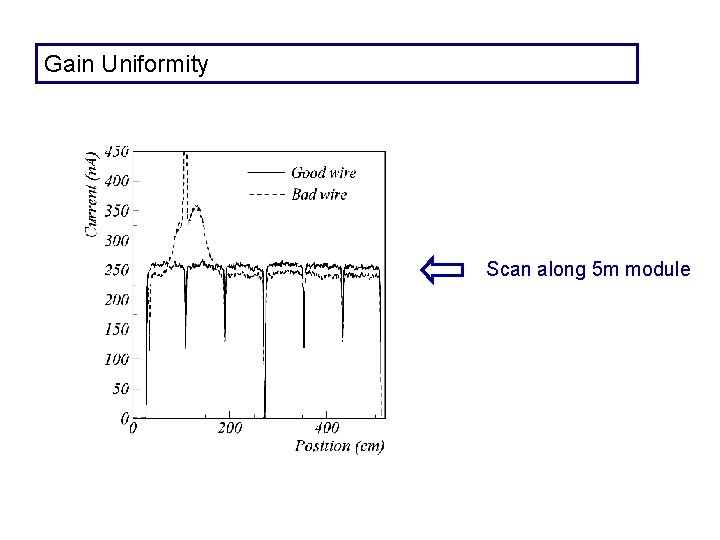
Gain Uniformity Scan along 5 m module
Gas Properties
- Slides: 9