
UKS 1975 1961 ENTERING THE EEC RUNUP TO
- Slides: 4
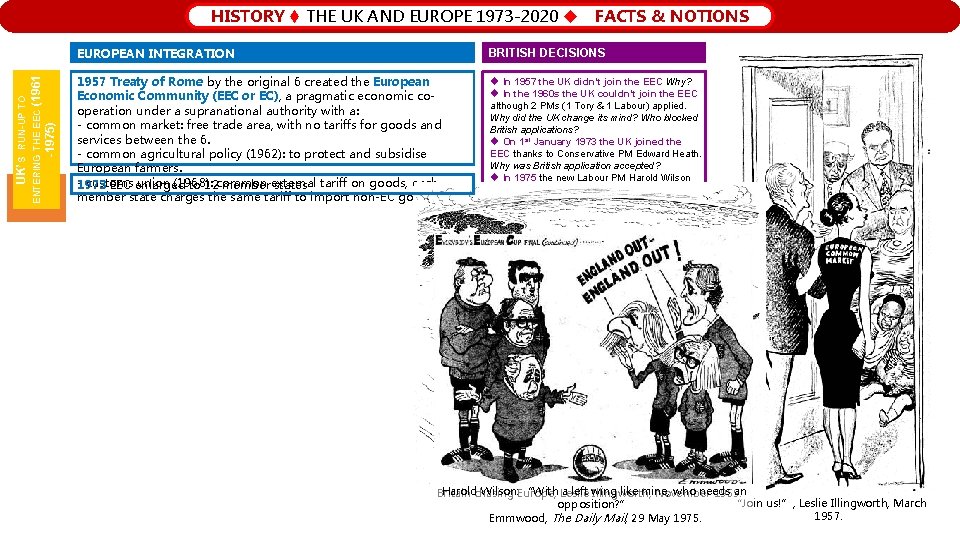
UK’S -1975) (1961 ENTERING THE EEC RUN-UP TO HISTORY t THE UK AND EUROPE 1973 -2020 FACTS & NOTIONS EUROPEAN INTEGRATION BRITISH DECISIONS 1957 Treaty of Rome by the original 6 created the European Economic Community (EEC or EC), a pragmatic economic cooperation under a supranational authority with a: - common market: free trade area, with no tariffs for goods and services between the 6. - common agricultural policy (1962): to protect and subsidise European farmers. - customs union (1968): 1973 EEC enlarged to 12 common memberexternal states tariff on goods, each member state charges the same tariff to import non-EC goods. In 1957 the UK didn’t join the EEC Why? In the 1960 s the UK couldn’t join the EEC although 2 PMs (1 Tory & 1 Labour) applied. Why did the UK change its mind? Who blocked British applications? On 1 st January 1973 the UK joined the EEC thanks to Conservative PM Edward Heath. Why was British application accepted? In 1975 the new Labour PM Harold Wilson organised a referendum on Britain staying in the EEC. Why? What was the result? Haroldchasing Wilson: Europe, “With Leslie a left wing like mine, who needs an Britain Illingworth, November 1959. “Join us!”, Leslie Illingworth, March opposition? ” 1957. Emmwood, The Daily Mail, 29 May 1975.
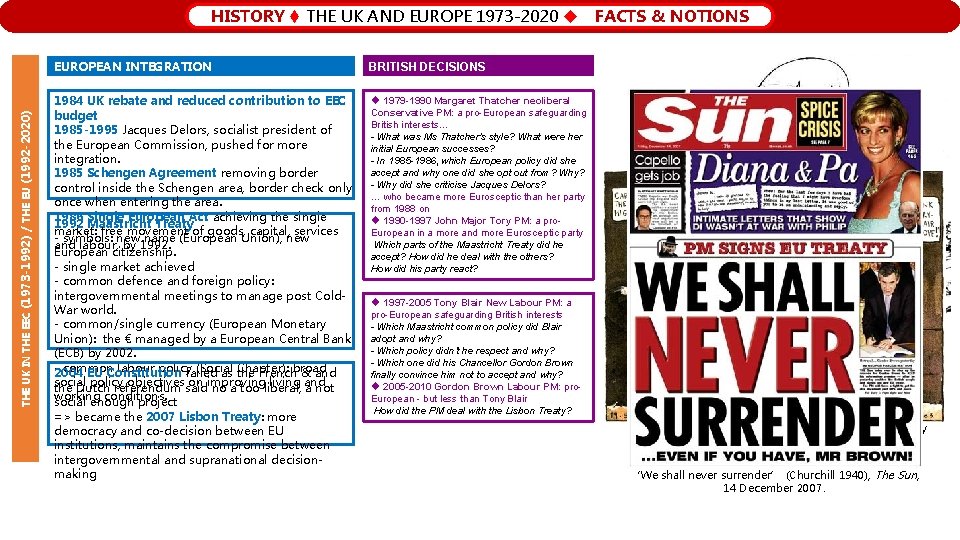
THE UK IN THE EEC (1973 -1992) / THE EU (1992 -2020) HISTORY t THE UK AND EUROPE 1973 -2020 EUROPEAN INTEGRATION BRITISH DECISIONS 1984 UK rebate and reduced contribution to EEC budget 1985 -1995 Jacques Delors, socialist president of the European Commission, pushed for more integration. 1985 Schengen Agreement removing border control inside the Schengen area, border check only once when entering the area. 1986 Single European Act achieving the single 1992 Maastricht Treaty market: free movement of goods, capital, services - symbols: new name (European Union), new and labour, by 1992. European citizenship. - single market achieved - common defence and foreign policy: intergovernmental meetings to manage post Cold. War world. - common/single currency (European Monetary Union): the € managed by a European Central Bank (ECB) by 2002. -2004 common labour policy (Social Chapter): EU Constitution failed as the Frenchbroad & and social policy objectivessaid on improving living and the Dutch referendum no a too liberal, a not working conditions. social enough project 1979 -1990 Margaret Thatcher neoliberal Conservative PM: a pro-European safeguarding British interests… - What was Ms Thatcher's style? What were her initial European successes? - In 1985 -1986, which European policy did she accept and why one did she opt out from? Why? - Why did she criticise Jacques Delors? … who became more Eurosceptic than her party from 1988 on 1990 -1997 John Major Tory PM: a pro. European in a more and more Eurosceptic party Which parts of the Maastricht Treaty did he accept? How did he deal with the others? How did his party react? => became the 2007 Lisbon Treaty: more democracy and co-decision between EU institutions, maintains the compromise between intergovernmental and supranational decisionmaking 1997 -2005 Tony Blair New Labour PM: a pro-European safeguarding British interests - Which Maastricht common policy did Blair adopt and why? - Which policy didn’t he respect and why? - Which one did his Chancellor Gordon Brown finally convince him not to accept and why? 2005 -2010 Gordon Brown Labour PM: pro. European - but less than Tony Blair How did the PM deal with the Lisbon Treaty? FACTS & NOTIONS ‘Maggie was there‘ Fritz Behrendt, 28 April 1980. ‘Hostage to Europe’, Bill Mc. Arthur, The Glasgow Herald, 18 April 1997. ‘Euro or not euro’, Morten Morland, The Times, 19 May The Independent , 11 May 2004. 2003. ‘We shall never surrender’ (Churchill 1940), The Sun, 14 December 2007.
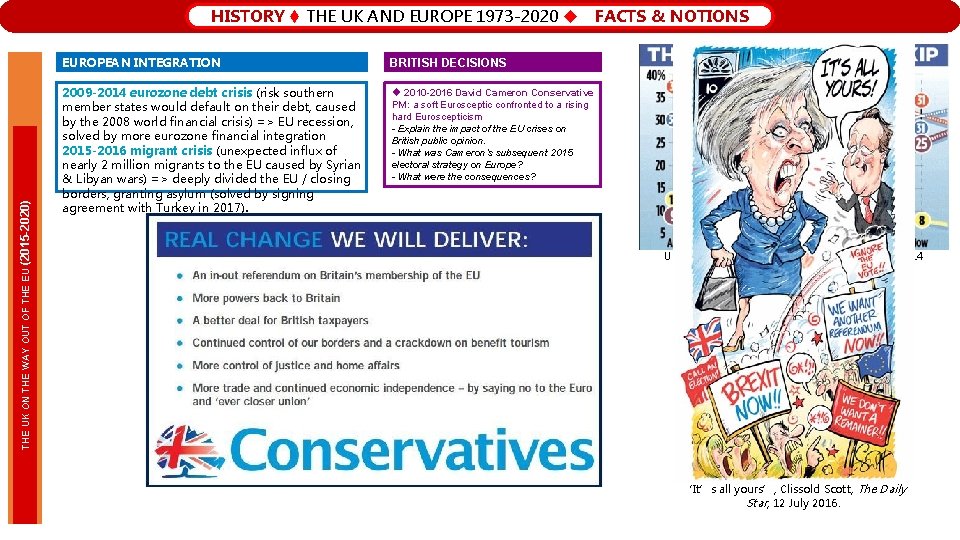
EUROPEAN INTEGRATION BRITISH DECISIONS 2009 -2014 eurozone debt crisis (risk southern member states would default on their debt, caused by the 2008 world financial crisis) => EU recession, solved by more eurozone financial integration 2015 -2016 migrant crisis (unexpected influx of nearly 2 million migrants to the EU caused by Syrian & Libyan wars) => deeply divided the EU / closing borders, granting asylum (solved by signing agreement with Turkey in 2017). 2010 -2016 David Cameron Conservative PM: a soft Eurosceptic confronted to a rising hard Euroscepticism - Explain the impact of the EU crises on British public opinion. - What was Cameron’s subsequent 2015 electoral strategy on Europe? - What were the consequences? FACTS & NOTIONS UKIP share of UKs votes, The Daily Mail, October 2014 THE UK ON THE WAY OUT OF THE EU (2015 -2020) HISTORY t THE UK AND EUROPE 1973 -2020 ‘It’s all yours’, Clissold Scott, The Daily Star, 12 July 2016.
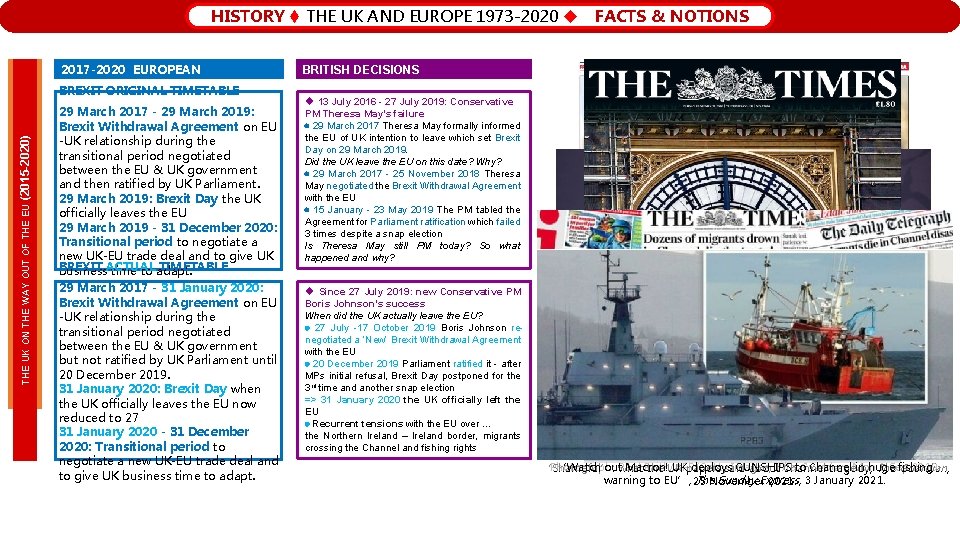
HISTORY t THE UK AND EUROPE 1973 -2020 THE UK ON THE WAY OUT OF THE EU (2015 -2020) 2017 -2020 EUROPEAN dis. INTEGRATION BREXIT ORIGINAL TIMETABLE 29 March 2017 - 29 March 2019: Brexit Withdrawal Agreement on EU -UK relationship during the transitional period negotiated between the EU & UK government and then ratified by UK Parliament. 29 March 2019: Brexit Day the UK officially leaves the EU 29 March 2019 - 31 December 2020: Transitional period to negotiate a new UK-EU trade deal and to give UK BREXIT TIMETABLE business. ACTUAL time to adapt. 29 March 2017 - 31 January 2020: Brexit Withdrawal Agreement on EU -UK relationship during the transitional period negotiated between the EU & UK government but not ratified by UK Parliament until 20 December 2019. 31 January 2020: Brexit Day when the UK officially leaves the EU now reduced to 27 31 January 2020 - 31 December 2020: Transitional period to negotiate a new UK-EU trade deal and to give UK business time to adapt. FACTS & NOTIONS BRITISH DECISIONS 13 July 2016 - 27 July 2019: Conservative PM Theresa May’s failure · 29 March 2017 Theresa May formally informed the EU of UK intention to leave which set Brexit Day on 29 March 2019. Did the UK leave the EU on this date? Why? · 29 March 2017 - 25 November 2018 Theresa May negotiated the Brexit Withdrawal Agreement with the EU · 15 January - 23 May 2019 The PM tabled the Agreement for Parliament ratification which failed 3 times despite a snap election Is Theresa May still PM today? So what happened and why? Since 27 July 2019: new Conservative PM Boris Johnson’s success When did the UK actually leave the EU? · 27 July -17 October 2019 Boris Johnson renegotiated a ’New’ Brexit Withdrawal Agreement with the EU · 20 December 2019 Parliament ratified it - after MPs initial refusal, Brexit Day postponed for the 3 rd time and another snap election => 31 January 2020 the UK officially left the EU · Recurrent tensions with the EU over … the Northern Ireland – Ireland border, migrants crossing the Channel and fishing rights ‘Happy No Brexit Day’ The Evening Standard, 29 March 2019. ‘Watch outwhat Macron! UKpapers deploys GUNSHIPS to Channel in huge fishing Photograph: Paul Faith/AFP/Getty Images, Guardian , Mon 2 Sep 2019. , ‘Shameful’: the UK said about. The Channel tragedy, The Guardian warning to EU’, 25 The. November Sunday Express , 3 January 2021.