
UK regulatory policy and the CLCIO Michael Williams
- Slides: 17
UK regulatory policy and the CLCIO Michael Williams
UK Regulatory environment • Common law system • Around half of UK laws are EU laws • Withdrawal (from the EU) Bill – translate to UK law • Regulatory environment underpinned by general nondiscriminatory principles • Better Regulation Agenda • Use of economic analysis to inform justification for government interventions • Scrutiny • Role of Parliament and Devolved Administrations • Impact Assessments
Looking ahead – post Brexit • How will the regulatory environment evolve? • Withdrawal (from the EU) Bill • Translate to UK law – minimal technical changes. • EU regulations considered at EU level. • Due diligence by European Commission and Member States • Challenge for government departments given scale of additional work. • No expected change to overall approach: • • Open, liberal economy, Respect for international rules national treatment and non-discrimination Interventions evidence based • Importance of international frameworks and rules • OECD Codes – process to aid due diligence.
UK Reservations under the CLCIO C/3. Road transport: passengers and freights, including chartering. Remarks: The reservation applies to the following operations: a) for passengers: • picking up or setting down on an international journey; • transport within the country; b) for freights: • • • transit; delivery on an international journey; collection on an international journey; return cargo where collection is authorised; return cargo where delivery is authorised; transport within the country.
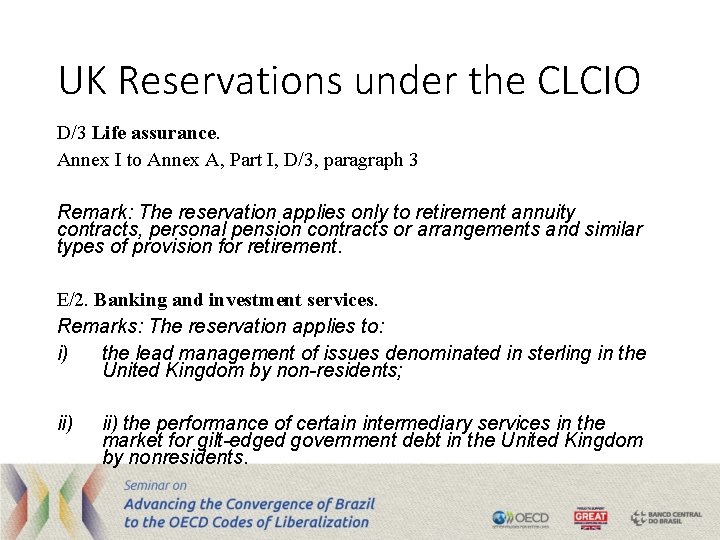
UK Reservations under the CLCIO D/3 Life assurance. Annex I to Annex A, Part I, D/3, paragraph 3 Remark: The reservation applies only to retirement annuity contracts, personal pension contracts or arrangements and similar types of provision for retirement. E/2. Banking and investment services. Remarks: The reservation applies to: i) the lead management of issues denominated in sterling in the United Kingdom by non-residents; ii) the performance of certain intermediary services in the market for gilt-edged government debt in the United Kingdom by nonresidents.
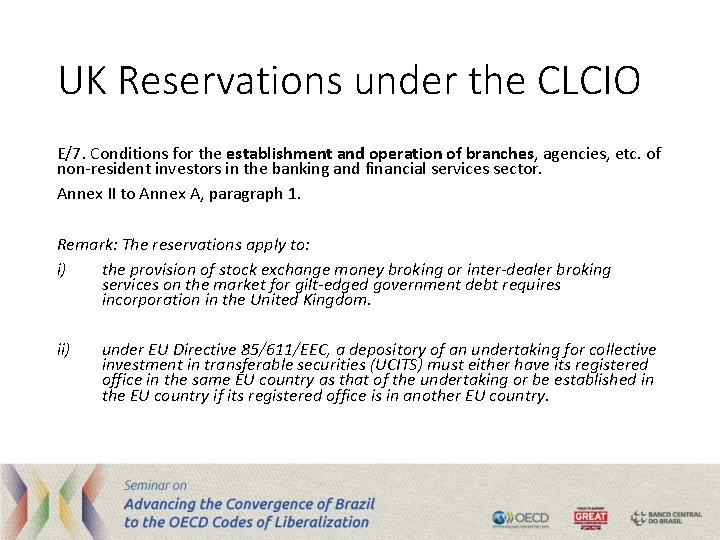
UK Reservations under the CLCIO E/7. Conditions for the establishment and operation of branches, agencies, etc. of non-resident investors in the banking and financial services sector. Annex II to Annex A, paragraph 1. Remark: The reservations apply to: i) the provision of stock exchange money broking or inter-dealer broking services on the market for gilt-edged government debt requires incorporation in the United Kingdom. ii) under EU Directive 85/611/EEC, a depository of an undertaking for collective investment in transferable securities (UCITS) must either have its registered office in the same EU country as that of the undertaking or be established in the EU country if its registered office is in another EU country.
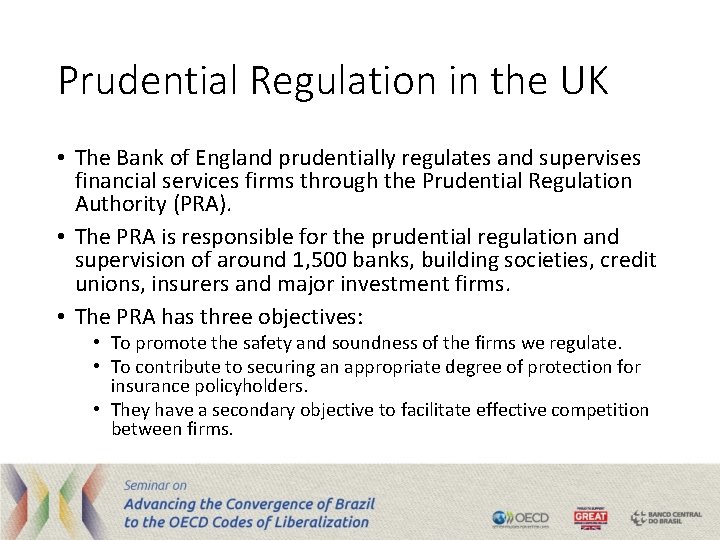
Prudential Regulation in the UK • The Bank of England prudentially regulates and supervises financial services firms through the Prudential Regulation Authority (PRA). • The PRA is responsible for the prudential regulation and supervision of around 1, 500 banks, building societies, credit unions, insurers and major investment firms. • The PRA has three objectives: • To promote the safety and soundness of the firms we regulate. • To contribute to securing an appropriate degree of protection for insurance policyholders. • They have a secondary objective to facilitate effective competition between firms.
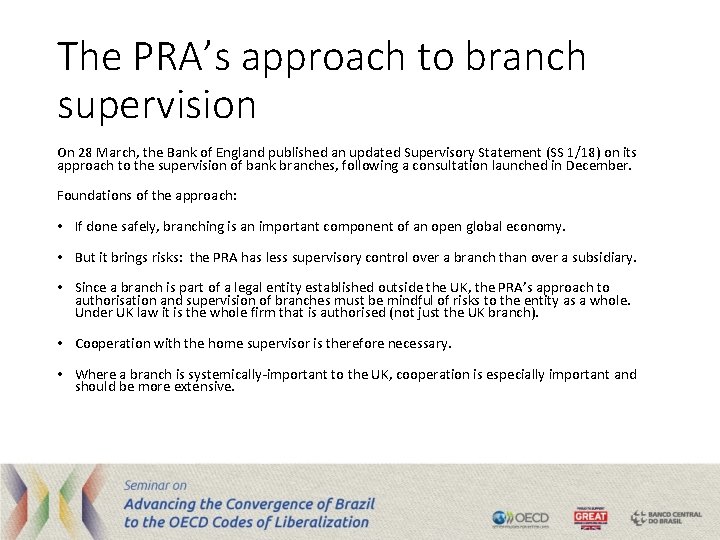
The PRA’s approach to branch supervision On 28 March, the Bank of England published an updated Supervisory Statement (SS 1/18) on its approach to the supervision of bank branches, following a consultation launched in December. Foundations of the approach: • If done safely, branching is an important component of an open global economy. • But it brings risks: the PRA has less supervisory control over a branch than over a subsidiary. • Since a branch is part of a legal entity established outside the UK, the PRA’s approach to authorisation and supervision of branches must be mindful of risks to the entity as a whole. Under UK law it is the whole firm that is authorised (not just the UK branch). • Cooperation with the home supervisor is therefore necessary. • Where a branch is systemically-important to the UK, cooperation is especially important and should be more extensive.
Branch supervision – key elements The PRA’s approach to the authorisation and supervision of branches of international firms is determined by: • the activities that a branch proposes to undertake in the UK; and • the nature of the home state regime for supervision and resolution, and the PRA’s relationship with the relevant home state authorities.
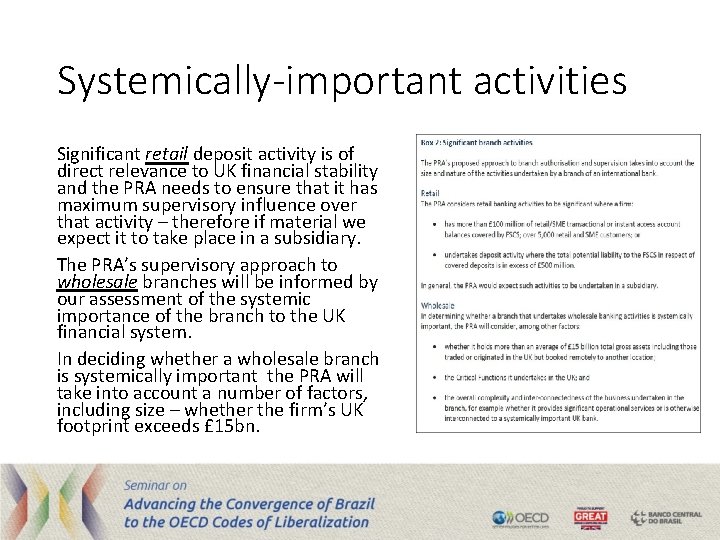
Systemically-important activities Significant retail deposit activity is of direct relevance to UK financial stability and the PRA needs to ensure that it has maximum supervisory influence over that activity – therefore if material we expect it to take place in a subsidiary. The PRA’s supervisory approach to wholesale branches will be informed by our assessment of the systemic importance of the branch to the UK financial system. In deciding whether a wholesale branch is systemically important the PRA will take into account a number of factors, including size – whether the firm’s UK footprint exceeds £ 15 bn.
Cooperation on supervision and resolution When considering a branch application the PRA will make an assessment of the home jurisdiction: - The equivalence of its regulatory regime; - The degree of supervisory cooperation with the home state supervisor; - The degree of assurance over resolution. Where a branch is systemically-important the PRA will put particular emphasis on the degree of influence and visibility that it has over supervisory outcomes for the firm as a whole and the wider group, as relevant to the PRA’s objectives. This requirement may be harder to satisfy where group structures are more complex, for example, where firms are branching into the UK via an intermediate subsidiary in a different jurisdiction. Supervisory Cooperation is necessary in order that the PRA is able to understand the risks facing the firm, and has appropriate influence over them. For systemic branches a deeper level of cooperation is expected. The PRA has made clear that incoming EEA wholesale branches may apply for authorisation as Third Country branches, on the presumption that there will continue to be a high degree of supervisory cooperation between the UK and the EU. There are expected to be no implications of the policy for the current operations of banks from non-EEA countries (given existing structures and cooperation).
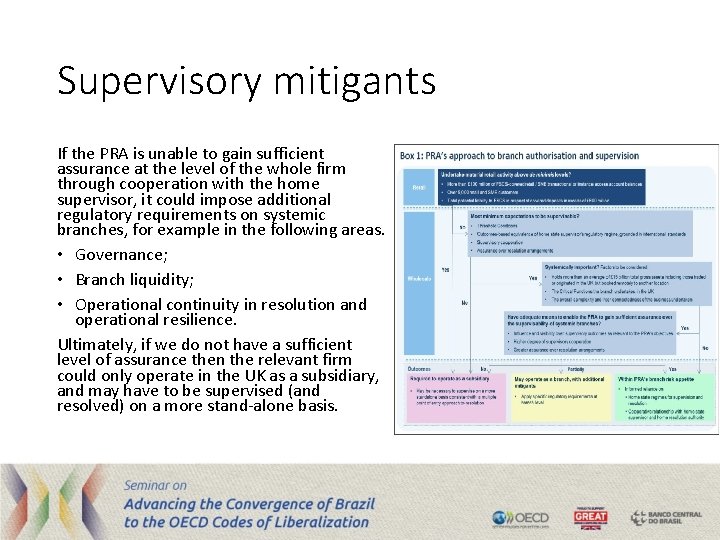
Supervisory mitigants If the PRA is unable to gain sufficient assurance at the level of the whole firm through cooperation with the home supervisor, it could impose additional regulatory requirements on systemic branches, for example in the following areas. • Governance; • Branch liquidity; • Operational continuity in resolution and operational resilience. Ultimately, if we do not have a sufficient level of assurance then the relevant firm could only operate in the UK as a subsidiary, and may have to be supervised (and resolved) on a more stand-alone basis.
Information on the UK’s regulation of bank branches is available at: • Supervisory Statement 1/18 - PRA approach to the authorisation and supervision of international bank branches: https: //www. bankofengland. co. uk/prudentialregulation/publication/2018/international-banks-pras-approach-to-branchauthorisation-and-supervision-ss • Supervisory Statement 4/18 - PRA approach to internal governance of international branches: https: //www. bankofengland. co. uk/prudentialregulation/publication/2016/internal-governance-of-third-country-branches-ss • The PRA’s accountability regime (Senior Managers Regime): https: //www. bankofengland. co. uk/prudential-regulation/keyinitiatives/strengthening-accountability
Changes to the regulation of bank branches – OECD assessment • In 2014, the PRA issued new supervisory requirements for branches of foreign banks • Followed publication of overall framework for supervisory requirements for all banks incorporated in the UK • Including for subsidiaries • Treatment of subsidiaries raises no issues having a bearing under the Codes • Branches of banks benefitting from EU single passport rules unaffected
PRA’s new approach to non-EEA bank branches supervision • Four criteria for authorisation: i. Home state supervisor (HSS) equivalence; ii. Extent of critical economic functions undertaken by the UK branch; iii. The level of assurance the PRA has from the HSS over resolution; and iv. A clear and agreed split of prudential supervisory responsibilities with the HSS
Regulation of Bank Branches – Assessment under the Codes • UK provided update to Advisory Task Force on the Codes in April 2014 • OECD Secretariat prepared an assessment on whether the new approach comforms with the UK’s obligations under the Codes • Annex II to Annex A of CLCIO • Calls for measures for branches or agencies on nonresident enterprises to be equivalent to those applying to domestic enterprises, ie not be subject to more burdensome requirements.
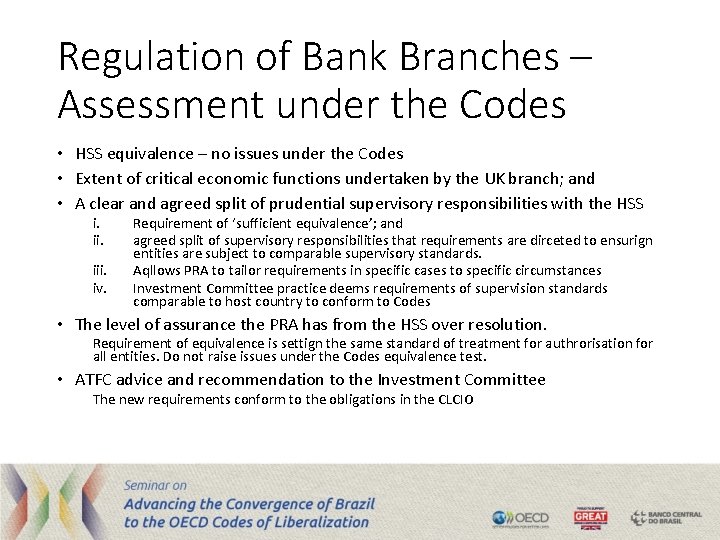
Regulation of Bank Branches – Assessment under the Codes • HSS equivalence – no issues under the Codes • Extent of critical economic functions undertaken by the UK branch; and • A clear and agreed split of prudential supervisory responsibilities with the HSS i. ii. iii. iv. Requirement of ‘sufficient equivalence’; and agreed split of supervisory responsibilities that requirements are dirceted to ensurign entities are subject to comparable supervisory standards. Aqllows PRA to tailor requirements in specific cases to specific circumstances Investment Committee practice deems requirements of supervision standards comparable to host country to conform to Codes • The level of assurance the PRA has from the HSS over resolution. Requirement of equivalence is settign the same standard of treatment for authrorisation for all entities. Do not raise issues under the Codes equivalence test. • ATFC advice and recommendation to the Investment Committee The new requirements conform to the obligations in the CLCIO