
UK ENGINEERING STUDENTS MATHS ENTRY QUALIFICATIONS GRADES and
- Slides: 1
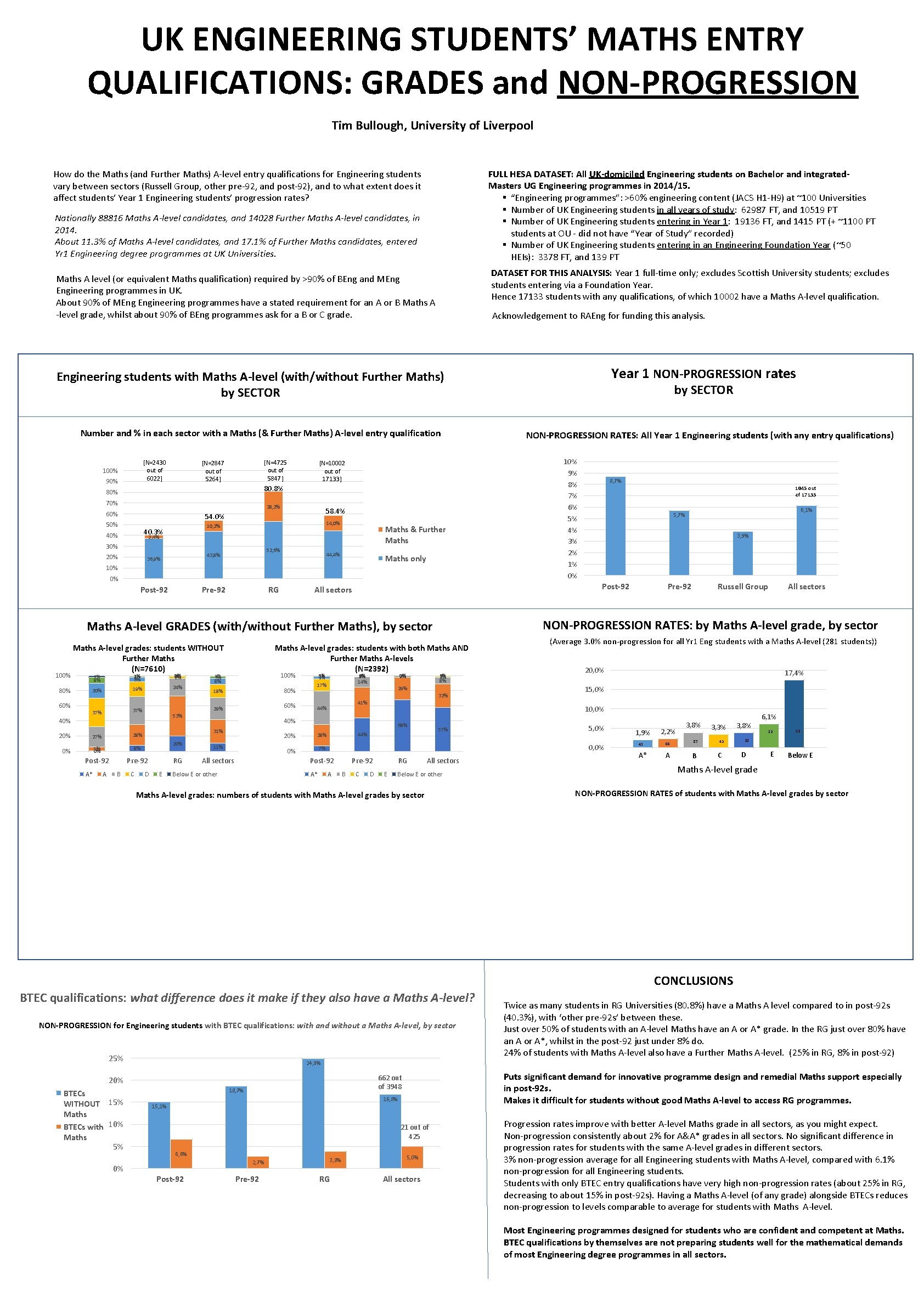
UK ENGINEERING STUDENTS’ MATHS ENTRY QUALIFICATIONS: GRADES and NON-PROGRESSION Tim Bullough, University of Liverpool FULL HESA DATASET: All UK-domiciled Engineering students on Bachelor and integrated. Masters UG Engineering programmes in 2014/15. § “Engineering programmes”: >60% engineering content (JACS H 1 -H 9) at ~100 Universities § Number of UK Engineering students in all years of study: 62987 FT, and 10519 PT § Number of UK Engineering students entering in Year 1: 19136 FT, and 1415 PT (+ ~1100 PT students at OU - did not have “Year of Study” recorded) § Number of UK Engineering students entering in an Engineering Foundation Year (~50 HEIs): 3378 FT, and 139 PT How do the Maths (and Further Maths) A-level entry qualifications for Engineering students vary between sectors (Russell Group, other pre-92, and post-92), and to what extent does it affect students’ Year 1 Engineering students’ progression rates? Nationally 88816 Maths A-level candidates, and 14028 Further Maths A-level candidates, in 2014. About 11. 3% of Maths A-level candidates, and 17. 1% of Further Maths candidates, entered Yr 1 Engineering degree programmes at UK Universities. DATASET FOR THIS ANALYSIS: Year 1 full-time only; excludes Scottish University students; excludes students entering via a Foundation Year. Hence 17133 students with any qualifications, of which 10002 have a Maths A-level qualification. Maths A level (or equivalent Maths qualification) required by >90% of BEng and MEng Engineering programmes in UK. About 90% of MEng Engineering programmes have a stated requirement for an A or B Maths A -level grade, whilst about 90% of BEng programmes ask for a B or C grade. Acknowledgement to RAEng for funding this analysis. Year 1 NON-PROGRESSION rates Engineering students with Maths A-level (with/without Further Maths) by SECTOR Number and % in each sector with a Maths (& Further Maths) A-level entry qualification [N=2430 out of 6022] 100% 90% [N=4725 out of 5847] [N=2847 out of 5264] [N=10002 out of 17133] 80. 8% 80% 70% 28, 2% 60% 58. 4% 54. 0% 50% 40. 3% 40% 14, 0% 10, 2% Maths & Further Maths 3, 4% 30% 20% 52, 6% 43, 8% 36, 9% 44, 4% Maths only 10% 0% Post-92 Pre-92 RG 100% 80% 60% 2% 8% 1% 1% 6% 0% 1% 2% 20% 19% 24% 37% 20% 5% 0% 8% Post-92 Pre-92 0% A* A B C 80% 29% 60% D RG E 0% 1% 3% 0% 2% 0% 1% 14% 17% 20% 11% 32% 41% 44% A* A Pre-92 B 1045 out of 17133 C 6, 1% 5, 7% 3, 9% Pre-92 Russell Group D RG E All sectors (Average 3. 0% non-progression for all Yr 1 Eng students with a Maths A-level (281 students)) 20, 0% 17, 4% 15, 0% 0, 0% 7% Post-92 Below E or other 57% 44% 28% 8, 7% 10, 0% 68% 0% All sectors 0% 1% 2% 8% 29% 40% 31% 28% 27% 18% 53% 40% 20% 10% 9% 8% 7% 6% 5% 4% 3% 2% 1% 0% NON-PROGRESSION RATES: by Maths A-level grade, by sector Maths A-level grades: students with both Maths AND Further Maths A-levels (N=2392) 1% 3% 8% NON-PROGRESSION RATES: All Year 1 Engineering students (with any entry qualifications) Post-92 All sectors Maths A-level GRADES (with/without Further Maths), by sector Maths A-level grades: students WITHOUT Further Maths (N=7610) by SECTOR All sectors Below E or other Maths A-level grades: numbers of students with Maths A-level grades by sector 1, 9% 2, 2% 3, 8% 41 66 87 A* A B 3, 3% 42 C 3, 8% 6, 1% 12 12 21 D E Below E Maths A-level grade NON-PROGRESSION RATES of students with Maths A-level grades by sector CONCLUSIONS BTEC qualifications: what difference does it make if they also have a Maths A-level? NON-PROGRESSION for Engineering students with BTEC qualifications: with and without a Maths A-level, by sector 25% 24, 9% Puts significant demand for innovative programme design and remedial Maths support especially in post-92 s. Makes it difficult for students without good Maths A-level to access RG programmes. 662 out of 3948 20% BTECs WITHOUT 15% Maths BTECs with 10% Maths 5% Twice as many students in RG Universities (80. 8%) have a Maths A level compared to in post-92 s (40. 3%), with ‘other pre-92 s’ between these. Just over 50% of students with an A-level Maths have an A or A* grade. In the RG just over 80% have an A or A*, whilst in the post-92 just under 8% do. 24% of students with Maths A-level also have a Further Maths A-level. (25% in RG, 8% in post-92) 18, 7% 16, 8% 15, 1% 21 out of 425 6, 6% 2, 7% 0% Post-92 Pre-92 3, 8% RG 5, 0% All sectors Progression rates improve with better A-level Maths grade in all sectors, as you might expect. Non-progression consistently about 2% for A&A* grades in all sectors. No significant difference in progression rates for students with the same A-level grades in different sectors. 3% non-progression average for all Engineering students with Maths A-level, compared with 6. 1% non-progression for all Engineering students. Students with only BTEC entry qualifications have very high non-progression rates (about 25% in RG, decreasing to about 15% in post-92 s). Having a Maths A-level (of any grade) alongside BTECs reduces non-progression to levels comparable to average for students with Maths A-level. Most Engineering programmes designed for students who are confident and competent at Maths. BTEC qualifications by themselves are not preparing students well for the mathematical demands of most Engineering degree programmes in all sectors.