
UK ATLAS Stave materials research Glasgow Liverpool QMUL
![FEA numbers Item Material K x / y / z [W/m-K] thickness [mm] Asic](https://slidetodoc.com/presentation_image_h/1de3963a15ff94b38a980f63c53f56a1/image-15.jpg "FEA numbers Item Material K x / y / z [W/m-K] thickness [mm] Asic")
- Slides: 30
UK ATLAS Stave materials research Glasgow, Liverpool, QMUL, RAL, UK Astronomy Technology Centre 11 th November 2010 ATLAS upgrade week. R. Bates 1
Contents • Update on thermal measurements – Discussion on hybrid model – Glues, face sheets etc – Foams • Update on FEA • Mechanical – Foams and plans 11 th November 2010 ATLAS upgrade week. R. Bates 2
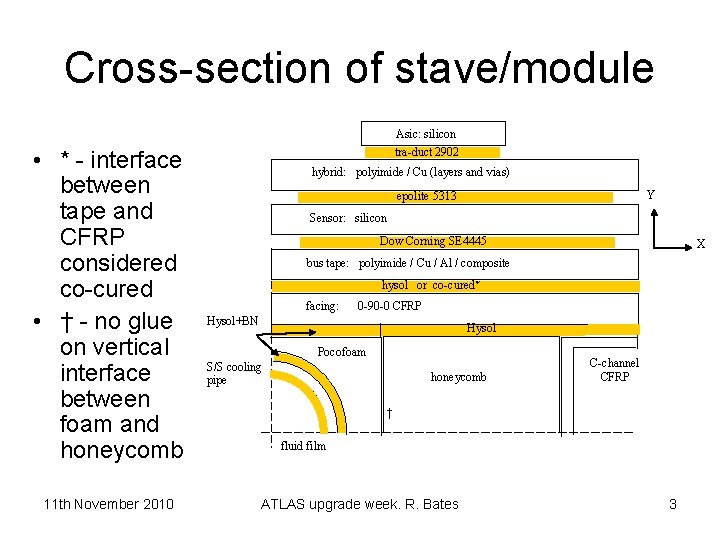
Cross-section of stave/module Asic: silicon • * - interface between tape and CFRP considered co-cured • † - no glue on vertical interface between foam and honeycomb 11 th November 2010 tra-duct 2902 hybrid: polyimide / Cu (layers and vias) Y epolite 5313 Sensor: silicon Dow Corning SE 4445 X bus tape: polyimide / Cu / Al / composite hysol or co-cured* facing: 0 -90 -0 CFRP Hysol+BN Hysol Pocofoam S/S cooling pipe honeycomb C-channel CFRP † fluid film ATLAS upgrade week. R. Bates 3
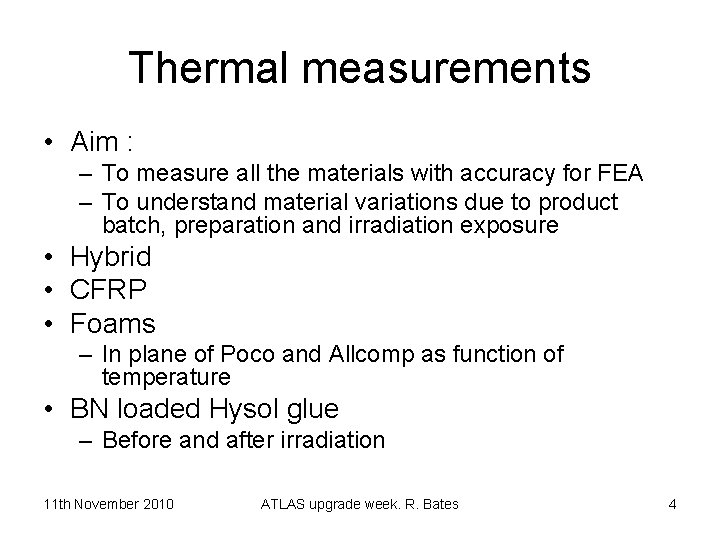
Thermal measurements • Aim : – To measure all the materials with accuracy for FEA – To understand material variations due to product batch, preparation and irradiation exposure • Hybrid • CFRP • Foams – In plane of Poco and Allcomp as function of temperature • BN loaded Hysol glue – Before and after irradiation 11 th November 2010 ATLAS upgrade week. R. Bates 4
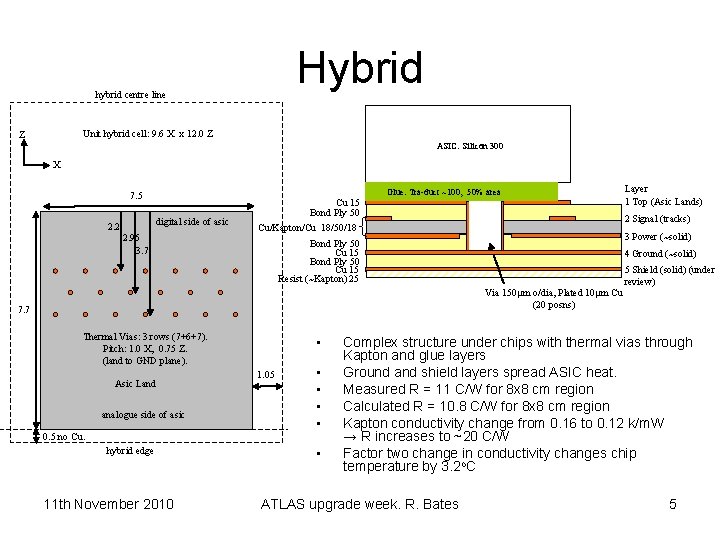
Hybrid hybrid centre line Unit hybrid cell: 9. 6 X x 12. 0 Z Z ASIC: Silicon 300 X Glue: Tra-duct ~100, 50% area 7. 5 digital side of asic 2. 2 2. 95 3. 7 Cu 15 Bond Ply 50 2 Signal (tracks) Cu/Kapton/Cu 18/50/18 3 Power (~solid) Bond Ply 50 Cu 15 Resist (~Kapton) 25 4 Ground (~solid) Via 150 mm o/dia, Plated 10 mm Cu (20 posns) 7. 7 Thermal Vias: 3 rows (7+6+7). Pitch: 1. 0 X, 0. 75 Z. (land to GND plane). Asic Land analogue side of asic • 1. 05 • • 0. 5 no Cu. hybrid edge 11 th November 2010 • Layer 1 Top (Asic Lands) 5 Shield (solid) (under review) Complex structure under chips with thermal vias through Kapton and glue layers Ground and shield layers spread ASIC heat. Measured R = 11 C/W for 8 x 8 cm region Calculated R = 10. 8 C/W for 8 x 8 cm region Kapton conductivity change from 0. 16 to 0. 12 k/m. W → R increases to ~20 C/W Factor two change in conductivity changes chip temperature by 3. 2 o. C ATLAS upgrade week. R. Bates 5
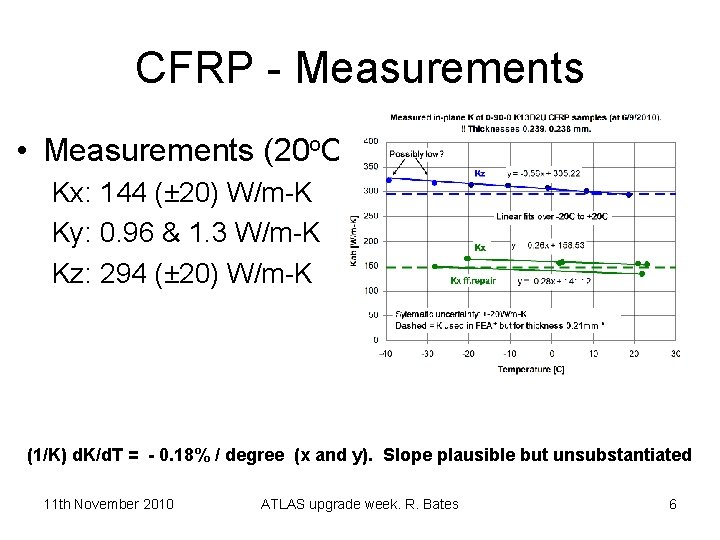
CFRP - Measurements • Measurements (20 o. C) Kx: 144 (± 20) W/m-K Ky: 0. 96 & 1. 3 W/m-K Kz: 294 (± 20) W/m-K (1/K) d. K/d. T = - 0. 18% / degree (x and y). Slope plausible but unsubstantiated 11 th November 2010 ATLAS upgrade week. R. Bates 6
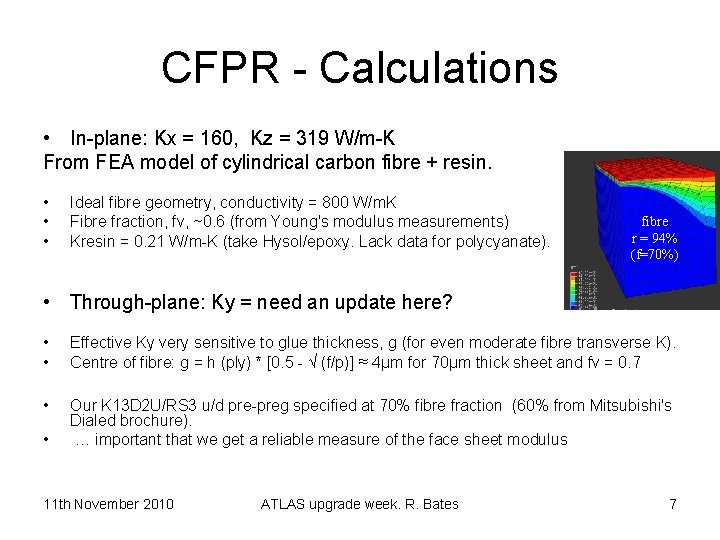
CFPR - Calculations • In-plane: Kx = 160, Kz = 319 W/m-K From FEA model of cylindrical carbon fibre + resin. • • • Ideal fibre geometry, conductivity = 800 W/m. K Fibre fraction, fv, ~0. 6 (from Young's modulus measurements) Kresin = 0. 21 W/m-K (take Hysol/epoxy. Lack data for polycyanate). fibre r = 94% (f=70%) • Through-plane: Ky = need an update here? • • Effective Ky very sensitive to glue thickness, g (for even moderate fibre transverse K). Centre of fibre: g = h (ply) * [0. 5 - √ (f/p)] ≈ 4µm for 70µm thick sheet and fv = 0. 7 • Our K 13 D 2 U/RS 3 u/d pre-preg specified at 70% fibre fraction (60% from Mitsubishi's Dialed brochure). … important that we get a reliable measure of the face sheet modulus • 11 th November 2010 ATLAS upgrade week. R. Bates 7
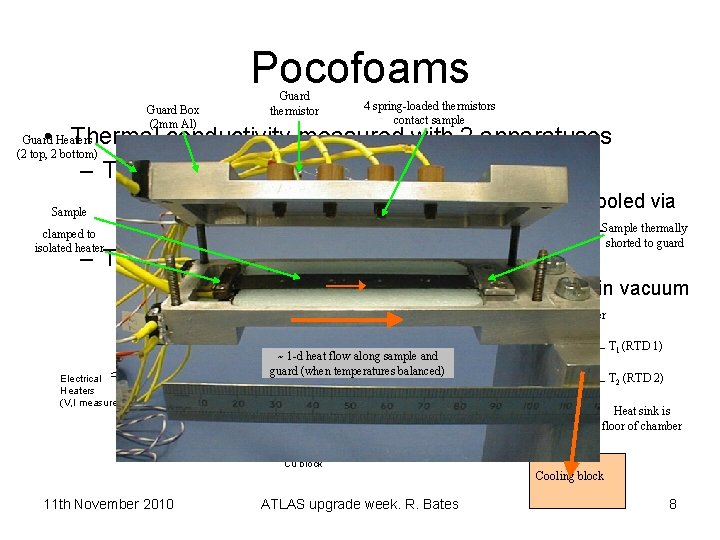
Pocofoams Guard thermistor Guard Box (2 mm Al) 4 spring-loaded thermistors contact sample • Thermal conductivity measured with 2 apparatuses – TIM apparatus Guard Heaters (2 top, 2 bottom) Sample clamped to isolated heater • 1 x 1 x 2 cm cube with heater attached to top surface, cooled via lower copper block, PT 100’s glued along edge, in air. Sample thermally shorted to guard – TTC apparatus • Thin samples surrounded by thermal shield, housed in vacuum Heater tank Electrical Heaters (V, I measured) RTD 1 ~ 1 -d heat flow along sample and RTD 2 RTD 3 Al thermal guard (when temperatures balanced) shield DUT T 1 (RTD 1) ΔL T 2 (RTD 2) PT 100 s H 2 O Plastic insulating supports Poco foam Lower Cu bar Heat sink is floor of chamber Water cooled Cu block Cooling block 11 th November 2010 ATLAS upgrade week. R. Bates 8
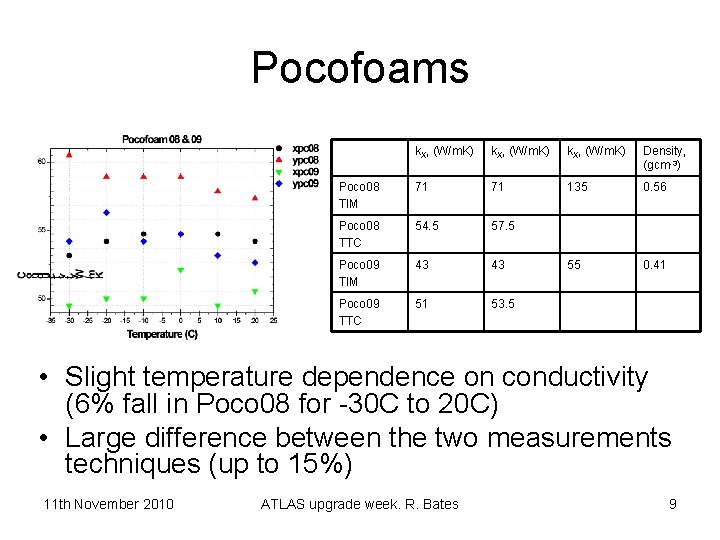
Pocofoams k. X, (W/m. K) Density, (gcm-3) Poco 08 TIM 71 71 135 0. 56 Poco 08 TTC 54. 5 57. 5 Poco 09 TIM 43 43 55 0. 41 Poco 09 TTC 51 53. 5 • Slight temperature dependence on conductivity (6% fall in Poco 08 for -30 C to 20 C) • Large difference between the two measurements techniques (up to 15%) 11 th November 2010 ATLAS upgrade week. R. Bates 9
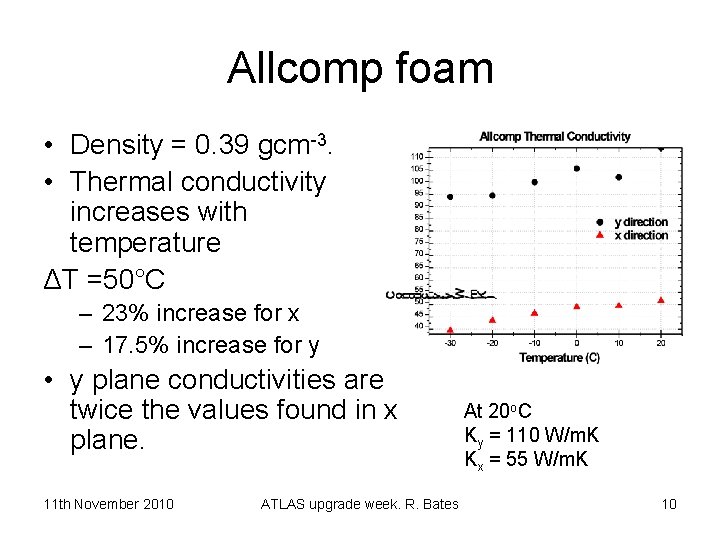
Allcomp foam • Density = 0. 39 gcm-3. • Thermal conductivity increases with temperature ΔT =50°C – 23% increase for x – 17. 5% increase for y • y plane conductivities are twice the values found in x plane. 11 th November 2010 ATLAS upgrade week. R. Bates At 20 o. C Ky = 110 W/m. K Kx = 55 W/m. K 10
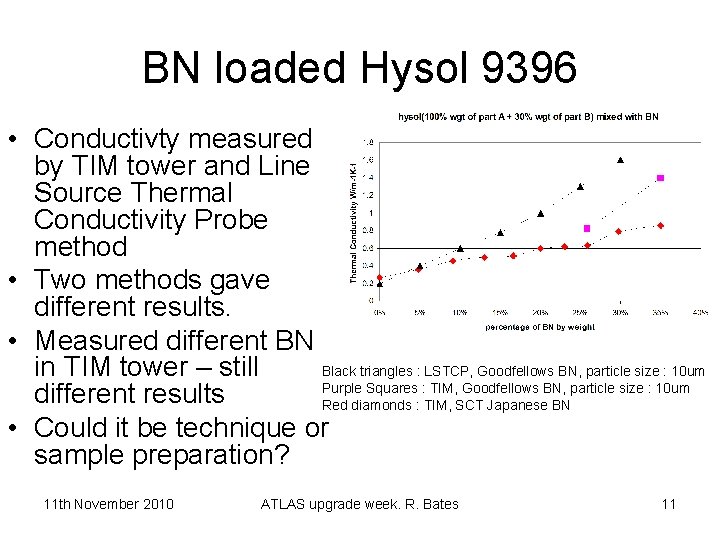
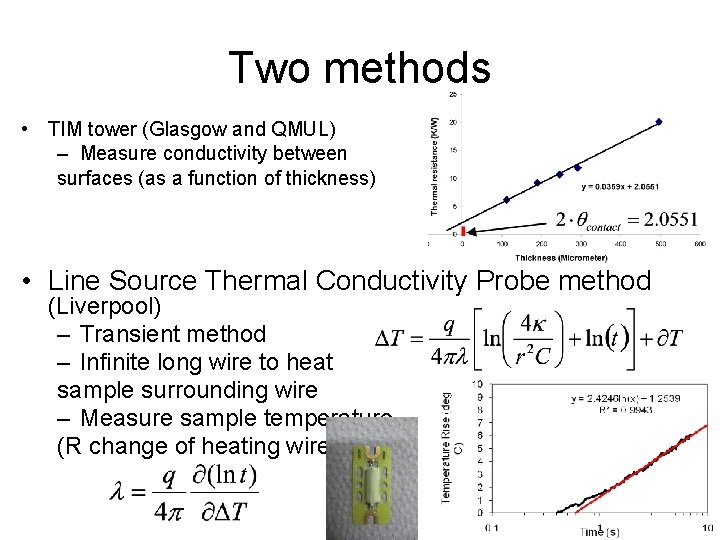
BN loaded Hysol 9396 • Conductivty measured by TIM tower and Line Source Thermal Conductivity Probe method • Two methods gave different results. • Measured different BN Black triangles : LSTCP, Goodfellows BN, particle size : 10 um in TIM tower – still Purple Squares : TIM, Goodfellows BN, particle size : 10 um different results Red diamonds : TIM, SCT Japanese BN • Could it be technique or sample preparation? 11 th November 2010 ATLAS upgrade week. R. Bates 11
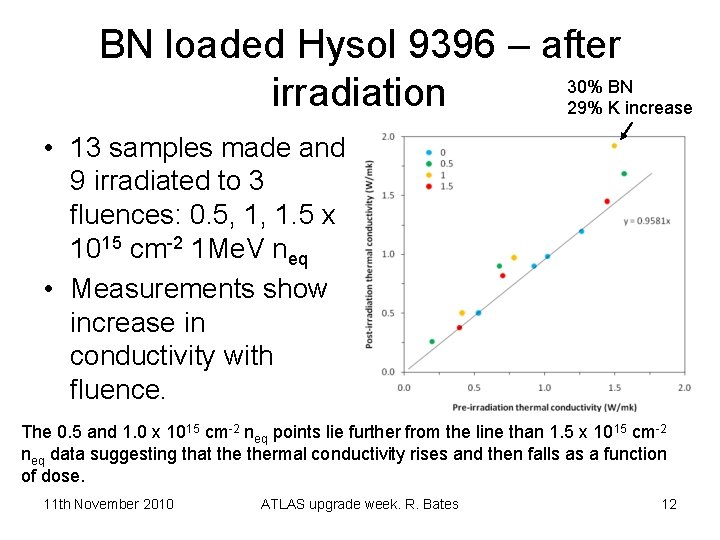
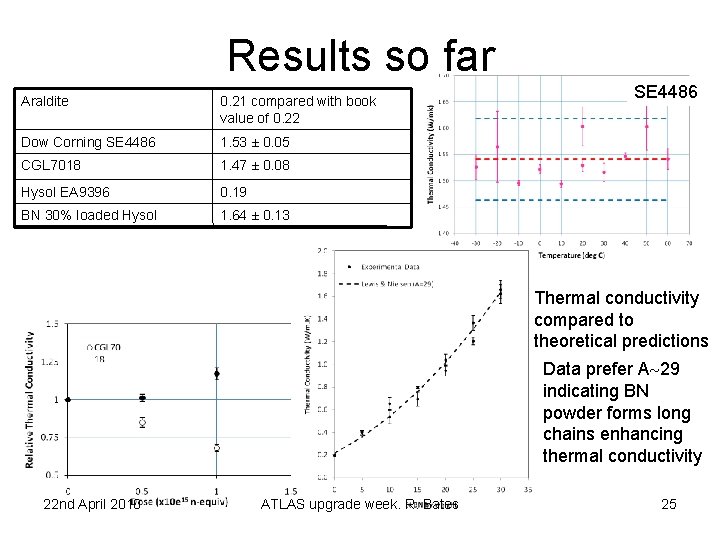
BN loaded Hysol 9396 – after 30% BN irradiation 29% K increase • 13 samples made and 9 irradiated to 3 fluences: 0. 5, 1, 1. 5 x 1015 cm-2 1 Me. V neq • Measurements show increase in conductivity with fluence. The 0. 5 and 1. 0 x 1015 cm-2 neq points lie further from the line than 1. 5 x 1015 cm-2 neq data suggesting that thermal conductivity rises and then falls as a function of dose. 11 th November 2010 ATLAS upgrade week. R. Bates 12
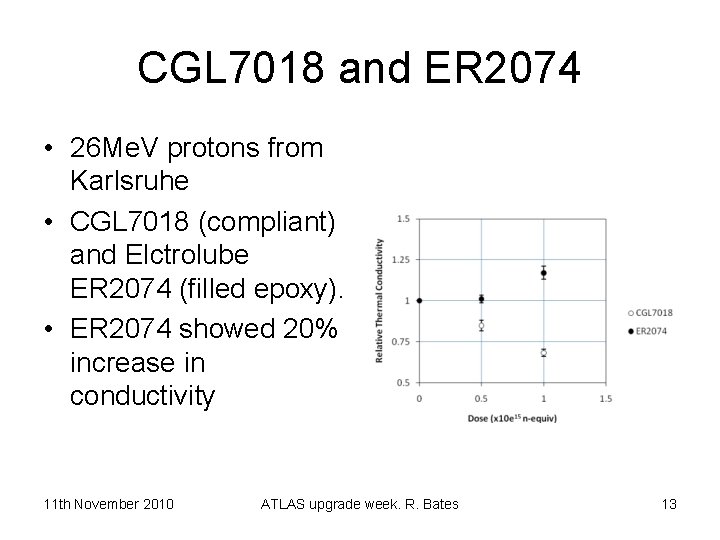
CGL 7018 and ER 2074 • 26 Me. V protons from Karlsruhe • CGL 7018 (compliant) and Elctrolube ER 2074 (filled epoxy). • ER 2074 showed 20% increase in conductivity 11 th November 2010 ATLAS upgrade week. R. Bates 13
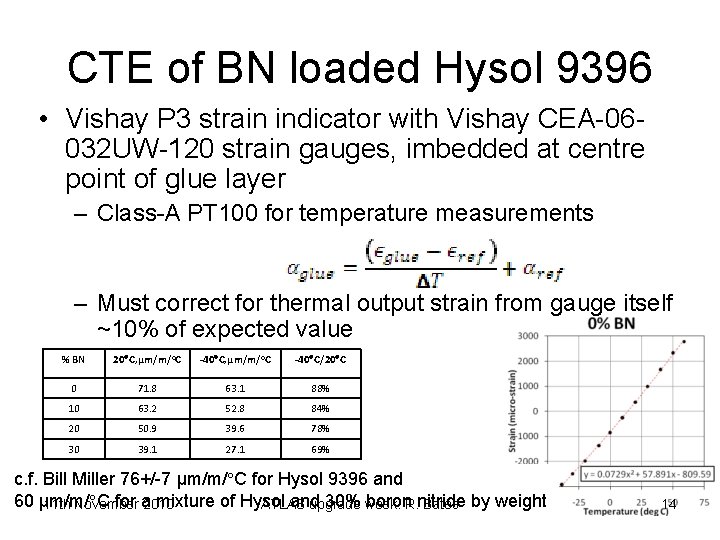
CTE of BN loaded Hysol 9396 • Vishay P 3 strain indicator with Vishay CEA-06032 UW-120 strain gauges, imbedded at centre point of glue layer – Class-A PT 100 for temperature measurements – Must correct for thermal output strain from gauge itself ~10% of expected value % BN 20 C, µm/m/o. C -40 C/20 C 0 71. 8 63. 1 88% 10 63. 2 52. 8 84% 20 50. 9 39. 6 78% 30 39. 1 27. 1 69% c. f. Bill Miller 76+/-7 µm/m/ C for Hysol 9396 and 60 µm/m/ C for a 2010 mixture of Hysol and 30% week. boron. R. nitride 11 th November ATLAS upgrade Bates by weight 14
FEA numbers Item Material K x / y / z [W/m-K] thickness [mm] Asic silicon see Table (1) 0. 3 asic to hybrid tra-duct-2902 2. 99 0. 1 50% area coverage! hybrid Cu/polyimide 64/? ? ? /64 0. 3 Kxz neglecting land, taking Affolder dims, inc. shield layer. hybrid to sensor epolite 0. 23 0. 1 2 mm stay-clear (guard region) Sensor silicon see Table (1) 0. 3 sensor to bus DC SE 4445(a) 1. 26 0. 2 glue pattern (a) aligned ~ Z bus tape Poly. I/Cu/Al 34 / 0. 24 / 34 0. 17 Al 25 um, 100%. Cu (16% area) neglected bus to facing Hysol 0. 21 0. 1 Facing 0 -90 -0 CFRP 150/1/300 0. 21 (Eng. dwgs 0. 27 mm too big). Hysol 0. 21 0 glue assumed 100% absorbed Air 0. 025 as drawn Hysol+BN 1. 63 0 Foam Pocofoam 43/55/43 as drawn P’foam to Pipe Hysol+BN 1. 63 0. 1 allows for pipe-foam gaps Cooling Pipe S/Steel 316 L see Table (2) 0. 22 3. 18 o/d Fluid film CO 2 Facing to honeyco mb Honeycomb Facing to Pocofoa m 11 th November 2010 additional info. notes/actions/references Future alternative: non-conductive glue (thinner) K from Glasgow measurement. Temperature dependence included K optimistic? Glasgow to measure. Measurements to support Omit if co-cured tape (preferred build). Ky need more understanding glue assumed 100% absorbed Gla. Poco 2009 (but Kx, y = 52 in Gla. TCC) htc = 4000 - 8000 W/m 2 K ATLAS upgrade week. R. Bates Temp dep included. Poss. alternatives: Titanium, 2 mm dia. Need input 15
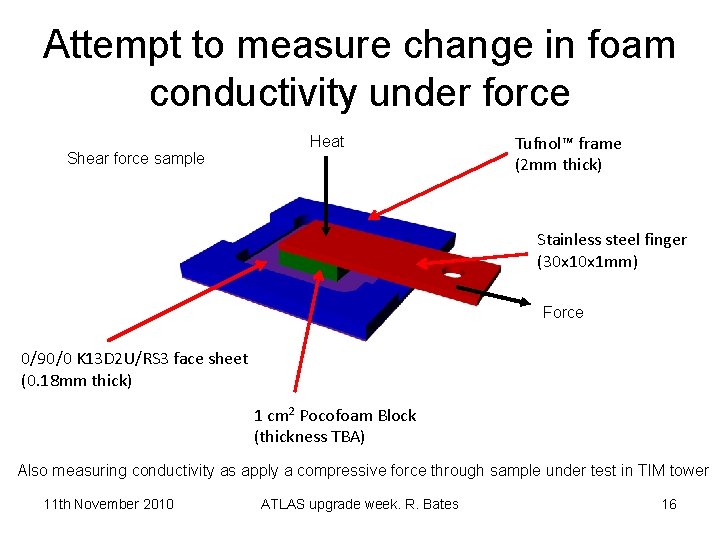
Attempt to measure change in foam conductivity under force Shear force sample Heat Tufnol™ frame (2 mm thick) Stainless steel finger (30 x 1 mm) Force 0/90/0 K 13 D 2 U/RS 3 face sheet (0. 18 mm thick) 1 cm 2 Pocofoam Block (thickness TBA) Also measuring conductivity as apply a compressive force through sample under test in TIM tower 11 th November 2010 ATLAS upgrade week. R. Bates 16
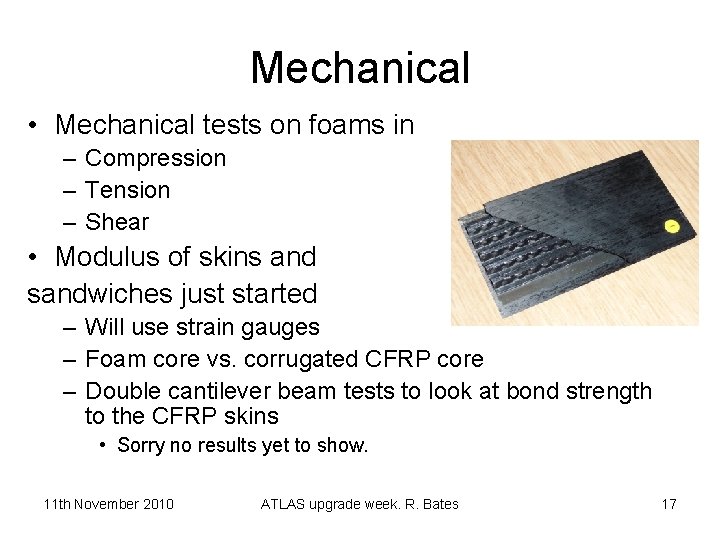
Mechanical • Mechanical tests on foams in – Compression – Tension – Shear • Modulus of skins and sandwiches just started – Will use strain gauges – Foam core vs. corrugated CFRP core – Double cantilever beam tests to look at bond strength to the CFRP skins • Sorry no results yet to show. 11 th November 2010 ATLAS upgrade week. R. Bates 17
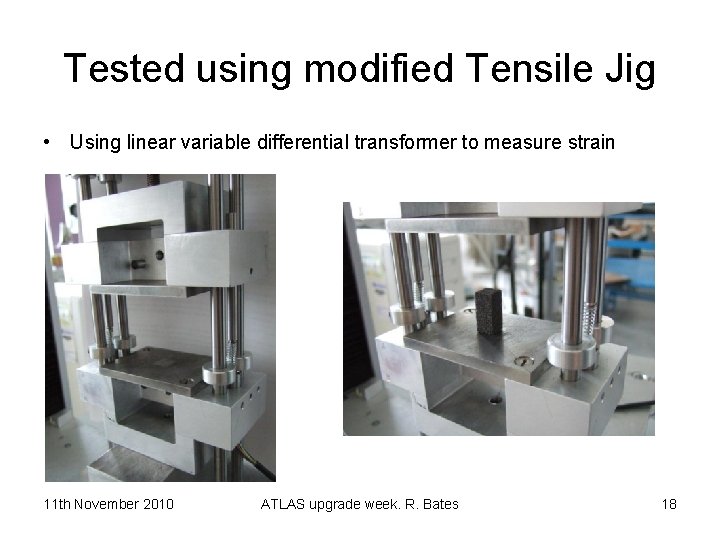
Tested using modified Tensile Jig • Using linear variable differential transformer to measure strain 11 th November 2010 ATLAS upgrade week. R. Bates 18
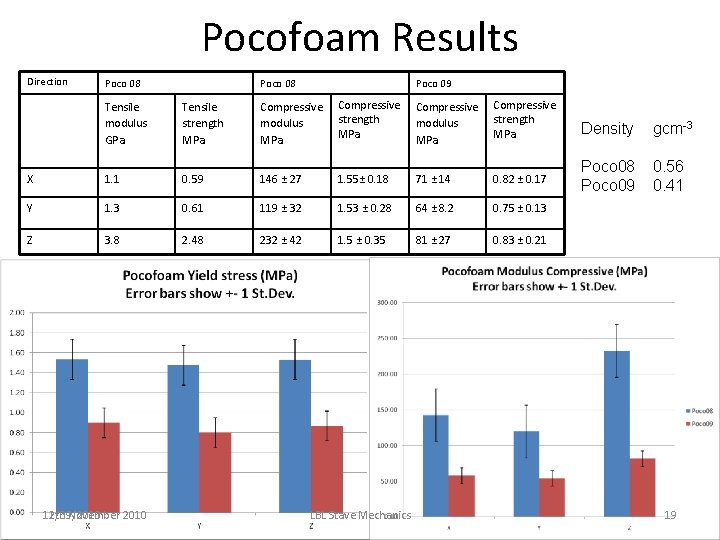
Pocofoam Results Direction Poco 08 Poco 09 Tensile modulus GPa Tensile strength MPa Compressive modulus MPa Compressive strength MPa X 1. 1 0. 59 146 ± 27 1. 55± 0. 18 71 ± 14 0. 82 ± 0. 17 Y 1. 3 0. 61 119 ± 32 1. 53 ± 0. 28 64 ± 8. 2 0. 75 ± 0. 13 Z 3. 8 2. 48 232 ± 42 1. 5 ± 0. 35 81 ± 27 0. 83 ± 0. 21 12/09/2010 11 th November 2010 LBL Stave Mechanics Density gcm-3 Poco 08 Poco 09 0. 56 0. 41 19
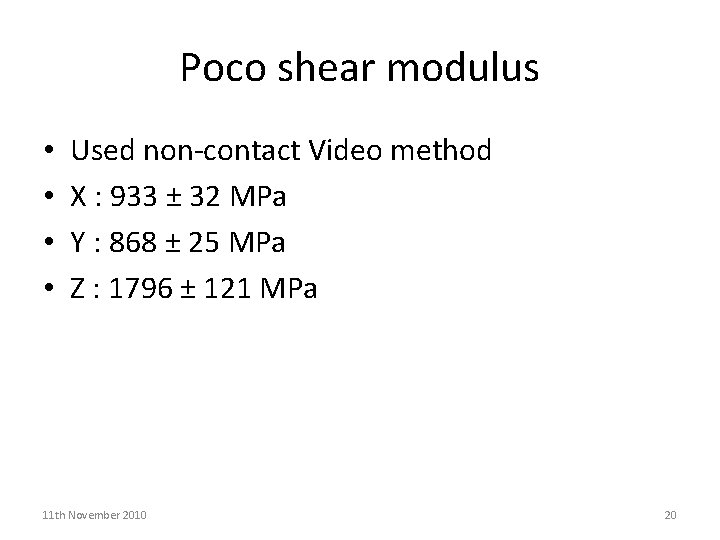
Poco shear modulus • • Used non-contact Video method X : 933 ± 32 MPa Y : 868 ± 25 MPa Z : 1796 ± 121 MPa 11 th November 2010 20
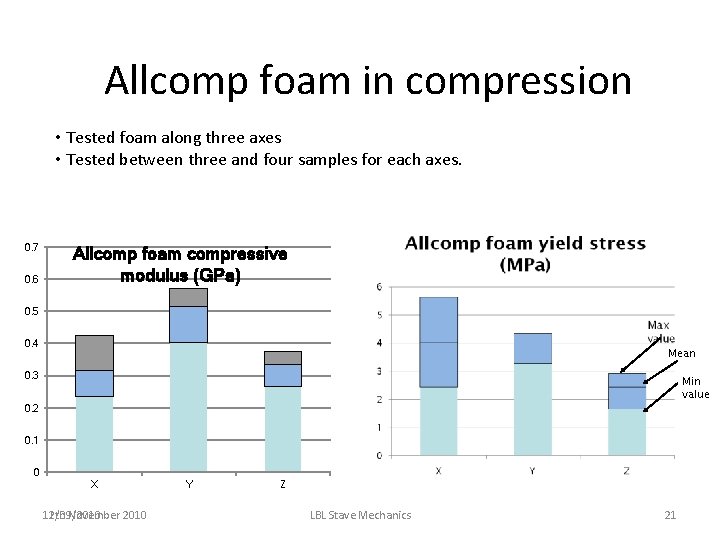
Allcomp foam in compression • Tested foam along three axes • Tested between three and four samples for each axes. 0. 7 0. 6 Allcomp foam compressive modulus (GPa) 0. 5 0. 4 Mean 0. 3 Min value 0. 2 0. 1 0 X 12/09/2010 11 th November 2010 Y Z LBL Stave Mechanics 21
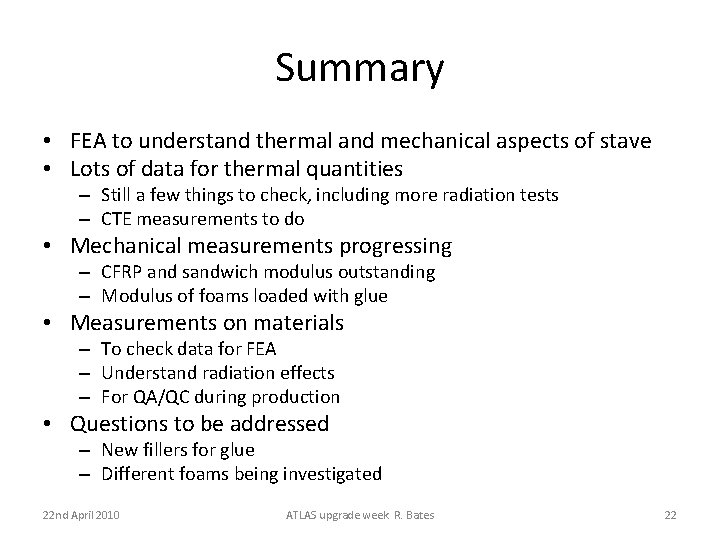
Summary • FEA to understand thermal and mechanical aspects of stave • Lots of data for thermal quantities – Still a few things to check, including more radiation tests – CTE measurements to do • Mechanical measurements progressing – CFRP and sandwich modulus outstanding – Modulus of foams loaded with glue • Measurements on materials – To check data for FEA – Understand radiation effects – For QA/QC during production • Questions to be addressed – New fillers for glue – Different foams being investigated 22 nd April 2010 ATLAS upgrade week. R. Bates 22
Back-up slides 11 th November 2010 23
Two methods • TIM tower (Glasgow and QMUL) – Measure conductivity between surfaces (as a function of thickness) • Line Source Thermal Conductivity Probe method (Liverpool) – Transient method – Infinite long wire to heat sample surrounding wire – Measure sample temperature (R change of heating wire)
Results so far Araldite 0. 21 compared with book value of 0. 22 Dow Corning SE 4486 1. 53 ± 0. 05 CGL 7018 1. 47 ± 0. 08 Hysol EA 9396 0. 19 BN 30% loaded Hysol 1. 64 ± 0. 13 SE 4486 Thermal conductivity compared to theoretical predictions Data prefer A 29 indicating BN powder forms long chains enhancing thermal conductivity 22 nd April 2010 ATLAS upgrade week. R. Bates 25
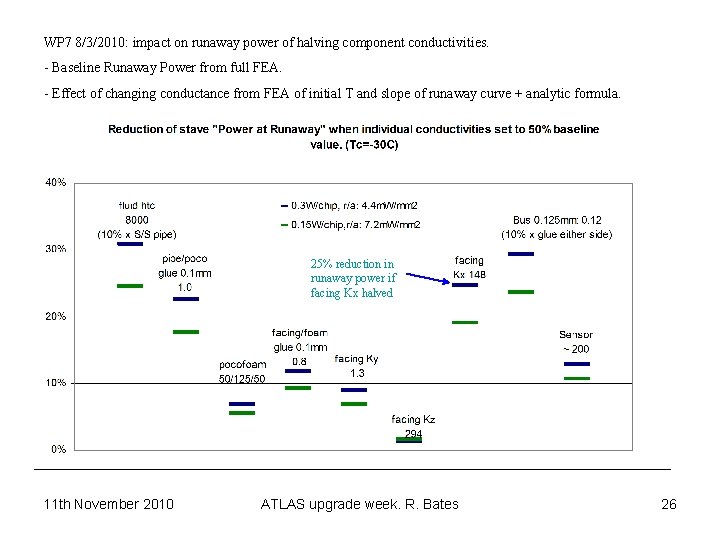
WP 7 8/3/2010: impact on runaway power of halving component conductivities. - Baseline Runaway Power from full FEA. - Effect of changing conductance from FEA of initial T and slope of runaway curve + analytic formula. 25% reduction in runaway power if facing Kx halved 11 th November 2010 ATLAS upgrade week. R. Bates 26
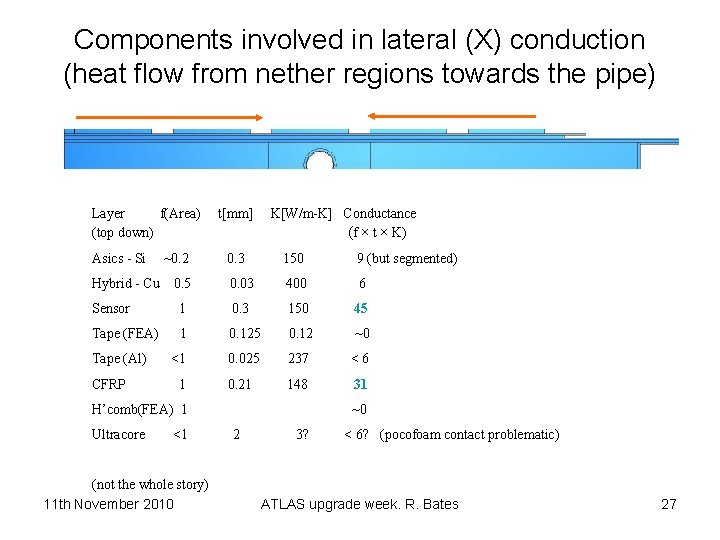
Components involved in lateral (X) conduction (heat flow from nether regions towards the pipe) Layer f(Area) (top down) Asics - Si K[W/m-K] Conductance (f × t × K) 0. 3 150 9 (but segmented) Hybrid - Cu 0. 5 0. 03 400 6 Sensor 1 0. 3 150 45 Tape (FEA) 1 0. 125 0. 12 ~0 <1 0. 025 237 <6 1 0. 21 148 31 Tape (Al) CFRP ~0. 2 t[mm] H’comb(FEA) 1 Ultracore <1 (not the whole story) 11 th November 2010 ~0 2 3? < 6? (pocofoam contact problematic) ATLAS upgrade week. R. Bates 27
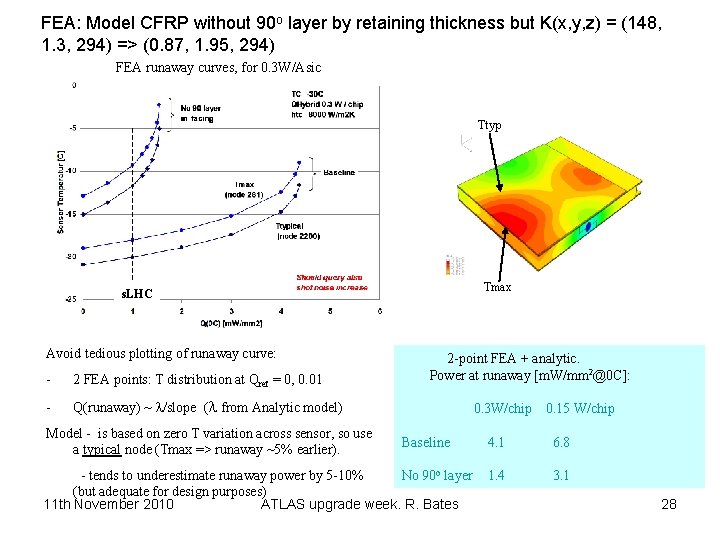
FEA: Model CFRP without 90 o layer by retaining thickness but K(x, y, z) = (148, 1. 3, 294) => (0. 87, 1. 95, 294) FEA runaway curves, for 0. 3 W/Asic Ttyp Tmax s. LHC Avoid tedious plotting of runaway curve: - 2 FEA points: T distribution at Qref = 0, 0. 01 - Q(runaway) ~ l/slope (l from Analytic model) Model - is based on zero T variation across sensor, so use a typical node (Tmax => runaway ~5% earlier). 2 -point FEA + analytic. Power at runaway [m. W/mm 2@0 C]: 0. 3 W/chip 0. 15 W/chip Baseline - tends to underestimate runaway power by 5 -10% No 90 o layer (but adequate for design purposes) 11 th November 2010 ATLAS upgrade week. R. Bates 4. 1 6. 8 1. 4 3. 1 28
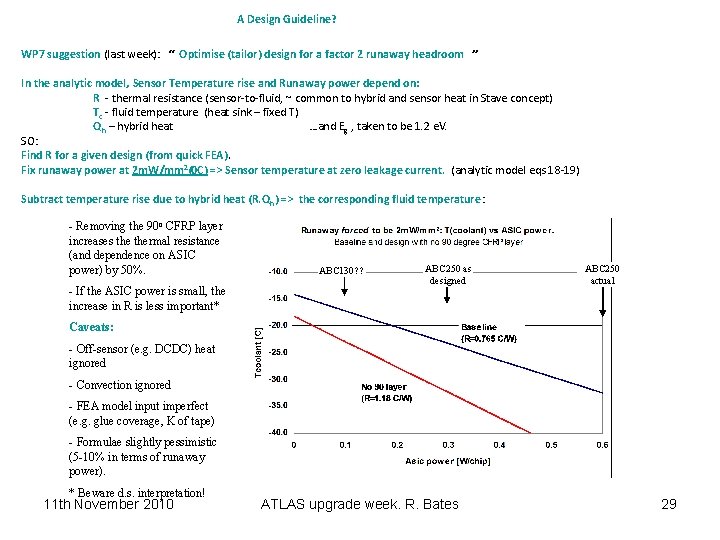
A Design Guideline? WP 7 suggestion (last week): “ Optimise (tailor) design for a factor 2 runaway headroom ” In the analytic model, Sensor Temperature rise and Runaway power depend on: R - thermal resistance (sensor-to-fluid, ~ common to hybrid and sensor heat in Stave concept) Tc - fluid temperature (heat sink – fixed T) Qh – hybrid heat …and Eg , taken to be 1. 2 e. V. SO: Find R for a given design (from quick FEA). Fix runaway power at 2 m. W/mm 2(0 C) => Sensor temperature at zero leakage current. (analytic model eqs 18 -19) Subtract temperature rise due to hybrid heat (R. Q h) => the corresponding fluid temperature: - Removing the 90 o CFRP layer increases thermal resistance (and dependence on ASIC power) by 50%. - If the ASIC power is small, the increase in R is less important* ABC 130? ? ABC 250 as designed ABC 250 actual Caveats: - Off-sensor (e. g. DCDC) heat ignored - Convection ignored - FEA model input imperfect (e. g. glue coverage, K of tape) - Formulae slightly pessimistic (5 -10% in terms of runaway power). * Beware d. s. interpretation! 11 th November 2010 ATLAS upgrade week. R. Bates 29
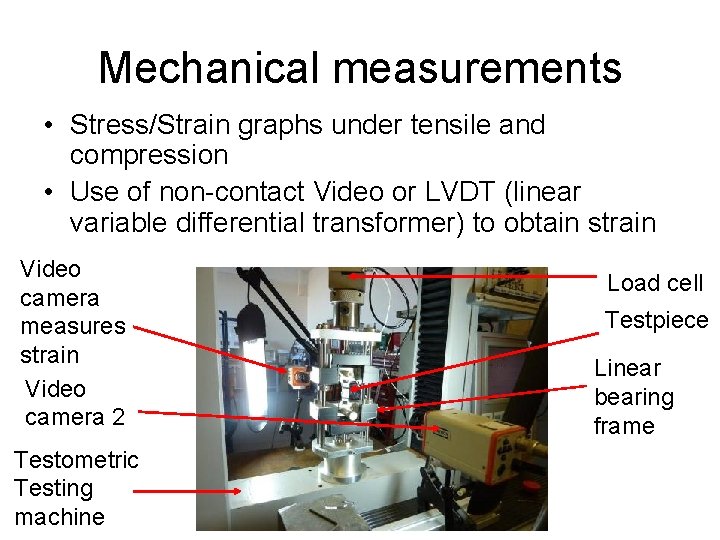
Mechanical measurements • Stress/Strain graphs under tensile and compression • Use of non-contact Video or LVDT (linear variable differential transformer) to obtain strain Video camera measures strain Video camera 2 Testometric Testing machine Load cell Testpiece Linear bearing frame