
Ui Path Academy Course Catalog Presentation Title Last



- Slides: 38
Ui. Path Academy Course Catalog Presentation Title Last Revision: February 2021
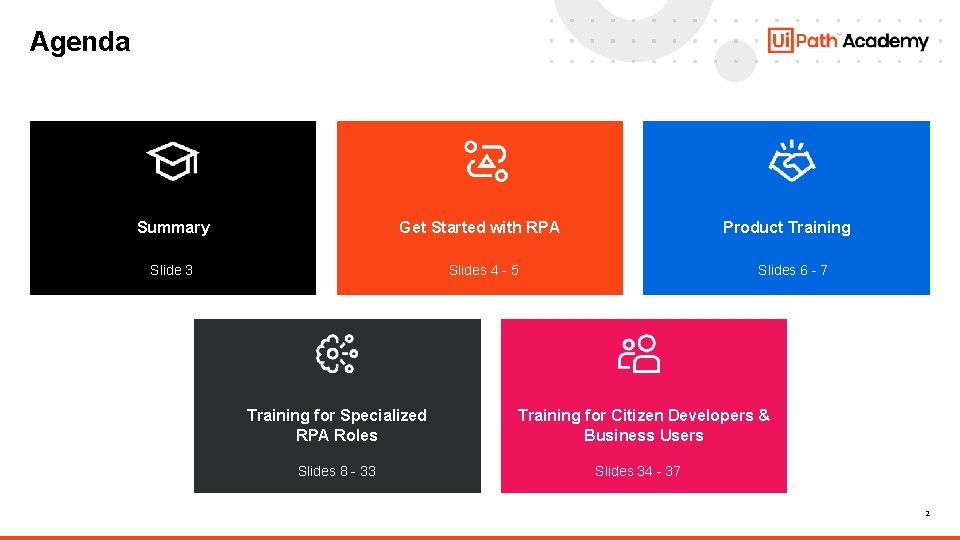
Agenda Summary Get Started with RPA Slide 3 Slides 4 - 5 Training for Specialized RPA Roles Slides 8 - 33 Product Training Slides 6 - 7 Training for Citizen Developers & Business Users Slides 34 - 37 2
Summary Ui. Path Academy is enabling companies looking to accelerate adoption of Robotic Process Automation by up-skilling professionals for automating repetitive work. The Academy experience is designed with a user-centric approach, delivering a high-quality learning journey. The courseware covers real-life automation scenarios, RPA best practices, and hands-on training experience. Learning Approach • Modern UX, combining several learning methods: demos, quizzes, simulations, exercises and reading • High-Definition streaming quality, with multilingual closed caption support in 9 languages (English, Japanese, French, German, Korean, Simplified Chinese, Turkish, Spanish, Portuguese) • Full localization support for Russian, Japanese, German and Turkish. • Free navigation within the learning plan and courses (users can jump to any lesson, at any time) • Downloadable resources and links to documentation in each lesson • Good case practices from real implementations provided by developers. 3
Get Started Discover a holistic learning experience driving awareness on Robotic Process Automation(RPA), understand how technology is transforming complex business processes, and learn how to create your first robot. Educate at scale with the RPA Starter Course.
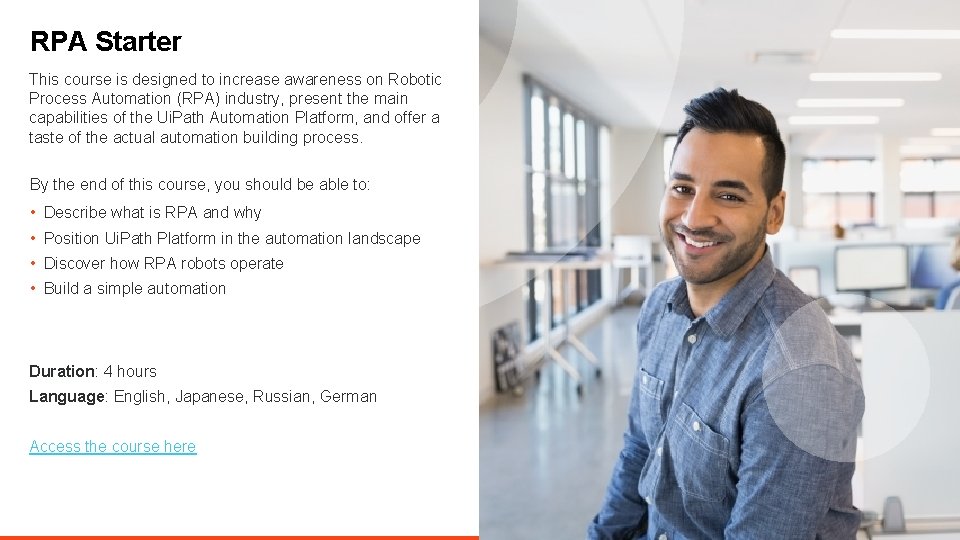
RPA Starter This course is designed to increase awareness on Robotic Process Automation (RPA) industry, present the main capabilities of the Ui. Path Automation Platform, and offer a taste of the actual automation building process. By the end of this course, you should be able to: • Describe what is RPA and why • Position Ui. Path Platform in the automation landscape • Discover how RPA robots operate • Build a simple automation Duration: 4 hours Language: English, Japanese, Russian, German Access the course here 5
Product Training One place to learn about the entire product offering of the Ui. Path platform.
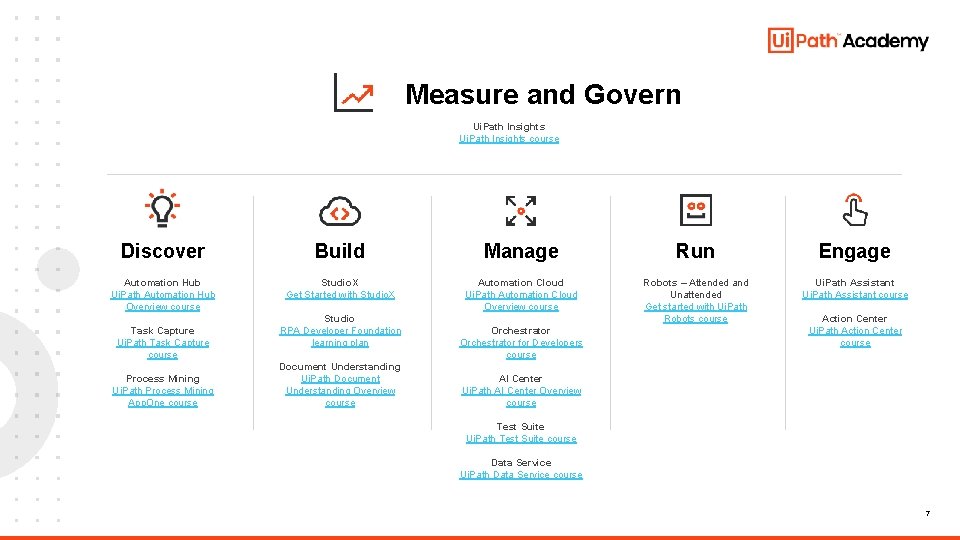
Measure and Govern Ui. Path Insights course Discover Build Manage Run Engage Automation Hub Ui. Path Automation Hub Overview course Studio. X Get Started with Studio. X Automation Cloud Ui. Path Automation Cloud Overview course Robots – Attended and Unattended Get started with Ui. Path Robots course Ui. Path Assistant course Task Capture Ui. Path Task Capture course Process Mining Ui. Path Process Mining App. One course Studio RPA Developer Foundation learning plan Document Understanding Ui. Path Document Understanding Overview course Orchestrator for Developers course Action Center Ui. Path Action Center course AI Center Ui. Path AI Center Overview course Test Suite Ui. Path Test Suite course Data Service Ui. Path Data Service course 7
Training for Specialized RPA Roles A fully automated enterprise develops internal, selfsustaining and scalable expertise to build, run and maintain robots as part of the automation journey. Discover a role based tailored training catalog for every critical role needed for implementing and scaling automation.
RPA Developer Responsibilities • • • Part of the RPA Deployment Project team Responsible for the end-to-end project development and implementation until the automation handover to Operations Strong stakeholder management between delivery teams Provides post Go Live support to Operations throughout stabilization phase Ensures successful RPA projects in terms of outcomes, duration and budget Skills: • • Experience with. NET/VB, VBA/Power. Shell or C# Strong analytical skills and business acumen Knowledge of any scripting languages Excellent communication skills - should be able to explain the technical aspects to non-technical people and to relevant stakeholders
RPA Developer Foundation This learning plan is designed for developers who want to expand their capabilities with Robotic Process Automation (RPA) and the Ui. Path Automation Platform. It will provide the essential knowledge and skills to create productionready automation workflows and components. Required exams: Ui. Path Certified RPA Associate (Ui. RPA) Duration: 39 hours Language: English, Japanese Multilingual Closed Caption Support: English, Japanese, French, German, Korean, Simplified Chinese, Turkish, Spanish, Portuguese Prerequisites: Basic programming experience Access the learning plan here 10
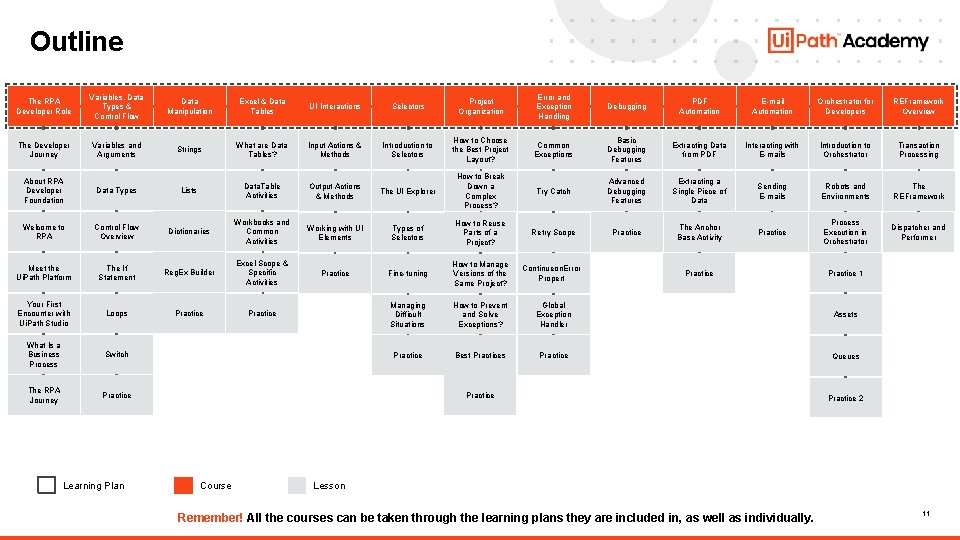
Outline The RPA Developer Role Variables, Data Types & Control Flow Data Manipulation Excel & Data Tables UI Interactions Selectors Project Organization Error and Exception Handling Debugging PDF Automation E-mail Automation Orchestrator for Developers REFramework Overview The Developer Journey Variables and Arguments Strings What are Data Tables? Input Actions & Methods Introduction to Selectors How to Choose the Best Project Layout? Common Exceptions Basic Debugging Features Extracting Data from PDF Interacting with E-mails Introduction to Orchestrator Transaction Processing Output Actions & Methods The UI Explorer How to Break Down a Complex Process? Try Catch Advanced Debugging Features Extracting a Single Piece of Data Sending E-mails Robots and Environments The REFramework Practice The Anchor Base Activity Practice Process Execution in Orchestrator Dispatcher and Performer About RPA Developer Foundation Data Types Lists Data. Table Activities Welcome to RPA Control Flow Overview Dictionaries Workbooks and Common Activities Working with UI Elements Types of Selectors How to Reuse Parts of a Project? Retry Scope Meet the Ui. Path Platform The If Statement Reg. Ex Builder Excel Scope & Specific Activities Practice Fine-tuning How to Manage Versions of the Same Project? Continueon. Error Propert Your First Encounter with Ui. Path Studio Loops Practice Managing Difficult Situations How to Prevent and Solve Exceptions? Global Exception Handler Assets What Is a Business Process Switch Practice Best Practices Practice Queues The RPA Journey Practice Learning Plan Practice Course Practice 1 Practice 2 Lesson Remember! All the courses can be taken through the learning plans they are included in, as well as individually. 11
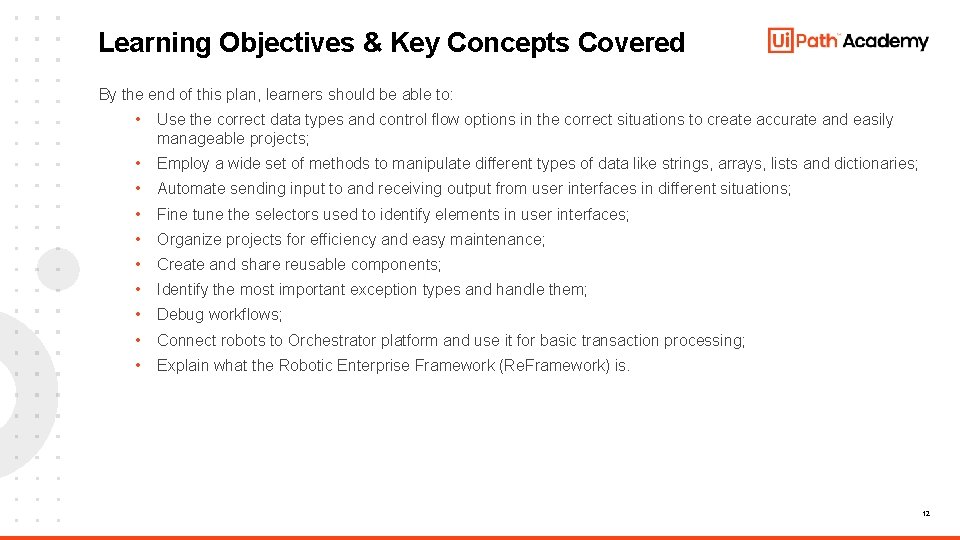
Learning Objectives & Key Concepts Covered By the end of this plan, learners should be able to: • Use the correct data types and control flow options in the correct situations to create accurate and easily manageable projects; • Employ a wide set of methods to manipulate different types of data like strings, arrays, lists and dictionaries; • Automate sending input to and receiving output from user interfaces in different situations; • Fine tune the selectors used to identify elements in user interfaces; • Organize projects for efficiency and easy maintenance; • Create and share reusable components; • Identify the most important exception types and handle them; • Debug workflows; • Connect robots to Orchestrator platform and use it for basic transaction processing; • Explain what the Robotic Enterprise Framework (Re. Framework) is. 12
Advanced RPA Developer Brief description: Building on the skills developed in the RPA Developer Foundation, this learning plan consists of one course that covers in depth the Robotic Enterprise Framework. This is a framework developed by the Ui. Path developers for reliable enterprise automation projects. The course consists of an in-depth coverage of this framework, followed by 2 complex exercises to equip you for real-life automation scenarios and their challenges. Required exams: Ui. Path Certified Advanced RPA Developer (Ui. ARD) Duration: 40 hours Language: English, Japanese Access the learning plan here 13
Learning Objectives & Key Concepts Covered By the end of this plan, learners should be able to: • Create production-ready automation projects using the Robotic Enterprise Framework • Apply the Ui. Path best practices • Build end-to-end functional and qualitative automation projects. 14
RPA Developer Continuous Learning This learning plan is composed of the non-core automation features and technologies. Some of the RPA developers may not need these at all, while others may work with them daily. Duration: 40 hours Language: English Prerequisites: Basic programming experience Access the learning plan here 15
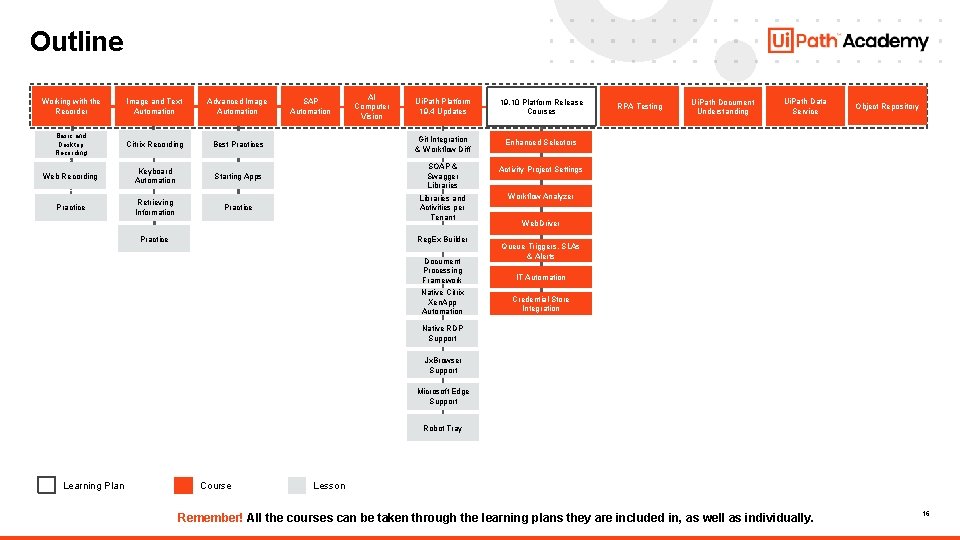
Outline AI Computer Vision Ui. Path Platform 19. 4 Updates 19. 10 Platform Release Courses Best Practices Git Integration & Workflow Diff Enhanced Selectors Keyboard Automation Starting Apps SOAP & Swagger Libraries Activity Project Settings Retrieving Information Libraries and Activities per Tenant Workflow Analyzer Practice Working with the Recorder Image and Text Automation Advanced Image Automation Basic and Desktop Recording Citrix Recording Web Recording Practice SAP Automation Practice Reg. Ex Builder Document Processing Framework Native Citrix Xen. App Automation RPA Testing Ui. Path Document Understanding Ui. Path Data Service Object Repository Web. Driver Queue Triggers, SLAs & Alerts IT Automation Credential Store Integration Native RDP Support Jx. Browser Support Microsoft Edge Support Robot Tray Learning Plan Course Lesson Remember! All the courses can be taken through the learning plans they are included in, as well as individually. 16
Learning Objectives & Key Concepts Covered By the end of this plan, learners should be able to: • Use all the in-app tools of Studio, such as Recorder and Command Palette • Use advanced techniques of image, text and virtual machine automation • Build automation projects for processes carried out using SAP • Improve the reliability of UI automation with enhanced selectors • Automate web browser without using the UI through Web. Driver • Build automation workflows that effectively use the queue capabilities of Orchestrator; • Test RPA projects using Studio Pro and Ui. Path Test Suite; • Use the Document Understanding Framework to build automation projects involving digitized documents. 17
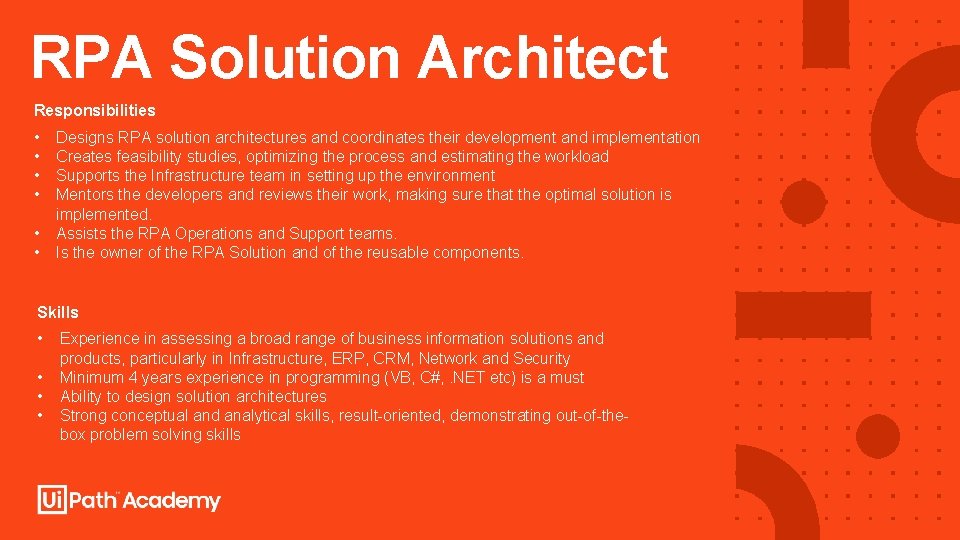
RPA Solution Architect Responsibilities • • • Designs RPA solution architectures and coordinates their development and implementation Creates feasibility studies, optimizing the process and estimating the workload Supports the Infrastructure team in setting up the environment Mentors the developers and reviews their work, making sure that the optimal solution is implemented. Assists the RPA Operations and Support teams. Is the owner of the RPA Solution and of the reusable components. Skills • • Experience in assessing a broad range of business information solutions and products, particularly in Infrastructure, ERP, CRM, Network and Security Minimum 4 years experience in programming (VB, C#, . NET etc) is a must Ability to design solution architectures Strong conceptual and analytical skills, result-oriented, demonstrating out-of-thebox problem solving skills
RPA Solution Architect Foundation From a technical standpoint, the RPA Solution Architect role is the most advanced. This is reflected in the way this learning plan is built. Starting with most of the RPA Developer courses, this learning plan continues with rolespecific content and coverage of the features and components related to the architecture and deployment of the Ui. Path solution in production. Duration: 94 hours Language: English Access the learning plan here 19
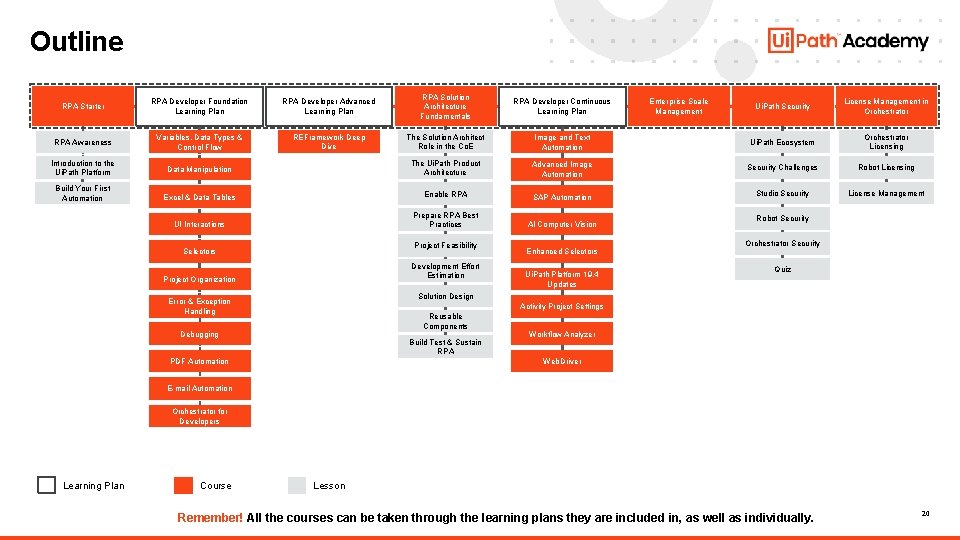
Outline RPA Starter RPA Developer Foundation Learning Plan RPA Developer Advanced Learning Plan RPA Solution Architecture Fundamentals RPA Developer Continuous Learning Plan RPA Awareness Variables, Data Types & Control Flow REFramework Deep Dive The Solution Architect Role in the Co. E Introduction to the Ui. Path Platform Data Manipulation Build Your First Automation Ui. Path Security License Management in Orchestrator Image and Text Automation Ui. Path Ecosystem Orchestrator Licensing The Ui. Path Product Architecture Advanced Image Automation Security Challenges Robot Licensing Excel & Data Tables Enable RPA SAP Automation Studio Security License Management UI Interactions Prepare RPA Best Practices AI Computer Vision Project Feasibility Selectors Development Effort Estimation Project Organization Enhanced Selectors Ui. Path Platform 19. 4 Updates Enterprise Scale Management Robot Security Orchestrator Security Quiz Solution Design Error & Exception Handling Activity Project Settings Reusable Components Debugging Build Test & Sustain RPA PDF Automation Workflow Analyzer Web. Driver E-mail Automation Orchestrator for Developers Learning Plan Course Lesson Remember! All the courses can be taken through the learning plans they are included in, as well as individually. 20
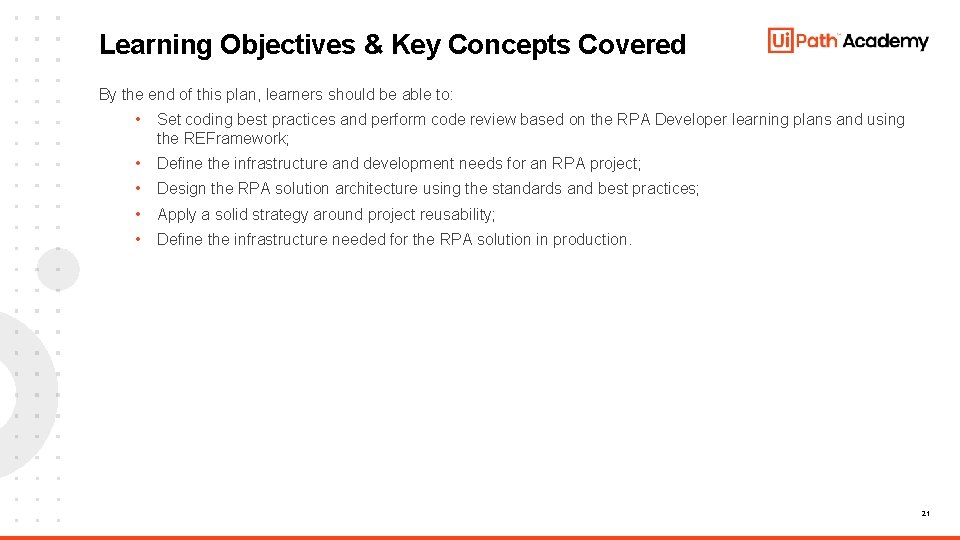
Learning Objectives & Key Concepts Covered By the end of this plan, learners should be able to: • Set coding best practices and perform code review based on the RPA Developer learning plans and using the REFramework; • Define the infrastructure and development needs for an RPA project; • Design the RPA solution architecture using the standards and best practices; • Apply a solid strategy around project reusability; • Define the infrastructure needed for the RPA solution in production. 21
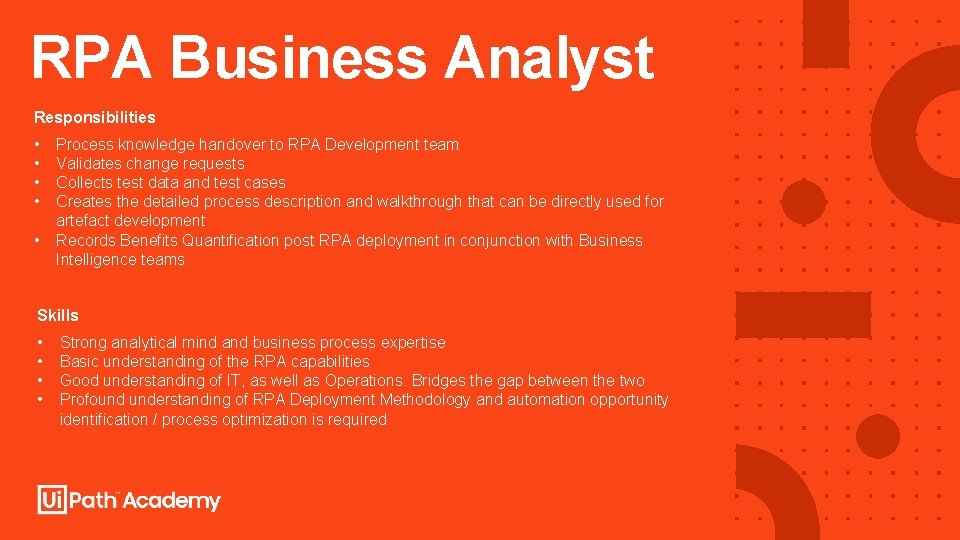
RPA Business Analyst Responsibilities • • • Process knowledge handover to RPA Development team Validates change requests Collects test data and test cases Creates the detailed process description and walkthrough that can be directly used for artefact development Records Benefits Quantification post RPA deployment in conjunction with Business Intelligence teams Skills • • Strong analytical mind and business process expertise Basic understanding of the RPA capabilities Good understanding of IT, as well as Operations. Bridges the gap between the two Profound understanding of RPA Deployment Methodology and automation opportunity identification / process optimization is required
RPA Business Analyst Foundation This Learning Plan is dedicated to any audience interested in the role played by a Business Analyst throughout an RPA implementation, and particularly to professionals who want to learn the fundamentals of Business Analysis in RPA Duration: 6 hours 30 mins Language: English, Turkish, German, Russian Multilingual Closed Caption Support: English, Japanese, French, German, Korean, Simplified Chinese, Turkish, Spanish, Portuguese Access the learning plan here 23
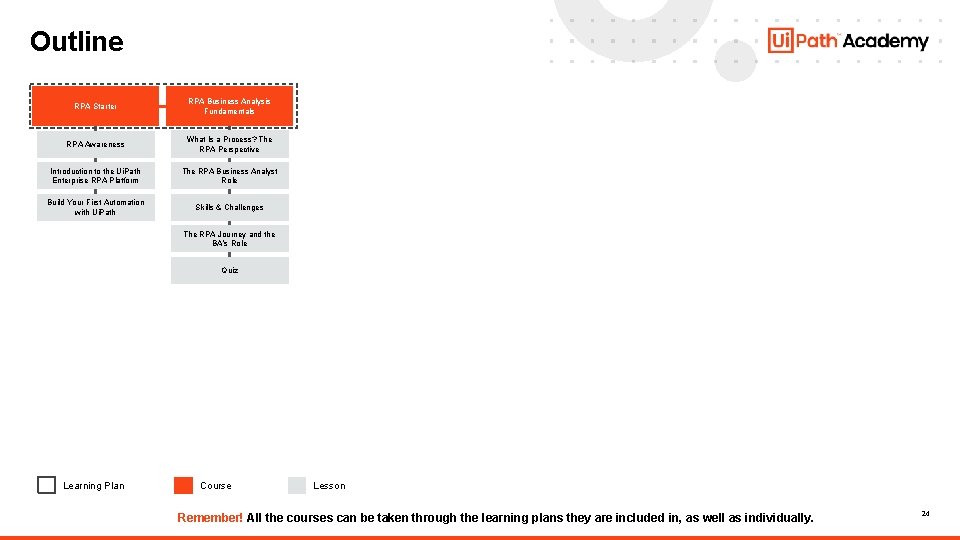
Outline RPA Starter RPA Business Analysis Fundamentals RPA Awareness What Is a Process? The RPA Perspective Introduction to the Ui. Path Enterprise RPA Platform The RPA Business Analyst Role Build Your First Automation with Ui. Path Skills & Challenges The RPA Journey and the BA’s Role Quiz Learning Plan Course Lesson Remember! All the courses can be taken through the learning plans they are included in, as well as individually. 24
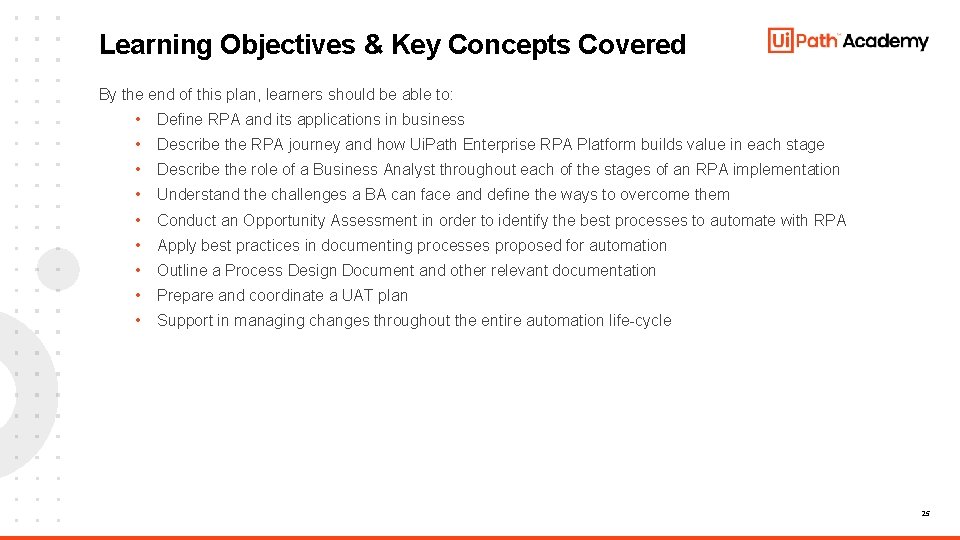
Learning Objectives & Key Concepts Covered By the end of this plan, learners should be able to: • Define RPA and its applications in business • Describe the RPA journey and how Ui. Path Enterprise RPA Platform builds value in each stage • Describe the role of a Business Analyst throughout each of the stages of an RPA implementation • Understand the challenges a BA can face and define the ways to overcome them • Conduct an Opportunity Assessment in order to identify the best processes to automate with RPA • Apply best practices in documenting processes proposed for automation • Outline a Process Design Document and other relevant documentation • Prepare and coordinate a UAT plan • Support in managing changes throughout the entire automation life-cycle 25
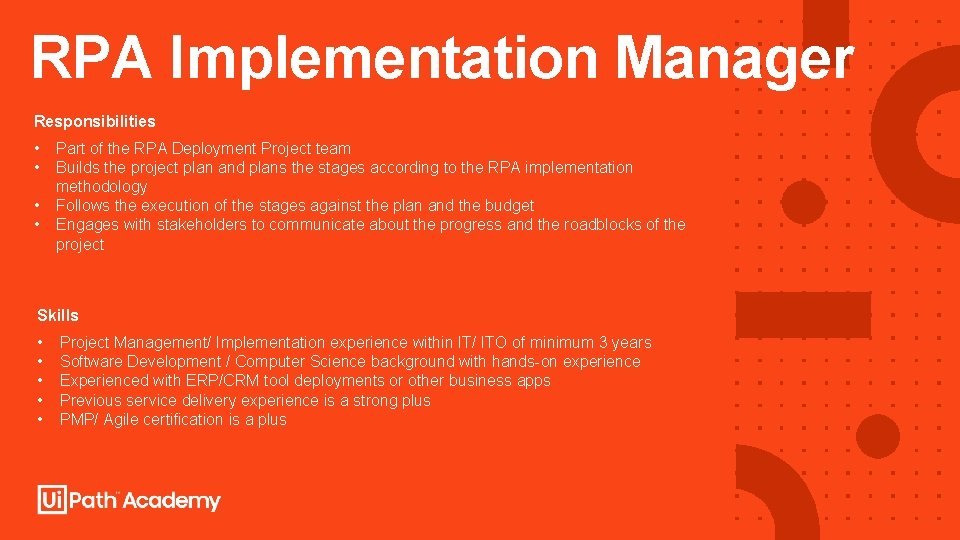
RPA Implementation Manager Responsibilities • • Part of the RPA Deployment Project team Builds the project plan and plans the stages according to the RPA implementation methodology Follows the execution of the stages against the plan and the budget Engages with stakeholders to communicate about the progress and the roadblocks of the project Skills • • • Project Management/ Implementation experience within IT/ ITO of minimum 3 years Software Development / Computer Science background with hands-on experience Experienced with ERP/CRM tool deployments or other business apps Previous service delivery experience is a strong plus PMP/ Agile certification is a plus
RPA Implementation Manager Foundation This learning plan covers the basics of RPA and then moves to the aspects of RPA project implementation, through the methodology recommended by Ui. Path following the hands-on experience and feedback collected from key customers. This methodology can be adapted to various contexts, and we recommend using the guidelines presented in the course to increase the control over your RPA practice. Duration: 6 hours 30 mins Language: English Access the learning plan here 27
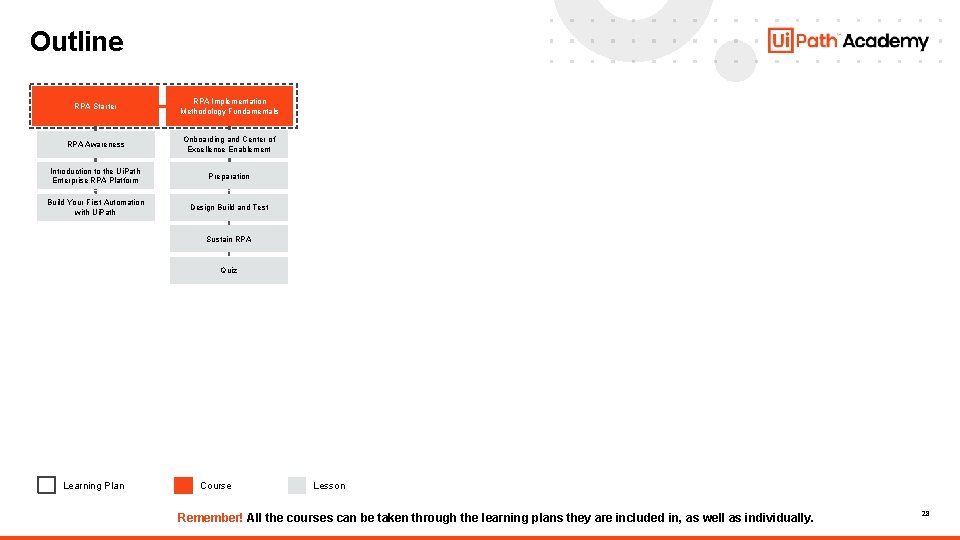
Outline RPA Starter RPA Implementation Methodology Fundamentals RPA Awareness Onboarding and Center of Excellence Enablement Introduction to the Ui. Path Enterprise RPA Platform Preparation Build Your First Automation with Ui. Path Design Build and Test Sustain RPA Quiz Learning Plan Course Lesson Remember! All the courses can be taken through the learning plans they are included in, as well as individually. 28
Learning Objectives & Key Concepts Covered By the end of this plan, learners should be able to: • Define RPA and its applications in business, • Describe the RPA journey and how Ui. Path Enterprise RPA Platform builds value in each stage, • Identify the different steps of an implementation; • Choose the processes suitable for automation; • Raise RPA Awareness throughout the organization; • Drive an RPA project throughout all the stages. 29
RPA Infrastructure Engineer Responsibilities • • • Sets up the RPA infrastructure Manages the infrastructure operations Provisions new machines for robots and associates them to different environments In charge of the data cleanup strategy Manages the application portfolio on the robot machines Skills • • Network security management and operating systems – minimum 3 years Good knowledge of security - both on-premise and cloud-based infrastructure Knowledge of ITIL and industry best practices Strong virtualization experience using Hyper-V, VMWare, Citrix Xen. App/Xen. Desktop
RPA Infrastructure Engineer Foundation This learning plan provides an introduction to RPA, and then delves into the particular aspects of setting up and maintaining the infrastructure for RPA development, testing and production module, making use of all the features brought by Ui. Path. Duration: 11 hours Language: English Access the learning plan here 31
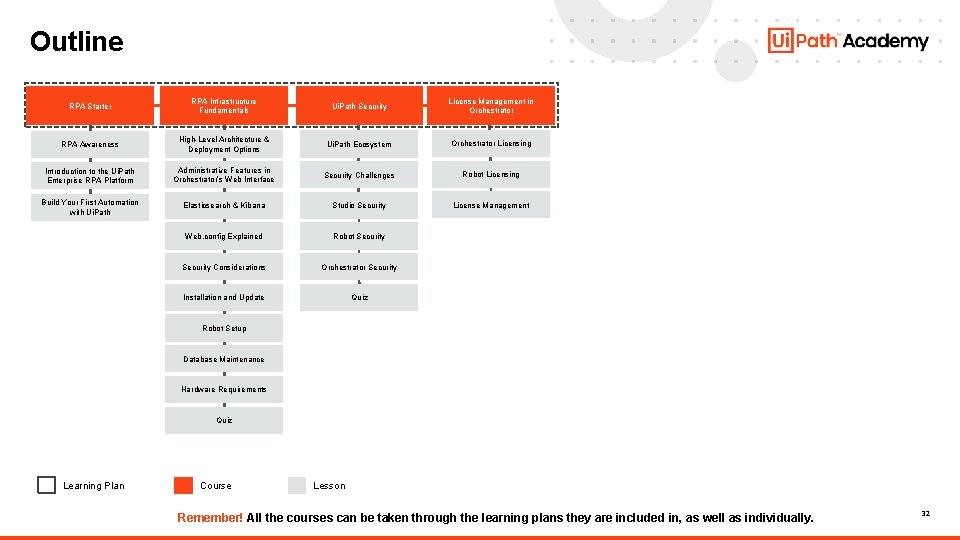
Outline RPA Starter RPA Infrastructure Fundamentals Ui. Path Security License Management in Orchestrator RPA Awareness High-Level Architecture & Deployment Options Ui. Path Ecosystem Orchestrator Licensing Introduction to the Ui. Path Enterprise RPA Platform Administrative Features in Orchestrator’s Web Interface Security Challenges Robot Licensing Build Your First Automation with Ui. Path Elasticsearch & Kibana Studio Security License Management Web. config Explained Robot Security Considerations Orchestrator Security Installation and Update Quiz Robot Setup Database Maintenance Hardware Requirements Quiz Learning Plan Course Lesson Remember! All the courses can be taken through the learning plans they are included in, as well as individually. 32
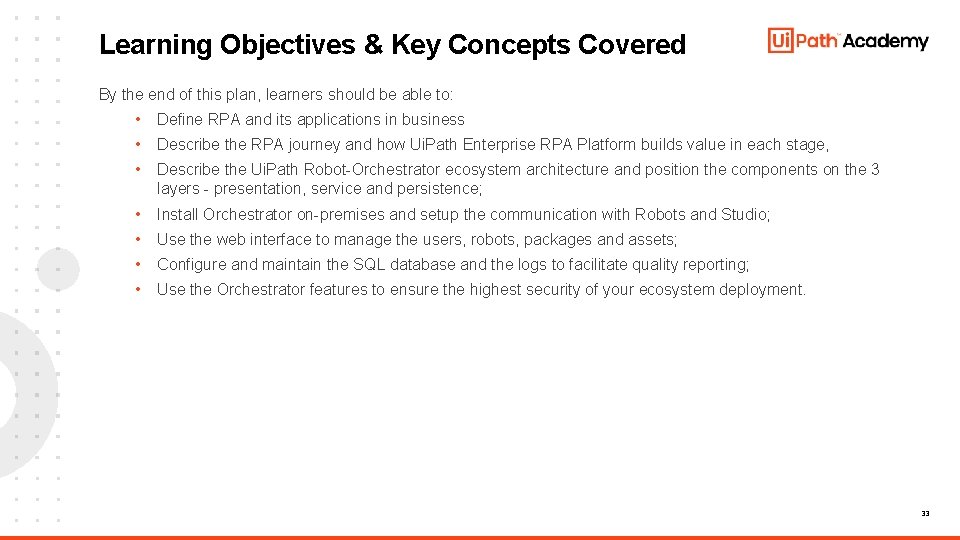
Learning Objectives & Key Concepts Covered By the end of this plan, learners should be able to: • Define RPA and its applications in business • Describe the RPA journey and how Ui. Path Enterprise RPA Platform builds value in each stage, • Describe the Ui. Path Robot-Orchestrator ecosystem architecture and position the components on the 3 layers - presentation, service and persistence; • Install Orchestrator on-premises and setup the communication with Robots and Studio; • Use the web interface to manage the users, robots, packages and assets; • Configure and maintain the SQL database and the logs to facilitate quality reporting; • Use the Orchestrator features to ensure the highest security of your ecosystem deployment. 33
Training for Citizen Developers
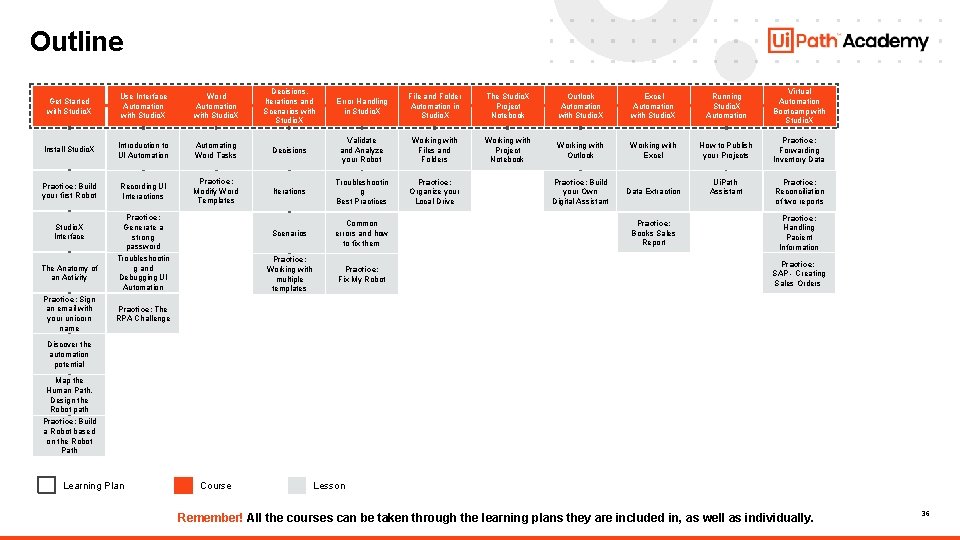
RPA Citizen Developer Foundation This learning plan is designed for business users that are looking to expand their capabilities with RPA and start using the Ui. Path platform. It will provide the essential knowledge and skills to create task automation projects with Studio. X. Duration: 10 hours Language: English, German Multilingual Closed Caption Support: English, Japanese, French, German, Korean, Simplified Chinese, Turkish, Spanish, Portuguese Prerequisites: Basic understanding of business processes Access the course here 35
Outline Get Started with Studio. X Use Interface Automation with Studio. X Word Automation with Studio. X Decisions, Iterations and Scenarios with Studio. X Error Handling in Studio. X File and Folder Automation in Studio. X The Studio. X Project Notebook Outlook Automation with Studio. X Excel Automation with Studio. X Running Studio. X Automation Virtual Automation Bootcamp with Studio. X Install Studio. X Introduction to UI Automation Automating Word Tasks Decisions Validate and Analyze your Robot Working with Files and Folders Working with Project Notebook Working with Outlook Working with Excel How to Publish your Projects Practice: Forwarding Inventory Data Practice: Build your first Robot Recording UI Interactions Practice: Modify Word Templates Iterations Troubleshootin g Best Practices Practice: Organize your Local Drive Practice: Build your Own Digital Assistant Data Extraction Ui. Path Assistant Studio. X Interface Practice: Generate a strong password Scenarios Common errors and how to fix them The Anatomy of an Activity Troubleshootin g and Debugging UI Automation Practice: Working with multiple templates Practice: Fix My Robot Practice: Sign an email with your unicorn name Practice: The RPA Challenge Practice: Books Sales Report Practice: Reconciliation of two reports Practice: Handling Pacient Information Practice: SAP - Creating Sales Orders Discover the automation potential Map the Human Path, Design the Robot path Practice: Build a Robot based on the Robot Path Learning Plan Course Lesson Remember! All the courses can be taken through the learning plans they are included in, as well as individually. 36
Learning Objectives & Key Concepts Covered Explore more than 15 practical exercises, a virtual automation bootcamp, demo videos, and get access to all of the Studio. X files available during this learning plan for creating your own automation portfolio. By the end of this plan, learners should be able to: • understand the Ui. Path hyperautomation platform • map the “human path” and “robot path” for your task design your first task automation with Studio. X • automate tasks for Microsoft Office Apps • organize and publish your project files • understand how to deal with errors • run an attended robot 37
Thank You Register on academy. uipath. com today. Ui. Path Confidential and Proprietary. Ui. Path and Ui. Path Partner Internal Use Only. © Ui. Path, Inc. All rights reserved. Information herein is subject to change without notice.