
UI Driven Android Application Reduction Jianjun Huang Yousra

![Bad Effect • Identified sensitive information exposure in Ad networks[2]. • Advertisements may reach](https://slidetodoc.com/presentation_image_h/1dace00d2ddc2cd37db12c37e8b26ddc/image-4.jpg "Bad Effect • Identified sensitive information exposure in Ad networks[2]. • Advertisements may reach")
- Slides: 42
UI Driven Android Application Reduction Jianjun Huang, Yousra Aafer, David Perry, Xiangyu Zhang, Chen Tian
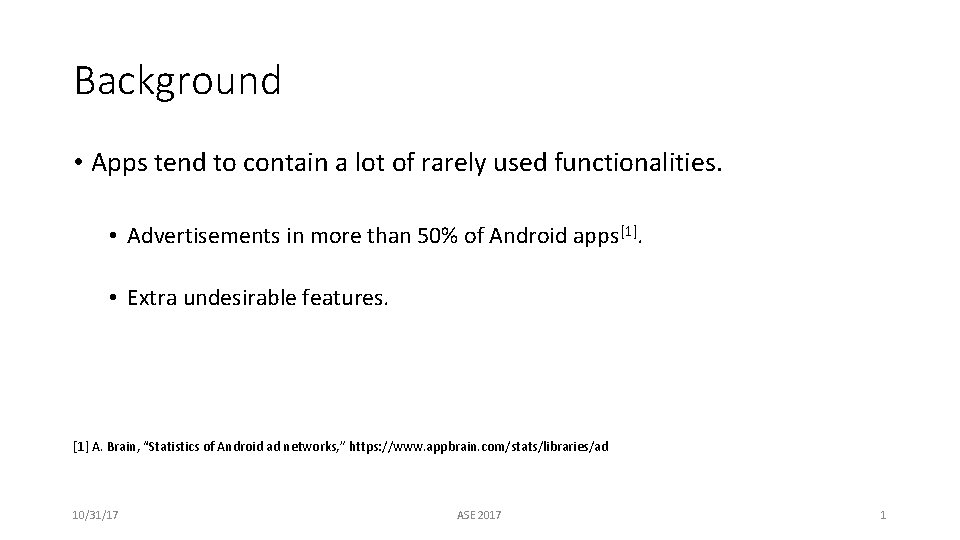
Background • Apps tend to contain a lot of rarely used functionalities. • Advertisements in more than 50% of Android apps[1]. • Extra undesirable features. [1] A. Brain, “Statistics of Android ad networks, ” https: //www. appbrain. com/stats/libraries/ad 10/31/17 ASE 2017 1
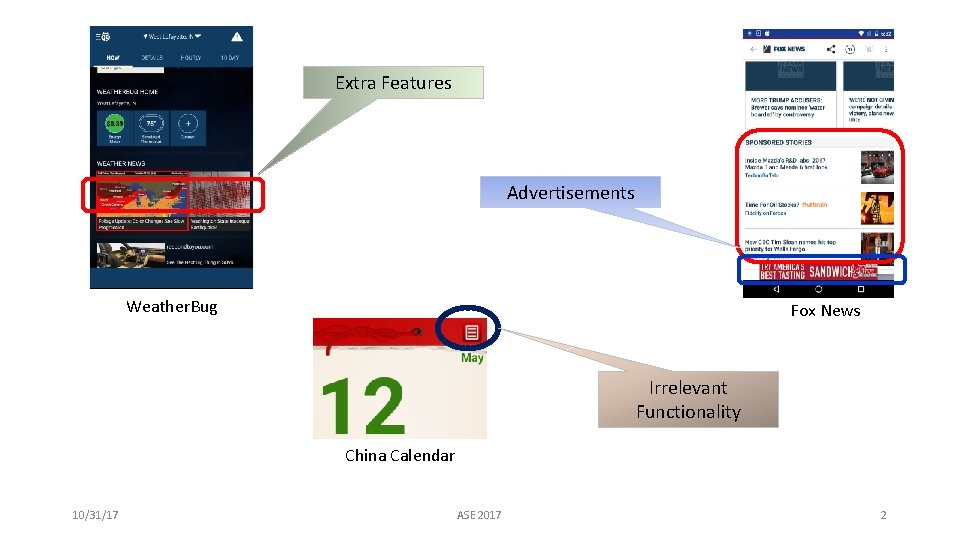
Extra Features Advertisements Weather. Bug Fox News Irrelevant Functionality China Calendar 10/31/17 ASE 2017 2
Bad Effect • Identified sensitive information exposure in Ad networks[2]. • Advertisements may reach some destinations that play an important role in propagating attacks[3]. • Additional consumption of battery power, CPU, bandwidth and so on[4]. • Also demonstrated in Evaluation part. [2] M. Egele, at el. Pi. OS: Detecting privacy leaks in i. OS applications. NDSS 2011. [3] V. Rastogi, at el. Are these ads safe: Detecting hidden attacks through the mobile app-web interfaces. NDSS 2016. [4] J. Gui, at el. Truth in advertising: The hidden cost of mobile ads for software developers. ICSE 2015. 10/31/17 ASE 2017 3
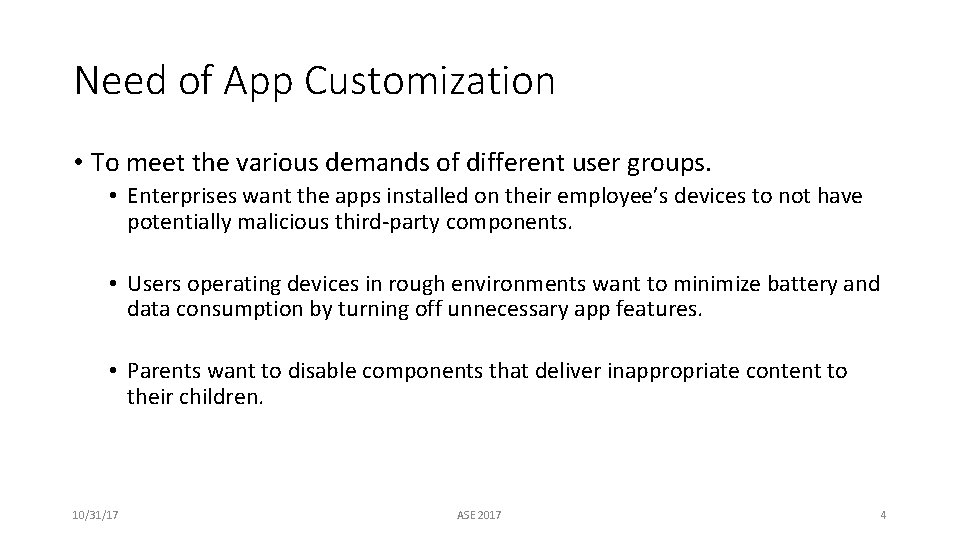
Need of App Customization • To meet the various demands of different user groups. • Enterprises want the apps installed on their employee’s devices to not have potentially malicious third-party components. • Users operating devices in rough environments want to minimize battery and data consumption by turning off unnecessary app features. • Parents want to disable components that deliver inappropriate content to their children. 10/31/17 ASE 2017 4
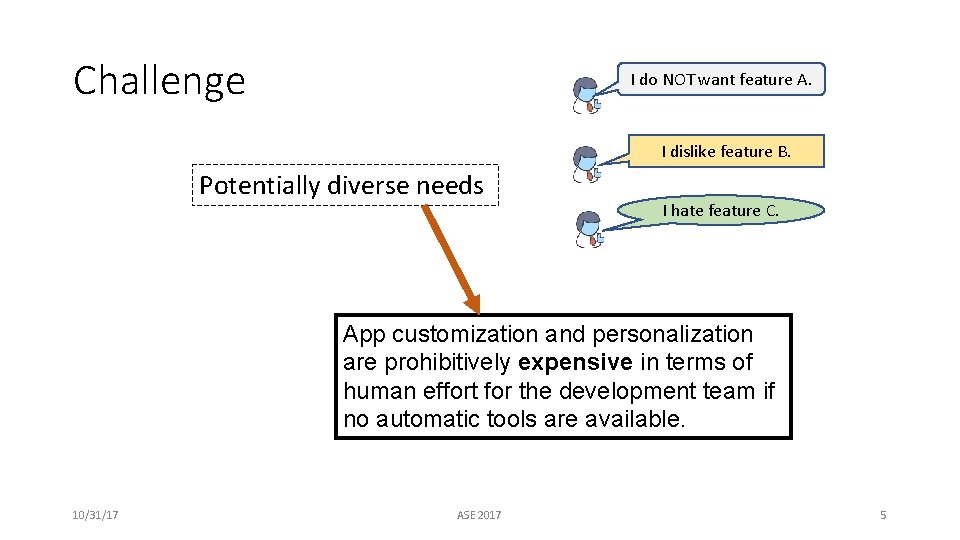
Challenge I do NOT want feature A. I dislike feature B. Potentially diverse needs I hate feature C. App customization and personalization are prohibitively expensive in terms of human effort for the development team if no automatic tools are available. 10/31/17 ASE 2017 5
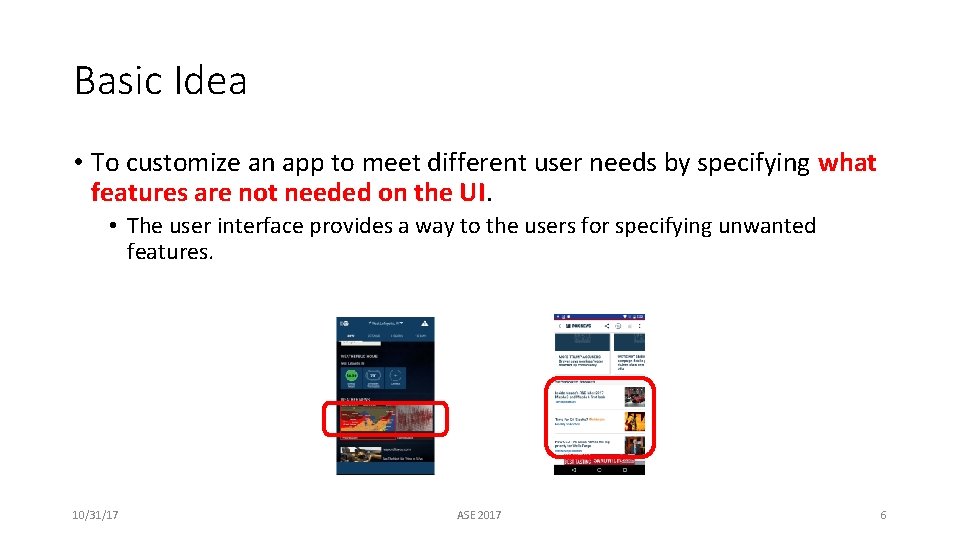
Basic Idea • To customize an app to meet different user needs by specifying what features are not needed on the UI. • The user interface provides a way to the users for specifying unwanted features. 10/31/17 ASE 2017 6
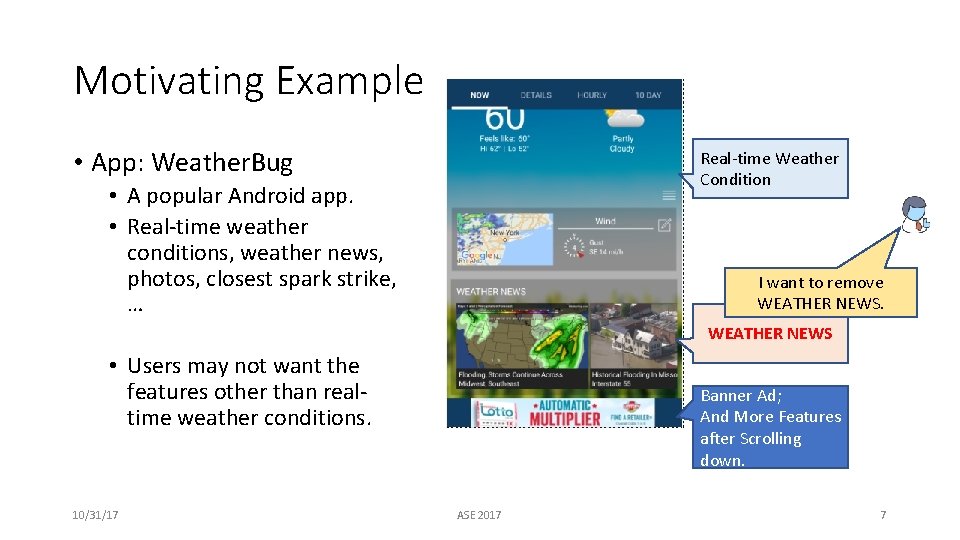
Motivating Example • App: Weather. Bug Real-time Weather Condition • A popular Android app. • Real-time weather conditions, weather news, photos, closest spark strike, … I want to remove WEATHER NEWS • Users may not want the features other than realtime weather conditions. 10/31/17 Banner Ad; And More Features after Scrolling down. ASE 2017 7
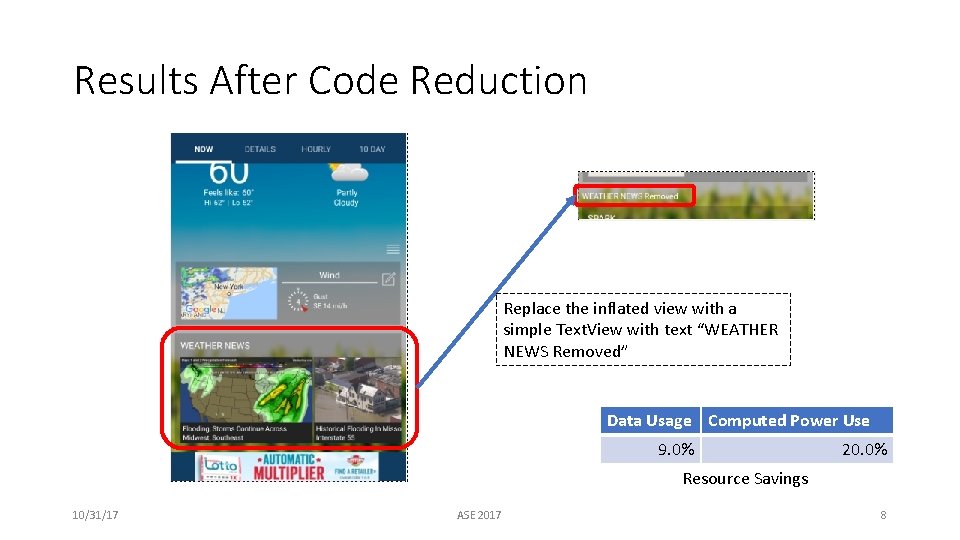
Results After Code Reduction Replace the inflated view with a simple Text. View with text “WEATHER NEWS Removed” Data Usage Computed Power Use 9. 0% 20. 0% Resource Savings 10/31/17 ASE 2017 8
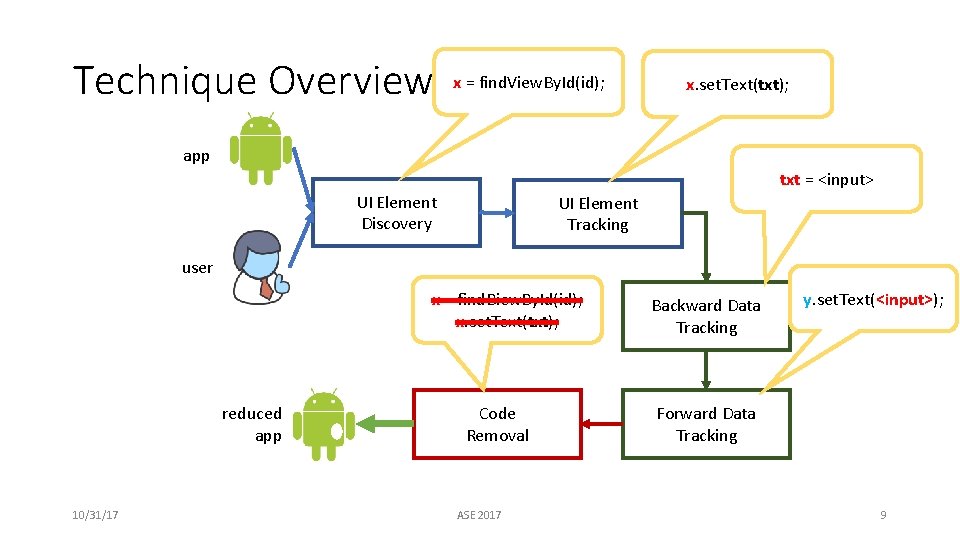
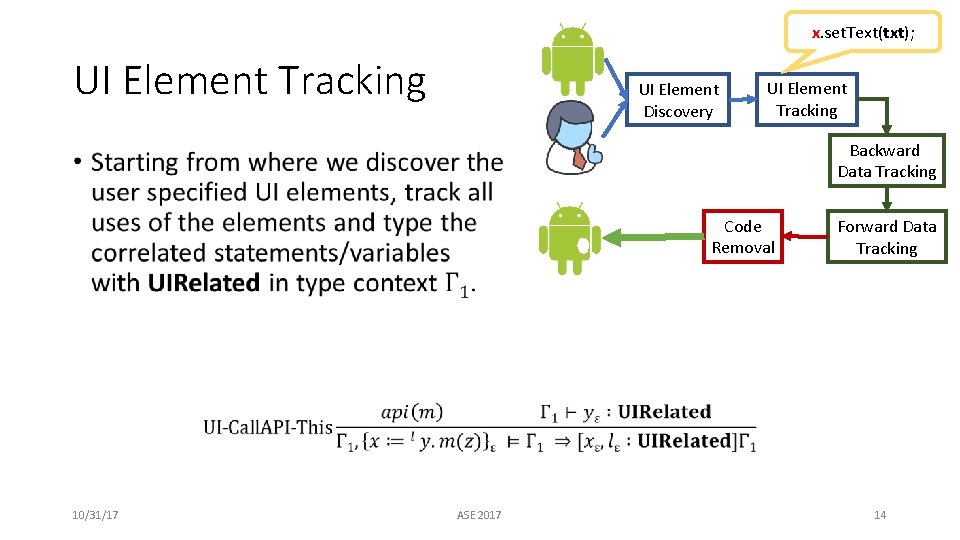
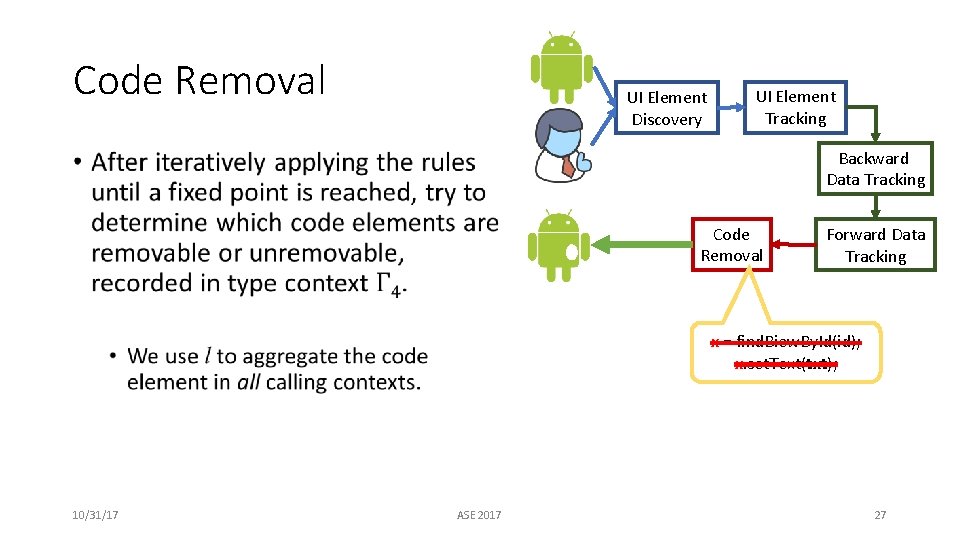
Technique Overview x = find. View. By. Id(id); x. set. Text(txt); app txt = <input> UI Element Discovery UI Element Tracking user x = find. Biew. By. Id(id); x. set. Text(txt); reduced app 10/31/17 Code Removal ASE 2017 Backward Data Tracking y. set. Text(<input>); Forward Data Tracking 9
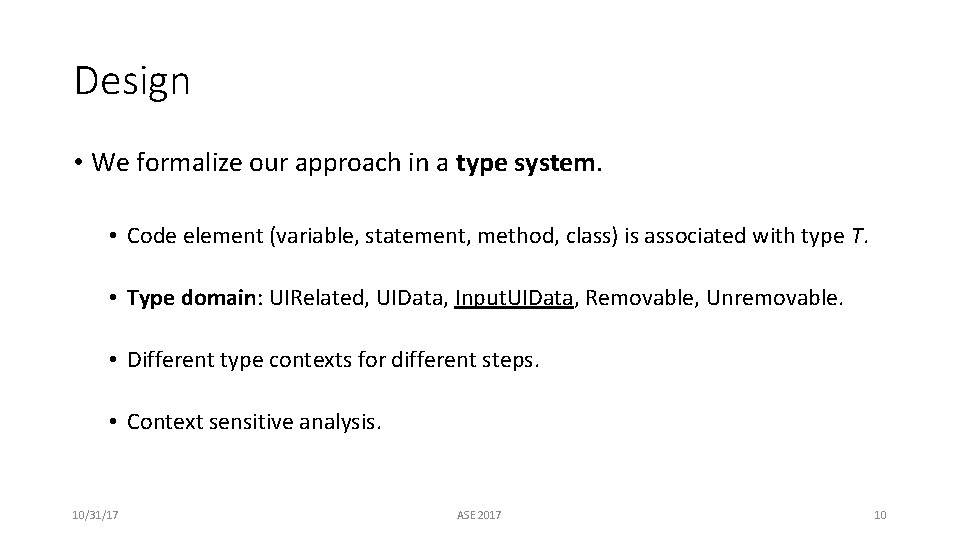
Design • We formalize our approach in a type system. • Code element (variable, statement, method, class) is associated with type T. • Type domain: UIRelated, UIData, Input. UIData, Removable, Unremovable. • Different type contexts for different steps. • Context sensitive analysis. 10/31/17 ASE 2017 10
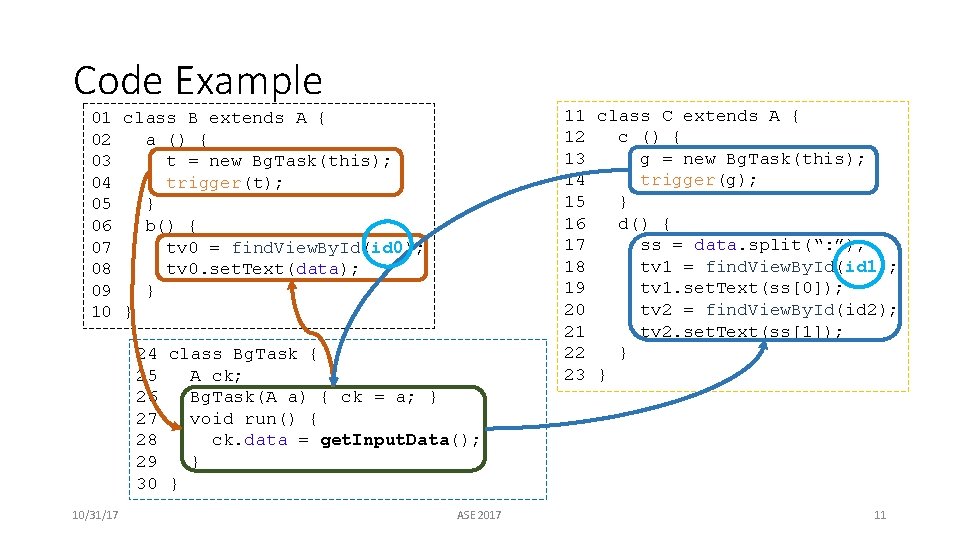
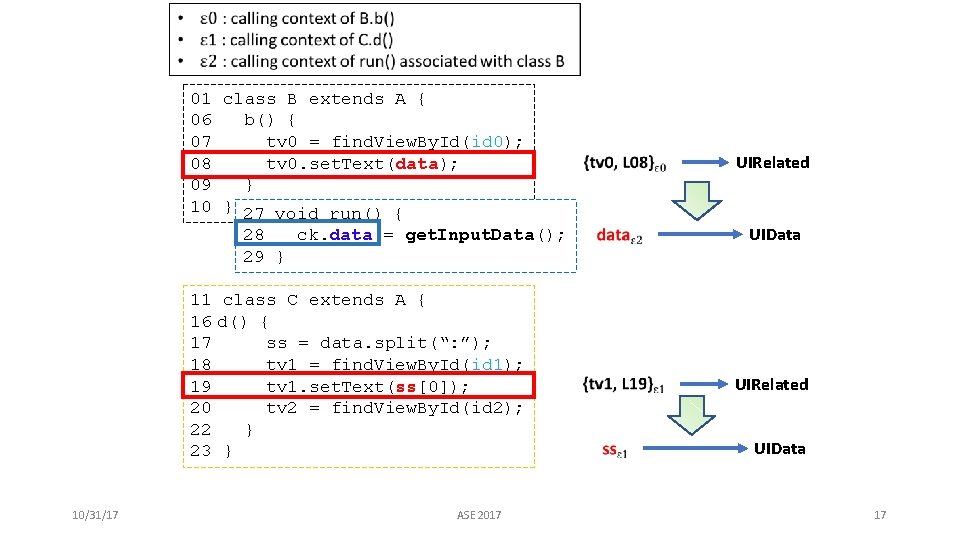
Code Example 01 class B extends A { 02 a () { 03 t = new Bg. Task(this); 04 trigger(t); 05 } 06 b() { 07 tv 0 = find. View. By. Id(id 0); 08 tv 0. set. Text(data); 09 } 10 } 24 class Bg. Task { 25 A ck; 26 Bg. Task(A a) { ck = a; } 27 void run() { 28 ck. data = get. Input. Data(); 29 } 30 } 10/31/17 ASE 2017 11 class C extends A { 12 c () { 13 g = new Bg. Task(this); 14 trigger(g); 15 } 16 d() { 17 ss = data. split(“: ”); 18 tv 1 = find. View. By. Id(id 1); 19 tv 1. set. Text(ss[0]); 20 tv 2 = find. View. By. Id(id 2); 21 tv 2. set. Text(ss[1]); 22 } 23 } 11
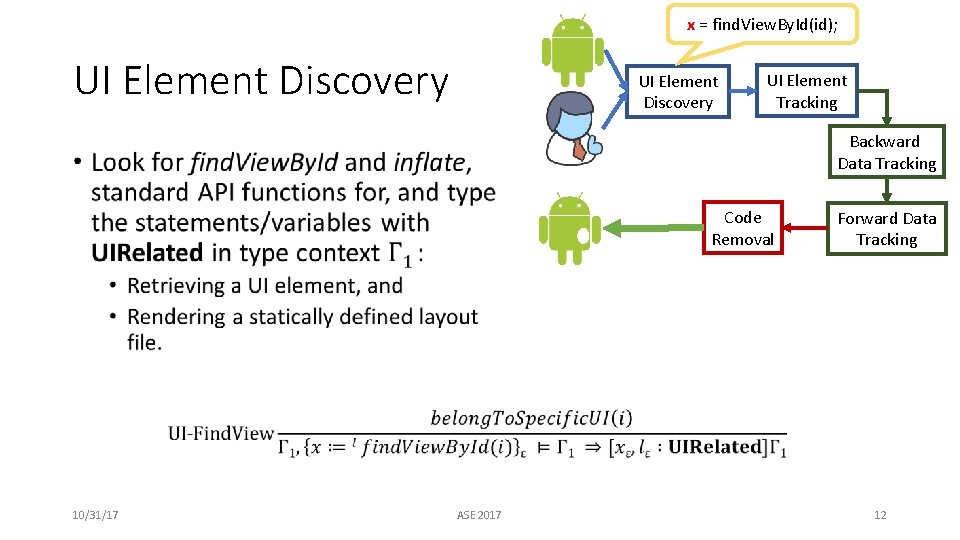
x = find. View. By. Id(id); UI Element Discovery UI Element Tracking Backward Data Tracking • Code Removal Forward Data Tracking 10/31/17 ASE 2017 12
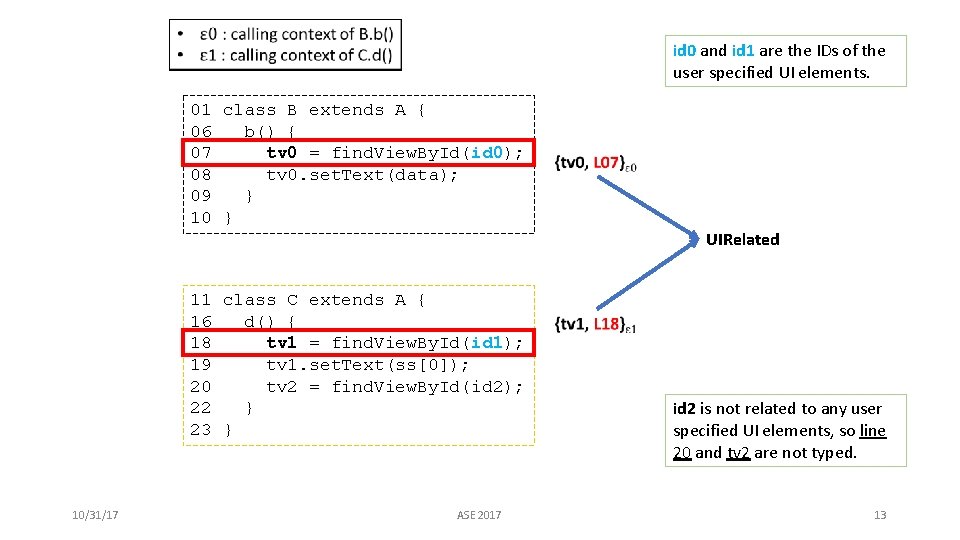
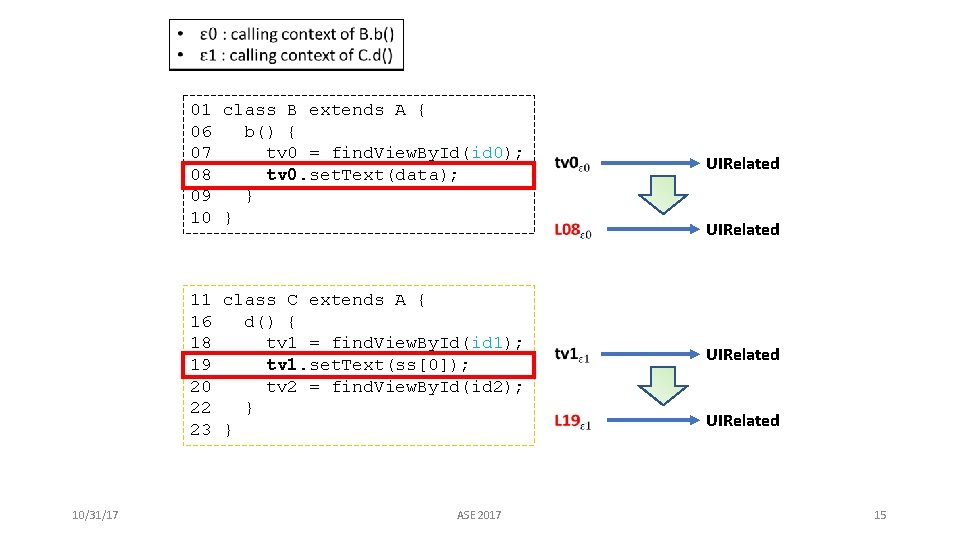
id 0 and id 1 are the IDs of the user specified UI elements. 01 class B extends A { 06 b() { 07 tv 0 = find. View. By. Id(id 0); 08 tv 0. set. Text(data); 09 } 10 } 11 class C extends A { 16 d() { 18 tv 1 = find. View. By. Id(id 1); 19 tv 1. set. Text(ss[0]); 20 tv 2 = find. View. By. Id(id 2); 22 } 23 } 10/31/17 ASE 2017 UIRelated id 2 is not related to any user specified UI elements, so line 20 and tv 2 are not typed. 13
x. set. Text(txt); UI Element Tracking UI Element Discovery UI Element Tracking Backward Data Tracking • Code Removal Forward Data Tracking 10/31/17 ASE 2017 14
01 class B extends A { 06 b() { 07 tv 0 = find. View. By. Id(id 0); 08 tv 0. set. Text(data); 09 } 10 } 11 class C extends A { 16 d() { 18 tv 1 = find. View. By. Id(id 1); 19 tv 1. set. Text(ss[0]); 20 tv 2 = find. View. By. Id(id 2); 22 } 23 } 10/31/17 ASE 2017 UIRelated 15
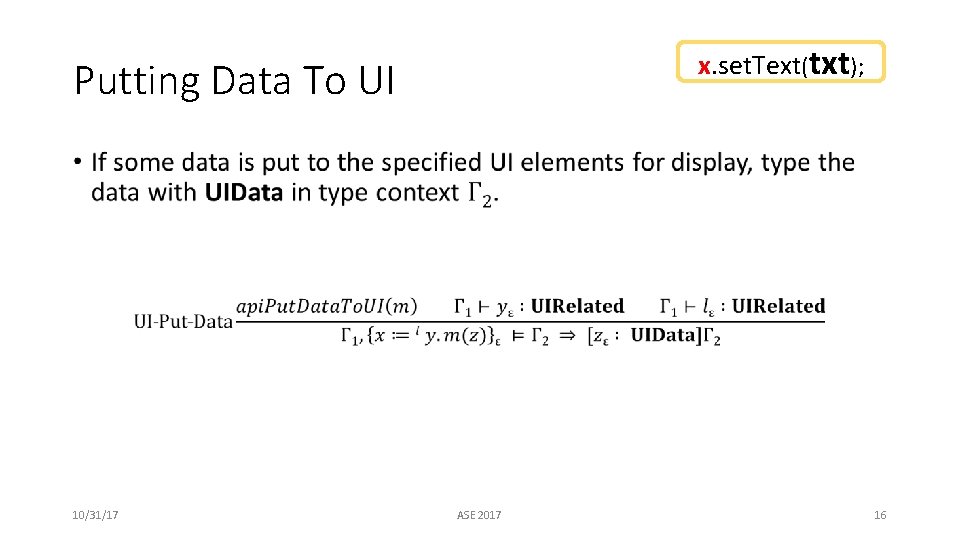
x. set. Text(txt); Putting Data To UI • 10/31/17 ASE 2017 16
01 class B extends A { 06 b() { 07 tv 0 = find. View. By. Id(id 0); 08 tv 0. set. Text(data); 09 } 10 } 27 void run() { 28 ck. data = get. Input. Data(); 29 } 11 class C extends A { 16 d() { 17 ss = data. split(“: ”); 18 tv 1 = find. View. By. Id(id 1); 19 tv 1. set. Text(ss[0]); 20 tv 2 = find. View. By. Id(id 2); 22 } 23 } 10/31/17 ASE 2017 UIRelated UIData UIRelated UIData 17
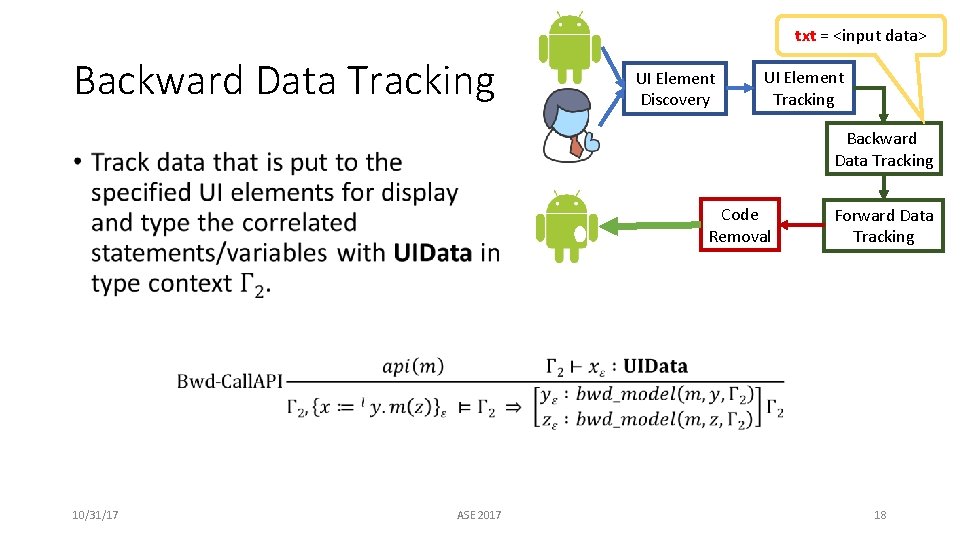
txt = <input data> Backward Data Tracking UI Element Discovery UI Element Tracking Backward Data Tracking • Code Removal Forward Data Tracking 10/31/17 ASE 2017 18
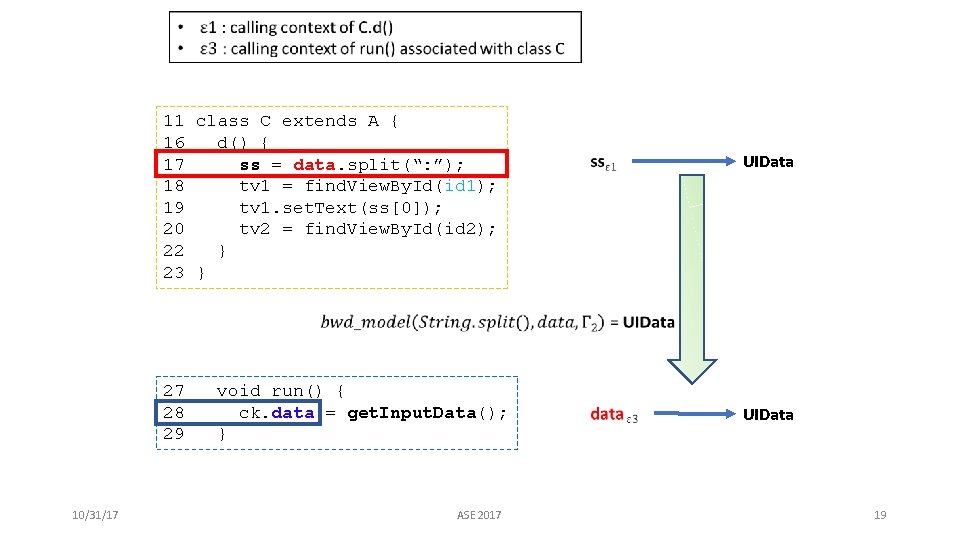
11 class C extends A { 16 d() { 17 ss = data. split(“: ”); 18 tv 1 = find. View. By. Id(id 1); 19 tv 1. set. Text(ss[0]); 20 tv 2 = find. View. By. Id(id 2); 22 } 23 } UIData 27 28 29 10/31/17 void run() { ck. data = get. Input. Data(); } ASE 2017 19
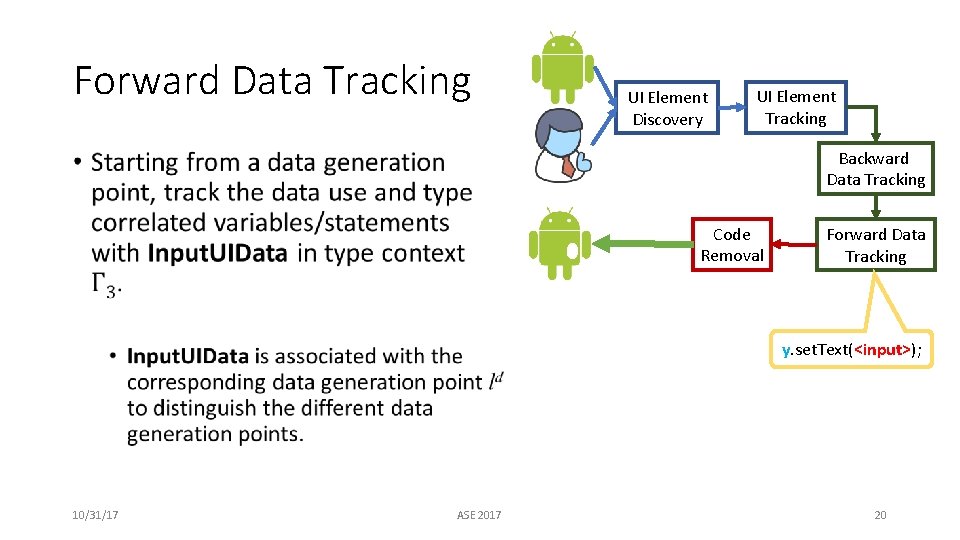
Forward Data Tracking UI Element Discovery UI Element Tracking • Backward Data Tracking Code Removal Forward Data Tracking y. set. Text(<input>); 10/31/17 ASE 2017 20
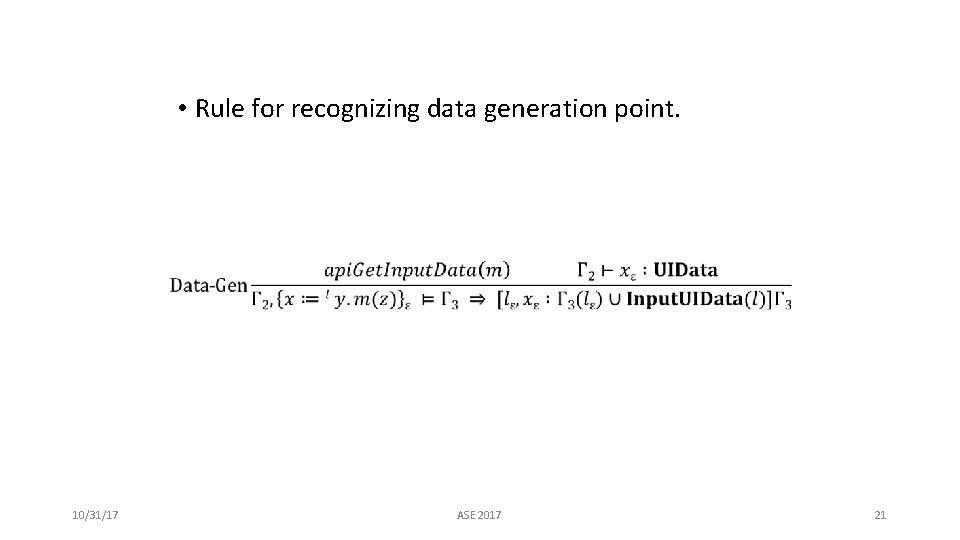
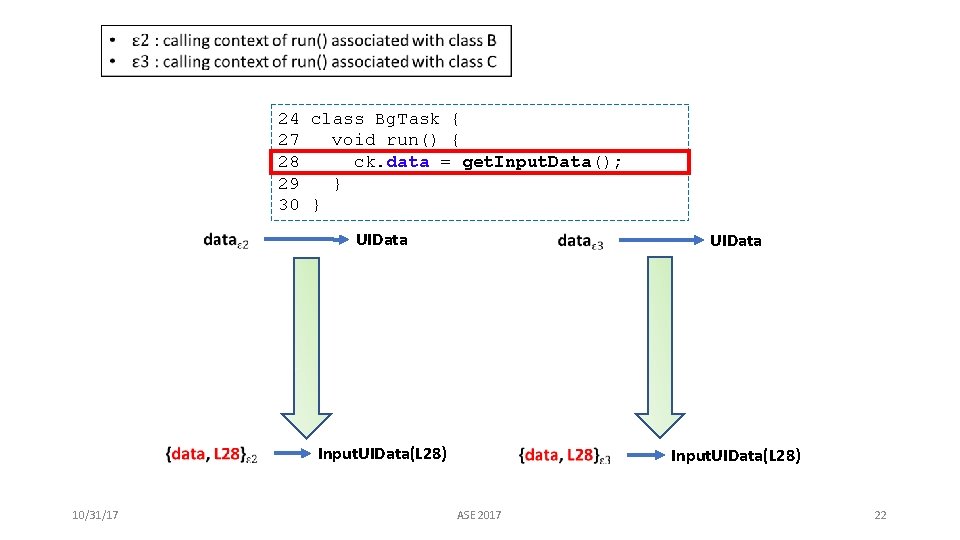
• Rule for recognizing data generation point. 10/31/17 ASE 2017 21
24 class Bg. Task { 27 void run() { 28 ck. data = get. Input. Data(); 29 } 30 } 10/31/17 UIData Input. UIData(L 28) ASE 2017 UIData Input. UIData(L 28) 22
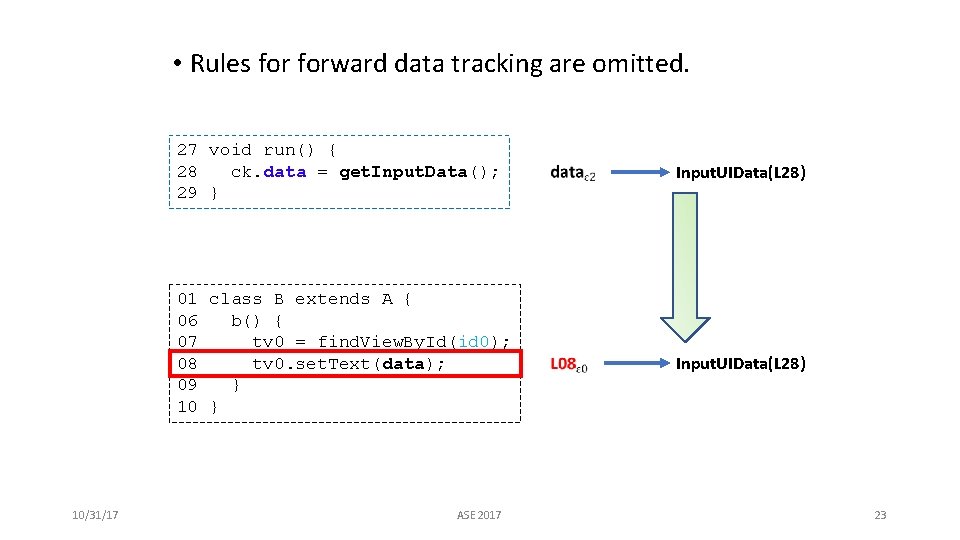
• Rules forward data tracking are omitted. 27 void run() { 28 ck. data = get. Input. Data(); 29 } 01 class B extends A { 06 b() { 07 tv 0 = find. View. By. Id(id 0); 08 tv 0. set. Text(data); 09 } 10/31/17 ASE 2017 Input. UIData(L 28) 23
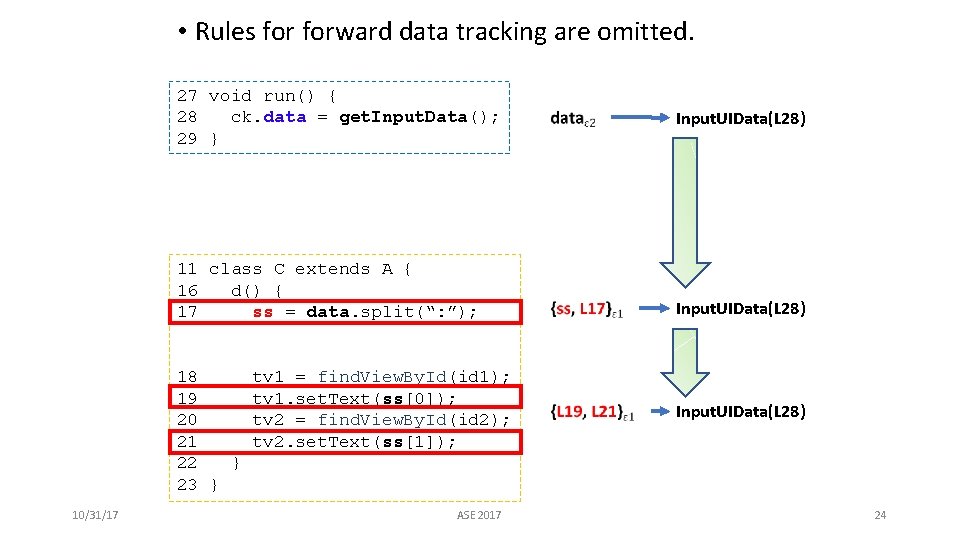
• Rules forward data tracking are omitted. 27 void run() { 28 ck. data = get. Input. Data(); 29 } 11 class C extends A { 16 d() { 17 ss = data. split(“: ”); 18 19 20 21 22 } 23 } 10/31/17 tv 1 = find. View. By. Id(id 1); tv 1. set. Text(ss[0]); tv 2 = find. View. By. Id(id 2); tv 2. set. Text(ss[1]); ASE 2017 Input. UIData(L 28) 24
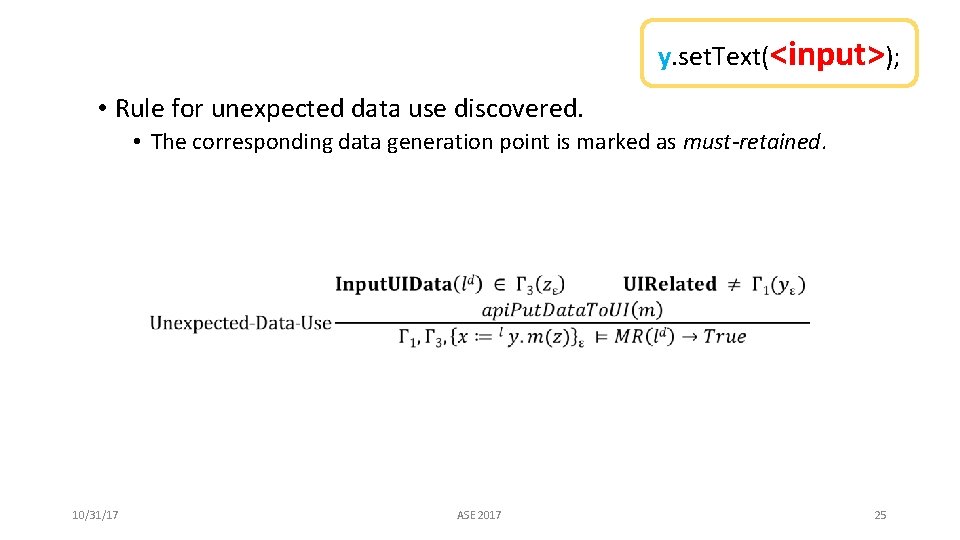
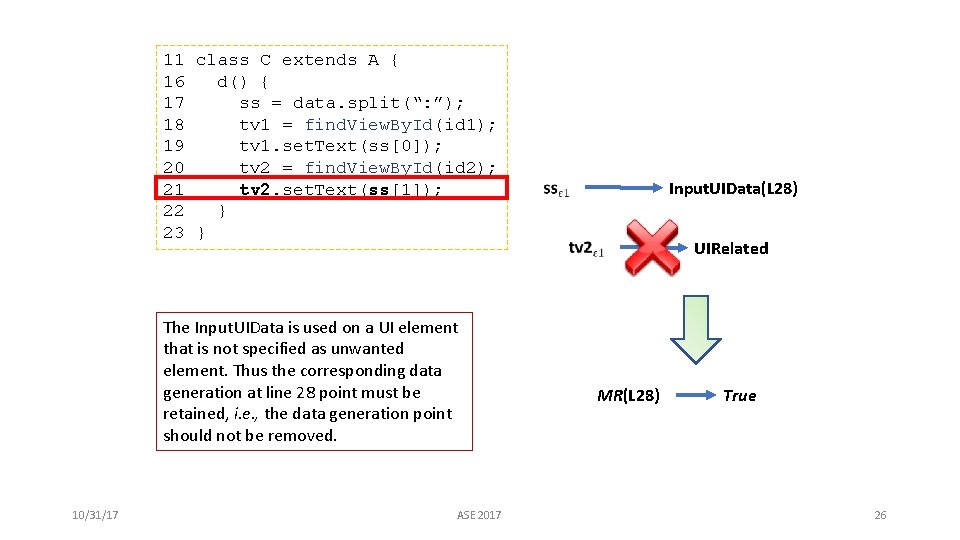
y. set. Text(<input>); • Rule for unexpected data use discovered. • The corresponding data generation point is marked as must-retained. 10/31/17 ASE 2017 25
11 class C extends A { 16 d() { 17 ss = data. split(“: ”); 18 tv 1 = find. View. By. Id(id 1); 19 tv 1. set. Text(ss[0]); 20 tv 2 = find. View. By. Id(id 2); 21 tv 2. set. Text(ss[1]); 22 } 23 } The Input. UIData is used on a UI element that is not specified as unwanted element. Thus the corresponding data generation at line 28 point must be retained, i. e. , the data generation point should not be removed. 10/31/17 ASE 2017 Input. UIData(L 28) UIRelated MR(L 28) True 26
Code Removal UI Element Discovery UI Element Tracking • Backward Data Tracking Code Removal Forward Data Tracking x = find. Biew. By. Id(id); x. set. Text(txt); 10/31/17 ASE 2017 27
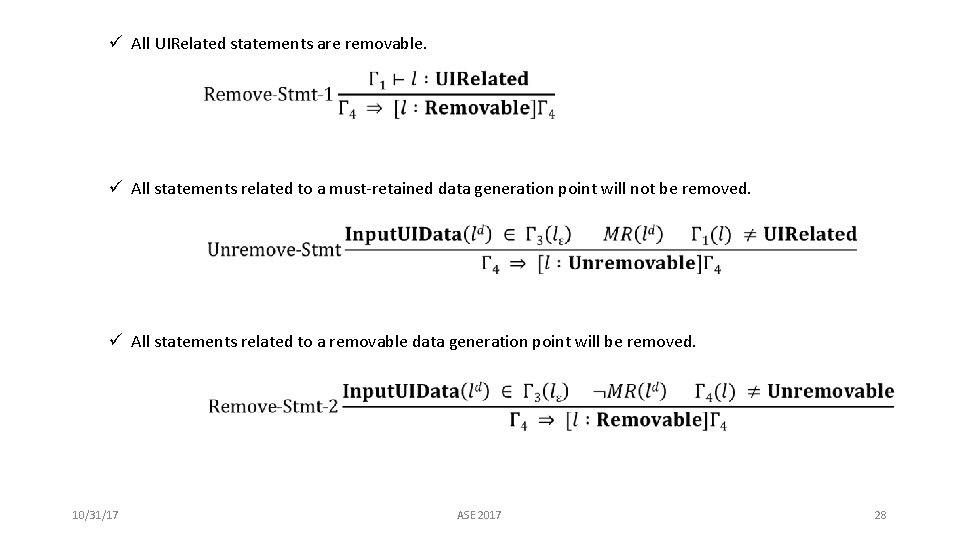
ü All UIRelated statements are removable. ü All statements related to a must-retained data generation point will not be removed. ü All statements related to a removable data generation point will be removed. 10/31/17 ASE 2017 28
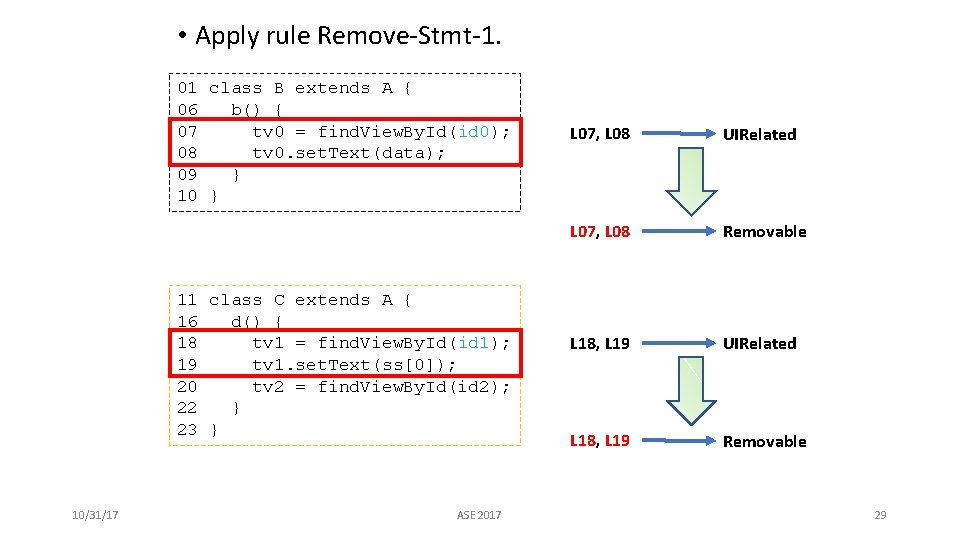
• Apply rule Remove-Stmt-1. 01 class B extends A { 06 b() { 07 tv 0 = find. View. By. Id(id 0); 08 tv 0. set. Text(data); 09 } 10 } 11 class C extends A { 16 d() { 18 tv 1 = find. View. By. Id(id 1); 19 tv 1. set. Text(ss[0]); 20 tv 2 = find. View. By. Id(id 2); 22 } 23 } 10/31/17 ASE 2017 L 07, L 08 UIRelated L 07, L 08 Removable L 18, L 19 UIRelated L 18, L 19 Removable 29
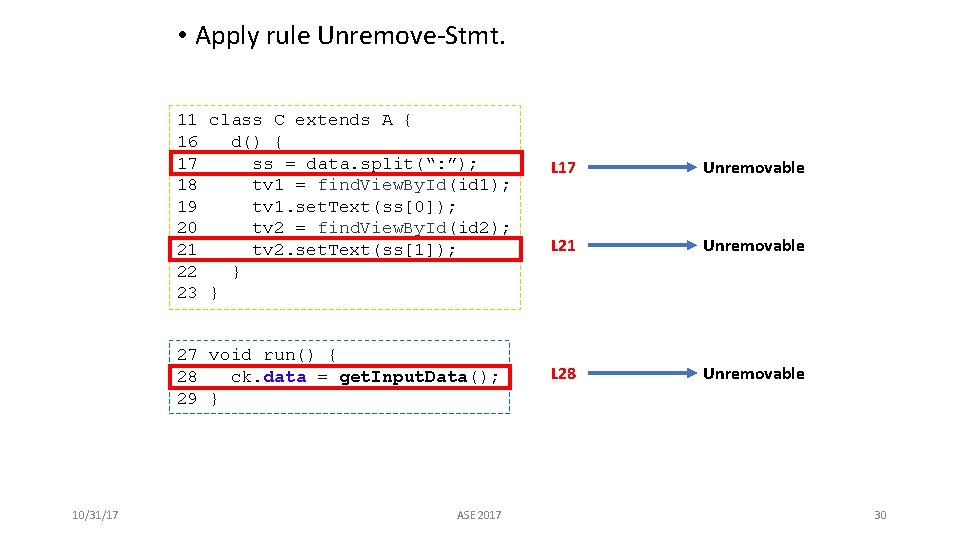
• Apply rule Unremove-Stmt. 11 class C extends A { 16 d() { 17 ss = data. split(“: ”); 18 tv 1 = find. View. By. Id(id 1); 19 tv 1. set. Text(ss[0]); 20 tv 2 = find. View. By. Id(id 2); 21 tv 2. set. Text(ss[1]); 22 } 23 } 27 void run() { 28 ck. data = get. Input. Data(); 29 } 10/31/17 ASE 2017 L 17 Unremovable L 21 Unremovable L 28 Unremovable 30
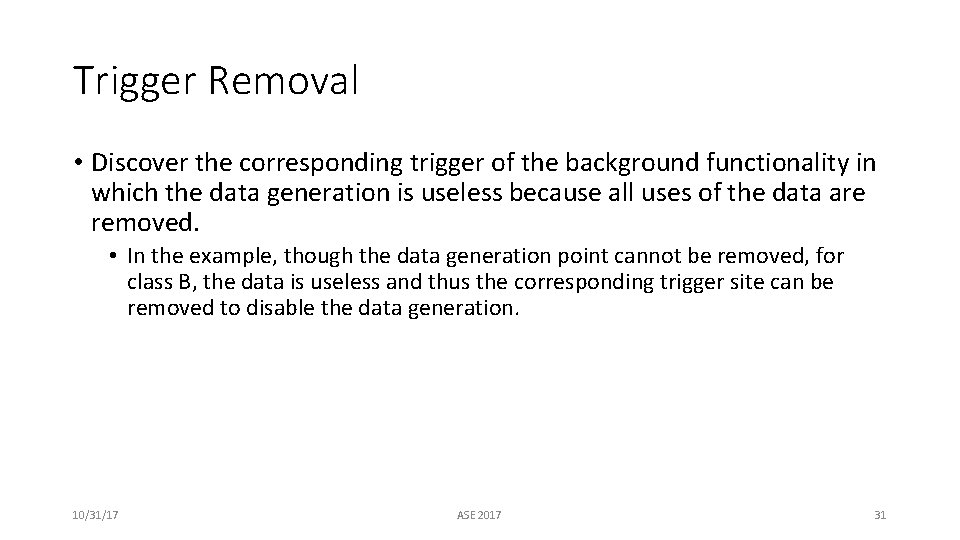
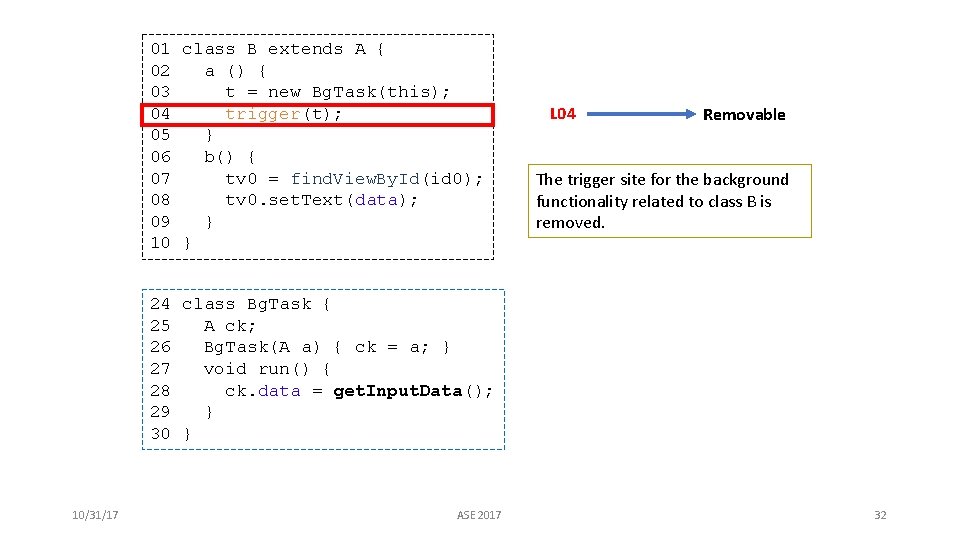
Trigger Removal • Discover the corresponding trigger of the background functionality in which the data generation is useless because all uses of the data are removed. • In the example, though the data generation point cannot be removed, for class B, the data is useless and thus the corresponding trigger site can be removed to disable the data generation. 10/31/17 ASE 2017 31
01 class B extends A { 02 a () { 03 t = new Bg. Task(this); 04 trigger(t); 05 } 06 b() { 07 tv 0 = find. View. By. Id(id 0); 08 tv 0. set. Text(data); 09 } 10 } L 04 Removable The trigger site for the background functionality related to class B is removed. 24 class Bg. Task { 25 A ck; 26 Bg. Task(A a) { ck = a; } 27 void run() { 28 ck. data = get. Input. Data(); 29 } 30 } 10/31/17 ASE 2017 32
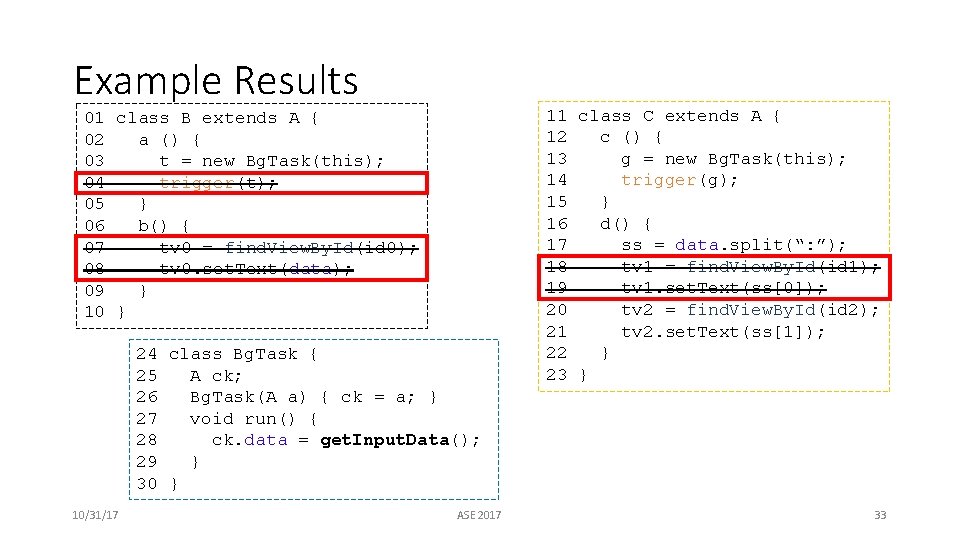
Example Results 01 class B extends A { 02 a () { 03 t = new Bg. Task(this); 04 trigger(t); 05 } 06 b() { 07 tv 0 = find. View. By. Id(id 0); 08 tv 0. set. Text(data); 09 } 10 } 24 class Bg. Task { 25 A ck; 26 Bg. Task(A a) { ck = a; } 27 void run() { 28 ck. data = get. Input. Data(); 29 } 30 } 10/31/17 ASE 2017 11 class C extends A { 12 c () { 13 g = new Bg. Task(this); 14 trigger(g); 15 } 16 d() { 17 ss = data. split(“: ”); 18 tv 1 = find. View. By. Id(id 1); 19 tv 1. set. Text(ss[0]); 20 tv 2 = find. View. By. Id(id 2); 21 tv 2. set. Text(ss[1]); 22 } 23 } 33
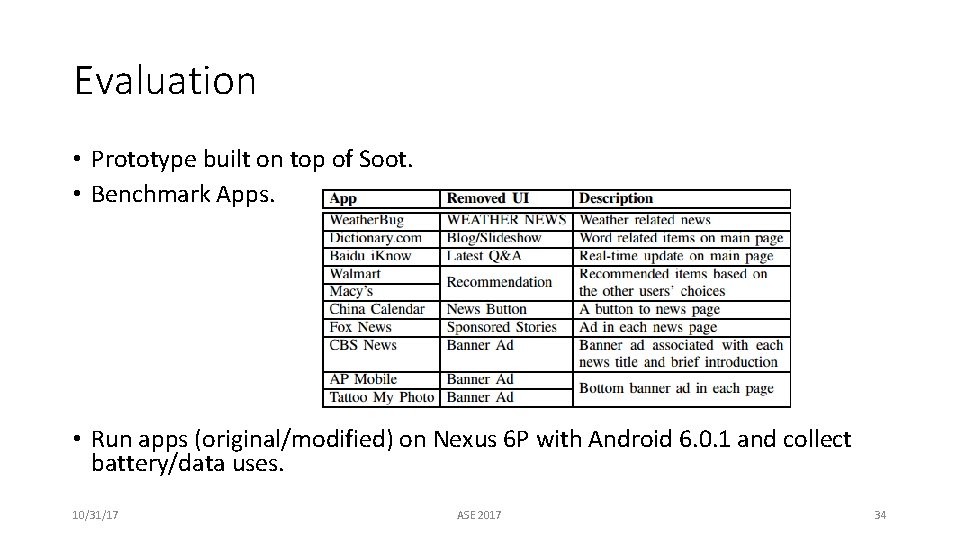
Evaluation • Prototype built on top of Soot. • Benchmark Apps. • Run apps (original/modified) on Nexus 6 P with Android 6. 0. 1 and collect battery/data uses. 10/31/17 ASE 2017 34
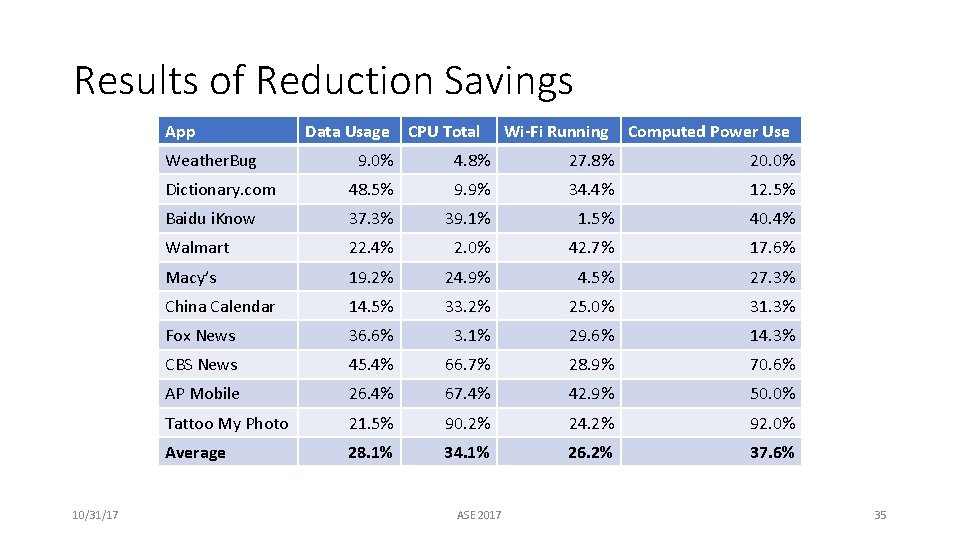
Results of Reduction Savings App Weather. Bug 10/31/17 Data Usage CPU Total Wi-Fi Running Computed Power Use 9. 0% 4. 8% 27. 8% 20. 0% Dictionary. com 48. 5% 9. 9% 34. 4% 12. 5% Baidu i. Know 37. 3% 39. 1% 1. 5% 40. 4% Walmart 22. 4% 2. 0% 42. 7% 17. 6% Macy’s 19. 2% 24. 9% 4. 5% 27. 3% China Calendar 14. 5% 33. 2% 25. 0% 31. 3% Fox News 36. 6% 3. 1% 29. 6% 14. 3% CBS News 45. 4% 66. 7% 28. 9% 70. 6% AP Mobile 26. 4% 67. 4% 42. 9% 50. 0% Tattoo My Photo 21. 5% 90. 2% 24. 2% 92. 0% Average 28. 1% 34. 1% 26. 2% 37. 6% ASE 2017 35
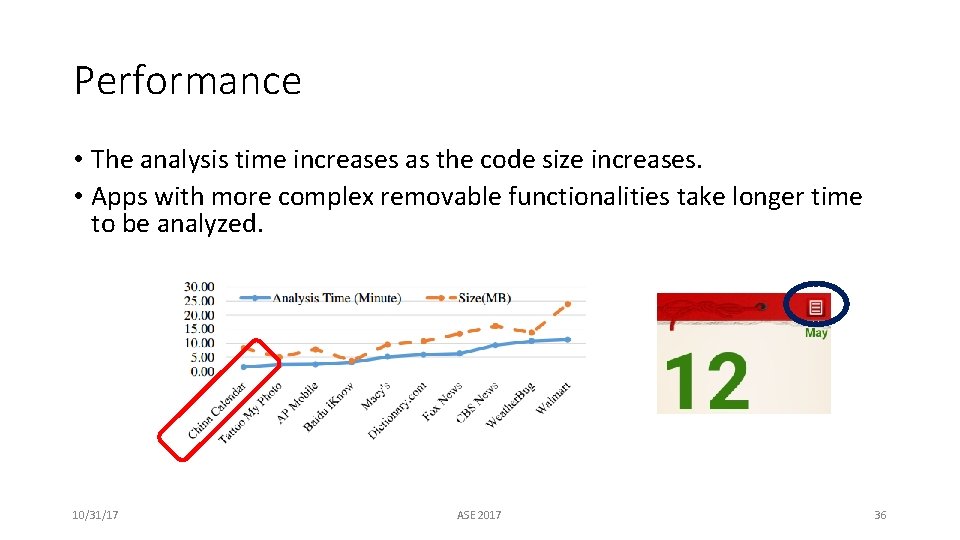
Performance • The analysis time increases as the code size increases. • Apps with more complex removable functionalities take longer time to be analyzed. 10/31/17 ASE 2017 36
Discussion • Limitations • Our analysis inherits the limitations of Android app analysis. • Rewriting supported by Soot may produce unrunable apps. • Usability • While the prototype runs on PCs, efforts are required to make it more usable for end users. 10/31/17 ASE 2017 37
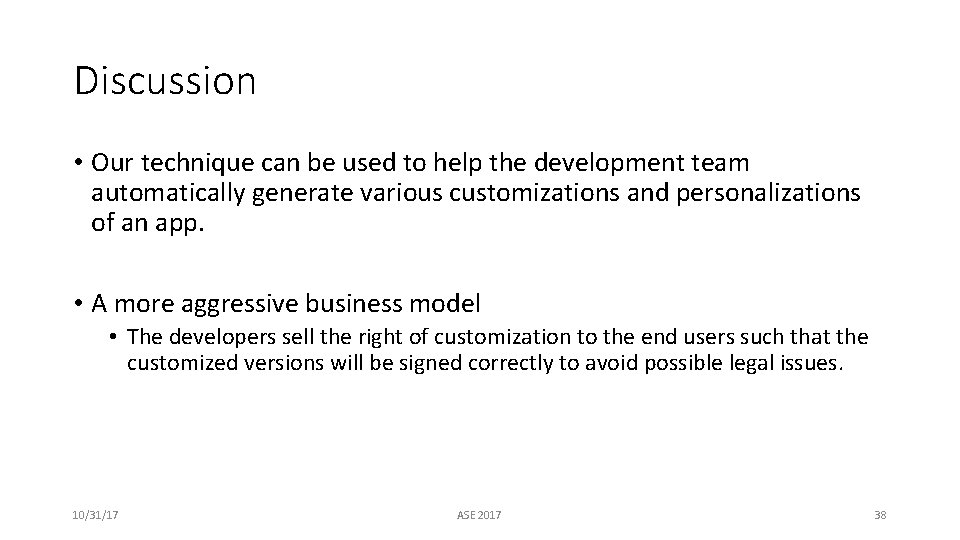
Discussion • Our technique can be used to help the development team automatically generate various customizations and personalizations of an app. • A more aggressive business model • The developers sell the right of customization to the end users such that the customized versions will be signed correctly to avoid possible legal issues. 10/31/17 ASE 2017 38
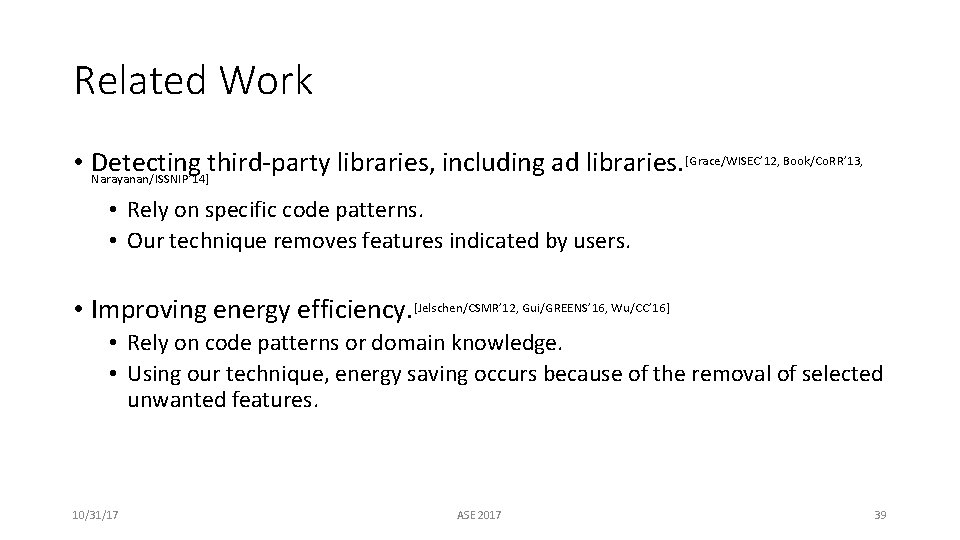
Related Work [Grace/WISEC’ 12, Book/Co. RR’ 13, • Detecting third-party libraries, including ad libraries. Narayanan/ISSNIP’ 14] • Rely on specific code patterns. • Our technique removes features indicated by users. • Improving energy efficiency. [Jelschen/CSMR’ 12, Gui/GREENS’ 16, Wu/CC’ 16] • Rely on code patterns or domain knowledge. • Using our technique, energy saving occurs because of the removal of selected unwanted features. 10/31/17 ASE 2017 39
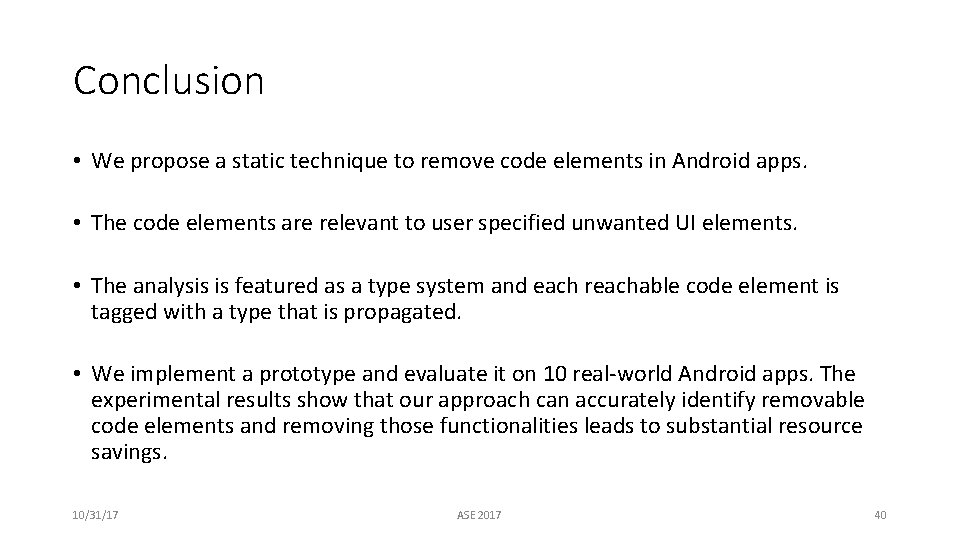
Conclusion • We propose a static technique to remove code elements in Android apps. • The code elements are relevant to user specified unwanted UI elements. • The analysis is featured as a type system and each reachable code element is tagged with a type that is propagated. • We implement a prototype and evaluate it on 10 real-world Android apps. The experimental results show that our approach can accurately identify removable code elements and removing those functionalities leads to substantial resource savings. 10/31/17 ASE 2017 40
END & Thanks 10/31/17 ASE 2017 41