
Uhthoffs Phenomenon A Mechanism of Multiple Sclerosis S
- Slides: 1
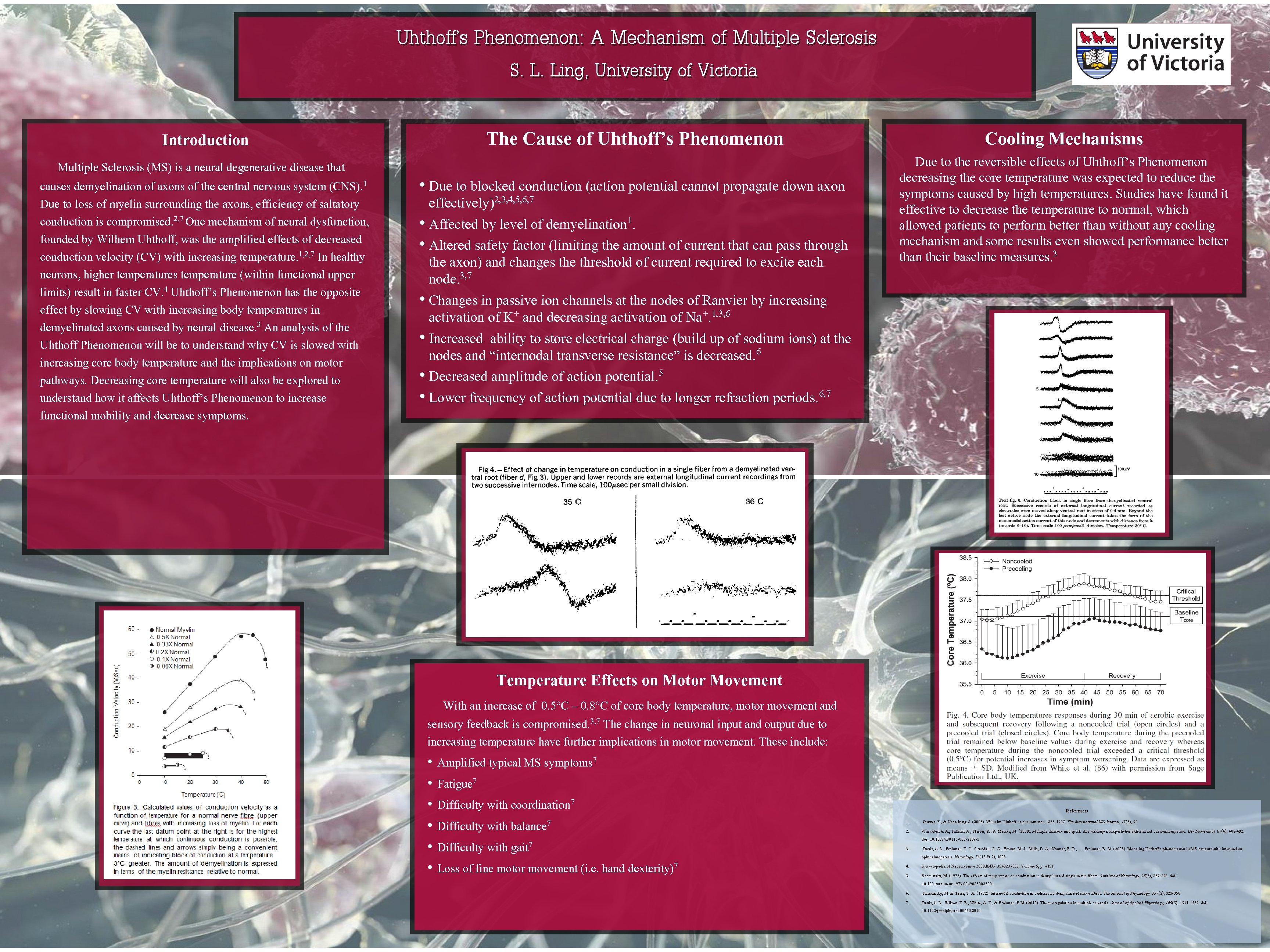
Uhthoff’s Phenomenon: A Mechanism of Multiple Sclerosis S. L. Ling, University of Victoria Introduction Multiple Sclerosis (MS) is a neural degenerative disease that causes demyelination of axons of the central nervous system (CNS). 1 Due to loss of myelin surrounding the axons, efficiency of saltatory conduction is compromised. 2, 7 One mechanism of neural dysfunction, founded by Wilhem Uhthoff, was the amplified effects of decreased conduction velocity (CV) with increasing temperature. 1, 2, 7 In healthy neurons, higher temperatures temperature (within functional upper limits) result in faster CV. 4 Uhthoff’s Phenomenon has the opposite effect by slowing CV with increasing body temperatures in demyelinated axons caused by neural disease. 3 An analysis of the Uhthoff Phenomenon will be to understand why CV is slowed with increasing core body temperature and the implications on motor pathways. Decreasing core temperature will also be explored to understand how it affects Uhthoff’s Phenomenon to increase functional mobility and decrease symptoms. The Cause of Uhthoff’s Phenomenon • Due to blocked conduction (action potential cannot propagate down axon 2, 3, 4, 5, 6, 7 effectively) • Affected by level of demyelination 1. • Altered safety factor (limiting the amount of current that can pass through the axon) and changes the threshold of current required to excite each 3, 7 node. • Changes in passive ion channels at the nodes of Ranvier by increasing activation of K+ and decreasing activation of Na+. 1, 3, 6 • Increased ability to store electrical charge (build up of sodium ions) at the nodes and “internodal transverse resistance” is decreased. 6 5 • Decreased amplitude of action potential. • Lower frequency of action potential due to longer refraction periods. 6, 7 Cooling Mechanisms Due to the reversible effects of Uhthoff’s Phenomenon decreasing the core temperature was expected to reduce the symptoms caused by high temperatures. Studies have found it effective to decrease the temperature to normal, which allowed patients to perform better than without any cooling mechanism and some results even showed performance better than their baseline measures. 3 Temperature Effects on Motor Movement With an increase of 0. 5°C – 0. 8°C of core body temperature, motor movement and sensory feedback is compromised. 3, 7 The change in neuronal input and output due to increasing temperature have further implications in motor movement. These include: • Amplified typical MS symptoms 7 • Fatigue 7 • Difficulty with coordination 7 • Difficulty with balance 7 • Difficulty with gait 7 • Loss of fine motor movement (i. e. hand dexterity)7 References 1. 2. 3. 4. 5. 6. 7. Stutzer, P. , & Kesselring, J. (2008). Wilhelm Uhthoff--a phenomenon 1853 -1927. The International MS Journal, 15(3), 90. Waschbisch, A. , Tallner, A. , Pfeifer, K. , & Mäurer, M. (2009). Multiple sklerose und sport: Auswirkungen körperlicher aktivität auf das immunsystem. Der Nervenarzt, 80(6), 688 -692. doi: 10. 1007/s 00115 -008 -2639 -3 Davis, S. L. , Frohman, T. C. , Crandall, C. G. , Brown, M. J. , Mills, D. A. , Kramer, P. D. , . . . Frohman, E. M. (2008). Modeling Uhthoff's phenomenon in MS patients with internuclear ophthalmoparesis. Neurology, 70(13 Pt 2), 1098. Encyclopedia of Neuroscience 2009, ISBN 3540237356, Volume 5, p. 4151 Rasminsky, M. (1973). The effects of temperature on conduction in demyelinated single nerve fibers. Archives of Neurology, 28(5), 287 -292. doi: 10. 1001/archneur. 1973. 0049023001 Rasminsky, M. & Sears, T. A. (1972). Internodal conduction in undissected demyelinated nerve fibres. The Journal of Physiology, 227(2), 323 -350. Davis, S. L. , Wilson, T. E. , White, A. T. , & Frohman, E. M. (2010). Thermoregulation in multiple sclerosis. Journal of Applied Physiology, 109(5), 1531 -1537. doi: 10. 1152/japplphysiol. 00460. 2010