
UHB 23 Colour and Lighten Hair Understanding the
UHB 23 – Colour and Lighten Hair Understanding the basic science for colouring services….
Unit Content • On completion of this lesson you will be able to: 1. 2. Know what the International Colour Chart (ICC) is and know the principle of colour Describe how the natural pigment in hair can affect the choice of colour and colouring products and the possible need to pre-lighten. 3. Compare different colouring and lightening products and the hair structure. 4. Explain how different strengths of peroxide influence colouring and lightening. 5. Describe how porosity levels can affect the choice and application of colouring and the results of the colouring process. 6. Explain the factors can effect the choice of colouring and lightening products and application techniques. 7. Explain the effects of temperature on the application and development of colour and lightening products. 8. Know how to dilute hydrogen peroxide to form different strengths of solution. 9. Know the importance of restoring the hair’s PH balance after the colouring process. 10. Know why its important to avoid disturbing areas still processing when removing colour from developed areas. 11. Know why its important to emulsify colour prior to removal 12. Explain why its important to make sure that the hair and scalp are free of colouring and lightening products

International Colour Chart (ICC) The ICC is used as a visual aid which clients can pick colour from. All the colours on the ICC are coloured on virgin hair to give the truest colour result. The ICC is made up of 10 base shades, no matter what brand you use the base shades will always be the same this is the main principle of the ICC so even if you move to another country they will have the same base shades. The tones are the only thing that aren’t the same on shade charts as different company's can number tones differently of even us a letter instead. Base Shades on the ICC 1 – Black 2 – Very Dark Brown 3 – Dark Brown 4 – Brown 5 – Light Brown 6 – Dark Blonde 7 – Blonde 8 - Light Blonde 9 - Very Light Blonde 10 – Lightest Blonde
How Natural hair Pigments affect the choice of colour…. There are two types natural hair these are: • White hair – no pigment • Virgin hair – contains colour pigment in the cortex Melanin is what gives tone to both our hair and skin, different types and different amounts of melanin give the hair different colours. The two main pigments found in the hair are: • Melanin – granular pigments dark colour • Pheomelanin – diffuse pigments red and yellow • The amount of melanin and Pheomelanin present in the hair depends on the hair colour. White hair has no melanin present which mean that it can be harder to colour, most white hair has to be with pre-softened, pre-pigged or extra base colour added to the desired colour to make the colour penetrate deep enough in to the cortex for the colour will grab on to the hair.
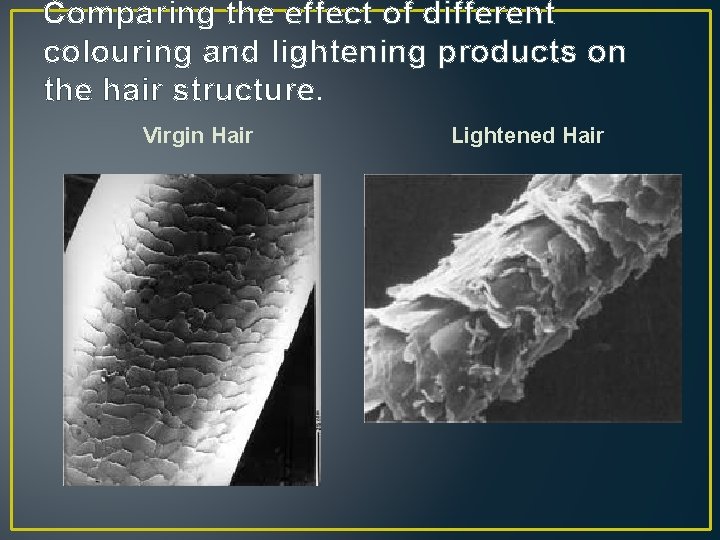
Comparing the effect of different colouring and lightening products on the hair structure. Virgin Hair Lightened Hair
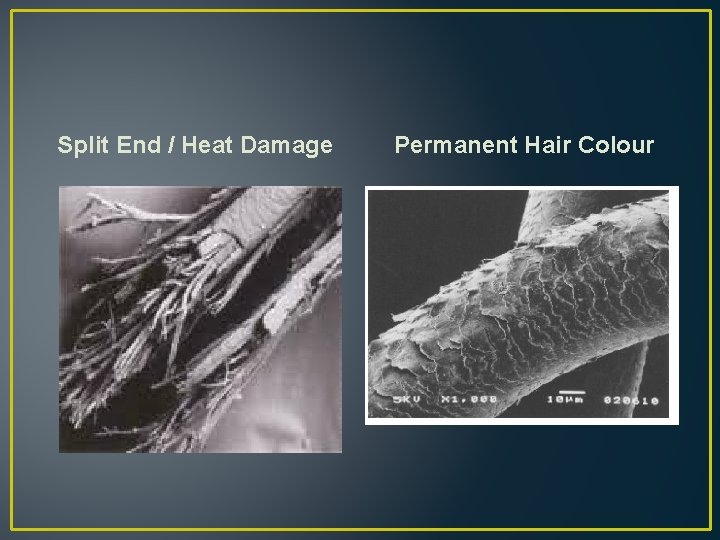
Split End / Heat Damage Permanent Hair Colour

How the different strengths of hydrogen peroxide influence colouring and lightening. . Hydrogen peroxide is mixed with both permanent colours and bleaches. If it were used by itself it would lighten the hair colour and make the hair more porous. This technique is also used to pre-soften very coarse that is resistant to colour. Once hydrogen peroxide is mixed with permanent colour or bleach it releases oxygen – this is known as oxidisation. The chemical formula for hydrogen peroxide is H 2 O 2 and here you can see how it breaks down during mixing: H 2 O 2 Hydrogen peroxide breaks down to form H 2 O + O Water and Oxygen
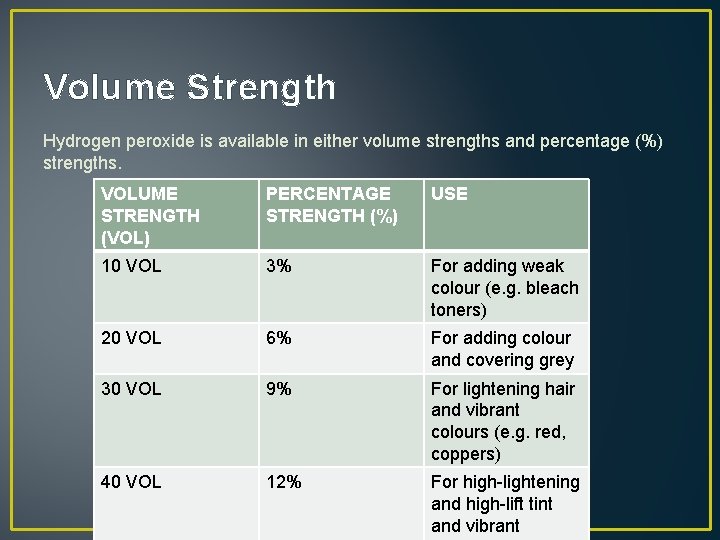
Volume Strength Hydrogen peroxide is available in either volume strengths and percentage (%) strengths. VOLUME STRENGTH (VOL) PERCENTAGE STRENGTH (%) USE 10 VOL 3% For adding weak colour (e. g. bleach toners) 20 VOL 6% For adding colour and covering grey 30 VOL 9% For lightening hair and vibrant colours (e. g. red, coppers) 40 VOL 12% For high-lightening and high-lift tint and vibrant
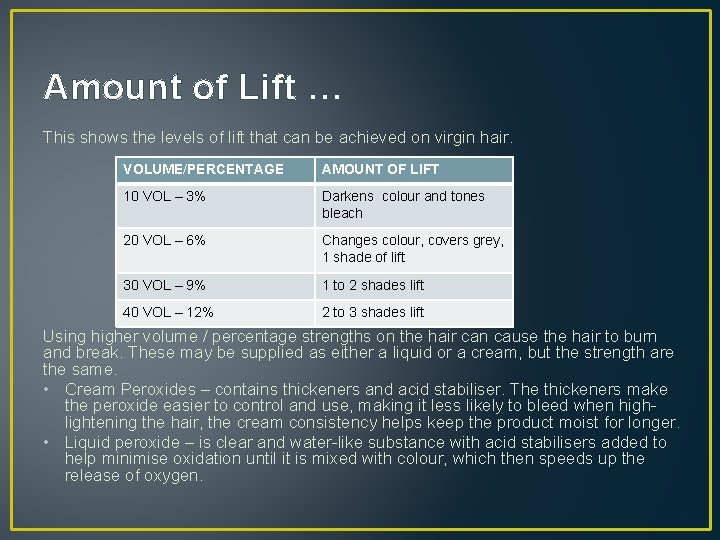
Amount of Lift … This shows the levels of lift that can be achieved on virgin hair. VOLUME/PERCENTAGE AMOUNT OF LIFT 10 VOL – 3% Darkens colour and tones bleach 20 VOL – 6% Changes colour, covers grey, 1 shade of lift 30 VOL – 9% 1 to 2 shades lift 40 VOL – 12% 2 to 3 shades lift Using higher volume / percentage strengths on the hair can cause the hair to burn and break. These may be supplied as either a liquid or a cream, but the strength are the same. • Cream Peroxides – contains thickeners and acid stabiliser. The thickeners make the peroxide easier to control and use, making it less likely to bleed when highlightening the hair, the cream consistency helps keep the product moist for longer. • Liquid peroxide – is clear and water-like substance with acid stabilisers added to help minimise oxidation until it is mixed with colour, which then speeds up the release of oxygen.
How to dilute hydrogen peroxide to form different strength of solution …. Hydrogen peroxide will not work if it has “gone off”, which means it has lost it’s strength (and it’s oxygen). This will happen if it is not stored properly. Therefore you must always: • Keep the container tightly closed and put the lid back on as soon as possible after use • Measure the amount of peroxide you need. If you have any left over, do not pour it back into the bottle as it may have picked up some dust. • Store in a cool, dark place. All peroxide have a acid stabiliser added to them which helps to prevent loss of strength. Sometimes you might have to dilute liquid hydrogen peroxide from stronger solution to a weaker one. The table below shows the different dilutions.
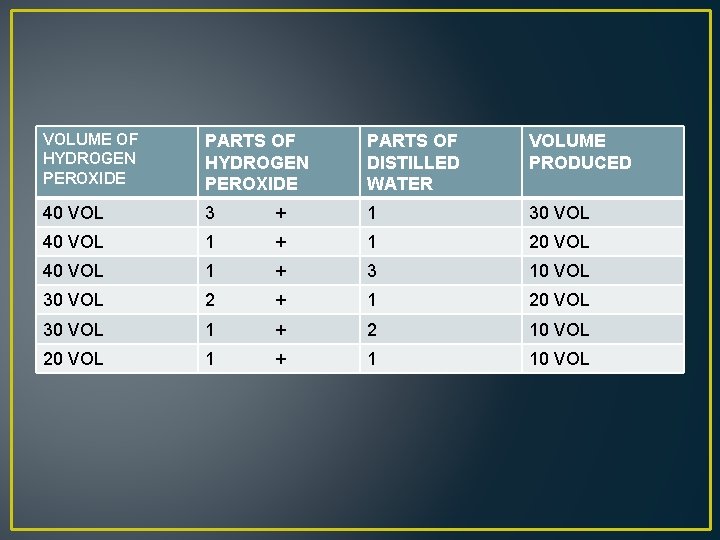
VOLUME OF HYDROGEN PEROXIDE PARTS OF DISTILLED WATER VOLUME PRODUCED 40 VOL 3 + 1 30 VOL 40 VOL 1 + 1 20 VOL 40 VOL 1 + 3 10 VOL 30 VOL 2 + 1 20 VOL 30 VOL 1 + 2 10 VOL 20 VOL 1 + 1 10 VOL
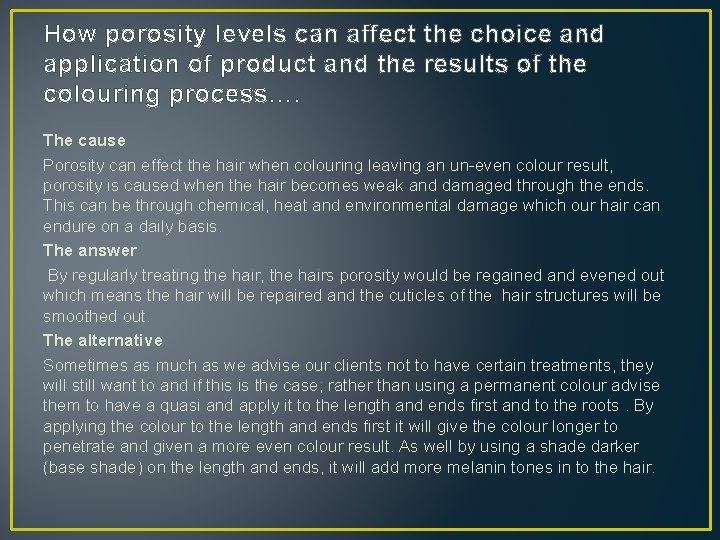
How porosity levels can affect the choice and application of product and the results of the colouring process…. The cause Porosity can effect the hair when colouring leaving an un-even colour result, porosity is caused when the hair becomes weak and damaged through the ends. This can be through chemical, heat and environmental damage which our hair can endure on a daily basis. The answer By regularly treating the hair, the hairs porosity would be regained and evened out which means the hair will be repaired and the cuticles of the hair structures will be smoothed out. The alternative Sometimes as much as we advise our clients not to have certain treatments, they will still want to and if this is the case; rather than using a permanent colour advise them to have a quasi and apply it to the length and ends first and to the roots. By applying the colour to the length and ends first it will give the colour longer to penetrate and given a more even colour result. As well by using a shade darker (base shade) on the length and ends, it will add more melanin tones in to the hair.
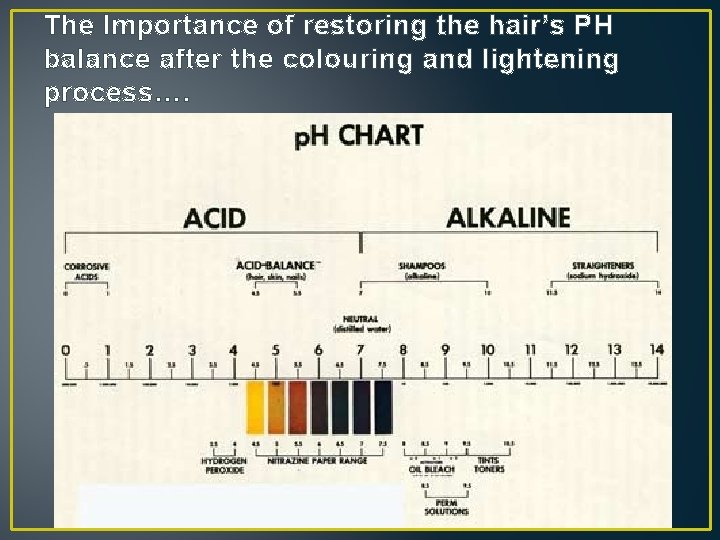
The Importance of restoring the hair’s PH balance after the colouring and lightening process….
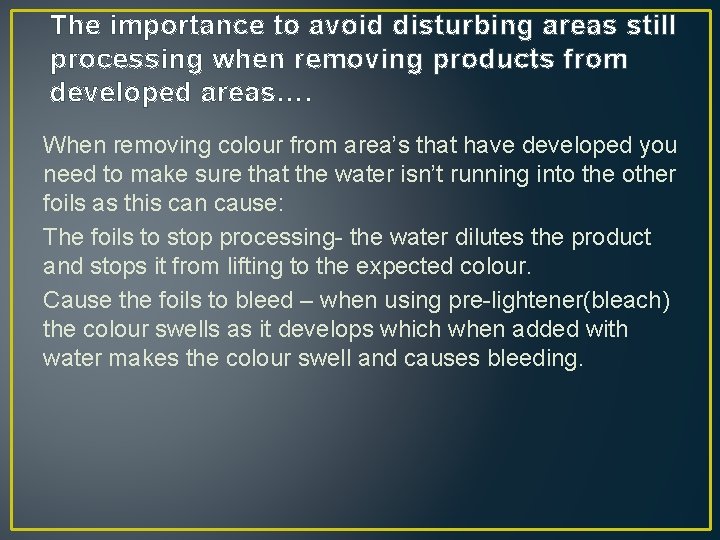
The importance to avoid disturbing areas still processing when removing products from developed areas…. When removing colour from area’s that have developed you need to make sure that the water isn’t running into the other foils as this can cause: The foils to stop processing- the water dilutes the product and stops it from lifting to the expected colour. Cause the foils to bleed – when using pre-lightener(bleach) the colour swells as it develops which when added with water makes the colour swell and causes bleeding.
Why is it important to emulsify colour prior remove…. How emulsification works Wet tint remove dry tint, so adding a little bit of water and rubbing it in to the colour while it’s still on the head will help remove the colour from the scalp.
Why it’s important to remove all the colour from the hair and scalp… Bleach and lightening products It’s important to remove bleach and lightening products from the hair and scalp as these products to no stop oxidising, which mean’s that they don’t stop developing so in effect the hair will become over processed which will result in hair loss/breakage and a irritable or sensitive which will cause sores and maybe cyst’s. Permanent / quasi colours These kind of colours actually stop oxidising after the given development time which mean they stop developing. Which means that the hair will not be any more damaged but that scalp will become sensitised and irritable.
- Slides: 16