
UH Distance Learning programmes through the lens of
- Slides: 12
UH Distance Learning programmes through the lens of student expectation Marija Cubric Karen Clark School of Law Business School www. herts. ac. uk Mariana Lilley School of Computer Science
Abstract The aim of this presentation is to summarise some preliminary findings from our Charitable Trust Fund Distance Learning project which are relevant to expectations of our distance learning students and, in particular, to discuss the importance of understanding and respecting specific needs of our growing distance learner population. Our project aims to pull together lessons from different distance learning programmes across the university. We build on work already done comparing the models of engagement on programmes. Our main objectives are to analyse and compare the pedagogy underpinning programmes offered in different schools at UH, to identify lessons learned and to devise strategies for embedding effective pedagogy at programme level. In addition, we are trying to identify what works best for which kinds of students. We take a multiple case-study approach, supported by data from students and staff surveys, interviews and information collected through Study. Net (e. g. discussion forums, access statistics, online induction events etc)
Contents Literature review Previous work on comparison of distance learning programmes Preliminary findings from initial students’ questionnaire What next…
Literature rich and rapidly expanding…. . . and confusing? Guri-Rosenblit & Gros (2011) identify a ‘“Tower of Babel” syndrome’ surrounding applications of technology in education Distance learning definition - ‘planned learning that occurs in a different place from teaching…’ (Moore & Kearsley, 1996: 2) - early correspondence courses > Internet enabled programmes We adopt this definition in the context of internet-enabled distance learning programmes Relative gap at programme level Merisotis and Phipps (1999), Zawacki-Richter, Backer, Vogt (2009)
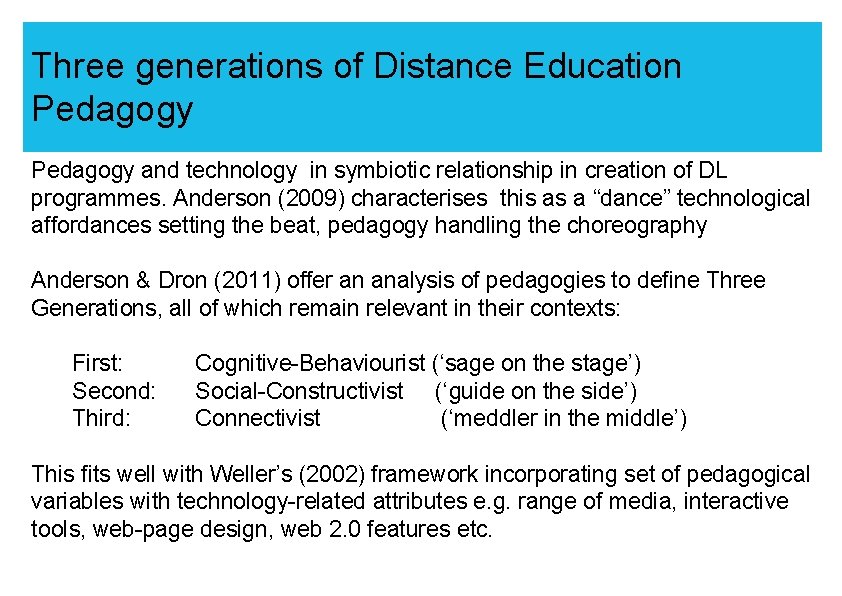
Three generations of Distance Education Pedagogy and technology in symbiotic relationship in creation of DL programmes. Anderson (2009) characterises this as a “dance” technological affordances setting the beat, pedagogy handling the choreography Anderson & Dron (2011) offer an analysis of pedagogies to define Three Generations, all of which remain relevant in their contexts: First: Second: Third: Cognitive-Behaviourist (‘sage on the stage’) Social-Constructivist (‘guide on the side’) Connectivist (‘meddler in the middle’) This fits well with Weller’s (2002) framework incorporating set of pedagogical variables with technology-related attributes e. g. range of media, interactive tools, web-page design, web 2. 0 features etc.
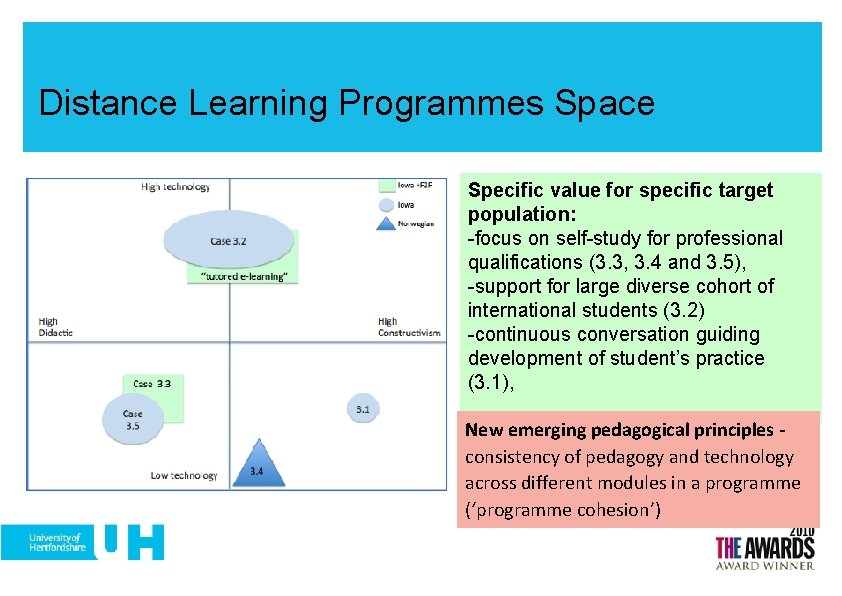
Distance Learning Programmes Space Specific value for specific target population: -focus on self-study for professional qualifications (3. 3, 3. 4 and 3. 5), -support for large diverse cohort of international students (3. 2) -continuous conversation guiding development of student’s practice (3. 1), New emerging pedagogical principles consistency of pedagogy and technology across different modules in a programme (‘programme cohesion’)
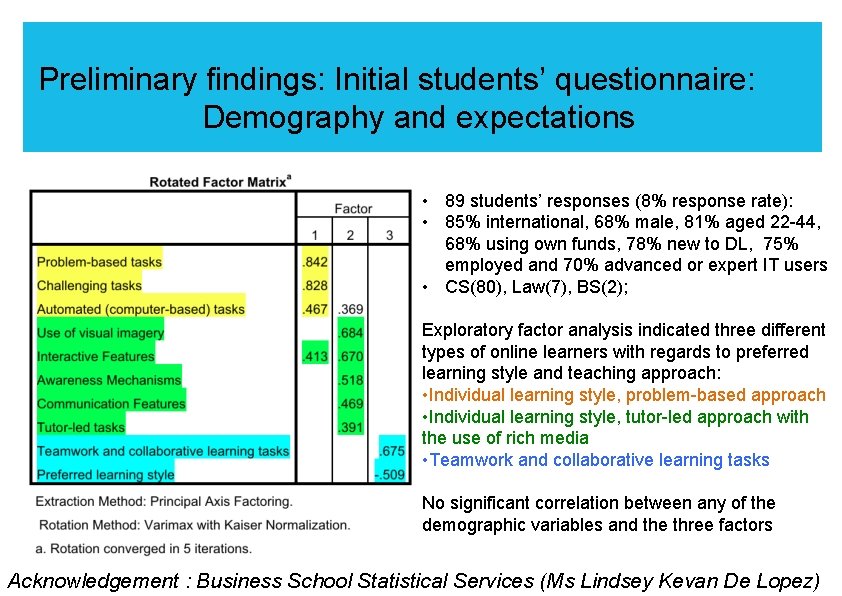
Preliminary findings: Initial students’ questionnaire: Demography and expectations 89 • 89 students’ responses (8% response rate): • 85% international, 68% male, 81% aged 22 -44, 68% using own funds, 78% new to DL, 75% employed and 70% advanced or expert IT users • CS(80), Law(7), BS(2); Exploratory factor analysis indicated three different types of online learners with regards to preferred learning style and teaching approach: • Individual learning style, problem-based approach • Individual learning style, tutor-led approach with the use of rich media • Teamwork and collaborative learning tasks No significant correlation between any of the demographic variables and the three factors Acknowledgement : Business School Statistical Services (Ms Lindsey Kevan De Lopez)
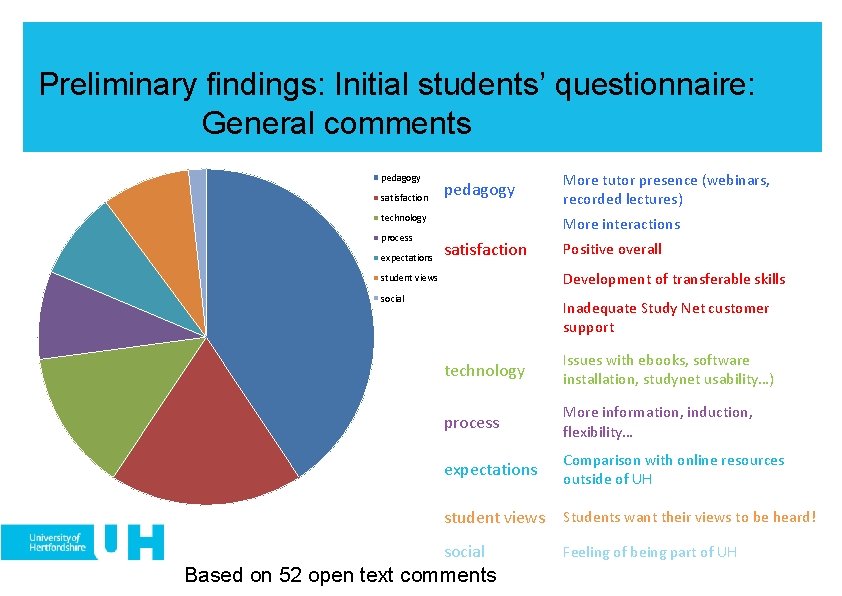
Preliminary findings: Initial students’ questionnaire: General comments pedagogy satisfaction pedagogy technology process expectations More tutor presence (webinars, recorded lectures) More interactions satisfaction Positive overall Development of transferable skills student views social Inadequate Study Net customer support technology Issues with ebooks, software installation, studynet usability…) process More information, induction, flexibility… expectations Comparison with online resources outside of UH student views Students want their views to be heard! social Based on 52 open text comments Feeling of being part of UH
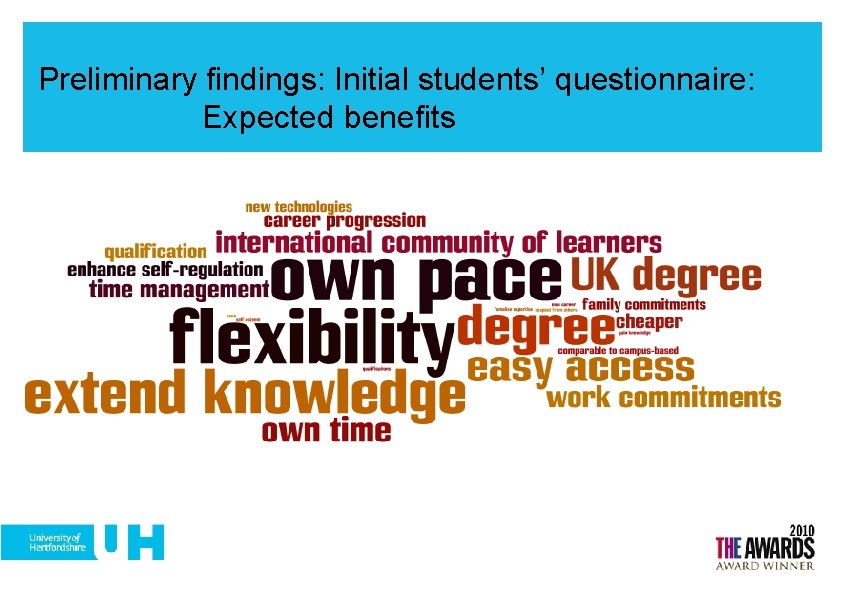
Preliminary findings: Initial students’ questionnaire: Expected benefits
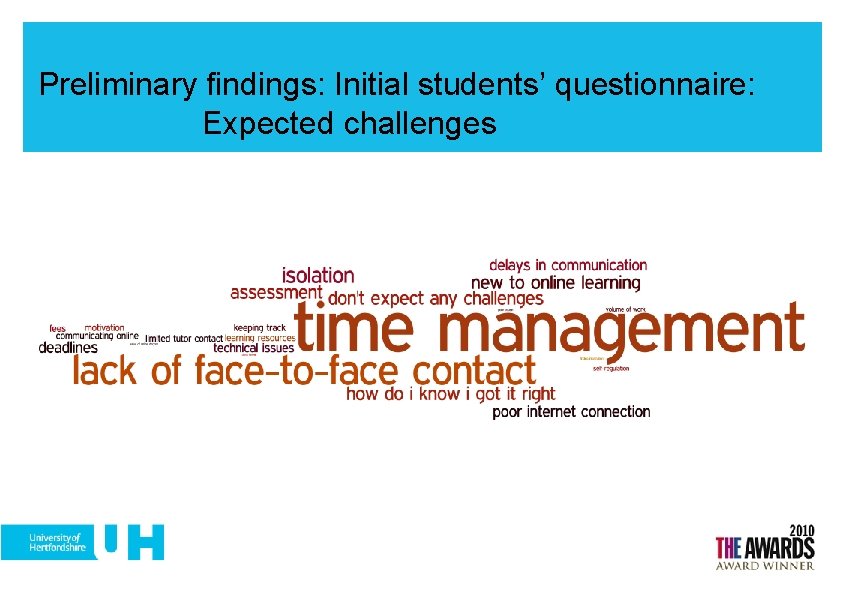
Preliminary findings: Initial students’ questionnaire: Expected challenges
What next … Ø Ø Staff questionnaire and interviews (in progress) Final students’ questionnaire (to include performance data) Comparison of students’ and staff expectations Comparison of students’ initial expectations and final views and results Ø Lessons learned from existing distance learning programmes Ø Pedagogical principles guiding the design and implementation of distance learning programmes Ø Strategies for embedding the pedagogical principles into design and implementation of distance learning programmes
Q&A UH Distance Learning programmes through the lens of student expectation Marija Cubric Karen Clark School of Law Business School www. herts. ac. uk Mariana Lilley School of Computer Science