
Ugandan EGovernment Interoperability Framework eGIF DRAFT eGovernment Architecture
Ugandan E-Government Interoperability Framework (e-GIF) DRAFT
e-Government Architecture § Architecture (ISO): The fundamental concepts or properties of a system in its environment embodied in: o its elements, o relationships, o and in the principles of its design and evolution. § We are building architecture of e-Government.
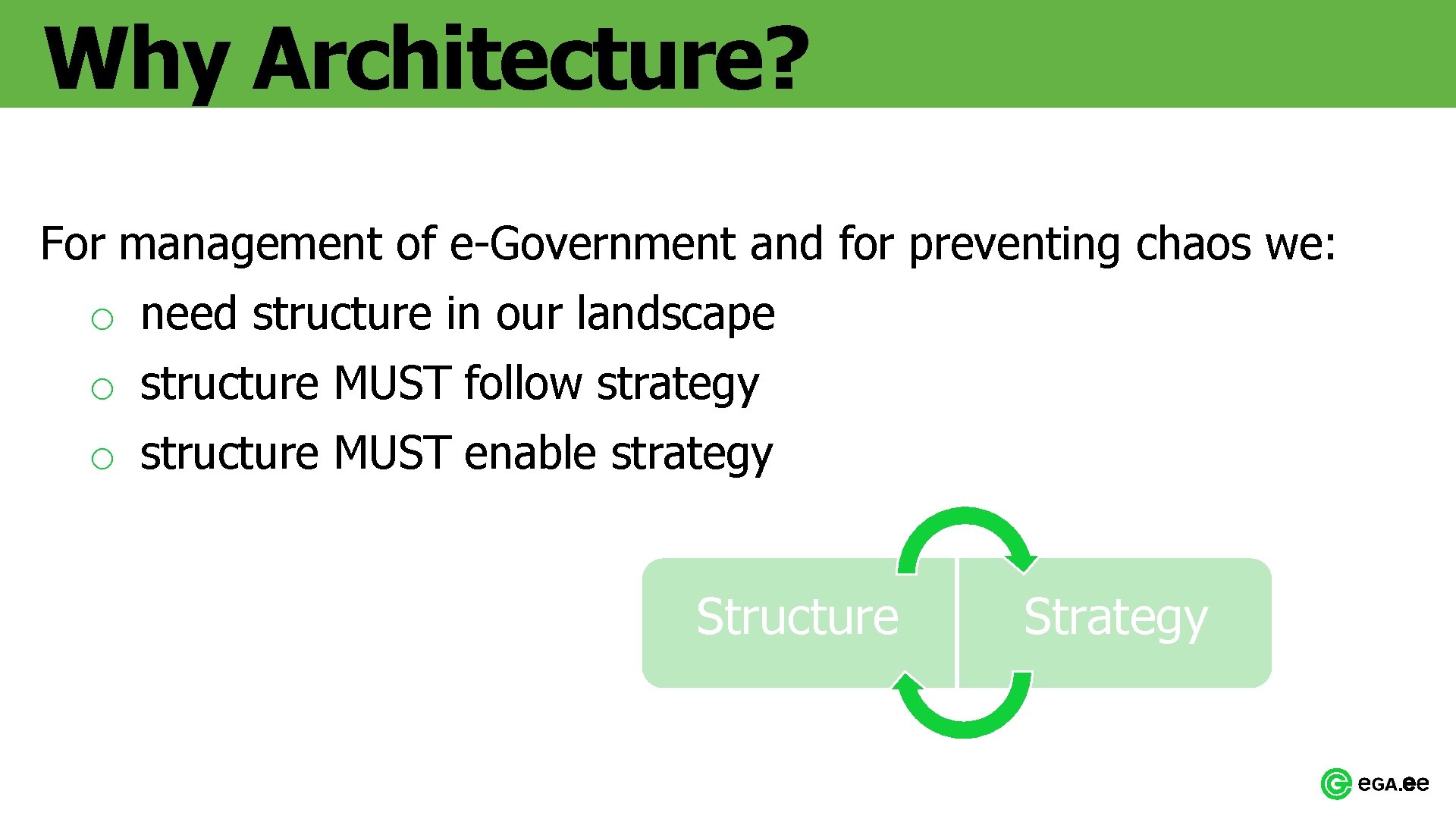
Why Architecture? For management of e-Government and for preventing chaos we: o need structure in our landscape o structure MUST follow strategy o structure MUST enable strategy Structure Strategy
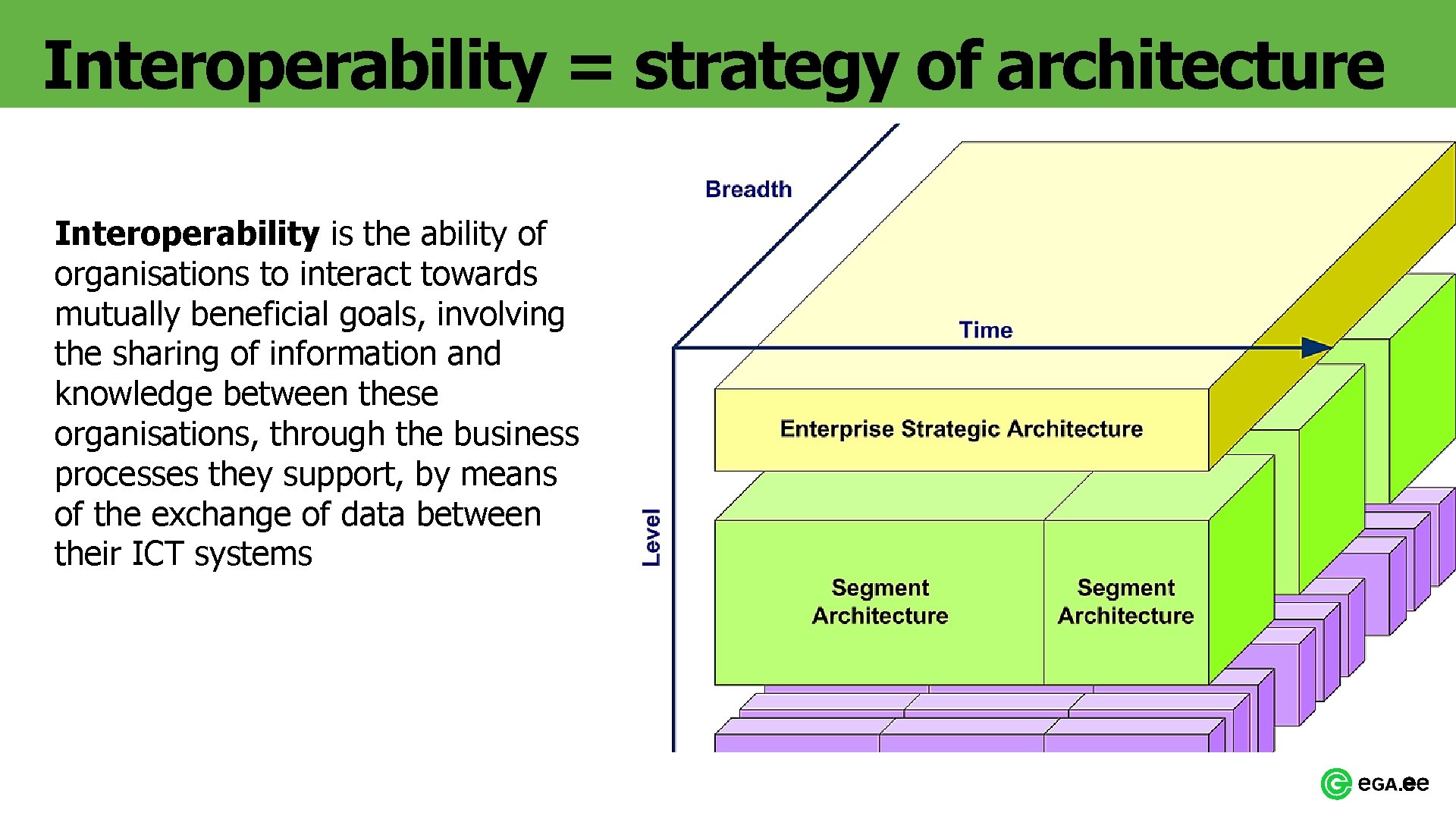
Interoperability = strategy of architecture Interoperability is the ability of organisations to interact towards mutually beneficial goals, involving the sharing of information and knowledge between these organisations, through the business processes they support, by means of the exchange of data between their ICT systems
Interoperability Framework The Ugandan E-Government Interoperability Framework (e-GIF) is the agreed approach to the implementation and delivery of Go. U public services in an interoperable manner. e-GIF outlines main principles, models, building blocks and general guidelines enabling development and implementation of electronic services for citizens, businesses and public administrations in the Ugandan Government.
Aim The interoperability framework aims to improve: o cooperation between public administrations aiming at the establishment of public services; o exchanging information between public administrations to fulfil legal requirements or political commitments; o sharing and reusing information among public administrations to increase administrative efficiency and reduce administrative burden on citizens and businesses
Specific objectives § § § § to facilitate the transformation of institution-based public administration into a servicecentred one, to reduce public sector IT expenses through a wide use of common rules and solutions; to improve the interoperability through coordinated use of centrally developed common infrastructure services and open standards; to improve the coordination and management of state information systems and to accelerate the development of IT solutions; to contribute to the co-development of the state information system; to allow autonomous development for all systems within the principles of organisational, semantic and technical interoperability; to endorse free competition in the area of public procurement.

e-GIF – Underlying Principles
Underlying Principles § The interoperability principles are fundamental behavioural aspects to drive interoperability actions. § Underlying principles will align IT systems to the strategic business goals of Ugandan government.
1. Subsidiarity and Proportionality § Information systems SHOULD support the existing organisational structures and their objectives § MDAs MUST align their frameworks and strategies with the e-GIF § Go. U information technology related political decisions SHOULD be enforced only if they are more efficient than the ones made in public sector institutions
2. Openness § The MDAs MUST publish the data they own as open data unless certain restrictions apply § The MDAs SHOULD ensure a level playing field for open source software and demonstrate active and fair consideration of using open source software, considering the total cost of ownership of the solution § The MDAs MUST give preference to open specifications, taking due account of the coverage of functional needs, maturity and market support and innovation
3. Transparency § The MDAs SHOULD ensure internal visibility and provide external interfaces for Go. U public services
4. Reusability § MDAs SHOULD reuse and share solutions and cooperate in the development of joint solutions § MDAs MUST reuse and share information and data unless certain privacy or confidentiality restrictions apply
5. Technological Neutrality and Data Portability § MDAs SHALL NOT impose any specific disproportionate technological solutions for citizens, businesses and other MDAs when establishing information systems and services § When developing functionality of information systems, technological decisions MUST be made as late as possible § MDAs MUST ensure that data is easily transferable between systems and applications § Information systems interfaces MUST be created in a technology neutral way, using open standards and specifications (XML, WSDL, SOAP, REST etc)
6. User -Centricity § A user SHOULD be able to choose an agreeable type of a service channel: service bureau, post, telephone, e-mail, and other Internet channels § A person identified with an electronic ID or with other secure means MUST be able to apply for any electronic public service § Citizen portal MUST acts as single contact point for public services. It is RECOMMENDED that multiple MDAs work together to provide aggregated services via the citizen portal § Users’ feedback SHOULD be systematically collected, assessed, and used as the basis for further service improvement. Mechanisms to involve users in analysis, design, assessment, and further development of Go. U public services SHOULD be put in place § Data MUST be provided by users only once, and MDAs SHOULD be able to retrieve and share this data considering data protection rules and legislation § Institution based approach MUST be replaced with a user-based approach. Institutions MUST provide information at their own initiative
7. Inclusion and Accessibility § MDAs SHALL ensure that all public sector websites and public services are accessible to all citizens, including persons with disabilities and special needs § The interfaces of Go. U public sector information systems, websites, and services SHALL comply at least with WCAG (Web Content Accessibility Guidelines) quality criteria - level AA § Public sector institutions MUST provide information in open formats. Citizens do not have to make extra expenses to use information (for example, obtain own software)
8. Security § Go. U SHOULD define a common security framework, adopt data protection legislation, and establish processes for public services to ensure secure and trustworthy data exchange between MDAs and in interactions with citizens and businesses § Go. U information systems MUST guarantee confidentiality, integrity, authenticity, availability and provability of data and services
9. Privacy § Citizens SHOULD be supplied by services through which they can check and, if necessary, correct the data collected about them by the public sector § Citizens SHOULD be supplied by services through which they find out who, and for what purposes, has used the data collected about them in the public sector
10. Administrative Simplification § MDAs SHOULD simplify processes and use digital channels whenever appropriate for the delivery of public services, to respond promptly and with high quality to users’ requests and reduce the administrative burden on MDAs, businesses and citizens
11. Preservation of Information § Uganda MUST formulate a long-term preservation policy for information in electronic form
12. Effectiveness and Efficiency § MDAs MUST evaluate the effectiveness and efficiency of different interoperability solutions and technological options considering user needs, proportionality and balance between costs and benefits
Next up… • Interoperability Layers

e-GIF – Layers
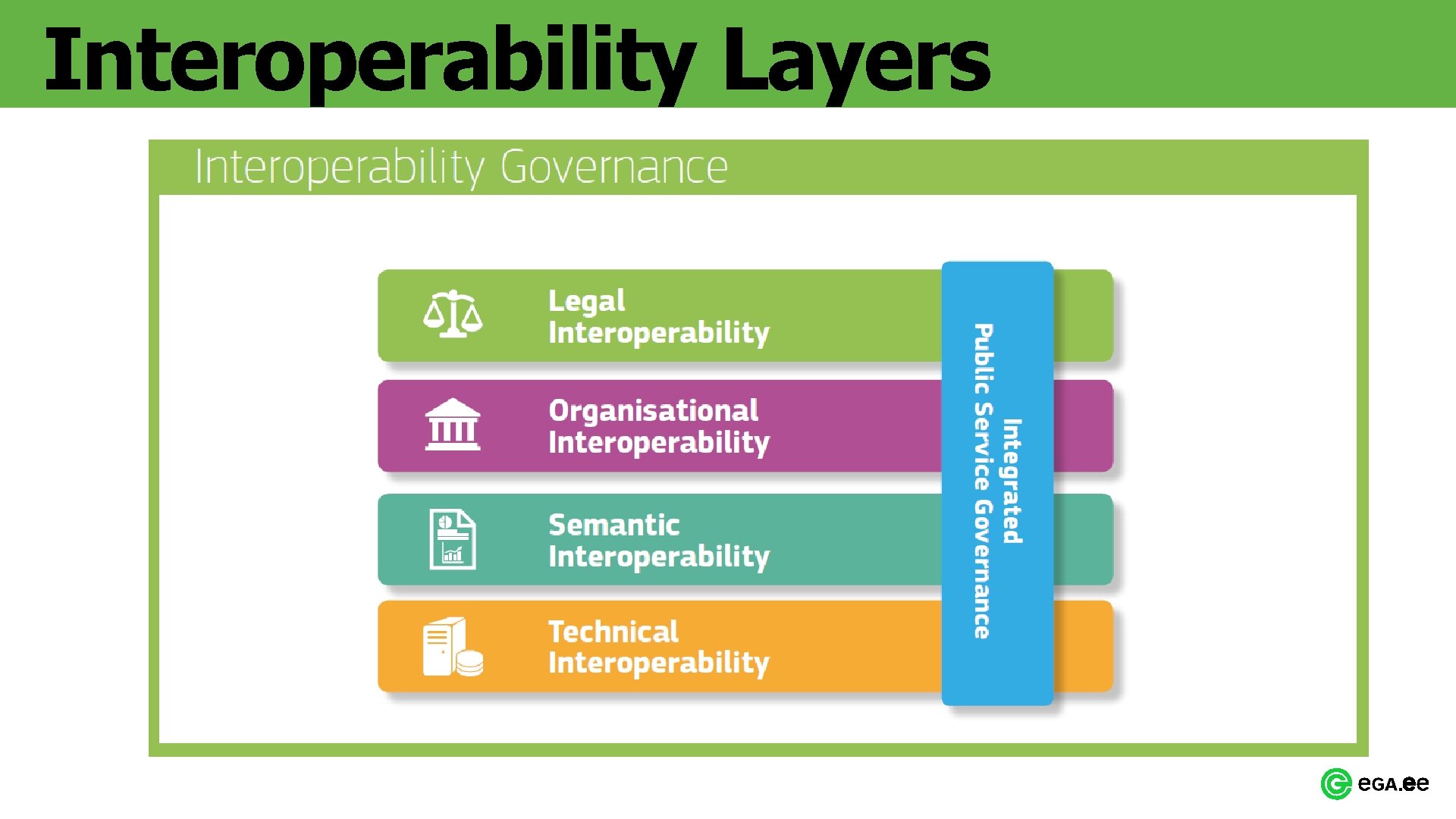
Interoperability Layers
Barriers § Ugandan information systems and services operate in a complex and changing environment. Political support is necessary for cross-sectoral efforts § The lack of the necessary in-house skill § Interoperability should be guaranteed in a sustainable way and not as a one-off target or project § Interoperability governance is the key to a holistic approach on interoperability
Interoperability Governance § The coordination body SHALL ensure holistic governance of interoperability activities across administrative levels and sectors § According to the good governance principles it is RECOMMENDED to separate the levels of decision making. It is RECOMMENDED to keep strategic decisions, supervision/coordination and implementation in separate institutions § The National Information Technology Authority (NITA-U) acts as central implementation unit and is responsible for interoperability enablers § It is RECOMMENDED to centralise development of the policies and decentralise the implementation
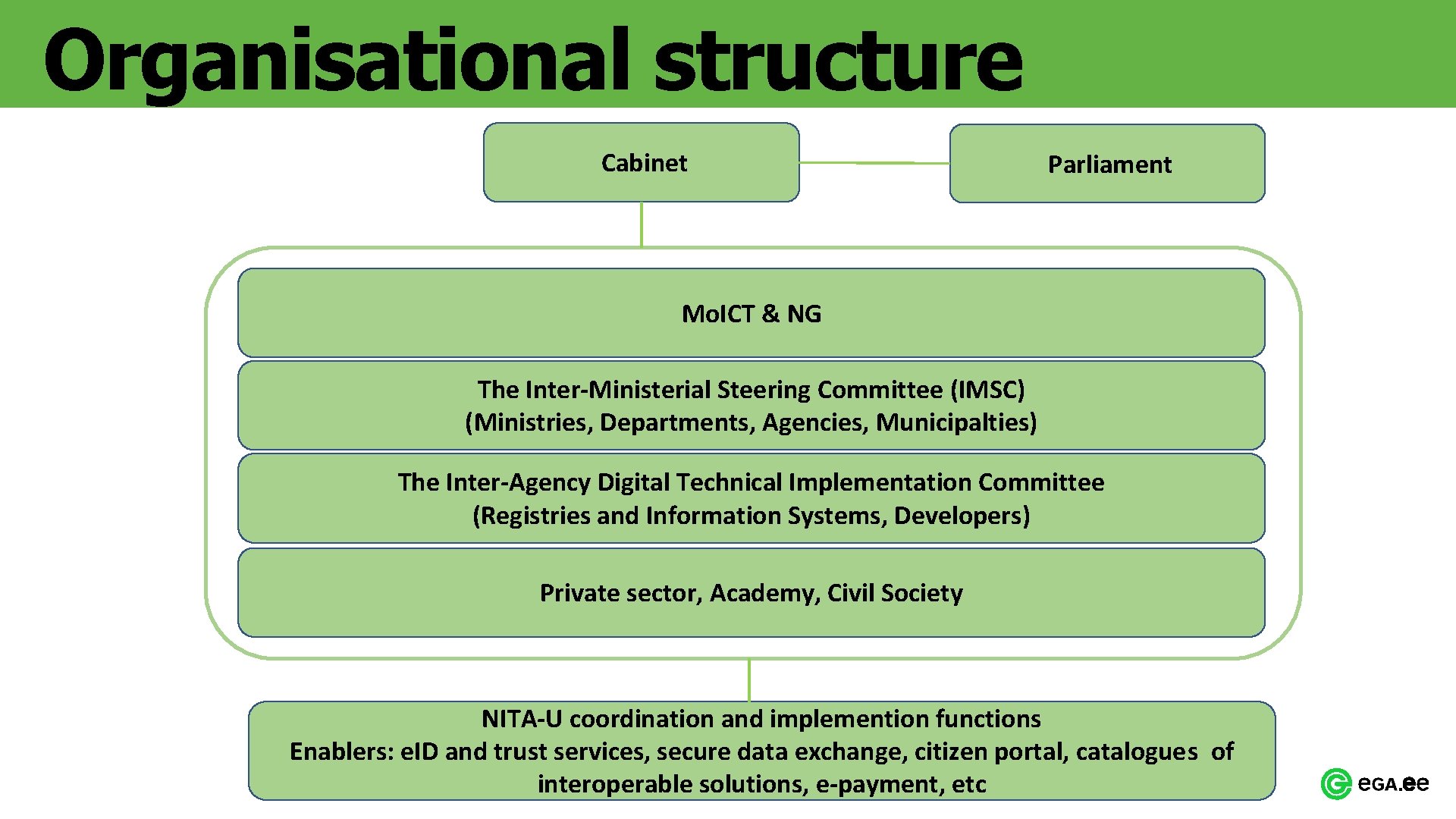
Organisational structure Cabinet Parliament Mo. ICT & NG The Inter-Ministerial Steering Committee (IMSC) (Ministries, Departments, Agencies, Municipalties) The Inter-Agency Digital Technical Implementation Committee (Registries and Information Systems, Developers) Private sector, Academy, Civil Society NITA-U coordination and implemention functions Enablers: e. ID and trust services, secure data exchange, citizen portal, catalogues of interoperable solutions, e-payment, etc
Financing § Government (or donors) cover from their investment budget development of cross government IT systems (hardware, software) § Operational costs (maintenance, support, further developments, etc. ) are covered from the MDA budgets
Standards and specifications § MDAs SHOULD implement open standard principles by using open source and proprietary software. The principles support equal access to government IT contracts and improve flexibility and ability when cooperating with other government organisations, citizens, and businesses § MDAs SHOULD follow an agreed minimum set of open standards. The choice and assessment of the standards is public and balanced. The list of standards will be reviewed once a year
Integrated Public Service Governance § Integrated public service governance on administration SHOULD include as a minimum: o the definition of organisational structures, roles & responsibilities and the decisionmaking process for the stakeholders involved; o the imposition of requirements for aspects of interoperability o a change management plan, to define the procedures and processes needed to deal with and control changes; o a business continuity/disaster recovery plan § MDAs SHOULD ensure interoperability and coordination over time when operating and delivering integrated public services by putting in place the necessary governance structure § MDAs SHOULD establish interoperability agreements at all layers, complemented by operational agreements and change management procedures
Legal Interoperability § Administration SHOULD ensure that legislation is screened by means of ‘interoperability checks’, to identify any barriers to interoperability § When drafting legislation to establish public service, seeking to make it consistent with relevant legislation, administrations MUST perform a ‘digital check’ and consider data protection requirements: o to ensure that it suits not only the physical but also the digital world (e. g. the internet); o to identify any barriers to digital exchange; o to identify and assess its ICT impact on stakeholders. § Information systems of Go. U are coordinated with legal acts, first, in the organizational dimension. In the semantic and technical dimension, interoperability is regulated with various agreements, standards or recommendations.
Add/improve legislation § Electronic identification and electronic signature § Databases / registries § Archiving § Access to information § Information and Communications Technology (ICT) legislation and competition law § Public procurement and Public-Private-Partnership (PPP) legislation § Intellectual property legislation § Incentives for use of e-services § Cybersecurity and cybercrime legislation
Follow requirements § Electronic Transactions Act 2011 § National Databank Regulations 2019 § E-Government Regulations 2015 § Electronic Transactions Regulations 2013 § National Payment Systems Act 2020 § The National Information Technology Authority-Uganda (NITA-U) Act 2009 § Electronic Signatures Act 2011 § Registration of Persons Act 2015 § Data Protection and Privacy Act 2019 § Communications Act 2013
Organisational Interoperability § Business Process Alignment: o Administrations SHOULD document business processes using commonly accepted modelling techniques and o agree on how these processes SHOULD be aligned to deliver an Ugandan public service § MDAs SHOULD document business processes using commonly accepted modelling techniques and agree on how these processes SHOULD be aligned to deliver a Go. U public service § Administrations SHOULD clarify and formalize organisational relationships for establishing and operating public services
Semantic Interoperability § § § MDAs SHOULD perceive data and information as a public asset that SHOULD be appropriately generated, collected, managed, shared, protected, and preserved An information management strategy SHOULD put in place at the highest possible level to avoid fragmentation and duplication. Management of metadata, master data and reference data SHOULD be prioritized All objects in government information systems MUST have a specified single identifier. All information systems MUST use the same identifier The same data in all information systems MUST be coded by using standard classification. All classifications MUST be published in the catalogue of semantic assets All address objects MUST be described by a uniform and unambiguous set of data Data standards SHALL be established and maintenance by owners of base registries and SHALL be published in the catalogue of information systems. Other MDAs SHALL be following these standards
Technical Interoperability § MDAs SHOULD use open specifications, where available, to ensure technical interoperability when establishing public services § Technical solutions of MDAs MUST support fulfilling the once only principle § Technical solutions MUST support service-centred approach § Administrations SHOULD separate front-end and back-end systems § MDAs SHALL use common infrastructure services established and administrated by NITA-U § Service oriented architecture MUST be followed by MDAs § MDAs SHALL be able to aggregate data services § Critical solutions SHOULD be hosted in a centralised cloud data centre
Conceptual Model for Integrated Public Services Provision
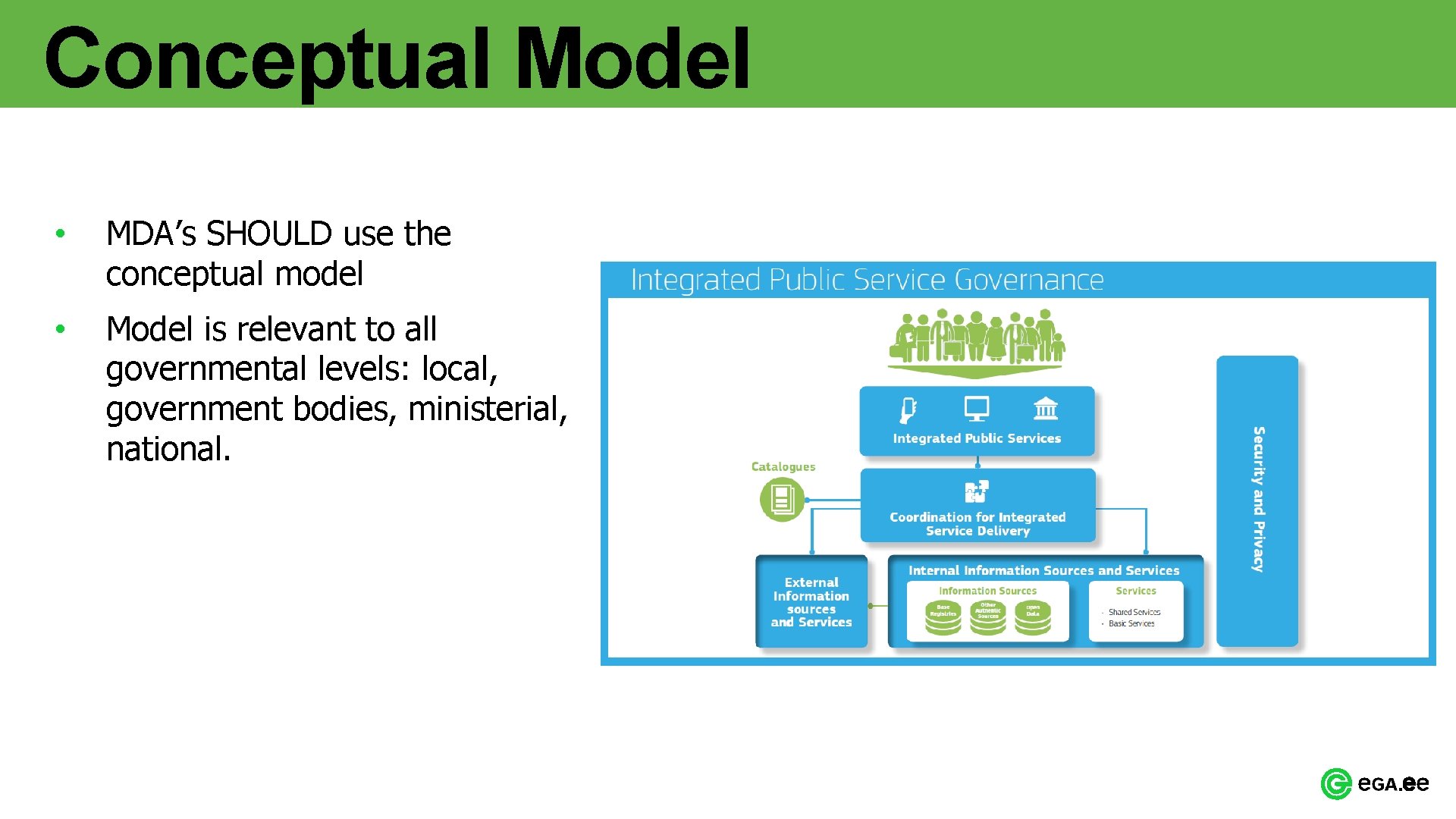
Conceptual Model • MDA’s SHOULD use the conceptual model • Model is relevant to all governmental levels: local, government bodies, ministerial, national.
Interconnecting loosely coupled components § MDAs SHOULD use the conceptual model for public services to design new services or reengineer existing ones and reuse, whenever possible, existing service and data components § Go. U MUST decide on a common scheme for interconnecting loosely coupled service components and put in place and maintain the necessary infrastructure for establishing and maintaining public services at the state level
Base Registries § MDAs SHALL make authoritative sources of information available to others while implementing access and control mechanisms to ensure security and privacy in accordance with the relevant legislation § MDAs SHALL develop interfaces with base registries and authoritative sources of information, publish the semantic and technical means and documentation needed for others to connect and reuse available information § MDAs SHALL match each base registry with appropriate metadata including the description of its content, service assurance and responsibilities, the type of master data it keeps, conditions of access and the relevant licences, terminology, a glossary, and information about any master data it uses from other base registries § MDAs SHALL create and follow data quality assurance plans for base registries and related master data
Open Data § MDAs SHOULD establish procedures and processes to integrate the opening of data in their common business processes, working routines, and in the development of new information systems § MDAs SHALL publish open data in machine-readable, non-proprietary formats. They SHALL ensure that open data is accompanied by high quality, machinereadable metadata in non-proprietary formats, including a description of their content, the way data is collected and its level of quality and the licence terms under which it is made available. The use of common vocabularies for expressing metadata is RECOMMENDED § MDAs SHOULD clearly communicate the right to access and reuse open data. The legal regimes for facilitating access and reuse, such as licences, SHOULD be standardised as much as possible
Catalogues § NITA-U SHOULD put in place catalogues of public services, public data, and interoperability solutions and use common models for describing them
External information sources and services § Where useful and feasible to do so, external information sources and services SHOULD be used while developing Go. U public services
Security and Privacy § MDAs SHOULD consider the specific security and privacy requirements and identify measures foreseen by the National Information Security Framework for the provision of each public service § NISF MUST align with ISMS (ISO/IEC 27001) requirements and support GESA and GEA concepts § Administration SHOULD use foreseen by NITA-U trust services as mechanisms that ensure secure and protected data exchange in public services
Governance of Interoperability Framework § The Ministry of ICT and National Guidance coordinates the initiatives relating to the interoperability of the state information system and MUST ensure the modernity of the e-GIF § All IT projects SHALL be compliant with the e-GIF
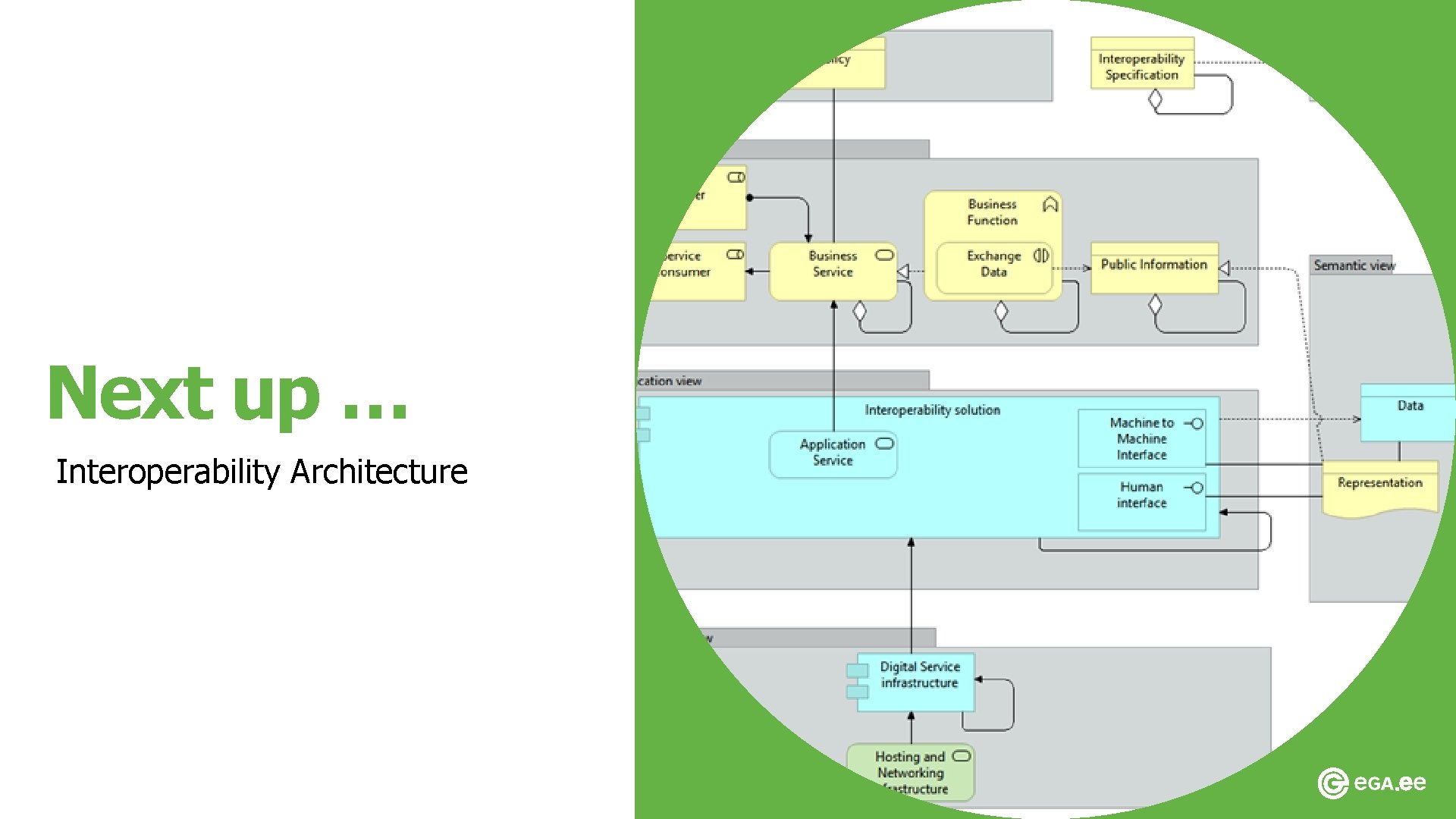
Next up … Interoperability Architecture

Let’s make digital transformation happen! Everywhere. Follow us: egovacademy
- Slides: 47