
UG Describe the Nature of Electromagnetic Waves AKA
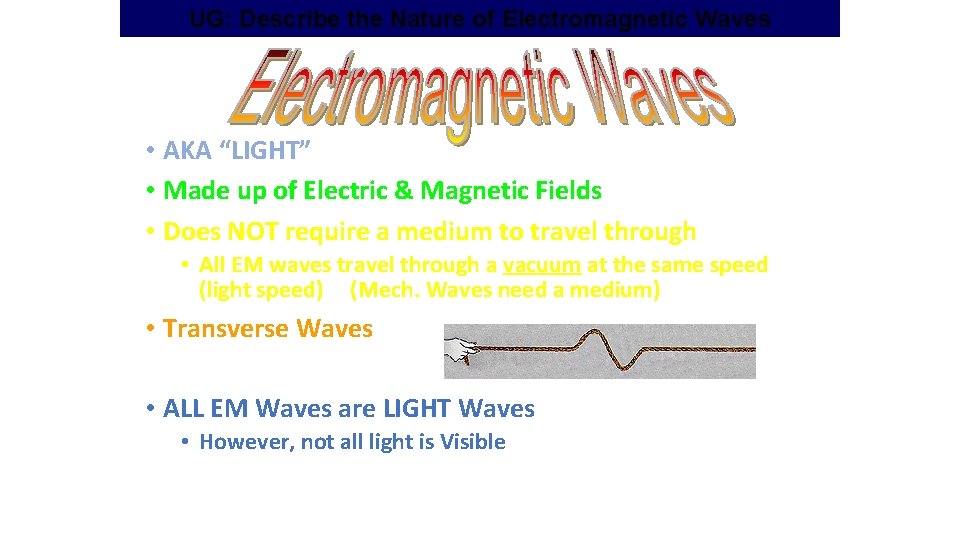
UG: Describe the Nature of Electromagnetic Waves • AKA “LIGHT” • Made up of Electric & Magnetic Fields • Does NOT require a medium to travel through • All EM waves travel through a vacuum at the same speed (light speed) (Mech. Waves need a medium) • Transverse Waves • ALL EM Waves are LIGHT Waves • However, not all light is Visible
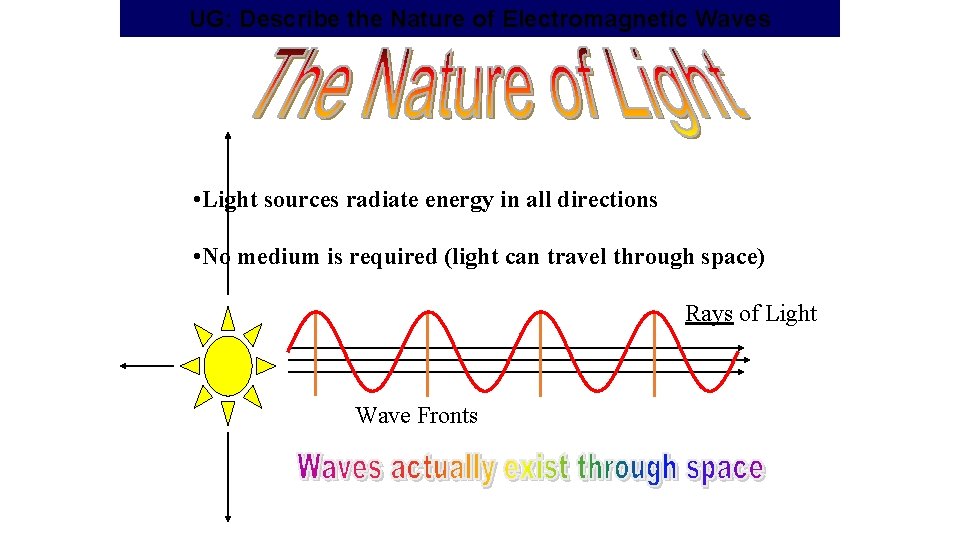
UG: Describe the Nature of Electromagnetic Waves • Light sources radiate energy in all directions • No medium is required (light can travel through space) Rays of Light Wave Fronts
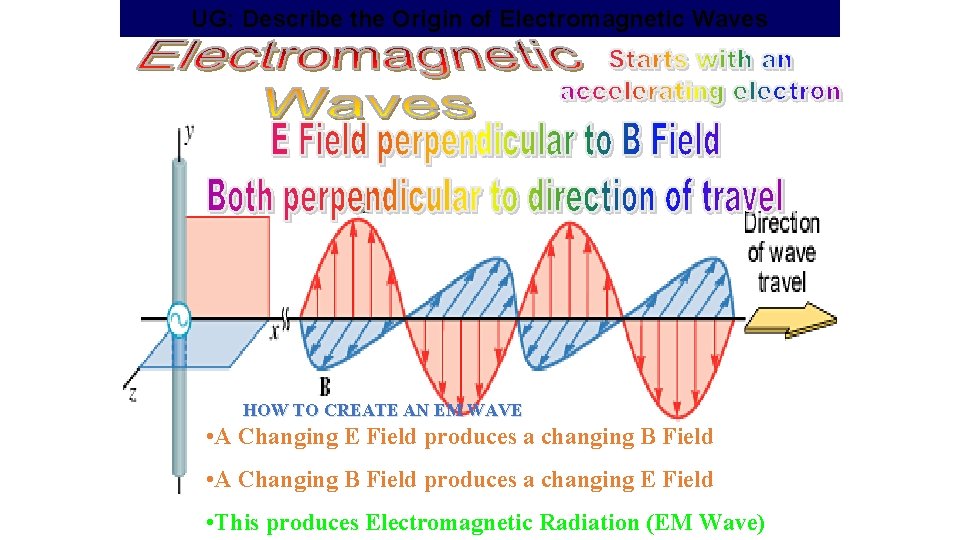
UG: Describe the Origin of Electromagnetic Waves HOW TO CREATE AN EM WAVE • A Changing E Field produces a changing B Field • A Changing B Field produces a changing E Field • This produces Electromagnetic Radiation (EM Wave)
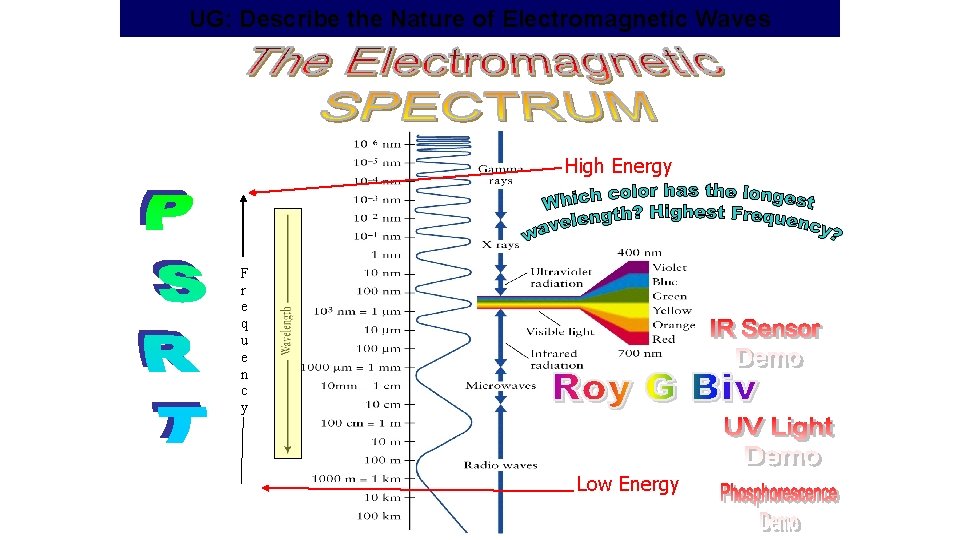
UG: Describe the Nature of Electromagnetic Waves High Energy F r e q u e n c y Low Energy
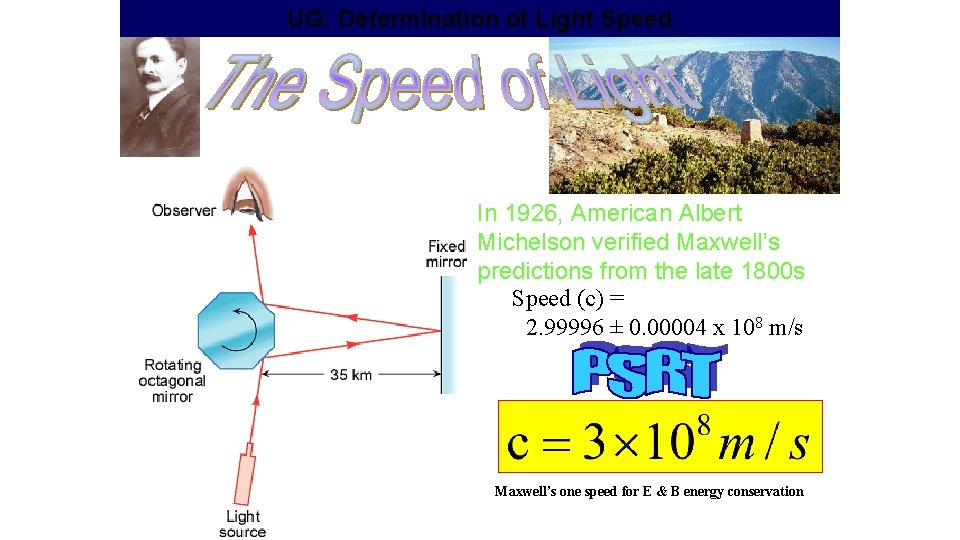
UG: Determination of Light Speed In 1926, American Albert Michelson verified Maxwell’s predictions from the late 1800 s Speed (c) = 2. 99996 ± 0. 00004 x 108 m/s Maxwell’s one speed for E & B energy conservation
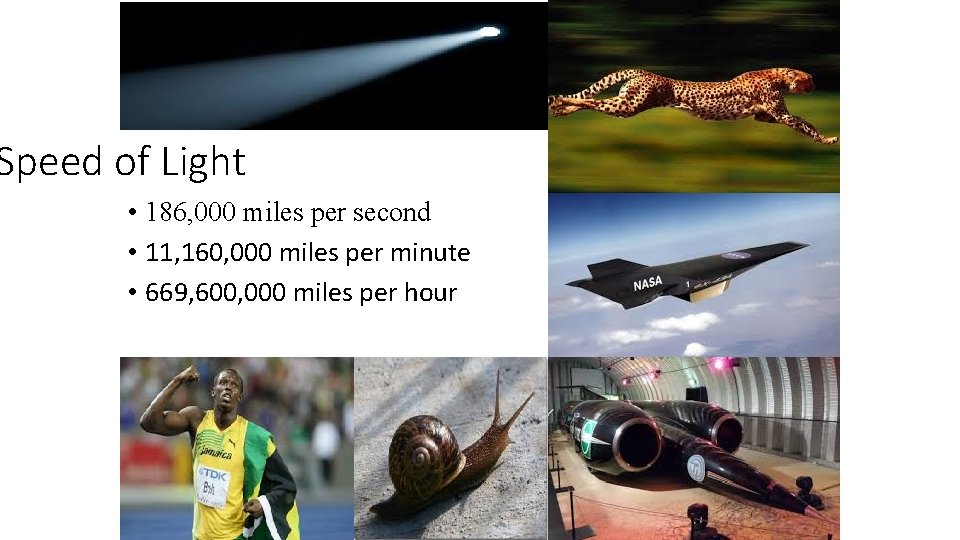
Speed of Light • 186, 000 miles per second • 11, 160, 000 miles per minute • 669, 600, 000 miles per hour
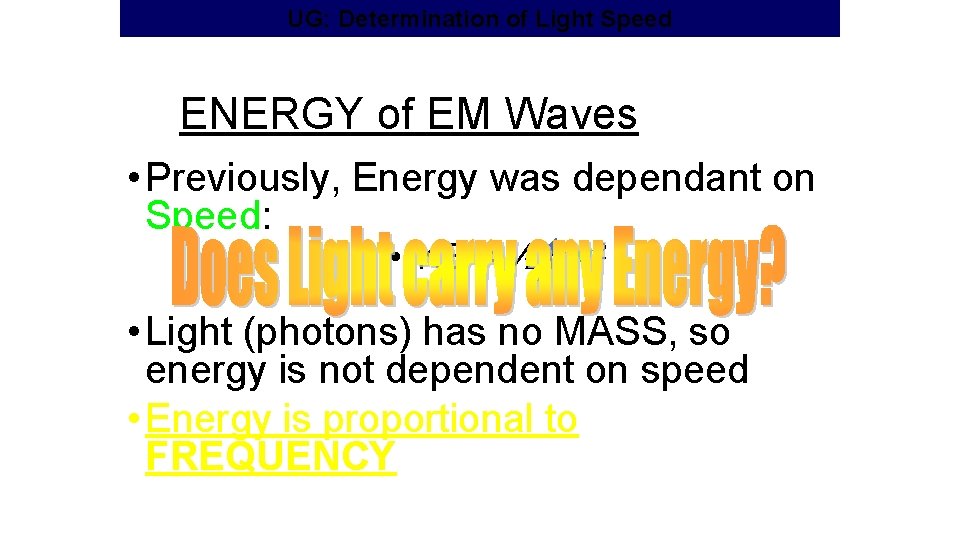
UG: Determination of Light Speed ENERGY of EM Waves • Previously, Energy was dependant on Speed: • KE = ½ mv 2 • Light (photons) has no MASS, so energy is not dependent on speed • Energy is proportional to FREQUENCY
It’s an EM Wave – so by def. Waves carry energy. Consider warmth of the Sun … that’s energy
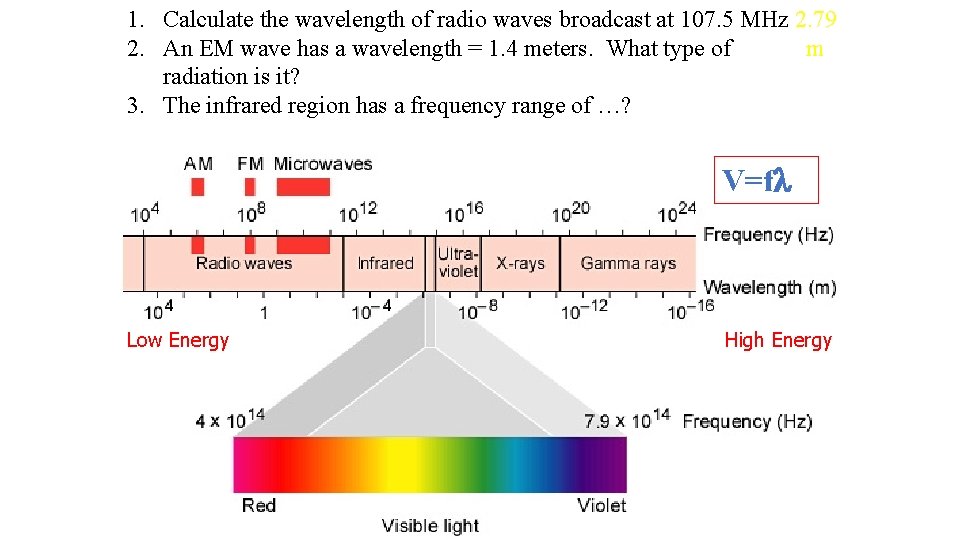
1. Calculate the wavelength of radio waves broadcast at 107. 5 MHz 2. 79 2. An EM wave has a wavelength = 1. 4 meters. What type of m radiation is it? 3. The infrared region has a frequency range of …? V=f Low Energy High Energy
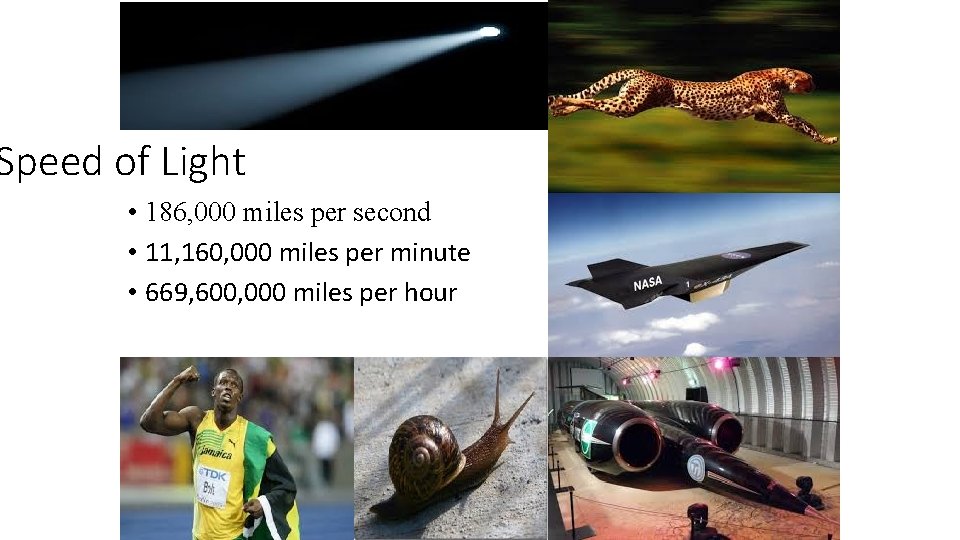
Speed of Light • 186, 000 miles per second • 11, 160, 000 miles per minute • 669, 600, 000 miles per hour
UG: Determination of Light Speed ENERGY of EM Waves • Previously, Energy was dependant on Speed: • KE = ½ mv 2 • Light (photons) has no MASS, so energy is not dependent on speed • Energy is proportional to FREQUENCY
It’s an EM Wave – so by def. Waves carry energy. Consider warmth of the Sun … that’s energy
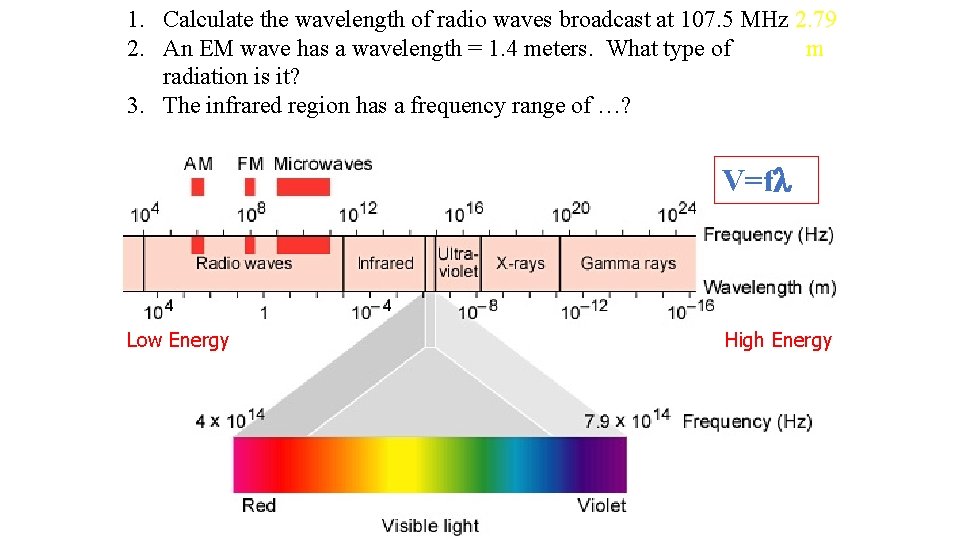
1. Calculate the wavelength of radio waves broadcast at 107. 5 MHz 2. 79 2. An EM wave has a wavelength = 1. 4 meters. What type of m radiation is it? 3. The infrared region has a frequency range of …? V=f Low Energy High Energy
UG: Determination of Light Speed
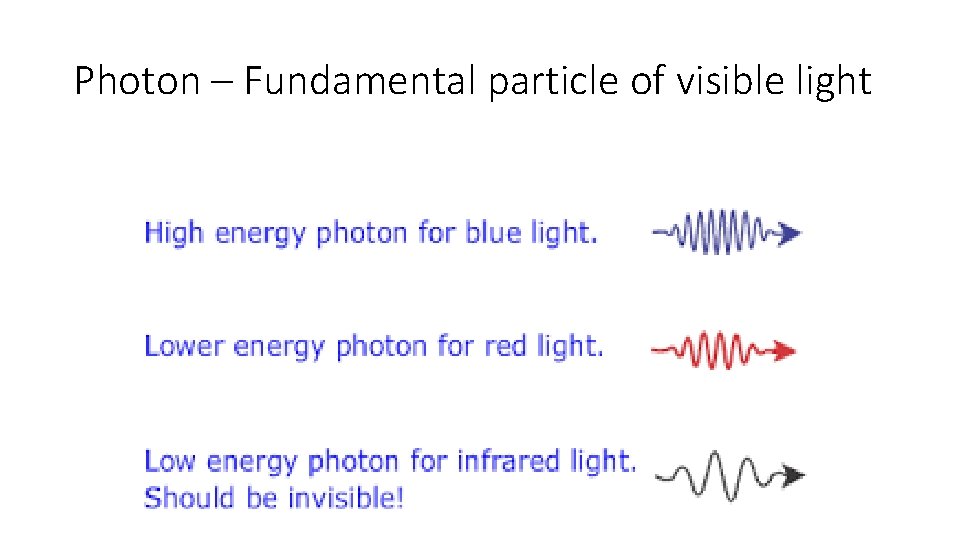
Photon – Fundamental particle of visible light
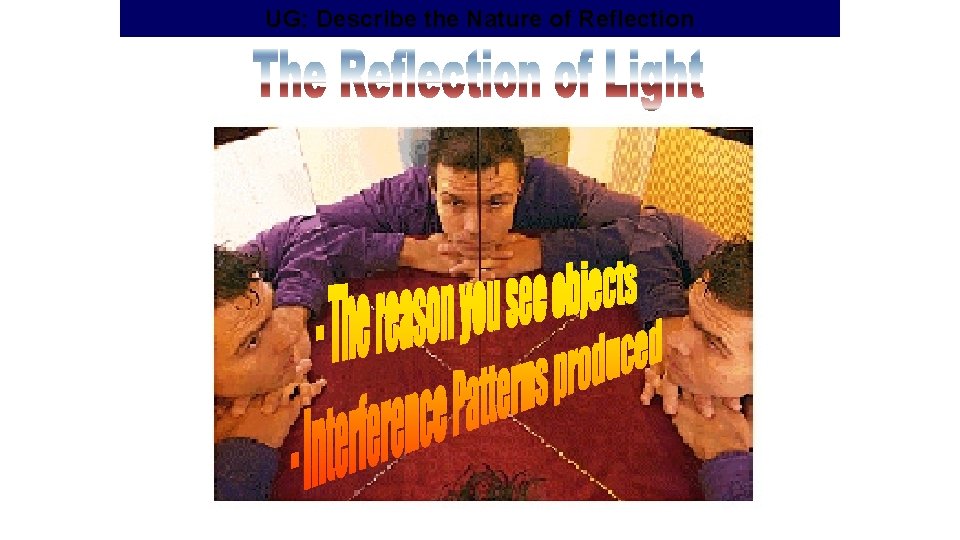
UG: Describe the Nature of Reflection
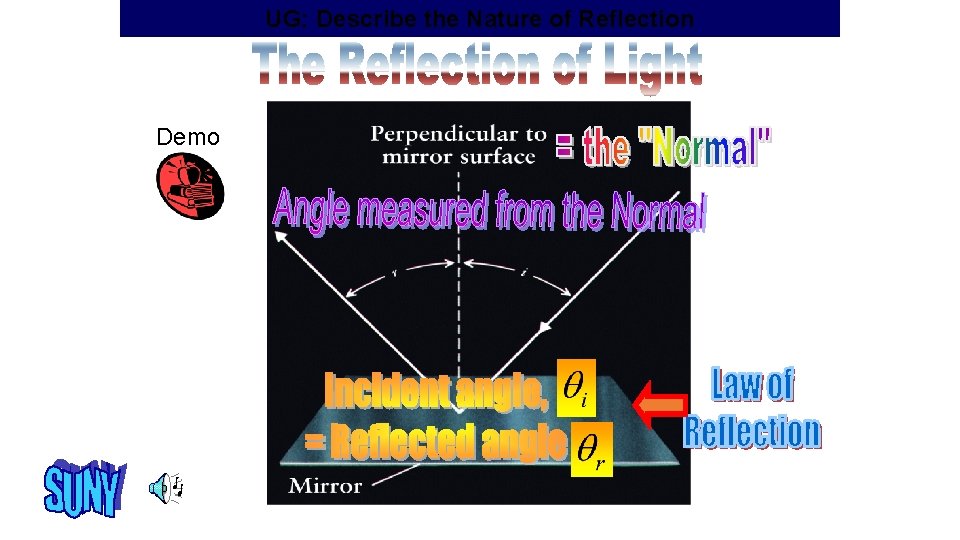
UG: Describe the Nature of Reflection Demo
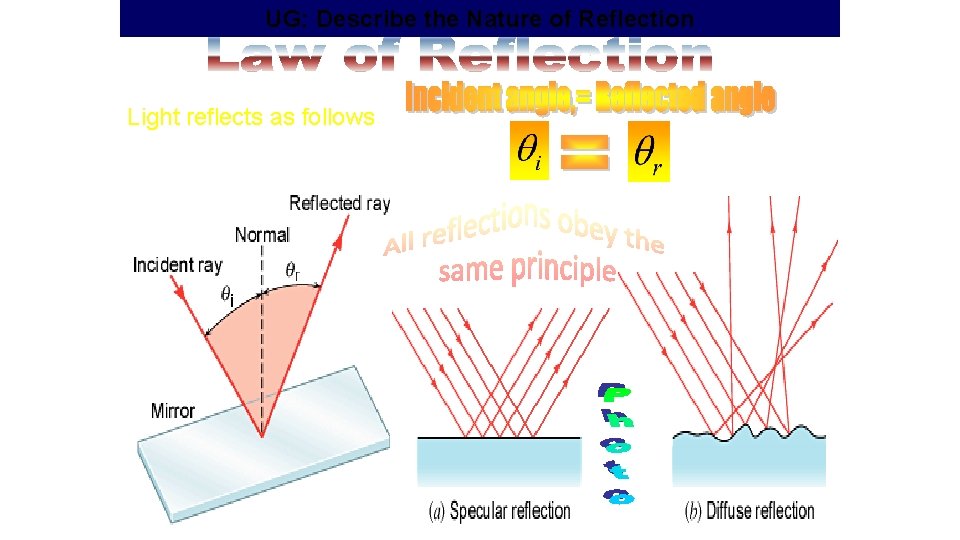
UG: Describe the Nature of Reflection Light reflects as follows
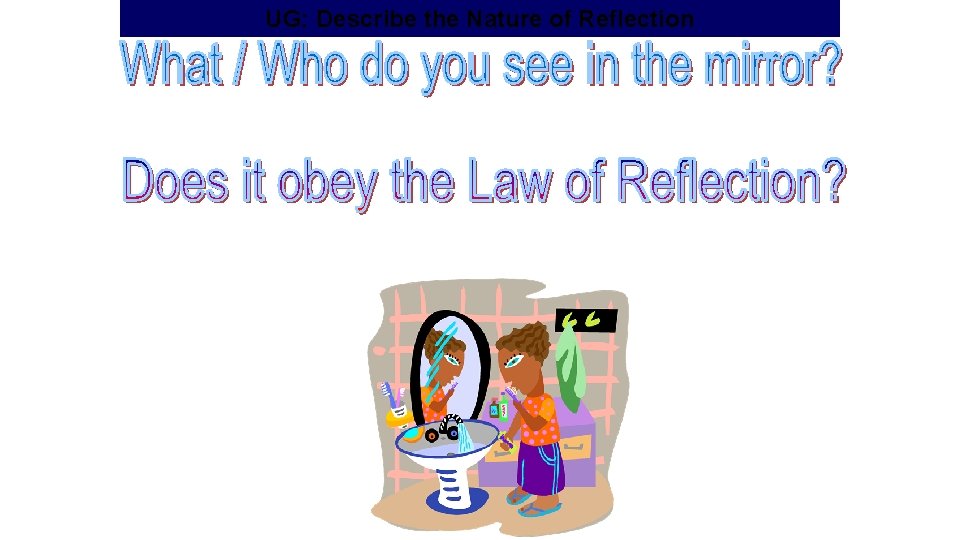
UG: Describe the Nature of Reflection
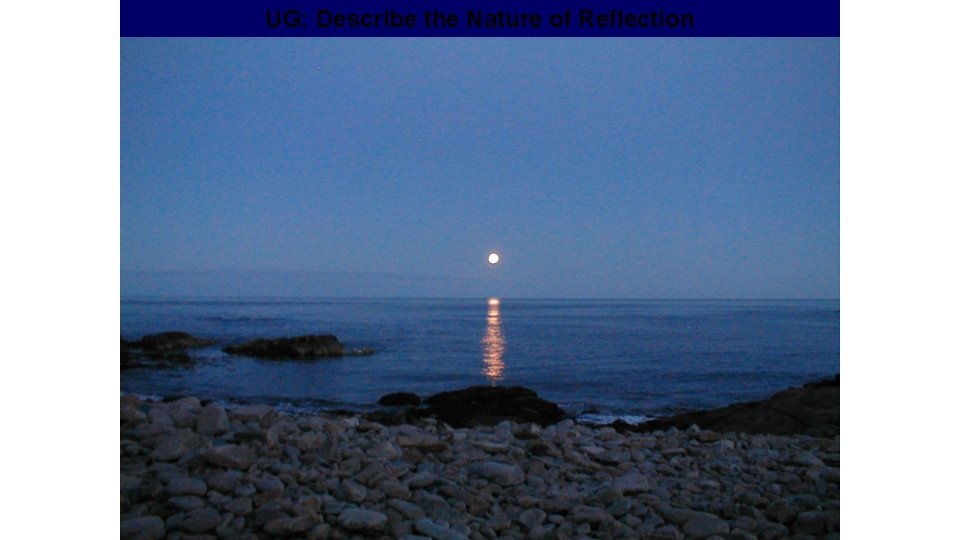
UG: Describe the Nature of Reflection
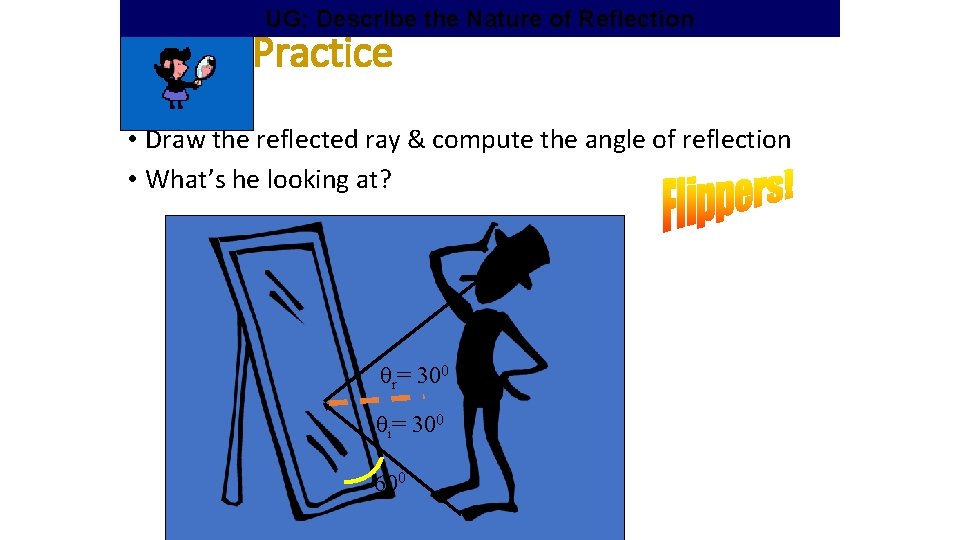
UG: Describe the Nature of Reflection Practice • Draw the reflected ray & compute the angle of reflection • What’s he looking at? r= 300 i= 300 600
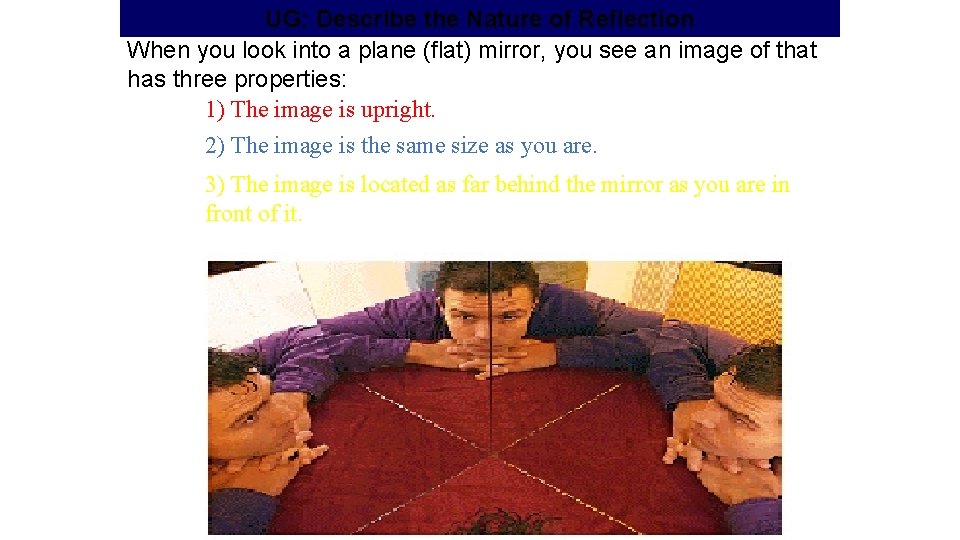
UG: Describe the Nature of Reflection When you look into a plane (flat) mirror, you see an image of that has three properties: 1) The image is upright. 2) The image is the same size as you are. 3) The image is located as far behind the mirror as you are in front of it.
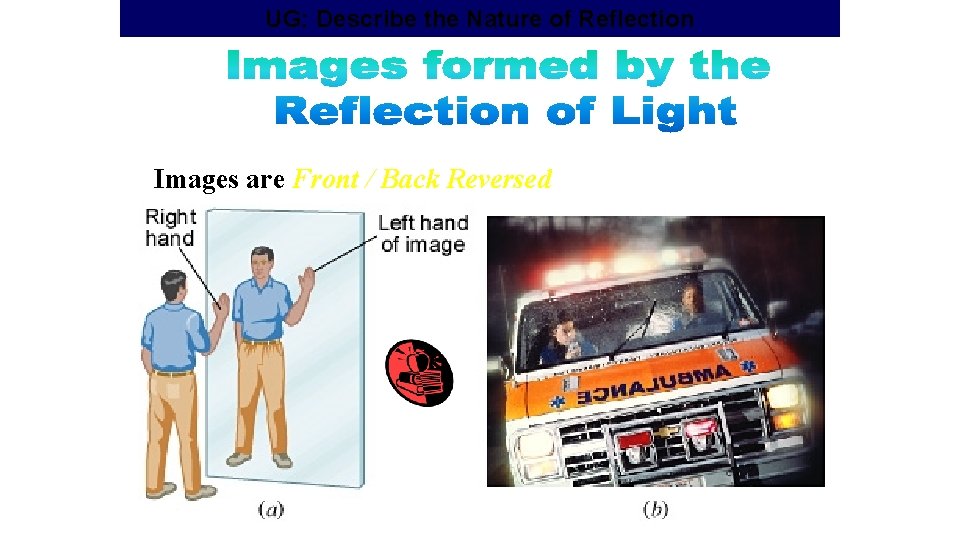
UG: Describe the Nature of Reflection Images are Front / Back Reversed
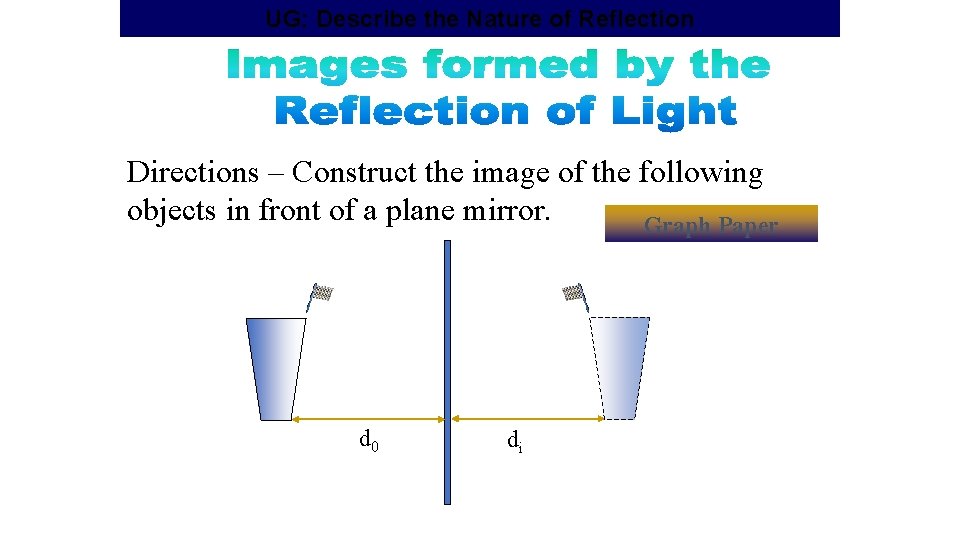
UG: Describe the Nature of Reflection Directions – Construct the image of the following objects in front of a plane mirror. Graph Paper d 0 di
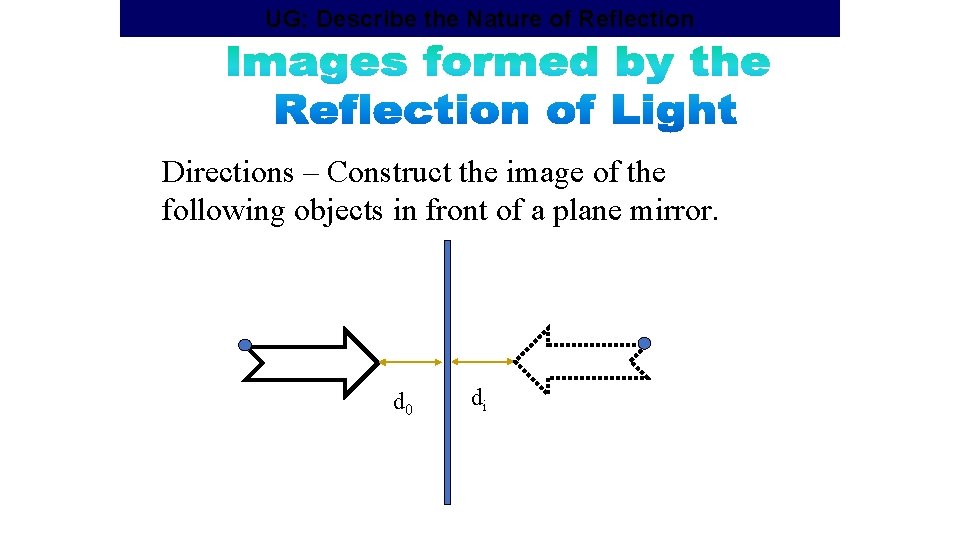
UG: Describe the Nature of Reflection Directions – Construct the image of the following objects in front of a plane mirror. d 0 di
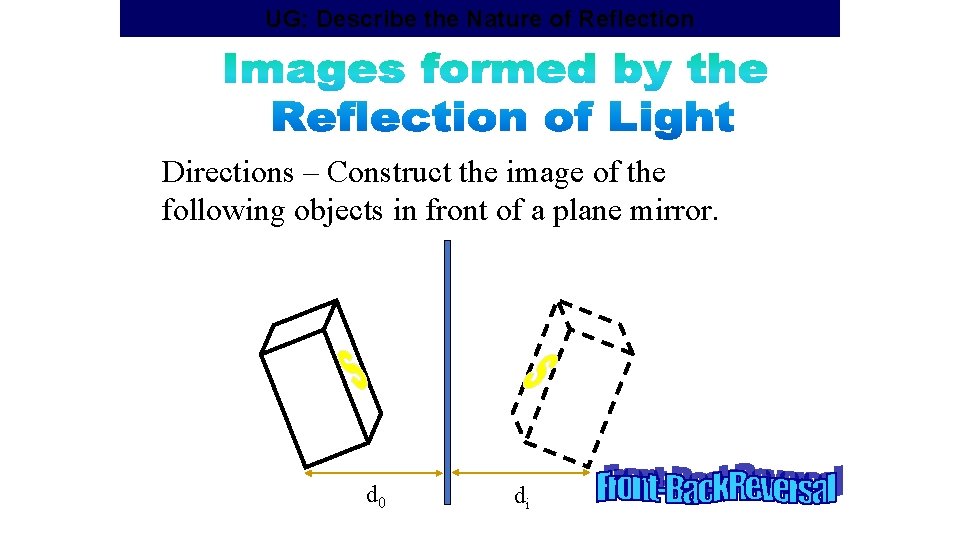
UG: Describe the Nature of Reflection Directions – Construct the image of the following objects in front of a plane mirror. d 0 di
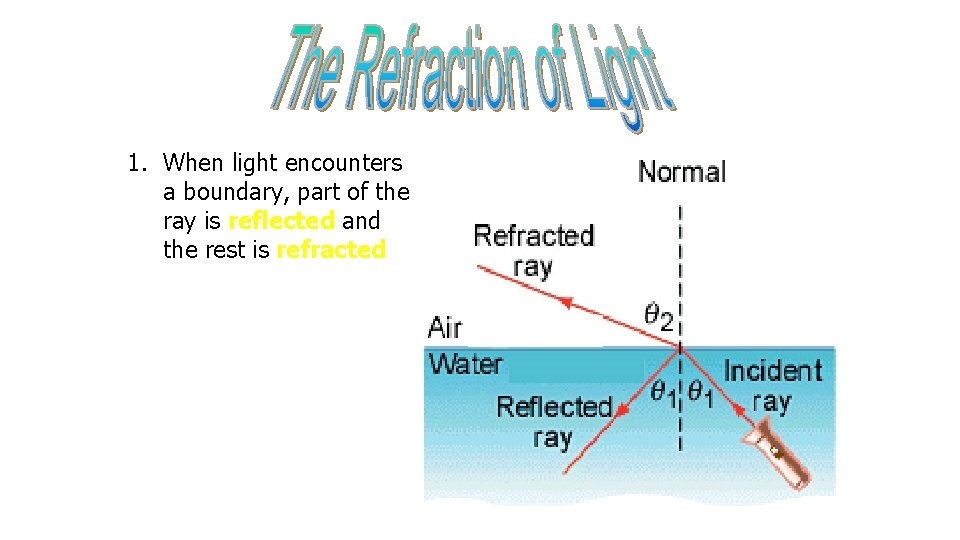
1. When light encounters a boundary, part of the ray is reflected and the rest is refracted
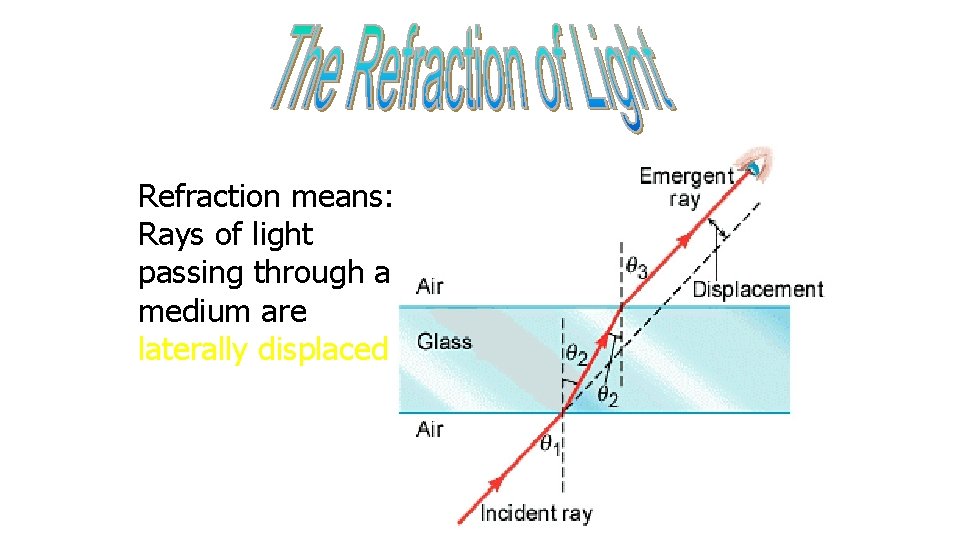
Refraction means: Rays of light passing through a medium are laterally displaced
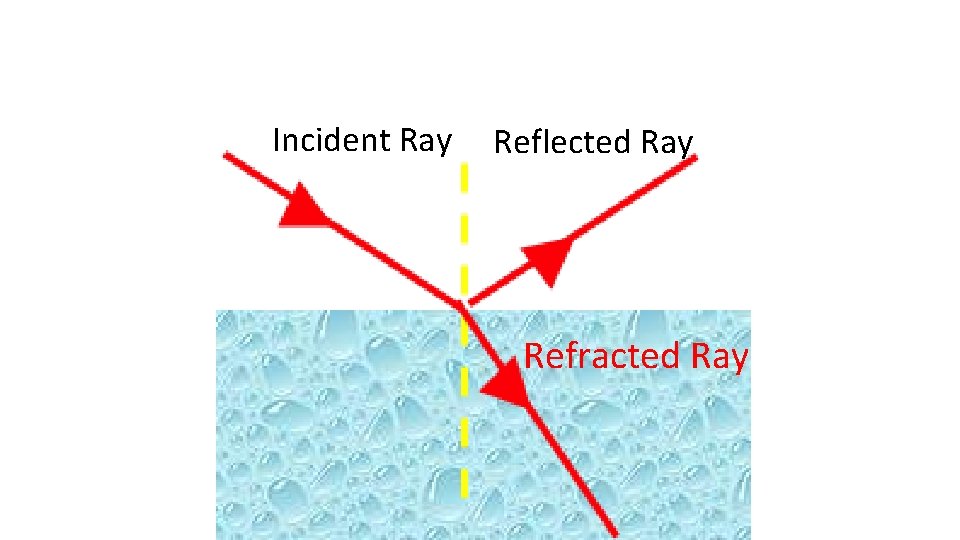
Incident Ray Reflected Ray Refracted Ray
2 depends on 1. 1 2. the optical densities of the two media
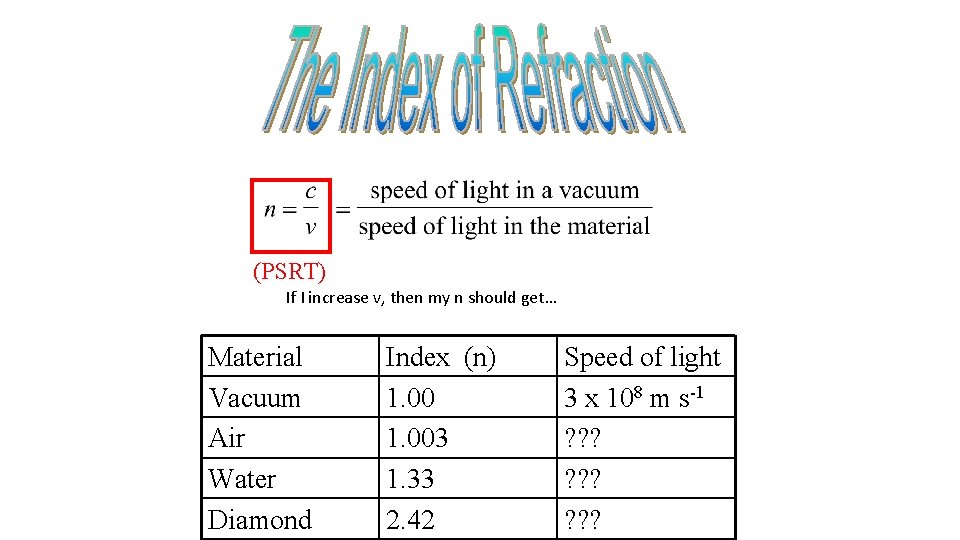
(PSRT) If I increase v, then my n should get… Material Vacuum Air Water Diamond Index (n) 1. 003 1. 33 2. 42 Speed of light 3 x 10⁸ m s-1 ? ? ? ? ?
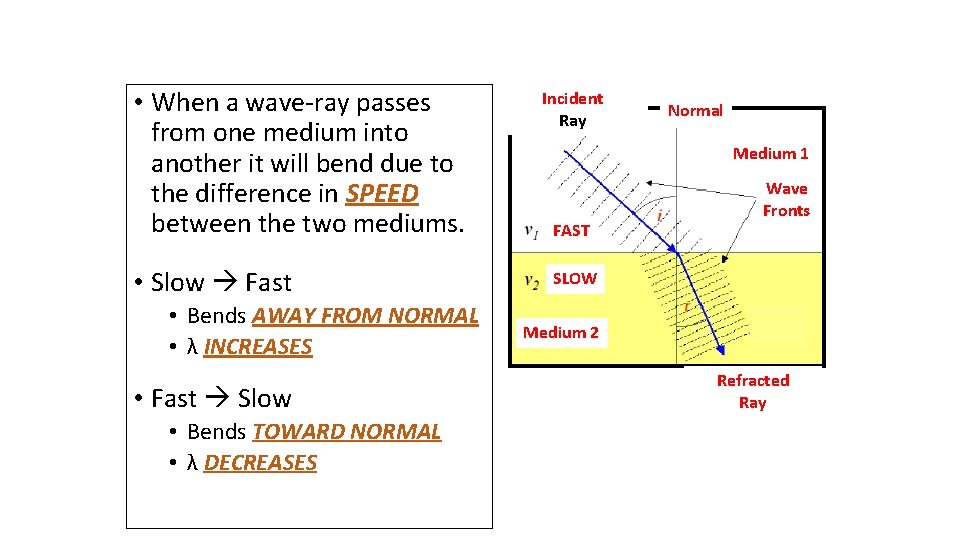
• When a wave-ray passes from one medium into another it will bend due to the difference in SPEED between the two mediums. • Slow Fast • Bends AWAY FROM NORMAL • λ INCREASES • Fast Slow • Bends TOWARD NORMAL • λ DECREASES Incident Ray Normal Medium 1 FAST Wave Fronts SLOW Medium 2 Refracted Ray
Why it slows down… • Refraction index is caused by the molecules in a medium. Air has very spread out molecules which does spread out the light molecules when it makes contact which is why light travels slower. A liquid, specifically water has more compact molecules which means the light molecules will travel even more slower. • Simplified: It depends on what the molecule makeup is of that medium.
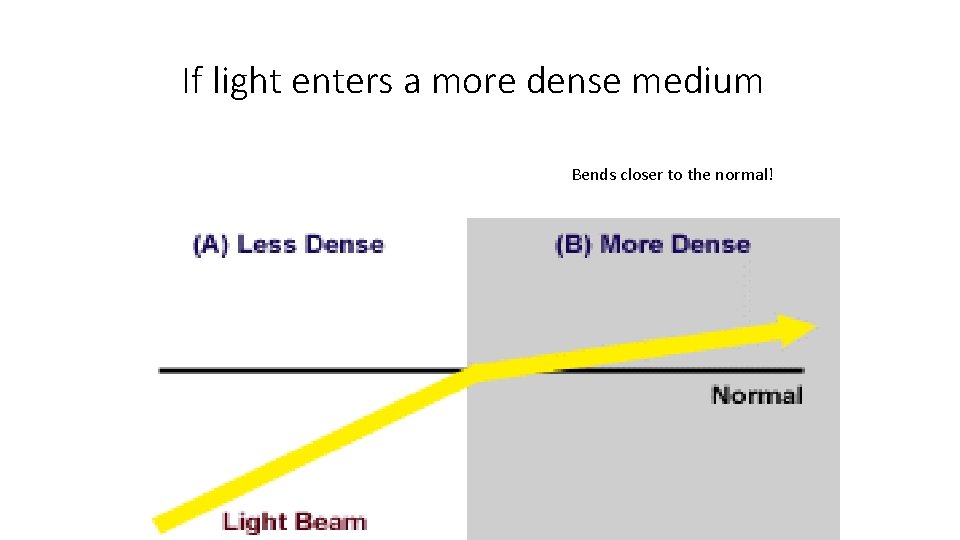
If light enters a more dense medium Bends closer to the normal!
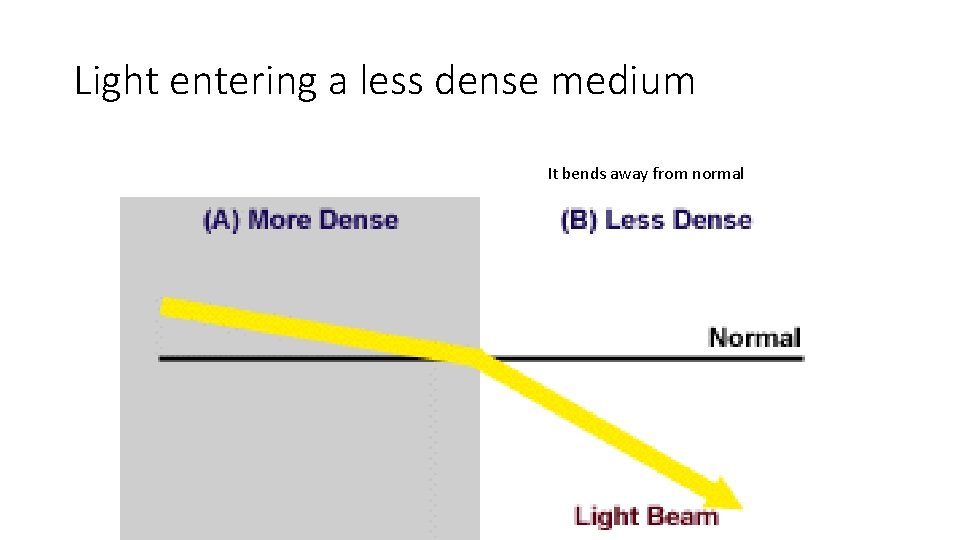
Light entering a less dense medium It bends away from normal
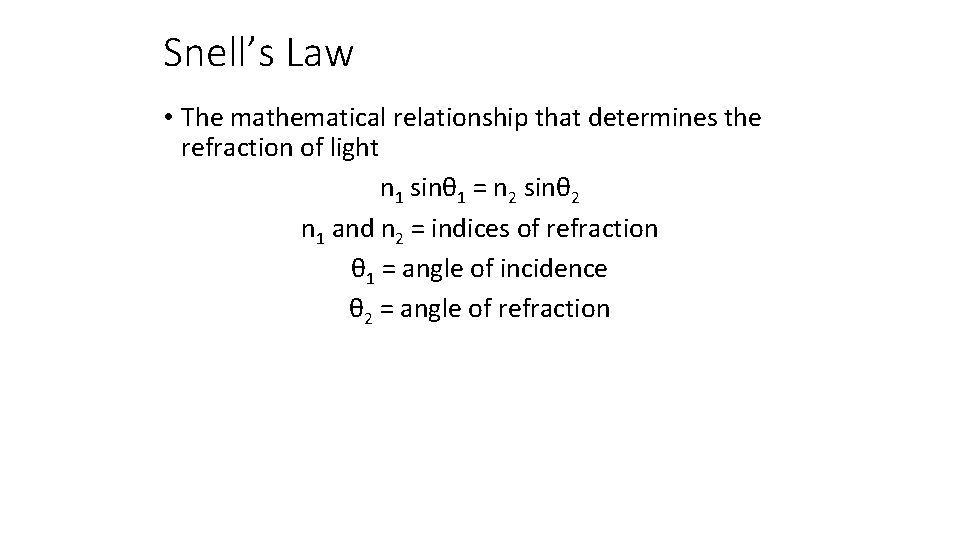
Snell’s Law • The mathematical relationship that determines the refraction of light n 1 sinθ 1 = n 2 sinθ 2 n 1 and n 2 = indices of refraction θ 1 = angle of incidence θ 2 = angle of refraction
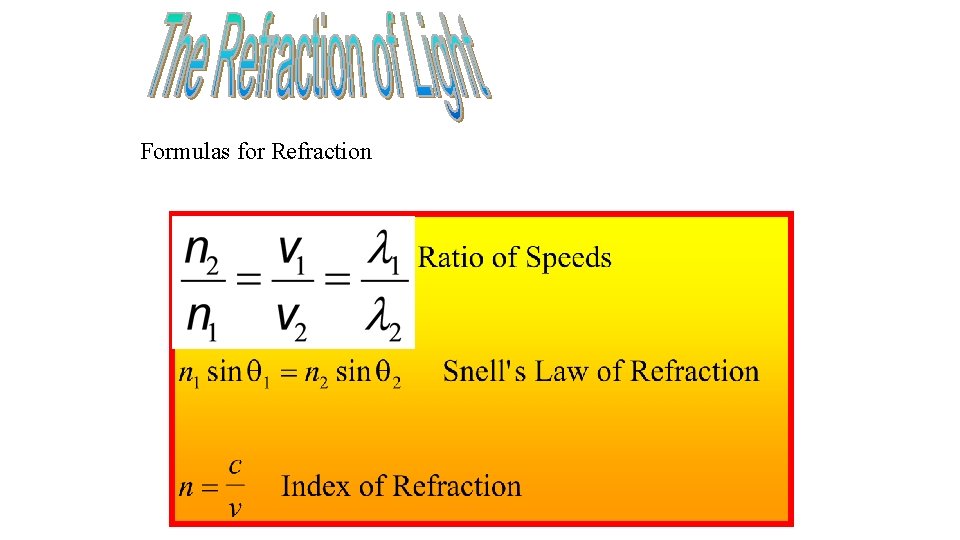
Formulas for Refraction
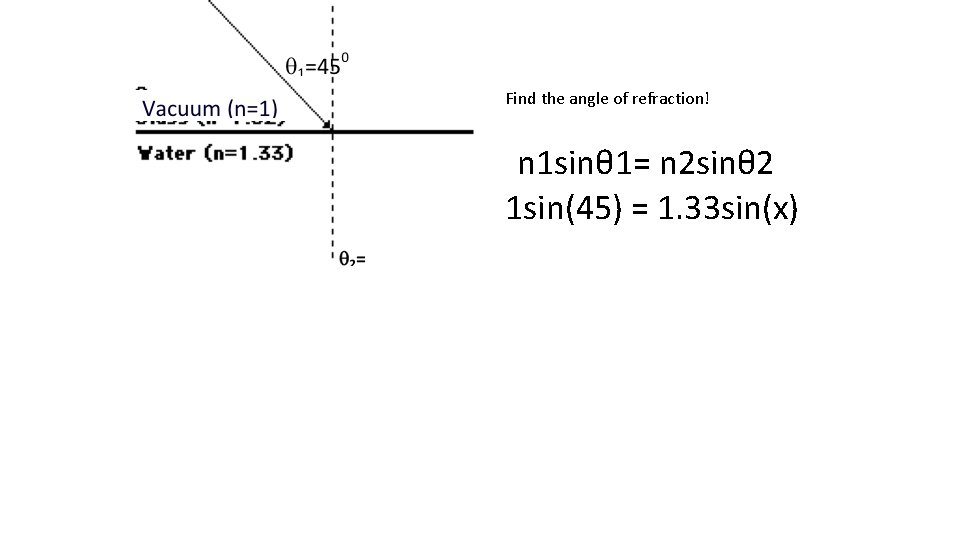
Find the angle of refraction! n 1 sinθ 1= n 2 sinθ 2 1 sin(45) = 1. 33 sin(x)
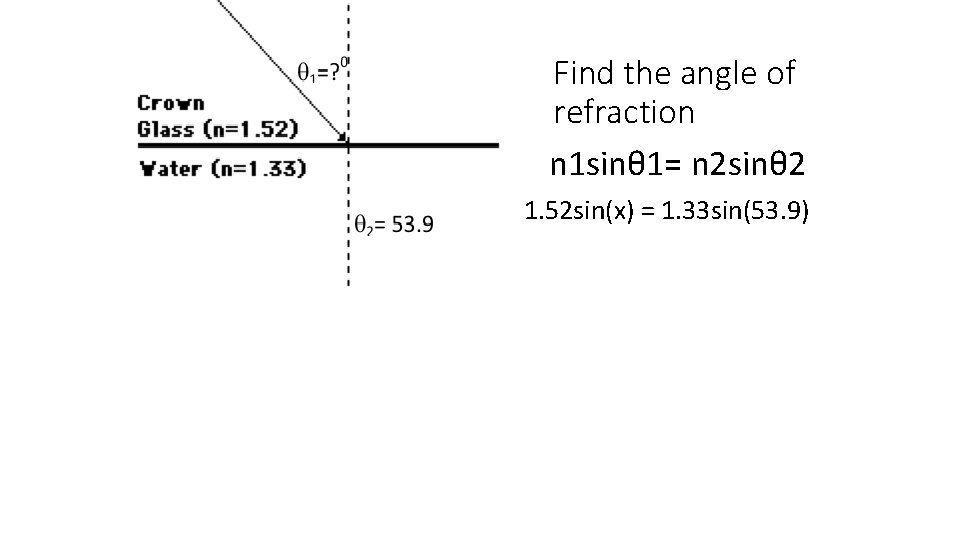
Find the angle of refraction n 1 sinθ 1= n 2 sinθ 2 1. 52 sin(x) = 1. 33 sin(53. 9)
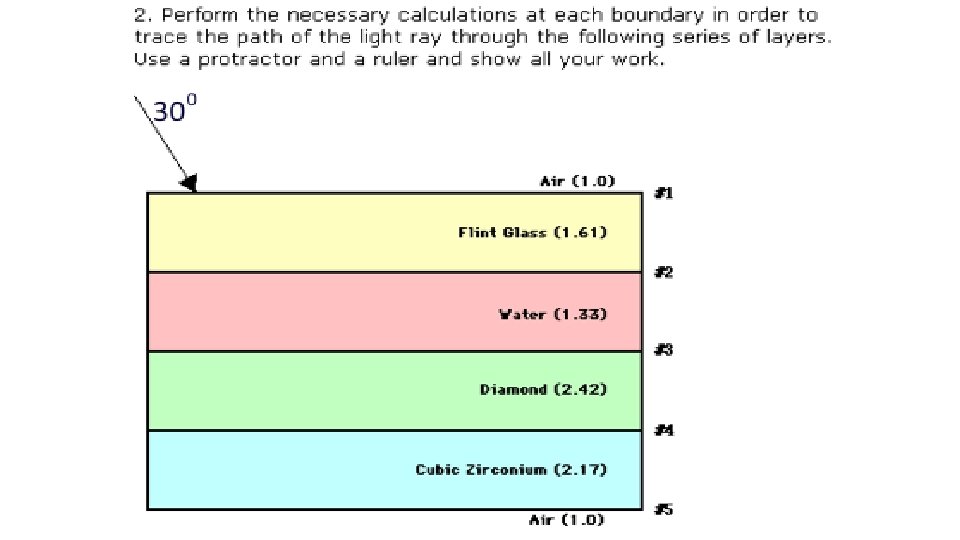
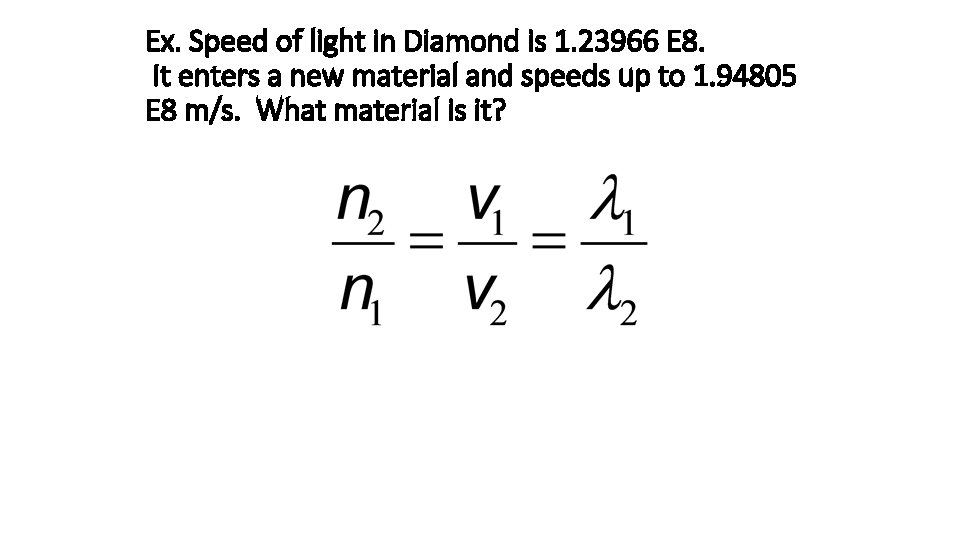
Ex. Speed of light in Diamond is 1. 23966 E 8. It enters a new material and speeds up to 1. 94805 E 8 m/s. What material is it?
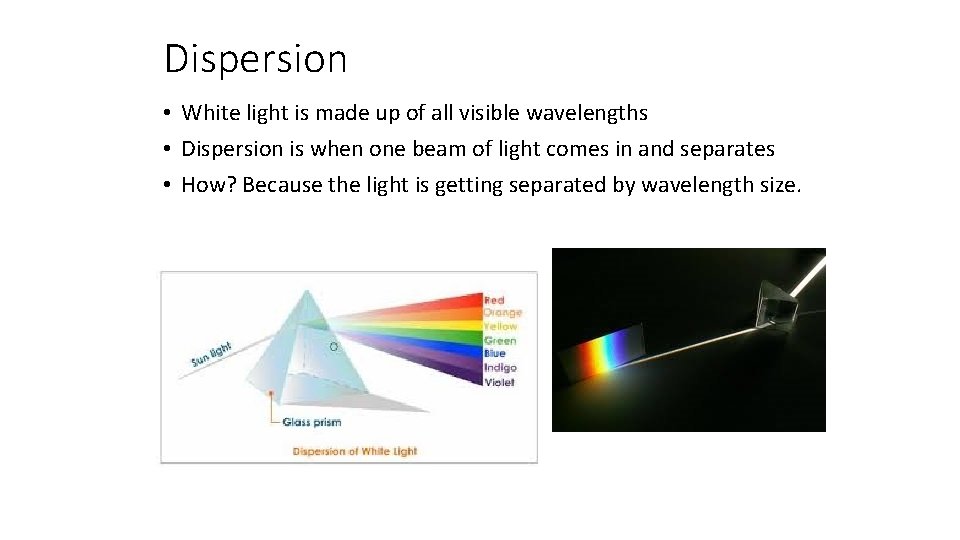
Dispersion • White light is made up of all visible wavelengths • Dispersion is when one beam of light comes in and separates • How? Because the light is getting separated by wavelength size.
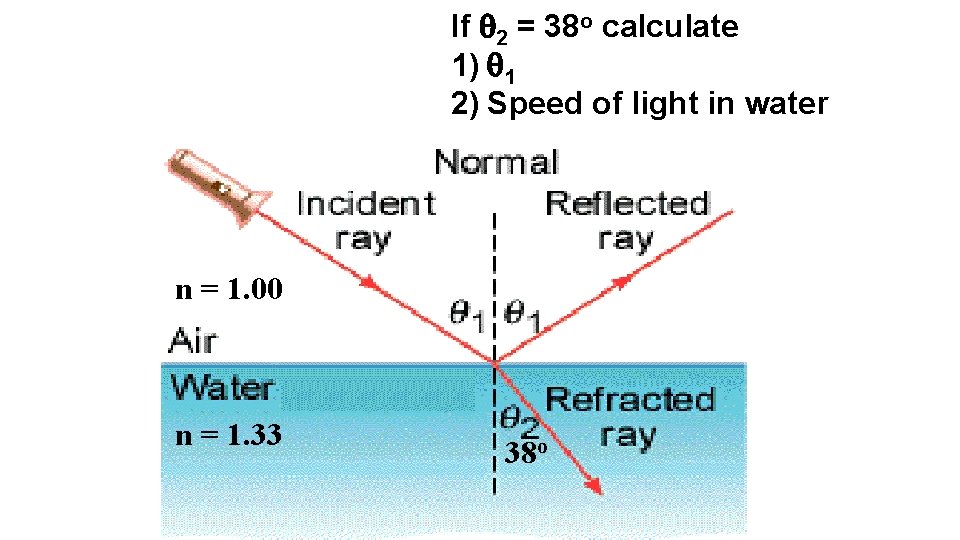
If 2 = 38 o calculate 1) 1 2) Speed of light in water n = 1. 00 n = 1. 33 38 o
- Slides: 44